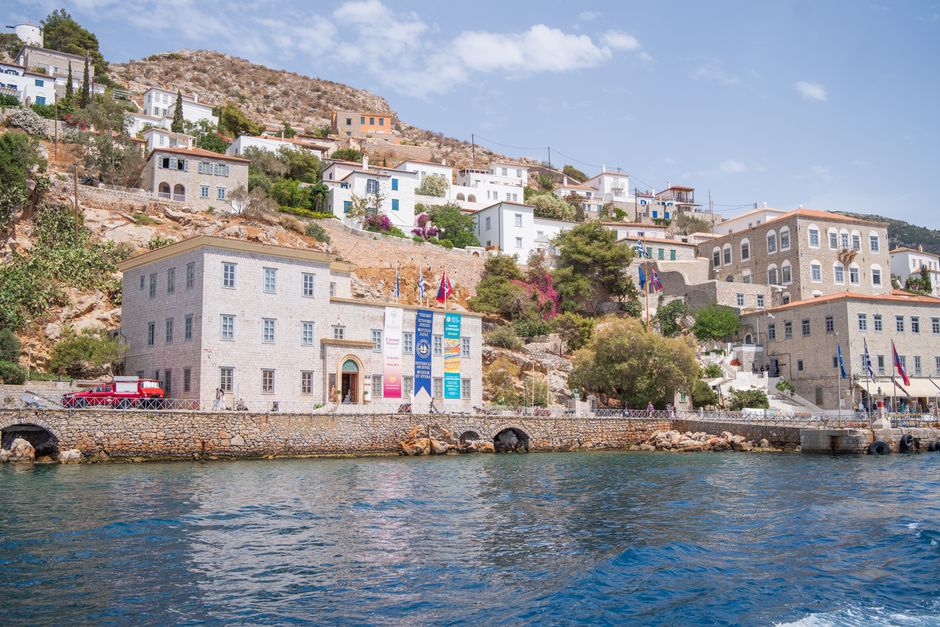
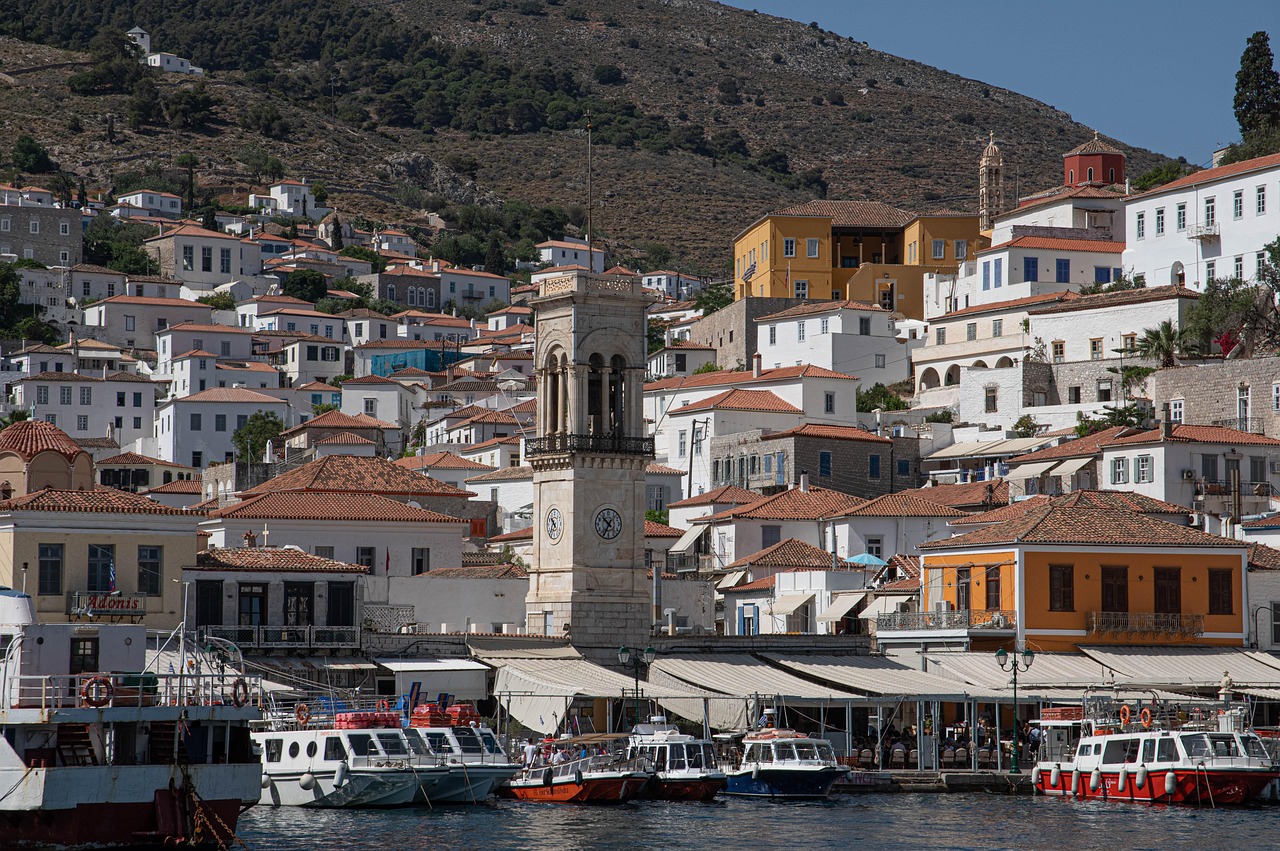
Hydra is the island that said no to cars. A long, rocky ridge in the Saronic Gulf, just off the coast of the Peloponnese, it has no cars or motorbikes at all: people and luggage move on foot, by donkey and mule, or by water taxi. Its one town wraps round a horseshoe harbour, where grey stone mansions built by 18th- and 19th-century sea captains climb the hills above cafés, yachts and fishing boats. Hydra’s fleet was the backbone of the Greek navy in the War of Independence, and the island has drawn painters, writers and musicians ever since. Today you come for the harbour and its museums, the walk along the coast to Kamini and Vlychos, swimming off the rocks, paths to hilltop monasteries, and an art scene that peaks with a summer show in the old slaughterhouse. Fast boats from Piraeus take about 1½–2 hours, so Hydra works as a day trip from Athens, but it is far better with two or three nights.
Right now in Hydra (Hydra Town)
- Wed 21–24°C 69–75°F Mostly clear
- Thu 21–23°C 70–74°F Clear
- Fri 22–25°C 71–76°F Mostly clear
Weather: MET Norway (CC BY 4.0) · Sea temperature: NOAA CoastWatch · Rates: ECB
Top tours in Hydra
See all tours for Hydra →
From local operators, with prices and reviews; you check availability and book on Viator, our partner. We may earn a commission at no extra cost to you. How we earn money
Hydra at a glance
- Best months: May–June and September–early October. Hydra has no weather station of its own; on the coast of Athens nearby, average highs run from about 25 °C in May to 32 °C in July and August, and winters are mild, around 14–15 °C by day (HNMS normals 1991–2020, Elliniko station). The sea is warm enough for swimming from June to October.
- Days needed: 1 for a day trip to the harbour, a museum and a swim; 2–4 to add the coastal walk, a monastery hike, beaches by water taxi and evenings in town.
- Getting there: fast boats from Piraeus all year (about 1½–2 hours; the quickest direct boats take around 70 minutes), or drive to Metochi on the Peloponnese coast and cross by small boat in a few minutes.
- Getting around: on foot, by donkey or mule for luggage, and by water taxi or small boat to the beaches. There are no cars, motorbikes or buses.
- Budget level: mid-range to expensive; rooms are few and much in demand on summer weekends, and restaurants on the harbour cost more than those in Kamini or the back streets. Like everywhere in Greece, a climate resilience fee is added per room per night (€2–€15 from April to October, depending on the type of accommodation). See our Greece guide for money, entry rules and daily costs.
Hydra’s town and villages, and who each one suits
- Hydra Town and the harbour: the island’s only town, where nearly everyone lives, with the port, the mansions, the museums, the cathedral and almost all hotels, tavernas and bars. Stay near the harbour for convenience, or higher up the hill for views and quiet (and more steps).
- Kamini: a small fishing harbour 15–20 minutes’ walk west along the coast path, with a little beach, fish tavernas and sunset views. Good for a calmer stay close to town.
- Vlychos: a hamlet with a pebble beach about 45 minutes’ walk west of town, with tavernas and a few rooms. For walkers and swimmers who like quiet evenings.
- Mandraki: a sheltered bay about 20 minutes’ walk east of town, with a resort and a sandy-shingle beach. For a beach-based stay.
Top things to see in Hydra
Hydra’s museums are small and run by different bodies, not by the Ministry of Culture’s ticketing service, so prices and hours vary. Prices below are as of October 2026.
The harbour and the car-free town
The harbour is the island’s living room. Boats arrive and leave all day, mules wait by the quay to carry luggage up the lanes, and cafés line the waterfront under the grey stone mansions. At its centre, the monastery of the Dormition, with its marble bell tower and cool courtyard, serves as the cathedral; a small ecclesiastical museum in the old monastery buildings displays icons, vestments and silverwork. The cannons on the ramparts at either end of the harbour recall the island’s naval past. Wander uphill through the whitewashed lanes, where the only traffic is people and donkeys, and come back to the harbour at sunset.
The Lazaros Kountouriotis Historic Mansion
This ochre-coloured mansion on the hill west of the harbour was built in the late 18th century, at the height of Hydra’s maritime wealth, by the family of Lazaros Kountouriotis, a shipowner who funded the fleet in the War of Independence; his brother Georgios became prime minister. It has been a museum since 2001, run by the National Historical Museum, with the family’s furniture, portraits and heirlooms upstairs and paintings and folk costumes downstairs, and great views over the port. The same ticket covers the Tetsis House and Studio, the home of the Hydriot painter Panayiotis Tetsis. How to visit: open daily 10:00–16:00 from March to October; a joint ticket is €10, €5 reduced (over-65s and students); free for under-18s and on 25 March, 18 May and 28 October. In winter, groups can visit by arrangement.
The Historical Archives–Museum of Hydra
Housed in a stone building on the harbour, near where the boats come in, this museum and archive was founded in 1918. It keeps the papers of Hydra’s merchant fleet and of the War of Independence, with portraits of the island’s captains and admirals, ship figureheads, weapons, maps and costumes; upstairs is a picture gallery, and the building also holds the island’s public library. The heart of the collection is the memory of the admiral Andreas Miaoulis. How to visit: open daily, with longer hours in summer, for a small entrance fee; check at the door, as hours change by season.
Profitis Ilias and the hilltop monasteries
A stepped path climbs from the top of the town, past the convent of Agia Efpraxia, to the monastery of Profitis Ilias, which sits at about 500 m on the ridge above the harbour, with views over the town, the Peloponnese and the islands. Allow about 1–1½ hours up on the steep path, start early in summer, and carry water. Dress modestly (shoulders and knees covered), visit quietly, and respect the times when the monks and nuns close their doors. Strong walkers can continue to Mount Eros, the island’s highest point, or follow the network of paths east to the monastery of Agia Triada and west to Episkopi. See our hiking guide.
DESTE Slaughterhouse and the art scene
Since 2009 the DESTE Foundation for Contemporary Art has turned Hydra’s old slaughterhouse, a stone building by the sea on the coast path east of the harbour, into a summer project space, inviting one artist or team each year to make a work for the place (recent years have included Jeff Koons, George Condo and Kiki Smith). The 2026 show, by the American artist Nari Ward, runs until 31 October. How to visit: the space opens from June to October, daily except Tuesdays, 11:00–13:00 and again in the evening (18:00–21:00 from 1 October). Galleries, artists’ studios and summer exhibitions around the harbour make Hydra one of the liveliest small art islands in Greece.
Swimming and beaches in Hydra
Hydra is a rocky island with few sandy beaches, and much of the best swimming is straight off the rocks into deep, clear water. Wear water shoes and check the conditions; the north wind can make the town side choppy in summer.
- Spilia and Hydronetta: swimming spots on the rocks just west of the harbour, with ladders and platforms, sunbeds and cocktail bars, a few minutes’ walk from town. Good for a quick swim, but the water is deep straight away.
- Avlaki and Kamini: rocky coves and a small beach along the coast path west of town.
- Vlychos and Plakes: pebble beaches about 45 minutes’ walk or a short water-taxi ride west, with sunbeds and tavernas.
- Mandraki: a sheltered bay east of town, the nearest thing to a sandy beach, with water sports.
- Bisti and Agios Nikolaos: pine-backed pebble coves with very clear water on the far west of the island, reached by boat from the harbour in summer. Bring snorkels.
Under Greece’s coastal law, part of every organised beach must be left free of sunbeds and you can always reach the water and spread your own towel. See our beaches guide, and our snorkeling guide for the clearest coves.
Walking, boats and diving
- The coast path: a paved path runs west from the harbour past Spilia, Avlaki and Kamini to Vlychos, about 45 minutes, with the sea on one side and the whole way car-free. Walk out and take a water taxi back.
- Hill paths: waymarked paths cross the island’s ridge to monasteries, chapels and remote coves. Go in spring or autumn, start early in summer, and avoid the hills on high fire-risk days. See our hiking guide.
- Water taxis and boat trips: water taxis wait in the harbour to take you to any beach or to Metochi, and in summer small boats run to Bisti and Agios Nikolaos; sailing trips round the island leave from the port. See our boat trips guide.
- Diving: a licensed dive centre takes beginners and certified divers to the island’s reefs and walls. See our diving guide.
Festivals and food in Hydra
The Miaoulia, the island’s big festival, is held every year in late June in honour of the admiral Andreas Miaoulis and Hydra’s fleet: a weekend of concerts, boat races and ceremonies ends with the dramatic night-time burning of a model Ottoman flagship in the harbour, with fireworks. Rooms are booked out months ahead. Easter is also memorable, with the Good Friday procession in Kamini, where the epitaph is carried into the sea. For food, try the island’s almond sweets (amygdalota), fresh fish at Kamini and Vlychos, and the simple tavernas in the back lanes.
Day trips and island hopping from Hydra
Fast boats link Hydra with the other Saronic islands and the Peloponnese coast: Spetses, about 30 minutes away, with its own mansions and pine-fringed beaches (horse carriages and scooters but few cars); Poros, a green island facing the town of Galatas; and the mainland ports of Ermioni and Porto Heli. From Metochi, the Peloponnese is yours to explore by car: Nafplio, with its Venetian fortresses and old town, and the ancient theatre of Epidaurus are about 1½–2 hours’ drive away. Athens is a day trip in the other direction.
Nearby destinations
Getting there and getting around
Fast boats from Piraeus
- Blue Star Ferries / Hellenic Seaways: daily high-speed boats from Piraeus to Hydra all year, from gate E8, taking about 1½ hours, and continuing to Ermioni, Spetses and Porto Heli; some also call at Poros.
- Alpha Lines: the Speedcat I sails Piraeus–Hydra–Spetses, about 1 hour 15 minutes to Hydra. In October 2026 it left Piraeus at 9:20 and 14:00 on most days (9:45 on Tuesdays and Wednesdays), with returns from Hydra around midday and at 17:00–17:15; summer timetables have more evening sailings.
These are passenger-only boats: you can’t take a car to Hydra. Book on the operator’s own site or app or a comparison platform, especially for summer weekends and the Miaoulia, and keep a buffer before an international flight: the Coast Guard can ban sailings in strong winds, and the fast boats are the first to stop. Cruise ships and day cruises from Athens also call at Hydra (often with Poros and Aegina); cruise passengers who go ashore pay a cruise passenger fee, usually added to the cruise bill (€5 from June to September, €3 in April, May and October and €1 in winter at ports other than Santorini and Mykonos).
By car via Metochi
If you are touring the Peloponnese, drive to Metochi, the nearest point of the mainland, opposite Hydra Town: about 2¾ hours from Athens via the Corinth motorway and the Epidaurus exit, according to the boat operator. Leave the car in the parking area at Metochi and cross on the Hydra Lines passenger boats, which run several times a day all year and take a few minutes; a ticket was about €7.50 one way. Water taxis also make the crossing at any hour, for a much higher fixed fare per boat.
On the island
There are no cars, motorbikes or buses on Hydra; only a few service vehicles. You walk everywhere, and the town is all steps and cobbles, so pack light and bring a bag you can carry. Porters with donkeys and mules wait on the harbour to carry luggage to your hotel for a fee; agree the price first, and walk beside the animals rather than ride them up steep steps. Water taxis, with fixed fares displayed on the quay, go to the beaches, Kamini, Vlychos, Mandraki and Metochi.
When to go and how long to stay
Hydra has hot, dry summers and mild, wetter winters. July and August are hot, with crowds of day-trippers on the harbour between late morning and late afternoon, and summer weekends bring yachts and Athenians. May, June, September and early October have warm days, a warm sea and calmer evenings, and are the best time for walking. Hydra stays open in winter, with fewer boats, many closed hotels and a quiet, local feel.
| Season | Average high / low | What it’s like |
|---|---|---|
| Spring (Mar–May) | 16–25 °C / 9–16 °C | Green hills and wild flowers; the best time for walking; sea still cool; Easter is a highlight. |
| Summer (Jun–Aug) | 29–32 °C / 20–23 °C | Hot, sunny and dry; busy harbour by day; the Miaoulia in late June; walk early or late. |
| Autumn (Sep–Nov) | 19–29 °C / 12–20 °C | Warm sea in September and October, fewer day-trippers; first rain from late October. |
| Winter (Dec–Feb) | 14–15 °C / 7–9 °C | Mild with rainy spells; quiet, with fewer boats and many hotels closed. |
Hydra has no HNMS climate station, so temperatures are the 1991–2020 climate normals of the Hellenic National Meteorological Service for Elliniko, on the coast of Athens about 65 km north; the island has a similar climate, with a little more wind. Rain falls mainly from November to February. Greece’s wildfire season runs from 1 May to 31 October: on days of high fire risk (category 4–5 on the daily map of the Ministry of Climate Crisis and Civil Protection), forests may be closed and any outdoor fire is banned. Call 112 if you see a fire.
A day trip to Hydra
Take an early fast boat from Piraeus. Walk the harbour and visit the Historical Archives–Museum, climb to the Kountouriotis Mansion, then walk the coast path to Kamini for lunch and a swim off the rocks at Spilia or Hydronetta on the way back. Catch the evening boat to Athens, or stay for the sunset if there is a later sailing. Organised one-day cruises from Athens visit Hydra, Poros and Aegina together, but give you only an hour or two ashore.
3–4 days in Hydra
Day 1: the harbour, the museums and the cathedral, and sunset at Kamini. Day 2: an early hike to Profitis Ilias, then an afternoon swim at Vlychos and a water taxi back. Day 3: a boat to Bisti or Agios Nikolaos for snorkelling, and the DESTE Slaughterhouse show in the evening (June to October). Day 4: a boat to Spetses, or cross to Metochi and drive to Nafplio and Epidaurus to continue your trip.
Where to stay in Hydra
- Near the harbour: converted mansions and small hotels a few minutes from the boats, with the most restaurants and nightlife; can be noisy in summer.
- Up the hill: quieter rooms with views over the port, at the cost of many steps.
- Kamini or Vlychos: village-style stays by the sea, a walk or water taxi from town.
- Mandraki: a beach resort east of town for a sea-and-sun stay.
Greece adds a climate resilience fee per room per night, set by type of accommodation, usually paid at the property (from April to October €2 for 1–2-star hotels and rooms up to €15 for 5-star hotels; campsites and youth hostels are exempt). Book early for summer weekends and the Miaoulia.
Practical tips for Hydra
- Pack for steps: no cars means carrying your own bags or paying a porter; a backpack or small case is easiest. The town is hard going with a wheelchair or pushchair.
- Beat the day-trippers: the harbour is busiest from late morning to late afternoon; explore early, swim at midday and enjoy the evenings.
- Wind and boats: fast boats can be cancelled in strong winds; leave a spare day before a flight home.
- Fire risk: no barbecues, campfires or cigarettes on the hill paths in summer; follow 112 alerts.
- Emergencies: call 112; tourist police 1571; coast guard 108.
What to pack for Hydra
Pack light: a small case or backpack you can carry up steps. Bring summer clothes, a sun hat, sunglasses, high-factor sunscreen and a refillable water bottle; flat shoes with good grip for the polished cobbles; walking shoes for Profitis Ilias; and water shoes and a snorkel mask for swimming off the rocks. Add a light layer for windy evenings and boat rides, a warmer jacket from November to April, and a scarf or long sleeves to cover your shoulders in the monasteries.
Hydra travel FAQ
Are there really no cars on Hydra?
Yes. Private cars and motorbikes are not allowed; apart from a few service vehicles, people walk, use donkeys and mules for luggage, and take water taxis to the beaches and the mainland.
How long is the ferry from Athens to Hydra?
About 1½–2 hours by fast boat from Piraeus, depending on the boat and the stops; the quickest direct sailings take around 70–75 minutes. Boats are passenger-only and run all year, with more sailings in summer.
Is Hydra worth a day trip from Athens?
Yes, with an early boat out and an evening boat back you get six to eight hours on the island: enough for the harbour, a museum and a swim. Staying a night or two lets you enjoy the quiet evenings after the day-trippers leave.
Can you take a car to Hydra?
No. Drive to Metochi on the Peloponnese coast, leave the car there and cross on the Hydra Lines passenger boat or a water taxi in a few minutes.
Does Hydra have sandy beaches?
Very few. Most swimming is off the rocks at Spilia, Hydronetta and Avlaki, or from pebble beaches at Kamini, Vlychos, Bisti and Agios Nikolaos. Mandraki, east of town, is the closest to a sandy beach.
How much does the Kountouriotis Mansion cost?
A joint ticket with the Tetsis House and Studio is €10, or €5 reduced, as of October 2026. It opens daily 10:00–16:00 from March to October, and is free for under-18s.
When is the Miaoulia festival?
Every year in late June, over a weekend. The highlight is the night-time burning of a model Ottoman flagship in the harbour, followed by fireworks. Book rooms and boats well ahead.
How do you get from Hydra to Nafplio?
Cross to Metochi by boat or water taxi and drive, or take a taxi, through Kranidi or Galatas and Epidaurus to Nafplio, about 1½–2 hours. Public transport is slow and needs changes.
When is the best time to visit Hydra?
May, June, September and early October: warm, sunny and less crowded than July and August, with good walking weather and the sea warm enough for swimming from June.
Is Hydra good for people with limited mobility?
It is hard. The harbour front is flat, but the rest of the town is steep steps and slippery cobbles, with no vehicles to help. Choose a hotel on the waterfront and ask about steps before booking.
Sources and last review
Researched and last reviewed on 4 October 2026. Prices and hours of the Lazaros Kountouriotis Historic Mansion and the Tetsis House come from the National Historical Museum; the DESTE Slaughterhouse dates and hours from the DESTE Foundation; Piraeus boat times from Blue Star Ferries and Alpha Lines; and the Metochi crossing from Hydra Lines. The climate resilience fee is set by Greek tax law and collected by the Independent Authority for Public Revenue (AADE); the cruise passenger fee by Law 5162/2024. Climate figures are the HNMS 1991–2020 normals for Elliniko (Athens coast), as Hydra has no station. Boat times and museum hours change by season, so check the operators and the museums before you travel.
Plan your trip
Partner links: TravelerCenter may earn a commission if you book, at no extra cost to you.
🇬🇷 Useful Greek phrases for Hydra
All 38 Greek phrases: restaurant, hotel, emergencies, romance (printable) →