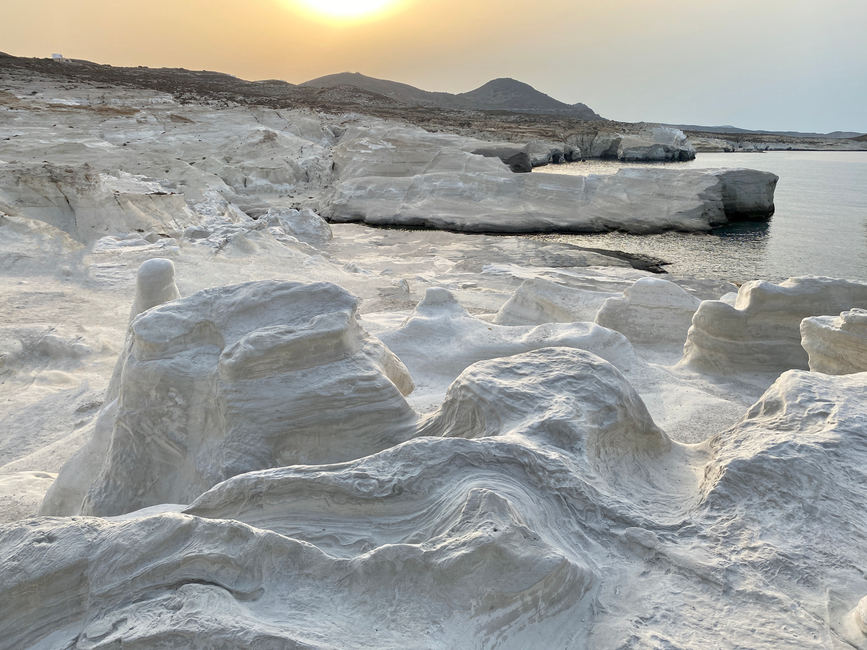
Milos is a volcanic island at the south-western edge of the Cyclades, and its coast looks like nowhere else in Greece. Wind and sea have carved its soft, colourful rock into a lunar white bay at Sarakiniko, sea caves and arches at Kleftiko, and more than 75 beaches of white, red, yellow and black stone. The island is also full of history: this is where a farmer found the Venus de Milo in 1820, and Milos has early Christian catacombs, a Roman theatre above the sea and Bronze Age ruins. Fishing villages with brightly painted boathouses, the syrmata, line the water at Klima and Firopotamos, and the hilltop village of Plaka has one of the finest sunset views in the Aegean. Milos has become much more popular in recent years, but it is still calmer than Santorini or Mykonos. Come in late May, June, September or early October, and give it four to six days.
Right now in Milos (Adamas)
- Wed 19–23°C 66–73°F Clear
- Thu 18–23°C 64–74°F Clear
- Fri 20–23°C 68–74°F Clear
Weather: MET Norway (CC BY 4.0) · Sea temperature: NOAA CoastWatch · Rates: ECB
Top tours in Milos
See all tours for Milos →
From local operators, with prices and reviews; you check availability and book on Viator, our partner. We may earn a commission at no extra cost to you. How we earn money
Milos at a glance
- Best months: late May–June and September–early October. Average highs run from about 23 °C in May to 30 °C in July and August, and winters are mild, around 14–16 °C by day (HNMS normals 1991–2020 for Santorini, the nearest comparable station with published normals). The sea is warm enough for swimming from June to October.
- Days needed: 3 for Plaka, Sarakiniko, Klima and a boat trip to Kleftiko; 5–6 to explore more beaches, the west of the island and Kimolos.
- Getting there: ferry from Piraeus (about 4½–5 hours direct, 7–8 hours via other islands) or from the other Cyclades; or fly from Athens to Milos airport (MLO) in about 30 minutes.
- Getting around: a few local bus lines in summer; a car or scooter is the easiest way to reach the beaches; boat trips for the south-west coast.
- Budget level: mid-range to expensive in summer, when rooms are scarce; book early. Like everywhere in Greece, a climate resilience fee is added per room per night (€2–€15 from April to October, depending on the type of accommodation). See our Greece guide for money, entry rules and daily costs.
Milos’s villages and who each one suits
- Adamas: the port, in the middle of the great natural harbour, with most of the services, car rentals, boat-trip departures, tavernas and a small beach. Practical and lively, the best base without a car.
- Plaka and Tripiti: the hilltop capital and its neighbour, with white lanes, the castle, the museum, the catacombs and sunset views. Romantic and atmospheric, for couples and culture lovers.
- Pollonia: a fishing village on the north-east tip with a sandy bay, good fish tavernas and the boat to Kimolos. Relaxed, for families and food lovers.
- Klima, Firopotamos and Mandrakia: tiny coastal hamlets of syrmata, some of which can be rented. Unique and peaceful, but with steps and few services.
- The west (Chalakas): wild, almost uninhabited, with dirt roads to remote beaches and the monastery of Agios Ioannis Siderianos. For explorers with a suitable vehicle.
Top things to see in Milos
Prices and hours below come from the Greek Ministry of Culture’s ticketing service (Hellenic Heritage), as of October 2026. Summer hours run from 1 April to 31 October; entry is free for all under-18s and EU citizens under 25 with ID, and on a few set days a year.
Sarakiniko
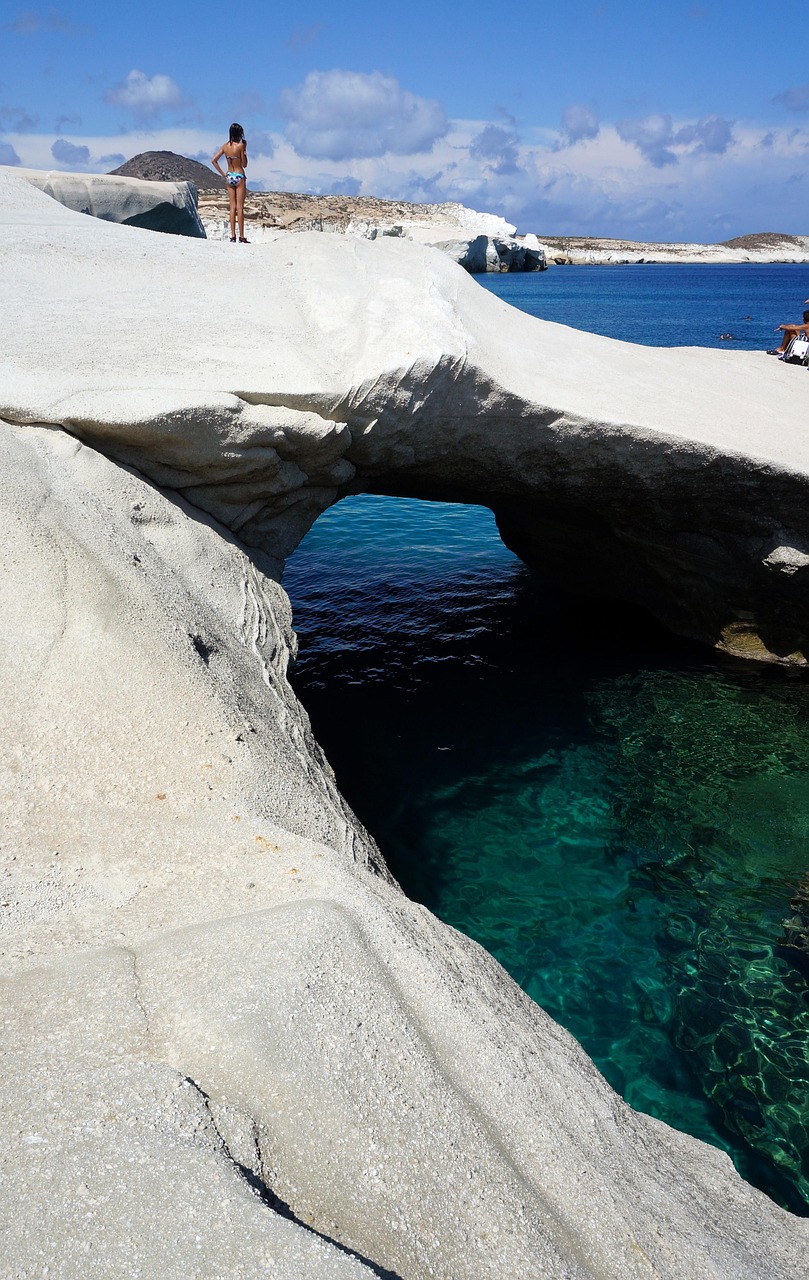
The most famous sight on Milos is a bay of smooth, wave-sculpted white volcanic rock on the north coast, with a narrow inlet of turquoise water and a small beach. It looks like a moonscape, and it is beautiful at sunrise and sunset. There is no shade, no services and the white rock is blinding and hot at midday, so bring water, a hat and sunglasses. People jump into the water from the rocks; check the depth first, and stay away from the edges when the north wind sends waves into the bay. Parking fills up early in summer.
Kleftiko
On the south-west coast, Kleftiko is a group of white cliffs, sea stacks, arches and caves where pirates once hid. It is best reached by sea: boat trips and sailing cruises leave daily in season from Adamas and Pollonia, with time to swim and snorkel through the arches. A rough path from the south coast leads to a viewpoint above, but it is long, hot and unmarked; most visitors go by boat. Book the day before, and expect trips to change route when the wind is strong. See our boat trips guide.
Plaka and the Kastro
Plaka, the capital, spreads along a ridge about 200 m above the sea, with lanes of white houses and churches. Climb the steps to the top of the hill, where the Venetian Kastro once stood: little remains of the castle, but the church of Panagia Thalassitra and the views over the bay and the islands are superb, above all at sunset. Arrive early in summer, as the top is small, and park at the edge of the village.
The Catacombs of Milos
Below the village of Tripiti, the catacombs are one of the most important early Christian monuments in Greece: an underground cemetery of galleries and tomb niches cut into the soft rock, where the island’s early Christian community buried its dead. A section is lit and open to visitors on a short guided route. How to visit: €10, €5 reduced. From April to October it opens 8:30–15:30, and from November to March 8:30–14:00, closed on Tuesdays all year. Last entry is 20 minutes before closing. Buy tickets online through Hellenic Heritage in summer, as group sizes are limited.
The Venus de Milo site and the ancient theatre
Between Tripiti and Klima lie the ruins of ancient Milos. In 1820 a farmer digging here found the statue of Aphrodite now known as the Venus de Milo, which was taken to France and is in the Louvre in Paris; a marble sign marks the place. A short walk away, the ancient theatre, rebuilt in Roman times in white marble, looks out over the bay and Klima. It is open-air and can be visited freely.
The Archaeological Museum and Phylakopi
The Archaeological Museum of Milos, in a neoclassical building in Plaka, displays finds from Bronze Age Phylakopi, obsidian tools, pottery and a plaster copy of the Venus de Milo (€5, €3 reduced; from April to October 8:30–15:30, closed on Tuesdays; from November to March open only Wednesday, Friday, Saturday and Sunday). On the north coast, Phylakopi was one of the leading prehistoric towns of the Aegean, rich from trade in Milos’s obsidian (€5, €3 reduced; open only on Saturdays and Sundays 8:30–15:30 from April to October, closed in winter).
Klima and the syrmata
Klima, below Tripiti, is the most famous of the fishing hamlets: a row of houses built into the rock at the water’s edge, with boat garages on the ground floor and painted doors and balconies in blue, red, green and yellow above. It is a pretty walk down from Tripiti. Respect the residents’ privacy; many syrmata are homes or rentals. Firopotamos, on the north coast, has a tiny white church on a rock, syrmata and a small beach with clear water, and Mandrakia is another picturesque cove nearby.
Beaches in Milos
Milos has more than 75 beaches. The municipality’s advice is to choose by the wind: when the north wind (the meltemi) blows, as it often does in July and August, go to the south coast or inside the bay; when the wind is from the south, go north.
- Firiplaka and Tsigrado: on the south coast. Firiplaka is a long sandy beach under colourful cliffs; neighbouring Tsigrado is a tiny cove reached down a steep gap in the rock with a rope and a ladder. Take care, or swim round from Firiplaka.
- Paliochori: a south-coast beach of coloured rocks and sand, where volcanic heat warms the sand and the water in places; tavernas and sunbeds.
- Provatas and Agia Kyriaki: sandy, organised beaches on the south coast, good for families.
- Papafragas: a narrow sea inlet between cliffs on the north coast near Pollonia. Look from above; access down to the water is steep and has been restricted for safety, so follow the signs.
- Pollonia and Achivadolimni: calm beaches with shade and tavernas, Achivadolimni the longest on the island inside the bay.
- Kleftiko, Gerontas and the west: reached by boat or by dirt road.
Many Milos beaches lie under soft cliffs: do not sit at the foot of cliffs, keep out of fenced areas and follow the signs, as rockfalls happen. Under Greece’s coastal law, part of every organised beach must be left free of sunbeds and you can always reach the water. See our beaches guide and our snorkeling guide.
Boat trips, sea kayaking and diving
- Boat trips: full-day cruises circle the island, stopping at Kleftiko, Sykia sea cave and the west-coast beaches; sailing yachts and small boats give a quieter day. Most leave Adamas or Pollonia in the morning.
- Sea kayaking: guided tours paddle along the colourful coast and into caves, from one day to several.
- Diving and snorkeling: the clear water, caves and volcanic rock formations make Milos one of the best islands in the Cyclades for diving with licensed centres. See our diving guide.
- Walking: geological walks and old mining tracks cross the island; the Milos Mining Museum in Adamas explains how obsidian, sulphur, bentonite and other minerals shaped the island. See our hiking guide.
Food in Milos
Try pitarakia (small fried cheese pies), ladenia (an island flatbread with tomato and onion), local cheeses such as xino and manoura, and fresh fish in Pollonia and Adamas. Thyme honey and capers are other local specialities.
A day trip to Kimolos
Kimolos, the small island just north-east of Milos, is a short boat ride from Pollonia, with frequent sailings in summer. It has a whitewashed hilltop village, its own syrmata, chalky white cliffs and quiet beaches. Go for the day with a scooter or on foot, or stay a night. Boat trips from Milos also visit the beaches of Polyaigos, an uninhabited island nearby.
Nearby destinations
Getting there and getting around
Ferries
- From Piraeus (Athens’ main port): Blue Star Ferries sails to Milos daily, taking about 4 hours and 35 minutes; according to the Municipality of Milos, direct conventional ferries take about 5 hours, and ships calling at Kythnos, Serifos and Sifnos 7–8 hours. High-speed boats are faster in season.
- Island hopping: in summer boats link Milos with Sifnos, Serifos, Folegandros, Ios, Naxos, Paros, Santorini and Crete, and Kimolos from Adamas and Pollonia.
Ferries dock at Adamas. Book on the operator’s own site or app or a comparison platform, especially in July and August, and keep a buffer day before an international flight: the Coast Guard can ban sailings in strong winds.
Flights
Milos airport (MLO) is about 4–5 km from Adamas. According to the municipality, there are 2–3 flights a day from Athens on small planes, taking about 30 minutes. There is no bus to the airport, so pre-book a taxi or pick up a hire car.
Buses, cars and taxis
Local buses link Adamas with Plaka, Tripiti, Pollonia, Sarakiniko and some southern beaches in summer; tickets are bought on the bus and the fare depends on the route. Milos has only about 15 taxis, so book ahead in summer. A car, scooter or quad is the easiest way to explore, but many beach roads, especially in the west, are rough dirt tracks and some rental contracts do not cover them. You need a driving licence valid for the vehicle (from outside the EU, usually with an International Driving Permit), helmets are compulsory on scooters and quads, and your travel insurance may not cover quads.
When to go and how long to stay
Milos has hot, dry, windy summers and mild, wetter winters. July and August are the busiest months, with full ferries and fully booked rooms; the meltemi can make boat trips rough and change which beaches are swimmable. Late May, June, September and early October are ideal: warm, sunny, with a warm sea and fewer people. From November to April many hotels and restaurants close, and boat trips stop.
| Season | Average high / low | What it’s like |
|---|---|---|
| Spring (Mar–May) | 16–23 °C / 11–17 °C | Green and flowery; good for walking and sightseeing; sea still cool; boat trips start in May. |
| Summer (Jun–Aug) | 28–30 °C / 21–24 °C | Hot, sunny and dry; windy in July and August; peak crowds and prices. |
| Autumn (Sep–Nov) | 19–27 °C / 14–21 °C | Warm sea in September and October, fewer people; first rain from late October. |
| Winter (Dec–Feb) | 14–16 °C / 10–11 °C | Mild but windy and damp; most places closed; peaceful. |
Temperatures are the 1991–2020 climate normals of the Hellenic National Meteorological Service (HNMS) for its Santorini station, about 100 km east, the nearest Cyclades station at a similar latitude with published normals; Milos is similar. Rain falls mainly from November to February. Greece’s wildfire season runs from 1 May to 31 October: on days of high fire risk (category 4–5 on the daily map of the Ministry of Climate Crisis and Civil Protection), forests and protected areas may be closed and any outdoor fire is banned. Call 112 if you see a fire.
3 days in Milos
Day 1: sunrise at Sarakiniko, a swim at Firopotamos, then the catacombs, the ancient theatre and Klima, and the sunset from the Kastro in Plaka. Day 2: a full-day boat trip to Kleftiko and the south-west coast. Day 3: the museum in Plaka, beaches on the south coast (Firiplaka, Paliochori), and dinner in Pollonia.
5–6 days in Milos
Add a day trip to Kimolos, a sea-kayaking tour, Papafragas and Phylakopi on a weekend, a drive to the west and Agios Ioannis Siderianos, and the Mining Museum. Then sail on to Sifnos, Folegandros or Santorini, or back to Athens.
Where to stay in Milos
- Without a car: Adamas, at the port, with most services and boat trips.
- Sunsets and atmosphere: Plaka or Tripiti.
- Families and food: Pollonia, with a calm beach and fish tavernas.
- Something special: a converted syrma in Klima, Firopotamos or Mandrakia; book very early.
Greece adds a climate resilience fee per room per night, set by type of accommodation, usually paid at the property (from April to October €2 for 1–2-star hotels and rooms up to €15 for 5-star hotels; campsites and youth hostels are exempt).
Practical tips for Milos
- Book early: rooms, hire cars and Kleftiko trips sell out in July and August.
- Go early: Sarakiniko and Plaka are best at sunrise or sunset; the middle of the day is hot and crowded.
- Follow the wind: choose south-coast beaches when the meltemi blows.
- Cliffs: stay out of fenced areas and away from cliff edges and cliff feet.
- Wind and ferries: strong winds can delay or cancel boats; leave a spare day before an international flight.
- Emergencies: call 112; tourist police 1571; coast guard 108.
What to pack for Milos
Pack light summer clothes, a sun hat, good sunglasses for the white rock, high-factor sunscreen and a refillable water bottle. Bring sandals or water shoes for rocks and pebbles, trainers for paths and dirt roads, a swimsuit and a snorkel mask, and a light windproof layer for boat trips and windy evenings. Add a light scarf for churches and a warmer jacket from November to April.
Milos travel FAQ
How many days do you need in Milos?
Three days covers Plaka, Sarakiniko, Klima, the catacombs and a boat trip to Kleftiko. Five or six days lets you add more beaches, the west of the island and Kimolos.
Can you get to Kleftiko by land?
Not easily. A long, rough, unmarked path leads to a viewpoint above, but most visitors go on a boat trip from Adamas or Pollonia, which lets you swim through the arches and caves.
How much are the Catacombs of Milos?
€10, or €5 reduced, as of October 2026. They are open 8:30–15:30 from April to October and 8:30–14:00 in winter, closed on Tuesdays.
Where was the Venus de Milo found?
In the ruins of ancient Milos, between Tripiti and Klima, by a farmer in 1820. The statue is in the Louvre in Paris; a sign marks the spot, and the museum in Plaka has a copy.
Is Sarakiniko worth it?
Yes, it is one of the most unusual landscapes in Greece. Go at sunrise or late afternoon, bring water and shade, and be careful jumping from the rocks.
Do you need a car in Milos?
It helps a lot. Buses are limited and seasonal, taxis are few, and many beaches are on dirt roads. Stay in Adamas if you will not drive.
How do you get to Milos from Athens?
Take a ferry from Piraeus (about 4½–5 hours direct, longer via other islands) or fly from Athens in about 30 minutes.
What is the best beach in Milos?
Sarakiniko for the scenery, Firiplaka for sand under colourful cliffs, Paliochori for warm water and tavernas, and Pollonia for families. Pick the side of the island sheltered from the wind.
What are syrmata?
Traditional fishermen’s houses built into the rock at the water’s edge, with boat garages below and living space above, painted in bright colours. Klima, Firopotamos and Mandrakia are the best places to see them.
When is the best time to visit Milos?
Late May, June, September and early October: warm, sunny and less crowded and windy than July and August, with the sea warm enough for swimming from June.
Sources and last review
Researched and last reviewed on 4 October 2026. Prices and hours of the Catacombs, the Archaeological Museum and Phylakopi come from the Greek Ministry of Culture’s Hellenic Heritage service. Flight, airport, ferry, bus, taxi, beach and boat-trip information comes from the Municipality of Milos; Piraeus ferry times and island connections from Blue Star Ferries. The climate resilience fee is set by Greek tax law and collected by the Independent Authority for Public Revenue (AADE). Climate figures are the HNMS 1991–2020 normals for Santorini, the nearest comparable station. Ferry times and boat trips change by season and weather, so check the operators and local announcements before you travel.
Plan your trip
Partner links: TravelerCenter may earn a commission if you book, at no extra cost to you.
🇬🇷 Useful Greek phrases for Milos
All 38 Greek phrases: restaurant, hotel, emergencies, romance (printable) →