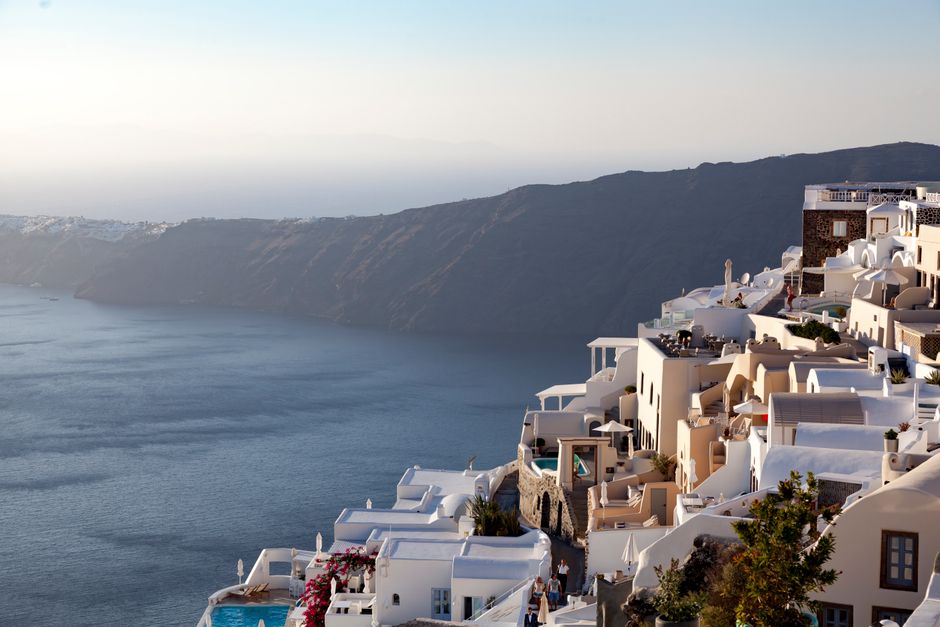
Santorini is the rim of a volcano. About 3,600 years ago a huge eruption blew out the centre of a round island and the sea poured in, leaving a ring of cliffs around a deep lagoon, the caldera. Today white villages line the top of those cliffs, and from Oia, Fira and Imerovigli you look down 300 m to the water and the dark volcanic islets in the middle. Add a Bronze Age town buried in ash, black-sand beaches, crisp white wines and the most famous sunsets in Greece, and it is easy to see why everyone comes. That is also the catch: in summer the caldera villages are crowded, especially on cruise-ship days. Come in May, June, September or October, stay at least three nights, and plan sunsets and sights around the crowds.
Right now in Santorini (Fira)
- Wed 19–21°C 66–69°F Clear
- Thu 19–22°C 66–71°F Clear
- Fri 20–22°C 68–71°F Clear
Weather: MET Norway (CC BY 4.0) · Sea temperature: NOAA CoastWatch · Rates: ECB
Top tours in Santorini
See all tours for Santorini →
From local operators, with prices and reviews; you check availability and book on Viator, our partner. We may earn a commission at no extra cost to you. How we earn money
Santorini at a glance
- Best months: May–June and September–October. Average highs run from about 19 °C in April to 30 °C in July and August, and winters are mild, around 14–16 °C by day (HNMS normals 1991–2020, Santorini station). The sea is warm enough for swimming from June to October.
- Days needed: 3 for the caldera villages, a sunset, the walk from Fira to Oia and Akrotiri; 4–5 to add beaches, wineries and a boat trip.
- Getting there: fly into Santorini (JTR), from Athens in about 45 minutes or direct from many European cities in season; or take a ferry from Piraeus or Rafina to the port of Athinios.
- Getting around: KTEL buses from Fira to Oia, the beaches, Akrotiri, the port and the airport (€2.20–€2.80 a ride); a car or scooter for wineries and villages.
- Budget level: one of the most expensive places in Greece, above all for caldera-view rooms in summer. Like everywhere in Greece, a climate resilience fee is added per room per night (€2–€15 from April to October, depending on the type of accommodation). See our Greece guide for money, entry rules and daily costs.
Santorini’s villages and who each one suits
- Oia: the postcard village at the northern tip, with blue domes, cave houses and the famous sunset from the castle ruins. Romantic and beautiful, very busy from late morning to after sunset. For honeymooners and photographers.
- Fira: the capital, in the middle of the caldera rim, with the most restaurants, bars and shops, the museums and the bus station. Lively and practical, the best base without a car.
- Firostefani and Imerovigli: quieter cliff-top villages just north of Fira, joined to it by the caldera path. Imerovigli sits on the highest part of the rim, facing the rock of Skaros. For views, calm and couples.
- Pyrgos, Megalochori and the inland villages: old villages among the vineyards, with lanes, churches and wineries close by, and lower prices. For a slower stay with a car.
- Kamari and Perissa: the long black-sand beaches on the east and south-east coast, with sunbeds, tavernas and family hotels. For beach holidays and budgets; no caldera view.
Top things to see in Santorini
Prices and hours below come from the Greek Ministry of Culture’s ticketing service (Hellenic Heritage), as of October 2026.
Oia
Oia is the Santorini of the posters: whitewashed cave houses and blue-domed churches stepping down the cliff, old windmills on the ridge and a marble main lane lined with galleries and cafés. Walk it early in the morning, when it is almost empty and the light is soft. The sunset crowd gathers around the ruins of the Venetian castle at the western tip from an hour before; arrive early, or watch it from a terrace with a drink or from a boat instead. Below the village, about 300 steps lead down to Ammoudi Bay, a tiny harbour with fish tavernas at the water’s edge. The rocky path from Ammoudi out to Cape Agios Nikolaos, a popular swimming spot, has stayed closed for rockfall risk since the 2025 earthquakes.
Fira
Fira spills over the cliff edge in terraces of hotels, bars and restaurants, all facing the volcano. Visit the Museum of Prehistoric Thera, which displays finds and wall paintings from Akrotiri (€10, €5 reduced; 8:30–15:30, closed Tuesdays), see the Orthodox cathedral and the Catholic quarter, and stay for an evening drink above the caldera. Below the town is the Old Port, where cruise passengers and boat trips come and go. A cable car links it with Fira (about €10 one way). The 588 stone steps of the Karavolades path, the other way up and down, were closed by the Municipal Port Fund of Thira after a landslide on 28 July 2026, “until further notice”; check whether they have reopened.
Imerovigli and Skaros Rock
Imerovigli, a 30-minute walk north of Fira, is the “balcony of the Aegean”, the highest village on the caldera rim. In front of it, the rock of Skaros sticks out into the caldera; a medieval castle once stood on top. A path runs down and out to it, and on round to a small chapel on the far side: allow an hour or so, wear proper shoes, and avoid the middle of the day in summer. Imerovigli is also a calmer, quieter place to watch the sunset than Oia.
The Fira–Oia caldera walk
The best way to see the caldera is on foot. The path from Fira to Oia follows the rim for about 10 km through Firostefani and Imerovigli, then leaves the villages behind and climbs over open, rocky hills before dropping into Oia. Most people take 3–4 hours with stops. The first part is paved, the rest is a dirt and gravel track with some steep sections and no shade or water after Imerovigli. Start early in the morning (or late in the afternoon to reach Oia for sunset, if you are confident of the way back by bus), wear walking shoes, a hat and sunscreen, and carry at least 1.5 litres of water a person. KTEL buses link Oia and Fira about every half hour in season, so you only need to walk one way. See our hiking guide.
Akrotiri, the buried Bronze Age town
At the south-west tip of the island, the eruption that formed the caldera buried a prosperous town of the Bronze Age under metres of ash, preserving two- and three-storey houses, streets, staircases, storage jars and beds. Its people seem to have left in time: no skeletons and few valuables have been found. Today the whole excavation is covered by a large roof and you walk through it on raised walkways. The town’s wall paintings are in the museum in Fira and in the National Archaeological Museum in Athens. How to visit: a ticket is €20, €10 reduced. From April to October it opens daily from 8:00 (until 20:00 from April to August, 19:30 in early September, 19:00 in late September, 18:30 in early October and 18:00 in late October), except on Mondays and Thursdays, when it opens only from 8:30 to 15:30. From November to March it is open 8:30–15:30 and closed on Tuesdays. Last entry is 20 minutes before closing. Entry is free on a few set days a year, and on the first and third Sunday of each month from November to March. Buy online through Hellenic Heritage to skip the queue. Buses run from Fira; combine it with Red Beach and the lighthouse at Akrotiri’s cape.
Ancient Thera and the volcano
On the ridge of Mesa Vouno, high above Kamari and Perissa, are the ruins of Ancient Thera, a Greek, Roman and Byzantine town with terraces, temples and a theatre looking out to sea (€10, €5 reduced; from April to October 8:30–15:30, closed on Wednesdays). A steep road climbs from Kamari, or walk up the old path from Perissa. Boat trips from the Old Port and from Ammoudi cross the caldera to Nea Kameni, the young volcanic island in the middle, where you walk up to the active crater over black lava, then swim in the warm, rust-coloured springs off Palea Kameni. See our boat trips guide.
Museums
- Archaeological Museum of Thera
- Museum of Prehistoric Thera
- Tomato Industrial Museum D. Nomikos
Peaks and mountains
- Profitis Ilias (Santorini)
Archaeological sites
- Akrotiri Archaeological Site
- Ancient Thera
Beaches
- Red Beach
Viewpoints
Beaches
Santorini’s beaches are not its main draw, but they are unusual: black or dark grey volcanic sand and pebbles, with red and white cliffs on the south coast. The sand gets very hot by midday in summer, so bring sandals.
- Kamari: a long, organised black-pebble beach with a seafront promenade, tavernas and an open-air cinema in summer, under the cliffs of Mesa Vouno. Easy by bus from Fira.
- Perissa and Perivolos: the longest stretch of black sand on the island, on the other side of the same mountain, with beach bars, water sports and cheaper places to stay. Good for families.
- Vlychada: further west, with wind-carved pale cliffs and a small marina; quieter.
- Red Beach: a small cove below dramatic red lava cliffs near Akrotiri. It has been officially off-limits on and off since 2013 because of rockfalls, and signs warn against the path over the headland; further rockfalls were reported in late 2025. Look at it from the viewpoint above, or see it from the water on a boat trip, and never sit under the cliffs. White Beach and Black Beach nearby are reached by boat.
Under Greece’s coastal law, part of every organised beach must be left free of sunbeds and you can always reach the water and spread your own towel. See our beaches guide and our snorkeling guide.
Santorini wine
Santorini’s volcanic soil, wind and lack of water produce some of Greece’s most distinctive wines. The vines are trained low into round baskets, called kouloura, that protect the grapes from the wind, and many are very old. The star is Assyrtiko, a dry, mineral, salty white; try also Nykteri, an oak-aged white, and sweet Vinsanto from sun-dried grapes. The wineries are around Pyrgos, Megalochori, Episkopi Gonia and Exo Gonia, and many offer tastings with views, some over the caldera; book ahead in summer, and do not drive afterwards. See our wine tasting guide. For food, try tomato fritters (tomatokeftedes) made with the island’s small, sweet tomatoes, fava (yellow split-pea purée), white aubergines and fresh fish in Ammoudi or at the tavernas of Vlychada.
Sunsets, crowds and cruise days
Santorini receives millions of visitors a year on an island only about 18 km long, and most of them want the same view at the same time. Cruise ships anchor in the caldera, and their passengers come ashore mostly between mid-morning and late afternoon, filling the lanes of Oia and Fira. A few ways to enjoy it anyway:
- Check the cruise calendar: the Municipal Port Fund of Thira allocates cruise-ship slots and limits daily arrivals. On days with several ships, spend the middle of the day at a beach, a winery or Akrotiri, and visit Oia and Fira early in the morning or in the evening.
- Watch the sunset somewhere else: Imerovigli and Firostefani, the castle of Pyrgos, the Akrotiri lighthouse or a sunset sail are all calmer than the castle in Oia.
- Book ahead: sunset tables, boat trips and caldera rooms sell out weeks ahead from June to September.
The cruise passenger fee
Since July 2025, Greece charges a fee to every cruise passenger who goes ashore, set by Law 5162/2024 (article 27). For Santorini and Mykonos it is the highest in the country: €20 per passenger from 1 June to 30 September, €12 in April, May and October, and €4 from November to March (€5, €3 and €1 at other Greek ports). The cruise line collects it, usually in the fare, as of October 2026. Since 28 July 2026, after the Karavolades steps were closed, cruise passengers on organised excursions are taken ashore at the port of Athinios and continue by coach, while others still use the Old Port and the cable car, where queues can be long.
The 2025 earthquakes: is Santorini safe now?
From late January 2025, thousands of small and moderate earthquakes struck the sea between Santorini and Amorgos, the strongest around magnitude 5. Schools closed, many residents and workers left for a few weeks, and the government declared a state of emergency on the island from 6 February; the civil protection authorities advised people to avoid the small cliff-foot ports (Ammoudi, Armeni, Korfos and the Old Port of Fira) because of the risk of rockfalls. Scientists found no sign of an imminent eruption: the swarm was caused by movement along undersea faults linked to magma deep below. Activity faded from March 2025.
In April 2026, on the advice of Greece’s earthquake and volcano monitoring committees, the authorities lifted most of the remaining restrictions under a new joint ministerial decision that runs until March 2027. Local measures stay where cliffs are unstable: parking is banned and traffic controlled at the port of Athinios, some cliff-foot areas below Fira are fenced off, and the path from Ammoudi to Cape Agios Nikolaos remains closed. As of October 2026, life on the island is normal and visitors are welcome. Sensible precautions:
- Respect fences and warning signs, and do not sit or swim right under cliffs, at Red Beach or elsewhere.
- Greece sends emergency alerts to mobile phones through the 112 service; read them and follow the instructions.
- If you feel an earthquake indoors, drop, take cover under a sturdy table and hold on; outdoors, move away from buildings, walls and cliff edges.
- Before you travel, check the Greek civil protection and municipality announcements, and your government’s travel information.
Activities and best months
- Beaches and swimmingVolcanic beaches of black, red and white sand: Kamari and the 5 km black-sand stretch of Perissa, Perivolos and Agios Georgios; Red Beach, with small boats on to White Beach; Monolithos with shallow water for families. · source
- Boat tripsCaiques leave daily from the small ports of Gialos (Fira) and Athinios for the caldera: a 20-30 minute walk up to the crater of Nea Kameni, then a swim in the warm sulphur springs of Palea Kameni, often with a stop on Thirasia. · source
- Scuba divingDivers explore the seabed at Cape Trypiti, the Adiavati reef and the shipwreck off Palea Kameni; diving centres operate at Ammoudi and Perissa. · source
- Wine tastingAssyrtiko, Athiri, Aidani, Mandilaria and Mavrotragano grow in basket-trained vines on volcanic soil; many wineries offer tastings and tours, and the cooperative winery (SantoWines) at Pyrgos pours Vinsanto and Assyrtiko on a terrace above the caldera. · source
Nearby destinations
Getting there and getting around
Flights
Santorini (Thira) airport, JTR, is on the east coast, about 6 km from Fira. Flights from Athens take about 45 minutes and run all year; from spring to autumn there are also direct flights from many European cities. KTEL buses link the airport with Fira (via Kamari, €2.20), and taxis and pre-booked transfers wait outside. The terminal is small and crowded at peak times, so arrive early for departures.
Ferries
- From Piraeus (Athens’ main port): high-speed boats take about 5 hours and conventional ferries about 7–8 hours, usually calling at Paros, Naxos or Ios on the way.
- From Rafina, closer to Athens airport: high-speed boats in season, via islands such as Mykonos, Paros and Naxos.
- Island hopping: boats link Santorini with Naxos and Mykonos several times a day in summer, and with Heraklion on Crete in about 2 hours. Book ahead in July and August, and allow for cancellations when the summer meltemi wind blows hard.
Ferries arrive at Athinios, a small port at the foot of the cliffs about 10 km south of Fira, reached by a road of tight hairpin bends that jams when big ships arrive. KTEL buses meet most ferries (€2.70 to Fira); otherwise pre-book a transfer or taxi.
Buses, cars and quads
The KTEL Santorini buses all start from Fira. In the 2026 summer timetable, buses to Oia leave about every half hour from 7:00 to 21:00, and Kamari and Perissa are served about as often; other lines go to Akrotiri, the airport, the port, Pyrgos, Megalochori, Monolithos and Vlychada. Most rides cost €2.20 (€2.70 to Perissa and the port), with a 25% surcharge after midnight. Buses get very full in summer, especially on the Fira–Oia line around sunset.
A small car is the easiest way to reach the wineries and quiet villages, but parking in Oia and Fira is very limited in summer: use the car parks at the edge and walk in. Quad bikes (ATVs) are popular with visitors and involved in many accidents on Santorini’s narrow, busy roads. You need a driving licence valid for the vehicle (from outside the EU, usually with an International Driving Permit), a helmet must be worn, and your travel insurance may not cover quads. In June 2026 the Greek government announced plans to make rental firms supply helmets with every rental and to allow quad rentals only to drivers who have held a licence for at least five years; check what applies when you travel. Taxis are few and must be booked in high season.
When to go and how long to stay
Santorini has a hot, dry summer and a mild, wetter winter, and it is windy: the north wind, the meltemi, blows hard on many days in July and August, cooling the air but roughing up the sea. July and August are the most crowded and expensive months. May, June, September and early October have warm days, warm or warming sea and fewer people, and are the best time for walking. From November to March many hotels and restaurants close, ferries are fewer, and the island is quiet, cheap and atmospheric, though too cool for swimming.
| Season | Average high / low | What it’s like |
|---|---|---|
| Spring (Mar–May) | 16–23 °C / 11–17 °C | Pleasant and green; good for walking and sightseeing; sea still cool; Easter is a big celebration. |
| Summer (Jun–Aug) | 28–30 °C / 21–24 °C | Hot, sunny and dry; windy in July and August; peak crowds and prices. |
| Autumn (Sep–Nov) | 19–27 °C / 14–21 °C | Warm sea in September and October, grape harvest, softer light; first rain from late October. |
| Winter (Dec–Feb) | 14–16 °C / 10–11 °C | Mild but windy and damp; many places closed; peaceful villages. |
Temperatures are the 1991–2020 climate normals of the Hellenic National Meteorological Service (HNMS) for its Santorini station. Rain falls mainly from November to February; from June to August it hardly rains at all.
3 days in Santorini
Day 1: Fira, the museum and an evening above the caldera. Day 2: walk from Fira to Oia in the morning, lunch in Ammoudi, and the sunset from Imerovigli on the way back. Day 3: Akrotiri, a look at Red Beach from the viewpoint, a winery tasting around Megalochori or Pyrgos, and a swim at Perissa or Kamari.
5 days in Santorini
Add a boat day to the volcano and the hot springs, or a sunset sail along the caldera; Ancient Thera in the morning and a beach afternoon in Kamari; and a lazy day in Pyrgos and the vineyards. Then take the ferry on to Naxos, Mykonos or Crete, or fly back to Athens.
Where to stay in Santorini
- Caldera views and romance: Oia, Imerovigli or Firostefani, in cave suites and hotels on the cliff; book early and expect high prices and many steps.
- Without a car: Fira, at the hub of the bus network, with the most restaurants and nightlife.
- Families and beach time: Kamari or Perissa, with flat access to the sea, larger rooms and lower prices.
- Wine and village life: Pyrgos, Megalochori or Vothonas, with a car.
Check how many steps lead to your room: many caldera hotels are reached only on foot, down long stairways. The climate resilience fee is added per room per night and paid at the hotel.
Practical tips for Santorini
- Go early: Oia and Fira are at their best before 9:00; the walk and Akrotiri are also best in the morning.
- Water and sun: there is little shade anywhere; carry water and sunscreen, even in spring and autumn.
- Donkeys: animal welfare groups ask visitors not to ride the donkeys up from the Old Port; take the cable car instead.
- Wind and ferries: strong winds can delay or cancel ferries; leave a spare day before an international flight.
- Drones and rooftops: do not climb on private roofs and church domes for photos; many are homes.
- Emergencies: call 112.
Weather month by month
Averages from HNMS normals 1991–2020, Santorini (airport); rain: HNMS averages (period not stated), Naxos · Last reviewed 4 Oct 2026
What to pack for Santorini
Pack light summer clothes, a sun hat, sunglasses, high-factor sunscreen and a refillable water bottle. Bring comfortable shoes with good grip for steps, marble lanes and the caldera path, and sandals or water shoes for the hot black sand and pebbles. A light windproof layer is useful on windy evenings and boat trips all year, and a warmer jacket from November to April. Add a swimsuit and a snorkel mask, and a light scarf to cover your shoulders in churches.
What to pack
- City walking shoesQuinta visits and harvest days mean steep terraces, gravel and cellar floors.
- Day packs and anti-theft bagsCarries water, towel and sunscreen down the long stairways to Algarve coves.
- Dry bags and phone pouchesProtects phones and cameras from sand and spray on beaches reached by ferry or steep paths.
- Fleeces and warm layersIt is cooler at sea than on land, especially on morning whale-watching trips.
- Quick-dry beach towelsA sand-shedding quick-dry towel packs small for beach days and lido visits.
- Rain jacketsA windproof, waterproof shell keeps you warm on open boats, where wind and spray cool you quickly.
- Reef-friendly sunscreenSummer UV is strong on Portuguese beaches and there is little shade below the cliffs.
- Water shoesRocky coves, lava pools and weever fish in shallow sand make water shoes useful.
- WetsuitsOn the west and north coasts the sea stays around 16–18 °C even in summer, so a thin suit helps for long swims.
- Wine bottle travel protectorsPort and Douro wines bought at the quintas travel home safely in checked luggage with padded bottle protectors.
Santorini travel FAQ
How many days do you need in Santorini?
Three days covers the caldera villages, the walk from Fira to Oia, a sunset and Akrotiri. Four or five days add beaches, wineries and a boat trip at a relaxed pace.
Is it safe to visit Santorini after the 2025 earthquakes?
Yes. The earthquake swarm of early 2025 faded from March 2025, and in April 2026 the authorities lifted most restrictions. A few cliff-foot areas and paths stay closed for rockfall risk; respect the signs and follow any 112 alerts.
How much does Akrotiri cost?
€20, or €10 reduced, as of October 2026. It opens daily, with shorter hours (8:30–15:30) on Mondays and Thursdays in summer and on all days in winter, when it closes on Tuesdays.
Can you visit Red Beach?
It has been officially restricted on and off since 2013 because of rockfalls, and more were reported in late 2025. See it from the viewpoint or from a boat, and do not sit under the cliffs.
How long is the walk from Fira to Oia?
About 10 km, taking 3–4 hours with stops. It is paved as far as Imerovigli, then a rocky track with some climbs and no shade. Start early and take the bus back.
Where is the best place to watch the sunset in Santorini?
The castle in Oia is the most famous and the most crowded. Imerovigli, Firostefani, the castle of Pyrgos, the Akrotiri lighthouse or a sunset cruise are calmer.
How much is the cruise passenger fee in Santorini?
€20 per passenger who goes ashore from June to September, €12 in April, May and October, and €4 from November to March, as of October 2026. It is usually included in the cruise fare.
Do you need a car in Santorini?
No. Buses from Fira reach Oia, the beaches, Akrotiri, the port and the airport for €2.20–€2.80. A car helps for wineries and inland villages, but parking in Oia and Fira is hard in summer.
Can tourists rent a quad in Santorini?
Yes, with a driving licence valid for the vehicle and a helmet. Quads are involved in many accidents, insurance may not cover them, and in 2026 the government announced stricter rental rules, so check before you book.
What is the best beach in Santorini?
Perissa and Perivolos for a long black-sand beach with everything on hand, Kamari for a promenade and easy buses, and Vlychada for quieter, sculpted cliffs.
When is the best time to visit Santorini?
May, June, September and early October: warm, sunny and less crowded than July and August, with the sea warm enough for swimming from June.
Sources
- © OpenStreetMap contributors · ODbL · fetched 4 Oct 2026
- Wikidata · CC0 · fetched 4 Oct 2026
Sources and last review
Researched and last reviewed on 4 October 2026. Prices and hours of Akrotiri, the Museum of Prehistoric Thera and Ancient Thera come from the Greek Ministry of Culture (Odysseus portal and Hellenic Heritage). Bus fares and timetables come from KTEL Santorini (prices updated 19 May 2026). The cruise passenger fee is set by Law 5162/2024, the climate resilience fee by Greek tax law and collected by the Independent Authority for Public Revenue (AADE). The earthquake and closure information comes from Greek civil protection advice and Municipal Port Fund of Thira notices as reported in the Greek press. Climate figures are the HNMS 1991–2020 normals for Santorini. Ferry times are typical and change by season, and closures can change quickly, so check the ferry companies, KTEL and local announcements before you travel.
Plan your trip
Partner links: TravelerCenter may earn a commission if you book, at no extra cost to you.
🇬🇷 Useful Greek phrases for Santorini
All 38 Greek phrases: restaurant, hotel, emergencies, romance (printable) →