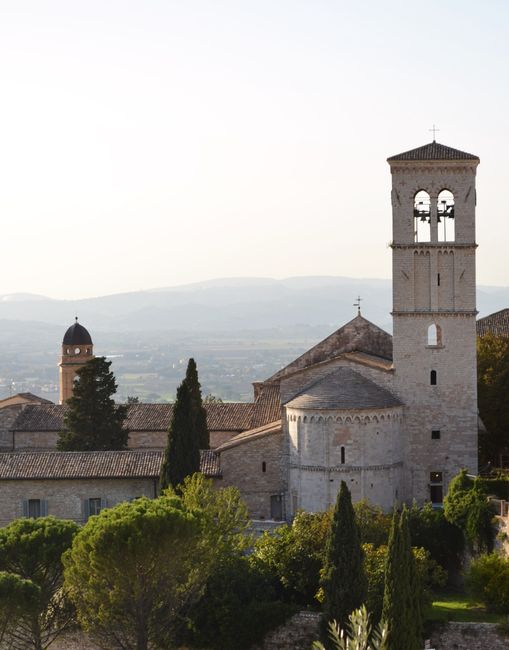
Assisi is the hill town of St Francis: a long ribbon of pink-and-white stone houses on the slopes of Monte Subasio, looking out over the green Umbrian plain, with the great Basilica of St Francis at one end and the Rocca Maggiore fortress above. It is one of the world’s most important Christian pilgrimage places and, with its Franciscan sites, a UNESCO World Heritage Site, but you don’t need to be religious to love its frescoes by Giotto, Cimabue and Simone Martini, its Roman temple, its quiet lanes full of geraniums and its views. 2026 is a special year: it marks 800 years since Francis died here on 3 October 1226, and the Catholic Church’s Year of St Francis runs until 10 January 2027. One full day covers the highlights; stay a night to see the town calm and golden at dusk. Assisi is an easy trip from Rome or Florence.
Right now in Assisi
- Wed 15–24°C 58–74°F Partly cloudy
- Thu 15–21°C 60–69°F 15 mm Rain
- Fri 13–18°C 55–64°F 3 mm Showers
Weather: MET Norway (CC BY 4.0) · Rates: ECB
Top tours in Assisi
See all tours for Assisi →
From local operators, with prices and reviews; you check availability and book on Viator, our partner. We may earn a commission at no extra cost to you. How we earn money
Assisi at a glance
- Best for: St Francis and Franciscan history, medieval frescoes, a beautiful walkable hill town, pilgrim routes and walks on Monte Subasio, and a base for Umbria.
- How long: 1 day for the Basilica, the town and Santa Chiara; 2 days with San Damiano, the Eremo delle Carceri and Santa Maria degli Angeli.
- Best time: April to June and September to October. Easter, early August and 3–4 October (the feast of St Francis) bring big crowds; winter is quiet and atmospheric.
- Book ahead: rooms for the feast days and Easter, especially in the anniversary year; guided visits of the Basilica.
- Getting in: trains from Rome take about 2 hours and from Florence about 2–2½ hours to Assisi station in the plain, then a short bus ride up the hill.
- Before you go: entry rules, money, trains and general safety are on our Italy travel guide.
Assisi’s areas and who each one suits
The old town stretches for about 1.5 km along the hillside, at about 400–500 metres, from the Basilica of St Francis in the west to the Basilica of Santa Chiara and the cathedral in the east, with Piazza del Comune in the middle. Down in the plain, about 4 km away, Santa Maria degli Angeli has the station and the great basilica built over the Porziuncola.
Around the Basilica of St Francis
The western end of town, around the Basilica and the Via San Francesco that leads to it. Convenient for an early visit and full of pilgrim hotels and religious guesthouses; busy by day, peaceful in the evening.
Piazza del Comune and the centre
The medieval main square with the Roman Temple of Minerva, the Torre del Popolo and cafés, and the lanes around it. Central for everything, with the most restaurants.
Santa Chiara, San Rufino and the upper lanes
The eastern part of town, around the Basilica of Santa Chiara and the cathedral of San Rufino, and the steep lanes climbing towards the Rocca. Quieter, with lovely views and good small hotels.
Santa Maria degli Angeli
The modern town on the plain, around its huge basilica and the station. Cheaper, flatter and practical by train or car, but you will need the bus or a taxi for the old town.
Top things to see in Assisi
Prices and hours were checked on the official sites in October 2026; check again before you go. The churches are free, but they are places of worship: dress modestly, keep silent, and don’t take photos inside.
The Basilica of St Francis
Built from 1228, just two years after Francis died, the Basilica is really two churches stacked one on top of the other, on a massive arcaded base above the valley. The Lower Church, low and shadowy, is covered with frescoes by Cimabue, Simone Martini and Pietro Lorenzetti; below it, the crypt holds the tomb of St Francis. The bright Gothic Upper Church is lined with the famous cycle of 28 scenes from the life of Francis traditionally given to Giotto. Parts of its vault collapsed in the earthquake of 1997 and have been painstakingly restored.
Entry is free. As of October 2026 the Lower Church is open from 6:00 to 19:00 (to 18:00 on Wednesdays), the Upper Church from 8:30 to 18:45 and the tomb from 6:00 to 18:15, with extra evening opening of the tomb for prayer on Fridays and Saturdays. Guided visits with a friar can be booked through the Basilica’s official booking site (prenotazioni.sanfrancesco.org).
The Basilica of Santa Chiara and San Damiano
The pink-and-white striped Basilica of Santa Chiara holds the tomb of St Clare, Francis’s companion and founder of the Poor Clares, and the painted crucifix of San Damiano that, the story goes, spoke to Francis. A 15-minute walk down through olive groves leads to San Damiano itself, the simple convent where Francis wrote the Canticle of the Creatures and Clare lived for 40 years. Both are free.
Piazza del Comune and the Temple of Minerva
The town’s main square is built on the old Roman forum. Its Temple of Minerva, from the 1st century BC, is one of the best-preserved Roman temple fronts in Italy, with six Corinthian columns; inside is a baroque church. Below the square you can visit the excavated Roman Forum, included in the combined ticket with the Rocca and the Pinacoteca.
The Rocca Maggiore
The medieval fortress crowning the hill above the town has the best views in Assisi, over the rooftops, the Basilica and the plain, and you can walk the walls and a long covered passage. As of October 2026 a ticket costs €8 (€6 reduced), or €10 (€7 reduced) combined with the Roman Forum and the Pinacoteca. It is open from 10:00 to 18:00 in October and 10:00 to 17:00 from November to February, with last tickets 45 minutes before closing.
More classic sights
- The Cathedral of San Rufino: a Romanesque façade with carved beasts, and the font where Francis and Clare were baptised.
- The Eremo delle Carceri: the hermitage in the woods of Monte Subasio, about 4 km uphill, where Francis went to pray; walk up or take a taxi.
- Santa Maria degli Angeli and the Porziuncola: a tiny chapel, restored by Francis, inside a vast basilica on the plain, near the place where he died.
- The Sanctuary of the Spoliation: the church of Santa Maria Maggiore, where the young Francis gave back his clothes to his father.
Other things to do in Assisi
Walks and Monte Subasio
Assisi is ringed by footpaths. Walk up to the Eremo delle Carceri and on to the bare summit of Monte Subasio (1,290 m) for views over half of Umbria, or follow the Bosco di San Francesco, a restored Franciscan woodland below the Basilica, cared for by the Italian environmental trust FAI. Pilgrim routes such as the Via di Francesco arrive here from La Verna in Tuscany and from Rome. See our hiking guide.
Food and wine
Umbrian food is simple and rich: black truffles, lentils from Castelluccio, cured pork from Norcia, strangozzi pasta, wood-fired roast meats and the flat torta al testo bread filled with ham or greens. Locally, look for the rocciata, a rolled pastry with apples, nuts and raisins. The great red wine of the area is Sagrantino from Montefalco, about 30 minutes away; see our wine tasting guide.
Cycling and the plain
The flat Umbrian valley below Assisi, with its olive groves and farms, is good for easy rides to Spello, Bevagna and Cannara, and road cyclists climb Monte Subasio. See our cycling guide.
Day trips from Assisi
Assisi is at the heart of Umbria, and its best day trips are to other hill towns. Trains run along the valley; for the countryside a car is easiest.
Spello, Perugia and Spoleto
Spello, about 10 minutes away by train, is a flower-filled hill town with Pinturicchio frescoes. Perugia, the Umbrian capital, about 25 minutes by train, has a grand medieval centre and the National Gallery of Umbria. Spoleto, about 40 minutes south, has a cathedral with Filippo Lippi frescoes and a dramatic aqueduct bridge.
Montefalco, Bevagna and Gubbio
Montefalco, the “balcony of Umbria”, is the home of Sagrantino wine; Bevagna is a tiny Roman and medieval town in the plain; Gubbio, about an hour north, is one of the most perfectly preserved medieval towns in Italy.
Tuscany, Rome and Florence
Cortona and Lake Trasimeno are about an hour away, and Siena about 1½–2 hours by car: see our Siena guide and our Tuscany guide. Assisi also fits neatly between Rome and Florence on a rail trip.
Nearby destinations
Getting there and getting around
By train
Assisi station is at Santa Maria degli Angeli, in the plain, on the line between Foligno and Terontola. From Rome, regional trains take about 2 hours, some direct and some with a change at Foligno; from Florence, allow about 2–2½ hours, changing at Terontola-Cortona or taking a direct regional train. Perugia is about 25 minutes away. Check times on trenitalia.com.
From the station to the old town
Busitalia’s line C runs from the square in front of the station up to the old town, about every half hour, stopping at Piazza Unità d’Italia below the Basilica and at Piazza Matteotti at the top of the town. The ride takes about 15–20 minutes. Taxis wait at the station.
By air
The nearest airport is Perugia’s San Francesco d’Assisi Umbria International Airport (PEG), about 15 km away, with a handful of European flights. Rome’s airports are about 2½ hours away, and Florence and Pisa further.
By car and parking
Assisi is just off the E45/SS75 road between Perugia and Foligno, about 2½ hours from Rome and Florence. The old town is a limited-traffic zone (ZTL): don’t drive in. Use the large car parks at the edge of the walls, such as Giovanni Paolo II near the Basilica, Porta Nuova near Santa Chiara and Mojano, linked to the centre by escalators and lifts; they charge by the hour, with day rates.
Getting around
The old town is small and car-free in spirit, but steep, with stepped lanes. Walk downhill from the Rocca or Santa Chiara to the Basilica, and use the C bus to save your legs going back up.
When to go and how long to stay
Assisi has an inland central Italian climate: hot, dry summers, cold winters with occasional snow on Monte Subasio, and wetter autumns. There is no Assisi or Perugia station in the official WMO set, so the table uses the WMO 1991–2020 climate normals for Arezzo (248 m), the nearest inland station with a very similar climate, also used on our Siena and Tuscany pages: long-term average daily highs and lows, and days with at least 1 mm of rain. The old town, at about 400–500 m, is a degree or two cooler.
| Season | Average high / low | Rainy days per month | What it’s like | Good for |
|---|---|---|---|---|
| Winter (Dec–Feb) | 9–11 °C / 0–1 °C | 7–9 | Cold, often grey or foggy, frosty nights | Quiet churches, Christmas nativity scenes, low prices |
| Spring (Mar–May) | 15–23 °C / 3–10 °C | 7–9 | Mild days, cool nights, green hills | Walking, Easter, Calendimaggio |
| Summer (Jun–Aug) | 28–32 °C / 13–16 °C | 4–6 | Hot and sunny; busy in early August | Early starts, evenings in the squares, Monte Subasio |
| Autumn (Sep–Nov) | 26 °C falling to 14 °C / 12 °C falling to 5 °C | 7 in September, 10 in November | Warm September, the feast of St Francis, wetter November | Pilgrimages, food and wine, olive harvest |
These are long-term averages; recent summers have been hotter. October and November are the wettest months, with about 110–120 mm of rain each.
Events worth planning around
- The Year of St Francis (to 10 January 2027): the Catholic Church’s special year for the 800th anniversary of the saint’s death, with pilgrimages, services and events in Assisi and across Italy. Earlier in 2026, from 22 February to 22 March, the saint’s remains were displayed in the Lower Church for the first time.
- Feast of St Francis (3–4 October): the Transitus on the evening of 3 October recalls his death, and on 4 October a solemn Mass is attended by Italy’s leaders. Since 2026, 4 October is again a national public holiday in Italy.
- Assisi Pax Mundi (15–18 October 2026): concerts in the Franciscan sites in and around the town.
- Calendimaggio (early May): a spring festival in which the town’s two halves compete with medieval costume, music and processions.
- The Perdono (1–2 August): pilgrims crowd the Porziuncola for the “Pardon of Assisi”.
How long to stay: 1- and 2-day plans
1 day: the Basilica of St Francis first thing, the Lower Church, the tomb and the Upper Church; then up Via San Francesco to Piazza del Comune and the Temple of Minerva, lunch, Santa Chiara and San Rufino, and the Rocca for the late-afternoon view.
2 days: add the walk down to San Damiano, the Eremo delle Carceri and Monte Subasio, and Santa Maria degli Angeli on the way to the station. More time: use Assisi as a base for Spello, Perugia, Montefalco and Gubbio.
Where to stay in Assisi and the tourist tax
- Near the Basilica: pilgrim hotels and convent guesthouses, perfect for an early visit.
- Piazza del Comune: central, with restaurants on the doorstep.
- Santa Chiara and the upper lanes: quieter, with views.
- Santa Maria degli Angeli: cheaper and practical by train.
- The countryside: farm stays and agriturismi among the olive groves, best with a car.
Assisi tourist tax (imposta di soggiorno): charged per person per night at your accommodation. The city raised it by €1 for every type of accommodation from January 2026, for the anniversary year; as of October 2026 rates run from about €2 (campsites and hostels) to €6 for the priciest holiday rentals, and the tax is not charged from the third consecutive night. Ask your host for the exact amount.
Practical tips for Assisi
- Dress for the churches: shoulders and knees covered, and no hats inside.
- Keep silent and put the camera away: photography is not allowed in the basilicas.
- Go early or late: coach groups fill the Basilica from mid-morning.
- Check the feast days: the anniversary year brings big pilgrimages and closures for services; check the Basilica’s calendar.
- Wear good shoes: the lanes are steep, stepped and slippery when wet.
- Park outside the walls and take the escalators up.
- Emergencies: call 112.
What to pack for Assisi
Comfortable walking shoes with grip for steep stone lanes and paths on Monte Subasio. Pack clothes that cover your shoulders and knees for the basilicas, or a light scarf and long skirt or trousers in summer. In summer, add a hat, sunscreen and a refillable water bottle (there are fountains in the town). In spring and autumn, bring layers and a compact umbrella, as November is the wettest month. In winter, a warm coat, hat and gloves: stone churches are cold inside.
Assisi travel FAQ
Is Assisi worth visiting?
Yes. The Basilica of St Francis is one of the great buildings of Europe, with frescoes that changed Italian art, and the town itself is beautiful, peaceful and full of views. You don’t need to be religious to enjoy it.
How many days do you need in Assisi?
One full day covers the Basilica, Santa Chiara, Piazza del Comune and the Rocca. Stay a night or two to see San Damiano, the Eremo delle Carceri and the town at its quietest.
Do you need tickets for the Basilica of St Francis?
No. Entry to the Upper and Lower Churches and the tomb is free. Guided visits with a friar can be booked online through the Basilica’s official booking site.
What are the Basilica of St Francis opening hours?
As of October 2026, the Lower Church opens from 6:00 to 19:00 (18:00 on Wednesdays), the Upper Church from 8:30 to 18:45 and the tomb from 6:00 to 18:15. Visits may be limited during services.
Why is 2026 special in Assisi?
It is the 800th anniversary of the death of St Francis, who died in Assisi on 3 October 1226. The Church’s Year of St Francis runs until 10 January 2027, and from 2026 Italy again celebrates 4 October, his feast day, as a national holiday.
How do I get from Rome to Assisi?
By train in about 2 hours to Assisi station, directly or changing at Foligno, then bus C up to the old town. By car, it is about 2½ hours.
How do I get from Florence to Assisi?
By train in about 2–2½ hours, directly or changing at Terontola-Cortona, then bus C. By car, allow about 2–2½ hours.
Can you drive into Assisi?
No, the old town is a limited-traffic zone. Park in the car parks outside the walls, such as Giovanni Paolo II, Porta Nuova or Mojano, and take the escalators up.
What should I wear to visit Assisi?
Clothes that cover your shoulders and knees to enter the basilicas, and comfortable shoes for steep lanes. Carry a scarf in summer.
How much is the Rocca Maggiore?
As of October 2026, €8 for adults and €6 reduced, or €10 with the Roman Forum and the Pinacoteca. It is open from 10:00 to 18:00 in October.
Sources and last review
Researched and last reviewed on 4 October 2026. Basilica opening hours and bookings come from the Sacred Convent of St Francis (basilica.sanfrancesco.org); Rocca Maggiore prices and hours and the station information from Visit Assisi, the Comune di Assisi’s official tourist site; the Year of St Francis dates from the Holy See’s announcements (Vatican News); climate from the WMO 1991–2020 normals for Arezzo (Italian Air Force station, archived by NOAA), the same station as our Siena and Tuscany pages. The tourist tax rates, bus C times and train journey times come from secondary sources and should be checked before you travel. Prices, timetables and opening hours change, so check the official sites before you go. For entry rules, money and safety, see our Italy travel guide.
Plan your trip
Partner links: TravelerCenter may earn a commission if you book, at no extra cost to you.
🇮🇹 Useful Italian phrases for Assisi
All 38 Italian phrases: restaurant, hotel, emergencies, romance (printable) →