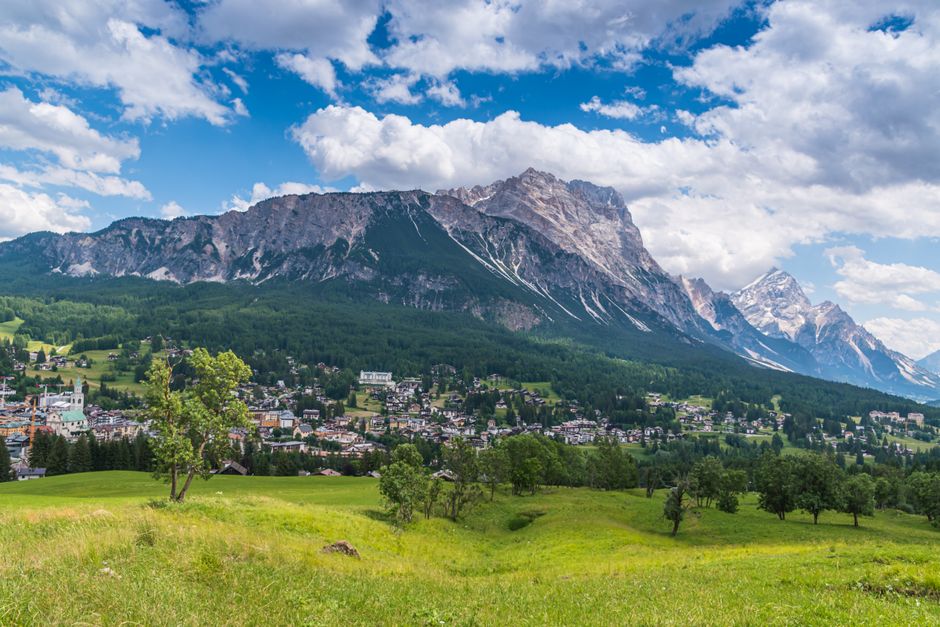
Cortina d’Ampezzo is the classic mountain resort of the Italian Dolomites: a small, stylish town in a wide green valley, ringed by some of the most dramatic peaks in the Alps, the Tofane, Cristallo, Sorapiss and Pomagagnon. It has a lively pedestrian high street, a pointed bell tower you see from every trail, Ladin traditions, great food, and lifts that climb from the edge of town to more than 3,000 metres. Cortina hosted the Winter Olympics in 1956 and again in February 2026, and it is the closest base for the Tre Cime di Lavaredo, Lago di Sorapis, the Lagazuoi and the Cinque Torri. Come for hiking and via ferrata from late June to September, or for skiing from December to early April. Three or four days is a good first stay.
Right now in Cortina d'Ampezzo
- Wed5–14°C41–58°FPartly cloudy
- Thu9–13°C48–56°F9 mm rain
- Fri5–10°C40–50°F2 mm rain
Top tours in Cortina d'Ampezzo
See all tours for Cortina d'Ampezzo →
From local operators, with prices and reviews; you check availability and book on Viator, our partner. We may earn a commission at no extra cost to you. How we earn money
Cortina d’Ampezzo at a glance
- Best for: mountain scenery, day hikes and hut lunches, lifts to high viewpoints, First World War history, skiing on Olympic slopes, and a stylish town to come back to in the evening.
- How long: 3–4 days for the lifts, the Tre Cime and Lago di Sorapis; a week to hike or ski properly.
- Best time: late June to mid-September for hiking, when lifts and huts are open; December to early April for skiing. October, November, May and early June are quiet, with most lifts closed.
- Book ahead: summer and Christmas rooms, and the toll road to the Tre Cime (online only, with your number plate). The Tre Cime shuttle bus and Lago di Sorapis needed no booking in 2026.
- Getting in: Cortina has no railway. Coaches run from Venice and its airport in about 2–2½ hours; buses link it with the train stations at Dobbiaco (about 50 minutes) and Calalzo.
- Before you go: entry rules, money, trains and general safety are on our Italy travel guide.
Cortina’s town and valley areas, and who each one suits
Cortina sits at about 1,224 metres in the Ampezzo valley, in the province of Belluno in the Veneto, close to the border with South Tyrol. The town itself is compact; the hamlets around it spread up the slopes. Much of the forest and pasture still belongs to the Regole d’Ampezzo, an ancient community of local families who also run the Dolomiti d’Ampezzo Natural Park and the town’s museums.
The centre and Corso Italia
The pedestrian Corso Italia runs past the parish church, smart boutiques, cafés and the old Cooperativa department store. It is the liveliest and priciest part of town.
Pocol and the road to the passes
West of the centre, the road climbs through Pocol towards the Falzarego and Giau passes, with hotels among the trees and views back over the valley. Handy for the Tofana slopes, the Cinque Torri and the Lagazuoi; you will want a car or the bus.
Zuel, Fiames and the north
Quieter hamlets along the Boite river, close to the cycle path on the old railway line and the road to Dobbiaco and the Tre Cime. Good for families and cyclists.
Chiave, Alverà and the east
Residential slopes on the sunny east side, on the road towards the Tre Croci pass, Misurina and the Cristallo lifts. Close to the start of the Lago di Sorapis hike and with good apartment rentals.
Top things to see in Cortina d’Ampezzo
Prices and hours were checked on the official sites in October 2026; check again before you go. Most lifts run from June to September and again in winter, and close in between.
The Tofana and the Freccia nel Cielo cable car
The “Arrow in the Sky” climbs from the Olympic Ice Stadium on the edge of town in three sections, to Col Drusciè (1,778 m), Ra Valles (2,475 m) and the summit station on the Tofana di Mezzo at 3,244 m, the highest point you can reach by lift around Cortina. In summer 2026 it ran from June to late September, from 9:00, with last rides down from the top at 16:50. As of October 2026 a return from Cortina to the summit costs €45 for adults and €23 for juniors, and children up to 6 travel free; shorter sections cost €25 return.
Faloria and Cristallo
The Faloria cable car leaves from the centre of town and climbs to about 2,120 m in a few minutes, to a sunny terrace with a hut, easy walks and views of the Sorapiss and the Tofane. Further east, the Cristallo chairlifts from Rio Gere reach Son Forca. Both run in summer (June to September) and in the ski season; the Faloria lift was closed when we checked in early October 2026.
The Lagazuoi and its war tunnels
From the Falzarego pass, about 16 km west of Cortina, a cable car rises to about 2,730 m, with a hut on the top and one of the great views of the Dolomites. During the First World War, Austrian and Italian troops fought here for years, digging tunnels into the rock; today the galleries, trenches and positions form an open-air museum. You can walk down through the restored tunnels with a head torch and helmet. In 2026 the Lagazuoi cable car runs until 18 October.
The Cinque Torri
Five stubby rock towers on a grassy shoulder below the Nuvolau, reached by chairlift from Bai de Dones on the Falzarego road. Restored First World War trenches wind between the towers, and the walk around them is easy and family-friendly. Combine it with the Lagazuoi for a full day.
The parish church and the town museums
The Basilica of Saints Philip and James on Corso Italia has a cheerful baroque interior, and its tall bell tower is the town’s landmark. The Regole d’Ampezzo run three small museums: the Mario Rimoldi modern art collection; the Rinaldo Zardini palaeontology museum, full of fossils found in the Dolomites; and an ethnographic museum on Ampezzo’s farming life. Check opening days locally, as they change by season.
More classic sights
- The Olympic Ice Stadium: built for the 1956 Games and used for curling in 2026; in season there is public skating.
- The Cortina Sliding Centre: the rebuilt bobsleigh, luge and skeleton track of the 2026 Games, on the site of the historic Eugenio Monti track on the edge of town.
- Passo Giau: a high pass at about 2,236 m with one of the most photographed panoramas in the Dolomites, best at sunset.
- Lago Ghedina and Lago di Pianozes: small forest lakes a short drive or walk from town, lovely for an easy afternoon.
Other things to do in Cortina d’Ampezzo
Hiking and via ferrata
Cortina is one of the great hiking bases of the Alps. Easy walks lead around the Cinque Torri and Lago Ghedina; harder days climb to huts such as the Rifugio Nuvolau. The area is also famous for via ferrata, protected climbing routes with fixed cables and ladders, many built on First World War paths: go with a mountain guide unless you have the experience and the gear. See our hiking guide.
Cycling
The former Calalzo–Cortina–Dobbiaco railway, closed in 1964, is now a gentle cycle and walking path through forests and over old bridges, part of the “Lunga Via delle Dolomiti”. It is the best easy ride in the area, and buses with bike racks run back from Dobbiaco. Road cyclists come for the Falzarego, Giau and Tre Croci passes; mountain bikers for the lift-served trails on the Tofana. See our cycling guide.
Skiing and winter
Cortina’s slopes are part of the Dolomiti Superski pass, with the Tofana (including the Olympia delle Tofane World Cup run), Faloria-Cristallo, Cinque Torri and Lagazuoi areas. The Lagazuoi links to the “Hidden Valley” run down to the Armentarola and to Alta Badia. Off the slopes: cross-country skiing on the old railway, snowshoeing and skating. The Dolomiti Superski season was expected to open on 28 November 2026, but lifts in Cortina often open later in December; check our Dolomites guide for passes.
Food and wine
Ampezzo cooking mixes Italian and Tyrolean: casunziei, half-moon ravioli filled with red beetroot and topped with poppy seeds and butter; dumplings (canederli); polenta with game or mushrooms; and apple strudel.
Day trips from Cortina d’Ampezzo
Cortina sits at the eastern end of the Dolomites, and the most famous sights of the eastern range are within an hour. Our Dolomites guide covers the whole range.
The Tre Cime di Lavaredo
The three great rock towers are about 25 km from Cortina, via Misurina. The classic loop around them is about 10 km and three to four hours on good paths, with huts on the way. The toll road from Misurina up to the Rifugio Auronzo needs an online booking in advance with your number plate; as of October 2026 the toll was €40 for a car, valid 12 hours, and the road is generally open from late May to late October. Without a car, take the Dolomiti Bus shuttle from Misurina, a €10 day ticket with no booking needed; in summer 2026 it ran from 30 May to 4 October, and line 51 from Cortina ran only in the main summer weeks (8 June to 9 September).
Lago di Sorapis
A milky-turquoise lake under the Sorapiss, about 2 hours’ walk each way from the Tre Croci pass, 8 km east of Cortina. Parts of the path are narrow and exposed, with cables and steps, so it is not for anyone uneasy with heights. As of October 2026 there is no booking or limit, but it is very crowded in summer: start early. Overnight stays at the Rifugio Vandelli must be booked.
Misurina and Lago di Braies
Lake Misurina, about 15 km away, is an easy stop with views of the Sorapiss and the Cadini peaks. Lago di Braies, in South Tyrol, is about an hour by car: in high summer it has its own access rules and bookings, explained in our Dolomites guide.
Nearby destinations
- Dolomites9 km
- Zillertal91 km
- Innsbruck99 km
- Zell am See-Kaprun101 km
- Kitzbühel103 km
- Venice123 km
- Bavarian Alps126 km
- Padua127 km
Getting there and getting around
By coach from Venice
The easiest way in without a car is by coach from Venice: coaches such as Cortina Express run from Venice, Mestre station and Venice Marco Polo airport, taking about 2–2½ hours, with more runs in the ski and summer seasons. Book ahead at busy times. Treviso airport is a similar distance.
By train and bus
There is no railway to Cortina. From the north, take the train along the Val Pusteria to Dobbiaco: bus 445 runs from Dobbiaco station to Cortina in about 45–50 minutes, six times a day in each direction until 12 December 2026, past Lago di Dobbiaco and the Tre Cime viewpoint at Lago di Landro. From the south, trains from Venice reach Calalzo di Cadore, where Dolomiti Bus line 30 continues to Cortina in about an hour.
By car and parking
From Venice, take the A27 motorway north and then the SS51 “Alemagna” road up the Cadore valley, about 2–2½ hours. Innsbruck, in Austria, is about 2 hours away via the Brenner and Val Pusteria. Corso Italia and the streets around it are pedestrian or limited-traffic zones, so park in the paid car parks around the centre and walk; if your hotel is in town, ask where to leave the car. In winter you need winter tyres or chains on board, and passes can close after heavy snow.
Getting around
Dolomiti Bus runs local and summer lines from the Cortina bus station to the lifts, the passes, Misurina and the Tre Cime, and ski buses in winter. A car gives the most freedom, but the toll and parking rules at the famous sights make buses worth using.
When to go and how long to stay
Cortina has a mountain climate: cold, bright and snowy winters, warm days and cool nights in summer with frequent afternoon storms, and much colder air up high. The table uses the WMO 1991–2020 climate normals for Dobbiaco (1,222 m), the Italian Air Force station about 30 km north and at the same altitude as Cortina, also used on our Dolomites page: long-term average daily highs and lows, and days with at least 1 mm of rain or snow. At 2,000–3,000 m it is roughly 6–12 °C colder.
| Season | Average high / low | Rainy days per month | What it’s like | Good for |
|---|---|---|---|---|
| Winter (Dec–Feb) | 1–3 °C / −8 to −7 °C | 4–5 | Cold, bright and snowy; the ski season runs from about December | Skiing, winter walks, skating, Christmas in town |
| Spring (Mar–May) | 8–16 °C / −3 to 5 °C | 5–10 | Spring skiing until early April, then snowmelt; many lifts, huts and hotels close in May | Late skiing, quiet valley walks |
| Summer (Jun–Aug) | 21–23 °C / 9–11 °C | 11–12 | Warm days, cool nights, frequent afternoon storms; busiest from late July to August | Hiking, via ferrata, lifts, cycling |
| Autumn (Sep–Nov) | 17 °C falling to 6 °C / 7 °C falling to −2 °C | 7–8 | Clear, golden September; larches turn yellow in October; most lifts close in late September | Quiet hikes, photography, low prices |
Summer is the wettest season, with about 100–120 mm a month from June to August, mostly in short storms: start hikes early and be off the high ground by mid-afternoon. September is often the most settled month. October can be glorious, but by then most lifts, huts and many hotels have closed.
Events worth planning around
- Women’s Alpine Ski World Cup (15–17 January 2027): two downhills and a super-G on the Olympia delle Tofane, the first World Cup races in Cortina since the Olympics. Expect a busy town that weekend.
- Christmas and New Year: the busiest and most expensive weeks of the winter, with a festive town centre; book early.
- Lavaredo Ultra Trail (late June): a big mountain running festival with races of up to 120 km starting and finishing in Cortina.
How long to stay: 2-, 3- and 5-day plans
2 days: the Tofana cable car to the summit on the first morning and a stroll on Corso Italia; on day two, the Lagazuoi, the war tunnels and the Cinque Torri, with sunset at the Giau pass.
3 days: add the Tre Cime loop, starting early by shuttle or with a booked car slot. 5 days: add Lago di Sorapis, a bike ride along the old railway to Dobbiaco, and a drive over the passes to Alta Badia or north to Lago di Braies.
Where to stay in Cortina d’Ampezzo and the tourist tax
- The centre: walk to the Faloria lift, the bus station, shops and restaurants; the priciest choice.
- Pocol and the west: quieter hotels with views, close to the Tofana and the passes; a car helps.
- Zuel and Fiames: calm, near the cycle path and the road north to the Tre Cime and Dobbiaco.
- Chiave, Alverà and the east: apartments on the sunny side, close to Misurina and Lago di Sorapis.
- Mountain huts: a night at a rifugio such as the Lagazuoi, for sunset above the clouds.
Cortina tourist tax (imposta di soggiorno): charged per person per night, for up to 5 consecutive nights, and paid at your accommodation. As of October 2026, the rates set by the Comune di Cortina d’Ampezzo are €5.00 in five-star hotels, €4.50 in four-star, €3.50 in three-star, €2.50 in two-star and €2.00 in one-star hotels; €2.50 in holiday apartments; €2.00 in B&Bs, farm stays and campsites; and €1.50 in guesthouses (affittacamere) and mountain huts. Children under 12 do not pay. Cortina chose not to raise the tax for the 2026 Olympics.
Practical tips for Cortina d’Ampezzo
- Check the lift calendar: most lifts close between late September and December, and between April and June; in 2026 the Lagazuoi runs until 18 October.
- Book the Tre Cime road in advance if you drive; otherwise take the shuttle from Misurina.
- Start hikes early: summer storms usually build in the afternoon, and lightning is dangerous on ridges and via ferrata.
- Respect the paths: the high ground is a natural park and much of the land is common property of the Regole.
- Carry cash and a card: some huts take only cash or have patchy card machines.
- Dress for the altitude: it can snow at 3,000 m in August.
- Emergencies: call 112.
What to pack for Cortina d’Ampezzo
In summer, pack hiking boots or trail shoes with good grip, a waterproof jacket, a warm fleece or light down jacket, a hat, gloves for the summit lifts, sunglasses and high-factor sunscreen, since the sun is strong at altitude. Bring a daypack, water bottle and a head torch for the Lagazuoi tunnels. For via ferrata you need a helmet, harness and via ferrata set, which you can rent in town. In winter, bring warm layers, waterproof boots with grip for icy streets, and your ski gear or plan to rent it.
Cortina d’Ampezzo travel FAQ
Is Cortina d’Ampezzo worth visiting?
Yes. It has spectacular scenery, great lifts and hiking, and a real town with good food. It is also the closest base for the Tre Cime, Lago di Sorapis and the Lagazuoi.
How many days do you need in Cortina?
Three or four days in summer let you ride the Tofana and Lagazuoi lifts, walk around the Tre Cime and hike to Lago di Sorapis. Stay a week to hike or ski properly.
When is the best time to visit Cortina d’Ampezzo?
Late June to mid-September for hiking, when lifts and huts are open, and December to early April for skiing. September is often the most settled month; October and November are quiet, with most lifts closed.
How do I get from Venice to Cortina?
By coach from Venice, Mestre or Venice airport, in about 2–2½ hours, or by car via the A27 and the Alemagna road. There is no train to Cortina; the nearest stations are Calalzo and Dobbiaco, with buses onward.
Do I need to book the Tre Cime di Lavaredo road from Cortina?
Yes, if you drive. As of October 2026 the toll road to the Rifugio Auronzo can only be used with an online booking made in advance with your number plate, at €40 for a car. The shuttle bus from Misurina needs no booking and cost €10 for a day ticket in 2026.
How much is the Tofana cable car?
As of October 2026 a return from Cortina to the Tofana di Mezzo summit (3,244 m) costs €45 for adults and €23 for juniors, and children up to 6 ride free. In summer 2026 it ran from June to late September.
Do you need to book Lago di Sorapis?
No. As of October 2026 there is no booking or limit for day hikers, but the path is narrow in places and very busy in summer, so go early. Only overnight stays at the Rifugio Vandelli need booking.
Can you visit the Olympic venues in Cortina?
You can see them: the 1956 Olympic Ice Stadium, which hosted curling in 2026 and has public skating in season, the rebuilt sliding track, and the Olympia delle Tofane slope, which you can ski in winter and which hosts World Cup races in January 2027.
How much is the tourist tax in Cortina d’Ampezzo?
From €1.50 to €5.00 per person per night depending on the type and category of accommodation, for up to 5 nights in a row, as of October 2026. Children under 12 are exempt.
Is Cortina good for beginners and families?
Yes. The Cinque Torri, Faloria and Lago Ghedina have easy walks, the old railway is a flat cycle path, and the ski areas have gentle slopes and ski schools.
Plan your trip
Partner links: TravelerCenter may earn a commission if you book, at no extra cost to you.
🇮🇹 Useful Italian phrases for Cortina d'Ampezzo
All 38 Italian phrases: restaurant, hotel, emergencies, romance (printable) →
Sources · last reviewed 4 October 2026
Researched and last reviewed on 4 October 2026. Tofana cable car prices and hours come from Tofana Freccia nel Cielo (freccianelcielo.com); the Faloria and Cristallo lifts from Faloria Cristallo; the Lagazuoi season from Lagazuoi (lagazuoi.it); the Tre Cime toll and booking from the municipality of Auronzo di Cadore; the Tre Cime shuttle from Dolomiti Bus; bus 445 from the South Tyrol public transport timetable; the tourist tax from the Comune di Cortina d’Ampezzo; climate from the WMO 1991–2020 normals for Dobbiaco (Italian Air Force station, archived by NOAA). The January 2027 World Cup dates and the Venice coach times come from secondary sources and should be checked with the organisers and operators. Prices, timetables and opening hours change, so check the official sites before you go. For entry rules, money and safety, see our Italy travel guide.
Data: Weather: MET Norway (CC BY 4.0) · Rates: ECB · Costs: World Bank ICP and price levels · Wikidata (CC0)