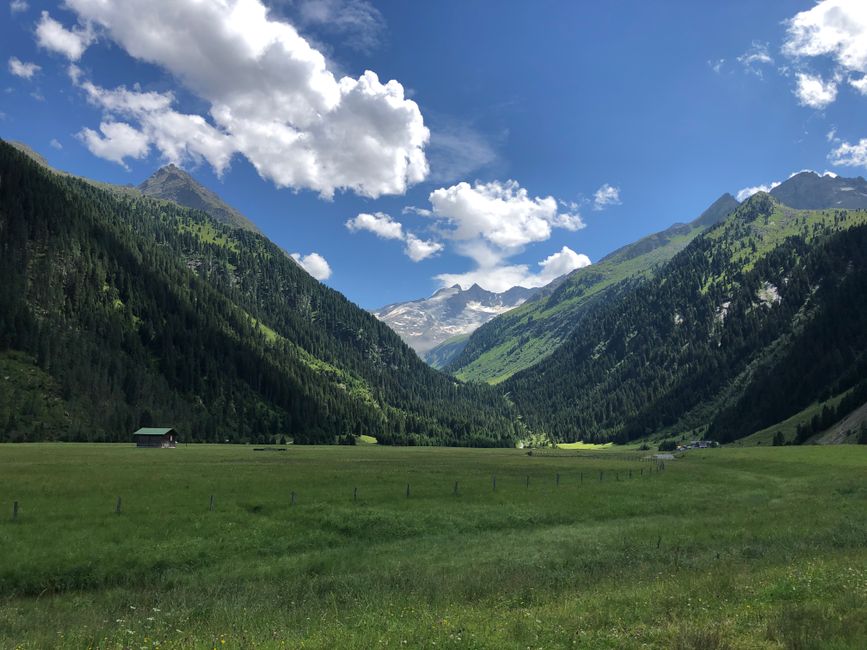
The Zillertal is Tyrol’s biggest holiday valley: a wide, green valley running south from the Inn for about 40 km, with villages strung along it from Fügen and Zell am Ziller to Mayrhofen, and four big ski areas on its slopes. At its head, the Hintertux Glacier offers skiing 365 days a year and an ice cave you can explore by boat, while side valleys climb to the glaciers and 3,000 m peaks of the Zillertal Alps. In summer, one card covers lifts, buses and pools, a steam train puffs up the valley, and hut-to-hut trails such as the Berliner Höhenweg draw hikers from all over Europe. Come for a ski week, or for a summer of walking, biking and lake swims.
Right now in Zillertal (Mayrhofen)
- Wed 8–20°C 47–69°F Mostly clear
- Thu 12–19°C 54–67°F 35 mm Heavy rain
- Fri 5–10°C 41–51°F 1 mm Partly cloudy
Weather: MET Norway (CC BY 4.0) · Air quality: OpenAQ · Rates: ECB
Top tours in Zillertal
See all tours for Zillertal →
From local operators, with prices and reviews; you check availability and book on Viator, our partner. We may earn a commission at no extra cost to you. How we earn money
The Zillertal at a glance
- Best for: big-valley skiing on one pass, year-round glacier skiing, family summers, hut-to-hut hiking, mountain biking and après-ski in Mayrhofen.
- How long: a week for skiing or hiking; a long weekend for a taste of the glacier and the valley.
- Best time: December to April for skiing (the glacier all year); late June to September for hiking and the high roads.
- Getting in: by train to Jenbach on the Inn valley main line (about 15 to 20 minutes from Innsbruck), then the Zillertalbahn up the valley to Mayrhofen; Innsbruck Airport is about 50 km away and Munich about 170 km.
- Getting around: the Zillertalbahn and buses run along the valley. As of October 2026, a Zillertal Superskipass day ticket costs €82 for adults.
- Before you go: entry rules, money, mountain safety and driving are in our Austria travel guide.
The Zillertal, village by village
Fügen, Kaltenbach and the lower valley
Close to the Inn valley, with family-friendly villages, the Spieljoch and the Hochzillertal–Hochfügen ski area, about 90 km of slopes up to around 2,400 m. Best for: families and quick access from Innsbruck and Munich.
Zell am Ziller and the Zillertal Arena
The valley’s old market town, known for its Gauderfest beer festival in spring, is the gateway to the Zillertal Arena, a ski area stretching over the Gerlos Pass to Königsleiten and Hochkrimml in Salzburg’s province, with about 400 km of hiking trails in summer. Best for: long ski circuits and a traditional village.
Mayrhofen
The busiest resort, at the end of the main valley, with the Penken and Ahorn ski areas (together about 142 km of slopes and 61 lifts in the Mayrhofner Bergbahnen area), the Harakiri, billed as Austria’s steepest groomed slope, and lively bars and clubs. In April, it hosts the Snowbombing music festival. Best for: skiers, snowboarders and nightlife.
Tux and Hintertux
A side valley climbing south-west from Mayrhofen to the Hintertux Glacier and the Ski- und Gletscherwelt Zillertal 3000, with a thermal spring in Hintertux. Best for: snow-sure skiing in any season.
Ginzling and the Zillergrund
Quiet side valleys south of Mayrhofen leading into the Zillertal Alps High Mountain Nature Park, with the Schlegeis reservoir, glaciers and huts. Best for: hikers and climbers.
The Hintertux Glacier
Austria’s only ski area open 365 days a year, the Hintertux Glacier rises from 1,500 m to 3,250 m, with slopes on the glacier all year and the full ski area down to the valley in winter. It is a training ground for national ski teams in the summer and autumn. As of October 2026, the lifts run daily 8:15–16:30, and an adult day pass costs €68 from 2 to 16 October 2026 and €82 in the winter season from 17 October 2026 to 7 May 2027 (€74 from 11:00). In summer, the glacier is open to sightseers on foot, with views from the top station over the Zillertal Alps and the Dolomites.
Nature’s Ice Palace (Natur Eis Palast), a natural crevasse cave 30 m below the slopes near the top station, is one of the most unusual sights in the Alps: guides lead you through blue ice halls, past icicles and frozen waterfalls, and onto an underground glacier lake by rubber boat. As of October 2026, the tour runs every hour from 10:30 to 14:30, every day of the year, lasts about 70 minutes and costs €39 for adults and €15 for children aged 6 to 14, plus the cable car; the minimum age is 6. Dress for sub-zero temperatures and bring sturdy shoes.
At 3,250 m, the air is thin and the sun is strong. Take it slowly, drink water, and wear sunglasses and sun cream even on cloudy days.
Peaks and mountains
- Großer Möseler
- Kreuzjoch
- Olperer
- Rastkogel
Nature
- Hintertux Glacier
- Schlegeisspeicher
Caves
- Spannagel Cave
Skiing: the Zillertal Superskipass
One pass, the Zillertal Superskipass, covers all four ski areas of the valley: Hochzillertal–Hochfügen–Spieljoch, the Zillertal Arena, the Mayrhofner Bergbahnen (Penken, Ahorn, Rastkogel, Eggalm) and the Ski- und Gletscherwelt Zillertal 3000 with the Hintertux Glacier: about 546 km of slopes and 180 lifts, linked by the Zillertalbahn and free ski buses. As of October 2026, prices for the 2026/27 season look unchanged from last winter: €82 for one day, €163.50 for two days and €399 for six days for adults. The valley-wide season runs from 4 December 2026 to 11 April 2027, with the glacier open before and after.
Mayrhofen’s Ahornbahn, which carries up to 160 people, is the biggest cable car in Austria, and the Ahorn’s broad, gentle slopes are good for beginners. Experts head for the Harakiri on the Penken, the Hintertux off-piste with a guide, or the freeride slopes of Hochfügen. Stay on marked slopes unless you have a guide and avalanche equipment, and check the Tyrol avalanche bulletin at avalanche.report.
Summer: the Zillertal Activcard
From late May to late October, the Zillertal Activcard covers one return ride per day on one of ten cable cars, one visit a day to six outdoor pools and lidos, and most public transport in the valley, including the regular Zillertalbahn trains. In the 2026 season (23 May to 26 October), it cost €95.50 for 3 days, €137.50 for 6 days, €186 for 9 days and €233 for 12 days for adults, with children about half price, plus a €2 card deposit. Many hotels include it in their summer packages, so ask before you buy.
Hiking: from easy walks to the Berliner Höhenweg
Lifts open up hundreds of kilometres of trails: panorama paths on the Penken, the Ahorn and the Gerlosstein, family walks to alpine dairies, and gorge walks in the side valleys. The Berliner Höhenweg, a loop of about 70 km in eight stages from Mayrhofen, links high huts below the glaciers and reaches 3,133 m at the Schönbichler Horn; it is best from mid-July to mid-September and only for fit, sure-footed hikers. The nature park house in Ginzling has information and runs guided walks in summer. See our hiking guide.
The high roads: Zillertaler Höhenstrasse and the Schlegeis
Two toll roads climb above the valley in summer. The Zillertaler Höhenstrasse winds for about 20 km along the eastern slopes to more than 2,000 m, past farms and huts with views across the valley. From Ginzling, a narrow toll road climbs to the Schlegeis reservoir at 1,782 m, held back by a 131 m dam and surrounded by glaciers, a starting point for walks to the Olperer hut and the Pfitscher Joch; it is open from about mid-May to late October. Check tolls and opening dates locally before you go.
Biking, rafting and paragliding
A valley cycle path follows the Ziller from Strass to Mayrhofen, and mountain-bike trails climb to the huts on both sides; e-bikes are easy to hire. Adventure centres in Mayrhofen and Zell offer rafting on the Ziller, canyoning and tandem paragliding. See our cycling guide.
Activities and best months
- CyclingThe Zillertal cycle route follows the Ziller for 31 km from Mayrhofen out to the valley entrance at Strass, past playgrounds, museums and a bathing lake at Schlitters, in about two hours; the Zillertalbahn train (nine stops) can carry you and your bike back. · source
- HikingTen summer cable cars and the Zillertal alpine roads lead into the mountains, with huts serving Zillertal food. Long-distance routes include the Berlin High Trail, an approx. 56 km circuit via six huts in the Zillertal Alps High Alpine Nature Park (up to 7 days), and the 7-day Alpine crossing from Tegernsee via Achensee and the Zillertal to Sterzing. · source
The Zillertalbahn and its steam train
The narrow-gauge Zillertalbahn has run from Jenbach to Mayrhofen since 1902. Modern diesel trains run every half hour, taking about 55 minutes, and are the easiest way to travel the valley. In summer, a historic steam train makes one return trip on selected days: in 2026 it ran from 2 June to 24 September, on Tuesdays to Thursdays, leaving Jenbach at 10:44 and Mayrhofen at 13:35, for €25 one way or €35.20 return for adults. The 2026 season is over; check zillertalbahn.at for 2027 dates. A combined ticket with the Achensee steam cog railway from Jenbach is also sold.
The railway’s modernisation is under way: a plan for hydrogen trains was dropped in 2024, and battery or hybrid electric trains are now favoured, but as of October 2026 no date has been set for them to enter service.
Day trips from the Zillertal
Lake Achensee, Tyrol’s largest lake, is a short ride from Jenbach by steam cog railway. Innsbruck and Swarovski Crystal Worlds in Wattens are about 45 minutes away. Over the Gerlos Pass, the Krimml Waterfalls are about an hour from Zell am Ziller; Kitzbühel is about an hour by car. The medieval glass-blowing town of Rattenberg lies just along the Inn valley.
Nearby destinations
- Bavarian Alps35 km
- Innsbruck36 km
- Kitzbühel41 km
- Zell am See-Kaprun70 km
- Dolomites83 km
- Cortina d'Ampezzo91 km
- Munich92 km
- Salzburg103 km
Getting to the Zillertal
By train. Railjets and regional trains stop at Jenbach, about 15 to 20 minutes from Innsbruck and about 1 hour 30 minutes from Munich; change there for the Zillertalbahn to Fügen, Zell am Ziller and Mayrhofen.
By air. Innsbruck Airport is about 50 km away, Salzburg about 150 km and Munich about 170 km, with transfer buses in winter.
By car. Leave the A12 Inn valley motorway at the Zillertal exit (vignette required) and follow the B169 up the valley. Saturday changeover days in winter bring long queues; travel early or late. Winter tyres are required in wintry conditions from 1 November to 15 April.
When to go and how long to stay
The Zillertal has cold, snowy winters and warm summers with afternoon thunderstorms; Mayrhofen, deep in the valley, gets little winter sun. On the glacier it is much colder. The table uses GeoSphere Austria’s 1991–2020 climate normals for the Mayrhofen station at 640 m (official sunshine figures are not available for this station).
| Season | Average temperature | Rain and snow per month | What it’s like |
|---|---|---|---|
| Winter (Dec–Feb) | −1.4 to 0.7 °C | 46–62 mm | Cold and snowy; the valley floor stays shady while the slopes get the sun |
| Spring (Mar–May) | 5.4 °C rising to 14.2 °C | 64–103 mm | Spring skiing to mid-April, Snowbombing, then a quiet season |
| Summer (Jun–Aug) | 17.3–18.9 °C | 136–154 mm | Warm, with storms in the afternoons; hiking, biking and steam trains |
| Autumn (Sep–Nov) | 14.4 °C falling to 4.1 °C | 100 falling to 77 mm | Settled September days, cattle drives; glacier skiing from autumn |
Mayrhofen gets about 1,120 mm of precipitation a year and has an average temperature of 9.3 °C.
A summer week
With an Activcard: the Penken and Ahorn panorama trails, a day on the Hintertux Glacier and the ice cave, the Schlegeis reservoir, a lido afternoon, a ride on the steam train, and a two-day taste of the Berliner Höhenweg with a night in a hut.
Weather month by month
Averages from GeoSphere Austria normals 1991–2020, Innsbruck Airport · Last reviewed 4 Oct 2026
Where to stay
- Mayrhofen: the widest choice of hotels, restaurants and nightlife, close to the Penken and Ahorn and 20 minutes from the glacier.
- Hintertux and Lanersbach: for glacier skiers and spa lovers.
- Zell am Ziller and Gerlos: traditional villages for the Zillertal Arena.
- Fügen and Kaltenbach: family hotels, quick to reach from the motorway and the airport.
Practical tips for the Zillertal
- Use the train: the Zillertalbahn avoids the valley’s traffic jams and parking problems.
- Check what’s open: many valley lifts close between mid-April and late May and from mid-October to early December; the glacier stays open.
- Ask about cards: hotels often include the Activcard in summer or offer ski pass packages in winter.
- Respect the mountains: start hikes early, carry a map and rain gear, and call 140 in a mountain emergency.
What to pack for the Zillertal
In winter: warm ski clothing, goggles, a helmet and extra layers for the glacier. In summer: hiking boots, a waterproof jacket, a warm layer and gloves for the glacier and high trails, sun protection, swimwear for the lidos, and a sleeping-bag liner for hut nights.
What to pack
- Day packs and anti-theft bagsA 20–30 litre pack carries layers, water, a head torch and snacks on full-day levada walks.
- Fleeces and warm layersSummits like Pico do Areeiro averaged about 11 °C over 2024, so a fleece is needed even in summer.
- HeadlampsLevada routes such as PR1 and PR9 pass through long, dark, wet tunnels.
- Hiking shoes and bootsMadeira's levadas and the Azores' crater rims are wet, rocky and slippery, so grippy shoes matter more than anywhere else in Portugal.
- Rain jacketsA packable shell covers showers and wind on coastal routes outside summer.
- Trekking polesLong stone staircases and steep descents on Madeira's peaks and the Azores' crater rims are easier on the knees with poles.
- Water bottles and hydration packsRiding in the Algarve and Alentejo heat needs more water than you expect.
Zillertal travel FAQ
Can you ski at Hintertux all year?
Yes, the Hintertux Glacier is open 365 days a year. As of October 2026, a day pass costs €68 until 16 October 2026 and €82 in the winter season from 17 October.
How much is the Zillertal Superskipass?
For 2026/27, €82 for one day and €399 for six days for adults, covering about 546 km of slopes and 180 lifts across four ski areas, including the Hintertux Glacier.
What does the Zillertal Activcard include?
One lift ride a day on one of ten cable cars, one pool visit a day at six outdoor pools, and most public transport in the valley. In 2026 it cost from €95.50 for 3 days and was valid from 23 May to 26 October.
When does the Zillertal steam train run?
In summer only: in 2026, from 2 June to 24 September on Tuesdays to Thursdays, from Jenbach at 10:44. A return costs €35.20 for adults. Check 2027 dates on zillertalbahn.at.
What is Nature’s Ice Palace at Hintertux?
A natural crevasse cave in the glacier, visited on 70-minute guided tours with a boat ride on an ice lake. As of October 2026, it costs €39 for adults plus the cable car, every day of the year; minimum age 6.
How do I get to Mayrhofen by train?
Take a train to Jenbach on the Innsbruck–Munich/Salzburg line, then the Zillertalbahn, which runs every half hour to Mayrhofen in about 55 minutes.
Is the Zillertal good for families?
Very. Gentle slopes on the Ahorn and the Spieljoch, playgrounds and adventure parks at the lift stations, lidos, and the Activcard in summer make it one of the most family-friendly valleys in Tyrol.
Which Zillertal village is best for skiing?
Mayrhofen for the biggest choice of slopes, nightlife and quick access to the glacier; Hintertux for snow-sure skiing early and late in the season; Zell am Ziller or Gerlos for the long circuits of the Zillertal Arena; and Fügen or Kaltenbach for families and short transfers. One Superskipass covers them all.
How many days do you need in the Zillertal?
A week for a ski or hiking holiday; three or four days for the glacier, the Penken or Ahorn and a steam train ride in summer.
Sources and last review
Researched and last reviewed on 4 October 2026. Hintertux Glacier hours, prices and the ice cave: Zillertaler Gletscherbahn (hintertuxergletscher.at); the Superskipass and the Activcard: Zillertal Tourismus (zillertal.at); the steam train timetable and fares: Zillertalbahn; Mayrhofen lifts: mayrhofen.at; Hochzillertal: hochzillertal.com; the nature park: Naturpark Zillertaler Alpen; climate: GeoSphere Austria 1991–2020 normals. The railway’s electrification plans, the high roads, the Berliner Höhenweg, the Harakiri and travel times come from secondary sources and are flagged for checking. Prices, timetables and rules change, so check the official links before you go. For Austria-wide entry rules, money and mountain safety, see our Austria travel guide.
Plan your trip
Partner links: TravelerCenter may earn a commission if you book, at no extra cost to you.
🇩🇪 Useful German phrases for Zillertal
All 38 German phrases: restaurant, hotel, emergencies, romance (printable) →