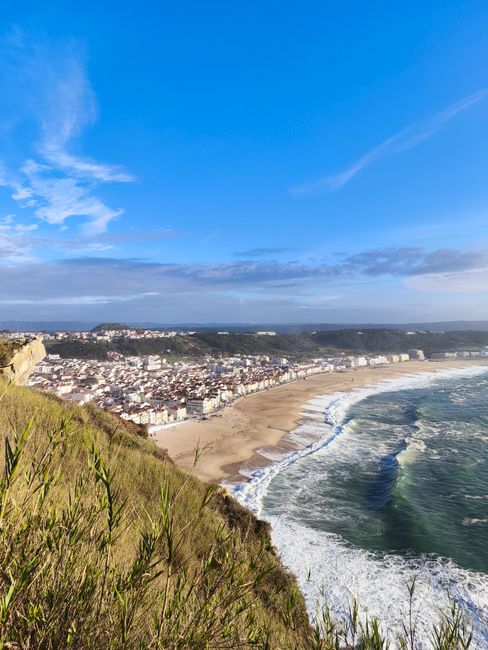
Nazaré is a fishing town on Portugal’s Silver Coast, about 120 km north of Lisbon, famous for two very different things: a long, sheltered town beach lined with cafés and fish restaurants, and, just around the headland, Praia do Norte, where the biggest waves ever surfed roll in on winter storm days. Between the two, the clifftop quarter of Sítio, reached by a funicular, has a pilgrimage church, a lookout over the whole bay and the old fort that has become the grandstand for big-wave surfing. Nazaré also keeps its fishing traditions, from fish drying in the sun on the beach to colourful boats. It is a summer beach resort, a winter show of nature, and a good base for the great monasteries of Alcobaça and Batalha. Give it one or two days, or more for beach holidays.
Right now in Nazaré
- Wed16–21°C61–70°FMostly clear
- Thu15–24°C59–74°FMostly clear
- Fri16–25°C60–78°FClear
Top tours in Nazaré
See all tours for Nazaré →
From local operators, with prices and reviews; you check availability and book on Viator, our partner. We may earn a commission at no extra cost to you. How we earn money
Nazaré at a glance
- Best for: beach days, watching giant waves, seafood, fishing traditions and day trips to the UNESCO monasteries of Alcobaça and Batalha.
- How long: 1 day for the beach, the funicular, Sítio and the fort; 2–3 days to add Alcobaça, Batalha and the coast.
- Best time: July to September for the beach; October to March, especially November to February, for big waves on Praia do Norte when a large swell arrives.
- Getting in: about 1 hour 30 minutes by car or around 2 hours by express bus from Lisbon; there is no railway station in town.
- Getting around: on foot along the seafront, and by the funicular up to Sítio; the fort and Praia do Norte are a 10-minute walk from the upper station.
- Before you go: entry rules, money and general safety are in our Portugal travel guide.
Nazaré, area by area
The town has three parts: the beach town (Praia) along the bay, the clifftop village of Sítio above its northern end, and the old inland village of Pederneira on a hill to the south-east. Praia do Norte lies on the far side of the headland, facing the open Atlantic.
Praia: the beach town
The lower town fills a grid of narrow streets behind a wide seafront avenue and a curving beach of pale sand about 1.5 km long. Most hotels, restaurants and shops are here. Best for: beach holidays, families and eating out.
Sítio: the clifftop village
On a cliff about 110 m above the beach, Sítio is the original pilgrimage village, with a large square, the sanctuary church of Our Lady of Nazaré, souvenir stalls and the best views of the bay. Best for: views, sunsets and the walk to the fort.
Pederneira
The old parish centre on a hill south-east of town, with a church, a small square and a viewpoint over the rooftops and the bay; quiet and rarely visited. Best for: a short walk and a different view.
Praia do Norte
North of the headland, a wild beach several kilometres long faces the open ocean, with dunes and pine woods behind. It is not a swimming beach: currents are strong and the waves can be dangerous even on calm-looking days. Best for: watching the waves, ideally from the fort above.
Top things to see in Nazaré
Opening hours and prices below were checked on official sites where they could be read in October 2026; several Nazaré municipal websites could not be reached during our review, so check locally.
The town beach and the seafront
Nazaré’s main beach is wide and sandy, sheltered by the headland, and in summer it fills with rows of striped beach tents. The seafront avenue behind it is lined with fish restaurants and cafés, and with women selling dried fruit and nuts and renting rooms. At the southern end of the beach, near the harbour, look for the racks of fish drying in the sun, a tradition kept alive by local women and shown in a small open-air display. Swim only where lifeguards are on duty in the summer bathing season; the Atlantic here is cool and can have strong currents. See our beaches guide.
The funicular (Ascensor da Nazaré)
The funicular, opened in 1889, climbs from the beach town to Sítio in a few minutes, running from early morning until late evening with departures every 15 to 30 minutes. A ticket costs a few euros; the official fare list could not be read during our review, so check at the station. You can also walk up a steep stepped path in about 20 minutes.
Sítio and the Sanctuary of Our Lady of Nazaré
The pilgrimage church on Sítio’s square holds a small statue of the Virgin that, according to legend, inspired the miracle of 1182, when a nobleman’s horse stopped at the very edge of the cliff in fog. The tiny Chapel of Memory (Ermida da Memória), with tiled walls, marks the spot at the cliff edge, next to the Miradouro do Suberco, the lookout with the classic view down over the beach, the town and the bay. A big festival in honour of Our Lady of Nazaré takes place in September.
The Fort of São Miguel Arcanjo and Praia do Norte
Built from 1577 and enlarged in the 17th century, the fort on the tip of the headland carries Nazaré’s red lighthouse and is the main viewpoint for the giant waves on Praia do Norte. Inside, an interpretation centre explains the Nazaré Canyon, the underwater gorge that focuses Atlantic swells onto the beach, and the Surfer Wall displays boards donated by the big-wave surfers who made the place famous. A small entry fee is charged; ask locally for current hours. On big days, the cliffs and steps around the fort fill with spectators from early morning.
Museu Dr. Joaquim Manso
In a former summer house in Sítio, this small ethnographic museum shows the fishing life of Nazaré: boats, nets, costumes, photographs and the history of the town’s beach and its traditions.
The giant waves of Praia do Norte
The waves at Nazaré are made by the Nazaré Canyon, a submarine gorge up to about 5 km deep that runs almost to the shore. It channels and focuses big Atlantic swells, so that on the right winter days waves on Praia do Norte reach heights of 20 m and more. Some of the biggest waves ever surfed have been ridden here since the early 2010s, towed in by jet ski.
When to see them. The big-wave season runs from about October to March, with the largest swells usually from November to February. Giant waves happen only on a handful of days each winter, when a large swell meets light winds, so follow surf forecasts and be ready to go at short notice. Morning is often best, before the wind picks up. The World Surf League’s big-wave event at Nazaré has no fixed date: it runs on a single day, called a few days ahead when conditions are right, within a winter waiting period. See our surfing guide.
How to watch safely. Watch from the fort and the clifftops, stay behind barriers and never go down onto the rocks or the beach on big days. Rogue waves have swept people off the shore.
Things to do around Nazaré
Alcobaça Monastery
Just 13 km inland, the Cistercian monastery of Santa Maria de Alcobaça, founded in the 12th century and a UNESCO World Heritage Site, has one of the purest Gothic churches in Europe and the carved tombs of King Pedro I and Inês de Castro, the tragic lovers of Portuguese history. As of October 2026, the official monuments body listed a ticket at €15, and hours of 9:00–18:30 from April to October and 9:00–17:30 from November to March (last entry 30 minutes before closing), with closures on 1 January, Easter Sunday, 1 May, 20 August and 25 December.
Batalha Monastery
About 30 km from Nazaré, the Monastery of Batalha was built to celebrate the Portuguese victory at Aljubarrota in 1385. Its Founder’s Chapel and the roofless Unfinished Chapels are masterpieces of Gothic and Manueline stonework, also UNESCO-listed. As of October 2026, a ticket cost €15, and the official monuments body listed daily hours of 9:00–18:30.
São Martinho do Porto and the Silver Coast
Ten minutes south, São Martinho do Porto has a shell-shaped bay with calm, warm water, ideal for children. Further south lie the walled village of Óbidos and the surf town of Peniche; inland, the pilgrimage town of Fátima is about 45 minutes away.
Eat and drink like a local
Eat grilled sardines and horse mackerel in summer, fish stew (caldeirada), grilled fish of the day, and dried and salted fish as a snack. Seafood rice (arroz de marisco) is a favourite for sharing. Inland, Alcobaça is known for its sweet pastries, made to old convent recipes, and for its cherry liqueur.
Getting to Nazaré
By bus. Express buses run from Lisbon’s Sete Rios terminal to Nazaré in about 2 hours, and there are connections from Leiria, Coimbra and Porto. Check times with the operators before you travel.
By car. From Lisbon, take the A8 motorway north, about 1 hour 30 minutes. In summer and on big-wave days, parking near the seafront and in Sítio fills early.
By train. The nearest station, Valado dos Frades on the regional Oeste line, is about 6 km away and has few trains; the bus is usually easier.
Getting around Nazaré
Walk along the seafront, and take the funicular between the beach and Sítio. From the upper station, the fort is about a 10-minute walk downhill, with a steep climb back up. Taxis and local buses cover longer trips; for Alcobaça and Batalha, a car or bus is needed.
When to go and how long to stay
Nazaré has a mild, oceanic climate. Summer days are pleasant rather than hot, usually around 21 °C, as the sea breeze and morning sea mists keep temperatures down, and the water stays cool. July and August are the beach season, with crowds and higher prices. Winter is mild and wet, but it is also the season of the big waves. May, June and September are good for quieter beach days.
| Season | Average high / low | Days with rain a month | What it’s like |
|---|---|---|---|
| Spring (Mar–May) | 16–19 °C / 9–12 °C | 7–9 | Mild and fresh; quiet beaches; good walking weather. |
| Summer (Jun–Aug) | 21–22 °C / 14–15 °C | 1–3 | Dry, breezy and often misty in the morning; beach season and crowds. |
| Autumn (Sep–Nov) | 21 °C falling to 17 °C / 15 °C falling to 10 °C | 5–11 | Warm September; rain and the first big swells from October. |
| Winter (Dec–Feb) | 14–15 °C / 7–8 °C | 8–11 | Mild, wet and stormy; the season of the giant waves. |
Figures are IPMA 1991–2020 normals for São Pedro de Moel, the nearest coastal station, about 20 km north of Nazaré. Days with rain count days with at least 1 mm.
Nazaré in 1 day
Morning on the beach and the seafront, a fish lunch, then the funicular to Sítio, the Suberco viewpoint, the sanctuary and the walk to the fort and Praia do Norte. Return to the beach town for sunset.
Nazaré in 3 days
Add a morning at Alcobaça Monastery and an afternoon at Batalha, a beach day at São Martinho do Porto, and, in winter, a dawn visit to the fort if a big swell is forecast. From Nazaré, continue to Lisbon or north to Porto.
Where to stay in Nazaré
- The beach town: for the beach, restaurants and walking everywhere; the most choice.
- Sítio: for views and quiet nights, close to the fort on big-wave days.
- Rented rooms: locals still rent rooms and flats by the seafront, a Nazaré tradition.
- São Martinho do Porto: for a calmer family base nearby.
Practical tips for Nazaré
- Big-wave days: arrive early, park outside the centre and walk; stay behind the barriers at the fort.
- Swimming: only on the town beach with lifeguards, never at Praia do Norte.
- Book ahead: for July, August and the September festival.
- Bring cash: for small stalls, the funicular and some cafés.
- Emergencies: call 112.
What to pack for Nazaré
Pack beachwear, sunscreen, a hat and sunglasses for summer, plus a warm layer for breezy evenings and morning mist. In winter, bring a waterproof jacket, warm layers, sturdy shoes for the clifftop paths and binoculars or a zoom lens for watching the surfers.
Nazaré travel FAQ
When is the best time to see the big waves in Nazaré?
From about October to March, with the biggest swells usually from November to February. Giant waves happen only on a few days each winter, so check surf forecasts and be ready to go at short notice.
Where do you watch the waves in Nazaré?
From the Fort of São Miguel Arcanjo and the clifftops on the headland above Praia do Norte, a short walk from the upper funicular station in Sítio.
Can you swim at Nazaré?
Yes, on the sheltered town beach in summer when lifeguards are on duty. Never swim at Praia do Norte, where currents and waves are dangerous.
Why are the waves so big at Nazaré?
Because of the Nazaré Canyon, an underwater gorge that runs almost to the shore and focuses big Atlantic swells onto Praia do Norte.
When is the Nazaré big-wave contest?
It has no fixed date. The World Surf League runs it on a single day within a winter waiting period, announced a few days ahead when a big swell and good winds line up.
How do I get from Lisbon to Nazaré?
By express bus from Sete Rios in about 2 hours, or by car on the A8 in about 1 hour 30 minutes. There is no train station in the town.
Can you visit Alcobaça and Batalha from Nazaré?
Yes. Alcobaça is about 13 km away and Batalha about 30 km. As of October 2026, each monastery charged €15 for adults.
How many days do you need in Nazaré?
One day for the beach, Sítio and the fort; two or three to add Alcobaça, Batalha and the coast.
Is Nazaré worth visiting in summer?
Yes, for the beach, seafood and the views from Sítio. The giant waves are a winter event, though the fort and the Surfer Wall are worth seeing all year.
Nearby destinations
Plan your trip
Partner links: TravelerCenter may earn a commission if you book, at no extra cost to you.
🇵🇹 Useful Portuguese phrases for Nazaré
All 38 Portuguese phrases: restaurant, hotel, emergencies, romance (printable) →
Sources · last reviewed 4 October 2026
Researched and last reviewed on 4 October 2026. Alcobaça and Batalha prices and hours: Museus e Monumentos de Portugal; the fort and its interpretation centre: the Centro de Portugal tourist board; climate: IPMA 1991–2020 normals for São Pedro de Moel. The Nazaré municipal websites could not be reached during our review, so funicular details, the fort’s entry fee, bus times and the World Surf League waiting period come from secondary sources and are flagged for checking. Prices, timetables and rules change, so check the official links before you go. For entry rules, money and general safety, see our Portugal travel guide; for the capital, our Lisbon guide; and for the north, our Porto guide.
Data: Weather: MET Norway (CC BY 4.0) · Sea temperature: NOAA CoastWatch · Rates: ECB · Costs: World Bank ICP and price levels · Wikidata (CC0)