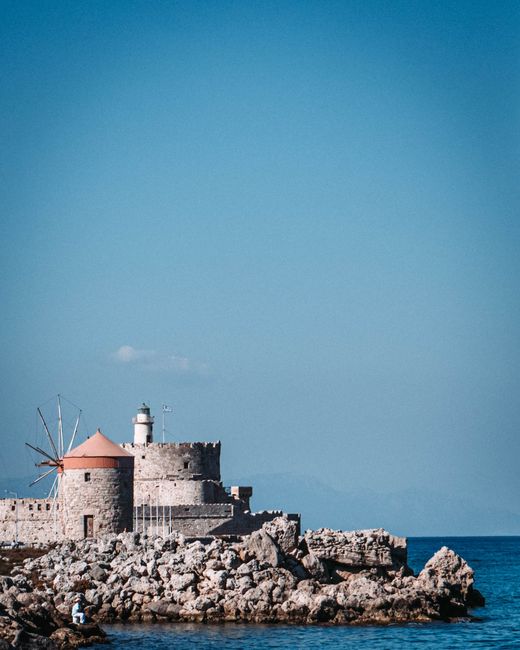
Rhodes is the largest of the Dodecanese islands, far out in the south-east Aegean close to the Turkish coast, and one of the sunniest places in Europe. Its capital holds the best-preserved medieval town in Europe, built by the Knights of St John behind four kilometres of walls; on the east coast, the white village of Lindos climbs to an ancient acropolis above a turquoise bay. Add long sandy beaches, pine-covered hills, wine villages and easy boat trips to Symi and the other islands, and you have one of Greece’s most complete holidays. The best months are May, June, September and October. Give it at least five days, ideally a week.
Right now in Rhodes (Rhodes town)
- Wed 21–25°C 69–77°F Partly cloudy
- Thu 19–23°C 67–74°F Clear
- Fri 21–24°C 69–76°F Clear
Weather: MET Norway (CC BY 4.0) · Sea temperature: NOAA CoastWatch · Rates: ECB
Top tours in Rhodes
See all tours for Rhodes →
From local operators, with prices and reviews; you check availability and book on Viator, our partner. We may earn a commission at no extra cost to you. How we earn money
Rhodes at a glance
- Best months: May–June and September–October. Average highs run from about 24 °C in May to 31 °C in August, and it almost never rains from June to September (WMO normals 1961–1990, Rhodes airport). The sea stays warm enough for swimming into early November.
- Days needed: 3 for Rhodes town and Lindos; 5–7 to add beaches, the west coast villages and a day trip to Symi.
- Getting there: fly into Rhodes Diagoras airport (RHO), with many direct flights from Europe in season and all year from Athens; or take the long ferry from Piraeus.
- Getting around: buses link Rhodes town with Lindos and the main resorts; a hire car is best for the south, the west coast and the hill villages.
- Budget level: mid-range, with good-value hotels and tavernas away from Lindos in high season. A per-room climate fee is added to every hotel bill. See our Greece guide for money, entry rules and daily costs.
- Summer rule to know: Greece’s fire season runs from 1 May to 31 October; on very-high-risk days forests can be closed, and lighting any fire outdoors is banned.
Rhodes’s areas and who each one suits
- Rhodes town: the walled Old Town, with its knights’ palaces, mosques, cobbled lanes and rooftop bars, plus the newer town around Mandraki harbour and Elli beach. Best for culture, food and nightlife, and for anyone without a car.
- The north-east coast (Faliraki, Kallithea, Afandou): a string of resorts and big hotels close to town, from lively Faliraki to quieter bays such as Anthony Quinn and Ladiko. Easy for families and short breaks.
- Lindos and the central east coast: the island’s postcard village under its acropolis, with Tsambika, Vlycha and St Paul’s Bay nearby. Romantic and beautiful, busy by day with coach tours.
- The south (Kiotari, Gennadi, Lachania, Prasonisi): long, quiet beaches, all-inclusive hotels and empty villages, ending at the windsurf spot of Prasonisi where two seas meet. For space and calm; a car helps.
- The west coast (Ialysos, Kamiros, Monolithos): breezier and greener, with ancient Kamiros, castles on crags, wine villages and sunsets over the sea. Good for road trips more than beach days.
Top things to see in Rhodes
Prices and hours below come from the Greek Ministry of Culture’s official site, as of October 2026. State sites now have a single price all year; EU citizens under 25 enter free with ID, and EU citizens over 65 get half price from 1 October to 31 May. Summer hours run from 1 April to 31 October, and winter hours from 1 November.
The Medieval City of Rhodes
The Old Town of Rhodes, a UNESCO World Heritage Site since 1988, was the stronghold of the Knights of St John, who ruled the island from the early 14th century until the Ottoman siege of 1522. Its walls run for about four kilometres, with moats, gates and towers still almost complete. Inside, walk the Street of the Knights, lined with the inns of the knights’ national “tongues”, and then lose yourself in the lanes of the old Turkish and Jewish quarters, with their mosques, hammams, fountains and arches. Sokratous Street is the busy shopping lane; the squares around Ippokratous and the quiet back streets are where locals eat. The Old Town is lived in, free to wander day and night, and at its best early in the morning or after the cruise passengers leave.
The Palace of the Grand Master
At the top of the Street of the Knights stands the fortress-palace of the order’s leader, built on a Byzantine citadel, damaged by an explosion in the 19th century and rebuilt by the Italians in the 1930s. Inside are grand halls with Roman and early Christian mosaic floors brought from Kos, and two good exhibitions on ancient and medieval Rhodes. How to visit: a ticket is €20. From 1 April to 31 October it is open every day 08:00–20:00; in winter it opens Wednesday to Monday, 08:30–15:30, and is closed on Tuesdays. Entry is free on a few set days a year, including 18 April and 18 May. Nearby, the Archaeological Museum fills the 15th-century Hospital of the Knights, with the famous marble Aphrodite of Rhodes (€10, summer daily 08:00–20:00).
Mandraki harbour and the Colossus
Mandraki, the old harbour just outside the walls, is where day boats leave for the east-coast beaches and Symi. Two columns topped by bronze deer mark its entrance, said to be where the Colossus of Rhodes stood. In truth, the giant bronze statue of the sun god Helios, one of the Seven Wonders of the Ancient World, did not straddle the harbour: it stood somewhere in the ancient city and fell in an earthquake around 226 BC, only some 50 years after it was finished. Above the town, on the hill of Monte Smith, the open-air Acropolis of Rhodes, with its stadium, small theatre and the columns of the Temple of Apollo, is free and always open, and a lovely place for sunset.
Lindos and its acropolis
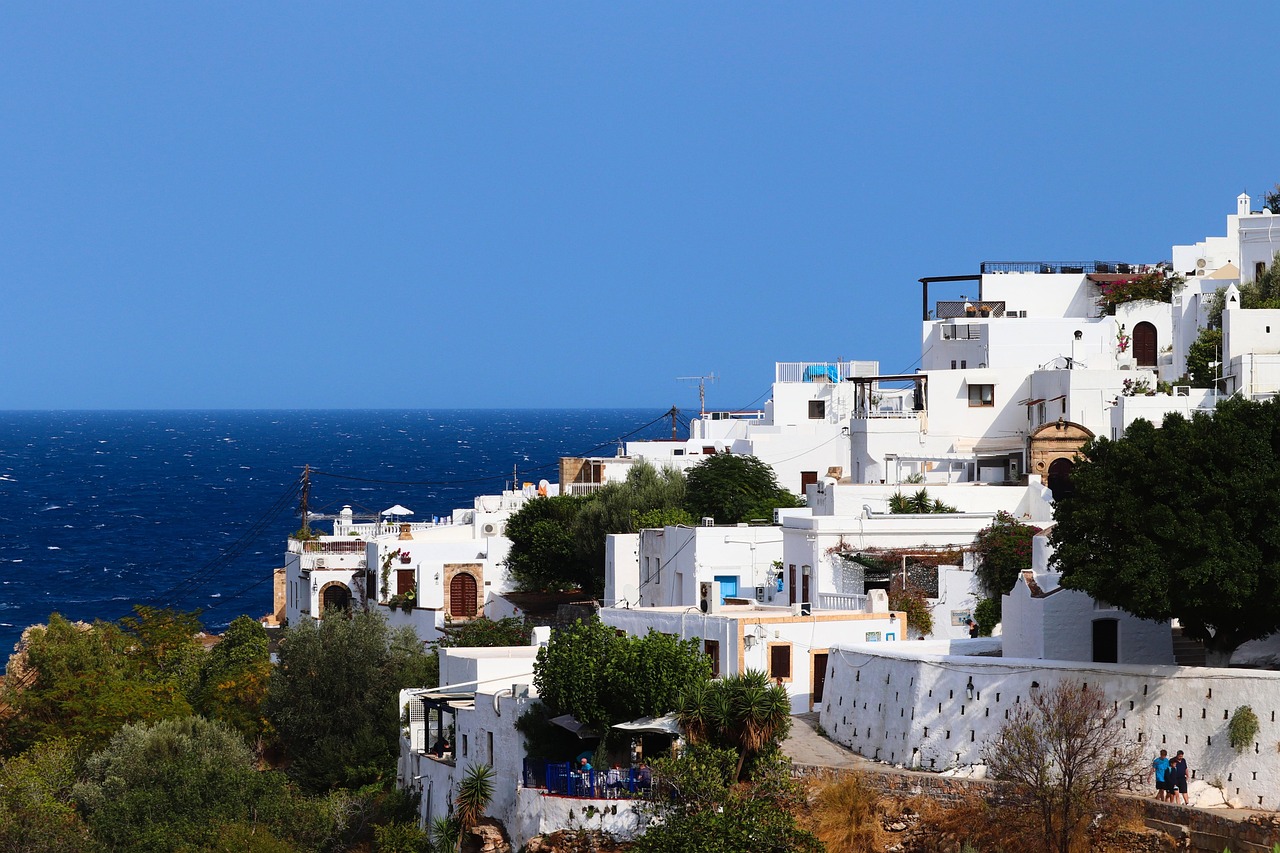
About 50 km south of Rhodes town, Lindos is a maze of whitewashed houses, pebble-mosaic courtyards and old captains’ mansions below a rock crowned by an ancient acropolis and a knights’ castle. At the top are the Temple of Athena Lindia, a long Hellenistic colonnade and a relief of a Greek warship carved into the rock, with views over the two bays. How to visit: a ticket is €20. The site is open 08:00–18:30 from 1 to 15 October 2026 and 08:00–18:00 from 16 to 31 October; in high summer, from April to August, it is open 08:00–20:00. In winter, from 1 November, it is open 08:30–15:10 and closed on Tuesdays. The climb from the village takes 15–20 minutes on steps and slippery stone; go at opening time or in the last two hours, with water and a hat. The site is not accessible for wheelchairs. Below the rock, tiny St Paul’s Bay, almost closed off by rocks, is one of the prettiest swimming spots on the island.
The Lindos donkeys: what to know
Donkey rides from the village square up towards the acropolis are a Lindos tradition, and a debated one: animal-welfare groups have long criticised the use of donkeys to carry tourists up steep, hot paths, as on Santorini. According to the local press in September 2026, the Lindos donkey owners now work under their own rules: a maximum rider weight of 65 kg, checked on a scale; rides only from 09:00 to 12:00, or until 13:00 if it is not above 35 °C; and about 10 of the 28 donkeys working each day in rotation. The village is small and the walk is short, so the easiest choice for the animals, and for you, is to go on foot. If you do ride, choose a cool morning and respect the weight limit.
Kamiros, Filerimos and the west coast
Ancient Kamiros, on a hillside above the west coast, is a whole Hellenistic town laid out on terraces, with streets, houses, a temple and a big cistern (€10; summer daily 08:00–20:00, winter 08:30–15:30, closed on Tuesdays). Closer to town, the hill of Filerimos, the acropolis of ancient Ialysos, has a monastery, the remains of a temple and a cypress-lined Way of the Cross to a huge cross with views over the island (€10). Further south, the ruined knights’ castles of Kritinia and Monolithos, perched on a 200-metre rock, are free to explore, and the wine villages of Embonas and Siana sit below Mount Attavyros, the island’s highest peak at 1,215 m.
Butterfly Valley and Kallithea Springs
Butterfly Valley (Petaloudes), in the hills of the west, is a shady ravine of oriental sweetgum trees, wooden bridges and small waterfalls. From late June to early September, thousands of Jersey tiger moths gather on the tree trunks to rest; they are fragile and easily disturbed, so walk quietly and do not clap or shake the branches to make them fly. The valley is run by a municipal company and open from about mid-April to the end of October; the ticket is around €6 in July to September and €3 in spring and autumn, when the moths are gone but the walk is still lovely. On the east coast, Kallithea Springs is a restored 1920s Italian spa of domes, mosaics and palm trees above a small rocky cove, good for photographs and a swim (about €5 in summer).
Archaeological sites
- Acropolis of Lindos
Nature reserves
- Ancient Kamiros
Other sights
- Valley of the Butterflies
Peaks and mountains
- Filerimos
Parks and gardens
- Acropolis of Rhodes
Monuments
- Medieval City of Rhodes
Museums
- Palace of the Grand Master of the Knights of Rhodes
Beaches in Rhodes
The east coast, sheltered from the summer north wind (the meltemi), has the calmest water and the most famous beaches; the west coast is wilder and windier, with pebbles and fewer people. For more ideas, see our beach guide.
| Beach | Area | Type | Good for |
|---|---|---|---|
| Anthony Quinn Bay | East, near Faliraki | Small rocky cove, emerald water | Snorkelling, photos; tiny and crowded in summer |
| Tsambika | East, north of Lindos | Long, shallow golden sand | Families, calm water |
| St Paul’s Bay and Lindos main beach | Lindos | Sandy, sheltered bays | Swimming under the acropolis |
| Faliraki | East | Long sandy beach | Water sports, bars, families |
| Elli | Rhodes town | Pebbles and sand, diving platform | A swim between sightseeing |
| Prasonisi | Southern tip | Sand spit between two seas | Windsurfing and kitesurfing |
| Kiotari, Gennadi and Glystra | South-east | Long sand and shingle | Space and quiet |
Anthony Quinn Bay, named after the actor who filmed The Guns of Navarone nearby, is a beautiful little cove of rocks and pines with very clear water, but it is small: in July and August its parking fills by about 09:30 and excursion boats arrive all day, so go early or late, or swim at Ladiko next door. Tsambika is one of the island’s best family beaches, with shallow water and sunbeds; above it, about 300 steps climb to the white Tsambika monastery, a 15–25 minute walk with a view along the whole coast. Wear water shoes on the rocky coves and swim inside the buoyed zones on busy beaches.
The 2023 wildfire and fire-season rules
What happened, and how the island looks now
On 18 July 2023, a wildfire broke out in the hills of central Rhodes and, pushed by strong winds during a heatwave, spread for days towards the south-east coast. According to the EU’s Copernicus emergency mapping service, it burned about 17,700 hectares, roughly an eighth of the island. Around 19,000 residents and holidaymakers were moved out of villages and hotels around Kiotari, Gennadi, Lardos, Pefki and Laerma, by road and by boat, in what the Greek authorities called the largest wildfire evacuation in the country’s history. Nobody was killed. The Greek government later offered free week-long stays in 2024 to guests who had been evacuated.
Rhodes town, Lindos, the north-east resorts, Butterfly Valley and the west coast were not burned. In the south-east, the beaches and hotels are open again, but on the hills behind them you will still see grey and blackened pine forest slowly turning green, and reforestation projects with local volunteers and tour companies are under way. Visiting is fine and welcome; a holiday in the south-east supports the villages that lost the most.
Fire-season rules (as of October 2026)
- Fire season: from 1 May to 31 October. Greece’s civil protection service publishes a daily fire-risk map for the next day, with five categories; category 4 is very high and category 5 is a state of alert.
- Closed forests: on category 4 and 5 days, the authorities can ban walking, driving and staying in forests, national parks and other high-risk areas, often for most of the day. Check the map before a hike or a drive into the hills.
- No fires outdoors: do not light barbecues, camp fires or anything else in the countryside, do not throw cigarette ends and do not use camping stoves among dry grass or pines.
- Penalties: fines run up to tens of thousands of euros, and starting a fire on a high-risk day can mean prison.
- If you see smoke or fire: call 112, and follow any evacuation message sent by 112 to your phone straight away.
Activities and best months
- Beaches and swimming253 km of coast: Anthony Quinn bay, Elli beach in Rhodes town, Lindos below the acropolis, Tsambika, Agathi and Glystra for families; Prasonisi at the southern tip is a meeting point for windsurfers. · source
- City sightseeingThe Medieval City of Rhodes (UNESCO 1988) is one of the best-preserved medieval towns: the Palace of the Grand Master, the Street of the Knights area, the Hospital of the Knights (Archaeological Museum) and churches and synagogues in the old Burgus. · source
- Scuba divingIxia and Kallithea have facilities for diving and water sports. · source
- Wine tastingThe island's modern wineries make award-winning PDO wines from Athiri, Mandilaria, white and Trani Muscat and Assyrtiko. · source
Other things to do in Rhodes
Boat trips, snorkelling and diving
From Mandraki harbour, day boats run down the east coast to Anthony Quinn Bay, Kallithea and Lindos, stopping for swims along the way; from Lindos and Faliraki, smaller boats and kayaks explore the coves. The water off the east coast is clear and calm, good for snorkelling around the rocks, and dive centres in Rhodes town and Kallithea run trips for beginners and certified divers. See our boat trips guide, snorkeling guide and diving guide.
Walking and cycling
Spring and autumn are lovely for walking: up Filerimos, from Lindos along the coast, through the Seven Springs (Epta Piges) valley with its narrow water tunnel, or up Mount Profitis Ilias with its Italian-era lodges and pine woods. The quiet roads of the south and the west are popular with road cyclists outside high summer. See our hiking guide and cycling guide, and check the fire-risk map in summer.
Food and wine
Rhodes’s food is classic Aegean: grilled fish and octopus, pitaroudia (chickpea fritters), matsi (homemade pasta), stuffed vegetables, local honey and thyme-scented cheeses. In the villages, tavernas serve slow-cooked goat and lamb. The island has its own wine appellation, with whites from the Athiri grape and reds from Mandilaria, made mostly around Embonas on the slopes of Attavyros, where several wineries offer tastings. See our wine tasting guide.
A day trip to Symi
Symi, a small island north-west of Rhodes, is one of the prettiest harbours in Greece: neoclassical captains’ houses in ochre, pink and cream climb the hills around the port of Gialos. Climb the Kali Strata, a stairway of about 500 steps, to the upper town of Chorio for the view; eat fresh Symi shrimp by the water; and swim at a pebble cove reached by water taxi. Many trips also stop at the Panormitis monastery in the south of the island, a major pilgrimage site whose feast falls on 8 November.
- By catamaran or ferry: Dodekanisos Seaways runs fast boats and a ferry from Rhodes town to Symi, taking from about 50 minutes to an hour and a half. Its day-trip return fares for Symi were €28 on offer and €48 at the normal price in 2026.
- By excursion boat: slower tourist boats leave Mandraki in the morning, stop at Panormitis and give you a few hours in Gialos, returning in the late afternoon.
- Stay a night: once the day boats leave, at around 18:00, Symi becomes calm and magical. A night or two is worth it if you have time.
Other easy trips from Rhodes include the islands of Chalki and Tilos, Kos and Patmos further north, and, with a passport, the Turkish resort of Marmaris, about an hour away by fast boat. Leaving for Turkey means leaving the Schengen area, so non-EU travellers go through full border checks on the way back.
Nearby destinations
Getting there and getting around
Flights
Rhodes Diagoras airport (RHO), run by Fraport Greece, is on the west coast about 14 km from Rhodes town. It has direct flights from much of Europe from spring to autumn, and from Athens all year (about an hour). Buses run from a stop between the terminals to Rhodes town in about 30–40 minutes; check the current timetable on the Municipality of Rhodes website. Taxis wait outside, and most hotels can arrange transfers.
By ferry
Blue Star Ferries sail from Piraeus, the port of Athens, to Rhodes, taking from about 11 hours on the fastest sailings to about 15 hours on routes calling at other islands; cabins are available. Ferries and catamarans also link Rhodes with the other Dodecanese islands, such as Kos, Symi and Patmos, and less often with Crete and the Cyclades. The big ferries use the Central and Akandia ports; Dodekanisos Seaways leaves from the Kolona harbour.
Buses, cars and taxis
- Buses: the island’s buses (KTEL for the east coast and RODA for the city and west) leave from two stations next to each other by the New Market in Rhodes town. Buses to Lindos run often in summer and take about an hour and a quarter. Timetables are posted on the Municipality of Rhodes website.
- Hire car: the best way to see the south, the west coast and the villages. Roads are good, but traffic and parking around Lindos and Faliraki are hard in summer. Park outside the Old Town walls; driving inside is restricted to residents.
- Taxis: plentiful in town and at the airport; agree on the fare or check that the meter is on.
- Walking: the Old Town is pedestrian, and the walk round the walls and the moat makes a fine evening stroll. See our city sightseeing guide.
When to go and how long to stay
Rhodes has a long, hot, dry summer and a mild, rainy winter. From June to September it barely rains at all, and the meltemi wind keeps the west coast breezy and the east coast calm. July and August are hot and busy, especially at Lindos. May and June have warm days, wildflowers and a sea that is warming up; September and October have the warmest sea of the year and fewer crowds. Winter is quiet, with many resort hotels closed, but Rhodes town stays alive all year.
| Season | Average high / low | Rainy days a month | What it’s like |
|---|---|---|---|
| Spring (Mar–May) | 17–24 °C / 10–16 °C | 2–7 | Green and flowery; great for walking and sights; the sea is cool until late May. |
| Summer (Jun–Aug) | 28–31 °C / 20–23 °C | 0–1 | Hot, dry and sunny; peak beach season; Lindos is busiest by day. |
| Autumn (Sep–Nov) | 20–28 °C / 13–21 °C | 1–6 | Warm sea and easier crowds in September and October; rain returns in November. |
| Winter (Dec–Feb) | 15–17 °C / 9–10 °C | 9–12 | Mild and green; quiet; many beach hotels closed. |
Figures are the WMO 1961–1990 climate normals for the Rhodes airport station (rainy day = at least 1 mm of rain), the latest official normals published for the island; recent summers have run slightly warmer. The island gets about 690 mm of rain a year, almost all of it between October and March, and well over 3,000 hours of sunshine.
3 days in Rhodes
Stay in or near Rhodes town. One day for the Old Town, the Palace of the Grand Master and the walls, with sunset on Monte Smith; one day for Lindos, its acropolis and a swim in St Paul’s Bay; and one day on the east-coast beaches or a boat trip from Mandraki.
5–7 days in Rhodes
Split your stay between Rhodes town (three nights) and Lindos or the south-east coast (three or four nights). Add a day trip to Symi, a drive down the west coast to Kamiros, Monolithos and the Embonas wineries, and a lazy day at Tsambika or Prasonisi. With more time, hop on to Kos and Patmos, or fly on to Santorini, Mykonos or Athens.
Where to stay in Rhodes
- Culture and evenings out: a boutique hotel inside the Old Town walls, or the new town near Mandraki and Elli beach.
- Romance: a restored captain’s house in Lindos, or a hotel on the bay at Pefki or Vlycha nearby.
- Families: the resorts of Faliraki, Kolymbia and Afandou, close to sandy beaches and to town.
- Peace and space: the south-east coast around Kiotari, Gennadi and Lachania, with a car.
- Without a car: Rhodes town, with buses and boats to everywhere else.
Greece adds a climate resilience fee per room per night, set by type of accommodation. As of October 2026, from April to October it is €2 for 1–2 star hotels and rented rooms, €5 for 3 stars, €10 for 4 stars, €15 for 5 stars and €8 for short-term holiday rentals (€15 for houses over 80 m²); it is much lower from November to March.
Practical tips for Rhodes
- Beat the heat at Lindos: climb to the acropolis at opening time or late in the day; coach tours arrive mid-morning.
- Cruise days: on days with several ships in port, the Old Town is crowded from late morning to late afternoon; visit the main sights early.
- Old Town paving: the cobbles are uneven and slippery; wear shoes with grip.
- Wind: on meltemi days, choose east-coast beaches; the west coast can be rough.
- Fire risk: in summer, check the daily fire-risk map before hiking, and never light a fire outdoors.
- Day trip to Turkey: bring your passport, and check visa rules for your nationality.
- Emergencies: call 112.
Weather month by month
Averages from HNMS normals 1991–2020, Rhodes (rain: 1955–2010 averages) · Last reviewed 4 Oct 2026
What to pack for Rhodes
Pack light, breathable clothes, a sun hat, sunglasses, high-factor reef-safe sunscreen and a refillable water bottle for the exposed climb to the Lindos acropolis and the hot Old Town lanes. Bring comfortable shoes with good grip for cobbles and polished stone, water shoes for the rocky coves at Anthony Quinn Bay and St Paul’s Bay, and a snorkel mask for the clear east-coast water. A light scarf or shirt covers shoulders in monasteries and churches, and a windproof layer helps on breezy evenings and boat trips. From November to March, add a light rain jacket.
What to pack
- City walking shoesLisbon and Porto are steep, with polished limestone cobbles that get slippery, so grippy soles matter.
- Day packs and anti-theft bagsCarries water, towel and sunscreen down the long stairways to Algarve coves.
- Dry bags and phone pouchesProtects phones and cameras from sand and spray on beaches reached by ferry or steep paths.
- Fleeces and warm layersA warm layer or windproof after a dive stops you chilling on the boat ride back.
- Quick-dry beach towelsA sand-shedding quick-dry towel packs small for beach days and lido visits.
- Rain jacketsFrom October to April Porto and Lisbon see rain on roughly a third of days.
- Reef-friendly sunscreenSummer UV is strong on Portuguese beaches and there is little shade below the cliffs.
- Travel adapters and convertersPortugal uses Type C and F sockets at 230 V, so most visitors from outside Europe need an adapter.
- Water shoesRocky coves, lava pools and weever fish in shallow sand make water shoes useful.
- WetsuitsOn the west and north coasts the sea stays around 16–18 °C even in summer, so a thin suit helps for long swims.
- Wine bottle travel protectorsPort and Douro wines bought at the quintas travel home safely in checked luggage with padded bottle protectors.
Rhodes travel FAQ
How many days do you need in Rhodes?
Three days covers the Old Town, Lindos and a beach day. Five to seven days lets you add Symi, the west coast and the quieter beaches of the south.
How much is the ticket for the Palace of the Grand Master?
€20 as of October 2026. It is open daily 08:00–20:00 from April to October, and Wednesday to Monday 08:30–15:30 in winter. EU citizens under 25 enter free with ID.
How much does the Lindos acropolis cost?
€20 as of October 2026. In the second half of October it is open 08:00–18:00, and in winter 08:30–15:10, closed on Tuesdays. Go early or late to avoid the heat and the tour groups.
Should I ride a donkey up to the Lindos acropolis?
The walk takes only 15–20 minutes, so walking is the kinder choice. The local donkey owners limit riders to 65 kg and work only in the cooler morning hours, according to local press reports in 2026.
Is Rhodes safe to visit after the 2023 wildfire?
Yes. The fire burned part of the south-east in July 2023; the hotels and beaches there have reopened, and the rest of the island was not affected. In summer, follow the fire-season rules and any 112 alerts.
What are the fire rules in Greece in summer?
From 1 May to 31 October, lighting fires and barbecues in the countryside is banned, and on very-high-risk days the authorities can close forests and national parks. Check the daily fire-risk map and call 112 if you see a fire.
How do I get from Rhodes to Symi?
By Dodekanisos Seaways catamaran or ferry from Rhodes town, in about 50 minutes to an hour and a half, or by excursion boat from Mandraki, which usually stops at Panormitis monastery too.
What are the best beaches in Rhodes?
Anthony Quinn Bay and Ladiko for clear water, Tsambika for families, St Paul’s Bay in Lindos, Faliraki for water sports and Prasonisi for windsurfing. The east coast is calmer than the west.
Do I need a car in Rhodes?
Not for Rhodes town, Lindos and the east-coast resorts, which buses serve well. A car makes it much easier to reach the south, the west coast, Kamiros and the villages.
When is the best time to visit Rhodes?
May, June, September and October: warm, sunny and less crowded than July and August. September and October have the warmest sea.
Where did the Colossus of Rhodes stand?
Nobody knows exactly. The bronze statue of Helios stood somewhere in the ancient city and fell in an earthquake around 226 BC. The idea that it straddled Mandraki harbour is a medieval legend.
Can I visit Turkey from Rhodes?
Yes. Boats go to Marmaris in about an hour. You need a passport, and should check whether your nationality needs a visa for Türkiye; non-EU travellers go through Schengen border checks on return.
Sources
- © OpenStreetMap contributors · ODbL · fetched 4 Oct 2026
- Wikidata · CC0 · fetched 4 Oct 2026
Sources and last review
Researched and last reviewed on 4 October 2026. Prices and hours for the Palace of the Grand Master, the Lindos acropolis, the Archaeological Museum, Kamiros and Filerimos come from the Greek Ministry of Culture’s official site; burned-area figures for the 2023 fire from the EU’s Copernicus emergency mapping service; fire-season rules from Greece’s civil protection service; Symi fares from Dodekanisos Seaways; airport details from Rhodes airport; and climate figures from the WMO 1961–1990 normals for Rhodes. Ferry and bus times are typical and change by season, so check the operators and the official sites before you travel.
Plan your trip
Partner links: TravelerCenter may earn a commission if you book, at no extra cost to you.
🇬🇷 Useful Greek phrases for Rhodes
All 38 Greek phrases: restaurant, hotel, emergencies, romance (printable) →