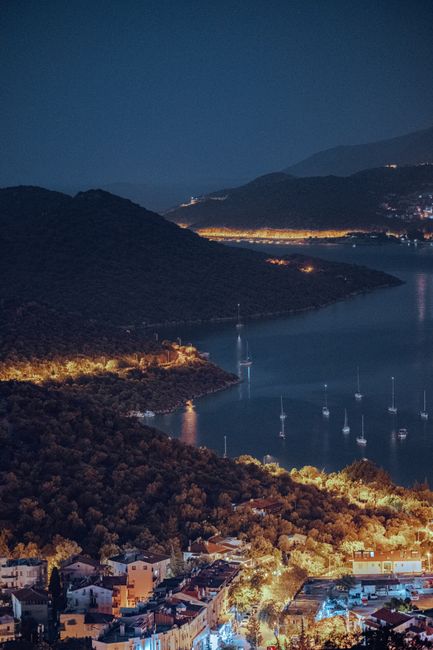
Kaş is a small, laid-back harbour town on the Lycian coast of south-west Türkiye, halfway between Fethiye and Antalya, where the Taurus mountains drop straight into one of the clearest seas in the Mediterranean. It has no big resort hotels and no long sandy beach; instead, it has whitewashed lanes draped with bougainvillea, an ancient Greek theatre facing the sunset, Lycian tombs carved into the cliffs, and some of the best diving and snorkelling in the country. From the harbour, boats run to the sunken city of Kekova, the cove of Kaputaş and, in under half an hour, the Greek island of Kastellorizo, which you can see from the seafront. The best months are May, June, September and October. Give it at least four days, ideally a week.
Right now in Kaş
- Wed 19–25°C 67–76°F Mostly clear
- Thu 19–24°C 66–75°F Mostly clear
- Fri 20–24°C 69–76°F Clear
Weather: MET Norway (CC BY 4.0) · Sea temperature: NOAA CoastWatch · Rates: ECB
Top tours in Kaş
See all tours for Kaş →
From local operators, with prices and reviews; you check availability and book on Viator, our partner. We may earn a commission at no extra cost to you. How we earn money
Kaş at a glance
- Best months: May–June and September–October, for warm sea, clear water and walking weather. July and August are hot (highs around 33 °C) but Kaş is breezier than the big resorts. Average highs run from about 25 °C in May to 33 °C in August (WMO 1991–2020 normals, Kaş station), and the sea reaches about 27–28 °C in August and September.
- Days needed: 3 for the town, a Kekova boat trip and a dive or snorkel; 5–7 to add Kastellorizo, Kaputaş, Patara and the ancient sites of Myra and Xanthos.
- Getting there: fly into Dalaman (DLM), about 110 km and 1 hour 45 minutes away, or Antalya (AYT), about 190 km and 3 to 3½ hours away. Buses run from both cities’ bus stations.
- Getting around: the town is walkable; minibuses (dolmuş) go along the coast, and boats do the rest. A hire car helps for Patara, Saklıkent and the mountain villages.
- Budget level: mid-range; cheaper than Bodrum, pricier than inland towns. Many hotels, dive centres and boat tours quote in euros. See our Türkiye guide for money, visas and costs.
Kaş’s areas and who each one suits
- The old town and harbour: the lanes around the main square, Uzun Çarşı (the long market street) and the harbour, full of small hotels, cafés, bars and boat stands. For first-timers and anyone without a car; lively but never rowdy.
- Çukurbağ peninsula: the long finger of land west of town, lined with villa hotels and private sea platforms, with views of Kastellorizo. Quiet and scenic; you will walk or take a taxi into town.
- Kalkan: a separate, more upmarket town 27 km west, with villas with private pools, rooftop restaurants and a strong British following. For couples and families who want more comfort.
- Üçağız and Kaleköy (Kekova): fishing villages 40 minutes east, with a few guesthouses. For those who want to wake up by the sunken city and kayak before the tour boats arrive.
Top things to see in Kaş
Türkiye’s state museums and ancient sites charge foreign visitors in euros, payable by card (and usually in Turkish lira at the day’s rate); Turkish citizens pay in lira and can use the MüzeKart. Prices below are the 2026 rates as of October 2026. The Ministry of Culture and Tourism has already announced higher prices for 2027, so check the official museum site (muze.gov.tr) before you go.
Antiphellos theatre and the Lycian tombs
Kaş stands on the site of Antiphellos, the harbour of the Lycian city of Phellos. A short walk west of the centre, its small Hellenistic theatre sits on a slope above the sea, facing Kastellorizo; it is free, always open and the town’s favourite place to watch the sunset. In the old town, at the top of Uzun Çarşı, the King’s Tomb (Kral Mezarı) is a 4th-century BC Lycian sarcophagus on a tall base, with lion heads on its lid, standing in the middle of the street. More tombs, carved like wooden houses, are cut into the cliffs behind town.
Kekova and the sunken city
The bay of Kekova, about 40 minutes east of Kaş by road, is the highlight of any stay. Along the north shore of Kekova island, the remains of the ancient town of Dolichiste, dropped into the sea by earthquakes in the 2nd century AD, lie in a few metres of glassy water: stairs, walls, house foundations and a harbour, seen from the deck of a boat or a kayak. Opposite, the village of Kaleköy (ancient Simena), reachable only by sea, climbs to a small castle with a tiny theatre cut into the rock and Lycian sarcophagi half-sunk in the water below. The castle ticket is about €4. The whole area is part of the Kaş-Kekova Special Environmental Protection Area and an archaeological zone.
- Boat tours: day boats leave Kaş harbour in the morning and stop at the sunken city, Kaleköy and two or three swimming bays (Tersane and Akvaryum are the classics), returning late afternoon. Shorter, cheaper tours start from Üçağız. In 2026, shared tours cost roughly 1,500–2,500 TL a person with lunch.
- Sea kayaking: guided half-day kayak tours from Üçağız paddle over the ruins in the calm morning water; about 2,600–3,000 TL with lunch, more with transfers from Kaş. It is the best way to see the sunken city closely.
- The rules: swimming, snorkelling and diving are forbidden over the sunken city and in the archaeological zone around it; boats keep moving along the ruins. Do not take anything from the seabed or the shore. Swim only where the boat stops, in the open bays.
Myra and the Church of St Nicholas
In Demre, an hour east of Kaş, the ancient city of Myra has the most striking cliff of Lycian house tombs anywhere, rising above a large Roman theatre with carved theatrical masks (about €13; daily 08:00–19:00). In the town centre, the Church of St Nicholas marks the place where the 4th-century bishop Nicholas, the saint behind Santa Claus, served and was buried; the Byzantine church, with its frescoes and floor mosaics, is now a museum (about €17). Combine both with Kekova on a day trip, or stop on the way to Antalya.
Patara, Xanthos and Letoon
Forty-five minutes west, Patara combines about 18 km of sand and dunes with the ruins of the Lycian League’s capital (about €15 for site and beach; daily 08:00–19:00). Loggerhead turtles nest on the beach, so stay away from marked nests and leave by dusk. Inland, Xanthos and Letoon are a joint UNESCO World Heritage Site (Xanthos about €3).
Archaeological sites
- Antiphellos Theatre
- Aperlae
- Patara
- Xanthos
Beaches
- Kaputaş Beach
- Patara Beach
Nature
- Kekova (Sunken City)
Beaches and swimming in Kaş
Kaş is a place of rocks, not sand: most swimming is from wooden platforms and ladders built over the sea by hotels and beach clubs, where the water is deep and clear right away. For a sandy day, head to Kaputaş or Patara. For more ideas, see our beach guide.
| Beach | Area | Type | Good for |
|---|---|---|---|
| Kaputaş | 20 km west, on the Kalkan road | Small sand-and-pebble cove under cliffs | The famous turquoise colour; photos; a morning swim |
| Büyükçakıl | South of the centre | Pebbles and platforms | A swim within walking distance of town |
| Küçükçakıl platforms | East of the harbour | Hotel and club platforms | Deep, clear water and snorkelling |
| Limanağzı | Across the bay, by water taxi | Small pebble coves with cafés | A lazy day without cars |
| Patara | 45 minutes west | 18 km of sand and dunes | Space, sunsets, families; turtle rules apply |
Kaputaş sits at the mouth of a gorge directly below the coastal road between Kaş and Kalkan. About 180 steps lead down from the road; there is no car park, just a few lay-bys that fill by mid-morning in summer, so come early, by dolmuş, or by boat. Expect showers, a kiosk and paid sunbeds. The sea gets deep quickly and can have waves when the wind blows from the west. Antalya province, which includes Kaş, had 232 Blue Flag beaches in 2026, the most of any Turkish province; the official list is on the TÜRÇEV Blue Flag site.
Diving and snorkelling in Kaş
Kaş is Türkiye’s best-known dive town. The sea floor drops away steeply close to shore, visibility is often 20–30 m in summer, and the water runs from about 17–18 °C in early spring to 27–28 °C in August and September. See our diving guide and snorkeling guide.
The main dive sites
- The Dakota (C-47) plane wreck: a twin-engine transport aircraft sunk in 2009 as an artificial reef, sitting at about 14–22 m. Suitable for beginners and the most photographed dive in Kaş.
- The Canyon: a crack in the rock that starts at 3–5 m and opens onto a wall falling past 50 m, with the scattered remains of a 1968 cargo ship between about 25 and 40 m. For certified divers.
- Pigeon Island (Güvercin Adası): a tank sunk on purpose at about 16–18 m, rocky reefs and a chance of eagle rays.
- Amphora sites and reefs: several sites have ancient amphora fragments on the bottom. They are protected cultural heritage: look, photograph, never touch or take.
Choosing a licensed dive centre
In Türkiye, a dive centre that takes tourists diving needs an authorisation from the Turkish Underwater Sports Federation (TSSF), Türkiye’s CMAS member, and its instructors must hold TSSF-recognised instructor certificates; its boats also need a marine tourism licence from the Ministry of Culture and Tourism. Most Kaş centres also teach PADI or SSI courses. Ask to see the TSSF dive centre certificate, check that equipment is in good order and that a guide goes in the water with every group.
As an example of 2026 prices, one long-established Kaş centre charges €50 for a one-to-one try dive, €40 for a single fun dive (€80 for two), €350 for ten dives and €375 for an open-water course; non-divers can join the boat for about €25. Snorkellers can join most dive boats or swim from the town platforms.
Wildfire season rules (as of October 2026)
The hills around Kaş are covered in dry pine and scrub, and south-west Türkiye has serious forest fires most summers; in late July 2026 a large fire in Muğla province forced evacuations, and in 2021 the Manavgat fire east of Antalya burned about 160,000 hectares. Kaş itself has not been badly hit in recent years, but the rules apply to everyone.
- Forest entry ban: under the Antalya Governorate’s 2026 fire circular, entering forests in Antalya province is banned from 1 May to 31 October 2026, except at listed forest parks and day-use areas. Lycian Way sections through forest may be closed; ask locally before a hike.
- No fires: no barbecues, campfires or stoves in the countryside; in the listed picnic areas, any fire is banned from 21:00 to 08:30 until 31 October. Do not throw cigarette ends from cars or boats.
- No fireworks or sky lanterns within about 4 km of forests.
- Penalties: breaking the ban brings administrative fines, and starting a fire can lead to prosecution and prison.
- If you see smoke or fire: call 112 straight away and follow the instructions of the gendarmerie and fire crews.
Activities and best months
- Beaches and swimmingMayJunJulAugSepKaputaş, a pocket beach at the mouth of a canyon 20 km from Kaş (about 200 steps down from the road), and Patara, 14 km long, where loggerhead turtles nest: from 15 May to 15 September the beach is open to visitors 08:00-20:00 only. · source
- Boat tripsThe most popular thing to do in Kaş is to take a boat from the small harbour to the calm turquoise bays; boat tours also go over the sunken city at Kekova, where swimming is forbidden. · source
- HikingThe Lycian Way passes Kaş, Kalkan and Patara on its way from Fethiye to Antalya, past the ancient cities of Patara, Xanthos and Myra. · source
- Scuba divingKaş is known for diving thanks to mild currents, clear water and protected marine areas, with sites for beginners and professionals; the Dimitri wreck, Besmi Island, Büyük Mağara cave and Uçanbalık are among the best-known spots. Dive schools offer lessons and rental. · source
- SnorkelingHidayet Cove, near the Antiphellos theatre, has clear deep water and a rocky shore that is excellent for snorkelling. · source
Other things to do in Kaş
Walking the Lycian Way
The Lycian Way, the waymarked trail from Ölüdeniz near Fethiye to Antalya, passes through Kaş; good day walks follow it west towards Limanağzı or east towards Üçağız. Walk in spring or autumn; summer is too hot, and forests may be closed. See our hiking guide.
Boat trips, sea kayaking and paragliding
Besides Kekova, day boats from the harbour stop at coves and islands around Kaş, and private gulets can be chartered. Sea kayaks and paddleboards are for rent, and tandem paragliders fly from the mountain above town. See our boat trips guide.
Food and evenings
Eat meze, grilled fish and octopus by the harbour, and gözleme (filled flatbread) in the mountain villages. Evenings are for the old town lanes and small music bars; there is no big club scene.
A day trip to Kastellorizo (Meis)
Kastellorizo, called Meis in Turkish, is the most easterly Greek island, just 2 km off the Turkish coast. Its harbour is a horseshoe of colourful neoclassical houses, tavernas and fishing boats under a red-rock hill with a Knights’ castle. Climb to the castle, swim from the rocks and eat grilled fish by the water.
- Ferries: Meis Express and Meis Ferry Lines run from Kaş harbour, daily from May to September and on fewer days in winter; the crossing takes about 20 minutes. Meis Express listed €25 one way and €35 for a return on another day in 2026 (children €15/€25); some routes add port taxes. Book a day ahead in summer.
- Documents: you leave Türkiye and enter Greece and the Schengen area. Bring a valid passport (EU citizens can use a national ID card) and a Schengen visa if your nationality needs one. Turkish citizens can use Greece’s express visa for the eastern Aegean islands, extended to April 2027.
- Border checks: since 10 April 2026 the EU’s Entry/Exit System (EES) is fully in use: non-EU visitors give fingerprints and a facial image on their first entry, instead of a passport stamp. Allow extra time at the small border post in Kastellorizo. ETIAS, the EU travel authorisation, is not yet required.
Further west, Fethiye and Ölüdeniz are two hours away; Greek Rhodes is reached by ferry from Marmaris or Fethiye.
Nearby destinations
Getting there and getting around
Flights and airport transfers
Dalaman (DLM) is the closest airport, about 110 km and 1 hour 45 minutes west, with many direct flights from Europe in summer and from Istanbul all year. There is no direct public bus to Kaş: take the Havaş shuttle to Fethiye bus station (300 TL, about an hour, timed to domestic arrivals) and then a coach to Kaş (about 2 hours), or book a private transfer. Antalya (AYT) is about 190 km and 3 to 3½ hours east by road; take the Havaş bus or the tram into Antalya and a coach from the main bus station (otogar), about 4 hours on to Kaş. Most hotels arrange transfers from either airport.
Buses, dolmuş and cars
- Long-distance buses: coaches leave Kaş bus station for Antalya (about 4 hours, via Demre and Finike) roughly every hour in season, and for Fethiye (about 2 hours, via Kalkan and Patara). Fares are low; buy at the station or online.
- Dolmuş: local minibuses run to Kalkan, Kaputaş, Patara and Üçağız. Pay the driver in cash, in lira.
- Hire car: useful for Patara, Saklıkent, Myra and the mountain villages. The coastal D400 road is spectacular but full of bends; take it slowly. Parking in the old town is hard in summer.
- Water taxis: small boats from the harbour cross to Limanağzı and the Çukurbağ coves. See our city sightseeing guide for walking the town.
When to go and how long to stay
Kaş has a long, hot, dry summer and a mild, wet winter. From June to September it barely rains, and an afternoon sea breeze takes the edge off the heat. May and June are green, warm and ideal for walking and diving; September and October have the warmest sea and fewer people. Winter is quiet, with some hotels closed, but the town lives all year and the light is beautiful.
| Season | Average high / low | Sea temperature | What it’s like |
|---|---|---|---|
| Spring (Mar–May) | 18–25 °C / 11–18 °C | 17–21 °C | Green and flowery; great for walking and diving; the sea is fresh until late May. |
| Summer (Jun–Aug) | 30–33 °C / 22–26 °C | 24–28 °C | Hot, dry and sunny; peak season for boats and Kastellorizo trips. |
| Autumn (Sep–Nov) | 22–30 °C / 15–23 °C | 21–27 °C | The warmest sea and calmer town in September and October; rain returns in November. |
| Winter (Dec–Feb) | 16–18 °C / 9–11 °C | 16–18 °C | Mild, with heavy rain on some days; quiet, with some hotels closed. |
Air temperatures are the WMO 1991–2020 climate normals for the Kaş station, supplied by Türkiye’s State Meteorological Service (MGM); Kaş gets about 830 mm of rain a year on about 60 rainy days, almost all between November and March. Sea temperatures are MGM’s long-term (1970–2025) monthly averages for the Turkish Mediterranean; recent years have run about a degree warmer.
3 days in Kaş
Day one: the old town, the King’s Tomb, a swim from the platforms and sunset at the Antiphellos theatre. Day two: a Kekova boat tour with the sunken city and Kaleköy castle. Day three: a morning dive or snorkel trip, then an afternoon at Kaputaş.
5–7 days in Kaş
Add a day trip to Kastellorizo, a day for Myra and the Church of St Nicholas in Demre (with a sea kayak at Kekova on the way), and a day at Patara and Xanthos. Fill the rest with a stretch of the Lycian Way, a second dive day or a lazy day at Limanağzı. With more time, continue to Fethiye and Ölüdeniz or east to Antalya.
Where to stay in Kaş
- Without a car: a small hotel or guesthouse in the old town or near the harbour.
- Romance and views: a boutique hotel on the Çukurbağ peninsula with its own sea platform.
- Families and groups: a villa with a pool in Kalkan or on the hills around Kaş.
Türkiye charges an accommodation tax (cut from 2% to 1% from 1 May to 31 December 2026) on room prices, usually included in the rate you see.
Practical tips for Kaş
- Money: the currency is the Turkish lira (about 55 TL to the euro and 49 TL to the US dollar in early October 2026). Pay by card in lira and refuse the offer to charge you in your home currency; keep some cash for dolmuş, markets and small cafés.
- Kaputaş early: arrive before 10:00 in summer for a parking space and a calm swim.
- Sea urchins: the rocks have urchins; wear water shoes on the ladders and in the coves.
- Kekova rules: no swimming over the sunken city, and never take pottery or stones from the sea or shore; it is a criminal offence.
- Greek day trip: carry your passport, and check that your Turkish visa allows re-entry.
- Fire risk: no barbecues or campfires outdoors in summer; respect forest closures.
- Emergencies: call 112 for ambulance, police and fire.
Weather month by month
Averages from MGM normals 1991–2020, Kaş · Last reviewed 4 Oct 2026
What to pack for Kaş
Pack light clothes, a sun hat, sunglasses, high-factor reef-safe sunscreen and a refillable bottle. Water shoes are essential for the rocky platforms and urchins, and your own snorkel mask is worth bringing for the clear water. Divers should bring their certification card and logbook. Bring trainers or light walking shoes with grip for the Lycian Way and the ancient sites, a light layer for evening boat rides, a scarf to cover shoulders in the St Nicholas church and mosques, and a light rain jacket from November to March.
What to pack
- Day packs and anti-theft bagsCarries water, towel and sunscreen down the long stairways to Algarve coves.
- Dry bags and phone pouchesProtects phones and cameras from sand and spray on beaches reached by ferry or steep paths.
- Fleeces and warm layersIt is cooler at sea than on land, especially on morning whale-watching trips.
- HeadlampsLevada routes such as PR1 and PR9 pass through long, dark, wet tunnels.
- Hiking shoes and bootsMadeira's levadas and the Azores' crater rims are wet, rocky and slippery, so grippy shoes matter more than anywhere else in Portugal.
- Quick-dry beach towelsA sand-shedding quick-dry towel packs small for beach days and lido visits.
- Rain jacketsA windproof, waterproof shell keeps you warm on open boats, where wind and spray cool you quickly.
- Reef-friendly sunscreenSummer UV is strong on Portuguese beaches and there is little shade below the cliffs.
- Snorkel masks and finsYour own mask fits better than a rental and makes clear-water coves and lava pools more fun.
- Trekking polesLong stone staircases and steep descents on Madeira's peaks and the Azores' crater rims are easier on the knees with poles.
- Water bottles and hydration packsAlgarve and Alentejo trails are hot and exposed with few refill points.
- Water shoesRocky coves, lava pools and weever fish in shallow sand make water shoes useful.
- WetsuitsOn the west and north coasts the sea stays around 16–18 °C even in summer, so a thin suit helps for long swims.
Kaş travel FAQ
How many days do you need in Kaş?
Three days covers the town, a Kekova boat trip and a dive or snorkel. Five to seven days lets you add Kastellorizo, Kaputaş, Patara and Myra.
Can you swim over the sunken city at Kekova?
No. Swimming, snorkelling and diving are forbidden over the ruins and in the archaeological zone. You see them from a boat or a kayak, and swim in the open bays where the boats stop.
How much does a dive cost in Kaş?
In 2026, about €40 for a single fun dive, €80 for two, and €50 for a try dive with an instructor, at one established centre; others are similar. An open-water course is about €375.
How do I get from Kaş to Kastellorizo?
Take Meis Express or Meis Ferry Lines from Kaş harbour; the crossing is about 20 minutes and cost €25 one way in 2026. Bring your passport and, if your nationality needs one, a Schengen visa.
How do I get to Kaputaş beach?
It is 20 km west of Kaş on the Kalkan road. Take the Kalkan dolmuş and ask to stop, or drive and park in a lay-by, then walk down about 180 steps.
How much is the ticket for Myra and the St Nicholas church?
In 2026, about €13 for Myra and €17 for the Church of St Nicholas in Demre, for foreign visitors. Prices rise for 2027; check muze.gov.tr.
How warm is the sea in Kaş?
Warm from June to October. Long-term averages for the Turkish Mediterranean, from Türkiye’s State Meteorological Service, are about 21 °C in May, 27–28 °C in August and September and still about 25 °C in October; the coolest month is February, at about 16 °C.
Should I pay in lira or euros in Kaş?
Prices in shops, restaurants and on buses are in Turkish lira, and a card in lira is usually the best deal. Museum tickets for foreign visitors, many hotels, dive centres and boat tours quote in euros; you can usually pay those by card too.
When is the best time to visit Kaş?
May, June, September and October: warm sea, clear water for diving and comfortable walking weather. July and August are hot and busier but still pleasant by the water.
Sources
- © OpenStreetMap contributors · ODbL · fetched 4 Oct 2026
- Wikidata · CC0 · fetched 4 Oct 2026
Sources and last review
Researched and last reviewed on 4 October 2026. Opening hours for Myra and Patara come from Türkiye’s official museum site (muze.gov.tr); ticket prices from the Ministry of Culture and Tourism’s 2026 price list as reported by local sources; dive centre licensing from the Turkish Underwater Sports Federation (TSSF) and the Ministry of Culture and Tourism; dive prices from the operator; ferry fares from Meis Express and Meis Ferry Lines; EU border rules from the European Commission; airport distances from Dalaman airport; forest-fire rules from the Antalya Governorate’s 2026 circular; climate from the WMO 1991–2020 normals (MGM data) and sea temperatures from MGM; exchange rates from the Central Bank of the Republic of Türkiye. Boat, bus and ferry times are typical and change by season, so check the operators and the official sites before you travel.
Plan your trip
Partner links: TravelerCenter may earn a commission if you book, at no extra cost to you.
🇹🇷 Useful Turkish phrases for Kaş
All 38 Turkish phrases: restaurant, hotel, emergencies, romance (printable) →