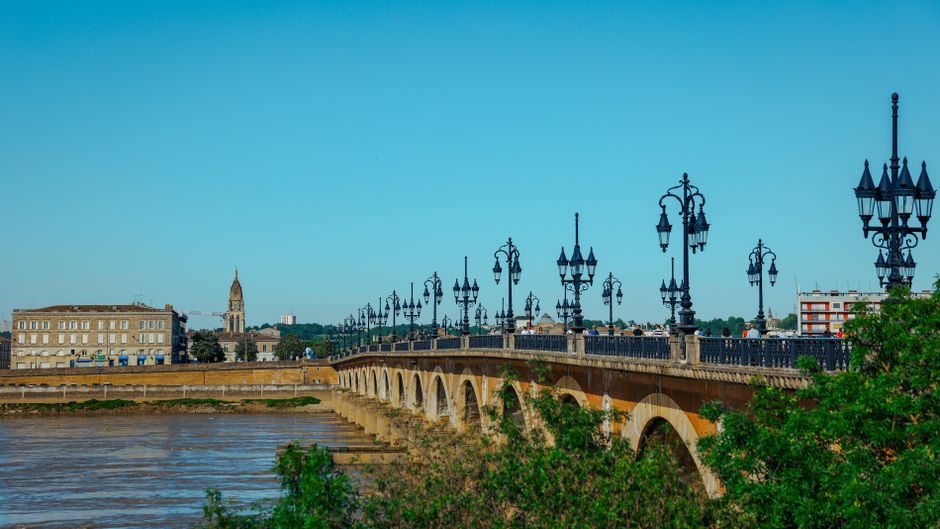
Bordeaux is the elegant river city of south-west France, built in pale limestone along a great curve of the Garonne and surrounded by the most famous vineyards on earth. You come to wander a UNESCO-listed old town of 18th-century squares, splash in the Miroir d’eau, eat and drink very well, and then head out to the châteaux of Saint-Émilion and the Médoc. The Atlantic is an hour away, with the oysters of Arcachon and Europe’s tallest sand dune. It is flat, walkable and well served by trams. Give it three days, or five with the vineyards and the coast.
Right now in Bordeaux
- Wed16–21°C61–70°F9 mm rain
- Thu12–17°C54–63°FPartly cloudy
- Fri9–17°C49–63°FCloudy
Top tours in Bordeaux
See all tours for Bordeaux →
From local operators, with prices and reviews; you check availability and book on Viator, our partner. We may earn a commission at no extra cost to you. How we earn money
Bordeaux at a glance
- Best for: wine tasting and château visits, 18th-century architecture, food markets, riverside walks and beach days on the Arcachon Bay.
- How long: 2–3 days for the city, 5 with Saint-Émilion, the Médoc and Arcachon, a week to slow down in the vineyards.
- Best time: May–June and September–October; the grape harvest runs from about mid-September. July and August are warm and lively.
- Getting in: Bordeaux-Mérignac airport, linked to the city by tram line F and the 30’Direct shuttle, or high-speed trains to Bordeaux Saint-Jean.
- Heritage: the historic centre, “Bordeaux, Port of the Moon”, has been on UNESCO’s World Heritage list since 2007; Saint-Émilion since 1999.
- Before you go: entry rules, money and general safety are in our France travel guide.
Bordeaux’s neighbourhoods
The city follows the left bank of the Garonne in a crescent, the “port of the moon” of its UNESCO name. The old centre and most sights sit on the left bank; the right bank, La Bastide, faces it across the Pont de Pierre.
Saint-Pierre and the Triangle d’Or
The heart of the old town, between the Place de la Bourse and the Grand Théâtre. Saint-Pierre is a maze of narrow streets, small squares and café terraces; the “golden triangle” of Cours de l’Intendance, Cours Clemenceau and Allées de Tourny holds the smart shops and grand facades. Best for: first visits and short stays, with everything on foot.
Saint-Michel and the Capucins
South of the centre, around the tall bell tower of the Basilica of Saint-Michel and the Marché des Capucins, the city’s big covered market. Multicultural, lively and cheaper, with flea markets on the square and oyster bars at the market on weekend mornings. Best for: food lovers and travellers on a budget.
Chartrons
The old wine merchants’ quarter north of the centre, where trading houses once stored barrels in long stone cellars. Today the Rue Notre-Dame is lined with antique dealers, wine bars and brunch cafés, and the riverside quays are made for walking and cycling. Best for: couples and anyone who likes a village feel close to town.
Bacalan and the Bassins à flot
The former docks further north, transformed in the last two decades: the Cité du Vin rises over the river, and the old wet docks are lined with new flats, restaurants and the huge concrete Second World War submarine base, now an arts venue. Best for: modern architecture and wine culture.
La Bastide (right bank)
Across the Pont de Pierre, the right bank has the best view of the left-bank facades, a long riverside park and the Darwin eco-quarter in old military barracks, with a skate park, organic food hall and street art. Best for: sunset views, families and a younger, alternative scene.
Saint-Jean and the station area
Around Bordeaux Saint-Jean, the main railway station, the Euratlantique district is being rebuilt with new hotels and offices. Not the prettiest corner, but handy for an early train or the airport tram. Best for: one-night stays and train travellers.
Top things to see in Bordeaux
Prices and hours below were checked on the official sites in October 2026. They change, so check before you go.
Place de la Bourse and the Miroir d’eau
Bordeaux’s postcard view: the curved 18th-century facades of the Place de la Bourse, with the Three Graces fountain, mirrored in a vast granite slab by the river. A thin film of water, about 2 cm deep, comes and goes on the Miroir d’eau, alternating with a cloud of mist sprayed from hundreds of nozzles. Children run through it on hot days, and it is the most photographed spot in the city. It is free and open all the time; the water effects run seasonally and stop in the coldest months. Come at dusk, when the Bourse is lit up and reflected.
Cathedral of Saint-André and the Tour Pey-Berland
The Gothic cathedral, a stop on the pilgrim roads to Santiago de Compostela, stands on the wide Place Pey-Berland next to the Hôtel de Ville. Its bell tower was built apart from the church, and you can climb the Tour Pey-Berland for a view over the rooftops to the river. The square is also a main tram stop, so it makes a natural starting point.
Grand Théâtre and the old town gates
The Grand Théâtre, with its row of twelve columns facing the Place de la Comédie, is the city’s opera house and a model of 18th-century neoclassical design; join a guided visit or, better, see a performance. Walk south from there through Saint-Pierre to the Porte Cailhau, a fairy-tale gate by the river, and on to the Grosse Cloche, the old belfry over a medieval street. The Rue Sainte-Catherine, one of the longest pedestrian shopping streets in Europe, runs straight through the centre.
La Cité du Vin
The swirling, wine-glass-shaped building in Bacalan is a museum of wine culture around the world rather than a sales pitch for Bordeaux. The interactive permanent exhibition has up to nine hours of content in nine languages, so allow two to three hours. The ticket includes a glass of wine (or organic grape juice) at the eighth-floor Belvédère, with a 360-degree view of the city. As of October 2026 it opens daily from 10:00 to 19:00 until 31 October; from 1 November it opens 10:00–18:00 on weekdays and Sundays and 10:00–19:00 on Saturdays and during the Christmas holidays, and it closes on 25 December. Tickets are €23 for adults, €18.40 reduced, €9 for ages 6–17 and free under 6; a family ticket (2 adults and 2 children) is €56. Tram to La Cité du Vin, or the Bato river shuttle.
Musée d’Aquitaine and the city’s museums
The Musée d’Aquitaine tells the region’s story from prehistory to the present, including Bordeaux’s role in the Atlantic slave trade, which built much of the wealth you see in the facades. The CAPC contemporary art museum fills a vast former colonial goods warehouse, and the Musée des Beaux-Arts and the Musée des Arts décoratifs et du Design are close to the cathedral. Several are included in the Bordeaux CityPass (see costs below).
The quays and the Pont de Pierre
Bordeaux turned its old docks into kilometres of riverside promenade, with lawns, skate ramps, cycle lanes and markets. Walk or cycle from the Chartrons to the Pont de Pierre, Napoleon’s brick-and-stone bridge with 17 arches, and cross it for the view back. On the Quai des Chartrons a big Sunday morning market sells oysters, cheese and roast chicken by the river.
Marché des Capucins
The “belly of Bordeaux”, a covered market of butchers, fishmongers, cheese and produce stalls with simple counters where you can eat. On weekend mornings locals stand at the oyster bars with a glass of white wine. Go before lunch; it closes on Mondays.
Monuments
- Basilica of Saint Severinus of Bordeaux
- Basilica of St. Michael, Bordeaux
- Bordeaux Cathedral
- Grand Théâtre de Bordeaux
- Great Synagogue of Bordeaux
- Port of the Moon
Other sights
- Pont de Pierre
Bordeaux wine: the regions and how to visit châteaux
The vineyards start inside the city limits: Bordeaux is one of the few big cities in Europe with wine estates in its suburbs, and the Pessac-Léognan châteaux can be reached by tram and bus. Beyond, the wine country divides into a few big areas, each with its own landscape and style.
Saint-Émilion (right bank)
The most beautiful wine village in the region, a medieval town of honey-coloured stone on a hillside, about 40 km east of Bordeaux. Its vineyard landscape, the Jurisdiction of Saint-Émilion, has been a UNESCO World Heritage site since 1999. Visit the underground monolithic church, carved out of the rock, walk the steep lanes and ramparts, and taste merlot-led reds at the estates all around, with Pomerol next door. Saint-Émilion has its own small railway station a short walk below the town, and many visitors come by train for the day.
The Médoc (left bank)
North-west of the city, the flat peninsula between the Gironde estuary and the Atlantic holds the grand estates of Margaux, Saint-Julien, Pauillac and Saint-Estèphe, many of them ranked in the famous 1855 classification. The D2 “Route des Châteaux” runs past one stately building after another. Distances are long and public transport thin, so most visitors drive or join a tour. The Médoc’s own Atlantic coast has wild surf beaches if you want to add a swim.
Graves, Sauternes and Entre-Deux-Mers
South of the city, Pessac-Léognan and Graves make reds and dry whites, and Sauternes and Barsac make the world-famous sweet wines. Between the Garonne and the Dordogne rivers, Entre-Deux-Mers is rolling, green country of dry whites, abbeys and quiet roads, lovely by bike.
How to visit châteaux
- Book ahead. Most châteaux welcome visitors by appointment only, at set times with limited places. Book directly on the estate’s website or through the Bordeaux tourism office, especially for the famous names, which may take weeks.
- Expect to pay. A visit usually includes the vineyard, the cellars and a tasting of two or three wines, and almost always costs a fee; premium tastings, lunches and workshops cost more.
- Watch the days. Many estates close on Sundays, some at weekends, and the busiest can stop visits during the harvest in September and October.
- Two or three a day. Leave time for lunch and the drive; one visit in the morning and one or two in the afternoon is plenty.
- Without a car. Take the tram or bus to the city estates, the train to Saint-Émilion, or a guided minibus tour from the city. The tourism office runs its own wine excursions.
More ideas are in our wine tasting guide. If you are travelling on through wine country, the Loire Valley and Portugal’s Douro Valley make good companions.
Things to do in Bordeaux
Eat and drink like a Bordelais
Look for entrecôte à la bordelaise, a rib steak with a red wine and shallot sauce; lamprey stewed in wine, a spring speciality; Arcachon oysters with little grilled sausages; and canelés, the small caramelised custard cakes with a soft centre, sold everywhere. Wine bars pour by the glass from every appellation, so you can taste a Médoc, a Saint-Émilion and a Sauternes in one evening without leaving the old town.
Cycle the quays and the green belt
Bordeaux is flat and has one of France’s largest pedestrian zones, plus long cycle lanes along both banks of the Garonne. Rent a bike or use the city’s shared bikes to ride from the Chartrons to the Cité du Vin and back along the right bank. Further out, an old railway line has become the Roger Lapébie cycle path through Entre-Deux-Mers vineyards. See our cycling guide.
Take a river cruise
Short cruises leave from the quays for an hour on the Garonne past the Port of the Moon facades and under the city’s bridges, including the lift bridge Jacques-Chaban-Delmas. Longer trips sail down to the estuary, the Médoc and Blaye’s citadel. The cheaper option is the Bato, the city’s river shuttle, which runs on the public transport ticket. See our boat trips guide.
Walk the old town with a guide
The tourism office runs guided walks through the UNESCO centre, including tastings and themed tours. They are a good way to understand how wine trade, river and slave trade shaped the city. Our city sightseeing guide has more tips for city breaks.
Activities and best months
- Boat tripsSeveral companies run 1.5-3 hour cruises on the Garonne (brunch, lunch, wine-and-canelé tastings, dinner) with views of the UNESCO-listed Port of the Moon waterfront.
- City sightseeingThe historic centre is UNESCO-listed; the tourist office runs walking tours past the Grand Théâtre, Palais Rohan, Porte Cailhau and the Girondins monument, plus a tourist train and a hop-on hop-off bus, and sells the Bordeaux CityPass.
- Wine tastingLa Cité du Vin has a permanent exhibition of more than 3,000 m², tasting workshops for beginners and a 35 m belvedere where a glass of wine comes with the view; the tourist office also lists the city's wine bars, tastings and tours that combine the city with vineyard visits.
Day trip to Arcachon and the Dune du Pilat
The Arcachon Bay is Bordeaux’s seaside, a big tidal lagoon of oyster farms, pine forests and fishing villages, about an hour from the city by regional train from Saint-Jean to Arcachon station.
The Dune du Pilat
Europe’s highest sand dune rises between the pine forest and the ocean at the mouth of the bay. The tourism office gives its height as 100 to 115 metres depending on the year, because it moves a few metres inland every year, slowly burying the forest. From Easter to All Saints’ Day a staircase of about 160 steps helps you up the steep forest side; the sea side slopes gently down to the beach. The view from the top, over the bay, the Cap Ferret peninsula and the Atlantic, is extraordinary at sunset. Entry is free; only the car park is paid. The official site says parking costs €7, €9 or €11 for 4, 8 or 12 hours in high season and €1–4 in low season, with the first 30 minutes free. The tourism office suggests the local Baïa bus from Arcachon, at €1 a journey, as the low-carbon way to get there.
Arcachon, oysters and Cap Ferret
Arcachon itself is a 19th-century resort with a long beach, a pier and the Ville d’Hiver, a hillside of fanciful villas built for wealthy winter visitors. Boats cross the bay to Cap Ferret, with its lighthouse, ocean beaches and oyster villages, and cruise round the Île aux Oiseaux and its stilt houses. Eat oysters straight from the farmers’ huts at L’Herbe or Le Canon, with a glass of local white. See our beaches guide; on the ocean side, Lacanau and Cap Ferret are popular surfing spots, but the currents are strong, so swim only at lifeguarded beaches between the flags.
Further afield
Bordeaux is the gateway to the whole south-west. The Basque coast, Biarritz and Spain’s San Sebastián are a few hours south by train or car, and make a fine extension for food lovers. Cognac lies about 1 hour 30 minutes to the north, and the Dordogne valley and its castles about 2 hours 30 minutes to the east.
Nearby destinations
- Arcachon Bay48 km
- Dordogne109 km
- La Rochelle154 km
- Île de Ré165 km
- Biarritz170 km
- Lourdes199 km
- San Sebastián202 km
- Toulouse212 km
Getting to Bordeaux
Bordeaux-Mérignac airport (BOD). About 12 km west of the centre. Since the network change of 6 December 2025, tram line F runs from Mérignac Aéroport through the city centre (Hôtel de Ville, Pey-Berland) to Bordeaux Saint-Jean station, which it reaches in about 45 minutes, on a normal tram ticket. The faster 30’Direct shuttle runs nonstop to Saint-Jean station in about 30 minutes every day; as of October 2026 a ticket costs €9 online or €10 on board, and children under 5 travel free.
By train. High-speed trains on the LGV Sud Europe Atlantique link Paris Montparnasse with Bordeaux Saint-Jean in a little over two hours on the fastest services. There are direct trains from Toulouse, Nantes and Lyon, and regional trains run to Arcachon, Saint-Émilion and the Médoc. Saint-Jean is on the tram network.
By car. Bordeaux sits on the A10 from Paris and the A63 to Spain. A ring road (the Rocade) circles the city and gets very busy at rush hour. Parking in the centre is expensive; park-and-ride car parks at tram terminals are the easy option.
Getting around Bordeaux
- Walking: the old town is compact, flat and largely pedestrian; the Place de la Bourse to the Chartrons is about 20 minutes on foot.
- Tram and bus (TBM): trams run about every 10 minutes during the day, backed up by more than 70 bus lines. According to the tourism office, a single ticket costs €1.90 (€2.10 bought on the bus) and is valid for one hour with changes; 2 trips cost €3.30 and 10 trips €15 (as of October 2026). Validate every time you board.
- Bato river shuttle: part of the TBM network, crossing and following the Garonne between the quays, Cité du Vin and the right bank.
- Bikes: shared bikes and many rental shops; cycle lanes along both banks.
- Car: not needed in the city. Hire one for the Médoc, or for a free-roaming day in Saint-Émilion and Entre-Deux-Mers, with a designated driver.
When to go and how long to stay
Bordeaux has a mild Atlantic climate: warm, sunny summers and cool, damp winters, with rain spread through the year. The table uses Météo-France’s 1991–2020 normals for Bordeaux-Mérignac: average daily highs and lows and days with at least 1 mm of rain.
| Season | Average high / low | Rainy days per month | What it’s like |
|---|---|---|---|
| Spring (Mar–May) | 16–22 °C / 6–11 °C | 10–11 | Fresh and green; vines in leaf, good walking weather, occasional showers |
| Summer (Jun–Aug) | 25–28 °C / 15–16 °C | 7–8 | Warm and sunny; about 8–9 days of 30 °C or more in July and in August; beach season |
| Autumn (Sep–Nov) | 24 °C falling to 14 °C / 13 °C falling to 7 °C | 9 in September, 11 in October, 13 in November | Golden September and the harvest; rain builds through November |
| Winter (Dec–Feb) | 11–12 °C / 4 °C | 10–13 | Cool and often grey, frosty nights now and then; quiet and cheaper |
Mérignac records about 925 mm of rain a year, with November the wettest month, and some 2,070 hours of sunshine. The sweet spots are May–June and September–October; in September, the harvest brings tractors and pickers to the vineyards, but some châteaux limit visits.
Bordeaux in 3 days
Day 1: the Place de la Bourse and Miroir d’eau, Saint-Pierre, the cathedral and Pey-Berland tower, and a wine bar in the evening. Day 2: walk or cycle the quays to the Chartrons and the Cité du Vin, then cross to the right bank for sunset. Day 3: a day trip to Saint-Émilion by train, with one or two château visits.
Bordeaux in 5 days
Add a day in Arcachon with the Dune du Pilat and oysters, and a guided tour of the Médoc châteaux. Fit in the Marché des Capucins and a museum on the mornings in town.
Bordeaux in a week
Add Sauternes and the Entre-Deux-Mers by bike, a night on Cap Ferret, or a trip on to the Basque coast and San Sebastián.
Weather month by month
Where to stay in Bordeaux
- Saint-Pierre / Triangle d’Or: the best base for a first visit, with sights, restaurants and the river on foot.
- Chartrons: village feel, wine bars and the quays; ten minutes by tram to the centre.
- Saint-Michel: lively, good value, near the Capucins market.
- Bassins à flot: modern hotels near the Cité du Vin.
- Saint-Jean: practical for early trains and the airport tram.
- A château in the vineyards: many estates rent rooms; you will want a car.
Book early for big events and for September and October weekends in the vineyards.
Costs, local rules and practical tips
Bordeaux CityPass. Sold by the tourism office, it gives unlimited TBM public transport plus entry to several museums and monuments. As of October 2026 it costs €37 for 24 hours, €48 for 48 hours, €56 for 72 hours and €62 for 96 hours. Check what it includes before you buy; it pays off if you visit several museums.
Costs. Hotels and château tastings are the big expenses. Much of the best is free: the Miroir d’eau, the quays, the old town, the markets and the view from the Pont de Pierre. A lunch menu (formule) in a bistro is the best-value way to eat well.
- Drink-driving: France’s limit is 0.5 g/l of alcohol in the blood, and 0.2 g/l for new drivers. On wine days, use a tour or a designated driver who spits.
- Eat on local time: lunch from about 12:00 to 14:00, dinner from about 19:30. Many kitchens close between services.
- Sundays and Mondays: many shops close on Sunday, the Capucins market and some restaurants on Monday, and many châteaux on Sunday.
- On the coast: respect the flags and the strong Atlantic currents, and don’t walk on the dune’s crumbling edges.
- Time zone: Central European Time (CET/CEST), the same as Paris and Madrid.
What to pack for Bordeaux
Comfortable walking shoes for stone pavements, smart-casual clothes for dinners and château visits, and a light rain jacket in spring, autumn and winter. In summer add sunglasses, a hat, sunscreen and swimwear for Arcachon, plus shoes you can climb sand in (or go barefoot) for the dune. A refillable water bottle helps on hot days, and a padded wine bag protects bottles in your luggage.
What to pack
- City walking shoesLisbon and Porto are steep, with polished limestone cobbles that get slippery, so grippy soles matter.
- Day packs and anti-theft bagsA small zipped or anti-theft bag makes crowded trams and viewpoints less stressful.
- Dry bags and phone pouchesSpray soaks phones and cameras on open boats to the Algarve caves and on whale-watching trips.
- Fleeces and warm layersIt is cooler at sea than on land, especially on morning whale-watching trips.
- Rain jacketsA windproof, waterproof shell keeps you warm on open boats, where wind and spray cool you quickly.
- Reef-friendly sunscreenSun reflects off the water on cruises and cave tours.
- Travel adapters and convertersPortugal uses Type C and F sockets at 230 V, so most visitors from outside Europe need an adapter.
- Water shoesKayak and small-boat trips to the Algarve grottoes land on rock and wet sand.
- Wine bottle travel protectorsPort and Douro wines bought at the quintas travel home safely in checked luggage with padded bottle protectors.
Bordeaux travel FAQ
How many days do you need in Bordeaux?
Two or three days covers the old town, the quays and the Cité du Vin. Five days adds Saint-Émilion, the Médoc and Arcachon; a week lets you stay in the vineyards.
What is the best time to visit Bordeaux?
May–June and September–October, with highs of about 22–25 °C and fewer crowds. July and August are warmer, with about eight days a month above 30 °C at Mérignac. The harvest starts around mid-September.
Do I need to book château visits in advance?
Yes, in most cases. Châteaux usually receive visitors by appointment, at set times and for a fee. Book on the estate’s website or through the tourism office, and check opening days, as many close on Sundays.
Can I visit Saint-Émilion without a car?
Yes. Regional trains run from Bordeaux Saint-Jean to Saint-Émilion station, a short walk below the town, and guided tours leave from Bordeaux. You can walk to nearby estates, but book visits ahead.
How do I get from Bordeaux airport to the city centre?
Take tram line F from Mérignac Aéroport into the centre and on to Saint-Jean station (about 45 minutes to the station), or the 30’Direct shuttle to Saint-Jean in about 30 minutes for €9 online or €10 on board (as of October 2026).
How much is the Cité du Vin?
As of October 2026, €23 for adults, €9 for ages 6–17 and free under 6, including a glass of wine or grape juice at the Belvédère. Allow two to three hours.
When does the Miroir d’eau work?
The square is open all the time and free. The water and mist effects run in cycles during the day in the warmer months and are switched off in the coldest part of winter, so check with the tourism office.
Is the Dune du Pilat worth it from Bordeaux?
Yes. Take the train to Arcachon, about an hour, then the local Baïa bus. The climb takes 15–20 minutes, with a staircase from Easter to All Saints’ Day, and entry is free.
Is the Bordeaux CityPass worth it?
It can be if you visit several museums and use public transport a lot. As of October 2026 it costs €37 for 24 hours up to €62 for 96 hours. Compare it with the entries you actually plan.
Is Bordeaux walkable?
Very. The centre is flat with a huge pedestrian zone, and the tram covers longer hops, such as the Cité du Vin or the station.
Can I combine Bordeaux with Spain?
Easily. The Basque coast is a few hours south, and San Sebastián is a natural next stop for food and wine lovers.
Plan your trip
Partner links: TravelerCenter may earn a commission if you book, at no extra cost to you.
🇫🇷 Useful French phrases for Bordeaux
All 38 French phrases: restaurant, hotel, emergencies, romance (printable) →
Sources · last reviewed 3 October 2026
Researched and last reviewed on 3 October 2026. Climate: Météo-France 1991–2020 normals for Bordeaux-Mérignac; heritage: UNESCO; transport: Bordeaux City Council (TBM network changes), Bordeaux Airport and 30’Direct; tickets, CityPass, the Miroir d’eau, the Dune du Pilat and wine visits without a car: the Bordeaux tourism office; the Cité du Vin and the Dune du Pilat from their official sites. Prices, timetables and rules change, so check the official links before you travel. For entry rules, money and general safety, see our France travel guide.
Also: bordeaux-tourisme.com · Météo-France normals 1991–2020, Bordeaux-Mérignac (airport) (climate)
Data: Weather: MET Norway (CC BY 4.0) · Rates: ECB · Costs: World Bank ICP and price levels · © OpenStreetMap contributors (ODBL) · Wikidata (CC0)