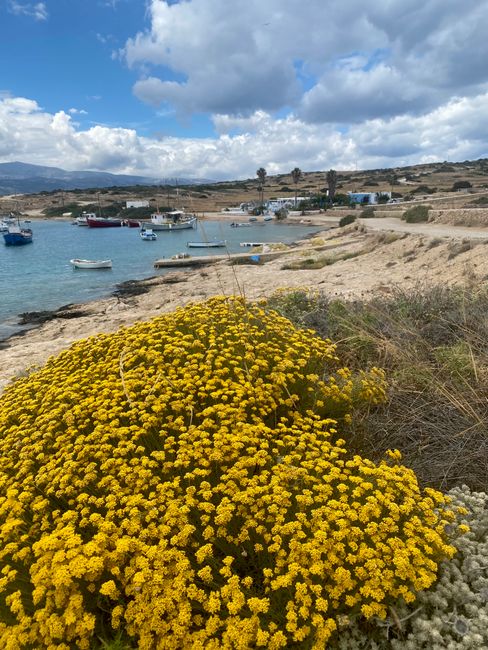
Naxos is the largest and greenest of the Cyclades, and the one that still feels like a real island rather than a resort. Its harbour town is guarded by a huge marble doorway, the Portara, and topped by a Venetian castle quarter; to the south run some of the longest, sandiest beaches in the Aegean; and inland are marble villages, olive groves, Byzantine chapels and Mount Zas, the highest peak in the Cyclades. Food is a highlight, from local cheeses and potatoes to citron liqueur. Prices are lower and crowds thinner than on Mykonos or Santorini, which makes Naxos a favourite with families and walkers. Come from May to October, stay at least four days, and rent a car for a day or two in the mountains.
Right now in Naxos (Naxos town)
- Wed17–21°C63–69°FClear
- Thu17–23°C63–74°FMostly clear
- Fri18–23°C64–74°FClear
Top tours in Naxos
See all tours for Naxos →
From local operators, with prices and reviews; you check availability and book on Viator, our partner. We may earn a commission at no extra cost to you. How we earn money
Naxos at a glance
- Best months: late May–June and September–early October. On nearby Mykonos, the closest station with official climate normals, average highs run from about 18 °C in April to 28–29 °C in July and August (HNMS normals 1991–2020); the mountain villages are cooler. The sea is warm enough for swimming from June to October.
- Days needed: 4 for Chora, the beaches and a day in the mountain villages; 6–7 to add the hike up Mount Zas, more villages and a day trip to the Small Cyclades.
- Getting there: by ferry from Piraeus or Rafina (about 3½–6 hours), or a short flight from Athens to Naxos airport (JNX).
- Getting around: KTEL buses run often along the beach coast and less often to the villages; a car makes the interior easy.
- Budget level: good value for the Cyclades, with plenty of family-run rooms and tavernas. A climate resilience fee is added per room per night (€2–€15 from April to October). See our Greece guide for money, entry rules and daily costs.
Naxos’s areas and who each one suits
- Chora (Naxos Town): the port town, with the Portara, the old lanes of Bourgos and the Kastro above, the harbour-front cafés and the town beach of Agios Georgios. For first-timers and anyone without a car.
- Agios Prokopios and Agia Anna: the beach villages a few kilometres south of town, with sandy bays, tavernas and frequent buses. For beach holidays and families.
- Plaka, Mikri Vigla and the south-west coast: long, wilder beaches backed by dunes and cedars, with scattered places to stay; Mikri Vigla is the island’s kitesurfing centre. For space, sunsets and water sports.
- The mountain villages: Halki, Filoti, Apeiranthos and Koronos in the green interior, with marble lanes, tower houses and village tavernas. For walkers, food lovers and a slower pace.
- The north: Apollonas, a fishing village with an ancient marble statue lying in a quarry nearby. Remote and quiet.
Top things to see in Naxos
Prices and hours below come from the Greek Ministry of Culture’s ticketing service (Hellenic Heritage), as of October 2026.
The Portara
The first thing you see as the ferry comes in is the Portara, a giant marble doorway standing alone on the islet of Palatia, joined to the harbour by a causeway. It is the entrance of a temple to Apollo begun around 530 BC by the ruler Lygdamis and never finished; the rest of its stone was carried off over the centuries, but the doorframe was too big to move. It is free and always open, a five-minute walk from the port. Come at sunset, when people gather on the rocks around it and the light turns the marble gold, and swim off the rocks below on calm days.
Chora, Bourgos and the Kastro
Behind the harbour front, the lanes of the old town climb through the Bourgos quarter, where Greek merchants lived, to the Kastro, the walled quarter built by the Venetian dukes who ruled Naxos and much of the Cyclades from the 13th century. Inside its gates are Venetian mansions with coats of arms, the Catholic cathedral and a former Jesuit school that houses the Archaeological Museum, with marble Cycladic figurines thousands of years old (open 9:00–14:00, closed Tuesdays; listed as free entry in 2026). Evenings in Chora are for strolling the waterfront and the lanes of Old Market Street, with dinner in the squares. The town beach, Agios Georgios, starts at the southern end of the harbour.
The Temple of Demeter at Sangri
In the fields near the village of Sangri, about 20 minutes’ drive from Chora, a marble temple to Demeter, the goddess of the harvest, has been partly rebuilt from its original pieces, with a small museum alongside. It is an atmospheric, uncrowded site among the barley and olives. How to visit: €5, €3 reduced; open 8:30–15:30 and closed on Tuesdays, all year. Combine it with Halki and the Tragea valley.
The kouroi of Naxos
Naxos was famous in antiquity for its marble and its sculptors. In the old quarries, unfinished giant statues of young men, the kouroi, still lie where they were abandoned 2,600 years ago, probably after they cracked: one near Melanes in the Flerio area, in a garden reached by a short path, and a 10-metre one in the hillside above Apollonas in the north. Both are free to visit.
Archaeological sites
- Kouroi of Flerio
Other sights
- Panagia Drosiani
- Portara of Naxos
- Temple of Demeter at Sangri
Museums
- Archaeological Collection of Apeiranthos
- Archaeological Museum of Naxos
Peaks and mountains
- Mount Zas
Beaches
Naxos has some of the best sandy beaches in the Cyclades, almost all on the west and south-west coast, south of Chora. The water is clear and in many places shallow for a long way, and the north wind, the meltemi, blows less strongly here than on Mykonos.
- Agios Georgios: the town beach, a long, shallow bay within walking distance of Chora, with tavernas, a windsurf school and calm water; great for small children.
- Agios Prokopios: a curve of golden sand with turquoise water, sunbeds and beach bars, about 10 minutes south of town by bus, and a salt lake behind it.
- Agia Anna: next door, a small fishing harbour and a sheltered beach with tavernas and rooms.
- Plaka: about 4 km of white sand backed by dunes and fields, organised at the northern end and quieter and more natural as you walk south. Superb sunsets.
- Mikri Vigla, Kastraki and Alyko: further south, wilder beaches; Mikri Vigla is a kitesurfing and windsurfing spot, and Alyko has a protected cedar forest on the dunes and small coves.
Under Greece’s coastal law, part of every organised beach must stay free of sunbeds and you can always reach the water and spread your own towel. See our beaches guide and our snorkeling guide.
The mountain villages
The interior of Naxos is the island’s surprise: terraced hills, olive and fruit groves, springs, Byzantine chapels with old frescoes and Venetian tower houses. A day’s loop by car from Chora takes in the best villages:
- Halki: the old capital of the interior, in the olive-filled Tragea valley, with neoclassical houses, galleries, cafés and a distillery making kitron, the liqueur made from the leaves of the citron tree.
- Filoti: the largest mountain village, on the slopes of Mount Zas, with a big square under plane trees and the starting points for the climb.
- Apeiranthos: a village of white marble lanes, arches and stone houses, with small museums and tavernas; its people descend from Cretan settlers and have their own dialect.
- Koronos and the north: a steep, green village of the old emery mines, then a winding road down to Apollonas and its kouros.
Eat in the villages: lamb and goat cooked slowly, local sausages, the island’s famous potatoes, and cheeses such as graviera of Naxos, a protected cheese, and the sharp, aged arseniko. Many villages hold summer festivals (panigyria) with music, dancing and food, the biggest around 15 August.
Hiking Mount Zas
Mount Zas (Zeus), 1,004 m, is the highest mountain in the Cyclades; according to legend, Zeus was raised in a cave on its slopes. On a clear day the summit view takes in Paros, Ios, the Small Cyclades and much of the Aegean.
- The short route: from the Aria spring and the chapel of Agia Marina, on the road from Filoti towards Danakos, a marked path climbs past the Cave of Zeus to the summit in about 1½–2 hours. The last part is steep and rocky.
- From Filoti: a longer path climbs from the village itself, about 3 hours up; you can go up one way and down the other.
- Tips: go in spring or autumn, or start very early in summer; there is no shade on the upper slopes and no water after the spring. Wear proper walking shoes, take a windproof layer, as the top is often windy and much cooler, and avoid it in low cloud or strong wind.
Naxos has a network of marked walking paths between the villages, many of them old stone-paved mule tracks; ask for the local trail map in Chora. See our hiking guide and our cycling guide.
Naxos with children
Naxos is one of the easiest Greek islands for families. The beaches of Agios Georgios, Agios Prokopios and Agia Anna have sand and gently shelving, shallow water; buses run often along the coast; and apartments and family rooms are plentiful and good value. Children enjoy the Portara and the castle lanes, a visit to a farm or a horse ride on the beaches, beginner windsurfing lessons on Agios Georgios bay, and spotting the giant kouroi. Bring sun protection for everyone, as shade on the beaches is limited to umbrellas and tamarisk trees.
From Naxos, small boats sail to the Small Cyclades, such as Koufonisia, with famously clear water and white sand, for a day trip or a few quiet nights. See our boat trips guide.
Activities and best months
- Beaches and swimmingAgios Georgios by the town for families, then Agios Prokopios, Agia Anna and Plaka to the south; Mikri Vigla for kitesurfing and windsurfing; quieter Parthena, Alyko and Pyrgaki with dunes and cedars.
Nearby destinations
Getting there and getting around
Ferries and flights
- From Piraeus: high-speed boats take about 3½–4 hours and conventional ferries about 5–6 hours, usually via Paros.
- From Rafina: high-speed boats in season, often via Tinos, Mykonos or Paros.
- Island hopping: Naxos sits in the middle of the Cyclades, with frequent boats in summer to Paros (under an hour), Mykonos, Santorini, Ios and the Small Cyclades. Book ahead in July and August.
- By air: the small Naxos airport (JNX), just south of Chora near Agios Prokopios, has short flights from Athens.
Ferries dock at the harbour of Chora, within walking distance of the old town and many hotels; the bus station is on the waterfront next to the port.
Getting around the island
- KTEL buses: from the bus station by the port. In summer the beach line to Agios Prokopios, Agia Anna and Plaka runs frequently from early morning until late at night; lines to the mountain villages (Halki, Filoti, Apeiranthos) and the north run a few times a day. Buy tickets at the KTEL office or kiosks before boarding.
- Car: the best way to explore the villages, Mount Zas and the southern beaches; roads in the mountains are winding and narrow but quiet. Book ahead in August.
- Scooters, quads and bikes: popular for beach hopping; wear a helmet, as the law requires, and note that the government announced stricter quad rental rules in June 2026.
When to go and how long to stay
Naxos has the dry, sunny, windy summer of the Cyclades. July and August are the busiest months, with Greek families on holiday, but still far calmer than Mykonos or Santorini. June and September are ideal: warm sea, long days and quiet beaches. Spring is green and full of flowers, perfect for walking; from November to March many hotels and beach tavernas close, but Chora and the villages stay alive.
| Season | Average high / low | What it’s like |
|---|---|---|
| Spring (Mar–May) | 15–22 °C / 10–16 °C | Green hills and wildflowers; best season for hiking and villages; sea still cool. |
| Summer (Jun–Aug) | 27–29 °C / 21–23 °C | Hot, sunny and dry; meltemi wind on many days in July and August; busiest in August. |
| Autumn (Sep–Nov) | 18–26 °C / 14–20 °C | Warm sea in September and early October; quieter beaches; first rains in November. |
| Winter (Dec–Feb) | 13–14 °C / 9–10 °C | Mild and windy, with some rain; snow sometimes on Mount Zas; many tourist businesses closed. |
Naxos has no station in the official climate normals of the Hellenic National Meteorological Service (HNMS), so the figures are the 1991–2020 normals for Mykonos, about 40 km to the north, which has a very similar coastal climate. The mountain villages are several degrees cooler.
4 days in Naxos
Day 1: Chora, the Kastro and the museum, and sunset at the Portara. Day 2: beach day at Agios Prokopios or Plaka. Day 3: by car to Sangri, Halki, Filoti and Apeiranthos, with lunch in a village. Day 4: hike Mount Zas in the morning and swim at Plaka in the afternoon, or a boat day to Koufonisia.
A week in the Cyclades with Naxos
Combine four nights on Naxos with two or three on Santorini or Mykonos, starting or ending in Athens. With more time, continue south to Crete by ferry from Santorini.
Where to stay in Naxos
- Without a car: Chora, near the port, or the Agios Georgios beach area at the southern edge of town.
- Families and beach holidays: Agios Prokopios or Agia Anna, on the frequent bus line.
- Space and sunsets: Plaka or Mikri Vigla, with a car.
- Walking and village life: a guesthouse in Halki, Filoti or Apeiranthos.
The climate resilience fee is added per room per night and paid at the accommodation.
Practical tips for Naxos
- Rent a car for at least a day: the interior is the best part of the island and buses there are infrequent.
- Hike early: start Mount Zas and village walks early in summer, with plenty of water.
- Wind: on meltemi days the west-coast beaches can be breezy; look for shelter at Agia Anna or Agios Georgios, or head to the kitesurf beaches to watch.
- Eat local: look for Naxos graviera, potatoes and meat, and finish with kitron.
- Ferries: strong winds can delay sailings; leave a spare day before an international flight.
- Emergencies: call 112.
Weather month by month
What to pack for Naxos
Pack light summer clothes, swimwear, a sun hat, sunglasses, high-factor sunscreen and a refillable water bottle. For Mount Zas and village paths, bring walking shoes or light hiking boots and a windproof layer. Water shoes help on rocky coves, a snorkel mask shows off the clear water, and a light scarf covers shoulders in churches and monasteries. In spring and autumn, add a warm jumper for evenings in the mountains.
What to pack
- Day packs and anti-theft bagsCarries water, towel and sunscreen down the long stairways to Algarve coves.
- Dry bags and phone pouchesProtects phones and cameras from sand and spray on beaches reached by ferry or steep paths.
- Quick-dry beach towelsA sand-shedding quick-dry towel packs small for beach days and lido visits.
- Reef-friendly sunscreenSummer UV is strong on Portuguese beaches and there is little shade below the cliffs.
- Water shoesRocky coves, lava pools and weever fish in shallow sand make water shoes useful.
- WetsuitsOn the west and north coasts the sea stays around 16–18 °C even in summer, so a thin suit helps for long swims.
Naxos travel FAQ
How many days do you need in Naxos?
Four days for Chora, the beaches and a day in the mountain villages; a week if you want to hike Mount Zas and take a boat to the Small Cyclades.
Is Naxos good for families?
Yes, one of the best Greek islands for families: sandy beaches with shallow water, frequent buses along the coast, plenty of family rooms and lower prices than Mykonos or Santorini.
What is the best beach in Naxos?
Agios Prokopios for golden sand and facilities, Plaka for a long, natural beach and sunsets, and Agios Georgios for calm, shallow water next to town.
Is the Portara free to visit?
Yes. The marble doorway on the Palatia islet is free and always open, a short walk along the causeway from the harbour, and busiest at sunset.
How hard is the hike up Mount Zas?
Moderate. From the Aria spring near Filoti it takes about 1½–2 hours to the 1,004 m summit, with a steep, rocky final section. Start early and carry water.
Do you need a car in Naxos?
Not for Chora and the main beaches, which have frequent buses in summer. For the mountain villages, Mount Zas and the quieter southern beaches, a car is much easier.
Naxos or Paros?
Naxos is bigger, greener and less developed, with longer sandy beaches and mountain villages; Paros is smaller, livelier and more polished. They are under an hour apart by ferry, so many people visit both.
How do you get from Athens to Naxos?
By ferry from Piraeus, about 3½–4 hours by high-speed boat or 5–6 hours by conventional ferry, from Rafina in season, or by a short flight to Naxos airport.
What food is Naxos known for?
Graviera and arseniko cheeses, potatoes, slow-cooked meat in the mountain villages, and kitron, a liqueur made from citron leaves, distilled in Halki.
When is the best time to visit Naxos?
June and September for beaches, with warm sea and fewer people; April, May and October for hiking and the villages.
Plan your trip
Partner links: TravelerCenter may earn a commission if you book, at no extra cost to you.
🇬🇷 Useful Greek phrases for Naxos
All 38 Greek phrases: restaurant, hotel, emergencies, romance (printable) →
Sources · last reviewed 4 October 2026
Researched and last reviewed on 4 October 2026. Prices and hours of the Temple of Demeter at Sangri and the Archaeological Museum of Naxos come from the Greek Ministry of Culture (Hellenic Heritage). The climate resilience fee is set by Greek tax law and collected by AADE. Climate figures are the HNMS 1991–2020 normals for the Mykonos station, the nearest with official normals. Ferry and bus times are typical and change by season, so check the ferry companies and KTEL Naxos before you travel.
Also: visitgreece.gr · HNMS station averages (period not stated), Naxos (climate)
Data: Weather: MET Norway (CC BY 4.0) · Sea temperature: NOAA CoastWatch · Rates: ECB · Costs: World Bank ICP and price levels · © OpenStreetMap contributors (ODBL) · Wikidata (CC0)