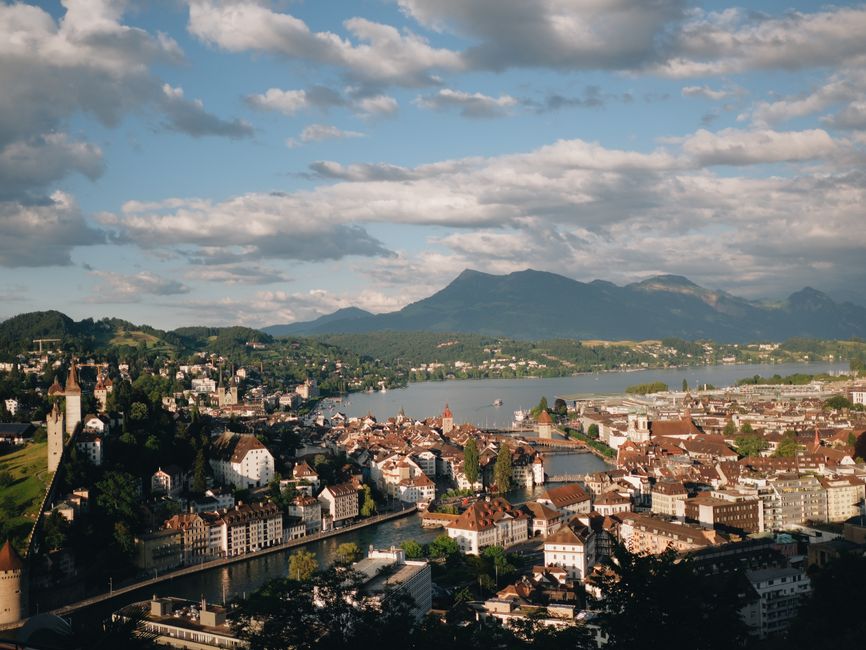
Lucerne is the Switzerland of postcards: a medieval wooden bridge with a stone water tower, painted guild houses along the Reuss river, a ring of watchtowers on the hill and a deep blue lake framed by mountains. It is small, walkable and only about 45 minutes by train from Zurich, and it is the best base in the country for easy mountain days: steamers cross the lake to the foot of Rigi, the “queen of the mountains”, the world’s steepest cogwheel railway climbs Pilatus, and a revolving cable car turns over the glaciers of the Titlis. Add the Swiss Museum of Transport, a summer music festival of world rank and a wild carnival, and two or three days fly by. Stay four to five to see the mountains properly.
Right now in Lucerne
- Wed11–23°C52–73°FPartly cloudy
- Thu11–15°C51–59°F22 mm rain
- Fri9–13°C47–55°F1 mm rain
Top tours in Lucerne
See all tours for Lucerne →
From local operators, with prices and reviews; you check availability and book on Viator, our partner. We may earn a commission at no extra cost to you. How we earn money
Lucerne at a glance
- Best for: a picture-perfect old town, lake cruises on paddle steamers, easy mountain excursions, museums for families, classical music and carnival.
- How long: 1 day for the old town and the bridges; 3–4 days to add Pilatus, Rigi, the lake and the Titlis.
- Best time: May to October, when the Pilatus cogwheel railway and the full boat timetable run; August for the Lucerne Festival; February for Fasnacht; December for Christmas markets.
- Getting in: about 45 minutes by train from Zurich, about 1 hour from Bern and Zurich Airport, and 1 hour 50 minutes from Interlaken on the Luzern–Interlaken Express.
- Getting around: on foot in town. Hotel guests get the Lucerne Visitor Card with free city buses; the Swiss Travel Pass covers the lake boats and Rigi.
- Before you go: rail passes, money, entry rules and mountain safety are in our Switzerland travel guide.
Lucerne, area by area
Lucerne sits where the Reuss flows out of Lake Lucerne (the Vierwaldstättersee, the “lake of the four forest cantons”). The station, the KKL concert hall and the boat piers are together on the south bank; the old town is across the Chapel Bridge on the north bank, and the lake promenades curve away on both sides.
The old town (Altstadt)
A compact, car-free web of squares, the Weinmarkt, Kornmarkt and Hirschenplatz, with painted façades, fountains and riverside cafés along the Reuss, climbing up to the Musegg Wall. Best for: sightseeing and atmospheric stays.
The station, KKL and Neustadt
South of the river, the station opens onto the lake, the boat piers and the KKL Luzern, Jean Nouvel’s concert and convention centre with its huge cantilevered roof. Behind it, the Neustadt is a grid of 19th-century streets with good-value restaurants and bars. Best for: practical stays and nightlife.
The lakefront (Seequai and Haldenstrasse)
East of the Chapel Bridge, the Schweizerhofquai and Nationalquai are lined with grand Belle Époque hotels, chestnut trees and benches facing Pilatus and Rigi; the promenade continues to the lido and the Museum of Transport. Best for: views and lake walks.
Top things to see in Lucerne
Prices and seasons below were checked in October 2026. They change, so check the official sites before you go.
The Chapel Bridge and the Water Tower
The Kapellbrücke, about 204 m long, was first built in the 14th century as part of the town’s fortifications and is often called the oldest covered wooden bridge in Europe. Under its roof hang triangular paintings from the 17th century showing the history of Lucerne and its patron saints. On 18 August 1993, a fire destroyed much of the bridge and most of the paintings; it was rebuilt and reopened in April 1994, and you can still see a few blackened panels. The octagonal stone Water Tower in the river, about 34 m high and older than the bridge, served as a prison, archive and treasury; it is not open to visitors. The bridge is free and open day and night; come early in the morning for photos without the crowds.
The Spreuer Bridge
Downstream, the smaller covered Spreuer Bridge, built in 1408, is less crowded and has its original 17th-century paintings: a cycle called the Dance of Death by Kaspar Meglinger, in which a skeleton visits people of every rank. Next to it is the Nadelwehr, a needle dam still regulated by hand to control the lake level.
The Lion Monument
Carved into a sandstone cliff above a small pond, the dying lion, designed by the Danish sculptor Bertel Thorvaldsen, commemorates the Swiss Guards killed defending the Tuileries Palace in Paris during the French Revolution in 1792. Mark Twain called it the most mournful and moving piece of stone in the world. It is free and a short walk north of the old town; the Glacier Garden next door shows potholes ground out by Ice Age glaciers.
The Musegg Wall
The 870 m stretch of medieval town wall on the hill behind the old town keeps nine towers. Several can be climbed for free, including the Zyt tower, whose clock is the oldest in town and is allowed to strike the hour a minute before all the others. As of October 2026, the wall was open daily from 1 April to 1 November 2026, from 8:00 to 19:00. The views over the rooftops, the lake and the Alps are among the best in Lucerne.
The Swiss Museum of Transport
The Verkehrshaus, by the lake on the eastern edge of town, is Switzerland’s most visited museum: locomotives, cable cars, ships, planes and space travel, with simulators, a planetarium, a chocolate ride (Swiss Chocolate Adventure) and a giant film theatre. As of October 2026, museum entry cost CHF 37 for adults, with the planetarium, the chocolate ride and the film theatre CHF 18 each. Plan at least half a day; it is a big hit with children.
Art museums
The Rosengart Collection, near the station, has an outstanding collection of Picasso and Paul Klee, plus Cézanne, Monet, Chagall and Miró, gathered by the art dealers Siegfried and Angela Rosengart. As of October 2026, it opened from 10:00 to 18:00 from April to October and from 11:00 to 17:00 from November to March. The Kunstmuseum Luzern is on the top floor of the KKL. The Bourbaki Panorama shows a huge circular painting of a French army crossing into Switzerland in 1871.
Other sights
- Chapel Bridge
- Lucerne Culture and Congress Centre
Museums
- Bourbaki-Panorama
- Swiss Museum of Transport
Monuments
- Lion Monument
Viewpoints
- Mount Pilatus
Peaks and mountains
- Rigi
Lucerne’s mountains: Pilatus, Rigi, Titlis and Stanserhorn
Lucerne’s great advantage is that real mountains start at the edge of the lake. Each is a full or half day out. Check the webcams in the morning and go up on the clearest day; the summits are much colder than town, so take a warm layer.
Pilatus and the Golden Round Trip
Lucerne’s own mountain rises steeply south-west of town to about 2,100 m, with a hotel, restaurants, short summit trails and views over the lake to the Bernese Alps. The classic way to do it is the Golden Round Trip: a boat from Lucerne to Alpnachstad, the cogwheel railway up (opened in 1889 and, at a gradient of up to 48%, the steepest in the world), then the “Dragon Ride” aerial cableway and panoramic gondolas down to Kriens and a bus back to town, or the same in reverse. The cogwheel railway runs only from about May to October; in winter you can still go up and down by gondola and cableway from Kriens. As of October 2026, Pilatus advertised the Golden Round Trip “from CHF 59.90” (a discounted fare); with the Swiss Travel Pass, the boat and bus are free and you pay a reduced fare for the mountain section. Reserve a seat on the cogwheel train in summer.
Rigi, the queen of the mountains
Rigi is a gentler, greener mountain between Lake Lucerne and Lake Zug, criss-crossed with walking paths and with views of the Alps on one side and a dozen lakes on the other. The Vitznau–Rigi railway, opened in 1871, was the first mountain railway in Europe; you can also ride up from Arth-Goldau or take the cable car from Weggis to Rigi Kaltbad, where a mineral bath designed by Mario Botta has warm pools with mountain views. The classic day: boat from Lucerne to Vitznau, train to Rigi Kulm (1,797 m), walk down to Rigi Kaltbad, cable car to Weggis and boat back. As of October 2026, a Rigi day pass for the mountain railways cost CHF 84 for adults, and Rigi is free with the Swiss Travel Pass and the GA travelcard. Steam trains run on special days.
Titlis and Engelberg
For snow and ice all year, go to the Titlis above Engelberg, about 45 minutes from Lucerne by train. A series of gondolas and the Rotair, the world’s first revolving cable car, carry you to the glacier at about 3,000 m, where you can walk through an illuminated glacier cave, play in the snow and cross the Titlis Cliff Walk, a suspension bridge opened in 2012 and billed as the highest in Europe. A new observation tower with a restaurant was opened at the summit in 2026. Titlis is one of the more expensive excursions; the Swiss Travel Pass and the Half Fare Card give a discount. Check titlis.ch for current prices and the weather.
Stanserhorn and Bürgenstock
The Stanserhorn (1,898 m), near Stans, is reached by a historic funicular from 1893 and then the CabriO, a double-deck cable car with an open roof deck; it is free with the Swiss Travel Pass in season. The Bürgenstock, a ridge rising from the lake, has a luxury resort, a cliff path and the Hammetschwand Lift, which bills itself as the highest outdoor lift in Europe.
Things to do in Lucerne
Cruise Lake Lucerne
The Lake Lucerne Navigation Company (SGV) runs a fleet of 21 boats, including five paddle steamers built between 1901 and 1928, calling at 32 landings around the lake. The trip to Flüelen at the far end, through the narrow Urnersee between cliffs, is one of the most beautiful boat rides in Switzerland; stop at the Rütli meadow, where Swiss tradition says the Confederation was sworn in 1291, or at Brunnen and Weggis. Boats are free with the Swiss Travel Pass and half price with the Half Fare Card. The full timetable runs from spring to autumn, with fewer boats in winter. See our boat trips guide.
The Lucerne Festival
Every summer, the world’s leading orchestras and soloists play in the KKL’s concert hall, famous for its acoustics. The Summer Festival 2027 runs from 12 August to 12 September 2027, with shorter festivals in spring (19 to 21 March 2027) and November.
Fasnacht, Lucerne’s carnival
Lucerne’s carnival is loud, colourful and chaotic. It starts at 5:00 on the Thursday before Ash Wednesday (the “Schmutziger Donnerstag”) with a big bang and the arrival of Fritschi, and continues for six days with masked parades and brass bands (Guggenmusig) until Shrove Tuesday night. By the church calendar, Fasnacht 2027 should run from Thursday 4 to Tuesday 9 February 2027; check luzern.com for the official programme.
Swim, walk and eat
In summer, swim at the Lido Luzern or the old wooden Seebad on the Nationalquai. Walk the lakeside path to the Museum of Transport or up to the Gütsch for the view. Try Luzerner Chügelipastete, a vol-au-vent filled with veal and mushrooms in cream sauce, at an old-town restaurant. For trails on Pilatus and Rigi, see our hiking guide.
Activities and best months
- Beaches and swimmingLake Lucerne has plenty of bathing spots; Strandbad Lido, Seebad Luzern and the Ufschötti lawn are the most popular in the city, and quieter spots and clear mountain lakes are close by.
- Boat tripsThe Lake Lucerne Navigation Company sails five historic paddle steamers and more than a dozen motor vessels all year round (reduced timetable in winter) from the Bahnhofquai opposite the station, with connections to the mountain railways of the Rigi, Pilatus, Klewenalp and Bürgenstock; the Jugendstil-era paddle steamers run between Lucerne and Flüelen, past the Rütli meadow where the Confederation was founded in 1291. Tickets can be bought on board without surcharge.
- City sightseeingLucerne Tourism's top sights are the Chapel Bridge and Water Tower, the Spreuer Bridge with its 17th-century paintings, the Musegg Wall and its nine towers, the Jesuit Church, the Lion Monument and the KKL concert hall on the lake; it says the city is best discovered on foot, with many guided tours.
- HikingThe Lucerne-Lake Lucerne region is packed with mountain railways and hiking areas: the Rigi, Pilatus, Titlis and Stanserhorn are the classics, there are guided hikes on Pilatus, and the eight-stage long-distance Tell Trail runs from Altdorf to the Brienzer Rothorn past lakes, villages and the 'Big 6' summits.
Day trips from Lucerne
Beyond the mountains above, Interlaken and the Jungfrau region are 1 hour 50 minutes away on the scenic Luzern–Interlaken Express over the Brünig Pass. Zurich is about 45 minutes away and Bern about an hour. The Gotthard Panorama Express combines a boat across Lake Lucerne with a train over the old Gotthard line to Ticino and Lugano in season. Small towns around the lake, such as Weggis, Vitznau and Brunnen, make lovely stops.
Nearby destinations
- Zurich40 km
- Interlaken53 km
- Bern66 km
- Basel78 km
- Vaduz93 km
- Lake Constance101 km
- Lake Maggiore111 km
- Zermatt123 km
Getting to Lucerne
By train. Lucerne station has direct trains from Zurich (about 45 minutes), Zurich Airport (about 1 hour), Bern (about 1 hour), Basel (about 1 hour) and Lugano (just under 2 hours through the Gotthard Base Tunnel). The Luzern–Interlaken Express runs hourly to Interlaken Ost in 1 hour 50 minutes; seat reservations are optional.
By air. Zurich Airport is the closest international airport, about an hour away by direct train.
By car. Lucerne is on the A2 motorway (vignette required). Parking in the centre is limited and expensive; park-and-ride sites are on the edge of town.
Getting around: the Visitor Card and the Museum Card
Walk in the old town; buses run to the Museum of Transport, Kriens (for Pilatus) and the suburbs. If you stay overnight and pay the visitor’s tax, your hotel gives you the free Lucerne Visitor Card, which covers second-class buses and trains in city zone 10 from your arrival day to your departure day (up to 14 days), plus discounts on mountain railways and museums. It does not include the lake boats.
For museums, the Museum Card Lucerne, sold by Lucerne Tourism, gives entry to about eight museums on two consecutive days, including the Swiss Museum of Transport, the Rosengart Collection, the Kunstmuseum, the Glacier Garden, the Bourbaki Panorama and the Richard Wagner Museum (closed in winter). As of October 2026, it cost from CHF 39, less than a single full-price ticket to the Transport Museum plus one more museum. The Swiss Travel Pass also includes free entry to several Lucerne museums.
When to go and how long to stay
Lucerne sits at the foot of the Alps, so it gets more rain than Zurich, much of it in summer thunderstorms. Summers are warm, winters cold and often grey, with fog over the lake and sunshine on the summits above. The table uses MeteoSwiss climate normals for 1991–2020 at Luzern.
| Month | Average daily high | What it’s like |
|---|---|---|
| January | 4.0 °C | Cold, foggy in town, sunny on the mountains; Fasnacht in February |
| April | 15.3 °C | Spring in the old town; boats increase, Pilatus cogwheel not yet running |
| July | 24.9 °C | Warm, all excursions running, thunderstorms on hot afternoons |
| October | 14.3 °C | Clear autumn days, golden forests; last month of the Golden Round Trip |
Lucerne gets about 1,290 mm of rain a year, falling on about 133 days, and about 1,530 hours of sunshine. In winter, when fog covers the lake, the summits of Rigi and Pilatus are often in bright sunshine.
Lucerne in 1 day
Cross the Chapel Bridge early, walk the old town squares and the Spreuer Bridge, see the Lion Monument and climb the Musegg Wall towers. In the afternoon, take a short lake cruise or visit the Museum of Transport, and end with a walk along the lake promenade at sunset.
Lucerne in 4 days
Day one in town as above; day two, the Golden Round Trip on Pilatus; day three, a boat to Vitznau and Rigi, with a swim at Rigi Kaltbad; day four, the Titlis from Engelberg or a long boat trip to Flüelen.
Weather month by month
Where to stay in Lucerne
- Old town: historic inns and boutique hotels in car-free streets.
- Lakefront: grand hotels with lake and mountain views on the Schweizerhofquai and Nationalquai.
- Near the station and Neustadt: the most practical base, with chain hotels and better value.
- Around the lake: Weggis, Vitznau and Brunnen for quiet lakeside resorts with boat connections.
- On the mountains: hotels on Pilatus Kulm and Rigi for sunset and sunrise above the clouds.
Lucerne is one of the busiest destinations in Switzerland in summer, and it’s popular with tour groups all year. Book early for July and August, the Lucerne Festival and Fasnacht.
Practical tips for Lucerne
- Watch the weather: save the mountains for the clearest day, and check the webcams first.
- Use your Swiss Travel Pass: lake boats, Rigi and the Stanserhorn are free; Pilatus and the Titlis are discounted.
- Remember the Pilatus season: the cogwheel railway runs only from about May to October.
- Go early: the Chapel Bridge and the Lion Monument are busy with groups from mid-morning.
- Ask for the Visitor Card: it gives free city buses for your whole stay.
What to pack for Lucerne
Layers for the mountains (a fleece and windproof jacket even in summer), sunglasses and sun cream for the high altitude and the glacier, shoes with grip for snow on the Titlis, a waterproof for summer storms, and swimwear for the lake and Rigi Kaltbad. Bring a Type J plug adapter.
What to pack
- City walking shoesLisbon and Porto are steep, with polished limestone cobbles that get slippery, so grippy soles matter.
- Day packs and anti-theft bagsCarries water, towel and sunscreen down the long stairways to Algarve coves.
- Dry bags and phone pouchesProtects phones and cameras from sand and spray on beaches reached by ferry or steep paths.
- Fleeces and warm layersIt is cooler at sea than on land, especially on morning whale-watching trips.
- HeadlampsLevada routes such as PR1 and PR9 pass through long, dark, wet tunnels.
- Hiking shoes and bootsMadeira's levadas and the Azores' crater rims are wet, rocky and slippery, so grippy shoes matter more than anywhere else in Portugal.
- Quick-dry beach towelsA sand-shedding quick-dry towel packs small for beach days and lido visits.
- Rain jacketsA windproof, waterproof shell keeps you warm on open boats, where wind and spray cool you quickly.
- Reef-friendly sunscreenSummer UV is strong on Portuguese beaches and there is little shade below the cliffs.
- Travel adapters and convertersPortugal uses Type C and F sockets at 230 V, so most visitors from outside Europe need an adapter.
- Trekking polesLong stone staircases and steep descents on Madeira's peaks and the Azores' crater rims are easier on the knees with poles.
- Water bottles and hydration packsAlgarve and Alentejo trails are hot and exposed with few refill points.
- Water shoesRocky coves, lava pools and weever fish in shallow sand make water shoes useful.
- WetsuitsOn the west and north coasts the sea stays around 16–18 °C even in summer, so a thin suit helps for long swims.
Lucerne travel FAQ
Which is better, Pilatus, Rigi or Titlis?
Pilatus is the most dramatic and the classic round trip from Lucerne; Rigi is gentler, best for walking and free with the Swiss Travel Pass; the Titlis has snow and a glacier all year. With a few days, combine Pilatus or Rigi with the Titlis.
Is Rigi free with the Swiss Travel Pass?
Yes. The Rigi railways and cable cars are free with the Swiss Travel Pass and the GA travelcard. As of October 2026, an adult day pass otherwise cost CHF 84.
When does the Pilatus cogwheel railway run?
From about May to October; exact dates depend on snow. The gondola and cableway from Kriens run most of the year, so you can reach the summit in winter too.
Are the Lake Lucerne boats included in the Swiss Travel Pass?
Yes, scheduled boats including the paddle steamers are free with the Swiss Travel Pass and half price with the Half Fare Card. Some special cruises and meals cost extra.
What does the Lucerne Visitor Card include?
Free second-class buses and trains in city zone 10 for up to 14 days, plus discounts on mountains and museums, for overnight guests who pay the visitor’s tax. It does not include the lake boats.
Is there a Lucerne museum pass?
Yes, the Museum Card Lucerne, from CHF 39 as of October 2026, valid two consecutive days at about eight museums including the Swiss Museum of Transport and the Rosengart Collection.
Can you walk on the Chapel Bridge?
Yes, it is a public footbridge, free and open at all times. The Water Tower beside it is not open to visitors.
How many days do you need in Lucerne?
One day for the town; three or four to add Pilatus, Rigi, a lake cruise and the Titlis.
When is the Lucerne Festival in 2027?
The Summer Festival runs from 12 August to 12 September 2027 in the KKL Luzern, with a spring festival from 19 to 21 March 2027.
How do I get from Lucerne to Interlaken?
On the Luzern–Interlaken Express, hourly, in 1 hour 50 minutes over the Brünig Pass. Seat reservations are optional, and the Swiss Travel Pass covers it.
When is the best time to visit Lucerne?
May to October for the mountains and boats, with June and September a little quieter than midsummer; February for Fasnacht; December for Christmas markets.
Plan your trip
Partner links: TravelerCenter may earn a commission if you book, at no extra cost to you.
🇩🇪 Useful German phrases for Lucerne
All 38 German phrases: restaurant, hotel, emergencies, romance (printable) →
Sources · last reviewed 4 October 2026
Researched and last reviewed on 4 October 2026. Lucerne Visitor Card and Museum Card: Lucerne Tourism (luzern.com); Musegg Wall: museggmauer.ch; Swiss Museum of Transport: verkehrshaus.ch; Rosengart Collection; Lucerne Festival dates: lucernefestival.ch; Golden Round Trip: Pilatus-Bahnen; Rigi prices and Swiss Travel Pass validity: Rigi Bahnen; lake boats: Lake Lucerne Navigation Company; Luzern–Interlaken Express: Switzerland Tourism; climate: MeteoSwiss 1991–2020 normals for Luzern, read via a secondary summary. The bridge history, the Titlis tower opening, the Fasnacht 2027 dates (calculated from the church calendar) and train times come partly from secondary sources and are flagged for checking. Prices, timetables and rules change, so check the official links before you go. For rail passes, money and entry rules, see our Switzerland travel guide.
Also: luzern.com · MeteoSwiss normals 1991–2020, Lucerne (climate)
Data: Weather: MET Norway (CC BY 4.0) · Air quality: OpenAQ · Rates: ECB · Costs: World Bank ICP and price levels · © OpenStreetMap contributors (ODBL) · Wikidata (CC0)