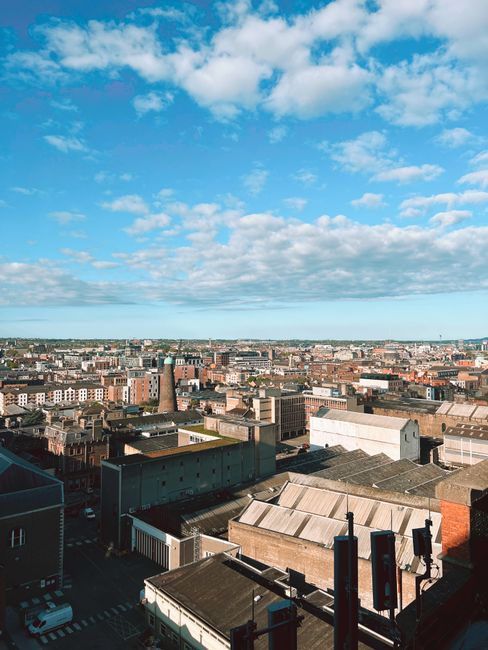
Dublin is a compact, friendly capital on the River Liffey, between the Irish Sea and the Wicklow Mountains. It is a city of Georgian squares and red-brick terraces, of medieval cathedrals and a Viking past, of writers, music and a pub on almost every corner. You come to see the Book of Kells at Trinity College, to learn the story of Ireland’s struggle for independence at Kilmainham Gaol, to pour a pint at the Guinness Storehouse and to walk the quays, the parks and the old Liberties. The sea is never far away: the DART train runs along Dublin Bay to the fishing harbour of Howth and the village of Dalkey, and the monastic valley of Glendalough is an easy day trip. Give it three days for the city, four or five to add day trips.
Right now in Dublin
- Wed7–13°C44–55°FMostly clear
- Thu6–12°C43–53°F3 mm rain
- Fri12–15°C53–59°F1 mm rain
Top tours in Dublin
See all tours for Dublin →
From local operators, with prices and reviews; you check availability and book on Viator, our partner. We may earn a commission at no extra cost to you. How we earn money
Dublin at a glance
- Best for: literary and political history, museums (many of them free), traditional music in pubs, Georgian architecture, and easy coastal and mountain day trips.
- How long: 2–3 days for Trinity College, the cathedrals, Kilmainham Gaol, the museums and the Guinness Storehouse; 4–5 days to add Howth, Dalkey and Glendalough.
- Best time: May to September for the longest days and mildest weather; around 17 March for St Patrick’s Festival; October and November for quieter streets.
- Getting in: Dublin Airport is 10 km north of the centre, 25–40 minutes by express coach; trains arrive at Heuston (from the west and south) and Connolly (from Belfast and the east coast); ferries dock at Dublin Port.
- Getting around: the centre is walkable; buses, the Luas tram and the DART cover the rest. As of October 2026, an adult TFI Leap card fare is €2 for 90 minutes of travel, and a Leap Visitor Card costs €8 for 24 hours.
- Good to know in 2026: Dublin Castle is closed to the public until January 2027 for Ireland’s EU Council Presidency, and the Long Room of Trinity’s Old Library stays open only until the end of 2027.
Ireland uses the euro, is not part of the Schengen area and has its own passport checks; it shares a Common Travel Area with the United Kingdom. Plugs are the three-pin type G, as in Britain; our travel adapter guide explains what to bring.
Dublin, area by area
The River Liffey divides the city into the Northside and the Southside, crossed by a string of bridges from the Ha’penny Bridge to the Samuel Beckett Bridge in the Docklands. The historic core is small: Trinity College to Christ Church Cathedral is a 15-minute walk.
Trinity, Grafton Street and Georgian Dublin
South of the river, Trinity College opens onto College Green, and the pedestrian Grafton Street, with its buskers and Bewley’s café, leads to St Stephen’s Green. To the east lie the finest Georgian streets and squares, Merrion Square, Fitzwilliam Square and the long view down Mount Street to the Pepper Canister Church, with their famous coloured doors, fanlights and iron railings. The National Gallery and the National Museum’s archaeology building are here too, and St Stephen’s Green and Merrion Square, with its statue of Oscar Wilde, are the city’s living rooms on a sunny day. Best for: first visits, museums and hotels close to everything.
Temple Bar and the medieval city
Temple Bar is a tangle of cobbled lanes between Dame Street and the Liffey, packed with pubs, live music and restaurants: lively, touristy and expensive at night. West of it is the oldest part of the city, with Dublin Castle, Christ Church Cathedral, Dublinia and, a little further south, St Patrick’s Cathedral and the Liberties, the old weavers’ and brewers’ quarter that leads to the Guinness Storehouse. Best for: nightlife, history and walking.
The Northside: O’Connell Street to Smithfield
O’Connell Street, Dublin’s broad main avenue, has the General Post Office, headquarters of the 1916 Easter Rising, and the steel Spire. Nearby are the Abbey Theatre, the Hugh Lane Gallery, the James Joyce Centre and the Jameson distillery in Smithfield. Further west are the National Museum at Collins Barracks and the Phoenix Park, one of the largest walled city parks in Europe, with Dublin Zoo and wild fallow deer. Best for: good-value hotels and a more local feel.
The Docklands and the bay
The old docks east of the Custom House are now glass offices, concert venues and EPIC, the emigration museum. Further out, the villages along Dublin Bay, from Howth to Dún Laoghaire and Dalkey, are reached by the DART. Best for: modern hotels, concerts and sea walks.
Top things to see in Dublin
Prices and hours below were checked on the official sites in October 2026. They change, and several Dublin attractions use timed tickets with prices that vary by date, so check before you go.
Trinity College and the Book of Kells Experience
Founded in 1592, Trinity College is Ireland’s oldest university, and its cobbled squares are free to walk through. The Book of Kells, a gospel book made by monks around the year 800 and one of the great treasures of medieval Europe, is displayed in the Treasury of the Old Library, two of its pages open at a time. Upstairs is the Long Room, the 65-metre, barrel-vaulted 18th-century library hall lined with marble busts.
The Old Library works. Trinity is preparing a major conservation and redevelopment of the Old Library. Almost all of the books have been taken off the Long Room’s shelves; only the first four bays still hold books, so the hall looks very different from the famous photographs. The college says the Old Library and the Long Room stay open to visitors until the end of 2027, when construction is due to start. After that, the Book of Kells will be shown in the restored Printing House on the campus, with a new exhibition.
Tickets. As of October 2026, the self-guided Book of Kells Experience (the manuscript, the Long Room and digital exhibitions in the Red Pavilion, about 90 minutes, with a free audio guide in 13 languages) costs from €25 for adults, with concessions for students and seniors; a shorter Book of Kells and Old Library ticket starts from €19, a bundle with the Trinity Trails campus walking tour from €37, and a guided visit from €65. Entry is timed and online booking is strongly recommended, especially from May to September. Hours are 8:30–18:30 Monday to Thursday, 8:30–19:00 on Friday and Saturday and 9:00–18:30 on Sunday.
Kilmainham Gaol
Kilmainham Gaol (1796–1924) held generations of Irish rebels, and fourteen leaders of the 1916 Easter Rising were executed in its Stonebreakers’ Yard. The guided tour is the most moving history lesson in the city. Visits are by guided tour only and take about 90 minutes. As of October 2026, admission costs €8 for adults, €6 for seniors and €4 for students and children aged 12 to 17 (under-12s free, ticket required), and €20 for a family. Book online: tickets sell out days ahead in summer, and only the official museum website is valid. The museum is open daily (closed 24–27 December).
The Guinness Storehouse
Arthur Guinness signed a 9,000-year lease on the St James’s Gate brewery in 1759. The Storehouse, a former fermentation building, tells the story of the beer over seven floors and ends at the glass-walled Gravity Bar with 360-degree views over the city. As of October 2026, the standard self-guided Guinness Storehouse Experience costs from €24, including a pint of Guinness or Guinness 0.0; prices vary by date and time, so booking online for a quieter slot saves money. Add-ons include the Guinness Academy (learn to pour your own pint, from €36) and tasting experiences for over-18s only.
EPIC, the Irish Emigration Museum
EPIC, in the brick vaults of the CHQ building in the Docklands, tells the stories of the millions who left Ireland in 20 interactive galleries; it suits families and anyone with Irish roots. As of October 2026, tickets cost €22 for adults, €19 for seniors and €11 for children, with family tickets from €39, 20% off if you book 30 days ahead, and a free return visit within 10 days. It opens daily 10:00–18:45, last admission 17:00.
The National Museum and the free galleries
Admission to the National Museum of Ireland is free. Its archaeology building on Kildare Street holds the gold of the Bronze Age, the Ardagh Chalice and the Tara Brooch, Viking Dublin and the eerie bog bodies of the Kingship and Sacrifice exhibition. Collins Barracks covers decorative arts, history and the Easter Rising. The natural history museum on Merrion Street, the much-loved “Dead Zoo”, is closed for works; some of its collection is shown in a new space, the Dead Zoo Lab, at Collins Barracks. The National Gallery, with Caravaggio’s Taking of Christ, and the Hugh Lane Gallery, with Francis Bacon’s studio, are also free for their permanent collections. Check opening days: several museums close on Mondays.
Dublin Castle (closed until January 2027)
For seven centuries Dublin Castle was the seat of English, then British, rule in Ireland, until its handover in 1922. Its tours usually take in the State Apartments, the Chapel Royal and the medieval undercroft. As of October 2026, the Dublin Castle campus is closed to the public until January 2027 while it hosts meetings and events for Ireland’s Presidency of the Council of the European Union. Public tours are expected to resume in January 2027; check the castle’s website before you plan a visit. The Chester Beatty library and museum, in the castle gardens, has its own website: check whether it is open during the closure.
St Patrick’s Cathedral and Christ Church Cathedral
Dublin has two medieval cathedrals, five minutes apart. St Patrick’s, the largest church in Ireland, dates from the 13th century; Jonathan Swift was its dean and is buried here. As of October 2026, admission costs €11.50 for adults, €10 for students and seniors and €5.50 for children aged 6 to 12, with a family ticket at €31 and a joint ticket with the neighbouring Marsh’s Library, Ireland’s first public library, at €17. Free guided tours run Monday to Saturday at 10:30 and 14:30. Christ Church, founded around 1030, has a huge medieval crypt; a self-guided visit with the crypt costs about €12 for adults. A covered bridge links it to Dublinia, a museum of Viking and medieval Dublin that children enjoy.
Other sights
- Book of Kells and the Old Library (Trinity College)
- Guinness Storehouse
Palaces
- Dublin Castle
Churches and cathedrals
- Christ Church Cathedral, Dublin
- St Patrick's Cathedral
Museums
- Kilmainham Gaol
Parks and gardens
- Phoenix Park
Pubs, music and festivals
The best pubs are the old Victorian bars with snugs, wood and brass, such as The Long Hall, Kehoe’s, Toners and Mulligan’s, and The Brazen Head, which claims to be Ireland’s oldest. Traditional music sessions happen nightly in Temple Bar, where drinks cost more, and in places such as The Cobblestone in Smithfield.
- St Patrick’s Festival fills the city around 17 March with a big parade on the day itself, music and family events; book hotels well ahead.
- Bloomsday (16 June) celebrates James Joyce.
- Autumn: the Dublin Theatre Festival and the Fringe in September and October, the Dublin Marathon on the last Sunday of October, and Bram Stoker Festival around Halloween.
Activities and best months
- Boat tripsDublin Discovered Boat Tours runs a 45-minute cruise on the River Liffey from the Docklands, with a guide telling the history of the river and the city.
- City sightseeingVisit Dublin points to the city's history everywhere, from Viking Age remains to Dublin Castle, the Georgian squares and the monuments to Irish revolutionaries and writers.
Day trips from Dublin
- Howth: a fishing harbour on a headland at the north end of Dublin Bay, 30 minutes from the centre by DART. Eat fish and chips on the pier and walk the Howth Cliff Path loops, with views to the Baily Lighthouse. See our hiking guide for more coastal walks.
- Dalkey and Killiney: south by DART, Dalkey is a village of castles and cafés; walk up Killiney Hill for one of the best views on the east coast.
- Glendalough: St Kevin’s 6th-century monastic settlement in a glacial valley with two lakes, in the Wicklow Mountains about 1 hour 15 minutes south. The round tower, churches and lakeside trails are free to explore; the visitor centre charges a small fee. As of October 2026, St Kevin’s Bus leaves St Stephen’s Green North at 11:00 and 18:00 daily (except Christmas Day), takes about 1 hour 20 minutes and costs €23 return; many tour companies combine Glendalough with Wicklow and Kilkenny.
- Brú na Bóinne: the 5,000-year-old passage tombs of Newgrange and Knowth, about 50 km north; book the visitor centre tour ahead.
- Belfast: about 2 hours 10 minutes by Enterprise train from Connolly, with no passport check at the border; see our Belfast guide.
Nearby destinations
- Belfast140 km
- Eryri (Snowdonia)162 km
- Galway185 km
- Causeway Coast207 km
- Liverpool217 km
- Cork220 km
- Connemara232 km
- Lake District240 km
Getting to Dublin
By air. Dublin Airport, 10 km north of the city, has direct flights from across Europe and North America (with US immigration preclearance). There is no rail link, so most visitors take an express coach:
- Dublin Express runs route 782 along the quays to Heuston Station and route 784 via Trinity College and the Docklands, with about 100 departures a day from about 03:00 to after midnight. As of October 2026, fares start from €9 one way online; luggage is included.
- Aircoach route 700 runs around the clock to O’Connell Street, Grafton Street and St Stephen’s Green and on to Leopardstown; expect to pay around €10 single, less online.
- Public buses 16 and 41 (Dublin Bus) are slower but cheaper: they are part of the TFI network, so the €2 Leap fare and the Leap Visitor Card are valid. The old Dublin Bus Airlink 747 has been replaced: the Airlink Express name (routes 747 and 757) is now used by the private operator DoDublin, whose website also sells Dublin Express and Aircoach tickets, so check which coach you are booking.
By train and coach. Irish Rail trains from Cork, Galway, Limerick and Kilkenny arrive at Heuston, west of the centre (take the Luas red line into town); trains from Belfast, Sligo and the east coast arrive at Connolly, near the Docklands. Ferries from Holyhead in Wales dock at Dublin Port.
Getting around Dublin and the Leap card
Walk in the centre. For longer trips, Transport for Ireland (TFI) joins up Dublin Bus and Go-Ahead buses, the two Luas tram lines (the red line along the quays to Heuston and the Docklands, the green line from Broombridge through O’Connell Street and St Stephen’s Green to the southern suburbs) and the DART coastal railway from Howth and Malahide to Bray and Greystones.
- TFI Leap card: a rechargeable smart card sold in shops and at stations. As of October 2026, the TFI 90 Minute Fare charges an adult €2 for unlimited changes between Dublin city buses, Luas, DART and commuter rail in zone 1 within 90 minutes of the first tap. Cash fares cost more, and buses do not give change.
- Leap Visitor Card: unlimited travel on the same services for €8 (24 hours), €18 (72 hours) or €24 (7 days), timed from your first tap; it covers public buses 16 and 41 to the airport but not Aircoach or Dublin Express. Buy it at the airport or in city shops.
Driving in central Dublin is slow and parking is expensive; only hire a car when you leave the city.
When to go and how long to stay
Dublin has a mild, damp climate, but it lies in the rain shadow of the Wicklow Mountains, so it is one of the driest places in Ireland, with about 770 mm of rain a year. Rain is light and frequent: expect at least 1 mm on 10 to 13 days a month. Summer evenings stay light until after 22:00 in June. The table uses Met Éireann’s 1991–2020 climate normals for Dublin Airport.
| Season | Average high / low | Rain per month | Sunshine per day | What it’s like |
|---|---|---|---|---|
| Winter (Dec–Feb) | 8.0–8.5 °C / 2.2–2.6 °C | 52–72 mm | 1.7–2.9 hours | Cool, grey and damp; frost is rare and snow unusual; Christmas lights |
| Spring (Mar–May) | 10.1 °C rising to 14.8 °C / 3.0–6.6 °C | 51–57 mm | 3.7–6.4 hours | The driest and sunniest time of year; St Patrick’s Festival |
| Summer (Jun–Aug) | 17.7–19.5 °C / 9.0–11.3 °C | 61–73 mm | 5.0–6.0 hours | Mild, rarely hot, long evenings; busiest season |
| Autumn (Sep–Nov) | 16.9 °C falling to 10.3 °C / 9.5–4.3 °C | 63–83 mm | 4.4 falling to 2.4 hours | Settled spells in September, wetter and windier by November |
The average temperature over the year is 9.7 °C, and Dublin Airport sees about 4 hours of sunshine a day on average. Bring a waterproof layer in any month; our rain jacket guide helps you choose one.
Dublin in 3 days
Day 1: the Book of Kells at opening time, St Stephen’s Green, the National Museum and the Georgian squares, then music in a traditional pub. Day 2: Christ Church, Dublinia and St Patrick’s Cathedral, a walk through the Liberties to the Guinness Storehouse, and Kilmainham Gaol in the afternoon. Day 3: O’Connell Street and the GPO, EPIC in the Docklands, then the DART to Howth for the cliff walk and seafood.
Dublin in 5 days
Add a day in Glendalough and the Wicklow Mountains, and a day split between the Phoenix Park, Dalkey and Killiney Hill, or a trip to Newgrange.
Weather month by month
Where to stay in Dublin
- Around Trinity, Grafton Street and St Stephen’s Green: the most central and most expensive, with grand hotels and Georgian townhouses.
- Temple Bar: lively and walkable to everything, but noisy late at night, especially at weekends.
- Northside (O’Connell Street, Smithfield): better value and close to the airport coaches and Connolly station.
- Docklands and Ballsbridge: modern hotels, quieter streets and easy DART access; good for concerts and the Aviva Stadium.
- By the sea: Howth, Dún Laoghaire or Dalkey for a quieter stay, 20 to 30 minutes from the centre by DART.
Dublin hotels are expensive, and prices jump for concerts, rugby internationals and St Patrick’s Festival; book early.
Practical tips for Dublin
- Book timed tickets early: the Book of Kells, Kilmainham Gaol and the Guinness Storehouse sell out in summer; the first slot of the day is the calmest.
- Check closures: Dublin Castle is closed until January 2027, the natural history museum is closed for works, and the Long Room has very few books on its shelves until the Old Library closes at the end of 2027.
- Use a Leap card: it is cheaper than cash and gives you 90 minutes of free changes.
- Pub manners: order at the bar; in a group, people take turns buying a “round”. Tipping 10–15% is usual in restaurants when service is not included, but not expected for drinks.
What to pack for Dublin
A light waterproof jacket with a hood (umbrellas struggle in the wind), layers, a sweater for cool evenings even in summer, and water-resistant shoes for cobbles and the Howth cliff path. You need a type G adapter. Our city sightseeing guide has more tips for timed tickets and city passes.
What to pack
- City walking shoesLisbon and Porto are steep, with polished limestone cobbles that get slippery, so grippy soles matter.
- Day packs and anti-theft bagsA small zipped or anti-theft bag makes crowded trams and viewpoints less stressful.
- Dry bags and phone pouchesSpray soaks phones and cameras on open boats to the Algarve caves and on whale-watching trips.
- Fleeces and warm layersIt is cooler at sea than on land, especially on morning whale-watching trips.
- Rain jacketsA windproof, waterproof shell keeps you warm on open boats, where wind and spray cool you quickly.
- Reef-friendly sunscreenSun reflects off the water on cruises and cave tours.
- Travel adapters and convertersPortugal uses Type C and F sockets at 230 V, so most visitors from outside Europe need an adapter.
- Water shoesKayak and small-boat trips to the Algarve grottoes land on rock and wet sand.
Dublin travel FAQ
How much does the Book of Kells cost?
As of October 2026, the self-guided Book of Kells Experience costs from €25 for adults, with concessions for students and seniors, and includes the Long Room and digital exhibitions. Entry is timed, so book online.
Is the Long Room at Trinity College closed?
No, but almost all of its books have been removed for the Old Library project. Trinity says it stays open until the end of 2027; the Book of Kells will then move to the Printing House on the campus.
Can I visit Dublin Castle in 2026?
Not until January 2027. The castle campus is closed to the public while it hosts events for Ireland’s EU Council Presidency; check the official website for the reopening date.
Do I need to book Kilmainham Gaol in advance?
Yes. Visits are by guided tour only and tickets regularly sell out, so book on the official museum website. As of October 2026, adults pay €8.
How much is the Guinness Storehouse?
As of October 2026, from €24 for the self-guided experience including a pint at the Gravity Bar. Prices vary by time slot, and booking online is cheaper than at the door.
How do I get from Dublin Airport to the city centre?
Take Dublin Express (routes 782 and 784, from €9 online) or Aircoach 700, which take 25 to 40 minutes, or public buses 16 and 41 with a Leap card. Older guides mention the Dublin Bus Airlink 747, which has been replaced by private coaches, and there is no train yet.
Is the Leap Visitor Card worth it?
If you use public transport more than three or four times a day, or take the DART to Howth or Dalkey. As of October 2026 it costs €8 for 24 hours, €18 for 72 hours and €24 for 7 days, compared with €2 per 90-minute journey on a standard Leap card.
Which museums in Dublin are free?
The National Museum of Ireland (archaeology on Kildare Street and Collins Barracks), the National Gallery and the Hugh Lane Gallery are free for their permanent collections. The cathedrals, Kilmainham Gaol and EPIC charge admission.
Can I visit Glendalough without a car?
Yes. As of October 2026, St Kevin’s Bus leaves St Stephen’s Green North daily at 11:00 and takes about 1 hour 20 minutes; a return costs €23.
Do I need a passport to travel from Dublin to Belfast?
There are no border checks, but carry your passport: UK entry rules still apply to non-Irish, non-British citizens.
How many days do you need in Dublin?
Three days covers the main sights; four or five lets you add Howth, Dalkey, Glendalough or Newgrange.
When is the best time to visit Dublin?
May to September for long days and the mildest weather; spring is usually the driest season. Mid-March for St Patrick’s Festival, and October or November for lower hotel prices.
Plan your trip
Partner links: TravelerCenter may earn a commission if you book, at no extra cost to you.
Sources · last reviewed 4 October 2026
Researched and last reviewed on 4 October 2026. Book of Kells tickets, hours and the Old Library project: Trinity College Dublin (visittrinity.ie and tcd.ie); Kilmainham Gaol and Glendalough: the Office of Public Works (heritageireland.ie); Dublin Castle closure: dublincastle.ie; Guinness Storehouse, EPIC and St Patrick’s Cathedral: their official sites; National Museum: museum.ie; airport coaches: Dublin Express; Leap fares and the Leap Visitor Card: TFI Leap Card; St Kevin’s Bus: its operator; climate: Met Éireann 1991–2020 normals for Dublin Airport. Christ Church prices, Aircoach fares and the current Airlink Express set-up come partly from secondary sources and are flagged for checking. Prices, timetables and rules change, so check the official links before you go. For crossing into Northern Ireland and Britain, see our United Kingdom travel guide.
Also: visitdublin.com · Met Éireann normals 1991–2020, Dublin Airport (climate)
Data: Weather: MET Norway (CC BY 4.0) · Sea temperature: NOAA CoastWatch · Rates: ECB · Costs: World Bank ICP and price levels · © OpenStreetMap contributors (ODBL) · Wikidata (CC0)