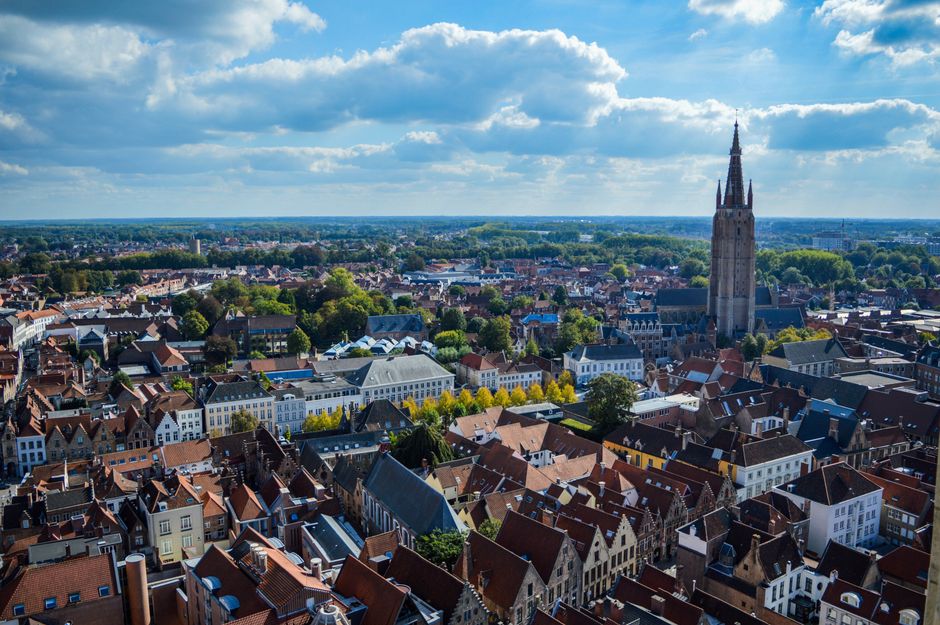
Bruges looks like a medieval painting come to life: stepped gables reflected in quiet canals, swans gliding under hump-backed bridges, cobbled squares watched over by the Belfry, and church towers rising above red-brick lanes. In the 15th century it was one of the richest cities in northern Europe; then its link to the sea silted up and the city fell asleep, which is why so much survives. Its whole historic centre is a UNESCO World Heritage Site. You come to climb the Belfry, take a boat along the canals, see Michelangelo’s Madonna and Child, walk through the peaceful Beguinage, and taste chocolate and beer in a city small enough to cross on foot in half an hour. It is just an hour from Brussels by train, but it rewards an overnight stay: the streets are magical in the evening, after the day-trippers have left.
Right now in Bruges
- Wed12–18°C53–65°F9 mm rain
- Thu11–14°C53–57°F5 mm rain
- Fri8–15°C47–60°F13 mm rain
Top tours in Bruges
See all tours for Bruges →
From local operators, with prices and reviews; you check availability and book on Viator, our partner. We may earn a commission at no extra cost to you. How we earn money
Bruges at a glance
- Best for: canals and medieval streets, the Belfry, Flemish primitive painting, boat trips, chocolate and beer, romantic breaks, Christmas markets and cycling to Damme.
- How long: one full day for the highlights; two days to see the museums, take it slowly and enjoy the evenings; three to add Damme, Ghent or the coast.
- Best time: April to June and September to October for pleasant weather; weekdays to avoid crowds; late November to early January for the Christmas markets.
- Getting in: three direct trains an hour from Brussels-Midi take about 1 hour, and there is a direct hourly train from Brussels Airport. The station is a 20-minute walk from the Markt.
- Getting around: on foot or by bike; the centre is compact and many streets are car-free. As of October 2026, a canal boat trip costs €15.
- Know before you go: the Groeninge Museum closes on 11 January 2027 for four years; its highlights move to the new BRUSK art gallery next door.
Bruges, area by area
The historic centre is an egg-shaped island ringed by a canal and the green ramparts (the vesten) where the city walls stood. Almost everything is within 15 minutes’ walk of the Markt. The railway station lies just outside the ring to the south-west.
The Markt and the Burg
The two main squares: the Markt, with the Belfry, the neo-Gothic Provincial Court and rows of gabled guild houses, and the smaller Burg next door, with the Gothic City Hall, the Basilica of the Holy Blood and the Liberty of Bruges. Best for: first-time visitors who want to be in the centre of things.
The canals to the Beguinage
South of the Burg, the Rozenhoedkaai (the most photographed spot in Bruges), the Dijver with the Groeninge Museum and BRUSK, the Church of Our Lady, St John’s Hospital and the Beguinage beside the Minnewater, the “Lake of Love”. Best for: the classic postcard views and the main museums.
Sint-Anna and the windmills
East of the centre, quiet residential streets lead to the Jerusalem Church, the lace centre, the Folk Museum and the windmills on the Kruisvest ramparts. Best for: peaceful walks, a local feel and bed and breakfasts.
‘t Zand and the west
The large square of ‘t Zand, with the modern Concertgebouw concert hall and an underground car park, is the gateway from the station; the shopping streets Steenstraat and Noordzandstraat lead to the Markt. Best for: travellers with cars or early trains, and mid-range hotels.
Top things to see in Bruges
Prices and hours below were checked on the official sites in October 2026. They change, so check before you go. Most Musea Brugge museums are closed on Mondays (the Gruuthuse Museum on Wednesdays).
The Belfry (Belfort)
The 83-metre Belfry has towered over the Markt since the 13th century and is part of the UNESCO-listed belfries of Belgium and France. Climb its 366 narrow, steep steps, past the carillon’s drum, to the bell chamber for a view over the rooftops. Only small groups can climb at once (about 15 to 25 people every 20 minutes), so book a time slot online. As of October 2026, tickets cost €16 for adults and €14 for ages 7 to 17 (€15 and €13 on weekdays from November to March); children under 7 go free. It opens daily 9:00–20:00 from April to early November and 10:00–18:00 in winter (Saturdays until 20:00), with last entry an hour before closing. The tower is closed for maintenance from 19 to 22 October 2026 and may close in strong winds.
The Church of Our Lady and Michelangelo’s Madonna
The 115-metre brick spire of the Church of Our Lady is the second-tallest brick church tower in the world. The church itself is free to enter; a ticket for the museum section shows the white marble Madonna and Child by Michelangelo, the only one of his sculptures to leave Italy in his lifetime, and the tombs of Mary of Burgundy and her father Charles the Bold. As of October 2026, the museum costs €10 for adults (free under 13), or €19 combined with the Gruuthuse Museum, and opens 9:30–17:00 (Sundays from 13:30).
The Groeninge Museum and BRUSK
The Groeninge Museum holds one of the world’s finest collections of Flemish primitives, including Jan van Eyck’s Madonna with Canon Joris van der Paele and Hans Memling’s Moreel Triptych, as well as works by Hieronymus Bosch, Gerard David and Magritte. It closes on 11 January 2027 for a four-year refurbishment; from March 2027, the heart of the collection will be shown at BRUSK, the new art gallery next door on the Dijver. As of October 2026, the Groeninge costs €15 for adults (free under 13) and BRUSK, with its 2026 exhibition by the digital artist Refik Anadol, €20. Both open 10:00–18:00 from April to early November and 9:30–17:00 in winter, closed on Mondays.
The Burg: City Hall and the Basilica of the Holy Blood
The City Hall (1376–1421) is one of the oldest in the Low Countries; its Gothic Hall has a vaulted wooden ceiling and murals of the city’s history. As of October 2026, entry costs €8, including the Liberty of Bruges. In the corner of the square, the Basilica of the Holy Blood has a dark Romanesque lower chapel and an ornate upper chapel holding a relic said to contain drops of Christ’s blood, brought to Bruges in the Middle Ages. The basilica is free and open daily 10:00–17:15; the museum and treasury cost €5. The relic is shown for veneration daily from 14:00 to 16:00. Every year on Ascension Day it is carried through the streets in the Procession of the Holy Blood, a UNESCO-listed pageant; the next is on 6 May 2027.
St John’s Hospital and the Gruuthuse Museum
One of Europe’s oldest surviving hospital buildings, St John’s Hospital tells the story of medieval care and holds six masterpieces by Hans Memling, including the Shrine of St Ursula; its 17th-century pharmacy is a gem. The Gruuthuse Museum, in the palace of a powerful 15th-century family, covers Bruges’ golden age with tapestries, lace and a private oratory looking into the Church of Our Lady. As of October 2026, each costs €15 for adults (free under 13); St John’s is closed on Mondays and Gruuthuse on Wednesdays.
The Beguinage and the Minnewater
The Beguinage (Begijnhof), founded in the 13th century for beguines, religious women who lived in community without taking vows, is a calm enclosure of white houses around a lawn of tall trees. It is free to enter; keep your voice down. Just south, the Minnewater lake is lovely at dusk.
The windmills on the ramparts
Four windmills stand on the eastern ramparts along the Kruisvest, a pleasant walk or cycle from the centre. The Sint-Janshuis Mill, still working, can be visited from April to early November (closed Mondays) for €5 as of October 2026.
Monuments
- Beguinage (Ten Wijngaerde)
- Belfry of Bruges
Churches and cathedrals
- Basilica of the Holy Blood
- Church of Our Lady, Bruges
Other sights
- Bruges City Hall
- St John's Hospital (Sint-Janshospitaal)
Museums
- Groeninge Museum
Canal boats, chocolate and beer
Boat trips on the canals
A 30-minute trip on the canals between Jan van Eyck Square and the Beguinage shows you hidden gardens and façades you cannot see from the street. Five companies run open boats from five landing stages (Huidenvettersplein, Rozenhoedkaai, Wollestraat, Nieuwstraat and Katelijnestraat), all with the same route and the same price, set by the city: as of October 2026, €15 for adults and €9 for children aged 4 to 11 (free under 4). From March to October boats run daily from 10:00 to 18:00; from November to February at least one landing stage is open each day, on a rota. You cannot book ahead, so expect queues on summer afternoons; go early or late. See our boat trips guide.
Chocolate, beer and food
Bruges has dozens of chocolate shops, from small family makers to chains; For beer, the De Halve Maan brewery, in the centre since 1856, runs tours and pumps its beer to the bottling plant through a 3-km underground pipeline, and cafés such as ‘t Brugs Beertje serve hundreds of Belgian beers. Try stoverij, Flemish beef stew made with beer.
Christmas and events in Bruges
Winter Glow (Wintergloed) now lasts almost the whole winter, from 20 November 2026 to 14 February 2027, with light installations, a new “Winter Giant” project, an ice rink and winter bars. The two Christmas markets, on the Markt and Simon Stevinplein, open from 20 November 2026 to 3 January 2027: 11:00–20:00 from Sunday to Thursday and 11:00–21:00 on Fridays and Saturdays (some stalls later), until 17:00 on Christmas Eve and 20:00 on New Year’s Eve.
Activities and best months
- Boat tripsFive boat companies run the same half-hour canal trip between Jan van Eyck Square and the Beguinage, past the Rozenhoedkaai, the Groenerei and the Church of Our Lady, from jetties such as Rozenhoedkaai and Huidenvettersplein. Boats sail daily 10:00-18:00 from March to October and on a rota (at least one jetty) in winter; tickets are bought on the spot only (EUR 15 adults, EUR 9 ages 4-11, valid to 31 December 2026). The Lamme Goedzak paddle boat also sails to Damme in season.
- City sightseeingThe 83-metre Belfry on the Markt, a UNESCO World Heritage Site since 1999 with Belgium's and France's other belfries, has 366 steps past the treasury and the carillon's drum room to a bell chamber with a 360-degree view. Entry is by time slot (about 15-25 visitors every 20 minutes), so Visit Bruges recommends booking ahead; adults pay EUR 16 (EUR 15 on winter weekdays).
- CyclingMost streets in the historic centre form a bicycle zone where cars may not go faster than 30 km/h or overtake cyclists, which Visit Bruges says makes the city extremely bicycle-friendly. Bikes and e-bikes can be rented around town, and the shared Blue-bike and Hoppy systems are available; slow down in busy spots such as the Markt.
Day trips from Bruges
- Damme: a pretty village 7 km north-east along the poplar-lined Damme Canal, with a Gothic town hall and bookshops. Cycle there in about half an hour (see our cycling guide) or take the paddle steamer Lamme Goedzak from the Noorweegse Kaai, about 35 minutes each way. In 2026 it sails daily from April to 4 October, then at weekends until 1 November; as of October 2026, a single costs €12 and a return €18. Bikes are no longer allowed on board.
- Ghent: a bigger, livelier medieval city with the Ghent Altarpiece and the Gravensteen castle; about 25 minutes by train.
- The Belgian coast: trains run to Ostend, Blankenberge and Knokke in 15 to 25 minutes, and the coast tram links all the seaside towns. See our beaches guide.
- Ypres and Flanders Fields: the First World War battlefields, cemeteries and the Menin Gate, where the Last Post is played every evening at 20:00, about an hour away by car or on a guided tour.
- Lissewege and Zeeland: the white village of Lissewege is part of Bruges, 20 minutes by train; across the Dutch border, Sluis and the beaches of Zeeland are close by; see our Zeeland guide.
Nearby destinations
Getting to Bruges
By train. Get off at “Brugge” station, not Brugge-Sint-Pieters. From Brussels-Midi, three direct trains an hour (towards Ostend, Knokke or Blankenberge) take about 1 hour, also stopping at Brussels-Central and Brussels-Nord; there are direct trains from Ghent, Antwerp and Leuven too. From London or Paris, change at Brussels-Midi, or at Lille for some connections; see our London guide and Paris guide. From the station, walk 20 minutes to the Markt, or take one of the frequent De Lijn buses to the centre.
By air. From Brussels Airport there is a direct train every hour, and other trains connect in Brussels. From Charleroi Airport, Flibco runs direct buses to the back of Bruges station, timed to flights. A taxi from Brussels Airport costs about €200 at a flat rate.
By car. Bruges is just off the E40 between Brussels and the coast. Driving in the centre is discouraged: many streets are car-free or one-way at set times, and street parking is paid. Park for free at a park-and-ride on the edge of town (such as Boogschutterslaan) or in the large Centrum-Station car park next to the station, where, as of October 2026, parking costs €1.40 an hour up to a maximum of €7.10 for 24 hours and includes a free return bus to the centre for up to four people (get the P+Bus ticket from De Lijn). The underground Centrum-‘t Zand car park is 10 minutes’ walk from the Markt but costs more.
Getting around Bruges and the Musea Brugge Card
Walk: the centre is compact and the best of Bruges is found in its side streets. Cycling is a pleasure too, and in most one-way streets bikes may ride both ways; rent a bike near the station or in the centre, or use the shared Blue-bike and Hoppy systems.
The Musea Brugge Card gives one entry to each of the city’s 12 or so municipal museums and sites for 72 hours, including the Belfry, BRUSK, the Groeninge Museum, the Church of Our Lady museum, St John’s Hospital, the Gruuthuse Museum, City Hall and the windmills. As of October 2026, it costs €49 for adults, €37 for under-26s and €25 for under-18s. With the Belfry (€16) and two €15 museums you have already passed the break-even point. You still need to book a time slot for the Belfry. Belgium’s annual museumPASSmusées is also valid.
When to go and how long to stay
Bruges, 15 km from the North Sea, has a mild maritime climate: cool summers, mild winters and rain in every month, with the wettest weather in autumn. The table uses the official 1991–2020 climate normals of the Royal Meteorological Institute of Belgium (RMI/KMI/IRM) for Ostend Airport, the nearest main station, about 20 km west on the coast; inland Bruges is usually slightly warmer by day in summer and colder on winter nights.
| Season | Average temperature | Average daily high | Rain per month | Sunshine per month | What it’s like |
|---|---|---|---|---|---|
| Winter (Dec–Feb) | 4.1–4.7 °C | 6.7–7.4 °C | 56–86 mm | 53–87 hours | Grey, damp and windy; Christmas markets and Winter Glow, quiet museums, cheap hotels |
| Spring (Mar–May) | 6.4 °C rising to 12.4 °C | 10.0–16.3 °C | 41–54 mm | 143–230 hours | The driest season; daffodils in the Beguinage, boats back in full service |
| Summer (Jun–Aug) | 15.3–17.4 °C | 19.1–21.7 °C | 63–82 mm | 224–239 hours | Pleasant and long evenings, but the busiest time; book rooms early |
| Autumn (Sep–Nov) | 14.9 °C falling to 7.6 °C | 19.1 falling to 10.4 °C | 73–89 mm | 172 falling to 67 hours | September is often lovely; wetter and windier from October |
Ostend gets about 800 mm of rain a year and about 1,840 hours of sunshine, with an average temperature of 10.4 °C. Bruges is busiest from late morning to late afternoon, at weekends, in July and August, and on days when cruise ships call at the nearby port of Zeebrugge. Stay the night and explore early and late, when the streets are almost empty. In January, after the Christmas holidays, some museums and attractions close for a few weeks.
Bruges in 1 day
Climb the Belfry at opening time, then see the Burg, the Basilica of the Holy Blood and the Rozenhoedkaai. Take a canal boat before the queues build, visit the Church of Our Lady and the Groeninge Museum or BRUSK, walk through the Beguinage to the Minnewater, and finish with a beer in a canal-side café.
Bruges in 2–3 days
Add St John’s Hospital and the Gruuthuse Museum, a brewery tour, the Sint-Anna district and the windmills on day 2, with an evening walk along the lit canals. On day 3, cycle or sail to Damme, or take the train to Ghent or the coast.
Weather month by month
Where to stay in Bruges
- Around the Markt and the Burg: historic hotels in the middle of everything; the busiest area by day.
- Along the canals near the Dijver and Beguinage: romantic canal-view rooms and guesthouses; book well ahead.
- Sint-Anna and Sint-Gillis: quiet streets of bed and breakfasts, 10 minutes’ walk from the Markt.
- Near the station and ‘t Zand: modern and budget hotels, handy for trains and car parks.
Prices are highest on summer and December weekends; midweek stays and the months of January to March are much cheaper. As of October 2026, Bruges charges an accommodation tax of €4.20 per person per night in hotels and guesthouses (including VAT; €1.68 at campsites), with under-18s exempt; it appears as a separate item on your bill.
Practical tips for Bruges
- Book the Belfry: time slots are limited and sell out on busy days; it is closed from 19 to 22 October 2026.
- See the Groeninge in time: it closes on 11 January 2027 for four years; afterwards, the highlights are at BRUSK.
- Mind Mondays: most museums are closed, though the Belfry, the boats and the churches are open.
- Go early or stay late: day-trippers and tour groups fill the centre from about 10:30 to 17:00, especially on cruise-ship days.
- Watch for bikes: cyclists can ride both ways in many one-way streets, and the cobbles are slippery when wet.
What to pack for Bruges
A light waterproof jacket or umbrella in every season, flat, comfortable shoes with a good grip for cobbles and the Belfry’s 366 steps, layers for sea breezes, and a warm coat, hat and gloves for the Christmas markets.
What to pack
- City walking shoesLisbon and Porto are steep, with polished limestone cobbles that get slippery, so grippy soles matter.
- Day packs and anti-theft bagsA small zipped or anti-theft bag makes crowded trams and viewpoints less stressful.
- Dry bags and phone pouchesSpray soaks phones and cameras on open boats to the Algarve caves and on whale-watching trips.
- Fleeces and warm layersIt is cooler at sea than on land, especially on morning whale-watching trips.
- Rain jacketsA windproof, waterproof shell keeps you warm on open boats, where wind and spray cool you quickly.
- Reef-friendly sunscreenSun reflects off the water on cruises and cave tours.
- Travel adapters and convertersPortugal uses Type C and F sockets at 230 V, so most visitors from outside Europe need an adapter.
- Water bottles and hydration packsRiding in the Algarve and Alentejo heat needs more water than you expect.
- Water shoesKayak and small-boat trips to the Algarve grottoes land on rock and wet sand.
Bruges travel FAQ
Do you need to book the Belfry in Bruges?
It is strongly recommended: only about 15 to 25 people can start the climb every 20 minutes. As of October 2026, tickets cost €16 for adults (€15 on winter weekdays) and €14 for ages 7 to 17.
How much is a boat trip in Bruges?
As of October 2026, €15 for adults and €9 for children aged 4 to 11, the same at all five landing stages. Trips last about 30 minutes and cannot be booked in advance.
Where can I see Michelangelo’s Madonna in Bruges?
In the museum section of the Church of Our Lady. The church is free, but the museum, with the Madonna and Child and the Burgundian tombs, costs €10 as of October 2026.
Is the Groeninge Museum closing?
Yes. It closes on 11 January 2027 for a four-year refurbishment. From March 2027, the highlights of the collection will be shown at BRUSK, next door on the Dijver.
Is the Musea Brugge Card worth it?
Yes, if you visit the Belfry and at least two other museums within 72 hours. As of October 2026, it costs €49 for adults, €37 for under-26s and €25 for under-18s.
How do I get from Brussels to Bruges?
By train: three direct trains an hour from Brussels-Midi take about 1 hour, also calling at Brussels-Central and Brussels-Nord. Get off at “Brugge” and walk 20 minutes to the Markt.
Where should I park in Bruges?
In the Centrum-Station car park next to the station (as of October 2026, €1.40 an hour, maximum €7.10 a day, with a free bus to the centre) or at a free park-and-ride on the edge of town.
Is there a tourist tax in Bruges?
Yes. As of October 2026, hotels and guesthouses add €4.20 per person per night, including VAT; under-18s are exempt.
When is the Bruges Christmas market in 2026?
The Christmas markets on the Markt and Simon Stevinplein run from 20 November 2026 to 3 January 2027. The wider Winter Glow programme continues until 14 February 2027.
Is Bruges worth more than a day trip?
Yes. One day covers the highlights, but staying overnight lets you enjoy the canals in the evening and early morning without the crowds, and adds time for the museums and Damme.
When is the best time to visit Bruges?
April to June and September for pleasant weather and fewer crowds than summer, ideally midweek; late November to early January for the Christmas markets.
Plan your trip
Partner links: TravelerCenter may earn a commission if you book, at no extra cost to you.
🇳🇱 Useful Dutch phrases for Bruges
All 38 Dutch phrases: restaurant, hotel, emergencies, romance (printable) →
Sources · last reviewed 4 October 2026
Researched and last reviewed on 4 October 2026. Museum prices, hours, the Belfry closure, the Groeninge closure and BRUSK: Musea Brugge (museabrugge.be) and Visit Bruges; boat trips, Christmas markets, Winter Glow, parking, trains, coaches and the accommodation tax: Visit Bruges (visitbruges.be); the Basilica of the Holy Blood and the 2027 procession: holyblood.com; the Damme boat: Lamme Goedzak; climate: RMI 1991–2020 normals for Ostend Airport, as published by the WMO. Train journey times to Ghent and the coast, Ypres and the Menin Gate, the breweries and the festivals come partly from general knowledge and are flagged for checking. Prices, timetables and rules change, so check the official links before you go. For other canal cities nearby, see our Amsterdam guide; and for the coast across the border, our Zeeland guide.
Also: visitbruges.be · RMI normals 1991–2020, Oostende Airport (climate)
Data: Weather: MET Norway (CC BY 4.0) · Sea temperature: NOAA CoastWatch · Rates: ECB · Costs: World Bank ICP and price levels · © OpenStreetMap contributors (ODBL) · Wikidata (CC0)