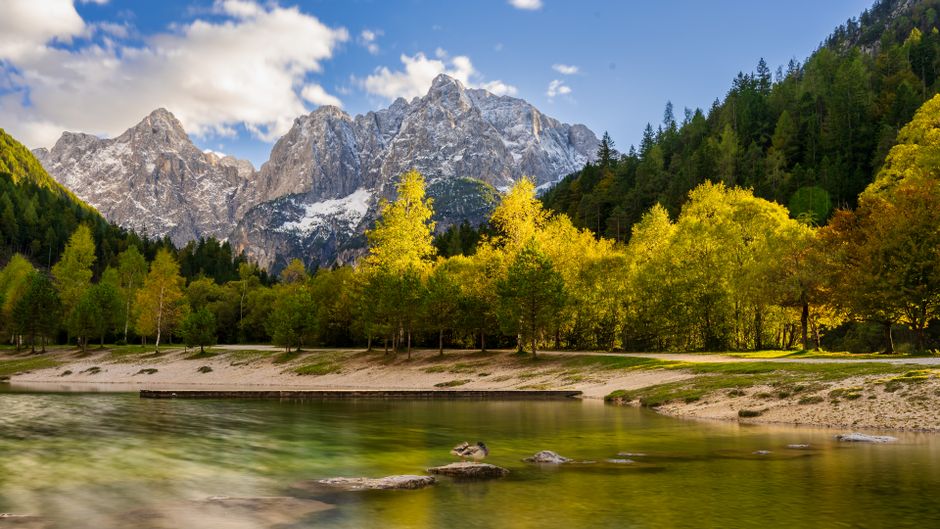
Triglav National Park is Slovenia’s only national park and one of the oldest in the Alps, protecting almost the whole of the Julian Alps around Mount Triglav (2,864 m), the country’s highest peak and national symbol. It is a place of limestone summits and high pastures, glacial lakes, deep gorges, waterfalls and two great valleys: Bohinj on the eastern side, with its large, clear lake, and the Soča valley on the western side, with its astonishingly blue-green river. You come to hike, swim, raft, cross the Vršič pass, ride the Vogel cable car and walk the gorges, staying in Bohinj, Bled, Kranjska Gora, Bovec or Kobarid. There is no entrance fee for the park itself. Give it at least three days; a week is better.
Right now in Triglav National Park (Ribčev Laz, Lake Bohinj)
- Wed11–17°C51–63°F3 mm rain
- Thu13–16°C55–60°F37 mm rain
- Fri10–14°C50–57°F5 mm rain
Top tours in Triglav National Park
See all tours for Triglav National Park →
From local operators, with prices and reviews; you check availability and book on Viator, our partner. We may earn a commission at no extra cost to you. How we earn money
Triglav National Park at a glance
- Best for: hiking from easy lake walks to Triglav’s summit, wild swimming, rafting and kayaking on the Soča, mountain drives, gorges and waterfalls.
- How long: 3 days for Bohinj, Vogel and one side of the Vršič pass; 5–7 days to add the Soča valley and a hut-to-hut hike.
- Best time: late June to September for high trails and huts; May to June and September to October for valleys, waterfalls and fewer people.
- Getting in: Bohinj is about 1 hour 15 minutes by car from Ljubljana (about 1 hour 45 minutes by bus); Kranjska Gora about 1 hour; the Soča valley about 2 hours via the Vršič pass in summer.
- Getting around: by car, local summer shuttles and buses; the Vršič pass is usually closed to cars in winter and spring.
- Before you go: drones and wild camping are banned in the park. Parking is paid at popular trailheads, and you need an e-vignette for Slovenian motorways.
How the park works: the areas and their bases
The park covers about 840 km², around 4% of Slovenia, along the borders with Italy and Austria. Its first protected area, around the Valley of the Triglav Lakes, dates from 1924, and it became a full national park with its present boundaries in 1981. Mount Triglav (“three heads”) sits in the middle, so the park is visited from several valleys, each with its own base towns.
Bohinj (south-east)
Lake Bohinj, the largest permanent natural lake in Slovenia at about 4.2 km long, is ringed by mountains, with the villages of Ribčev Laz, Stara Fužina and Ukanc on its shores. Here are the Vogel cable car, the Savica waterfall, the Mostnica gorge and the start of the trail to the Triglav Lakes. Base: Bohinj’s lakeside villages or Bohinjska Bistrica.
Bled, Pokljuka and Radovna (east)
Bled itself lies just outside the park, but its Vintgar gorge is inside, and the forested Pokljuka plateau and the quiet Radovna valley lead towards Triglav’s eastern approaches. Base: Bled.
Kranjska Gora and the Vrata valley (north)
From Mojstrana, the Vrata valley ends below Triglav’s huge 1,000 m north face, with the Peričnik waterfall on the way. Further west, Kranjska Gora is the gateway to the Vršič pass, Lake Jasna and the Planica valley. Base: Kranjska Gora or Mojstrana.
Trenta and the Soča valley (west)
Over the Vršič pass, the Trenta valley follows the young Soča river from its source past emerald pools, the Great Soča Gorge and down to Bovec. Just outside the park, Kobarid and Tolmin complete the valley. Base: Bovec, Trenta or Kobarid.
Top things to see in Triglav National Park
Prices and hours below were checked in October 2026. They change, so check before you go.
Lake Bohinj
Walk around the lake (about 12 km, 3–4 hours), swim in its clear, cool water in July and August, take the electric panoramic boat between Ribčev Laz and Ukanc in season, or rent a kayak or paddleboard. At Ribčev Laz, the small Church of St John the Baptist by the stone bridge has medieval frescoes. Motorboats are not allowed, and the lake stays quiet even in summer.
The Vogel cable car
From Ukanc, at the western end of the lake, a cable car climbs to about 1,535 m in a few minutes, with a view straight across to Triglav and down to the lake. From the top, chairlifts and paths lead higher on the Vogel ridge; in winter it is a ski area. As of the 2026 summer season, a return ticket cost €35 for adults and €19 for children, with combined Bohinj packages available; it runs every half hour from about 8:00 to 18:00 in summer. Check the autumn timetable and any maintenance closure before you go.
The Savica waterfall
Above Ukanc, the Savica, one of the sources of the Sava river, drops about 78 m in an A-shaped cascade from a cave in the cliff. It is about 20–30 minutes’ walk up some 500 steps from the car park. A small entrance fee is charged at the path (about €3–4 for adults in 2026), and parking is paid. In autumn 2026, a local bus line ran to the waterfall.
The Valley of the Triglav Lakes
A high karst valley holding a chain of seven (some say ten) small glacial lakes between about 1,300 and 2,000 m, the oldest protected part of the park. The classic approach is the steep Komarča path from Savica to the Black Lake (about 1 hour 30 minutes), then on to the Seven Lakes hut. It is a full day’s hike, or an overnight stay in a mountain hut, from late June to September.
The Vršič pass
At 1,611 m, Vršič is Slovenia’s highest road pass, with 50 numbered hairpins (24 on the Kranjska Gora side and 26 on the Trenta side). It was built during the First World War by Russian prisoners of war, and the wooden Russian Chapel beside hairpin 8 remembers those killed by an avalanche in 1916. The road is usually closed by snow from late autumn until spring. In summer 2026, barriers controlled traffic on the pass, parking at the summit was closed until the end of August, and a free bus ran between Kranjska Gora and Bovec over the pass from 1 June to 30 September, almost hourly in high season.
The Soča river and its gorges
The Soča’s colour comes from the white limestone bed and the pure, cold water. A short path leads to its source in a cave at the head of the Trenta valley, and the long-distance Soča Trail follows the river through the park. Don’t miss the Great Soča Gorge near Soča village and the suspension bridges further down. Just outside the park near Kobarid, the Kozjak waterfall falls into a cave-like chamber; as of 2026, a small entrance fee is charged from spring to autumn. At the park’s southern edge, the Tolmin Gorges are a short loop through narrow canyons with the “Bear’s Head” rock wedged between the walls; as of October 2026, tickets cost €8 for adults in spring and autumn and €12 from June to September (children €4 and €6), and booking a time slot online is recommended.
The Vintgar gorge
Near Bled, the Radovna river runs through the 1.6 km Vintgar gorge on wooden walkways to the Šum waterfall. As of October 2026, entry is by timed slot with an All-in-One Pass costing €15 for adults and €5 for children, including the shuttle from a free central car park in Bled; it closes in winter.
Peaks and mountains
- Triglav
Nature
- Lake Bohinj
- Savica Falls
- Tolmin Gorges
- Valley of the Triglav Lakes
Viewpoints
- Vogel
- Vršič Pass
Climbing Triglav and hiking hut to hut
Climbing Triglav is a Slovenian rite of passage, but it is a serious mountain. All routes to the summit end with exposed sections protected by steel cables and pegs, a simple via ferrata, so you need a head for heights, a helmet and, ideally, a climbing harness and via ferrata set. Most people take two days, staying overnight at a mountain hut such as Kredarica (2,515 m), the highest hut in Slovenia, or Planika. Popular approaches start from the Vrata valley, Pokljuka, Bohinj via the Seven Lakes, or Trenta. If you’re not an experienced mountain walker, hire a licensed mountain guide.
The main huts open from about June or July to the end of September; in 2026, the Kredarica hut was open from 6 June to 30 September. Book beds ahead in July and August through the huts or the Alpine Association of Slovenia (PZS). Bring cash, a sleeping-bag liner and hut slippers. Snow can lie on high trails until July, and afternoon thunderstorms are common: start early and be off exposed ridges by early afternoon.
For something gentler, the Juliana Trail is a 270 km multi-day loop around the Julian Alps through valleys and villages, mostly below 1,000 m. Easy day walks include the Mostnica gorge and the Devil’s Bridge near Stara Fužina, Lake Jasna, Planica and the Pokljuka gorge. See our hiking guide.
Activities and best months
- Boat tripsAprMayJunJulAugSepOctTwo quiet electric panoramic boats, Triglavska roža and Zlatorog, cross Lake Bohinj between Ribčev Laz (by the bridge and St John's church) and Ukanc in about 30 minutes, daily from early April to 1 November 2026, most often in summer.
- HikingThe park has 826 km of mountain trails (43 km difficult, 24 km very difficult) and 38 mountain huts that can be booked online; the 267 km Juliana Trail circles the Julian Alps through the valleys without climbing the peaks.
Rafting, kayaking and other adventures
Bovec is Slovenia’s adventure capital. Licensed outfitters run rafting, kayaking and canyoning on the Soča and its tributaries from about April to October, when snowmelt or rain gives enough water; the river is cold (often under 10 °C), so wetsuits, helmets and life jackets are provided. Paragliding, ziplining and mountain biking are also popular around Bovec and Kobarid. Navigation on the Soča is regulated: private kayakers need a permit, and entry points are fixed.
Park rules
- No wild camping: camping and sleeping in vans or tents are allowed only in campsites; fines are enforced.
- No drones without special permission.
- Stay on marked trails, take your rubbish home, don’t light fires, and don’t pick protected plants such as edelweiss.
- Dogs on a lead, and keep away from grazing herds on the high pastures.
- Cycling only on roads and marked bike routes, not on hiking trails.
- Camper vans are banned on some narrow roads in summer, including the road from Ukanc to the Savica waterfall in July and August.
Around the park: Kobarid, Bovec and Kranjska Gora
Kobarid’s museum tells the story of the Isonzo Front of the First World War, when Italian and Austro-Hungarian armies fought twelve battles along the Soča, and a historical trail leads to trenches, an Italian ossuary and the Kozjak waterfall. Bovec has an airfield, cafés and the Kanin ski area. Kranjska Gora, near the Austrian and Italian borders, has hiking, cycling and summer bobsleigh in summer and skiing in winter, and the Planica Nordic centre for ski jumping. All three make good bases outside the park’s core.
Nearby destinations
Getting there and getting around
By car. From Ljubljana, take the A2 motorway (e-vignette needed) towards Jesenice, then turn off for Bled and Bohinj, or continue to Kranjska Gora. To reach the Soča valley when the Vršič pass is closed, drive via Italy’s Predel pass or take the car train through the Bohinj tunnel from Bohinjska Bistrica to Most na Soči (about 45 minutes; tickets on board). Parking at Bohinj, Savica, Vogel, Vrata and the gorges is paid and fills early in summer.
By bus. Buses run from Ljubljana via Bled to Bohinj and to Kranjska Gora, and from Ljubljana and Nova Gorica to Tolmin, Kobarid and Bovec. In summer, local shuttles link Bohinj’s car parks with Ukanc, Vogel, Savica and the high pastures, and the free Vršič bus links Kranjska Gora and Bovec.
By train. The scenic Bohinj railway runs from Jesenice via Bled Jezero and Bohinjska Bistrica to Most na Soči and Nova Gorica, close to Tolmin. As of October 2026, works on the main line from Ljubljana to Jesenice mean replacement buses on several dates, so check Slovenian Railways before you travel.
Information centres. The park runs visitor centres including Dom Trenta in the Trenta valley, Triglavska roža in Bled and centres in Stara Fužina (Bohinj) and Mojstrana (the Slovenian Alpine Museum), with maps, exhibitions and advice.
When to go and how long to stay
The Julian Alps are one of the wettest parts of Europe: moist air from the Adriatic hits the mountains and falls as heavy rain, especially in autumn. Summers in the valleys are warm, while the high peaks stay cool and can see snow at any time. The table uses ARSO’s official 1991–2020 averages for Bohinjska Češnjica (596 m), in the Bohinj valley.
| Season | Average daily high | Average night low | Rain per month | What it’s like |
|---|---|---|---|---|
| Winter (Dec–Feb) | 4–6 °C | −5 to −4 °C | 100–181 mm | Cold, often snowy; skiing at Vogel and Kranjska Gora; Vršič closed |
| Spring (Mar–May) | 11 °C rising to 20 °C | −1 to 7 °C | 127–140 mm | Waterfalls in full flow; snow on high trails into June |
| Summer (Jun–Aug) | 24–26 °C | 11–12 °C | 145–165 mm | Warm valleys, cool peaks, frequent afternoon storms; huts open |
| Autumn (Sep–Nov) | 21 °C falling to 9 °C | 9 °C falling to 1 °C | 211–257 mm | Golden larches and beeches in September and October; heavy rain later |
Bohinj gets about 1,940 mm of rain a year on about 119 days, half as much again as Ljubljana, and the mountains above get more. Above 2,000 m, it is much colder: expect freezing nights even in summer, and check the mountain forecast from ARSO before setting out.
Triglav National Park in 3 days
Day 1: Lake Bohinj, the Savica waterfall and the Vogel cable car. Day 2: the Vintgar gorge and the Pokljuka plateau, or the Vrata valley and Peričnik waterfall. Day 3 (June to October): over the Vršič pass to the Soča source, the Great Soča Gorge and Bovec, returning or continuing to the coast.
Triglav National Park in 6 days
Two nights in Bohinj, with a hike to the Triglav Lakes; two nights in Kranjska Gora or the Vrata valley, with a two-day guided ascent of Triglav or a hut-to-hut walk; and two nights in Bovec or Kobarid for rafting, the Kozjak waterfall, the Tolmin Gorges and the war museum.
Weather month by month
Where to stay in and around the park
- Bohinj: lakeside hotels, guesthouses and apartments in Ribčev Laz, Stara Fužina and Ukanc; a big campsite at Ukanc.
- Bled: the widest choice and the best transport, 30 minutes from Bohinj.
- Kranjska Gora and Mojstrana: hotels and apartments at the foot of the Vršič pass and the Vrata valley.
- Bovec, Trenta and Kobarid: guesthouses, adventure lodges, glamping and riverside campsites in the Soča valley.
- Mountain huts: dormitories and simple rooms, open roughly June to September; book ahead in high season.
Practical tips for Triglav National Park
- Start early: car parks at Savica, Vogel and Vrata fill by mid-morning in summer, and storms build in the afternoon.
- Check the Vršič pass: it opens and closes with the snow; when closed, use the Predel pass or the car train.
- Carry cash: mountain huts, waterfall kiosks and some car parks don’t take cards.
- Get insured: make sure your travel insurance covers mountain rescue.
- Respect the cold water: the Soča is beautiful but icy and fast; swim only in calm, known spots.
What to pack for Triglav National Park
Proper hiking shoes or boots with grip for wet limestone, a waterproof jacket for sudden storms (see our guide to rain jackets), warm layers, a hat and gloves for high trails even in August, sunscreen and sunglasses, a refillable water bottle and a first-aid kit. For Triglav itself, add a helmet and a via ferrata set. For the lakes and the Soča, pack swimwear and water shoes for stony entries.
What to pack
- Day packs and anti-theft bagsA 20–30 litre pack carries layers, water, a head torch and snacks on full-day levada walks.
- Dry bags and phone pouchesSpray soaks phones and cameras on open boats to the Algarve caves and on whale-watching trips.
- Fleeces and warm layersIt is cooler at sea than on land, especially on morning whale-watching trips.
- HeadlampsLevada routes such as PR1 and PR9 pass through long, dark, wet tunnels.
- Hiking shoes and bootsMadeira's levadas and the Azores' crater rims are wet, rocky and slippery, so grippy shoes matter more than anywhere else in Portugal.
- Rain jacketsA windproof, waterproof shell keeps you warm on open boats, where wind and spray cool you quickly.
- Reef-friendly sunscreenSun reflects off the water on cruises and cave tours.
- Trekking polesLong stone staircases and steep descents on Madeira's peaks and the Azores' crater rims are easier on the knees with poles.
- Water bottles and hydration packsAlgarve and Alentejo trails are hot and exposed with few refill points.
- Water shoesKayak and small-boat trips to the Algarve grottoes land on rock and wet sand.
Triglav National Park travel FAQ
Is there an entrance fee for Triglav National Park?
No. You pay only for some attractions, such as the Vintgar gorge, the Savica waterfall, the Tolmin Gorges and the Vogel cable car, and for parking at popular spots.
Where is the best base for Triglav National Park?
Bohinj for lakes and hiking, Bled for transport and choice, Kranjska Gora for the Vršič pass and the north face, and Bovec or Kobarid for the Soča valley and adventure sports. Many people split their stay between two sides of the park.
Can beginners climb Triglav?
Fit beginners can, but only with a licensed mountain guide. The summit routes have exposed, cabled sections, and most people take two days with a night in a hut. The season runs from about late June to September.
When is the Vršič pass open?
Usually from late spring to late autumn, depending on snow. In summer 2026, a free bus ran over the pass from 1 June to 30 September, and summit parking was closed until the end of August. Check road conditions before you go.
Can you swim in Lake Bohinj?
Yes. The water is clear and cool, warmest in late July and August. There are pebble beaches around Ribčev Laz and Ukanc. Motorboats are banned.
Is wild camping allowed in Triglav National Park?
No. Camping and overnight stays in vans or tents are allowed only in official campsites, and rangers issue fines. Drones are also banned without special permission.
How much are the Tolmin Gorges?
As of October 2026, €8 for adults in spring, October and November and €12 from June to September, with lower prices for children, students and seniors. Booking a one-hour time slot online is recommended.
Can I visit without a car?
Yes: buses reach Bled, Bohinj, Kranjska Gora and the Soča valley, and summer shuttles and the free Vršič bus fill the gaps. A car is still easier outside summer and for early starts.
When is the best time to visit Triglav National Park?
Late June to mid-September for high trails, huts and swimming; September and early October for autumn colours and quieter valleys; May and June for waterfalls in full flow.
Plan your trip
Partner links: TravelerCenter may earn a commission if you book, at no extra cost to you.
🇸🇮 Useful Slovenian phrases for Triglav National Park
All 38 Slovenian phrases: restaurant, hotel, emergencies, romance (printable) →
Sources · last reviewed 4 October 2026
Researched and last reviewed on 4 October 2026. The Vršič pass: the Municipality of Kranjska Gora and AMZS; the Tolmin Gorges: Soča Valley Tourist Board; the Vintgar gorge: vintgar.si; Bohinj traffic rules: Bohinj’s official traffic pages; the Vogel cable car: vogel.si; climate: ARSO’s official 1991–2020 averages for Bohinjska Češnjica. The park’s area and rules, the Savica and Kozjak fees, hut opening dates, the car train and railway works come partly from secondary sources (the park’s own site could not be read automatically) and are flagged for checking. Prices, timetables and rules change, so check the official links before you go.
Also: bohinj.si · tnp.si · ARSO normals 1991–2020, Rateče (climate)
Data: Weather: MET Norway (CC BY 4.0) · Rates: ECB · Costs: World Bank ICP and price levels · © OpenStreetMap contributors (ODBL) · Wikidata (CC0)