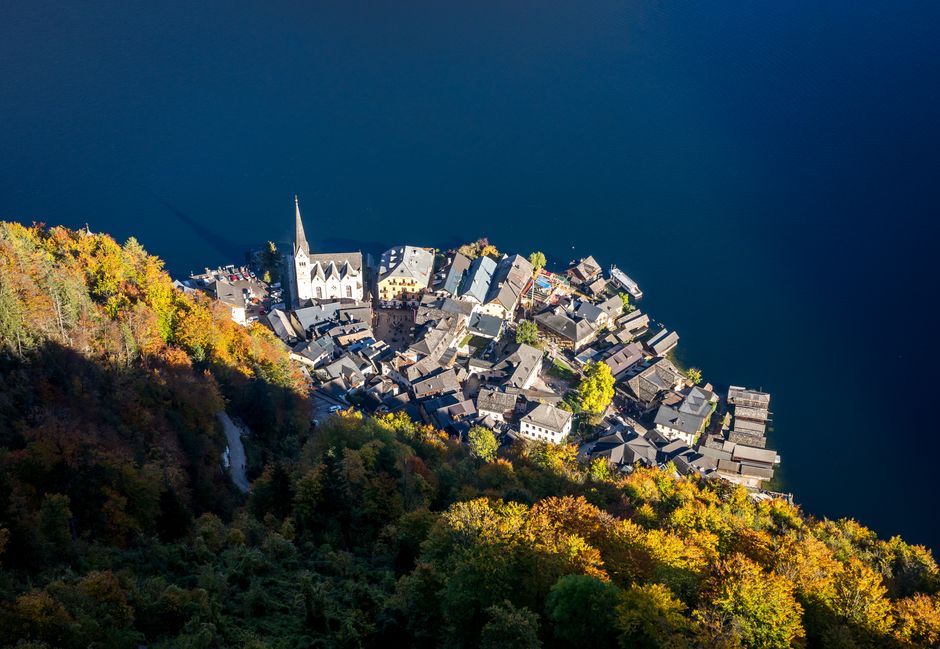
Hallstatt is the village from a thousand postcards: pastel houses and a pointed church spire squeezed onto a ledge between a dark lake and a sheer mountain wall in the Salzkammergut. It is also one of the oldest continuously inhabited places in Europe, where people have mined salt for about 7,000 years and gave their name to a whole Iron Age culture. With fewer than 800 residents and well over a million day visitors a year, it has become a symbol of overtourism, and the village now limits coaches and asks visitors to come quietly and respectfully. Come early or stay the night, ride the new funicular to the salt mine and the Skywalk, see the painted skulls of the Bone House, and add the Dachstein ice caves across the lake. One full day is enough for the village; two lets you enjoy it after the crowds leave.
Right now in Hallstatt
- Wed9–23°C48–74°FMostly clear
- Thu11–20°C51–68°F16 mm rain
- Fri7–11°C44–51°F5 mm rain
Top tours in Hallstatt
See all tours for Hallstatt →
From local operators, with prices and reviews; you check availability and book on Viator, our partner. We may earn a commission at no extra cost to you. How we earn money
Hallstatt at a glance
- Best for: lake and mountain scenery, salt-mining history, the Dachstein caves, gentle walks and a quiet night in a famous village.
- How long: 1 day for the village, the salt mine and the Skywalk; 2 days to add the Dachstein ice caves and the 5fingers platform or the Gosau lakes.
- Best time: May, June, September and October, early in the morning or in the evening; winter is quiet and magical but many things close.
- Getting in: by train to Hallstatt station on the opposite shore and the ferry across, or by bus via Bad Ischl; day-trippers’ cars must use the paid car parks outside the centre.
- Getting around: on foot; the whole village is about 1 km long. As of October 2026, the new Salzbergbahn funicular and salt mine combined ticket costs €49 for adults.
- Before you go: entry rules, money and driving are in our Austria travel guide.
Visiting Hallstatt responsibly: the rules in 2026
Hallstatt has about 740 residents. On busy summer days up to 10,000 visitors arrive, and the mayor has said the village expected a record of around 1.2 million day visitors in 2025. Residents have protested, including a blockade of the tunnel road in August 2023, and the village has introduced a series of measures. As of October 2026, there is no entry fee for the village itself, but these rules apply:
- Coach slots: since July 2020, tour coaches may only arrive and leave with a booked time slot, and must stay at least 2 hours 20 minutes. Since 1 May 2026, the slot fee is €126 per coach. The number of coaches is capped (reported at 54 a day), which has cut peak days from more than 100 coaches to about 40 or 50. If you are on a group tour, check that it has a booked slot.
- No cars in the centre: barriers keep day visitors’ cars out of the historic centre. Park at P1 or P2 at the edge of the village (15 to 20 minutes’ walk) or at P3/P4 further out. As of October 2026, parking costs €5 for an hour, €10 for 3–4 hours and €15 for 7–12 hours; day visitors can’t reserve. Hotel guests may drive to their hotel or use a shuttle from P1.
- The photo spot: the classic postcard view is from the road at the north end of the village. In May 2023 the village briefly put up a wooden screen there to stop crowds blocking the street and residents’ homes; it came down within days. Use the official “Fotopoint” on Gosaumühlstrasse (bus stop Hallstatt Lahn), and don’t stand in the road.
- No drones: Hallstatt is signposted as a no-drone zone, and Austrian law bans flying over built-up areas without a permit.
- Respect private property: people live in these houses. Don’t walk into gardens, onto private jetties or through doorways, keep your voice down, and take your rubbish with you.
The best thing you can do for Hallstatt, and for your own visit, is to stay overnight or arrive before 9:00 or after 17:00. The village is peaceful in the early morning and in the evening, when the coaches have gone.
Top things to see in Hallstatt
Prices and hours below were checked on the official sites in October 2026. They change, so check before you go.
The Salt Mine and the new Salzbergbahn
Salzwelten Hallstatt is the oldest salt mine in the world, worked for about 7,000 years. A guided tour takes you into the mountain in miners’ overalls, down two long wooden miners’ slides, past an underground salt lake and to the “Man in Salt”, a prehistoric miner found preserved in 1734. The Hallstatt high valley above the village is also the site of a huge Iron Age cemetery, whose finds gave the Hallstatt culture its name.
The funicular and the mine closed for about a year for a complete rebuild, and the new Salzbergbahn reopened on 29 August 2026: step-free, with cars for 60 people instead of 24, a ride of under three minutes, a new valley station shop, and a bistro and terrace at the top. As of October 2026, a combined ticket for the funicular and the mine tour costs €49 for adults and €23 for children aged 4 to 15; the funicular alone costs €29 return, and the mine alone €33 if you walk up. Children must be at least 4 for the mine. The mine is open daily 9:30–16:30 until 1 November 2026 and 9:30–15:00 from 2 November to 6 January 2027.
The Skywalk “World Heritage View”
At the top station of the funicular, the Skywalk platform juts out 350 m above the village for a bird’s-eye view of the rooftops, the lake and the Dachstein mountains. It is free; you only pay for the funicular, or you can walk up in about 45 minutes on a steep path from the village.
The Bone House and the churches
With no room to expand the tiny cemetery on its ledge, Hallstatt dug up its dead after a decade or two and moved the bones to the charnel house in St Michael’s Chapel. Around 1,200 skulls are stacked there, 610 of them painted with names, dates and garlands of flowers, ivy or oak leaves; painting began in 1720 and the last skull was added in 1995. As of October 2026, entry costs €2 for adults; it opens 10:00–17:00 in October and shorter hours from November (closed Mondays and Tuesdays). The Catholic parish church above it has a fine Gothic winged altar, and the Protestant church by the water has the spire you see in every photo.
The Marktplatz and the lakeside
The little market square, with its Holy Trinity column and flower-decked houses, is the heart of the village. Wander the lanes and stairways behind it, visit the World Heritage Museum on the prehistory of salt mining, and walk along the lake to the Lahn district in the south. Rowing boats and electric boats can be hired in summer, and a short boat trip on the lake gives the best view of the village from the water.
Museums
- Hallstatt Museum
Other sights
- Hallstatt Salt Mine (Salzwelten)
Nature
- Hallstätter See
Viewpoints
- 5 Fingers
- Krippenstein
Caves
- Dachstein Giant Ice Cave
Peaks and mountains
- Hoher Dachstein
The Dachstein: ice caves, 5fingers and Krippenstein
At Obertraun, at the south end of the lake, a cable car climbs the Krippenstein on the Dachstein massif. Its first section reaches the Dachstein Giant Ice Cave, with frozen halls and ice sculptures lit by lamps (it is about −2 °C inside even in summer), and the Mammoth Cave, one of the largest cave systems in Europe. Further up, the 5fingers viewing platform, five narrow steel “fingers” over a 400 m drop, is a short walk from the Krippenstein station, with dizzying views down to Hallstatt and the lake.
As of October 2026, the cable car runs daily until 1 November 2026, and the ice cave is open until 1 November; cave tours are booked on site only. A ticket for the cable car’s first section and both caves costs €50.20 for adults, the Panorama ticket (cable car only, to the top) €46.70, and an all-in-one ticket €66.20; children born in 2020 or later go free. Take warm clothes and sturdy shoes: the cave tours involve hundreds of steps.
Things to do around the Hallstätter See
- Walk the lake: easy lakeside paths lead to Obertraun and the Echern valley waterfalls; the old Soleleitung brine pipeline trail, one of the oldest pipelines in the world, runs from Hallstatt towards Bad Ischl. See our hiking guide.
- Take a boat: besides the ferry from the station, lake round trips between Hallstatt and Obertraun run from May to September. See our boat trips guide.
- Swim: the lake is cool and clear; there are bathing spots at Obertraun and at the Lahn end of the village in summer.
- Gosau lakes: about 30 minutes by car or bus, the Vorderer Gosausee mirrors the Dachstein glacier, with an easy walk around the lake.
Activities and best months
- Boat tripsHallstättersee Schifffahrt runs Austria's only year-round scheduled boat line, the ferry 'Stefanie' between Hallstatt Markt and the railway station on the east shore (about 15 min), plus round trips such as the 'Round-trip South' via Hallstatt Lahn and Obertraun; in summer the round-trip boats call at all landing stages. You can also hire your own electric or rowing boat on the promenade.
- City sightseeingThe World Heritage village's sights include the famous photo point a short walk from the market square, the pilgrimage church with its historic ossuary, the oldest salt mine in the world with the 'World Heritage View' platform 350 m above the roofs, the prehistoric burial ground on the Salzberg and the Echern valley waterfalls a few minutes from the centre.
- HikingThe Hallstatt Dachstein Salzkammergut tourist board's hiking pages cover the walk up to the World Heritage View on the Salzberg, the Krippenstein hiking area above Obertraun, the east-bank trail between Bad Goisern and Obertraun, Lake Gosau and huts such as the Simonyhütte and Iglmoosalm; a guided high-alpine Sarstein hike (7-9 hours) is offered for experienced hikers in autumn 2026.
Day trips from Hallstatt
Bad Ischl, 30 minutes north, was Emperor Franz Joseph’s summer resort, with the Kaiservilla and the famous Zauner patisserie. St Wolfgang and the Wolfgangsee, with the Schafberg cog railway, are about 45 minutes away. Bad Aussee and the Altaussee lake lie over the pass in Styria. Salzburg is about 1 hour 30 minutes to 2 hours away.
Nearby destinations
- Salzburg53 km
- Zell am See-Kaprun69 km
- Kitzbühel95 km
- Triglav National Park131 km
- Zillertal136 km
- Bled137 km
- Bavarian Alps141 km
- Graz145 km
Getting to Hallstatt
By train and ferry. The Salzkammergut railway runs roughly every hour between Attnang-Puchheim (on the Vienna–Salzburg main line) and Stainach-Irdning, via Gmunden and Bad Ischl. Hallstatt station is on the east shore of the lake, opposite the village, with no road to it: the little ferry MS Stefanie meets every train and crosses in a few minutes. As of October 2026 it costs €4 one way and €8 return, cash only. From Vienna, change at Attnang-Puchheim (about 3 hours 30 minutes in total); from Salzburg, take bus 150 to Bad Ischl, then the train or bus 542/543.
By bus. Regional buses 542 and 543 run from Bad Ischl along the west shore to Hallstatt’s Lahn bus stop at the south end of the village, the most convenient arrival point.
By car. Hallstatt is about 75 km from Salzburg on the B158 and B145, or via the A1 motorway (vignette required). Day visitors must use the car parks outside the centre; at peak times they fill up by mid-morning.
When to go and how long to stay
Hallstatt lies deep in the northern Alps at about 510 m, so it is wet, with cool winters and mild summers; the village gets little direct sun in winter, when the mountain shades it for much of the day. Hallstatt has no current weather station, so the table uses GeoSphere Austria’s 1991–2020 climate normals for Bad Goisern, about 8 km north on the same lake valley.
| Season | Average temperature | Rain per month | Sunshine per month | What it’s like |
|---|---|---|---|---|
| Winter (Dec–Feb) | −1.2 to 0.5 °C | 85–103 mm | 55–87 hours | Cold, snowy and quiet; some sights closed or on short hours |
| Spring (Mar–May) | 4.7 °C rising to 14.0 °C | 83–134 mm | 128–191 hours | Snow on the peaks, waterfalls in spate, caves open from May |
| Summer (Jun–Aug) | 17.5–19.1 °C | 160–177 mm | 188–207 hours | Mild and showery; peak crowds, boats and swimming |
| Autumn (Sep–Nov) | 14.5 °C falling to 4.2 °C | 139 falling to 87 mm | 148 falling to 69 hours | Golden woods and calm days; caves close at the start of November |
The area gets about 1,450 mm of rain a year, more than twice as much as Vienna, and about 1,630 hours of sunshine, with an average temperature of 9.3 °C. Morning mist on the lake often clears to sunshine by late morning.
Hallstatt in 1 day
Arrive early by train and ferry, walk the lakeside and the Marktplatz before the crowds, ride the Salzbergbahn to the Skywalk and the salt mine, visit the Bone House after lunch, and take a boat on the lake in the afternoon.
Hallstatt in 2 days
Stay the night to see the village in the evening light, then spend day two on the Dachstein: the ice caves in the morning and the 5fingers platform, or the Gosau lakes.
Weather month by month
Where to stay in and around Hallstatt
- In the village: a handful of lakeside hotels and guesthouses; small, expensive and booked months ahead, but unbeatable in the evening.
- Obertraun: quieter hotels and apartments at the south end of the lake, by the Dachstein cable car, a few minutes away by bus, boat or bike.
- Bad Goisern and Gosau: more choice and better value, 15 to 30 minutes away.
- Bad Ischl: a good base with trains, restaurants and spa hotels.
Practical tips for Hallstatt
- Beat the crowds: arrive before 9:00 or after 17:00, or stay overnight.
- Carry cash: the ferry takes cash only, as do some cafés and the Bone House.
- Check the season: the Dachstein caves close on 1 November and reopen in May; the salt mine runs shorter hours in winter.
- Be a good guest: stay off private property, keep noise down and don’t fly drones.
What to pack for Hallstatt
A waterproof jacket in every season, comfortable shoes with grip for the steep lanes and the path up to the Skywalk, and a warm layer for the salt mine (about 8 °C) and the ice cave (below freezing), even in August. In winter, bring boots and warm clothes; the lanes can be icy.
What to pack
- City walking shoesLisbon and Porto are steep, with polished limestone cobbles that get slippery, so grippy soles matter.
- Day packs and anti-theft bagsA small zipped or anti-theft bag makes crowded trams and viewpoints less stressful.
- Dry bags and phone pouchesSpray soaks phones and cameras on open boats to the Algarve caves and on whale-watching trips.
- Fleeces and warm layersIt is cooler at sea than on land, especially on morning whale-watching trips.
- HeadlampsLevada routes such as PR1 and PR9 pass through long, dark, wet tunnels.
- Hiking shoes and bootsMadeira's levadas and the Azores' crater rims are wet, rocky and slippery, so grippy shoes matter more than anywhere else in Portugal.
- Rain jacketsA windproof, waterproof shell keeps you warm on open boats, where wind and spray cool you quickly.
- Reef-friendly sunscreenSun reflects off the water on cruises and cave tours.
- Travel adapters and convertersPortugal uses Type C and F sockets at 230 V, so most visitors from outside Europe need an adapter.
- Trekking polesLong stone staircases and steep descents on Madeira's peaks and the Azores' crater rims are easier on the knees with poles.
- Water bottles and hydration packsAlgarve and Alentejo trails are hot and exposed with few refill points.
- Water shoesKayak and small-boat trips to the Algarve grottoes land on rock and wet sand.
Hallstatt travel FAQ
Is there an entry fee for Hallstatt?
No. As of October 2026 the village itself is free to visit. Coaches need a paid time slot (€126 since May 2026), and day visitors’ cars must use the paid car parks outside the centre.
Can I drive into Hallstatt?
Only if you are staying at a hotel in the village. Day visitors park at P1 or P2, 15 to 20 minutes’ walk away, from €5 for an hour.
How much is the Hallstatt salt mine and funicular?
As of October 2026, a combined ticket costs €49 for adults and €23 for children; the funicular alone costs €29 return. The new Salzbergbahn reopened on 29 August 2026 after a year-long rebuild.
Is the Hallstatt Skywalk free?
Yes. You pay only for the funicular, or you can walk up in about 45 minutes.
How do you get to Hallstatt by train?
Take the Salzkammergut railway to Hallstatt station on the opposite shore, then the ferry, which meets every train (€4 one way, cash only). From Vienna change at Attnang-Puchheim; from Salzburg take bus 150 to Bad Ischl, then the train or bus.
Is the Dachstein ice cave worth it?
Yes, from May to 1 November. A ticket with the cable car and both caves costs €50.20 as of October 2026. Bring warm clothes: it is below freezing inside.
Where is the famous Hallstatt photo spot?
At the north end of the village; use the official Fotopoint on Gosaumühlstrasse and keep off the road and private property.
Should I stay overnight in Hallstatt?
If you can. The village is calm in the evening and early morning, and overnight guests are exactly what Hallstatt wants more of.
Plan your trip
Partner links: TravelerCenter may earn a commission if you book, at no extra cost to you.
🇩🇪 Useful German phrases for Hallstatt
All 38 German phrases: restaurant, hotel, emergencies, romance (printable) →
Sources · last reviewed 4 October 2026
Researched and last reviewed on 4 October 2026. Salt mine and funicular prices and hours: Salzwelten (salzwelten.at); parking and the photo spot: Tourismusverband Dachstein Salzkammergut (hallstatt.net); coach slots: Hallstatt parking operator (hallstatt-parking.com); the Bone House and the Skywalk: dachstein.salzkammergut.at; the ferry: Hallstättersee Schifffahrt; Dachstein cable car and caves: Dachstein Salzkammergut; climate: GeoSphere Austria 1991–2020 normals for Bad Goisern. Visitor numbers, the coach cap, the 2023 screen and protests, the drone ban and the funicular rebuild details come from press reports and are flagged for checking. Prices, timetables and rules change, so check the official links before you go. For Austria-wide entry rules, money and transport, see our Austria travel guide.
Also: hallstattschifffahrt.at · hallstatt.net · GeoSphere Austria normals 1991–2020, Kremsmünster (Upper Austria) (climate)
Data: Weather: MET Norway (CC BY 4.0) · Air quality: OpenAQ · Rates: ECB · Costs: World Bank ICP and price levels · © OpenStreetMap contributors (ODBL) · Wikidata (CC0)