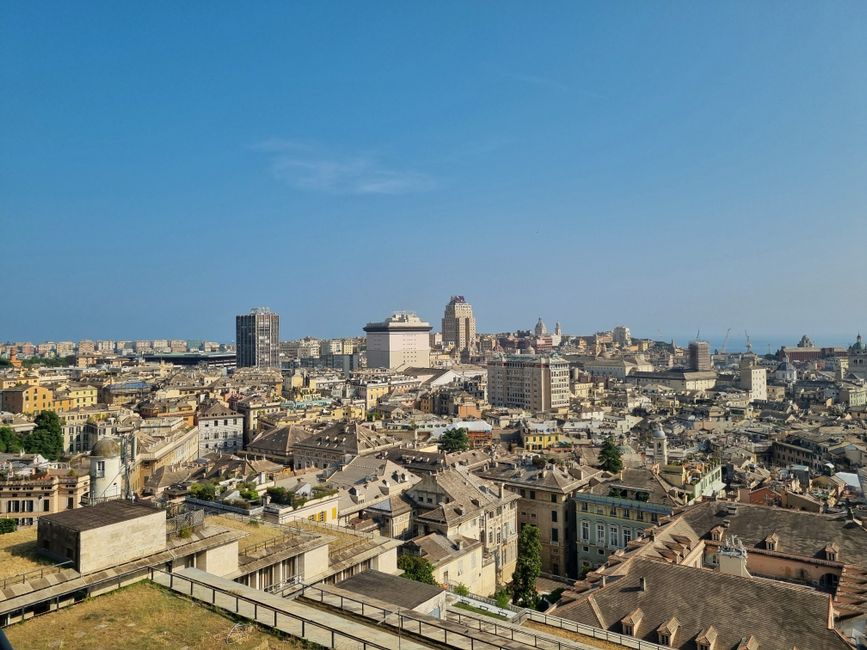
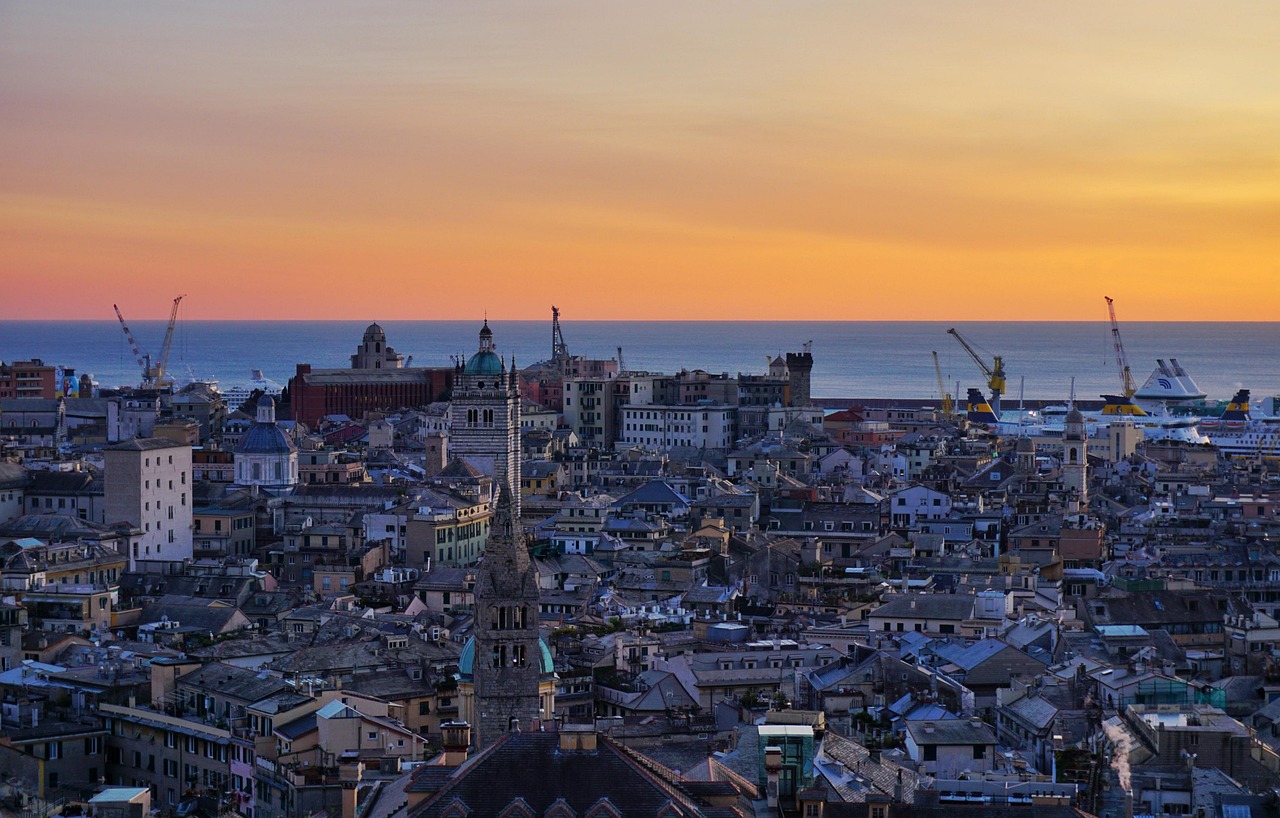
Genoa (Genova) is a proud old port city that rewards the curious. Behind the busy harbour lies one of the largest medieval old towns in Europe, a maze of narrow, shadowy lanes called caruggi, opening suddenly on to Renaissance palaces so grand that their street, the Strada Nuova, is a UNESCO World Heritage Site. Add one of Europe’s biggest aquariums, lifts and funiculars up to panoramic terraces, a fishing village inside the city at Boccadasse, and the birthplace of pesto and focaccia. Genoa is also the gateway to the Italian Riviera, with Portofino, Camogli and the Cinque Terre a short train or boat ride away. It suits city sightseeing and food lovers who like a city with a bit of grit. Give it two days, three or four with the Riviera.
Right now in Genoa
- Wed17–22°C63–72°F22 mm rain
- Thu18–19°C64–67°F36 mm rain
- Fri17–21°C62–70°FClear
Top tours in Genoa
See all tours for Genoa →
From local operators, with prices and reviews; you check availability and book on Viator, our partner. We may earn a commission at no extra cost to you. How we earn money
Genoa at a glance
- Best for: a vast medieval old town, Renaissance palaces, the Aquarium, sea views, Ligurian food, and day trips along the Riviera.
- How long: 2 days for the city, 3–4 with Portofino, Camogli or the Cinque Terre.
- Best time: April to June and September to mid-October. Summers are warm and humid; October and November bring heavy autumn rain.
- Book ahead: a fixed-date Aquarium ticket online (cheaper than at the desk), and Rolli Days palace tours when they run.
- Getting in: trains from Milan, Turin and Pisa; the Volabus from Genoa airport; ferries to Sardinia, Corsica and Sicily.
- Before you go: entry rules, money, trains and general safety are on our Italy travel guide.
Genoa’s neighbourhoods and who each one suits
Genoa stretches for about 30 km along the coast, squeezed between the sea and steep hills, so the city climbs in layers connected by lifts, funiculars and stairways. The centre lies between the two main stations, Piazza Principe in the west and Brignole in the east.
The centro storico and the caruggi
The medieval old town behind the harbour, a dense web of lanes around San Lorenzo cathedral, Piazza San Matteo and Via San Luca, full of tiny shops, focaccia bakeries and historic food stores. Atmospheric and central, though some lanes near the port feel rough at night; stay on the main streets after dark.
Via Garibaldi and Via Balbi
The “new” streets of the 16th and 17th centuries, lined with the palaces of the Rolli. Via Garibaldi (the Strada Nuova) holds the Palazzo Rosso, Palazzo Bianco and Palazzo Tursi museums, and Via Balbi leads to the Royal Palace and Piazza Principe station. Elegant and handy for sightseeing.
Porto Antico
The old harbour, rebuilt by Genoese architect Renzo Piano in 1992, with the Aquarium, the Bigo panoramic lift, the Galata maritime museum and waterfront bars. Lively and family-friendly, and the departure point for harbour and Riviera boat trips.
Piazza De Ferrari and Carignano
The 19th-century centre around the great fountain of Piazza De Ferrari, the Palazzo Ducale and the Carlo Felice opera house, with Via XX Settembre’s shopping arcades running towards Brignole station. Up the hill, Carignano is quiet and residential. A practical base with good transport.
Albaro, Boccadasse and Nervi
To the east, the smart residential district of Albaro leads down to Boccadasse, a pastel fishing village with a pebble beach, and the Corso Italia seafront promenade. Further east, Nervi has a clifftop walk and parks. Ideal for a seaside feel within the city.
Top things to see in Genoa
Prices and hours were checked on the official sites in October 2026; check again before you go.
The Aquarium of Genoa
One of the largest aquariums in Europe, on the Porto Antico, with dolphins, sharks, seals, penguins, manatees and a hall of jellyfish, plus a glass biosphere of tropical plants next door. As of October 2026 adult tickets cost from €26 online for a fixed date and time slot (about €34 at the ticket desk), children aged 4 to 12 from €16, and under-4s go free. A more expensive Open Flexi ticket lets you change the date. Allow at least two and a half hours, and come early or late to avoid school groups.
The Strada Nuova Museums and the Palazzi dei Rolli
In the 16th century, Genoa’s banking families built a street of palaces so magnificent that the city kept official lists (rolli) of those fit to host visiting kings and popes. The Strada Nuova and the Rolli palaces are a UNESCO World Heritage Site. Three of them on Via Garibaldi form the Strada Nuova Museums: Palazzo Rosso, with frescoed rooms and a roof terrace; Palazzo Bianco, the region’s main art gallery, with Caravaggio’s Ecce Homo; and Palazzo Tursi, the town hall, which displays Paganini’s violin. As of October 2026 the combined ticket, which also covers the Museo di Sant’Agostino, costs €14 (reduced €9). From 28 September 2026 they are open daily from 10:00 to 18:30, but on Mondays only Palazzo Rosso opens. A few weekends a year, the Rolli Days open private palaces free to the public with guided visits.
San Lorenzo Cathedral and Palazzo Ducale
The black-and-white striped Gothic cathedral holds the Treasury of San Lorenzo and, in a corner, a British naval shell that crashed through the roof in 1941 and never exploded. Nearby, the Palazzo Ducale, once the seat of the Doges of Genoa, hosts major exhibitions and has a tower you can visit.
Lifts, funiculars and viewpoints
Genoa’s public transport includes funiculars and more than a dozen lifts that carry you up the hills on a normal bus ticket. The Art Nouveau Castelletto lift rises from Piazza Portello to the Spianata di Castelletto, a terrace with a sweeping view over the roofs and the port. The Zecca–Righi funicular climbs to the Righi, at the edge of the park of the old walls and forts, for walks and views. At the harbour, the Bigo lift lifts you over the Porto Antico.
The Lanterna
Genoa’s lighthouse, the symbol of the city, is one of the oldest and tallest working lighthouses in the world, about 77 metres high. A promenade leads to it from the ferry terminal area, and the tower and its museum open to visitors on certain days; check before you go.
More classic sights
- Via del Campo and the caruggi: the lanes sung by Fabrizio De André, with old shops and street shrines.
- Galata Museo del Mare: the largest maritime museum in the Mediterranean, with a full-size galley and a submarine.
- Staglieno Cemetery: a vast monumental cemetery full of extraordinary 19th-century sculpture.
- Piazza De Ferrari: the big bronze fountain at the heart of modern Genoa.
- Christopher Columbus’s House: a reconstructed medieval house near the Porta Soprana gate, where the explorer is said to have grown up.
The Genova Museum Card: is it worth it?
The city’s museum card, sold by the Musei di Genova, costs €24 for 24 hours or €45 for 48 hours as of October 2026, and covers the civic museums, including the Strada Nuova Museums. It does not include the Aquarium, which is privately run. If you will see the Strada Nuova Museums and two or three other civic museums in a day, it pays off; otherwise single tickets are cheaper.
Other things to do in Genoa
Pesto, focaccia and street food
Genoa is the home of pesto alla genovese, made with local basil, pine nuts, garlic, Pecorino and Parmigiano; eat it on trofie or trenette pasta. Start the day like a local with a slice of focaccia genovese, salty and oily, dipped in a cappuccino, and snack on farinata, a chickpea pancake, fried seafood in paper cones, and pansoti with walnut sauce. The old town’s historic bakeries and the Mercato Orientale on Via XX Settembre are the places to taste them. Pair with Vermentino, the crisp local white (see our wine tasting guide).
The seafront and Nervi
Walk the Corso Italia promenade to Boccadasse for an ice cream on the pebbles, or take the train to Nervi for the Anita Garibaldi clifftop path, parks and small beaches. In summer, locals swim from the rocks and the small beaches along the coast; see our beaches guide.
Boat trips
From the Porto Antico, harbour tours, seasonal whale-watching trips in the Pelagos marine sanctuary and summer boats to Camogli, San Fruttuoso and Portofino all depart. See our boat trips guide.
Day trips from Genoa: Portofino, Camogli and the Cinque Terre
Portofino and Santa Margherita
The famous harbour of Portofino, with its pastel houses and luxury yachts, is about 40 km east. The easiest way is a regional train to Santa Margherita Ligure (about 40 minutes), then the AMT bus 782 along the coast or a boat from the Servizio Marittimo del Tigullio, which also runs to the abbey of San Fruttuoso in its hidden cove. In season, boats also leave Genoa’s Porto Antico for Portofino and San Fruttuoso. Roads to Portofino are narrow and parking is scarce and expensive, so avoid driving in summer.
Camogli and the Portofino park
Camogli is a fishing town of tall painted houses on the Golfo Paradiso, about 30 minutes by train. From Camogli or Portofino, trails cross the Portofino Regional Park to San Fruttuoso, a beautiful but rugged hiking route; boats can take you back. The clear water here is also good for snorkelling and diving, including the underwater Christ of the Abyss statue off San Fruttuoso.
The Cinque Terre
Regional trains reach Levanto and Monterosso in about 1½ to 2 hours, sometimes with a change at Sestri Levante. It makes a long day; see our Cinque Terre guide for the villages, trails and the Cinque Terre Card.
The western Riviera and France
West of Genoa, trains run along the Riviera di Ponente through resort towns such as Finale Ligure and Sanremo to the French border, and on to Monaco and Nice. Milan and Turin are each about two hours inland.
Nearby destinations
- Portofino25 km
- Cinque Terre69 km
- Milan120 km
- Turin124 km
- Pisa140 km
- Lucca141 km
- Monte Carlo142 km
- Bergamo154 km
Getting there and getting around
From Genoa airport
Genoa’s Cristoforo Colombo airport (GOA) is built on the sea, about 6 km west of the centre. The AMT Volabus links it with Piazza Principe and Brignole stations via the centre in about 30 minutes; it needs its own ticket or the 24-hour MetDaily pass, not the standard city ticket. A taxi takes about 20 minutes.
By train
Genova Piazza Principe and Genova Brignole are the main stations, both central. Trains run to Milan (about 1½ to 2 hours), Turin (about 2 hours), Pisa (about 2 hours), La Spezia (about 1 hour 20) and along the Riviera to the French border. Many trains stop at both stations; check which one suits your hotel.
By ferry
Genoa is one of Italy’s main ferry ports, with overnight ferries to Sardinia (Olbia and Porto Torres), Corsica (Bastia), Sicily (Palermo) and Tunisia from the ferry terminal near the Lanterna. For Corsica see our Corsica guide, and for Sicily our Sicily guide.
Buses, metro, lifts and funiculars
AMT runs buses, a single metro line through the centre, the funiculars, the public lifts and the Navebus ferry across the harbour to Pegli. As of October 2026 a standard ticket costs €2 and is valid for 110 minutes on the whole urban network, including the metro, lifts and funiculars, but not the Volabus. The MetDaily pass (€10 for 24 hours) also covers the Volabus and bus 782 from Santa Margherita to Portofino. An integrated AMT and Trenitalia ticket for train stations within the city costs €2.20.
Driving and the ZTL
Don’t drive in the centro storico: the old town is a pedestrian and ZTL area with camera-controlled gates, and the lanes are too narrow for cars anyway. Fines arrive later through your rental company. Use the car parks at the Porto Antico or near the stations, and travel the Riviera by train, as coastal roads and parking are congested in summer.
When to go and how long to stay
Genoa has a mild Mediterranean climate: the hills shield it from the cold north, so winters are among the mildest in northern Italy, while autumn brings heavy rain. The table uses the WMO 1991–2020 climate normals for the Genova Sestri station at the airport, on the coast: long-term average daily highs and lows, and days with at least 1 mm of rain. A few months are missing from the official sheet, so some ranges are based on the neighbouring months.
| Season | Average high / low | Rainy days per month | What it’s like | Good for |
|---|---|---|---|---|
| Winter (Dec–Feb) | 12–13 °C / 6–7 °C | 4–7 | Mild for the north, with occasional cold winds | Museums, food, quiet streets |
| Spring (Mar–May) | About 18 °C in April / 9–11 °C | 5–7 | Mild and fresh, flowers on the coast | Walking, the Riviera, boat trips |
| Summer (Jun–Aug) | 25–28 °C / 19–22 °C | 3–4 | Warm, humid and sunny; sea warm for swimming | Beaches, Portofino, evenings by the sea |
| Autumn (Sep–Nov) | 25 °C falling to 16 °C / 19 °C falling to 10 °C | 5 in September, 9 in November | Warm September, then heavy downpours | Food, fewer crowds; pack for rain |
These are long-term averages. Rain falls in short, heavy bursts in autumn: November averages about 200 mm and October about 150 mm at the airport station, and Liguria’s civil protection issues weather alerts (allerta meteo) that can close parks and schools. Recent summers have been hotter.
Events worth planning around
- Rolli Days: a few weekends a year when private Rolli palaces open to the public; check the official Rolli Days site for dates.
- Autumn: the Genoa Boat Show (Salone Nautico) at the start of October, when hotels fill up.
- 24 June: the feast of San Giovanni Battista, the city’s patron saint.
- Regatta of the Ancient Maritime Republics: Genoa takes its turn to host this historic rowing race with Pisa, Venice and Amalfi.
How long to stay: 2-, 3- and 4-day plans
2 days: Day 1, the caruggi, San Lorenzo, Palazzo Ducale and Piazza De Ferrari, focaccia for lunch, the Strada Nuova Museums, and sunset from the Spianata di Castelletto. Day 2, the Aquarium and the Porto Antico in the morning, then the Corso Italia walk to Boccadasse.
3 days: add Portofino and Santa Margherita, or Camogli and the walk to San Fruttuoso. 4 days: add a day in the Cinque Terre, or Nervi and the Righi.
Where to stay in Genoa and the tourist tax
- Centro storico: the most atmospheric; choose a hotel on a main street.
- Via Garibaldi and Via Balbi: palaces and museums, near Piazza Principe.
- Porto Antico: waterfront hotels, near the Aquarium.
- De Ferrari and Brignole: practical and well connected.
- Albaro and Nervi: by the sea, quieter, with trains into town.
Genoa tourist tax (imposta di soggiorno): paid per person per night by non-residents. As of October 2026 the rates are €2 in a 1-star hotel, €2.50 in a 2-star, €3 in a 3-star, €4 in a 4-star and €5 in a 5-star, with €2 in hostels and campsites. Since 1 August 2026, B&Bs, guest houses and holiday homes charge €4, and furnished tourist apartments €5 (€4 in some outer districts). For a couple in a 4-star hotel that is €8 a night.
Practical tips for Genoa
- Use the lifts and funiculars: they save steep climbs and are included in the city ticket.
- Buy Aquarium tickets online: fixed-date tickets are much cheaper than at the desk.
- Mind Mondays: on Mondays only Palazzo Rosso of the Strada Nuova Museums is open.
- Stay alert at night in the lanes near the port and around the stations, and keep valuables close.
- Check the weather alerts in autumn, when sudden storms can close parks and some services.
- Take the train along the Riviera instead of driving in summer.
- Emergencies: call 112.
What to pack for Genoa
Comfortable shoes with good grip for steep stairways, cobbles and the walks to Boccadasse and San Fruttuoso. In summer, pack light clothes, a swimsuit, sandals for the rocks, sunscreen and a hat. In spring and autumn bring layers and a proper rain jacket or umbrella, especially for October and November downpours. Winter is mild, but a warm jacket helps against the wind. Cover your shoulders and knees for churches, and pack a small bag for a picnic of focaccia on the hills.
Genoa travel FAQ
Is Genoa worth visiting?
Yes. It has one of Europe’s largest medieval old towns, UNESCO-listed Renaissance palaces, a great aquarium, sea views and superb food, and it is the gateway to Portofino and the Riviera. It is grittier and far less touristy than Florence or Venice.
How many days do you need in Genoa?
Two days for the old town, the palaces and the Aquarium; three or four to add Portofino, Camogli or the Cinque Terre.
How much is the Genoa Aquarium?
As of October 2026, adult tickets start at €26 online for a fixed date and time, about €34 at the desk, and children aged 4 to 12 start at €16. Under-4s go free.
What are the Palazzi dei Rolli?
The palaces of Genoa’s richest families, listed in official registers from 1576 to host state guests. The Strada Nuova and the Rolli palaces are a UNESCO site; three of them form the Strada Nuova Museums, and others open on Rolli Days.
How do I get from Genoa airport to the city?
Take the AMT Volabus to Piazza Principe or Brignole station, about 30 minutes. It needs its own ticket or the €10 MetDaily pass. A taxi takes about 20 minutes.
How do I get from Genoa to Portofino?
Take the train to Santa Margherita Ligure, about 40 minutes, then bus 782 or a boat to Portofino. In season, boats also leave from Genoa’s Porto Antico. Avoid driving in summer.
Can I visit the Cinque Terre from Genoa?
Yes, as a long day trip. Trains reach Levanto and Monterosso in about 1½ to 2 hours, sometimes changing at Sestri Levante.
What food is Genoa famous for?
Pesto alla genovese, focaccia genovese, farinata chickpea pancakes, pansoti with walnut sauce and fried seafood, washed down with Vermentino white wine.
How much is a bus ticket in Genoa?
€2 for 110 minutes on the city network, including the metro, lifts and funiculars, as of October 2026. The 24-hour MetDaily costs €10 and also covers the Volabus and the Portofino bus.
When is the best time to visit Genoa?
April to June and September to mid-October. Summer is good for the beaches but humid; late October and November are the rainiest months.
How much is the tourist tax in Genoa?
In hotels, €2 per person per night at 1 star rising to €5 at 5 stars; €4 in B&Bs and holiday homes and €5 in tourist apartments since August 2026.
Plan your trip
Partner links: TravelerCenter may earn a commission if you book, at no extra cost to you.
🇮🇹 Useful Italian phrases for Genoa
All 38 Italian phrases: restaurant, hotel, emergencies, romance (printable) →
Sources · last reviewed 4 October 2026
Researched and last reviewed on 4 October 2026. Aquarium prices come from the Acquario di Genova; Strada Nuova Museums prices, hours and the Genova Museum Card from Musei di Genova; transport fares from the city’s official tourism site, Visit Genoa, with AMT as the operator; the tourist tax from the Comune di Genova; climate from the WMO 1991–2020 normals for Genova Sestri (Italian Air Force station, archived by NOAA). Portofino boat services, ferry routes, train times and event details are general and should be checked with the operators. Prices, timetables and opening hours change, so check the official sites before you go. For entry rules, money and safety, see our Italy travel guide.
Data: Weather: MET Norway (CC BY 4.0) · Sea temperature: NOAA CoastWatch · Rates: ECB · Costs: World Bank ICP and price levels · Wikidata (CC0)