Lefkada is the Ionian island you can drive to. A short causeway and a small floating bridge join it to the mainland, so you can arrive by car or bus, yet once across you find some of the most spectacular beaches in Greece: long arcs of white pebbles under towering cliffs on the west coast, with water of an unreal, milky turquoise. Porto Katsiki is the famous one; Kathisma, Egremni and the village beach of Agios Nikitas are close behind. The east coast is gentler, with the sailing harbour of Nydri looking out at a scatter of green islets, Meganisi and Onassis’s former island of Skorpios, and in the south Vasiliki is one of Europe’s best-known windsurfing bays. Lefkada Town, rebuilt after earthquakes with colourful wooden upper floors, is lively and local. Come in June or September, and give it five days to a week.
Right now in Lefkada (Lefkada Town)
- Wed 17–25°C 62–77°F Mostly clear
- Thu 16–23°C 61–74°F 12 mm Rain
- Fri 19–24°C 67–75°F 10 mm Rain
Weather: MET Norway (CC BY 4.0) · Sea temperature: NOAA CoastWatch · Rates: ECB
Top tours in Lefkada
See all tours for Lefkada →
From local operators, with prices and reviews; you check availability and book on Viator, our partner. We may earn a commission at no extra cost to you. How we earn money
Lefkada at a glance
- Best months: June and September; May and early October are quieter and still warm. Average highs run from about 23 °C in May to 30–31 °C in July and August, and winters are mild, around 13–15 °C by day (HNMS normals 1991–2020, Aktion station near Preveza airport). The sea is warm enough for swimming from June to October.
- Days needed: 3 for Lefkada Town, the west-coast beaches and a boat day from Nydri; 5–7 to add Vasiliki, the mountain villages and a day on Kefalonia or Ithaca.
- Getting there: fly into Preveza-Aktion airport (PVK), about 20 km away on the mainland, or drive or take a KTEL bus from Athens; in season, ferries cross from Kefalonia to Vasiliki.
- Getting around: a car or scooter is best for the west-coast beaches and villages; KTEL buses link Lefkada Town with Nydri often and with Vasiliki and the villages a few times a day.
- Budget level: mid-range, with good-value rooms and tavernas away from Nydri and Agios Nikitas in August. Like everywhere in Greece, a climate resilience fee is added per room per night (€2–€15 from April to October, depending on the type of accommodation). See our Greece guide for money, entry rules and daily costs.
Lefkada’s towns and resorts, and who each one suits
- Lefkada Town: the capital at the north tip, by the causeway, with a big marina, a pedestrian main street, cafés and bars, and the long beach of Gyra and the windmills nearby. The best base without a car and for nightlife.
- Agios Nikitas: a small, pretty village of narrow lanes and tavernas running down to a pebble beach on the west coast, ten minutes from Kathisma. Romantic, but busy and hard to park in August.
- Nydri: the main resort on the east coast, facing the islets, with a waterfront of restaurants and the busiest boat-trip harbour. For families and boat days.
- Vasiliki: a fishing village in a wide bay in the south, the island’s windsurfing centre, with ferries to Kefalonia and boats to Porto Katsiki. For water sports and a relaxed village feel.
- The mountain villages: Karya, Englouvi with its lentil fields, and Exanthia above the west coast. For traditional life, cooler evenings and sunset views, with a car.
Top things to see in Lefkada
Prices and hours of state sites come from the Greek Ministry of Culture’s ticketing service (Hellenic Heritage), as of October 2026. At all state sites entry is free for all under-18s and EU citizens under 25 with ID, and on a few set days a year.
The causeway, the floating bridge and the Castle of Agia Mavra
Lefkada is separated from the mainland only by a shallow lagoon and a narrow channel. The road crosses on a causeway and a short floating bridge, about 50 m long, which swings aside to let yachts pass through the canal, so you may wait a few minutes in summer. Guarding the crossing is the Castle of Agia Mavra, a “floating” fortress on an islet among the marshes, first built in the 14th century and rebuilt by the Ottomans, Venetians and British; it was besieged a dozen times and was once the island’s capital. A museum opened in 2024 in its bastions tells its story with multimedia displays and finds. How to visit: €5, €3 reduced. From April to October it opens 8:00 until 18:00–20:00 depending on the month (18:00 in late October); from November to March 8:30–15:30; closed on Tuesdays all year.
Lefkada Town
After repeated earthquakes, the people of Lefkada learned to build houses with stone ground floors and light wooden or metal-clad upper floors, painted in bright colours, and these give the old town its character. Wander the pedestrian main street to the square, the Venetian-era churches with their bell towers, and the lanes of the old town, then walk along the lagoon at sunset. The Archaeological Museum, in the municipal cultural centre by the sea, shows finds from the island’s caves, sanctuaries and graves, with a room on the German archaeologist Wilhelm Dörpfeld, who believed Lefkada was Homer’s Ithaca (€5, €3 reduced; 8:30–15:30, closed on Tuesdays). North of town, the long sandy beach of Gyra and its old windmills line the edge of the lagoon. See our city sightseeing guide.
Cape Lefkatas and its lighthouse
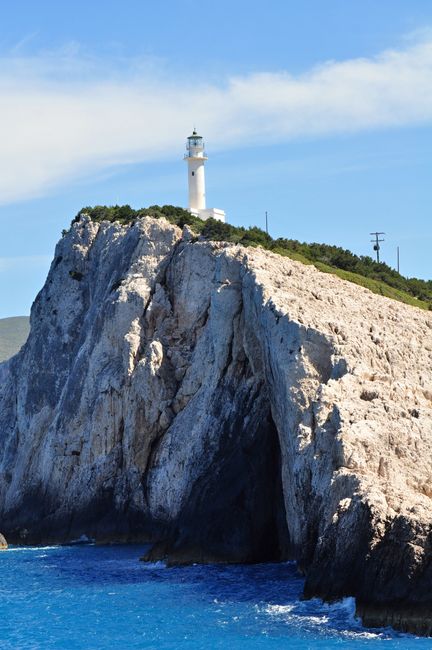
At the southern tip of the island, white cliffs about 60 m high drop into the sea at Cape Lefkatas (Cape Doukato), crowned by a lighthouse. In ancient times a temple of Apollo stood here, and legend says the poet Sappho threw herself from the cliff for love; the ancients called it the “Lover’s Leap”. It is a wild, windswept place, reached by a narrow road beyond Porto Katsiki, and one of the finest sunset viewpoints in the Ionian. Keep well back from the cliff edge.
Dimosari waterfall
Above Nydri, a shady path follows the stream of the Dimosari gorge past plane trees to a waterfall that drops into a small pool, where some people take a cold swim. It is an easy walk of about 20–30 minutes from the car park, and a welcome break from the heat. In late summer the flow can drop to a trickle. Wear shoes with grip on the wet rocks. See our hiking guide for longer walks in the mountains.
Beaches in Lefkada
The west coast has the famous beaches: white pebbles and sand under high cliffs, with dazzling water but often strong waves and a steep shelf, so swim carefully when it is windy and watch children. The east coast is sheltered and calm, with smaller beaches facing the islets. In 2026, Lefkada had two Blue Flag beaches, Ai Giannis and Gyra, both near Lefkada Town.
- Porto Katsiki: the island’s most photographed beach, a curve of white pebbles under sheer cliffs in the south-west. A car park sits above the beach (paid in summer), and steep steps lead down; it gets very crowded in August. Boats from Nydri and Vasiliki also call here in calm weather.
- Egremni: a long, wild beach under steep cliffs north of Porto Katsiki. Its road and stairway were badly damaged by landslides in the earthquake of 2015, and access by land has since been rebuilt and repaired more than once; it is a long, steep climb of several hundred steps. We could not confirm the current official status, so ask locally before you go, or see it from the sea on a boat trip.
- Kathisma: a long, organised beach of fine sand and pebbles near Agios Nikitas, with beach bars, sunbeds and paragliders landing on the sand from the hills above. Easy to reach and great at sunset.
- Agios Nikitas and Mylos: the village beach is small and lively; Mylos, round the headland, is a quieter sandy beach reached by water taxi from the village or a hilly footpath.
- Ai Giannis and Gyra: long, windy beaches north of town, by the lagoon, popular with kitesurfers.
- Vasiliki and Agiofili: Vasiliki’s pebble bay is for windsurfers; tiny Agiofili, next door, is a turquoise cove reached by a short walk or water taxi.
Under Greece’s coastal law, part of every organised beach must be left free of sunbeds and you can always reach the water with your own towel. See our beaches guide and our snorkeling guide.
Windsurfing, boat trips and sailing
- Windsurfing in Vasiliki: on summer afternoons a strong, steady thermal wind funnels down into Vasiliki bay, while mornings are calm, so beginners learn early and experienced riders fly later in the day. Several windsurf centres rent boards and run lessons from May to October. Ai Giannis, north of town, is the kitesurfing spot. See our surfing guide.
- Boat trips from Nydri: day cruises leave Nydri for the islets and coves of the Inland Ionian Sea: they circle Skorpios, the private island once owned by Aristotle Onassis (you cannot land), stop at Meganisi‘s sea caves and swimming bays and its villages of Spartochori and Vathy, and often continue to Kalamos, Ithaca or Kefalonia’s coast. Licence-free motorboats can be rented in Nydri for exploring on your own. See our boat trips guide.
- Sailing: Lefkada’s marina and the sheltered waters between Lefkada, Meganisi, Ithaca and the mainland are among the most popular sailing grounds in Greece, with many yacht charter bases.
- Diving: dive centres in Nydri, Vasiliki and Agios Nikitas visit reefs, caves and walls. See our diving guide.
Food and village life
Look for Englouvi lentils, small and tasty, grown on a mountain plateau and celebrated at a festival in August; salami of Lefkada, a local cured sausage; savoro, fish in a vinegar and rosemary sauce; and the island’s honey and almond sweets. In the hill village of Karya, women once made a famous embroidery, still shown in a small folk museum. The mountain villages hold summer festivals with music and dancing.
Day trips from Lefkada
- Kefalonia: from April to October, a ferry crosses from Vasiliki to Fiskardo in about an hour (in October 2026, once a day, at 11:00, returning from Fiskardo at 12:15). With a car you can see Fiskardo, Assos and Myrtos in a long day; better, stay a few nights. See our Kefalonia guide.
- Ithaca and Meganisi: Meganisi is a short ferry hop from Nydri all year; Ithaca, Odysseus’s island, is easiest on a boat trip from Nydri or by ferry via Kefalonia.
- Preveza and Nicopolis: across the strait, the ruins of Nicopolis, the “city of victory” founded by Octavian after the Battle of Actium in 31 BC, are among the largest archaeological sites in Greece (€10, €5 reduced; from April to October 8:00 until 18:00–20:00 depending on the month, closed on Tuesdays). Its museum is a separate €10 ticket. Preveza town has a lively waterfront.
- Further afield: Corfu is about three to four hours north by road and ferry from Igoumenitsa, and Zakynthos is reached via Kefalonia in summer.
Nearby destinations
Getting there and getting around
Flights: Preveza-Aktion airport (PVK)
Lefkada has no airport of its own. The nearest is Aktion National Airport (PVK), run by Fraport Greece, on the mainland near Preveza, about 20 km and 25–30 minutes by road from Lefkada Town. It has direct flights from much of Europe in summer, mostly charters and low-cost airlines, and few flights in winter. By bus: KTEL Lefkada’s buses between Lefkada and Preveza stop at Aktion and serve airport passengers; in October 2026 there were several a day each way, and the fare to Preveza is about €4.20–€4.50, paid to the driver. Flight and bus times do not always match, so many visitors take a taxi, from the rank opposite Arrivals building B, or pick up a hire car.
By bus or car from Athens and Thessaloniki
KTEL Lefkada runs coaches to and from Athens three times a day (€40 one way, €72 return), as well as services to Thessaloniki (€43), Patras and Igoumenitsa. Tickets can be bought online. By car from Athens, take the motorway west over the Rio-Antirrio bridge and north along the Ionian Road, then cross to Lefkada on the causeway; allow about four and a half hours.
Ferries to Kefalonia, Ithaca and Meganisi
- Vasiliki–Fiskardo (Kefalonia): West Ferry, April to October, about 60 minutes; one sailing a day in spring and autumn and more in summer.
- Nydri–Meganisi: small car ferries cross to Spilia and Vathy on Meganisi all year.
- Ithaca: some summer boats link Vasiliki or Nydri with Ithaca; otherwise go via Kefalonia, where ferries run from Sami to Pisaetos all year and from Fiskardo to Frikes in summer.
Book on the operator’s own site or app or on a comparison platform, especially in July and August, and keep a buffer day before an international flight: the Coast Guard can ban sailings in strong winds.
Buses, cars and scooters on the island
KTEL Lefkada runs local buses from Lefkada Town to Nydri about every hour or two from early morning to evening, and a few times a day to Vasiliki, Agios Nikitas, Karya and other villages; summer services to Kathisma stop in autumn. Local fares range from €2.20 to €4.20. For the west-coast beaches and the mountain villages a car or scooter is much easier; the road along the west coast is narrow and winding, with tight parking at the beaches in August. You need a driving licence valid for the vehicle (from outside the EU, usually with an International Driving Permit); helmets are compulsory on scooters and quads.
When to go and how long to stay
Lefkada has hot, dry summers and mild, rainy winters; the Ionian islands are greener and wetter than the Aegean. July and August are hot and busy, with the best afternoon winds in Vasiliki and the most crowded beaches. June and September are ideal, and the sea stays warm into October, when the first autumn storms arrive. From November to April most resort hotels close, but Lefkada Town stays lively.
| Season | Average high / low | What it’s like |
|---|---|---|
| Spring (Mar–May) | 16–23 °C / 9–15 °C | Green and flowery; good for walking and villages; sea cool until late May. |
| Summer (Jun–Aug) | 28–31 °C / 19–22 °C | Hot, sunny and dry; afternoon winds in Vasiliki; peak crowds on the west coast. |
| Autumn (Sep–Nov) | 19–27 °C / 12–19 °C | September is perfect; rain and storms grow from October. |
| Winter (Dec–Feb) | 13–15 °C / 7–8 °C | Mild, wet and green; most resorts closed; Lefkada Town local and quiet. |
Temperatures are the 1991–2020 climate normals of the Hellenic National Meteorological Service (HNMS) for its Aktion station, by Preveza airport, about 15 km north of Lefkada Town. Almost all the rain falls between October and April. Greece’s wildfire season runs from 1 May to 31 October: on days of high fire risk (category 4–5 on the daily map of the Ministry of Climate Crisis and Civil Protection), forests may be closed and any outdoor fire is banned. Call 112 if you see a fire.
3 days in Lefkada
Day 1: Lefkada Town, the Castle of Agia Mavra and a swim at Gyra or Ai Giannis, with dinner in the old town. Day 2: the west coast: Kathisma in the morning, Porto Katsiki at midday or late afternoon, and sunset at Cape Lefkatas. Day 3: a boat trip from Nydri around Skorpios and Meganisi, then the Dimosari waterfall.
5–7 days in Lefkada
Add a windsurf lesson in Vasiliki and a swim at Agiofili, the mountain villages of Karya and Englouvi, Agios Nikitas and Mylos beach, and a day on Meganisi. Then take the ferry to Fiskardo and continue to Kefalonia, or visit Nicopolis and Preveza on your way to the airport.
Where to stay in Lefkada
- Without a car: Lefkada Town, at the hub of the buses, with restaurants and nightlife.
- West-coast beaches and sunsets: Agios Nikitas, Kalamitsi or the villages above Kathisma.
- Families and boat trips: Nydri, Perigiali or Nikiana on the calm east coast.
- Windsurfing and a village feel: Vasiliki, also handy for the ferry to Kefalonia and boats to Porto Katsiki.
Greece adds a climate resilience fee per room per night, set by type of accommodation, usually paid at the property (from April to October €2 for 1–2-star hotels and rooms up to €15 for 5-star hotels; campsites and youth hostels are exempt).
Practical tips for Lefkada
- Beach timing: reach Porto Katsiki and Kathisma before 10:00 in July and August, or come after 17:00 for the evening light.
- Waves and cliffs: west-coast beaches shelve steeply and get rough in a north-westerly wind; keep away from the foot of the cliffs, where stones can fall.
- The bridge: the floating bridge opens for boats, so allow a little extra time when heading for the airport.
- Fire risk: no barbecues or fires in the countryside in summer; follow 112 alerts.
- Emergencies: call 112; tourist police 1571; coast guard 108.
What to pack for Lefkada
Pack swimwear, a sun hat, sunglasses, high-factor sunscreen and a refillable water bottle, plus water shoes for the pebble beaches and a beach umbrella or shade if you prefer the wilder coves. Bring a snorkel mask and a dry bag for boat days, shoes with grip for the steps at Porto Katsiki and the Dimosari path, a windproof layer for evenings and boat trips, and a scarf to cover shoulders in churches. From October, add a rain jacket.
Lefkada travel FAQ
How do you get to Lefkada?
Fly into Preveza-Aktion airport (PVK), about 20 km away, then take a taxi, hire car or KTEL bus; or come by road from Athens (KTEL coaches three times a day) and cross the causeway and floating bridge. In season, ferries also arrive in Vasiliki from Kefalonia.
Is Lefkada an island if you can drive there?
Yes. A narrow channel separates it from the mainland, crossed by a causeway and a short floating bridge that swings open to let boats through.
What is the best beach in Lefkada?
Porto Katsiki is the most famous, with white pebbles under high cliffs; Kathisma is the easiest long beach; Agiofili and Mylos are smaller and quieter. Egremni is spectacular, but check access locally.
Can you get to Egremni beach?
Access by land, a long stairway down the cliff, has been closed and repaired several times since the 2015 earthquake, and we could not confirm its official status for October 2026. Ask locally, or see it from a boat.
How do you get from Preveza airport to Lefkada?
By taxi or hire car in about 25–30 minutes, or by KTEL Lefkada’s Preveza buses, which stop at Aktion several times a day, for about €4.20–€4.50.
Can you go from Lefkada to Kefalonia?
Yes. From April to October, West Ferry sails from Vasiliki to Fiskardo in about an hour; in October 2026 there was one sailing a day.
Is Vasiliki good for beginner windsurfers?
Yes. Mornings are usually calm, ideal for lessons, and the wind builds in the afternoon for experienced riders. The season runs from May to October, best in July and August.
Can you visit Skorpios?
No, it is a private island. Boat trips from Nydri sail around it and stop at Meganisi and nearby coves instead.
Do I need a car in Lefkada?
It helps a lot. Buses link Lefkada Town with Nydri often, but the west-coast beaches and villages have few services, especially outside summer.
When is the best time to visit Lefkada?
June and September: warm, sunny and less crowded than July and August, with a warm sea. May and early October are quieter still.
Sources and last review
Researched and last reviewed on 4 October 2026. Prices and hours of the Castle of Agia Mavra, the Archaeological Museum of Lefkada and Nicopolis come from the Greek Ministry of Culture’s Hellenic Heritage service. Bus routes, times and fares come from KTEL Lefkada; the Vasiliki–Fiskardo and Nydri–Meganisi ferries from West Ferry; the airport from Aktion airport (Fraport Greece); and Blue Flag beaches from the Blue Flag programme in Greece. The climate resilience fee is set by Greek tax law and collected by AADE. Climate figures are the HNMS 1991–2020 normals for Aktion. Egremni access could not be confirmed from an official source. Check the operators and local announcements before you travel.
Plan your trip
Partner links: TravelerCenter may earn a commission if you book, at no extra cost to you.
🇬🇷 Useful Greek phrases for Lefkada
All 38 Greek phrases: restaurant, hotel, emergencies, romance (printable) →