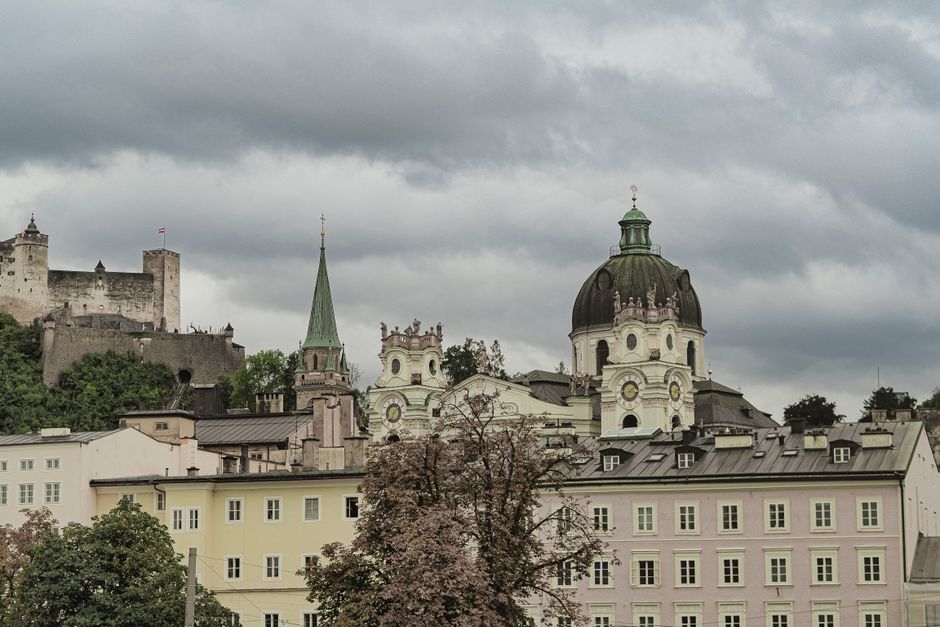
Salzburg is a baroque stage set on the Salzach river: domes and church towers under the white walls of the Hohensalzburg Fortress, a cliff-hemmed old town of lanes and passageways, and mountains on the horizon. It is the city where Mozart was born, where the Salzburg Festival fills the summer with opera and theatre, and where The Sound of Music was filmed. You come to ride the funicular up to the fortress, visit Mozart’s Birthplace, walk the Mirabell Gardens and the Getreidegasse, and eat dumplings in a monastery tavern; it is also the best base for Hallstatt, the Salzkammergut lakes, the Werfen ice cave and the Eagle’s Nest. Give it two days for the city, three or four to add day trips.
Right now in Salzburg
- Wed 9–22°C 47–72°F Mostly clear
- Thu 12–19°C 54–66°F 12 mm Showers
- Fri 7–12°C 45–53°F 5 mm Partly cloudy
Weather: MET Norway (CC BY 4.0) · Air quality: OpenAQ · Rates: ECB
Top tours in Salzburg
See all tours for Salzburg →
From local operators, with prices and reviews; you check availability and book on Viator, our partner. We may earn a commission at no extra cost to you. How we earn money
Salzburg at a glance
- Best for: baroque architecture, Mozart and classical music, the Salzburg Festival, Sound of Music locations, Christmas markets and day trips to lakes and mountains.
- How long: 2 days for the fortress, the old town, Mozart and Mirabell; 3–4 days to add Hellbrunn, the Untersberg, Hallstatt or the ice caves.
- Best time: May, June and September for mild weather and fewer crowds; late July and August for the festival; late November to Christmas for the markets.
- Getting in: trains from Vienna take about 2 hours 30 minutes and from Munich about 1 hour 40 minutes; the airport is 15–25 minutes away by bus.
- Getting around: the old town is walkable; buses and trolleybuses cover the rest. As of October 2026, the Salzburg Card costs from €35 for 24 hours and includes transport and most sights.
- Before you go: entry rules, money, tipping and driving are in our Austria travel guide.
Salzburg, area by area
The Salzach divides the city. On the left bank, the Altstadt (old town) is squeezed between the river and two wooded hills, the Mönchsberg and the Festungsberg with the fortress on top. On the right bank, the Neustadt (new town) runs from the Mirabell Gardens to the main station, about 20 minutes’ walk north. The whole historic centre is a UNESCO World Heritage Site.
The Altstadt
The Getreidegasse, with its wrought-iron guild signs and passageways (Durchhäuser), the cathedral squares (Domplatz, Residenzplatz and Kapitelplatz), St Peter’s Abbey and the Festival halls carved into the Mönchsberg. Best for: first visits and atmospheric hotels.
The right bank: Mirabell, Linzer Gasse and Kapuzinerberg
Across the river, the Mirabell Palace and Gardens, the Mozart Residence, the Marionette Theatre and the Mozarteum concert hall; Linzer Gasse, a local shopping street; and the Kapuzinerberg, with forest paths and a monastery. Best for: good-value hotels a short walk from the old town.
Mülln, Nonntal and the edges
Mülln, under the Mönchsberg, has the Augustiner Bräu beer hall; Nonntal, below the fortress, has Nonnberg Abbey and leads to Schloss Leopoldskron and its lake. Further south, Hellbrunn’s palace and trick fountains and the Untersberg cable car are a bus ride away. Best for: quiet stays and walks.
Top things to see in Salzburg
Prices and hours below were checked on the official sites in October 2026. They change, so check before you go.
Hohensalzburg Fortress and the FestungsBahn
Begun in 1077 by the prince-archbishops who ruled Salzburg, Hohensalzburg is one of the largest fully preserved medieval castles in Central Europe, and it was never taken by force. Inside its walls are courtyards, the Golden Hall and the Golden Chamber of Archbishop Leonhard von Keutschach, a fortress museum, a puppet museum and the Magic Theatre, and terraces with views over the domes of the old town and south to the Alps. The FestungsBahn funicular, running since 1892, climbs from the Festungsgasse in about a minute; or walk up the steep lane in 15 to 20 minutes.
Tickets. As of October 2026, there are two ticket levels, Basic and All-Inclusive (which covers more of the interior), each with or without the funicular. With the funicular, the All-Inclusive ticket costs €19.20 and the Basic €15.50 for adults; on foot they cost €14.50 and €12, and footpath tickets include the ride down. Children aged 6 to 14 pay €7.30 or €6.30. The fortress is open every day of the year: 9:30–17:00 from October to April and 8:30–20:00 from May to September. Funicular closures: the FestungsBahn will not run from 9 to 13 November 2026 (interiors closed too) or from 11 January to 14 March 2027, when you must walk up.
Mozart’s Birthplace and the Mozart Residence
Wolfgang Amadeus Mozart was born on 27 January 1756 on the third floor of Getreidegasse 9, the yellow house where the family lived until 1773. Today it shows his childhood violin, his clavichord, portraits and letters. The family then moved across the river to a larger apartment on Makartplatz, the Mozart Residence (Mozart-Wohnhaus), with displays on his life and music. As of October 2026, each museum costs €18 for adults, and a combined ticket for both costs €25, valid for 48 hours; children aged 6 to 14 pay €6 (€8 combined), and a family ticket costs €32 (€50 combined). The Birthplace opens daily 9:00–17:30; check the Residence’s hours, which are shorter out of season.
Mirabell Palace and Gardens
Prince-Archbishop Wolf Dietrich built Mirabell in 1606 for his companion Salome Alt and their children. The formal baroque gardens, with flowerbeds, statues, the Pegasus Fountain, a dwarf garden and the hedge theatre, frame the classic view of the fortress, and are free and open daily from early morning until dusk. Inside the palace, the Marble Hall, where Mozart played, is one of the most popular wedding venues in the world and is free to visit on weekdays when no event is on.
Salzburg Cathedral and the DomQuartier
The cathedral, rebuilt in early baroque style in the 17th century, has a huge dome, five organs and the font where Mozart was baptised. Since 2021, visitors pay a maintenance contribution of €7 (free for children 13 and under, and for services). The DomQuartier links the Residenz state rooms, the cathedral galleries, the cathedral museum and St Peter’s Abbey’s collections in a single route; as of October 2026 it costs €15 (€12 for partial access, with prices reduced while the Residenzgalerie is closed until autumn 2027) and opens 10:00–17:00, daily except Tuesday.
St Peter’s Abbey and its cemetery
Founded around 696, St Peter’s is the oldest monastery in the German-speaking world still in use. Its cemetery, with wrought-iron grave crosses under the cliff, is one of the most beautiful in Europe, and from it you can climb to the catacombs, early Christian chapels cut into the rock of the Mönchsberg (open 10:00–17:00 with a lunch break from October to April). St Peter Stiftskulinarium, inside the abbey walls, claims to be the oldest restaurant in Europe.
Hellbrunn Palace and the trick fountains
South of the city, Prince-Archbishop Markus Sittikus built Hellbrunn in the early 17th century as a summer pleasure palace, with water features designed to soak his guests: hidden jets in stone seats, grottoes, a mechanical theatre with 200 water-driven figures. The guided tour of the trick fountains is great fun with children, and you will get wet. The 2026 season runs from 28 March to 1 November; a ticket for the palace and trick fountains costs €16.50 for adults. The park, with the Sound of Music gazebo, is free. Take bus 25 from the centre.
Museums
- Mozart's birthplace
Churches and cathedrals
- Salzburg Cathedral
Protected areas
- Historic Centre of the City of Salzburg
Monuments
- Hohensalzburg Fortress
Palaces
- Mirabell Palace
Other sights
- Hellbrunn Palace
Peaks and mountains
- Gaisberg
The Sound of Music in Salzburg
The 1965 film is far better known abroad than in Austria, but its locations draw fans from around the world: the Mirabell Gardens and Pegasus Fountain (“Do-Re-Mi”), Nonnberg Abbey, where the real Maria von Trapp was a novice, the lake and terrace of Schloss Leopoldskron, the glass gazebo now in the Hellbrunn park, and the wedding church at Mondsee, 30 km away.
- New museum: on 20 September 2026 the Salzburg Museum opened Sound of Music Salzburg, a museum about the film and the real Trapp family, at the entrance to the Hellbrunn park next to the gazebo. As of October 2026 it costs €8 for adults (free with the Salzburg Card), opens daily 9:30–17:30 until 1 November 2026 and reopens on 20 March 2027.
- Tours: the long-running bus tours visit the main locations in about four hours, including Mondsee: Panorama Tours’ Original Sound of Music Tour from €70 and Bob’s Special Tours, in small minibuses, from about €75.
- On stage: the Salzburg Marionette Theatre performs a puppet version of The Sound of Music on selected dates.
Festivals, concerts and Christmas
Salzburg Festival 2027 and other festivals
The Salzburg Festival, founded in 1920, is one of the world’s leading festivals of opera, theatre and concerts, opening each year with Jedermann (Everyman) on the cathedral square. The 2027 festival runs from 16 July to 29 August 2027. Tickets go on sale months ahead and the best performances sell out; rooms in the city book up early. The festival year also includes Mozart Week (21–31 January 2027), the Easter Festival (20–29 March 2027, its 60th anniversary, with the Berlin Philharmonic) and the Whitsun Festival (14–17 May 2027). All year, chamber concerts take place in the Marble Hall, the fortress and the Mozarteum.
Christmas markets 2026
The Salzburg Christkindlmarkt, one of the oldest in the German-speaking world, fills the Domplatz and Residenzplatz from 19 November 2026 to 1 January 2027, opening about 10:00 to 20:30 on weekdays and longer on Fridays and Saturdays (until 15:00 on 24 December). The Hellbrunn Advent market (19 November to 24 December, closed most Mondays, entry €8 including a hot drink, free after 19:00) is lit by thousands of candles in the palace courtyard. The Fortress Advent market in the castle courtyard opens on Advent weekends (27–29 November, 4–8, 11–13 and 18–20 December 2026, 11:00–19:00, free entry on foot). On Christmas Eve, many people visit the Silent Night Chapel in Oberndorf, 20 km north, where “Stille Nacht” was first sung in 1818.
Activities and best months
- City sightseeingSalzburg's tourist board top 10 runs from the Hohensalzburg Fortress, the Mozart museums and Getreidegasse to Hellbrunn Palace, with Mirabell Palace and Gardens and Salzburg Cathedral; the old town is a UNESCO World Heritage Site. The Salzburg Card gives free or discounted entry to most attractions and free public transport. · source
- HikingThe city mountains are part of Salzburg's scenery, and the tourist board suggests themed walks in town and hikes just minutes away on the Gaisberg and the Untersberg, or in the Antheringer Au nature reserve. Several long-distance hiking trails start in or pass through the city. · source
Day trips from Salzburg
- Hallstatt and the Salzkammergut: the lakes of Fuschlsee, Wolfgangsee (with St Wolfgang and the Schafberg rack railway) and Mondsee lie on the way to Hallstatt, about 1 hour 30 minutes to 2 hours by car or by bus and train via Bad Ischl. See our Hallstatt guide for the visitor rules.
- Untersberg: a cable car from Grödig climbs to about 1,800 m in under ten minutes for views of the city and the Alps. As of October 2026 a return costs €34; it closes for maintenance from 2 November to about 13 December 2026.
- Eisriesenwelt, Werfen: the world’s largest ice cave, about 40 minutes south, open 1 May to 1 November 2026; a ticket with the cable car costs €41 online (€45 on site), with a 30-minute entry slot. Wear warm clothes: it is below 0 °C inside even in summer.
- Hallein Salt Mine: slide down miners’ chutes and cross an underground salt lake at Salzwelten Salzburg (€35), 20 minutes south by train.
- Berchtesgaden and the Eagle’s Nest: just over the German border, the Kehlsteinhaus mountain house (reached by special bus and a brass-lined lift, usually May to October) and the Königssee lake; see our Bavarian Alps guide.
Nearby destinations
- Hallstatt53 km
- Zell am See-Kaprun56 km
- Kitzbühel63 km
- Bavarian Alps97 km
- Zillertal103 km
- Munich116 km
- Innsbruck137 km
- Český Krumlov147 km
Getting to Salzburg
By train. Salzburg Hauptbahnhof is on the main line between Vienna (about 2 hours 30 minutes on the fastest Railjets and WESTbahn trains) and Munich (about 1 hour 40 minutes), with direct trains to Innsbruck, Zürich, Graz and Klagenfurt. Germany runs border checks on trains from Salzburg into Bavaria, so carry your passport.
By air. Salzburg Airport is 4 km west of the centre. Bus 2 runs to the main station in about 23 minutes every 15 to 20 minutes, and bus 10 to the old town in about 15 minutes (Monday to Saturday). Munich Airport, about 2 hours 30 minutes away by train or transfer bus, has more long-haul flights.
By car. Salzburg is on the A1 and A10 motorways (vignette required). The old town is largely car-free; use the Altstadt garage inside the Mönchsberg or a park-and-ride.
Getting around Salzburg and the Salzburg Card
Walk in the old town and along the river. Buses and trolleybuses run from the station to the centre and out to Hellbrunn and the Untersberg; as of October 2026 a single ticket costs €3 on board, or €2.50 each in a block of five bought in advance. Bikes are popular on the riverside paths.
The Salzburg Card gives one free entry to the city’s museums and sights, including the fortress and funicular, Mozart’s Birthplace and Residence, Hellbrunn, the Untersberg cable car, the catacombs and the new Sound of Music museum, plus free buses (not the S-Bahn). As of October 2026, it costs €38 for 24 hours, €45 for 48 hours and €49 for 72 hours in high season (April to October), and €35, €41 and €44 from November to March; children aged 6 to 15 pay half. It pays for itself with the fortress, a Mozart museum and Hellbrunn.
When to go and how long to stay
Salzburg sits at the northern edge of the Alps, where clouds pile up against the mountains, so it is one of Austria’s wettest cities, famous for its steady drizzle (Schnürlregen), especially in summer. The table uses GeoSphere Austria’s 1991–2020 climate normals: temperature at Salzburg Airport, and rain and sunshine at Salzburg-Freisaal, both on the edge of the city.
| Season | Average temperature | Rain per month | Sunshine per month | What it’s like |
|---|---|---|---|---|
| Winter (Dec–Feb) | 0.0–1.6 °C | 64–87 mm | 71–101 hours | Cold, snow possible; Christmas markets and Mozart Week |
| Spring (Mar–May) | 5.7 °C rising to 14.4 °C | 92–170 mm | 140–197 hours | Blossom in Mirabell, Easter Festival, Hellbrunn reopens |
| Summer (Jun–Aug) | 17.9–19.6 °C | 183–193 mm | 196–212 hours | Warm, with frequent showers and storms; the Salzburg Festival |
| Autumn (Sep–Nov) | 15.0 °C falling to 4.8 °C | 145 falling to 84 mm | 161 falling to 82 hours | Often settled and golden in September and October; quieter streets |
Salzburg gets about 1,490 mm of rain a year, more than twice as much as Vienna, and about 1,760 hours of sunshine, with an average temperature of 10 °C. Always carry an umbrella. The old town is busiest from late morning to late afternoon in July and August, when day-trippers and festival crowds overlap.
Salzburg in 2 days
Day 1: the fortress at opening time, the cathedral and the DomQuartier, St Peter’s cemetery and catacombs, then the Getreidegasse and Mozart’s Birthplace, and dinner at the Augustiner Bräu beer hall. Day 2: the Mirabell Gardens, the Mozart Residence, a walk on the Mönchsberg or Kapuzinerberg, and Hellbrunn’s trick fountains in the afternoon.
Salzburg in 4 days
Add a Sound of Music tour or the Untersberg on day 3, and a full day in Hallstatt and the Salzkammergut, or at the Werfen ice cave, on day 4.
Weather month by month
Averages from GeoSphere Austria normals 1991–2020, Kremsmünster (Upper Austria) · Last reviewed 4 Oct 2026
Where to stay in Salzburg
- Altstadt: historic hotels in the heart of the old town; atmospheric and expensive, with limited car access.
- Right bank (Neustadt): hotels around Mirabell and Linzer Gasse, five minutes’ walk across the river; better value.
- Near the main station: modern hotels for train travellers and day trips.
- Outskirts and the lakes: country inns in Anif, Grödig or on the Fuschlsee and Wolfgangsee for a quieter stay with a car.
Prices peak during the Salzburg Festival and on Advent weekends; book months ahead for those dates. A small local tax per night is added to hotel bills.
Practical tips for Salzburg
- Go up early: the fortress and the Getreidegasse are calm before 10:00; tour groups arrive late morning.
- Check the funicular: it is closed from 9 to 13 November 2026 and from 11 January to 14 March 2027.
- Bring an umbrella: Salzburg’s rain is famous, especially in summer.
- Plan the festival early: tickets and rooms for July and August sell out months ahead.
- Eat local: try Salzburger Nockerl, a soufflé shaped like the three hills of the city, and the original Mozartkugel chocolates from Café Fürst.
What to pack for Salzburg
An umbrella or light waterproof in every season, comfortable shoes for cobbles and the walk up to the fortress, layers for changeable mountain weather, and a warm coat, hat and gloves in winter. If you are going to the festival, bring smart clothes: evening dress is common for opera premieres. For the Werfen ice cave, pack a warm jacket and sturdy shoes even in August.
What to pack
- City walking shoesLisbon and Porto are steep, with polished limestone cobbles that get slippery, so grippy soles matter.
- Day packs and anti-theft bagsA small zipped or anti-theft bag makes crowded trams and viewpoints less stressful.
- Fleeces and warm layersSummits like Pico do Areeiro averaged about 11 °C over 2024, so a fleece is needed even in summer.
- HeadlampsLevada routes such as PR1 and PR9 pass through long, dark, wet tunnels.
- Hiking shoes and bootsMadeira's levadas and the Azores' crater rims are wet, rocky and slippery, so grippy shoes matter more than anywhere else in Portugal.
- Rain jacketsFrom October to April Porto and Lisbon see rain on roughly a third of days.
- Travel adapters and convertersPortugal uses Type C and F sockets at 230 V, so most visitors from outside Europe need an adapter.
- Trekking polesLong stone staircases and steep descents on Madeira's peaks and the Azores' crater rims are easier on the knees with poles.
- Water bottles and hydration packsAlgarve and Alentejo trails are hot and exposed with few refill points.
Salzburg travel FAQ
How much does Hohensalzburg Fortress cost?
As of October 2026, the All-Inclusive ticket with the funicular costs €19.20 for adults and the Basic ticket €15.50; on foot they cost €14.50 and €12. The fortress is open every day of the year.
Is the fortress funicular running?
It runs most of the year but is closed from 9 to 13 November 2026 and from 11 January to 14 March 2027; walk up the Festungsgasse in 15 to 20 minutes instead.
How much is Mozart’s Birthplace?
As of October 2026, €18 for adults, or €25 for a combined ticket with the Mozart Residence, valid for 48 hours. Both are included in the Salzburg Card.
Is the Salzburg Card worth it?
Usually, if you visit three or more sights in a day. As of October 2026, it costs €38 for 24 hours in high season and €35 from November to March, and includes the fortress and funicular, the Mozart museums, Hellbrunn, the Untersberg cable car and city buses.
When is the Salzburg Festival in 2027?
From 16 July to 29 August 2027. The Easter Festival runs from 20 to 29 March 2027 and the Whitsun Festival from 14 to 17 May 2027.
When is the Salzburg Christmas market in 2026?
The Christkindlmarkt on the cathedral squares runs from 19 November 2026 to 1 January 2027. The Hellbrunn Advent market runs from 19 November to 24 December, and the fortress market on Advent weekends.
Where was The Sound of Music filmed in Salzburg?
At the Mirabell Gardens, Nonnberg Abbey, Schloss Leopoldskron, the gazebo now at Hellbrunn and the church at Mondsee. A new Sound of Music museum opened at Hellbrunn in September 2026.
Can you visit Hallstatt as a day trip from Salzburg?
Yes. It takes about 1 hour 30 minutes to 2 hours by car, or by bus 150 to Bad Ischl and on by bus or train. Go early, and respect the village’s visitor rules.
How many days do you need in Salzburg?
Two days for the fortress, the old town, Mozart and Mirabell; three or four to add Hellbrunn, a Sound of Music tour and day trips to Hallstatt or the ice caves.
When is the best time to visit Salzburg?
May, June and September for mild weather and smaller crowds; July and August for the festival; late November and December for the Christmas markets.
Sources
- © OpenStreetMap contributors · ODbL · fetched 4 Oct 2026
- Wikidata · CC0 · fetched 4 Oct 2026
Sources and last review
Researched and last reviewed on 4 October 2026. Fortress tickets, hours, closures and the Advent market: festung-hohensalzburg.at; Mozart museums: Mozarteum Foundation; DomQuartier: domquartier.at; catacombs: St Peter’s Abbey; Hellbrunn season: City of Salzburg; the Salzburg Card, cathedral and Marble Hall: Tourismus Salzburg (salzburg.info); the Sound of Music museum: Salzburg Museum; festival dates: Salzburg Festival, Easter Festival and Mozarteum; the Christkindlmarkt and Hellbrunn Advent: their official sites; buses: Salzburg Verkehr and Salzburg Airport; the Untersberg, Eisriesenwelt and Hallein salt mine: their operators; tours: Panorama Tours and Bob’s Special Tours; climate: GeoSphere Austria 1991–2020 normals. Hellbrunn prices, train times and the Eagle’s Nest season come partly from secondary sources and are flagged for checking. Prices, timetables and rules change, so check the official links before you go. For Austria-wide entry rules, money and transport, see our Austria travel guide; and for the Bavarian side of the border, our Munich guide.
Plan your trip
Partner links: TravelerCenter may earn a commission if you book, at no extra cost to you.
🇩🇪 Useful German phrases for Salzburg
All 38 German phrases: restaurant, hotel, emergencies, romance (printable) →