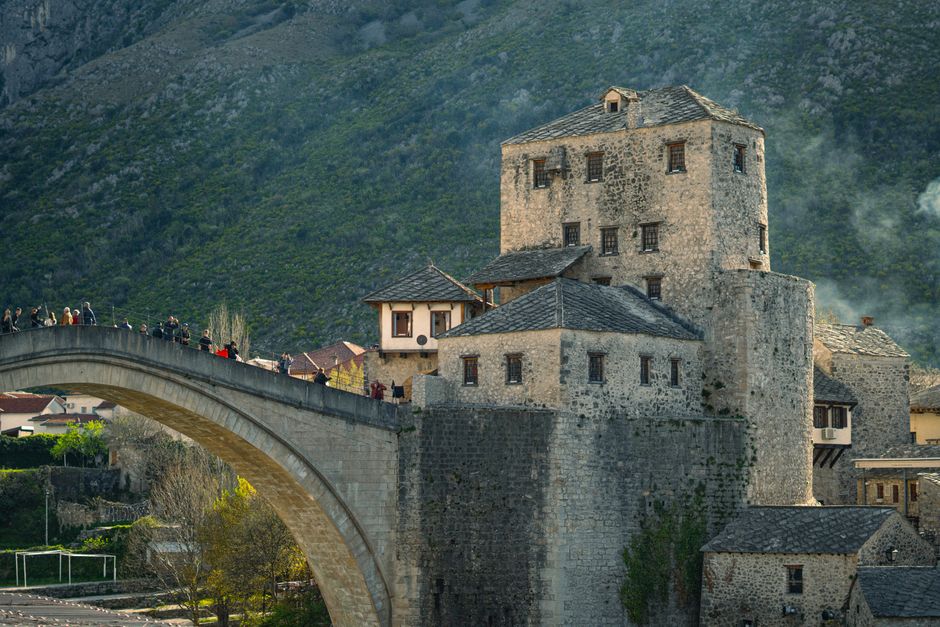
Bosnia and Herzegovina is a small, mountainous country with a big heart and a long memory, where minarets, Orthodox domes and Catholic spires share the same skyline. Sarajevo, the capital, is one of Europe’s most fascinating cities: an Ottoman bazaar, Austro-Hungarian boulevards and moving reminders of the 1990s siege in a valley ringed by hills. In the south, Mostar’s 16th-century Old Bridge arches over the emerald Neretva, and Herzegovina’s sunny wine country hides the Kravica waterfalls, the dervish house at Blagaj and the pilgrimage town of Međugorje. The rest of the country is rivers, forests and mountains: rafting on the Una, Neretva and Tara, the waterfall in the middle of Jajce, and the Drina bridge at Višegrad. Prices are low and the coffee is ceremonial. May, June and September are the sweet spots. Give it a week for a first trip, ten days to two weeks to see the country properly.
Right now in Bosnia and Herzegovina
- Wed 9–21°C 49–70°F Clear
- Thu 11–22°C 51–71°F 1 mm Partly cloudy
- Fri 13–16°C 55–61°F 17 mm Heavy showers
Weather: MET Norway (CC BY 4.0) · Air quality: OpenAQ
Multi-day tours of Bosnia and Herzegovina
Multi-day tours from local operators. You check dates and book on Viator, our partner; we may earn a commission at no extra cost to you. How we earn money
Bosnia and Herzegovina at a glance: mountains, rivers and two regions
Bosnia and Herzegovina covers about 51,200 square kilometres in the western Balkans, bordered by Croatia to the north, west and south, Serbia to the east and Montenegro to the south-east. It is almost landlocked: a 20 km strip of coast at Neum gives it a short stretch of the Adriatic. The country’s name joins two historic regions. Bosnia, the larger, northern part, is a land of forested mountains and green river valleys draining north to the Sava; Herzegovina, in the south, is drier, rockier and warmer, with Mediterranean vegetation, vineyards and the Neretva river flowing down to the sea. The highest peak, Maglić (2,386 m), is on the Montenegrin border in Sutjeska National Park.
Bosnia and Herzegovina’s last census, in 2013, counted about 3.53 million people, and the population has fallen since, as many young people have moved abroad; in mid-2026 the Federation’s statistics office estimated about 2.13 million people in the Federation alone. Sarajevo, Banja Luka, Tuzla, Zenica and Mostar are the largest cities. Its three main peoples are Bosniaks (mostly Muslim), Serbs (mostly Orthodox) and Croats (mostly Catholic), and Bosnian, Serbian and Croatian, three standard forms of the same language, are all official; you will see both the Latin and Cyrillic alphabets. English is widely spoken by younger people and in tourism, and German is common.
Under the 1995 Dayton Peace Agreement, which ended the war, the country is made up of two entities, the Federation of Bosnia and Herzegovina (divided into ten cantons) and Republika Srpska, plus the self-governing Brčko District, with a weak central state above them and an international High Representative overseeing the peace agreement. You don’t need any paperwork to cross between the entities, but you will notice changes in flags, alphabets and sometimes public holidays. Bosnia and Herzegovina is an EU candidate country but not a member, and it is not in the Schengen area. It uses the convertible mark (KM). Time zone: Central European Time (UTC+1, UTC+2 from the last Sunday in March to the last Sunday in October).
Bosnia and Herzegovina’s regions
- Sarajevo: the capital, in a narrow valley of the Miljacka river: the Ottoman bazaar of Baščaršija, the Gazi Husrev-beg Mosque, the Latin Bridge where Archduke Franz Ferdinand was assassinated in 1914, the restored City Hall, the Tunnel of Hope from the 1992–95 siege, and the Olympic mountains of Jahorina, Bjelašnica and Trebević just outside the city.
- Herzegovina: the sunny south: Mostar and its Old Bridge (UNESCO), the dervish house at Blagaj, the Ottoman hill village of Počitelj, the Kravica waterfalls, the pilgrimage town of Međugorje, the wine villages around Čitluk and Ljubuški, Trebinje near Dubrovnik, and the small resort of Neum on the coast.
- Central Bosnia: the old royal and Ottoman heartland: Jajce, with its waterfall in the town centre and a hilltop fortress; Travnik, birthplace of the Nobel prize-winning writer Ivo Andrić; Konjic and the Neretva canyon, with rafting and Tito’s secret nuclear bunker; and the remote highland village of Lukomir.
- The north-west (Bosanska Krajina): Banja Luka, the largest city of Republika Srpska, and the Una National Park near Bihać, with the Štrbački buk waterfalls and some of the country’s best rafting.
- The east: the Drina valley, with the Mehmed Paša Sokolović Bridge at Višegrad (UNESCO), Sutjeska National Park and the Perućica primeval forest, rafting on the Tara near Foča, and the Srebrenica–Potočari Memorial to the victims of the 1995 genocide.
Where to go: Sarajevo, Mostar and the rivers
Most visitors come in through Sarajevo, or cross from Croatia’s coast to Mostar. The two cities are about two hours apart by train or road along the Neretva valley, one of the most beautiful routes in the Balkans.
Sarajevo
Sarajevo is where East meets West in one walk: from the copper workshops, mosques and ćevapi grills of Baščaršija, past the “Meeting of Cultures” line marked on the pavement of Ferhadija street, into the Austro-Hungarian centre. Visit the Gazi Husrev-beg Mosque, the Sebilj fountain, the Latin Bridge and the City Hall (Vijećnica), climb to the Yellow Fortress for sunset, and learn about the 1992–95 siege at the Tunnel of Hope and the War Childhood Museum. The Trebević cable car lifts you to the 1984 Olympic bobsleigh track. See our Sarajevo guide for details.
Mostar
Mostar’s Old Bridge (Stari Most), built in 1566, destroyed in 1993 and rebuilt in 2004, is the symbol of the country. Watch the divers leap 20-odd metres into the river, wander the cobbled bazaar, climb the minaret of the Koski Mehmed-Pasha Mosque for the classic view, and visit an Ottoman family house. Day trips go to Blagaj, Počitelj and Kravica. See our Mostar guide.
Blagaj, Počitelj and Kravica
At Blagaj, a 16th-century dervish house (tekija) stands beside the spring of the Buna, which gushes from a cave beneath a 200-metre cliff. Počitelj is a fortified Ottoman village climbing a hill above the Neretva. The Kravica waterfalls, a wide horseshoe of cascades on the Trebižat river, are a favourite summer swimming spot.
Međugorje
Since six local children said they saw the Virgin Mary on a hillside in 1981, this village in western Herzegovina has become one of the world’s best-known Catholic pilgrimage sites, with St James’s Church, Apparition Hill and Cross Mountain. See our Međugorje guide.
Jajce and Travnik
Jajce is one of Bosnia’s most photogenic towns: the Pliva river plunges over a 20-metre waterfall right in the town, below a medieval fortress where the last Bosnian king was crowned. Upstream are the Pliva lakes with their wooden watermills. Travnik, an hour east, was the seat of the Ottoman viziers, with a fortress, painted mosque and Andrić’s birthplace.
Višegrad and the Drina
The eleven-arch Mehmed Paša Sokolović Bridge (1577) over the Drina, made famous by Ivo Andrić’s novel The Bridge on the Drina, is a UNESCO World Heritage Site.
The Una and Sutjeska national parks
In the north-west, the Una National Park protects a clear green river with waterfalls at Štrbački buk and Martin Brod. In the south-east, Sutjeska National Park has the Perućica primeval forest, high mountain hikes to Maglić and the Tara river rafting centres near Foča.
Trebinje
Only 30 km from Dubrovnik, Trebinje is a relaxed Herzegovinian town with plane-tree-shaded squares, an Ottoman bridge, wineries and the hilltop Hercegovačka Gračanica church.
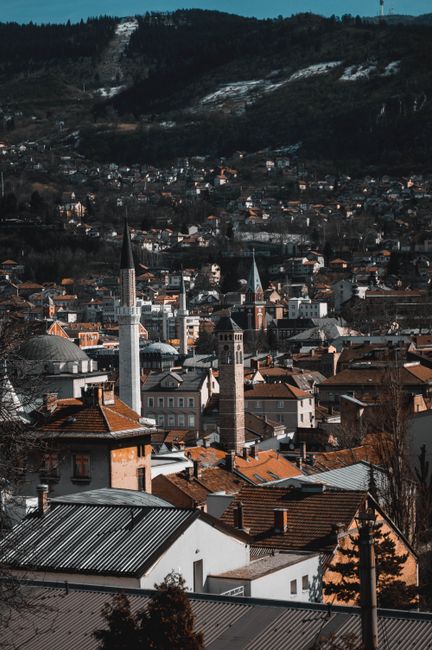
Međugorje Travel Guide
Plan a visit to Međugorje: St James's Church and the evening prayer programme with summer and winter times, climbing Apparition Hill and Cross Mountain,…
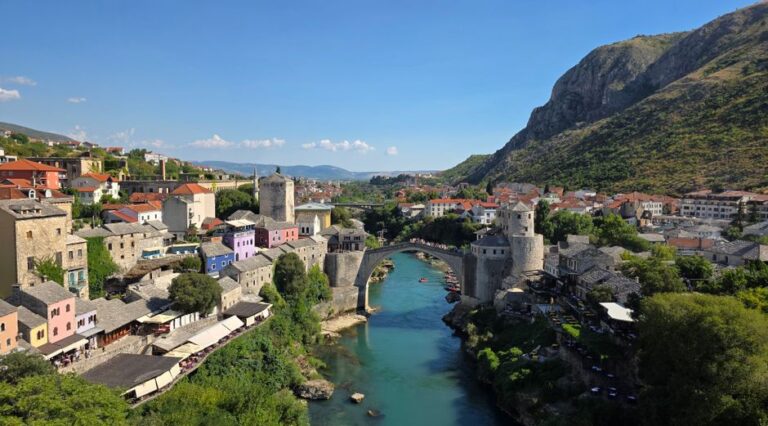
Mostar Travel Guide
Plan a trip to Mostar: the Old Bridge and its story, when the divers jump, the Koski Mehmed-Pasha Mosque view, the Old Bridge museum…
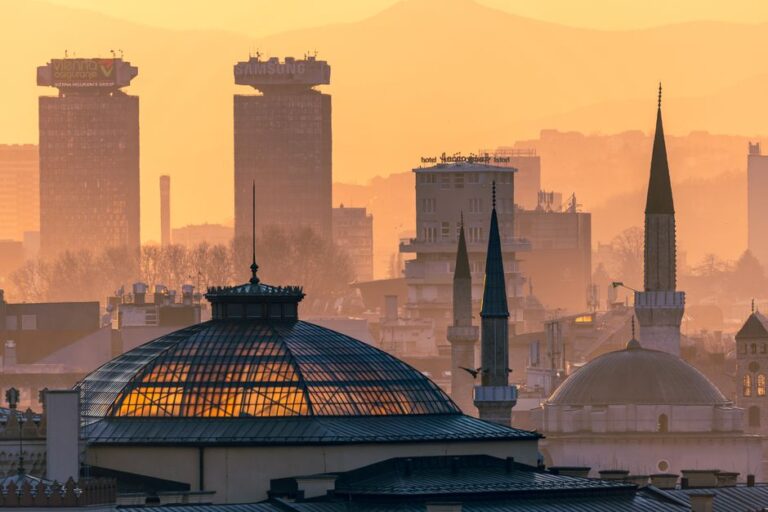
Sarajevo Travel Guide
Plan a trip to Sarajevo: Baščaršija and the Gazi Husrev-beg Mosque, the Latin Bridge and the 1914 assassination museum, the City Hall, the Tunnel…
Best time to visit Bosnia and Herzegovina, region by region
The country has two climates. Bosnia, in the north and in the mountains, has a continental climate: warm summers, cold, snowy winters and fog in the valleys. Herzegovina, in the south, has a Mediterranean-influenced climate: Mostar is one of the hottest cities in the Balkans in summer, with highs above 33 °C in July and August, while its winters are mild but very wet. The table shows rounded average daily highs and lows and yearly rainfall from the official 1991–2020 normals that the national weather services submitted to the World Meteorological Organization.
| Region (station) | Spring highs (Mar–May) | Summer highs (Jun–Aug) | Autumn highs (Sep–Nov) | Winter highs (Dec–Feb) | Winter lows (Dec–Feb) | Rain a year |
|---|---|---|---|---|---|---|
| Sarajevo (630 m) | 11.5 °C rising to 21.5 °C | 25–28 °C | 22.5 °C falling to 10.5 °C | 4–6.5 °C | about −3 to −1.5 °C | about 950 mm |
| Herzegovina (Mostar) | 16 °C rising to 25 °C | 30–33.5 °C | 27 °C falling to 15 °C | 9–11.5 °C | about 2.5 to 4 °C | about 1,445 mm |
| North (Banja Luka) | 14 °C rising to 23.5 °C | 27–30 °C | 24 °C falling to 12.5 °C | 6–9 °C | about −2.5 to −1 °C | about 1,050 mm |
| Eastern Herzegovina (Trebinje) | 15 °C rising to 23.5 °C | 28.5–32 °C | 26 °C falling to 16 °C | 10.5–12 °C | about 2.5 to 3.5 °C | about 1,575 mm |
In Herzegovina, most rain falls from October to March, often in heavy downpours, while summers are dry and sunny. In Sarajevo and central Bosnia, rain is spread through the year and snow is common from December to March; the mountains above 1,200 m keep snow cover for skiing. Sarajevo’s valley often fills with fog and air pollution on still winter days.
Crowds and prices through the year
- April to early June: one of the best times to visit: green hills, full rivers for rafting and pleasant temperatures in Mostar before the heat. Catholic and Orthodox Easter bring pilgrims and busy weekends.
- July and August: peak season in Mostar, Međugorje and Kravica, with day-trippers from Croatia’s coast filling the Old Bridge area by late morning; Sarajevo is busy during its film festival in August. Mostar is very hot, so sightsee early and late.
- September and October: excellent: warm, golden weather, the grape harvest in Herzegovina, fewer crowds and lower prices.
- November to March: cold, with fog and smog in Sarajevo and snow in the mountains; the ski season at Jahorina and Bjelašnica runs from about December to March. Herzegovina is quiet, mild and rainy.
Festivals and events: late 2026 and 2027
Dates announced by the organisers so far (several 2027 dates had not been published when we checked):
| Event | Dates | Good to know |
|---|---|---|
| Sarajevo Winter (Sarajevska zima) | 7 February – 21 March 2027 | A long-running festival of theatre, music, film and art across the city, founded during the siege |
| Međugorje Youth Festival (Mladifest) | Tuesday 27 – Saturday 31 July 2027 | Tens of thousands of young Catholic pilgrims; earlier than usual in 2027 because of World Youth Day in Seoul; rooms in Međugorje and Mostar fill up |
| Old Bridge diving competition, Mostar | late July (the 460th edition was on 26 July 2026) | The traditional summer jumps from the Old Bridge, organised by the Mostari divers’ club; 2027 date to be confirmed |
| Sarajevo Film Festival | mid-August (the 2026 edition ran 14–21 August) | The Balkans’ biggest film festival, with open-air screenings; 2027 dates not yet announced, and hotels fill up |
- November and December: Statehood Day on 25 November in the Federation, Advent and Christmas in Catholic Herzegovina, and the start of the ski season on Jahorina and Bjelašnica in December.
- January to March: Orthodox Christmas (7 January) in Republika Srpska and Serb communities, and Ramadan, which in 2027 is expected to run from about 8 February to Ramazanski Bajram on about 9 March; in Sarajevo, the old town is lively at sunset as families break the fast.
- Summer: Red Bull Cliff Diving has stopped in Mostar ten times since 2015, most recently on 31 July – 1 August 2026; the 2027 calendar was not out when we checked. Rafting, open-air concerts and wine festivals in Herzegovina fill the season.
- September and October: grape harvests and wine fairs in Herzegovina.
Public holidays
Bosnia and Herzegovina has no single national list of public holidays: the Federation, Republika Srpska and Brčko District each set their own, and people also get their own religious holidays off. Shops and offices close in the areas where a holiday is celebrated. The main ones, from October 2026:
| Holiday | Date | Where |
|---|---|---|
| Statehood Day | Wednesday 25 November 2026 | Federation |
| Catholic Christmas | Friday 25 December 2026 | Catholics; widely observed in the Federation |
| New Year | Friday 1 and Saturday 2 January 2027 | Everywhere |
| Orthodox Christmas | Thursday 7 January 2027 | Orthodox; Republika Srpska |
| Republic Day | Saturday 9 January 2027 | Republika Srpska (the state Constitutional Court has ruled the date unconstitutional, but it is still marked) |
| Independence Day | Monday 1 March 2027 | Federation |
| Ramazanski Bajram (Eid al-Fitr) | about Tuesday 9 March 2027 | Muslims; the exact day depends on the moon |
| Catholic Easter | Sunday 28 and Monday 29 March 2027 | Catholics |
| Orthodox Easter | Friday 30 April – Monday 3 May 2027 | Orthodox; Republika Srpska |
| Labour Day | Saturday 1 and Sunday 2 May 2027 | Everywhere |
| Victory Day | Sunday 9 May 2027 | Republika Srpska |
| Kurban Bajram (Eid al-Adha) | about Sunday 16 May 2027 | Muslims; the exact day depends on the moon |
| Statehood Day | Thursday 25 November 2027 | Federation |
Check locally around holidays, as museums, banks and some buses change their hours.
How long to stay: sample itineraries
Sarajevo and Mostar are linked by train, bus and the A1 motorway along the Neretva valley. Buses reach most towns, but a car makes it much easier to see Jajce, the national parks and the villages of Herzegovina.
4 days: Sarajevo and Mostar
Spend two days in Sarajevo: Baščaršija and the mosques, the Latin Bridge and City Hall, the Tunnel of Hope and the Trebević cable car. Then take the morning train down the Neretva valley to Mostar for the Old Bridge in the evening light and a day trip to Blagaj, Počitelj and Kravica.
7 days: the classic loop
Add a night in Jajce for the waterfall, the fortress and the Pliva lakes, with a stop at Travnik, and a day or two in Herzegovina for Međugorje, the wineries and Trebinje.
10 days: add the rivers and mountains
Add rafting on the Neretva, Una or Tara, a hike in Sutjeska National Park or to the highland village of Lukomir, and the bridge at Višegrad on the way to or from Serbia.
14 days: the Balkans loop
Combine Bosnia and Herzegovina with Croatia’s coast: Dubrovnik is about two and a half to three hours from Mostar and 30 minutes from Trebinje, and Split about three hours from Mostar, so you can fly in to one and out of Sarajevo. Zagreb is about six hours from Sarajevo, and Belgrade about six to seven hours by bus. Montenegro’s Bay of Kotor is a short drive from Trebinje.
Entry, money and costs
Entry: visas, registration and EES (last reviewed October 2026)
Bosnia and Herzegovina is not in the EU or the Schengen area and sets its own entry rules. Citizens of EU and EEA countries, Switzerland, the UK, the United States, Canada, Australia and many other countries can visit without a visa for up to 90 days in any 180-day period; EU citizens can also enter with a national ID card. Others need a visa from a Bosnian embassy. Time spent in Bosnia and Herzegovina does not count towards your 90 days in the Schengen area.
- Passports: your passport must have been issued less than 10 years before you arrive and be valid for at least 90 days after the day you plan to leave. Make sure it is stamped when you enter and leave, as border guards use the stamps to check you haven’t overstayed.
- Registering your stay: foreign visitors must be registered within 48 hours of arrival, according to the Service for Foreigners’ Affairs (the UK government gives 72 hours). Hotels, hostels and licensed apartments do this for you when you check in; otherwise, ask your host or register at the nearest field office of the Service for Foreigners’ Affairs or a police station.
- Children: under-18s travelling alone or with only one parent, or with another adult, should carry a notarised letter of consent from the parents.
- Between the entities: there are no checks or formalities when you cross between the Federation and Republika Srpska.
- EES at the EU border: Bosnia and Herzegovina is not part of the EU’s Entry/Exit System, but Croatia is. Since 10 April 2026, non-EU travellers entering Croatia from Bosnia and Herzegovina have their passport details, a photo and fingerprints recorded on their first crossing instead of a stamp. In spring and summer 2026 waits of one to three hours were reported at busy crossings such as Gradiška, Kostajnica and Brod, and longer at peak times; the UK government advises allowing extra time. The Gradiška crossing has moved to a new facility.
- ETIAS: the EU’s planned travel authorisation is not needed for Bosnia and Herzegovina. For onward travel to Croatia and the rest of the Schengen area, it is not in operation as of October 2026, and no start date has been published.
Rules change, so check the Bosnian Ministry of Foreign Affairs, the Service for Foreigners’ Affairs and your own government’s travel information before you travel.
Language
A few words help everywhere in the country: zdravo (hello), dobar dan (good day), hvala (thank you), molim (please), izvolite (here you are, or “can I help you?”), živjeli (cheers), ulaz and izlaz (entrance and exit), and muški and ženski (men and women). Merhaba and selam are common greetings among Bosniaks.
Money: the convertible mark, cards and cash
Bosnia and Herzegovina uses the convertible mark (konvertibilna marka, written KM; code BAM), divided into 100 feninga. It is pegged to the euro by the Central Bank at a fixed rate of 1 euro = 1.95583 KM, so 1 KM is worth about €0.51, and many people simply count two marks to the euro. Cards and phone payments are accepted in hotels, supermarkets, most restaurants and petrol stations in the cities, but carry cash for bakeries, ćevapi shops, markets, small guesthouses, the Tunnel of Hope (cash only) and the countryside. ATMs are everywhere in towns. Euros are accepted at motorway toll booths and in many hotels and tourist businesses in Mostar and Međugorje, usually at a rounded rate of 1:2, with change given in marks. When a card terminal or ATM offers to charge you in your home currency, choose marks.
Tipping
Tipping is appreciated rather than expected: round up the bill or leave about 10% in restaurants if the service was good, round up taxi fares, and tip guides and rafting instructors a little.
VAT and tax-free shopping
Prices include VAT (PDV) at a single rate of 17%. Visitors who live abroad can reclaim VAT on goods they take home in their personal luggage: under the rules in force since August 2025, the purchase must be more than 200 KM in one shop, and fuel, alcohol and tobacco are excluded. Ask the shop for the refund form (PDV-SL-2) when you pay, have it certified by customs at the border when you leave, with the unused goods and receipt, and then claim the refund from the shop. Few tourists use it, and not all shops take part.
Typical travel costs
Bosnia and Herzegovina is one of the best-value countries in Europe, noticeably cheaper than neighbouring Croatia. Mostar’s Old Bridge area and Sarajevo’s centre are pricier than elsewhere. These estimates, per person per day, are a planning guide as of October 2026:
| Style | Estimated cost per day | What that looks like |
|---|---|---|
| Budget | about 70–100 KM (€35–50) | Hostel dorm or simple guesthouse, burek and ćevapi, buses and trains, free sights plus a museum or two |
| Mid-range | about 150–250 KM (€75–130) | Double room in a good hotel or boutique guesthouse shared by two, restaurant dinners with wine, a guided tour or rafting trip |
| High-end | about 400 KM+ (€200+) | The best hotels in Sarajevo and Mostar, private guides and drivers, fine dining |
Hotels add a small tourist tax per person per night, set locally. The figures above are our estimates, not official statistics.
Getting there and getting around
Airports
- Sarajevo International Airport (SJJ): the main gateway, at Butmir on the western edge of the city. In winter 2026–27, Ryanair suspends its Sarajevo flights, while Wizz Air keeps London Luton and Rome year-round and adds Berlin and Bratislava from 3 December and Prague from 18 December 2026; regular flights also connect Sarajevo with hubs such as Istanbul, Vienna and Belgrade. Fog can delay or divert flights in December and January. The Centrotrans airport bus runs to the old town (Baščaršija) for 5 KM as of October 2026, roughly hourly.
- Mostar (OMO): a small airport south of the city, with year-round flights to Belgrade (Air Serbia), Zagreb (Croatia Airlines) and Stuttgart (Eurowings) and some seasonal routes.
- Tuzla (TZL) and Banja Luka (BNX): regional airports with low-cost flights to some European cities, handy for the north.
Many visitors fly into Croatia instead: Dubrovnik is about two and a half to three hours from Mostar, and Split about three hours, with many more flights in summer.
Trains
Trains are few but the Sarajevo–Mostar line is a highlight: it winds down the Neretva valley past Jablanica’s lakes and gorges, one of the most scenic rail journeys in Europe. In the 2025–26 timetable of the Federation’s railways (ŽFBH), two trains a day run each way between Sarajevo and Čapljina via Mostar, leaving Sarajevo at 07:15 and 16:46 and taking about 2 hours to Mostar. A one-way ticket to Mostar costs about 11.90 KM and a return about 19.30 KM. In summer, some trains continue to Ploče on the Croatian coast on Fridays to Sundays (from late June to late September in 2026). Other lines run from Sarajevo north to Zenica and Doboj, and in Republika Srpska from Banja Luka to Doboj. There are no international trains to Zagreb or Belgrade. Timetables change in mid-December, so check before you travel.
Buses
Buses go almost everywhere and are cheap and fairly comfortable. Sarajevo’s main bus station is next to the railway station, with buses to Mostar (about 2 hours 40 minutes, about eight a day, around 36 KM one way online in October 2026), Jajce, Travnik, Bihać, Tuzla and international routes to Croatia, Serbia, Montenegro and Western Europe; some buses to Republika Srpska and Serbia use the East Sarajevo (Lukavica) bus station instead. Mostar has frequent buses to Split, Dubrovnik and Međugorje, especially in summer. Buy tickets at the station, and expect a small charge for luggage in the hold.
Driving, tolls and border insurance
A car is the best way to see the countryside, but roads are mostly two-lane, winding and slow, so allow more time than the distance suggests. Sections of the A1 motorway (Corridor Vc) run from the Croatian border in the north via Zenica to Sarajevo and on to Tarčin, and in western Herzegovina near Međugorje and Ljubuški; between Tarčin and Mostar you still drive the old main road along the Neretva. Republika Srpska has its own motorways, such as Banja Luka–Gradiška and Banja Luka–Doboj.
- Tolls: there is no vignette; you pay at toll booths in marks, euros or by card. For example, Sarajevo to Zenica costs about 7 KM for a car (as reported for 2026). An electronic tag is available for regular users.
- Rules: dipped headlights must be on at all times, day and night. Speed limits are 130 km/h on motorways, 100 on expressways, 80 on other roads outside towns and 50 in built-up areas. The alcohol limit is 0.3 grams per kilogram (stricter for young and professional drivers). Police carry out frequent checks and can fine on the spot.
- Winter: from November to April, cars must have winter tyres with at least 4 mm of tread and carry snow chains.
- Insurance and licences: Bosnia and Herzegovina is in the green card system; check that your insurance covers it, or buy border insurance at the main crossings. If you rent a car in the country, carry an International Driving Permit (1968 convention) with your licence. Check that a hire car from Croatia may cross the border.
- Landmines: never pull off onto verges, tracks or fields in the countryside; stay on the tarmac.
Taxis and bikes
In Sarajevo and the big towns, metered taxis are cheap; use registered companies and agree the fare first at Sarajevo airport, where drivers sometimes quote fixed prices. Cycling is growing, with mountain-bike trails around Sarajevo and the Una valley, but main roads have no shoulders and traffic can be fast.
Culture, coffee, food and everyday etiquette
Coffee is a ritual: Bosnian coffee (bosanska kafa) is brewed in a copper džezva, served on a tray with a sugar cube and rahat lokum (Turkish delight), and drunk slowly. People are warm and generous hosts, and the country’s mixed heritage is part of daily life. Dress modestly in mosques, churches and monasteries; in mosques, women cover their hair, everyone removes their shoes, and visits are best avoided at prayer times, especially at Friday midday prayers. The 1990s war touched every family. Visitors are welcome to ask about it, and many guides lead excellent tours, but listen respectfully, avoid taking sides, and don’t joke about it. During Ramadan, eat and drink discreetly in public in Muslim areas.
The food is hearty and meaty. Try ćevapi in a somun flatbread with onions and kajmak, burek (meat pie; the cheese, spinach and potato versions are sirnica, zeljanica and krompiruša), begova čorba (the bey’s chicken soup), klepe (dumplings), dolma and sogan-dolma (stuffed vegetables and onions), bosanski lonac (Bosnian hotpot) and sweets such as baklava and tufahija (poached apple stuffed with walnuts). Herzegovina makes fine wines from the local Žilavka (white) and Blatina (red) grapes, and rakija is offered everywhere outside the most observant Muslim homes.
Safety, health, accessibility and connectivity
Safety
Current conditions (October 2026): expect longer waits at Schengen borders because of the EU’s Entry/Exit System, and note that the Gradiška crossing has moved. Landmines remain in some rural areas, so stay on paved roads and marked paths. Recent politically related unrest has not affected tourists, but avoid demonstrations, as bystanders could be caught up in them.
In practice, Bosnia and Herzegovina is a safe and friendly country, and violent crime against visitors is rare. The risks to take seriously are these:
- Landmines: the 1992–95 war left minefields that are still being cleared. In January 2026, according to the country’s Mine Action Centre as reported in the press, about 775 square kilometres, around 1.5% of the country, was still suspected to be contaminated. Cities, main roads and popular tourist sites are clear, but in the countryside stay on paved roads and well-used paths, never enter abandoned or ruined buildings, keep out of areas marked with red skull-and-crossbones signs or tape, and hike with a local guide or on marked trails. The US government notes that deaths from explosions occurred as recently as August 2025.
- Petty crime: pickpockets work on Sarajevo’s trams and in Baščaršija, and there have been thefts from cars at viewpoints on Mount Trebević; lock your car and keep valuables out of sight.
- Protests and politics: demonstrations happen from time to time and are usually peaceful; avoid them. Terrorist attacks cannot be ruled out.
- Water: diving from Mostar’s Old Bridge is dangerous and has caused deaths; leave it to the trained divers. Go rafting only with licensed operators.
Emergency numbers: 122 for police, 123 for the fire service and 124 for an ambulance. The European emergency number 112 was not working reliably across the whole country in 2026, so use the three local numbers.
Health
Travellers should have travel insurance with medical cover: the EHIC and GHIC are not valid, though some countries have reciprocal agreements (UK visitors should check the UK government’s guidance). Private clinics in Sarajevo, Mostar and Banja Luka are good. Pharmacies (apoteka) are found in every town. Tap water is generally safe in cities. Sarajevo’s air pollution can be severe on still winter days; people with breathing or heart conditions should check air-quality readings. In summer, ticks are common in forests and meadows, and Herzegovina’s heat can be fierce: drink plenty of water and avoid walking in the middle of the day.
Accessibility
Accessibility is limited. Sarajevo’s old town is mostly flat but cobbled, while the hills around it are steep. Mostar’s Old Bridge is steep, ridged and slippery, and the bazaar is cobbled. Newer hotels and shopping centres are accessible; trams, buses and many museums are not fully adapted.
Connectivity and power
Bosnia and Herzegovina is not part of the EU’s roaming area, so EU and UK mobile plans may charge high roaming fees; under an agreement between EU and Western Balkan operators, cheaper data packages are offered, and in February 2026 the European Commission proposed talks to bring the region into “roam like at home”, but that was not in force as of October 2026. A local prepaid SIM or eSIM from BH Telecom, m:tel or HT Eronet is cheap. Coverage is good in towns and along main roads, patchy in deep valleys and mountains, and Wi-Fi is standard in hotels and cafés. Bosnia and Herzegovina uses 230 V and European two-pin plugs, type C and F. You need an adapter for UK, US and Australian plugs; see our guide to travel adapters.
Things to do: history, rivers, mountains and wine
- City sightseeing: Sarajevo’s bazaar, mosques, museums and siege sites, Mostar’s Old Bridge and Ottoman houses, Jajce, Travnik, Počitelj, Trebinje and Banja Luka.
- Hiking: the Olympic mountains above Sarajevo, the walk to the highland village of Lukomir on Bjelašnica, the Perućica forest and Maglić in Sutjeska National Park, and the Via Dinarica trail. Stay on marked paths because of landmines.
- Wine tasting: Herzegovina’s wineries around Čitluk, Međugorje, Ljubuški, Stolac and Trebinje, with Žilavka whites and Blatina and Vranac reds.
- Rafting and kayaking: the Neretva near Konjic, the Una near Bihać and the Tara near Foča, usually from April to October.
What to pack
Pack for the season and the altitude: light, breathable clothes, a sun hat and sunscreen for hot Herzegovinian summers; a warm coat, hat and gloves from November to March, especially in Sarajevo and the mountains. Bring shoes with good grip for cobbles and Mostar’s slippery bridge, water shoes for swimming at Kravica and in rivers, hiking shoes for the mountains, a light rain jacket for spring and autumn, a scarf for mosque visits, and a type F plug adapter if you come from outside continental Europe.
Bosnia and Herzegovina travel FAQ
When is the best time to visit Bosnia and Herzegovina?
May, June and September are the best all-round months: warm, green and less crowded. July and August are very hot in Mostar and busy with day-trippers; December to March is ski season in the mountains around Sarajevo.
How many days do you need in Bosnia and Herzegovina?
Four days covers Sarajevo and Mostar. A week lets you add Jajce, Travnik and Herzegovina’s waterfalls and wineries, and ten days to two weeks gives time for rafting, the national parks and Višegrad.
Does Bosnia and Herzegovina use the euro?
No. It uses the convertible mark (KM), fixed at 1.95583 KM to the euro. Euros are accepted at toll booths and by many hotels and tourist businesses, usually at 2 KM to the euro, but you will get change in marks.
Do I need a visa for Bosnia and Herzegovina?
Not if you are a citizen of the EU, the UK, the US, Canada, Australia or many other countries: you can stay up to 90 days in any 180-day period. EU citizens can use an ID card. Others should check with a Bosnian embassy.
Is Bosnia and Herzegovina in the EU or the Schengen area?
No. It is an EU candidate country but not a member, and it is not in Schengen. Crossing into Croatia means a full border check, with EU Entry/Exit System registration for non-EU travellers since April 2026.
Do I have to register with the police in Bosnia and Herzegovina?
Yes, within 48 hours of arrival, according to the Service for Foreigners’ Affairs, but hotels, hostels and licensed apartments do it for you at check-in. In a private apartment, ask your host.
Is Bosnia and Herzegovina safe for tourists?
Yes, generally. The main risks are landmines in the countryside, so stay on paved roads and marked paths, and pickpockets in Sarajevo.
How do I get from Sarajevo to Mostar?
By train down the Neretva valley, about 2 hours with two departures a day (07:15 and 16:46 from Sarajevo in the 2025–26 timetable), or by bus, about 2 hours 40 minutes, with about eight departures a day. By car, allow about two and a half hours.
Can I visit Mostar as a day trip from Dubrovnik or Split?
Yes, many tours do, but it is a long day of two and a half to three hours each way plus border queues. Staying a night lets you see the Old Bridge in the quiet evening and morning.
Do I need a vignette to drive in Bosnia and Herzegovina?
No. Motorways have toll booths where you pay in marks, euros or by card. Dipped headlights must be on at all times, and winter tyres and snow chains are required from November to April.
What plug type does Bosnia and Herzegovina use?
Type C and F European two-pin plugs, at 230 V. Visitors from the UK, Ireland, North America and Australia need an adapter.
Can I combine Bosnia and Herzegovina with Croatia and Montenegro?
Easily. Mostar is about three hours from Split and Dubrovnik, Trebinje is 30 minutes from Dubrovnik, and Montenegro’s Bay of Kotor is a short drive from Trebinje, so a loop through all three countries works well.
Sources and last review
Researched and last reviewed on 4 October 2026. Safety information from GOV.UK foreign travel information and the US State Department’s country information; entry rules from the Bosnian Ministry of Security and the UK government; the exchange rate from the Central Bank of Bosnia and Herzegovina; VAT refunds from the Indirect Taxation Authority; climate from the official 1991–2020 station normals submitted to the World Meteorological Organization (archived by NOAA); train times from the Federation’s railways (ŽFBH); Sarajevo airport bus from Sarajevo International Airport; Sarajevo Winter and the Youth Festival from the organisers; EU roaming from the European Commission. Population estimates, mine figures, toll prices, train fares, flight schedules, holiday and Bajram dates, border waiting times and some event dates come from press reports or secondary sources and are flagged for checking. Daily costs are estimates. Prices, timetables and entry rules change, so check the official sites before you travel.
Plan your trip
Partner links: TravelerCenter may earn a commission if you book, at no extra cost to you.