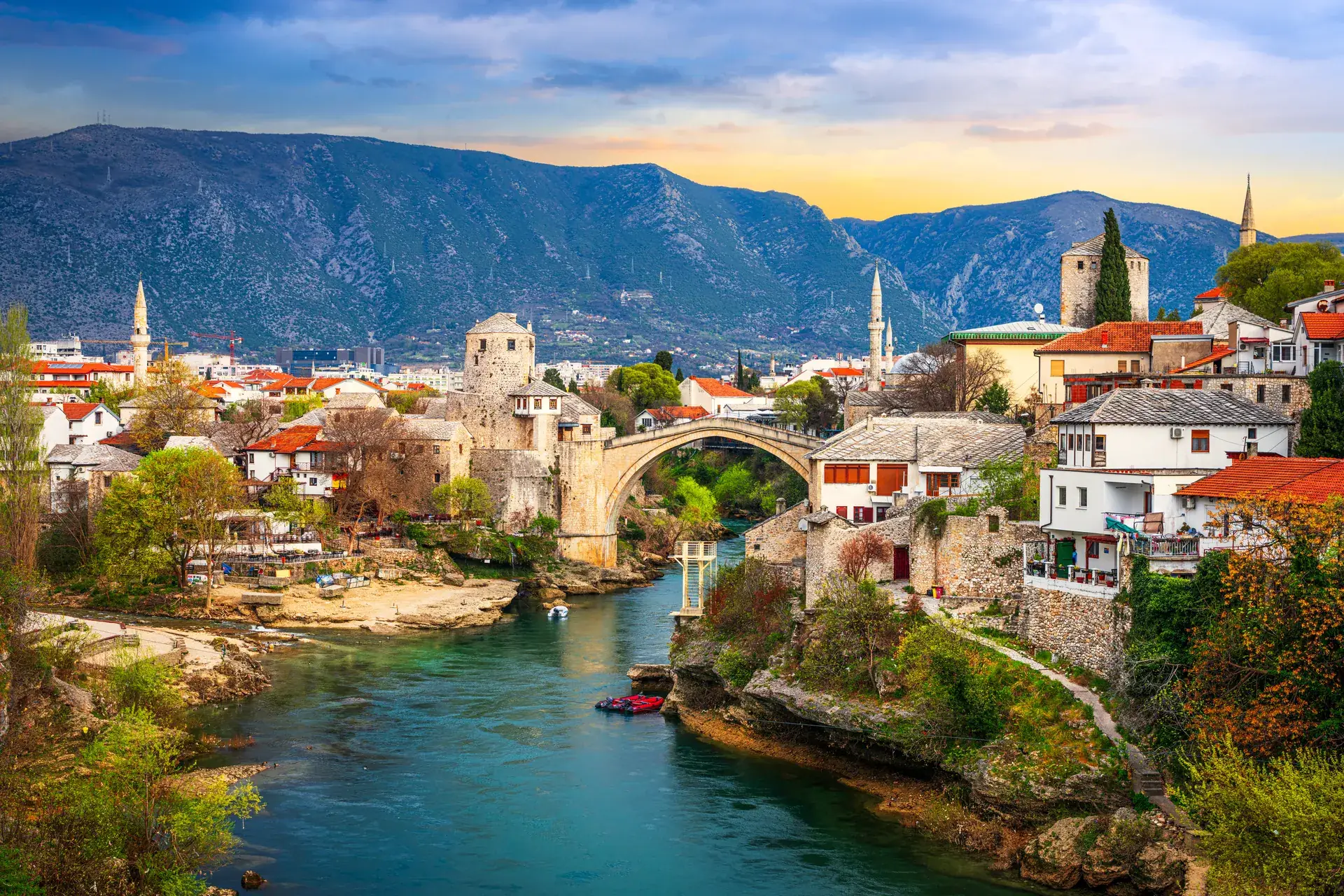
Short answer: with 7 days, spend three nights in Sarajevo and three in Mostar, linked by one of Europe’s most beautiful train rides down the Neretva valley, with a day out to Blagaj, Počitelj and the Kravica waterfalls. With 10 days, hire a car and add the waterfall town of Jajce on the way south and two nights in Trebinje, close to Dubrovnik. With 14 days, loop through the whole country: the Una National Park in the north-west, Jajce, Sarajevo, the Drina bridge at Višegrad, Sutjeska’s mountains and Herzegovina. Distances are short, but roads are slow and winding, so keep the driving days light.
This guide turns the sample trips on our Bosnia and Herzegovina travel guide into day-by-day plans, with travel times between stops and the best area to sleep in each night. Choose your month with our best time to visit Bosnia and Herzegovina guide, see the highlights in our top 10 places to visit in Bosnia and Herzegovina, and for a plan built around your dates and interests, use our AI trip planner. Everything was checked as of October 2026.
The three routes at a glance
| Route | Days | Stops and nights | Best for |
|---|---|---|---|
| Sarajevo and Mostar by train | 7 | Sarajevo 3, Mostar 3 | First trip, no driving, the two great cities and Herzegovina’s highlights |
| Sarajevo, Jajce, Herzegovina and Trebinje | 10 | Sarajevo 3, Jajce 1, Mostar 3, Trebinje 2 | A road trip with waterfalls, Ottoman villages, wine and an easy finish near Dubrovnik |
| The whole-country loop | 14 | Sarajevo 3, Višegrad 1, Sutjeska 1, Trebinje 2, Mostar 3, Jajce 1, Una National Park 2 | Rivers, mountains and national parks as well as the cities |
Most visitors fly into Sarajevo International Airport, a short ride from the old town (a Centrotrans airport bus runs to Baščaršija about hourly for 5 KM), or arrive overland from Croatia’s coast: Dubrovnik is about 30 minutes from Trebinje and Split about three hours from Mostar, which makes it easy to fly in to one and out of the other. Citizens of the EU, the UK, the United States, Canada, Australia and many other countries don’t need a visa for stays of up to 90 days; hotels register your stay with the authorities when you check in.
Travel times between the main stops
These are the legs used in the plans below. “ŽFBH” marks departure times from the Federation railway’s 2025–26 timetable and “Centrotrans” times from the bus operator’s own listings; road times are approximate and depend on traffic and mountain roads.
| Leg | Fastest way | Time | Source |
|---|---|---|---|
| Sarajevo – Mostar | Train down the Neretva valley, two a day (07:15 and 16:46 from Sarajevo) | about 2 h | ŽFBH (departures); journey time approximate |
| Sarajevo – Mostar | Bus, about eight a day | about 2 h 40–2 h 45 | Centrotrans |
| Mostar – Blagaj, Počitelj, Kravica | Car or day tour (Blagaj also by local bus) | a short drive each; a full day for all three | Approximate |
| Mostar – Međugorje | Bus | about 30–45 min | Approximate (bus listings) |
| Sarajevo – Jajce | Bus (a few a day) or car, via Travnik | about 3 h 30 by bus | Approximate (booking sites) |
| Jajce – Travnik | Car or bus | about 1 h | Approximate |
| Mostar – Trebinje | Car (buses are few) | about 2 h–2 h 30 | Approximate |
| Trebinje – Dubrovnik | Car, taxi or bus | about 30 min (about 30 km) | Approximate |
| Mostar – Dubrovnik / Split | Bus | about 3 h 15 / about 3 h 45–5 h | Approximate (bus listings) |
| Sarajevo – Višegrad | Car or bus | about 2 h–2 h 30 | Approximate |
| Višegrad – Sutjeska (Tjentište) – Trebinje | Car, via Foča and Gacko | about 1 h 30 + about 2 h | Approximate |
| Jajce – Una National Park (Bihać) | Car | about 2 h 30 | Approximate |
Trains are few, but the Sarajevo–Mostar line, winding past Jablanica’s lakes and gorges, is a highlight in its own right: sit on the right-hand side going south for the best river views. Buses reach most towns, but a car makes it far easier to see Jajce, the villages of Herzegovina and the national parks. Euros are accepted at motorway toll booths; elsewhere, pay in convertible marks (KM), which are pegged to the euro at about 2 KM to €1.
7 days: Sarajevo and Mostar by train
The classic first trip, with no driving. Book a day tour (or a driver) for Herzegovina’s sights from Mostar.
- Day 1, Sarajevo: Arrive and head to Baščaršija, the Ottoman bazaar, for ćevapi and a Bosnian coffee served in a copper džezva. Sunset from the Yellow Fortress above the old town. Sleep: Baščaršija or the old town.
- Day 2, East meets West: The Gazi Husrev-beg Mosque, the Sebilj fountain and the copper workshops, then walk Ferhadija street into the Austro-Hungarian center, past the Latin Bridge to the restored City Hall (Vijećnica). Sleep: same.
- Day 3, the mountain and the museums: The Trebević cable car up to the 1984 Olympic bobsleigh track (30 KM return), lunch with a view, then the Tunnel of Hope museum near the airport (cash only) or the National Museum. Sleep: same.
- Day 4, the Neretva valley to Mostar: The 07:15 train reaches Mostar in about two hours. Drop your bags, see the Old Bridge before the day-trippers arrive, and climb the minaret of the Koski Mehmed-Pasha Mosque for the classic view. Sleep: Mostar old town (3 nights).
- Day 5, Herzegovina day out: The dervish house at Blagaj beside the Buna spring (open 08:30–20:30), the Ottoman hill village of Počitelj, and a swim at the Kravica waterfalls (20 KM, open until 22:00 from June to September).
- Day 6, Mostar slowly: An Ottoman family house such as Kajtaz House, the bazaar, the bridge divers, and a wine tasting in the vineyards around Čitluk or Međugorje in the afternoon.
- Day 7, home: Train or bus back to Sarajevo for your flight, or a bus to Dubrovnik or Split for a flight from the coast.
Swap it: flying in from Croatia? Start in Mostar, then take the train up to Sarajevo and fly home from there. Pilgrims can trade day 6 for Međugorje, 30–45 minutes from Mostar by bus. More detail is in our Sarajevo and Mostar guides.
10 days: Sarajevo, Jajce, Herzegovina and Trebinje
A road trip from the mountains to the sunny south. Pick up a hire car in Sarajevo on day 4 and drop it in Trebinje or Dubrovnik (a one-way, cross-border drop usually costs extra; ask when you book).
- Days 1–3, Sarajevo: As days 1–3 of the 7-day plan: Baščaršija, the mosques and City Hall, the Yellow Fortress, the Trebević cable car and a museum. Sleep: Baščaršija or the old town (3 nights).
- Day 4, Travnik and Jajce: Drive north-west to Travnik, the old seat of the Ottoman viziers, for its fortress and painted mosque, then on to Jajce (about an hour). See the Pliva waterfall in the town center at sunset. Sleep: Jajce (1 night).
- Day 5, the Pliva lakes and south to Mostar: Morning at the fortress and the wooden watermills on the Pliva lakes, then a long, scenic drive south to Mostar (allow most of the afternoon). Sleep: Mostar old town (3 nights).
- Day 6, Mostar: The Old Bridge early, the bazaar, a minaret climb and an Ottoman house; sunset by the river.
- Day 7, Blagaj, Počitelj and Kravica: All three in a day by car, with a trout lunch on the Buna at Blagaj and a swim at Kravica in summer.
- Day 8, to Trebinje: Drive south-east through the Herzegovinian karst (about 2–2½ hours), stopping at a winery on the way. Evening in Trebinje’s plane-tree-shaded old town. Sleep: Trebinje (2 nights).
- Day 9, Trebinje or Dubrovnik: Sunset from the hilltop Hercegovačka Gračanica church, the Ottoman Arslanagić Bridge and a wine tasting; or a day trip to Dubrovnik, about 30 minutes away.
- Day 10, home: Fly home from Dubrovnik, the closest big airport.
Swap it: want rivers instead of wine? Replace day 9 with rafting on the Neretva near Konjic (best from April to June, when the rivers are fullest), on the road between Sarajevo and Mostar. Without a car, do Sarajevo and Mostar by train, take a day tour from Mostar, and catch a bus to Dubrovnik for the last two nights in Trebinje or on the coast. Our Dubrovnik guide covers the next stop.
14 days: the whole-country loop
Two weeks lets you add the wild east and the green north-west to the classic sights. This is a car route, with a few long driving days on mountain roads; do it from late May to September, when the high passes and park trails are free of snow.
- Days 1–3, Sarajevo: The old town, City Hall, the Yellow Fortress and Mount Trebević. On day 3, an optional trip up to the highland village of Lukomir on Bjelašnica, one of the highest and most remote villages in the country. Sleep: Baščaršija (3 nights).
- Day 4, Višegrad: Pick up a car and drive east along the Drina (about 2–2½ hours) to the eleven-arch Mehmed Paša Sokolović Bridge, a UNESCO World Heritage Site built by the great Ottoman architect Sinan. Walk across it at sunset. Sleep: Višegrad (1 night).
- Day 5, Sutjeska National Park: Drive via Foča (rafting centers on the Tara are nearby) to Tjentište, then hike in the Perućica primeval forest, one of the last in Europe, to the viewpoint over the Skakavac waterfall. Sleep: Tjentište or Foča (1 night).
- Day 6, to Trebinje: South over the plateau via Gacko (about 2 hours). Afternoon in Trebinje’s old town and at Hercegovačka Gračanica. Sleep: Trebinje (2 nights).
- Day 7, Trebinje’s wineries or Dubrovnik: A day trip to Dubrovnik (about 30 minutes) or a slow day of cellars and markets.
- Day 8, to Mostar: Drive north-west (about 2–2½ hours), stopping at Počitelj. Evening at the Old Bridge. Sleep: Mostar old town (3 nights).
- Days 9–10, Mostar and Herzegovina: Mostar’s sights on day 9; Blagaj and Kravica, with an afternoon in Međugorje or the Čitluk wine villages, on day 10.
- Day 11, to Jajce: North through the Neretva gorge and the mountains of central Bosnia (most of the day), with a stop at Konjic’s Ottoman bridge or Jablanica. Sleep: Jajce (1 night).
- Day 12, to the Una: The Pliva lakes and watermills in the morning, then drive north-west to the Una National Park near Bihać (about 2½ hours). Sleep: Bihać or by the river at Martin Brod (2 nights).
- Day 13, Štrbački buk and a rafting trip: The boardwalks at Štrbački buk, a broad wall of cascades (8–20 KM by season in 2026), and a half-day rafting trip on the Una.
- Day 14, home: It is a long day’s drive back to Sarajevo for your flight; many travelers instead continue to Zagreb or the northern Dalmatian coast in Croatia and fly home from there.
Swap it: shorter on driving stamina? Leave out Višegrad and Sutjeska and give Sarajevo and Mostar an extra night each. Want the sea? End with two or three nights in Dubrovnik or on the Bay of Kotor in neighboring Montenegro, a short drive from Trebinje, instead of the Una.
Where to sleep, by stop
| Stop | Best area for a short stay | Why |
|---|---|---|
| Sarajevo | Baščaršija and the old town, or the Austro-Hungarian center along Ferhadija | Walk to every sight; trams run west to the stations |
| Mostar | The old town near the Old Bridge | See the bridge early and late, before and after the day-trip crowds; parking is easier just outside the pedestrian zone |
| Jajce | The old town below the fortress | The waterfall and fortress on foot; the Pliva lakes a short drive away |
| Trebinje | The old town by the river | Cafés, the market and the bridge on foot; cheaper than Dubrovnik |
| Višegrad | Near the old bridge | The bridge at sunset and in the early morning |
| Sutjeska | Tjentište, or Foča for the Tara rafting camps | Closest to the park’s trails |
| Una National Park | Bihać, or riverside guesthouses near Martin Brod or Kulen Vakuf | Rafting companies and the park entrances |
| Međugorje | Near St James’s Church | For pilgrims; rooms fill during the Youth Festival (27–31 July 2027) |
A small tourist tax, 3 KM per person per night in Sarajevo and in Mostar as of October 2026, is added to hotel bills. Book early for August in Sarajevo, when the film festival fills the city, and for July and August in Mostar.
Alternatives by interest
Rafters and river lovers
Bosnia and Herzegovina has three great rafting rivers: the Neretva near Konjic, the Una near Bihać and the Tara near Foča. They run fullest after the snowmelt, from April to June, which is the best time for white water; summer trips are gentler. Build a week around them: Sarajevo, then Konjic for the Neretva, the Tara from Foča, and the Una at the end of the 14-day loop. Swim at Kravica and in the Pliva lakes in summer.
Hikers
Sutjeska National Park has the Perućica forest and Maglić (2,386 m), the country’s highest peak, on the border with Montenegro; the trails are usually free of snow from late May to early October. Closer to Sarajevo, walk from Umoljani to Lukomir on Bjelašnica, or the trails on Mount Trebević. Hire a local guide for high routes, and stay on marked paths.
Wine and food lovers
Herzegovina’s sunny karst grows the white Žilavka and red Blatina grapes. Spend time in the wine villages around Čitluk and Međugorje and in Trebinje, which has several cellars open for tastings; the harvest is in September. In Sarajevo, try ćevapi, burek and other pita pies, and a slow Bosnian coffee with a cube of sugar and rahat lokum.
Families
Stay in two bases, Sarajevo and Mostar, and travel by train. Children love the cable car up Trebević, the bridge divers in Mostar and a swim at Kravica (half price for ages 7 to 18, free under 7). In winter, Jahorina and Bjelašnica above Sarajevo are affordable family ski resorts, usually open from about December to March.
Tips for planning your route
- Choose your season. May, June and September are the sweet spots for every route here; April and October are good too. July and August are very hot in Mostar (highs around 33 °C) and busy with day-trippers from the coast; winter is cold and snowy in Sarajevo and the mountains. See our best time to visit guide.
- Check the train times. Only two trains a day run each way between Sarajevo and Mostar, and the timetable changes each December; check the Federation railways (ŽFBH) before you travel. Buses fill the gaps.
- Drive slowly and allow time. Apart from the motorway sections, roads are two-lane and winding, and mountain driving takes longer than the distances suggest. Drive with dipped headlights on and carry your car’s papers and cross-border insurance if you rented outside the country.
- Carry cash. Cards work in hotels and most city restaurants, but bakeries, ćevapi shops, markets, small guesthouses and some sights (the Tunnel of Hope museum among them) take cash only.
- Keep your passport stamped and handy. Border officials check entry and exit stamps, and your hotel needs your passport to register your stay.
- Stay on marked paths in the countryside. In rural and mountain areas, keep to paved roads, marked trails and popular sites, and hike with a local guide off the beaten track.
Bosnia and Herzegovina itinerary FAQ
Is 7 days enough for Bosnia and Herzegovina?
Yes for Sarajevo, Mostar and the highlights of Herzegovina: Blagaj, Počitelj and Kravica. To add Jajce, Trebinje, the rivers or the national parks, plan 10 days to two weeks.
How long is the train from Sarajevo to Mostar?
About two hours. In the 2025–26 timetable, trains leave Sarajevo at 07:15 and 16:46 and continue to Čapljina. Buses take about 2 hours 40 minutes, with about eight departures a day.
Should I start in Sarajevo or Mostar?
Start in Sarajevo if you fly in there, and finish in Mostar or Trebinje so you can fly home from Dubrovnik or Split. If your flight lands on Croatia’s coast, do it the other way round.
Do I need a car in Bosnia and Herzegovina?
Not for the 7-day route: trains and buses link Sarajevo and Mostar, and day tours cover Herzegovina. For Jajce, Trebinje, the villages and the national parks, a car saves a lot of time.
Can I visit Bosnia and Herzegovina from Dubrovnik or Split?
Yes. Mostar is about three hours from either by bus, and day tours run from both, but an overnight stay lets you see the Old Bridge without the crowds. Trebinje is only about 30 minutes from Dubrovnik.
How many days do you need in Sarajevo?
Two full days covers the old town, the Austro-Hungarian center and the Yellow Fortress; a third lets you add the Trebević cable car, a museum or a trip to the mountains.
What is the best month for a Bosnia and Herzegovina itinerary?
May, June or September: warm days in Sarajevo, comfortable heat in Mostar, full rivers in late spring, and fewer crowds than in July and August.
Sources
Researched and last reviewed by TravelerCenter on 8 October 2026. Train departures come from the Federation railways’ (ŽFBH) 2025–26 timetable; Sarajevo–Mostar bus times from Centrotrans; the airport bus from Sarajevo International Airport; entry and registration rules from the Service for Foreigners’ Affairs; the exchange rate from the Central Bank of Bosnia and Herzegovina; Kravica’s prices and hours from the site’s operator; the Una park tickets, the Blagaj tekija hours and the Trebević cable car fares as cited on our Bosnia and Herzegovina guides; and climate from the 1991–2020 normals submitted to the WMO. Road times, other bus times, the Sarajevo–Mostar train journey time and the Sarajevo–Jajce bus time are approximate or secondary. Timetables, prices and rules change, so check with the operator before you travel.
Data: Wikidata (CC0)