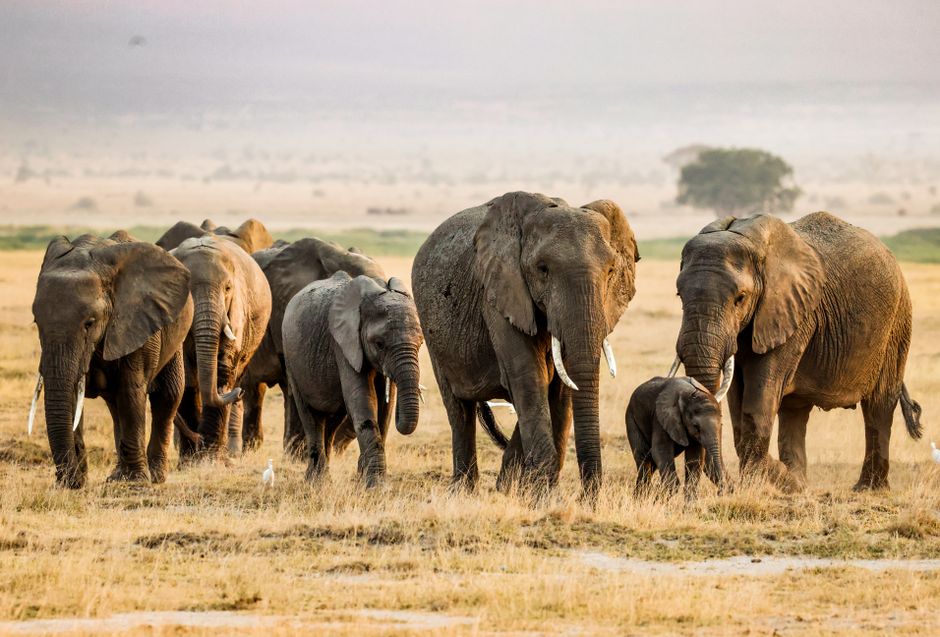
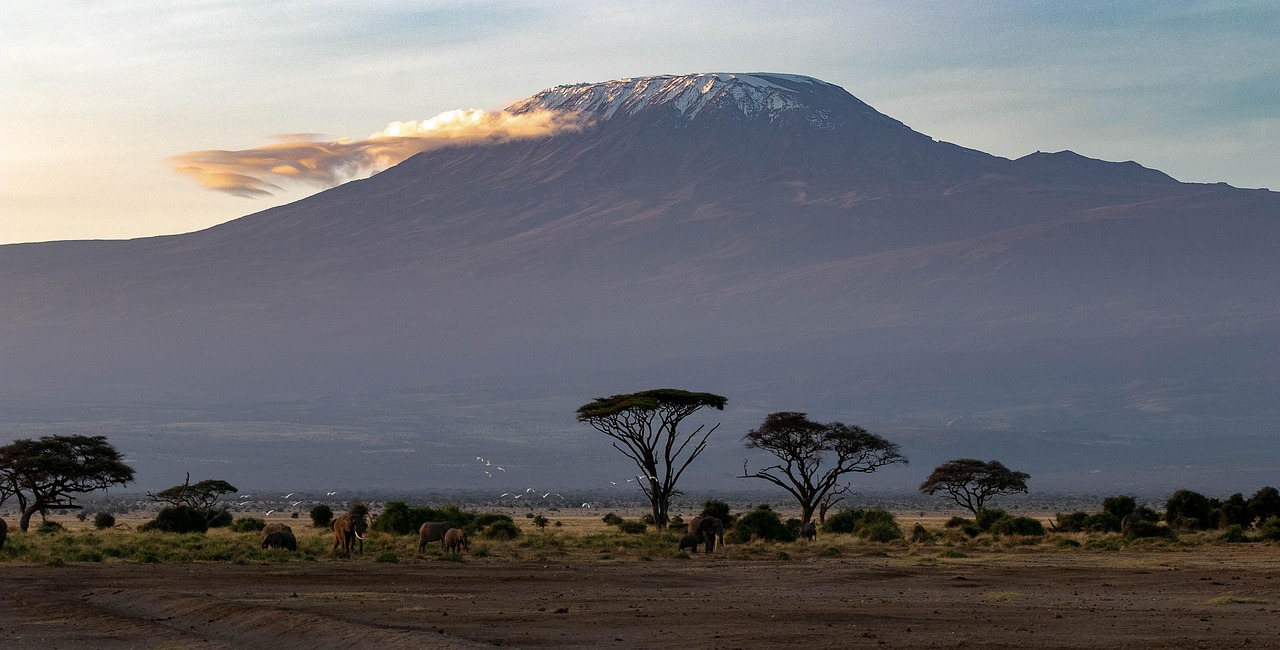
Amboseli National Park, in Kajiado County in southern Kenya, is famous for one view above all: herds of elephants crossing the dusty plains beneath the snow-capped dome of Mount Kilimanjaro, which rises just across the border in Tanzania. Kenya Wildlife Service (KWS) calls it one of Africa’s premier destinations for close encounters with large elephant herds, and some of the most studied elephants on Earth live here, including big old bulls with long tusks. The park is small and mostly flat, with an ancient dry lake bed that shimmers with mirages, open grasslands, acacia woodland and lush swamps fed by underground water from Kilimanjaro’s snows, which keep animals here even in the driest months. Besides elephants, you’ll see buffalo, hippos, zebras, wildebeest, giraffes, lions, hyenas and more than 400 species of birds, including flamingos and pelicans when the lake holds water. The Maasai live around the park, and their cattle and villages are part of the landscape. Amboseli is about 4–5 hours by road from Nairobi, or a short flight, and combines well with Tsavo West and Tsavo East on a southern Kenya circuit or with the coast. Two or three nights are enough for most visitors.
Right now in Amboseli National Park (Amboseli)
- Wed19–31°C67–88°FPartly cloudy
- Thu20–31°C68–87°FMostly clear
- Fri20–26°C67–80°F13 mm rain
- Sat 10 Oct Mazingira Day
Top tours in Amboseli National Park
See all tours for Amboseli National Park →
From local operators, with prices and reviews; you check availability and book on Viator, our partner. We may earn a commission at no extra cost to you. How we earn money
Amboseli at a glance
- Best for: elephants, Kilimanjaro views, swamp wildlife, birds and photography.
- How long: 2–3 nights.
- Best time: June to October and January to February are driest, with the clearest mountain views early in the morning.
- Getting there: about 4–5 hours by road from Nairobi via Emali or Namanga, or a short flight to an airstrip in or near the park.
- Park fees: US$90 per non-resident adult per day, under KWS’s 2025 conservation fees.
- Good to know: Kilimanjaro often hides in clouds by midday; be out at dawn and late afternoon.
- Before you go: the eTA, money and general safety are in our Kenya travel guide.
Park fees, gates and rules
Amboseli park fees
Amboseli is one of KWS’s two premium parks. Under the KWS conservation fees for 2025, non-resident adults pay US$90 and children and students US$45 per day; Kenyan citizens and residents pay in shillings, and children aged five and under enter free. A daily fee covers a single entry and is valid for up to 24 hours. If you’re touring southern Kenya, KWS sells a Tsavo West–Amboseli package for US$150 and a Tsavo East–Tsavo West–Amboseli package for US$215 for non-resident adults. Fees are paid online through KWSPay on Kenya’s eCitizen platform, by card or mobile money, and your safari operator usually pays them for you. Camping costs US$30 per adult at public campsites and US$50 at special campsites, plus a vehicle fee charged by seat count.
Gates and opening hours
According to KWS, the main gates are Iremito Gate, reached from Emali on the Nairobi–Mombasa highway; Kimana Gate, on the road from Kimana and Tsavo West; and Meshanani Gate, reached from Namanga on the Tanzanian border. Gates open at 6 a.m. and close at 6 p.m., unless you’re staying overnight inside the park.
Park rules
KWS asks visitors to stay in their vehicles except at designated points, stay on established roads (off-road driving is strictly prohibited), keep at least 20 m (65 ft) from wildlife, drive at no more than 40 km/h (25 mph), avoid hooting and loud noise, never feed animals, and carry out all trash. Amboseli, like all KWS parks, is a single-use-plastic-free zone. Driving on the dry lake bed and the swamp edges is restricted to marked tracks, both for safety and to protect fragile ground.
A short history
The name Amboseli is usually traced to a Maasai word for “salty dust”, a fair description of the dry lake bed. The area was a game reserve on Maasai land before it was gazetted as a national park on 1 November 1974, according to KWS, and it is the core of a UNESCO Man and the Biosphere reserve, where conservation and Maasai pastoralism share the wider landscape. Elephants and other animals move freely between the park, the surrounding group ranches, Kilimanjaro’s lower slopes and the Chyulu Hills and Tsavo, so the community lands around the park are as important for wildlife as the park itself.
Amboseli’s areas and who each one suits
The swamps
The heart of the park is a chain of swamps, including Enkongo Narok and Longinye, fed by springs that carry meltwater from Kilimanjaro through volcanic rock. Elephants wade in up to their bellies to feed on the papyrus, with hippos, buffalo and waterbirds around them. This is where you’ll spend most of your game drives.
Observation Hill
Observation Hill (Nomatior) is one of the few places where you can leave your vehicle and walk up a short path. From the top, there are wide views over the swamps, the plains and, on a clear day, Kilimanjaro. KWS notes its cultural history, linked to the Ndorobo community.
Lake Amboseli
The western part of the park is the bed of seasonal Lake Amboseli, dry and dusty for most of the year, with mirages and dust devils in the heat; after good rains it fills briefly and attracts flamingos and pelicans.
Ol Tukai and the woodlands
Ol Tukai, in the center, has the park’s lodges and headquarters among yellow-barked fever trees and palms, and the woodland around it is good for giraffes and smaller antelope.
The surrounding Maasai lands
Outside the park, group ranches and conservancies such as Kimana, Selenkay and Olgulului protect migration corridors used by elephants moving to and from Tsavo and Kilimanjaro, and host camps that offer walks and cultural visits.
Top things to see in Amboseli
Elephants under Kilimanjaro
Amboseli’s elephants are relaxed around vehicles, which lets you watch family groups at close range as they walk to the swamps in the morning and out to the plains in the evening. Long-term researchers have followed individual families here since the 1970s. The classic photo, elephants with the snowy summit behind them, is best at sunrise, when the mountain is most likely to be clear.
Big cats and other wildlife
Lions and spotted hyenas are present, and cheetahs are seen on the open plains, though less often than in the Mara. Buffalo, zebras, wildebeest, Maasai giraffes, Grant’s and Thomson’s gazelles, impala, gerenuk, warthogs and jackals are common. In the swamps, look for hippos, otters and huge flocks of birds.
Birdlife
KWS lists Amboseli as one of Kenya’s 60 Important Bird Areas, with more than 400 species, including about 40 birds of prey. Watch for African fish eagles, pelicans, herons, egrets, crowned cranes, kingfishers and, when the lake holds water, flamingos.
Maasai culture
KWS highlights visits to Maasai manyattas and cultural centers around the park, where communities show their homes, dances and beadwork. Agree the price beforehand and ask before taking photos.
Other things to do in Amboseli
Game drives and sunset views
Most visitors do two drives a day: at dawn, when Kilimanjaro is clearest, and in the late afternoon, when elephants leave the swamps. A sundowner on a viewpoint, with the mountain glowing pink, is unforgettable.
Walks and night experiences outside the park
Walking safaris and night drives are not allowed inside the national park, but conservancies and camps on the surrounding Maasai lands offer guided walks with Maasai rangers. KWS also promotes Amboseli’s dark skies for stargazing; ask your camp about astronomy evenings.
Scenic flights
Light-aircraft and helicopter flights over the park and toward Kilimanjaro can be arranged from some lodges. KWS charges a helicopter-tourism fee of US$100 per person per park for non-residents.
Food and drink
Meals are included at almost all lodges and camps, with buffet or plated menus, bush breakfasts and sundowners. Expect international dishes alongside Kenyan favorites such as nyama choma, sukuma wiki, ugali, chapati and samosas, with Kenyan tea and coffee. There are no restaurants open to the public inside the park beyond the lodges, so bring water and snacks on long drives.
Day trips and nearby
Tsavo West National Park
West Tsavo, about 2–3 hours east via Kimana, has volcanic scenery, the crystal-clear Mzima Springs with hippos and crocodiles, and the Shetani lava flow. The non-resident adult fee is US$80 under KWS’s 2025 fees, and the Tsavo West–Amboseli package saves money if you’re visiting both.
Chyulu Hills
The green volcanic Chyulu Hills, between Amboseli and Tsavo West, have forest, caves and walks, with a KWS fee of US$40 for non-resident adults.
Tsavo East
Continue east along the highway for Tsavo East’s red elephants and the Galana River. See our Tsavo East National Park guide.
Kilimanjaro
The mountain itself is in Tanzania; climbs start from the Tanzanian side, and the nearest border crossings from Amboseli are at Namanga and Loitokitok. See our Kilimanjaro National Park guide.
Nearby destinations
- Kilimanjaro National Park48 km
- Arusha102 km
- Nairobi159 km
- Tsavo East National Park170 km
- Tarangire National Park206 km
- Ngorongoro Conservation Area208 km
- Maasai Mara National Reserve268 km
- Serengeti National Park296 km
Getting there and getting around
By road
From Nairobi, KWS gives two main routes. The first follows the Nairobi–Mombasa highway to Emali, then the Emali–Loitokitok road to the Iremito Gate, about 204 km (127 miles) in total, or on to Kimana and the Kimana Gate. The second runs south to Namanga on the Tanzanian border, paved to Namanga and gravel from there to the Meshanani Gate, about 220 km (137 miles). Either way, allow 4–5 hours. A road also links Amboseli with Tsavo West through Kimana Gate, about 240 km (149 miles) from Nairobi via that route. Most visitors travel with a safari operator in a 4×4 or pop-top minivan.
By air
KWS lists a tarmacked airstrip at Kimana for light aircraft, and other airstrips in the area; scheduled flights from Nairobi’s Wilson Airport take about 45 minutes to an hour. Lodges meet guests at the airstrip.
Getting around
You explore the park on game drives in a closed or pop-top 4×4. Self-driving is possible with a sturdy vehicle, a map and plenty of water, but tracks become very dusty in the dry season and muddy after rain.
When to go and how long to stay
Amboseli is semi-arid, with warm days around 26–31 °C (79–88 °F) and cool nights. The dry seasons, from June to October and in January and February, are best for game viewing, as animals gather near the swamps, though it is dusty and the mountain can be hazy by midday. The long rains fall from about March to May and the short rains in November and December, turning the park green and bringing the lake back to life; some tracks become muddy. Kilimanjaro is often clearest at dawn and dusk year-round. The table uses Kenya Meteorological Department (KMD) averages for Makindu, the nearest station with published normals, about 75 km (47 miles) northeast at a slightly lower altitude, as published by the World Meteorological Organization (WMO): average daily highs and lows, total rainfall and days with at least 1 mm of rain. Amboseli itself is usually drier.
| Month | Average high / low | Rain (days with 1 mm or more) | What to expect |
|---|---|---|---|
| January | 29 °C (84 °F) / 17 °C (63 °F) | 42 mm (1.7 in), 4 days | Warm and fairly dry; clear mornings |
| February | 31 °C (87 °F) / 18 °C (64 °F) | 30 mm (1.2 in), 3 days | Hot and dry; excellent game viewing |
| March | 31 °C (87 °F) / 18 °C (65 °F) | 77 mm (3.0 in), 7 days | Long rains may start; green plains |
| April | 30 °C (85 °F) / 18 °C (65 °F) | 113 mm (4.4 in), 10 days | Wettest period; muddy tracks; low season |
| May | 28 °C (83 °F) / 17 °C (62 °F) | 29 mm (1.1 in), 3 days | Rain easing; very quiet |
| June | 27 °C (81 °F) / 15 °C (58 °F) | 2 mm (under 0.1 in), 1 day | Dry season begins; cool nights |
| July | 26 °C (80 °F) / 14 °C (57 °F) | 1 mm (under 0.1 in), 2 days | Coolest month; dusty, animals at swamps |
| August | 27 °C (80 °F) / 14 °C (58 °F) | 1 mm (under 0.1 in), 2 days | Dry and dusty; peak season |
| September | 29 °C (83 °F) / 15 °C (59 °F) | 2 mm (under 0.1 in), 1 day | Dry; elephants concentrated at swamps |
| October | 30 °C (86 °F) / 17 °C (62 °F) | 28 mm (1.1 in), 4 days | Warm; first clouds build up |
| November | 28 °C (83 °F) / 18 °C (64 °F) | 172 mm (6.8 in), 11 days | Short rains; lush and quiet |
| December | 28 °C (82 °F) / 18 °C (64 °F) | 115 mm (4.5 in), 8 days | Rains easing; busy at holidays |
How long to stay: 2 and 3 nights
- 2 nights: three or four game drives and Observation Hill, enough for the elephants and the mountain.
- 3 nights: add a conservancy walk, a cultural visit, a full day by the swamps or a scenic flight.
Where to stay in Amboseli
KWS lists several lodges and camps inside the park, including Ol Tukai Lodge, Amboseli Serena Lodge and others, plus KWS’s own Mbugani Homes guest houses and cottages, and public campsites. Many more camps lie on the Maasai lands around the park, including luxury tented camps in private conservancies, which offer walks and fewer vehicles.
- Inside the park: the shortest drives to the swamps and Kilimanjaro views from your room.
- Conservancy camps: walks, night drives and exclusivity.
- KWS bandas and campsites: the budget option; book ahead with KWS.
Typical costs
Prices are approximate, for October 2026, converted at about KES 129.8 to the US dollar (Central Bank of Kenya). Park fees are KWS’s 2025 non-resident rates.
| Item | Typical cost |
|---|---|
| Amboseli park fee, non-resident adult, per day | US$90 (about KES 11,680) |
| Child or student, per day | US$45 (about KES 5,840) |
| Tsavo West–Amboseli package, non-resident adult | US$150 (about KES 19,460) |
| Public campsite, non-resident adult, per night | US$30 (about KES 3,890) |
| Vehicle with fewer than 6 seats, per day | KES 600 (about US$4.6) |
| 3-day road safari from Nairobi, shared, per person | about US$450–900 |
| Mid-range lodge, per person per night, full board | about US$200–400 |
Safety in Amboseli
Wildlife: stay in your vehicle except at Observation Hill and other designated points, keep your distance from elephants, especially mothers with calves and bulls in musth, and give way to animals on the road. Lodges and camps are unfenced; follow your camp’s rules about walking at night and use an escort. Malaria occurs in all parts of Kenya below 2,500 m (8,200 ft), including the game parks, so ask a travel-health professional about antimalarials and use repellent; the US CDC recommends yellow fever vaccination for most travelers to areas outside Nairobi and the coast. Dust and sun: bring a scarf or buff, sunglasses and high-factor sunscreen, and drink plenty of water. Roads: drive in daylight; the Emali–Loitokitok road and highways carry trucks and fast traffic. Take your passport if you plan to visit the Namanga area near the border. In an emergency, call 999 or 112.
Practical tips for Amboseli
- Go at dawn: the clearest views of Kilimanjaro come early, before clouds build up.
- Bring a long lens: elephants are close, but birds and big cats can be far.
- Combine parks: if you’ll visit Tsavo West too, the KWS package fee saves money.
- Pay online: KWS fees are paid through KWSPay on Kenya’s eCitizen platform, by card or mobile money.
- Keep it plastic-free: single-use plastics aren’t allowed in Kenya’s parks.
What to pack for Amboseli
Neutral-colored, lightweight clothes in layers, a warm fleece for early mornings, a wide-brimmed hat, sunglasses, a buff or scarf against dust, high-factor sunscreen, insect repellent, binoculars, a camera with a zoom lens and spare batteries, a headlamp, comfortable closed shoes and a power adapter for Kenya’s 240 V type G sockets. See our hiking shoes and travel adapters guides.
Amboseli National Park travel FAQ
How much is the Amboseli park fee?
US$90 per non-resident adult and US$45 per child or student, per day, under KWS’s 2025 conservation fees.
Can you see Kilimanjaro from Amboseli?
Yes, on clear days, best at sunrise and in the late afternoon. The mountain is in Tanzania, just south of the border.
How far is Amboseli from Nairobi?
About 204–220 km (127–137 miles), or 4–5 hours by road, depending on the route; or about an hour by light aircraft.
What is the best time to visit Amboseli?
June to October and January to February, when it’s dry and animals gather at the swamps.
Can you see the Big Five in Amboseli?
You’ll see elephants, buffalo and lions; leopards are rare and rhinos aren’t usually seen, so plan on the Big Five elsewhere.
How many days do you need in Amboseli?
Two nights are enough for most visitors; three if you want walks or a conservancy stay.
Is there a combined ticket for Amboseli and Tsavo?
Yes. KWS sells a Tsavo West–Amboseli package for US$150 and a Tsavo East–Tsavo West–Amboseli package for US$215 for non-resident adults.
Can I walk in Amboseli?
Only at designated points such as Observation Hill; guided walks are offered in the conservancies outside the park.
What time do Amboseli’s gates open?
From 6 a.m. to 6 p.m., unless you’re staying overnight inside the park.
Is Amboseli good for photography?
Excellent: relaxed elephants, open views and the mountain backdrop make it one of Africa’s most photogenic parks.
Plan your trip
Partner links: TravelerCenter may earn a commission if you book, at no extra cost to you.
🇹🇿 Useful Swahili phrases for Amboseli National Park
All 38 Swahili phrases: restaurant, hotel, emergencies, romance (printable) →
Sources · last reviewed 5 October 2026
Researched and last reviewed on 5 October 2026. Park fees, packages, camping and vehicle fees, the 24-hour daily fee, payment, gates, routes and distances, the airstrip, gate hours, park rules, plastic-free rules, attractions, bird figures, Observation Hill, the gazettement date and accommodation: Kenya Wildlife Service and its 2025 conservation fees; malaria and yellow fever: the US CDC; emergency numbers: the UK government’s factual safety pages, used for practical facts only; climate averages: the Kenya Meteorological Department via the World Meteorological Organization (Makindu station); the exchange rate: the Central Bank of Kenya. Elephant research history, swamp names, conservancies, flight times and typical prices are general references or estimates, flagged for checking. Fees and rules change, so check with KWS or your operator before you go. For the eTA, money and general safety, see our Kenya travel guide.
Data: Weather: MET Norway (CC BY 4.0) · Rates: ECB · Holidays: Nager.Date · Costs: World Bank ICP and price levels · Wikidata (CC0)