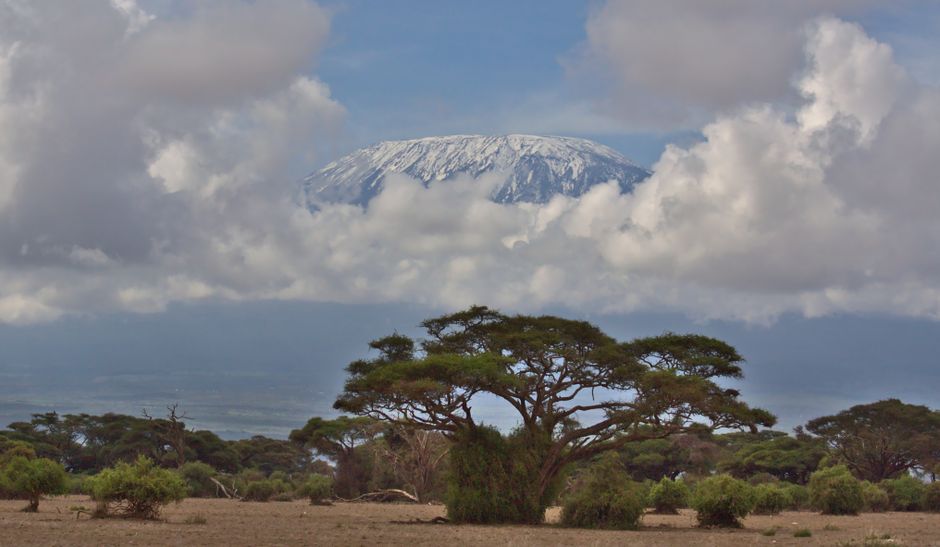
Kilimanjaro National Park, in northern Tanzania near the Kenyan border, protects Mount Kilimanjaro, the highest mountain in Africa and, as Tanzania National Parks (TANAPA) puts it, the world’s highest free-standing volcano. Its summit, Uhuru Peak on the snow-capped cone of Kibo, reaches 5,895 m (19,341 ft); beside it rise the jagged Mawenzi (5,149 m, or 16,893 ft) and the old, collapsed Shira volcano (3,962 m, or 12,999 ft). The park covers 1,712 km² (661 square miles), was declared a national park in 1973, opened to tourism in 1977 and became a UNESCO World Heritage Site in 1987, according to TANAPA. Climbing Kilimanjaro needs no technical mountaineering skills, which makes it one of the world’s most popular high-altitude treks, but it’s a serious undertaking: you walk from tropical farmland through rainforest with colobus monkeys, heather moorland with giant groundsels and lobelias, and alpine desert to glaciers and a frozen summit crater, usually in 6 to 9 days. All climbs must be guided by a licensed operator, and the key to success and safety is time to acclimatize. Many visitors also come just to see the mountain, for day hikes on the lower slopes, or to combine a climb with a safari in the northern parks and a beach stay in Zanzibar.
Right now in Kilimanjaro National Park (Kilimanjaro)
- Wed -6–-2°C 21–28°F 25 mm Heavy snow
- Thu -7–-2°C 19–29°F 22 mm Heavy snow
- Fri -6–-4°C 21–26°F 25 mm Heavy snow
Weather: MET Norway (CC BY 4.0)
Top tours in Kilimanjaro National Park
See all tours for Kilimanjaro National Park →
From local operators, with prices and reviews; you check availability and book on Viator, our partner. We may earn a commission at no extra cost to you. How we earn money
Kilimanjaro at a glance
- Best for: climbing Africa’s highest peak, high-altitude trekking, day hikes in the rainforest and mountain views.
- How long: 6–9 days for a summit climb, plus a night in Moshi or Arusha before and after.
- Best time: January to early March and June to October, the drier months.
- Getting there: fly to Kilimanjaro International Airport (JRO), about an hour from Moshi; climbs start at gates on the south, west and north sides.
- Park fees: TZS 178,850 (about US$68) per non-resident adult per 24 hours in TANAPA’s 2026/27 tariff, plus camping or hut and rescue fees.
- Good to know: solo climbing isn’t allowed; choose a longer route for better acclimatization.
- Before you go: the visa, insurance, money and general safety are in our Tanzania travel guide.
Park fees, rules and permits
Kilimanjaro fees for 2026/27
TANAPA publishes Kilimanjaro’s tariffs by financial year (July 1 to June 30). For non-resident adults in 2026/27, the tariff lists:
| Fee | Non-resident adult |
|---|---|
| Entry (conservation) fee, per 24 hours | TZS 178,850 (about US$68) |
| Child aged 5–15, entry per 24 hours | TZS 51,100 (about US$19) |
| Public camping, per night | TZS 127,750 (about US$48) |
| Hut fee on the Marangu route, per night | TZS 153,300 (about US$58) |
| Upper Barafu camping, per night | TZS 255,500 (about US$97) |
| Rescue fee, per trip | TZS 51,100 (about US$19) |
| Mountain cycling, per person | TZS 127,750 (about US$48) |
The tariff also lists small fees for licensed mountain guides, porters and cooks (TZS 3,500 and TZS 5,000), paid by the operator. Fees are valid for 24 hours from entry and are paid through the government’s electronic payment gateway; your operator pays them and includes them in the climb price. As a rough guide, a six-night camping climb on the Machame route involves about six days of entry fees, six nights of camping and the rescue fee, about TZS 1.9 million (about US$720) per person in park fees alone. Ask your operator whether 18% VAT is added.
The mandatory guide rule
TANAPA’s visitor guide is clear: all climbs must be guided by a licensed operator, and solo trekking is not permitted. Climbers must stay on marked routes, follow camp rules, practice Leave No Trace and follow ranger and guide instructions; drones need prior authorization, and off-trail travel and open fires are restricted. Your team usually includes a lead guide, assistant guides, a cook and porters who carry the tents, food and gear.
Choosing an operator
Pick a licensed operator with good safety equipment (supplemental oxygen, pulse oximeters and a first aid kit), a sensible itinerary and fair treatment of porters, including proper pay, food, clothing and load limits. Very cheap climbs often cut corners on all of these.
Kilimanjaro’s routes and who each one suits
TANAPA names the main gates as Marangu, Machame, Lemosho (via Londorossi) and Rongai in the north, with Mweka Gate used for descent on most routes. The routes most climbers use are:
Marangu
The only route with huts, at Mandara, Horombo and Kibo, according to TANAPA. It’s the most direct route, usually 5–6 days, with a gentler gradient but less time to acclimatize; adding an extra day at Horombo improves your chances. Up and down by the same path.
Machame
The most popular camping route, usually 6–7 days, climbing through rainforest to the Shira Plateau, under the Lava Tower and up the Barranco Wall, with good “climb high, sleep low” acclimatization. Scenic and busy.
Lemosho
Starting in the west from Londorossi Gate, usually 7–8 days, crossing the Shira Plateau before joining the Machame route. Quieter at first, with excellent scenery and acclimatization; a favorite of many operators.
Rongai
The only route from the north, near the Kenyan border, usually 6–7 days, drier and quieter, with views across to Amboseli and a descent on the Marangu side.
Northern Circuit, Shira and Umbwe
The Northern Circuit, usually 8–9 days, circles the north side of Kibo and offers the longest acclimatization and the fewest people; the Shira route starts high on the plateau; and the steep Umbwe route is for experienced trekkers only.
A typical day on the mountain
Days start early with tea or coffee brought to your tent, a wash with a bowl of warm water and a cooked breakfast. You walk for about 4–7 hours at a slow, steady pace, with breaks for snacks and lunch, while porters race ahead to set up camp. Afternoons are for rest, short acclimatization walks and hot drinks; dinner is at dusk, and guides check your health, often measuring blood-oxygen levels, before an early night. Summit night is the exception: a midnight start and 10–15 hours of walking up and back down.
Day hikes and short visits
TANAPA lists guided day hikes on the Marangu and Shira sides and nature walks in the lower forest, for example to Mandara Hut and the Maundi Crater from Marangu Gate, if you want to experience the mountain without climbing to the summit.
Top things to see on Kilimanjaro
Uhuru Peak and the summit crater
The final climb usually starts around midnight from Barafu Camp or Kibo Hut, reaching Stella Point or Gilman’s Point on the crater rim around sunrise and Uhuru Peak an hour or two later. TANAPA describes the famous sunrises above a sea of clouds. From the top, you look down on the remaining glaciers and across to Mawenzi.
The glaciers
TANAPA mentions remnant icefields such as the Furtwängler and Rebmann glaciers crowning the summit slopes. They have shrunk dramatically over the last century, so see them while you can.
The Shira Plateau and Mawenzi
The Shira Plateau, a high caldera with giant groundsels and moorland, and the rugged spires of Mawenzi, Africa’s third-highest peak, are among the most scenic parts of the mountain, along with the Kibo–Mawenzi saddle, a high-altitude desert.
Forest and wildlife
The montane forest, from about 1,800 to 2,800 m (5,900 to 9,200 ft), is home to black-and-white colobus and blue monkeys, orchids and streams, according to TANAPA. Large animals are rarely seen higher up.
Other things to do around Kilimanjaro
Moshi and coffee tours
Moshi, at the foot of the mountain, is the main base for climbs, with hotels, cafés and gear shops. The Chagga villages on the lower slopes grow coffee and bananas; coffee tours show you how beans are grown, roasted and brewed.
Waterfalls and Lake Chala
Walks to waterfalls such as Materuni, above Moshi, and visits to Lake Chala, a crater lake on the Kenyan border, are popular rest-day trips.
Food and drink
On the mountain, the cook prepares surprisingly good meals: porridge, eggs and toast for breakfast, soups, pasta, rice, stews and fresh vegetables, with plenty of hot drinks to keep you hydrated. In Moshi, try Tanzanian ndizi (banana) stew, a Chagga specialty, mishkaki skewers, chips mayai (fries with egg) and Kilimanjaro coffee.
Day trips and nearby
- Arusha and Arusha National Park: Mount Meru, lakes and forests, about 1½ hours west. See our Arusha guide.
- Tarangire, Ngorongoro and Serengeti: combine your climb with a safari on the northern circuit. See our Tarangire National Park, Ngorongoro and Serengeti National Park guides.
- Amboseli: the classic view of Kilimanjaro is from the Kenyan side. See our Amboseli National Park guide.
- Zanzibar: a beach break after the climb. See our Zanzibar guide.
Nearby destinations
- Amboseli National Park48 km
- Arusha83 km
- Tsavo East National Park159 km
- Tarangire National Park186 km
- Nairobi207 km
- Ngorongoro Conservation Area212 km
- Mombasa278 km
- Diani Beach282 km
Getting there and getting around
By air
According to TANAPA, most climbers arrive via Kilimanjaro International Airport (JRO), between Moshi and Arusha, or Arusha Airport (ARK), which has domestic flights. JRO has international flights, including via Doha and Dubai, and connections from Nairobi, Dar es Salaam and Zanzibar. Moshi is about an hour by road from JRO.
By road
Shuttle buses link Nairobi and Arusha/Moshi via the Namanga border crossing in about 6–7 hours. Operators provide transfers from Moshi or Arusha to the starting gates, from about 1 hour to Machame or Marangu to 3–4 hours to Londorossi or the Rongai trailhead.
When to go and how long to stay
Kilimanjaro can be climbed year-round, but the driest and most popular months are January to early March and June to October. The long rains from about March to May bring mud, cloud and snow higher up, and the short rains in November and December are lighter. Weather on the mountain varies with altitude: warm in the forest, cool on the moorland, and below freezing at the summit at night, where temperatures can fall to around -10 to -20 °C (14 to -4 °F) with wind chill (estimate). The table uses Tanzania Meteorological Authority (TMA) climate normals for 1991–2020 for Kilimanjaro International Airport, at 891 m (2,923 ft) between Moshi and Arusha, as published by the World Meteorological Organization (WMO); it reflects conditions at the foot of the mountain.
| Month | Average high / low | Rain (days with 1 mm or more) | What to expect |
|---|---|---|---|
| January | 33 °C (92 °F) / 19 °C (66 °F) | 43 mm (1.7 in), 4 days | Dry, warm; clear mornings; good climbing |
| February | 34 °C (93 °F) / 19 °C (66 °F) | 39 mm (1.5 in), 3 days | Warm and mostly dry; good climbing |
| March | 33 °C (91 °F) / 20 °C (68 °F) | 94 mm (3.7 in), 6 days | Long rains begin; wetter trails |
| April | 30 °C (86 °F) / 20 °C (68 °F) | 132 mm (5.2 in), 12 days | Wettest month; quiet on the mountain |
| May | 27 °C (81 °F) / 19 °C (66 °F) | 73 mm (2.9 in), 9 days | Rain easing; snow possible high up |
| June | 26 °C (80 °F) / 16 °C (61 °F) | 9 mm (0.4 in), 2 days | Dry season begins; cold nights high up |
| July | 26 °C (79 °F) / 15 °C (59 °F) | 4 mm (0.1 in), 1 day | Coolest at the base; popular for climbing |
| August | 27 °C (81 °F) / 15 °C (60 °F) | 6 mm (0.2 in), 1 day | Dry and clear; busy |
| September | 30 °C (85 °F) / 16 °C (61 °F) | 5 mm (0.2 in), 1 day | Dry; excellent conditions |
| October | 31 °C (88 °F) / 18 °C (64 °F) | 24 mm (1.0 in), 3 days | Warm; good climbing early in the month |
| November | 32 °C (89 °F) / 19 °C (66 °F) | 51 mm (2.0 in), 5 days | Short rains; afternoon showers |
| December | 32 °C (90 °F) / 19 °C (66 °F) | 44 mm (1.8 in), 4 days | Showers easing; busy over the holidays |
The mountain’s climate zones
On the way up, you pass through five broad zones: the cultivated slopes below about 1,800 m (5,900 ft), with farms and villages; the montane forest, humid and often muddy; the heath and moorland from about 2,800 m (9,200 ft), with giant heathers, groundsels and lobelias; the alpine desert above about 4,000 m (13,100 ft), with strong sun by day and freezing nights; and the arctic summit zone above about 5,000 m (16,400 ft), with ice, rock and very thin air (approximate altitudes).
How long to stay: choosing your itinerary
- 6 days: the minimum for most routes; acclimatization is limited.
- 7 days: a good balance on Machame or Rongai, or Marangu with an extra day.
- 8–9 days: Lemosho or the Northern Circuit, with the best acclimatization and summit chances.
- Plus: a night in Moshi or Arusha before and after for briefings and rest.
Typical costs
Prices are approximate, for October 2026, converted at about TZS 2,637 to the US dollar (Bank of Tanzania). Park fees are TANAPA’s 2026/27 non-resident rates; climbs are priced by operators in US dollars and include park fees, guides, porters, food and transfers.
| Item | Typical cost |
|---|---|
| Park fees for a 6-night camping climb (entry, camping, rescue) | about TZS 1.9 million (about US$720) |
| 6–7 day climb with a mid-range operator, per person | about US$2,200–3,500 |
| 8–9 day climb, per person | about US$2,800–4,500 |
| Tips for the crew, per climber | about US$250–400 |
| Gear rental (sleeping bag, poles, jacket), per item | about US$10–30 for the climb |
| Mid-range hotel in Moshi, double per night | about US$60–150 |
Safety on Kilimanjaro
Altitude is the main danger. TANAPA’s guidance is to plan for altitude: choose an itinerary with acclimatization days, ascend slowly, stay hydrated, and report symptoms promptly to your guide. Mild headache, nausea, poor sleep and breathlessness are common; severe headache, confusion, loss of coordination, breathlessness at rest or a wet cough can signal life-threatening altitude illness, and the treatment is to descend immediately. Discuss medication and your fitness with a doctor before you go, and don’t climb if you’re unwell. Cold and weather: TANAPA recommends carrying proper cold-weather and rain gear, a headlamp and personal medicines, keeping to designated paths, never hiking alone, and respecting the weather, which changes quickly at high altitude. Rescue and insurance: TANAPA charges a rescue fee per trip and recommends insurance that covers mountain rescue; make sure your policy covers trekking to 6,000 m (19,700 ft) and helicopter evacuation, as Tanzania’s compulsory inbound insurance is basic. Malaria is present below 1,800 m (5,900 ft), including Moshi and Arusha, though not on the upper mountain. In an emergency, call 112.
Practical tips for Kilimanjaro
- Go “pole pole”: Swahili for “slowly, slowly”, the guides’ golden rule.
- Drink 3–4 liters a day: dehydration worsens altitude sickness.
- Break in your boots: blisters are the most common problem on the trail.
- Pack for four seasons: from humid forest to sub-zero summit night.
- Tip fairly: porters, cooks and guides rely on tips; your operator will give guidelines.
- Keep it clean: carry out all trash, and leave plastic bags at home; they’re banned in Tanzania.
What to pack for Kilimanjaro
Broken-in waterproof hiking boots, trekking poles, a warm down jacket, a waterproof jacket and trousers, thermal base layers, fleece mid-layers, warm hat, gloves and liner gloves, a buff, sun hat, glacier sunglasses, high-factor sunscreen and lip balm, a four-season sleeping bag (rated to about -10 °C or 14 °F), a headlamp with spare batteries, water bottles or a hydration bladder, water purification, a first aid kit and blister care, snacks, and a power bank. See our hiking shoes, rain jackets and travel adapters guides, and our hiking guide.
Kilimanjaro National Park travel FAQ
How much does it cost to climb Kilimanjaro?
Most climbs cost about US$2,200–4,500 per person with a mid-range operator, including about US$720–850 in park fees for a typical 6–7 night camping route, plus tips.
Can I climb Kilimanjaro without a guide?
No. TANAPA says all climbs must be guided by a licensed operator, and solo trekking isn’t permitted.
Which Kilimanjaro route is best?
Lemosho and Machame offer good scenery and acclimatization; Marangu has huts; Rongai is quieter and drier; the Northern Circuit is longest and least crowded.
How high is Kilimanjaro?
Uhuru Peak, the summit on Kibo, is 5,895 m (19,341 ft), according to TANAPA.
How many days does it take to climb Kilimanjaro?
Usually 6–9 days; longer itineraries give better acclimatization and higher summit success.
When is the best time to climb Kilimanjaro?
January to early March and June to October, the driest months.
What are the Kilimanjaro park fees?
In TANAPA’s 2026/27 tariff, TZS 178,850 per non-resident adult per 24 hours, plus camping (TZS 127,750 per night) or Marangu hut fees (TZS 153,300 per night) and a rescue fee (TZS 51,100).
Do I need training to climb Kilimanjaro?
You don’t need technical skills, but you should be fit enough to hike 6–8 hours a day for several days; train with long hikes, ideally on hills.
What is altitude sickness, and how is it treated?
It’s illness caused by reduced oxygen at height; mild symptoms are common, but severe symptoms require immediate descent. Ascend slowly and tell your guide about any symptoms.
Where do Kilimanjaro climbs start?
Most start from Moshi, with transfers to the Marangu, Machame, Londorossi (Lemosho) or Rongai gates; descents usually end at Mweka Gate.
Sources and last review
Researched and last reviewed on 5 October 2026. Peak heights, park size, dates, UNESCO status, gates, Marangu huts, licensed-operator and no-solo rules, regulations, safety guidance, attractions, glaciers, forest wildlife, day hikes and airports: Tanzania National Parks (TANAPA); entry, camping, hut, Upper Barafu, rescue, cycling and crew fees for 2026/27 and their 24-hour validity: TANAPA tariff data; malaria: the US CDC; insurance, plastic bags and emergency numbers: the UK government’s factual entry and safety pages, used for practical facts only; climate normals: the Tanzania Meteorological Authority via the World Meteorological Organization’s 1991–2020 normals (Kilimanjaro International Airport station); the exchange rate: the Bank of Tanzania. Route descriptions and durations, summit temperatures, transfer times, VAT treatment, tipping, operator and gear prices are general references or estimates, flagged for checking. Fees and rules change, so check with your operator before you go. For the visa, insurance, money and general safety, see our Tanzania travel guide.
Plan your trip
Partner links: TravelerCenter may earn a commission if you book, at no extra cost to you.
🇹🇿 Useful Swahili phrases for Kilimanjaro National Park
All 38 Swahili phrases: restaurant, hotel, emergencies, romance (printable) →