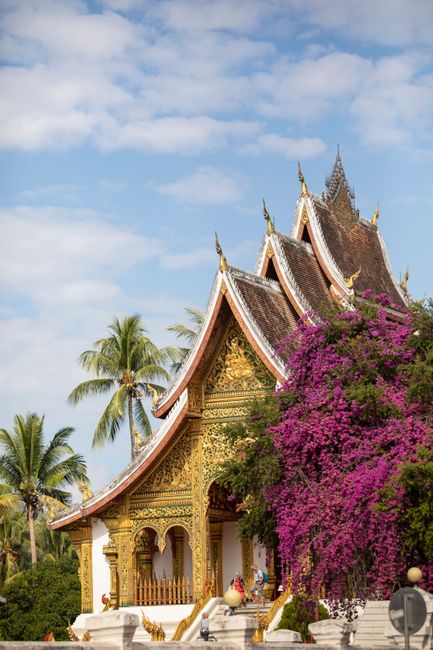
Laos is Southeast Asia’s only landlocked country, a land of forested mountains, limestone karsts and slow, wide rivers stretched along the Mekong between Thailand, Vietnam, Cambodia, Myanmar and China. It is the region’s most relaxed destination: a place of saffron-robed monks collecting alms at dawn, gilded temples, French colonial towns, riverside sunsets and some of the friendliest people in Asia. Most first visits revolve around three places linked by the Laos–China Railway: the UNESCO-listed royal town of Luang Prabang, on a peninsula where the Nam Khan meets the Mekong; the mountain-ringed adventure town of Vang Vieng; and the low-key capital, Vientiane. Farther afield lie the mysterious Plain of Jars, the caves and loops of central Laos, the coffee plateau and waterfalls of the south, and the river islands of Si Phan Don. A few things need planning: most visitors need a visa, available online or on arrival; a digital arrival form is required at the main entry points; the wet season from May to October brings heavy rain and floods, and smoke from crop burning hazes the north from February to April; and unexploded ordnance from the Indochina wars still contaminates large parts of the countryside.
Right now in Laos
- Wed 22–30°C 71–85°F 1 mm Light showers
- Thu 23–30°C 73–86°F Mostly clear
- Fri 24–31°C 76–88°F 2 mm Cloudy
Weather: MET Norway (CC BY 4.0)
Multi-day tours of Laos
Multi-day tours from local operators. You check dates and book on Viator, our partner; we may earn a commission at no extra cost to you. How we earn money
Laos at a glance
The Lao People’s Democratic Republic is a one-party socialist state with a population of about 7.8 million, the smallest of mainland Southeast Asia’s countries by population. It covers about 237,000 km² (91,500 sq miles), a little larger than Utah, and is divided into 17 provinces and Vientiane Capital. About 80% of the land is mountainous, and the Mekong forms much of the border with Thailand. The capital and largest city is Vientiane. Lao is the official language, close to Thai; English is spoken in tourist areas, and some older people speak French. Most Lao are Theravada Buddhists, and dozens of ethnic groups, including the Hmong and Khmu, live in the hills.
Laos uses Indochina Time (UTC+7), with no daylight saving time, the same as Thailand, Cambodia and Vietnam. Electricity is 230 V, with sockets that take flat two-pin (type A) and round two-pin (types C, E and F) plugs. The currency is the kip (LAK).
A short history
The kingdom of Lan Xang, the “Land of a Million Elephants”, was founded in 1353 with its capital at Luang Prabang, later moving to Vientiane, and in the 18th century it split into rival kingdoms that fell under Siamese control. France made Laos part of French Indochina in the 1890s, and it gained full independence in 1953. During the Vietnam War, Laos was drawn into a long civil conflict and became, per person, the most heavily bombed country in history, as the United States dropped more than two million tons of ordnance between 1964 and 1973. In 1975, the communist Pathet Lao took power, ending the 600-year-old monarchy. Laos began opening up to tourism in the 1990s, and the railway to China, opened in 2021, has transformed travel through the north.
Laos’s regions
- The north: Luang Prabang, the river villages of Nong Khiaw and Muang Ngoi, trekking around Luang Namtha and Phongsali, the Gibbon Experience near Houay Xai, and the Plain of Jars in Xieng Khouang.
- The center: Vientiane, Vang Vieng, the limestone landscapes of the Thakhek Loop and the river cave of Kong Lor, and Hin Nam No National Park.
- The south: Pakse, the Bolaven Plateau’s coffee plantations and waterfalls, the Khmer temple of Vat Phou at Champasak, and the Mekong islands and waterfalls of Si Phan Don (the 4,000 Islands).
Where to go: royal towns, rivers and mountains
A classic first trip follows the railway from Vientiane through Vang Vieng to Luang Prabang, or the reverse, often combined with a slow boat on the Mekong from the Thai border. See our guides to each place:
- Luang Prabang: the former royal capital, with dozens of temples, the morning alms round, the night market, Mount Phousi, Kuang Si Falls and the Pak Ou Caves.
- Vientiane: the laid-back capital on the Mekong, with Pha That Luang, Wat Si Saket, Patuxai, the COPE visitor center and riverside sunsets.
- Vang Vieng: limestone karsts and caves along the Nam Song river, with tubing, kayaking, blue lagoons, viewpoints and hot-air balloons.
Other favorites include the Plain of Jars, the river village of Nong Khiaw, the Kong Lor cave and the Thakhek Loop, Vat Phou and the old town of Champasak, the Bolaven Plateau’s waterfalls, and Si Phan Don, with its hammocks, river dolphins and the Khone Phapheng falls, the largest by volume in Southeast Asia.
The Plain of Jars, around Phonsavan in Xieng Khouang province, about 6–7 hours by road from Luang Prabang or a short flight from Vientiane, is scattered with hundreds of carved stone jars whose purpose is still debated, probably funerary; the main sites have been cleared of bombs by the mine-clearance charity MAG, whose markers show the safe paths. In the far south, Si Phan Don spreads across a 14 km-wide (9-mile) stretch of the Mekong, where the islands of Don Det and Don Khon offer hammock-lined guesthouses, cycling, the Li Phi falls and a few rare Irrawaddy dolphins near the Cambodian border.
In the north, Nong Khiaw, about 3–4 hours by road from Luang Prabang, sits beneath dramatic limestone cliffs on the Nam Ou river, with a steep hike to a sunrise viewpoint, caves used as shelters during the war and boat trips upriver to the car-free village of Muang Ngoi. In central Laos, the Thakhek Loop, a three- to four-day motorbike circuit through karst country, leads to the Kong Lor cave, where boats travel 7 km (4 miles) along an underground river.
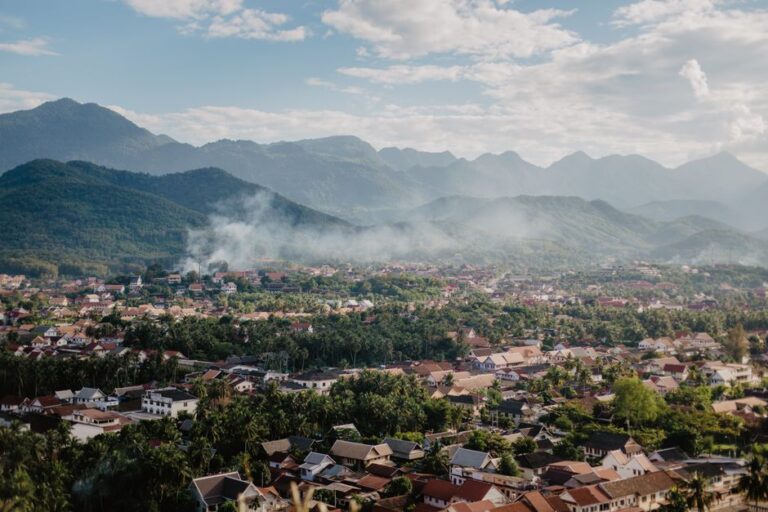
Luang Prabang Travel Guide
Plan a trip to Luang Prabang: the peninsula, riversides and outskirts and where to stay, the morning alms round and its etiquette, Wat Xieng…
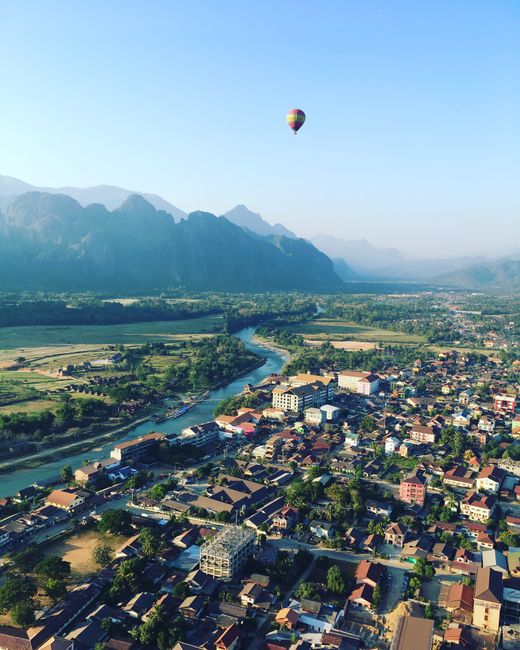
Vang Vieng Travel Guide
Plan a trip to Vang Vieng: the town, the riverside and the west bank and where to stay, tubing and kayaking on the Nam…
Vientiane Travel Guide
Plan a trip to Vientiane: the riverside, the old center and Sisattanak and where to stay, Pha That Luang, Wat Si Saket, Haw Phra…
Best time to visit Laos
Laos has a tropical monsoon climate with three seasons. The cool, dry season from November to February is the most popular time to visit, with sunny days around 28–32 °C (82–90 °F) in the lowlands, and cold nights and morning mist in the northern mountains. The hot season, from March to May, brings temperatures of 34–36 °C (93–97 °F), and from about February to April smoke from the burning of fields often hazes the north, including Luang Prabang, reducing views and air quality. The wet season, from May to October, brings heavy rain, especially from July to September, when rivers rise, rural roads can wash out and landslides hit mountain routes; it is also when the countryside is greenest and the waterfalls fullest.
In practice, November to February is the best time for most of the country; October and November are lovely, with green landscapes, full waterfalls and festivals; and the south is best visited from November to April.
The table shows rounded averages from the 1991–2020 climate normals of the Lao Department of Meteorology and Hydrology, as submitted to the World Meteorological Organization (WMO), for one station in each main travel area.
| Area (station) | January high / low | July high / low | Rain a year | Wettest months |
|---|---|---|---|---|
| North: Luang Prabang | 28 °C (83 °F) / 15 °C (58 °F) | 32 °C (90 °F) / 24 °C (75 °F) | about 1,470 mm (58 in) | July and August |
| Center: Vientiane | 29 °C (84 °F) / 18 °C (65 °F) | 32 °C (89 °F) / 25 °C (78 °F) | about 1,660 mm (65 in) | July and August |
| South: Pakse | 33 °C (91 °F) / 23 °C (74 °F) | 32 °C (90 °F) / 25 °C (77 °F) | about 1,970 mm (78 in) | July and August |
Laos month by month
| Month | Weather | Highlights | Crowds and prices |
|---|---|---|---|
| January | Cool and dry; cold nights in the north | Ideal for Luang Prabang and trekking | High |
| February | Dry and warming; haze begins in the north | Clear skies in the south | High |
| March | Hot; smoky in the north | Good for the south and Si Phan Don | Moderate |
| April | The hottest month | Pi Mai Lao (Lao New Year, mid-April), with water throwing and processions in Luang Prabang | High around New Year |
| May | Hot; first rains | Boun Bang Fai rocket festivals; Visakha Bucha | Low |
| June | Wet season begins | Green rice fields; fewer visitors | Low |
| July | Wet, with heavy downpours | Lush landscapes; full rivers | Low |
| August | The wettest month | Boat races begin in some towns | Low |
| September | Wet; floods possible | Boat-racing festivals | Low |
| October | Rains ending | Boun Ok Phansa, the end of Buddhist Lent, with boat races and Lai Heua Fai, the festival of lights, in Luang Prabang | Rising |
| November | Cool and dry | Boun That Luang festival in Vientiane at the November full moon | High |
| December | Cool and dry | Peak season; misty mornings on the rivers | Very high around the holidays |
Festivals and holidays
- Pi Mai Lao (Lao New Year): three days in mid-April, the biggest festival of the year, with water throwing, sand stupas, Buddha images washed in procession and, in Luang Prabang, parades and a beauty pageant; transport and hotels fill up.
- Boun Bang Fai: rocket festivals in May, when villages launch homemade bamboo rockets to call for rain.
- Boun Khao Phansa and Boun Ok Phansa: the start and end of Buddhist Lent, in July and October; Ok Phansa is followed by boat races on the Mekong and, in Luang Prabang, by Lai Heua Fai, when illuminated boats are floated on the river.
- Boun That Luang: a week-long festival at Vientiane’s golden stupa at the November full moon, with processions, a market and an early-morning alms ceremony.
- National Day: December 2, marking the founding of the Lao PDR in 1975.
Rainy season, floods and smoke
From July to September, river levels can rise within hours, and heavy storms cause flash floods and landslides that close roads in the mountains, especially in the north; tropical storms crossing Vietnam bring several days of rain. Follow forecasts from the Department of Meteorology and Hydrology and local news, allow extra time for road travel, and remember that floods and landslides can expose unexploded ordnance. In the dry season, smoke from crop burning reduces air quality in the north from about February to April; check an air-quality index before planning hikes.
How long to stay: sample itineraries
- 7 days: Vientiane (1 night), Vang Vieng (2) and Luang Prabang (4), traveling by train.
- 10 days: add Nong Khiaw (2) from Luang Prabang, or the slow boat from Houay Xai to Luang Prabang (2 days).
- 14 days: add the Plain of Jars (2) or the Thakhek Loop and Kong Lor (3).
- Three weeks: add the south: Pakse, the Bolaven Plateau, Champasak and Si Phan Don, before continuing to Cambodia. See our Cambodia guide.
Entry, money and costs
Visas and the e-visa (last reviewed October 2026)
Most visitors need a visa. According to the official Lao e-visa portal, laoevisa.gov.la, run for the Ministry of Foreign Affairs, the tourist e-visa allows a stay of 30 days, is processed within three working days and is valid for entry within 60 days of approval; the fee, shown by the portal’s fee calculator, is US$50 for citizens of most countries, including the United States, the United Kingdom, Canada, Australia, New Zealand, India and much of Europe, and US$35 for China. It is single-entry, cannot be refunded and must be used at one of the nine designated entry points: Wattay International Airport (Vientiane), Luang Prabang and Pakse international airports, the Lao–Thai Friendship Bridges I (Vientiane), II (Savannakhet) and IV (Bokeo), the Boten road checkpoint on the Chinese border, and the Boten and Khamsavath (Vientiane) railway stations. Your passport must be valid for more than 180 days from arrival.
A visa on arrival is available at the international airports and many land borders, paid in cash, with a passport photo; the fee depends on nationality. Citizens of the other ASEAN countries and a few others, including Japan (30 days since June 2025), can visit without a visa for short stays. According to the UK government, tourist visas can be extended twice while in Laos, for up to 60 additional days, and overstaying brings heavy fines.
The Lao Digital Immigration Form
All foreign nationals entering Laos through Wattay International Airport, Luang Prabang International Airport, Pakse International Airport and the Lao–Thai Friendship Bridge I must complete the Lao Digital Immigration Form (LDIF) online within three days before arrival, and again before departure, according to the UK government; it replaces the paper arrival and departure cards there.
Customs and rules to know
Drug offenses, including possession of cannabis, carry very severe penalties. E-cigarettes, vapes, heated tobacco and shisha are illegal to possess, use, import or sell. By law, sexual relationships between foreigners and Lao nationals are prohibited unless they are married under Lao law. Photographing military sites is banned, and you should avoid photographing bridges and airfields. Carry your passport or a copy.
Money and cards
The currency is the kip (LAK), and Laos is largely a cash economy. On October 5, 2026, the Bank of the Lao PDR’s reference rate was about 22,364 kip to the US dollar; prices on this site use about 22,400. Notes go up to 100,000 kip, so carry a thick wallet. ATMs are found in towns, though withdrawal limits are low and fees high; cards are accepted mainly in upscale hotels and restaurants. US dollars and Thai baht are accepted in some tourist businesses, usually at a poor rate. Inflation has been high: the national rate was 7.9% in September 2026, so prices change quickly.
Tipping
Tipping is not traditional, but it is appreciated in tourism: round up restaurant bills, and tip guides, drivers and boat crews if you are happy with their service.
What a trip costs
Prices are approximate, for October 2026, converted at about 22,400 kip to the US dollar.
| Item | Typical cost |
|---|---|
| Bowl of khao piak sen or noodle soup at a local stall | 30,000–50,000 LAK (about US$1.35–2.25) |
| Dinner in a mid-range restaurant | 150,000–350,000 LAK (about US$6.70–15.60) per person |
| Large Beerlao in a restaurant | 20,000–35,000 LAK (about US$0.90–1.55) |
| Tuk-tuk ride across town | 30,000–60,000 LAK (about US$1.35–2.70) |
| Laos–China Railway, Vientiane to Luang Prabang, second class | 360,000 LAK (about US$16) |
| Temple or museum entry | 20,000–60,000 LAK (about US$0.90–2.70) |
| Kuang Si Falls entry | about 60,000 LAK (about US$2.70) |
| Mid-range hotel double, per night | 600,000–1,500,000 LAK (about US$27–67) |
A comfortable mid-range trip costs roughly 1,300,000–2,200,000 LAK (about US$58–98) per person per day, sharing a double room; backpackers using guesthouses, street food and buses can manage on 600,000–900,000 LAK (about US$27–40).
Getting there and getting around
Airports
The main international airports are Wattay International (VTE) in Vientiane and Luang Prabang International (LPQ), with smaller Pakse International (PKZ) in the south. Lao Airlines and regional carriers fly from Bangkok, Chiang Mai, Hanoi, Ho Chi Minh City, Siem Reap, Kunming and other Chinese cities, Seoul, Singapore and Kuala Lumpur; see our Thailand, Vietnam, Singapore, Malaysia and South Korea guides.
The Laos–China Railway
Opened in December 2021, the Laos–China Railway runs about 420 km (260 miles) from Vientiane to Boten on the Chinese border, with stations including Vang Vieng and Luang Prabang, and through trains continue to Kunming. Fast electric trains link Vientiane with Vang Vieng in about an hour and Luang Prabang in about two hours, replacing bus rides that took 4–10 hours. Since April 1, 2026, the fares shown in the operator’s official LCR Ticket app for Vientiane to Luang Prabang have been 360,000 kip in second class, 569,000 kip in first class and 1,063,000 kip in business class, after an increase of about 9%. Tickets are sold through the app and at stations and ticket offices; you need your passport to buy a ticket and to board, trains sell out in the high season, and stations are well outside town centers, so allow time for the transfer and the airport-style security check. Through trains to China require a Chinese visa or visa-free eligibility.
Trains and borders with Thailand
Since July 2024, passenger trains have run from Khamsavath Station in Vientiane across the Friendship Bridge to Nong Khai, Udon Thani and Bangkok’s Krung Thep Aphiwat station, according to the Lao News Agency. Laos’s busiest land crossings with Thailand are the four Lao–Thai Friendship Bridges at Vientiane, Savannakhet, Thakhek and Houay Xai. From Houay Xai, the slow boat down the Mekong to Luang Prabang takes two days, with a night in Pak Beng. Crossings to Vietnam (such as Nam Phao–Cau Treo and Dansavanh–Lao Bao), Cambodia (Nong Nok Khiene–Trapeang Kriel) and China (Boten–Mohan) are also open; check whether your visa type is accepted at each.
Buses, minivans and tuk-tuks
Buses and minivans link all towns, but mountain roads are slow and winding; the Vientiane–Vang Vieng Expressway, opened in 2020, is the country’s first expressway. In towns, tuk-tuks and jumbo trucks are the usual transport, and the ride-hailing app loca operates in Vientiane. Domestic flights link Vientiane with Luang Prabang, Pakse and a few other towns.
Driving and motorbikes
Laotians drive on the right. Renting a motorbike is popular for loops in the north and center, but roads can be poor, with livestock and unlit vehicles at night; wear a helmet, which rental shops may not supply, and never leave your passport as a deposit. If you have an accident, you may have to pay compensation even if you are not at fault.
National parks and World Heritage Sites
Laos has four UNESCO World Heritage Sites:
- Town of Luang Prabang: the royal town of temples and colonial houses, inscribed in 1995. See our Luang Prabang guide.
- Vat Phou and Associated Ancient Settlements within the Champasak Cultural Landscape: a Khmer temple complex on a mountainside, older than Angkor Wat.
- Megalithic Jar Sites in Xieng Khouang (Plain of Jars): fields of giant stone jars more than 1,500 years old; visit only the marked, cleared sites.
- Hin Nam No National Park: karst mountains, caves and forests on the Vietnamese border, Laos’s first natural World Heritage Site, inscribed in 2025.
Laos also has dozens of national protected areas, among them Nam Ha near Luang Namtha and Phou Khao Khouay near Vientiane, offering community-based treks, kayaking and wildlife. See our hiking, boat trips and cycling guides.
Culture, food and everyday etiquette
Food
Lao food is built around sticky rice (khao niao), eaten with the hands from small bamboo baskets. The national dish is larb, a salad of minced meat or fish with herbs, lime, chili and toasted rice; others include tam mak hoong, a fiery papaya salad with fermented fish sauce; khao piak sen, a thick noodle soup; or lam, a herby stew from Luang Prabang; grilled river fish and sausages; and khao jee, French-style baguette sandwiches. Laos grows excellent coffee on the Bolaven Plateau, and Beerlao is the national beer. Street food is generally safe where food is cooked fresh.
The morning alms round
Every dawn, Buddhist monks walk through Lao towns to receive offerings of sticky rice from kneeling residents, a ceremony known as tak bat. In Luang Prabang it has become a major attraction, and the authorities and monks ask visitors to respect it: watch silently from across the street or at a distance, never block the procession or use flash, dress modestly, and take part only if it is meaningful to you, kneeling, with your head lower than the monks’, and offering rice you bought or prepared yourself rather than from street sellers. See our Luang Prabang guide.
A few words of Lao
English is common in tourist businesses, but a few words of Lao go a long way: sabaidee (hello), khop jai (thank you), khop jai lai lai (thank you very much), baw pen nyang (no problem, you’re welcome), tao dai? (how much?), sep lai (delicious) and lakon (goodbye). Lao is tonal and close to Thai, and many Lao understand Thai from television; signs outside tourist areas are mostly in the Lao script.
Responsible travel
Support community-based tourism, such as homestays and guided treks run with village committees in Nam Ha and other protected areas, and buy textiles and crafts from fair-trade shops and the makers themselves. Don’t give money or sweets to children, which can encourage begging, and ask before entering villages or photographing people, especially at ethnic minority ceremonies. Avoid wildlife products in markets, which are often illegal, and say no to elephant rides; choose sanctuaries where you can watch the animals instead.
Etiquette
Greet people with a nop, palms together, and a smile. Dress modestly away from the pool and the river, covering shoulders and knees at temples, and don’t walk around towns in swimwear. Remove your shoes before entering homes and temple halls, don’t touch people’s heads or point your feet at people or Buddha images, and women should not touch monks or hand things to them directly. Keep your voice down and stay calm; raising your voice causes loss of face. Ask before photographing people, especially in ethnic minority villages.
Safety, health and connectivity
Laos is one of the safest countries in Southeast Asia for visitors. These are the main things to know:
- Unexploded ordnance (UXO): from 1964 to 1973, more than 270 million cluster submunitions were dropped on Laos, and tens of millions failed to explode, according to the country’s UXO authority; they still kill and injure people every year, especially in Xieng Khouang, Houaphan and the south. Stay on well-used paths and roads, never pick up or touch metal objects, and go with a local guide in rural areas. The risk rises after floods and landslides.
- Roads: road conditions are poor in many areas, and traveling after dark is particularly risky because of unlit vehicles and livestock.
- Rivers: tubing, kayaking, rafting and swimming can be dangerous, with strong currents and hidden obstacles, and safety standards vary; wear a life jacket, avoid alcohol on the water and don’t board overcrowded boats.
- Methanol and drink spiking: methanol-contaminated drinks killed several foreign tourists in Vang Vieng in November 2024, and the authorities banned the sale of Tiger Vodka and Tiger Whisky; stick to sealed, branded drinks and never leave drinks unattended.
- Floods, landslides and smoke: see the seasonal section above.
- Petty crime: bag snatching by thieves on motorbikes occurs in Vientiane and tourist towns; use hotel safes and your own lock.
- Health: dengue fever occurs in the wet season and malaria in remote forests; use insect repellent and drink bottled water. Medical care is basic outside Vientiane, and serious cases are often transferred to Thailand; have travel insurance that covers evacuation.
- Emergencies: call 1191 for police, 1195 for an ambulance and 1190 for fire; the tourist police operate in Vientiane and Luang Prabang.
Mobile coverage is good in towns and along main roads, patchy in remote mountains. Prepaid SIM cards and eSIMs from Unitel, Lao Telecom and others must be registered with your passport; Wi-Fi is standard in hotels and cafés.
Things to do: temples, rivers, caves and trains
Watch the dawn alms round in Luang Prabang, swim at Kuang Si Falls, ride the train to Vang Vieng and kayak past the karsts, explore the Plain of Jars, take the slow boat down the Mekong, trek to hill-tribe villages around Luang Namtha, float through the Kong Lor cave, sip coffee on the Bolaven Plateau and swing in a hammock in Si Phan Don. See our city sightseeing, hiking and boat trips guides. Laos pairs naturally with Thailand, Vietnam and Cambodia, and with Sri Lanka for a longer trip in Asia.
Laos travel FAQ
Do I need a visa to visit Laos?
Most visitors do. You can apply for an e-visa at laoevisa.gov.la or get a visa on arrival at international airports and many land borders. ASEAN citizens and a few others, including Japanese citizens, can visit visa-free for short stays.
How much is the Laos e-visa?
US$50 for citizens of most countries, including the United States, the United Kingdom, Canada and Australia, and US$35 for China, according to the official portal’s fee calculator. It allows a 30-day stay.
Where can I use the Laos e-visa?
At nine designated points: Wattay, Luang Prabang and Pakse airports, Friendship Bridges I, II and IV, the Boten checkpoint, and the Boten and Khamsavath railway stations.
What is the Lao Digital Immigration Form?
An online arrival and departure form that foreign nationals must complete within three days before arriving or leaving through Wattay, Luang Prabang or Pakse airports or Friendship Bridge I.
How do I travel from Vientiane to Luang Prabang?
By the Laos–China Railway in about two hours, with tickets from 360,000 kip in second class since April 2026; or by domestic flight, or by bus in about 9–10 hours.
How do I buy Laos–China Railway tickets?
Through the official LCR Ticket app or at stations and ticket offices, with your passport. Trains sell out in the high season, so book as early as sales allow.
What is the best time to visit Laos?
November to February, when it is dry and cool. March to May is hot, with smoke in the north, and May to October is the wet season.
Can I take part in the alms giving in Luang Prabang?
You can, respectfully: kneel, dress modestly, stay silent, offer rice you prepared or bought from a trusted shop, and never use flash. Otherwise, watch quietly from a distance.
What currency is used in Laos?
The Lao kip, about 22,400 to the US dollar in October 2026. Laos is largely cash-based; ATMs are found in towns.
Is Laos safe for tourists?
Yes, generally. The main risks are road accidents, river activities, unexploded ordnance in rural areas, methanol-contaminated drinks and rainy-season floods.
How many days do I need in Laos?
A week covers Vientiane, Vang Vieng and Luang Prabang; two weeks lets you add the north or the south.
Can I take the train from Bangkok to Vientiane?
Yes. Since July 2024, trains have run from Bangkok’s Krung Thep Aphiwat station to Khamsavath Station in Vientiane, according to the Lao News Agency.
Are vapes legal in Laos?
No. E-cigarettes, vapes, heated tobacco and shisha are illegal to possess, use, import or sell, and offenders can be fined or imprisoned.
Sources and last review
Researched and last reviewed on 4 October 2026. E-visa fees by nationality, stay length, processing time, approval-letter validity, the nine e-visa ports and passport validity: the official Lao e-visa portal (laoevisa.gov.la); exchange rate and inflation: the Bank of the Lao PDR and the Lao News Agency; the Bangkok–Vientiane train: the Lao News Agency; climate normals: the Lao Department of Meteorology and Hydrology via the World Meteorological Organization’s 1991–2020 normals. The Lao Digital Immigration Form, visas on arrival, visa extensions, overstay fines, the e-cigarette ban, relationship and drug laws, motorbike rental risks, accident compensation, river and road safety, methanol and the Tiger Vodka ban, and unexploded ordnance are from the UK government’s factual entry and safety pages. The Laos–China Railway fares from April 1, 2026, are from the operator’s LCR Ticket app as reported by the Laotian Times; the Japanese visa exemption is from Lao tourism news; the UXO figures, population, area, history, UNESCO inscriptions, journey times, border crossings, emergency numbers and typical prices are general references or estimates, flagged for checking. Rules and prices change, so check the official sites before you go.
Plugs and power in Laos
Laos uses 230 V, 50 Hz and these plugs (left) and wall sockets (right):
All plug types and voltages by country → · Check what you need to pack →
Plan your trip
Partner links: TravelerCenter may earn a commission if you book, at no extra cost to you.
🇱🇦 Useful Lao phrases for Laos
All 38 Lao phrases: restaurant, hotel, emergencies, romance (printable) →