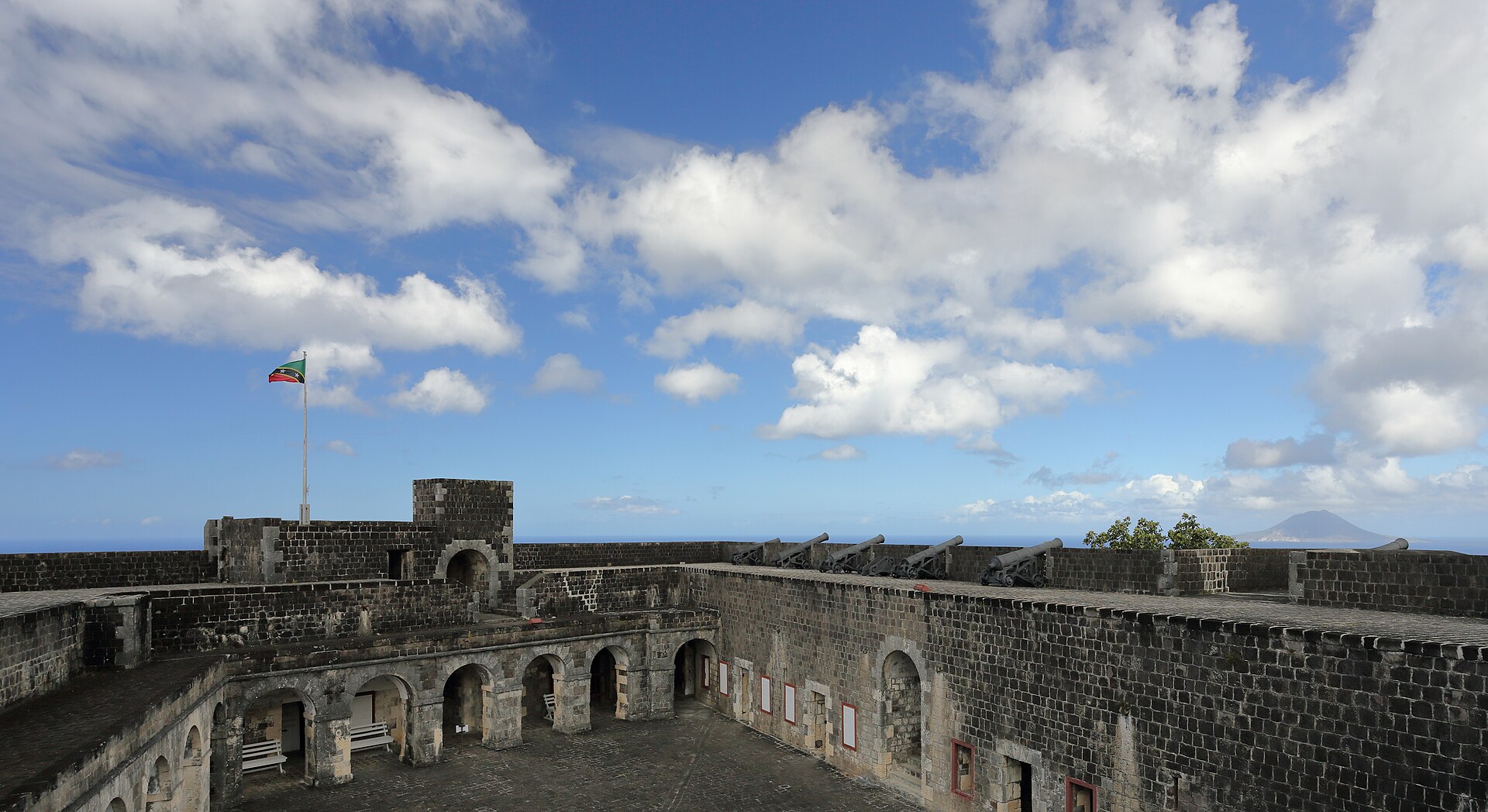
Saint Kitts and Nevis is a federation of two green volcanic islands in the Leeward Islands of the Eastern Caribbean, separated by a channel called The Narrows, only about 3 km (2 miles) wide. St. Kitts, the larger island, has the capital, Basseterre, the cruise port of Port Zante, the main airport and most of the hotels. Its sights include the hilltop citadel of Brimstone Hill, a UNESCO World Heritage Site; the St. Kitts Scenic Railway, built to carry sugar cane and now a three-hour tour around the island; rainforest trails on the slopes of Mount Liamuiga; and the beach bars of Frigate Bay and the South East Peninsula, with views across to Nevis. Nevis, a short ferry ride away, is quieter, centered on its almost perfectly round volcanic peak, the little capital of Charlestown and old plantation inns. English is the official language, the currency is the Eastern Caribbean dollar, and you drive on the left. Most visitors need an approved electronic travel authorization (eTA) before they fly. The drier months from about January to April are the most popular. A week lets you see both islands comfortably.
Right now in Saint Kitts and Nevis
- Sat25–29°C77–83°F6 mm rain
- Sun24–29°C74–84°F14 mm rain
- Mon25–29°C78–85°F2 mm rain
Weather, sun and air quality here are for one point near the centre of Saint Kitts and Nevis, not the whole country; conditions elsewhere can differ. Readings refresh through the day.
Saint Kitts and Nevis: quick answers
- Best time to visit Saint Kitts and Nevis
- The islands are warm all year, cooled by the trade winds, with little difference in temperature between seasons. More
- Places to visit in Saint Kitts and Nevis
- Basseterre, Brimstone Hill Fortress, The St. Kitts Scenic Railway, Romney Manor, rainforest and Mount Liamuiga, Frigate Bay and the South East Peninsula, Nevis. More
- Things to do in Saint Kitts and Nevis
- History, hikes, boats and beach bars. More
- Entry rules for Saint Kitts and Nevis
- You need a valid passport. More
Saint Kitts and Nevis at a glance: overview and geography
The federation is one of the smallest countries in the Americas. According to the St. Kitts Tourism Authority, St. Kitts covers 68 square miles (about 176 km²) and has around 40,000 people; Nevis, to the south-east, is smaller, at about 36 square miles (93 km²), with roughly 12,000 more. St. Kitts is shaped a little like a cricket bat, or a guitar: a round, mountainous body in the north-west, crowned by the dormant volcano Mount Liamuiga, about 1,156 m (3,792 feet) high and often wrapped in cloud, and a long, narrow neck, the South East Peninsula, stretching toward Nevis with salt ponds and the island’s best beaches. Nevis is a single cone, Nevis Peak, about 985 m (3,232 feet) high, ringed by a coastal road and villages.
The Kalinago (Carib) people lived here when Christopher Columbus sighted the island on his second voyage in 1493 and named it after Saint Christopher, later shortened to St. Kitts. In 1623, English and then French settlers arrived, and the tourism authority describes St. Kitts as the first non-Spanish European colony in the Caribbean, which is why it is often called the “mother colony” of the British West Indies. For three centuries the islands’ economy rested on sugar grown by enslaved Africans; the great fortress on Brimstone Hill, built over about a century largely by enslaved Africans, guarded the trade. Saint Kitts and Nevis became independent on September 19, 1983, and remains a Commonwealth realm. Nevis, the birthplace of Alexander Hamilton, has its own island administration within the federation. The sugar industry closed in 2005, and tourism is now the main industry.
Time zone: the islands use Atlantic Standard Time (UTC−4) all year, with no daylight saving time, so they are one hour ahead of New York in winter and on the same time in summer.
The regions
- Basseterre: the capital and cruise port on St. Kitts’s south coast, with the Circus, Independence Square, Port Zante and the ferry terminal for Nevis. See our Basseterre travel guide.
- Frigate Bay: just south-east of Basseterre, at the start of the peninsula, with large resorts, a golf course and the Strip of beach bars on the Caribbean side.
- The South East Peninsula: salt ponds, green hills and the beaches of South Friars, Cockleshell Bay and Banana Bay, looking straight across The Narrows to Nevis.
- The Caribbean (west) coast: villages and old estates on the road north from Basseterre, including Romney Manor at Old Road and Brimstone Hill near Sandy Point.
- The north and Atlantic coast: rural villages, black-sand beaches and the trails up Mount Liamuiga, circled by the route of the Scenic Railway.
- Nevis: Charlestown, Pinney’s Beach, Nevis Peak and the plantation inns on the slopes, reached by ferry, water taxi or a short flight.
Videos of Saint Kitts and Nevis
Hand-picked travel videos from YouTube creators to help you picture the trip. They play from YouTube; the facts in this guide come from our own research.
Where to go: Basseterre, Brimstone Hill, the peninsula and Nevis
St. Kitts is small: a single main road circles the island, and most sights are within an hour of Basseterre. Many visitors stay in Frigate Bay or on the peninsula and take day trips around the island and to Nevis.
Basseterre
The compact capital is a mix of Georgian stone buildings, wooden houses with fretwork balconies and busy shops. Its heart is the Circus, a small roundabout modeled on London’s Piccadilly Circus, with the green Berkeley Memorial Clock in the middle, and nearby Independence Square, once a slave market and now a shady park. The National Museum, St. George’s Anglican Church and the Co-Cathedral of the Immaculate Conception are all within walking distance, and Port Zante, where the cruise ships dock, has duty-free shops, a marina and the ferry terminal. Our Basseterre guide has the details.
Brimstone Hill Fortress
On a steep volcanic hill above the west coast, about 12 km (7.5 miles) from Basseterre as the crow flies, Brimstone Hill Fortress National Park is one of the best-preserved colonial fortifications in the Americas and was inscribed as a UNESCO World Heritage Site in 1999. Built by British military engineers and the labor of enslaved Africans, it was nicknamed the “Gibraltar of the West Indies”. Climb to the Citadel of Fort George for views over the sea to Sint Eustatius and Saba, walk the ramparts and visit the small museum. According to the park, entrance costs US$15, children 12 and under pay half price, and it is open daily from 9:30 am to 5:30 pm.
The St. Kitts Scenic Railway
The narrow-gauge railway was built between 1912 and 1926 to carry cane from the plantations to the sugar factory in Basseterre. Today, according to the operator, the tour makes a 30-mile (48 km) circle around the island, 18 miles by train and 12 by sightseeing bus, in about three hours, with drinks and live commentary as you pass old sugar mills, villages, rainforest and the sea. It runs mainly for cruise passengers, so check the schedule and book ahead.
Romney Manor, rainforest and Mount Liamuiga
At Old Road, on the west coast, the gardens of Romney Manor shelter Caribelle Batik, where you can watch batik being made, and a huge old saman tree. Above it, the Wingfield Estate has the island’s zip lines. The rainforest rising behind is laced with trails, and the hike to the crater rim of Mount Liamuiga, the island’s highest peak, is a challenging climb of more than 2,000 feet, best done with a local guide.
Frigate Bay and the South East Peninsula
Frigate Bay has two faces: the calm Caribbean side, where the Strip’s beach bars come alive at sunset, and the windier Atlantic side, lined with resorts. Beyond it, the road over the hills of the peninsula leads to South Friars Bay, Cockleshell Bay and Banana Bay, calm beaches with beach bars, water sports and the classic view of Nevis Peak across The Narrows. The peninsula’s salt ponds attract water birds, and you may see green vervet monkeys along the roads.
Nevis
Nevis feels like a step back in time. Charlestown, its small capital, has stone buildings, a waterfront market and the museum in the house where Alexander Hamilton was born. North of town, Pinney’s Beach is a long strip of sand with beach bars, and inland, old sugar estates have become plantation inns with gardens and views. Hikers can tackle the steep, muddy trail up Nevis Peak with a guide, or easier walks through the forest on the lower slopes. Because the two islands are one country, you can travel between them freely, with no immigration check.
A few more worth your time
The Black Rocks, lava formations on the Atlantic coast near Belle Vue; the petroglyphs and old estates along the west coast road; the ruins of the Fairview Great House and other plantation houses; the village of Sandy Point below Brimstone Hill; a catamaran trip down the coast and across to Nevis for snorkeling and lunch; and, on Nevis, the hot spring at the Bath Hotel ruins and the botanical garden.
Basseterre Travel Guide
Plan a visit to Basseterre, the capital of St. Kitts: the Circus and Berkeley Memorial Clock, Independence Square, the National Museum, the cathedral and…
Multi-day tours of Saint Kitts and Nevis
Multi-day tours from local operators. You check dates and book on Viator, our partner; we may earn a commission at no extra cost to you. How we earn money
Best time to visit Saint Kitts and Nevis
The islands are warm all year, cooled by the trade winds, with little difference in temperature between seasons. The drier, slightly cooler months are January to April; from about June to November, it is hotter and more humid, with more showers, and the Atlantic hurricane season runs from June 1 to November 30, according to the US National Hurricane Center. The table uses the World Meteorological Organization’s (WMO) 1991–2020 climate normals for Robert L. Bradshaw International Airport, just north-east of Basseterre. The station records about 1,140 mm (45 inches) of rain a year and nearly 2,900 hours of sunshine; the mountains are much wetter and a few degrees cooler.
| Season (Robert L. Bradshaw Airport, 1991–2020) | Average afternoon high | Average night low | Rainfall a month | What it’s like |
|---|---|---|---|---|
| Winter (Dec–Feb) | 29 °C (84–85 °F) | 23–24 °C (73–75 °F) | 51–110 mm (2.0–4.3 in) | Breezy and pleasant; Sugar Mas carnival over Christmas and New Year; peak season. |
| Spring (Mar–May) | 29–30 °C (84–86 °F) | 23–25 °C (73–76 °F) | 46–84 mm (1.8–3.3 in) | The driest stretch, with March the driest month; good for hiking. |
| Summer (Jun–Aug) | 31 °C (88 °F) | 26 °C (78 °F) | 70–107 mm (2.7–4.2 in) | Hot; the St. Kitts Music Festival in June and Culturama on Nevis in July–August. |
| Autumn (Sep–Nov) | 30–31 °C (87–88 °F) | 25 °C (76–78 °F) | 117–188 mm (4.6–7.4 in) | The wettest months, with October the wettest; peak storm season; quiet and cheaper. |
Rain usually comes as short, heavy showers rather than all-day downpours: the airport averages 8 days with 1 mm or more of rain in March, and 14 in October and December. The sea stays warm enough for swimming all year.
Hurricanes and storms
The islands lie in the path of Atlantic storms, and the risk is highest from August to October. Most years pass without a direct hit, but storms can bring strong winds, heavy rain and rough seas that stop the ferries. If you travel between June and November, take travel insurance that covers storms, follow the forecasts of the US National Hurricane Center, and allow some flexibility in your plans.
Crowds and prices through the year
High season runs from mid-December to April, when hotel rates peak and cruise ships call almost every day; according to the Government of Saint Kitts and Nevis, 748,056 cruise passengers arrived between October 2024 and April 2025. Busy cruise days fill Basseterre, the railway and the beaches nearest the port, so plan big sights for days with fewer ships. Hotels also fill for the St. Kitts Music Festival in June and for Sugar Mas. September and October are the quietest months, and some small hotels and restaurants close for a break.
Festivals and public holidays
The national carnival, Sugar Mas, fills Basseterre with parades, pageants, J’ouvert and soca from Christmas Eve through New Year, according to the tourism authority. The St. Kitts Music Festival, a three-night concert at Warner Park in Basseterre, brings international and Caribbean stars in June. On Nevis, Culturama, from late July into early August, celebrates African heritage with pageants, folk performances, boat races and food, and the Cross-Channel Swim is a 2.5-mile open-water race across The Narrows. The Nevis Island Administration lists these public holidays: New Year’s Day (January 1), Carnival Day (January 2), Good Friday, Easter Monday, Labour Day (the first Monday in May), Whit Monday, Emancipation Day (the first Monday in August) and Culturama Day (the following Tuesday), National Heroes Day (September 16), Independence Day (September 19), Christmas Day and Boxing Day.
How long to stay: sample itineraries
Basseterre to Brimstone Hill is about half an hour by road, Basseterre to Cockleshell Bay about 20 minutes, and the passenger ferry from Basseterre to Charlestown on Nevis takes about 45 minutes.
3–4 days: St. Kitts highlights
Day 1: Basseterre’s Circus, Independence Square and Port Zante, then sunset on the Frigate Bay Strip. Day 2: the Scenic Railway or a drive around the island, with Brimstone Hill, Romney Manor and the Black Rocks. Day 3: the beaches of the South East Peninsula. Day 4: a rainforest hike or zip line, or a catamaran trip to Nevis.
7 days: both islands
Four nights on St. Kitts, as above, with a guided climb of Mount Liamuiga, then three nights on Nevis: Charlestown and the Alexander Hamilton museum, Pinney’s Beach, the plantation inns and a hike on Nevis Peak’s slopes.
10 days: add a neighboring island
Add a few days on Sint Maarten, reached by the Makana ferry from Port Zante or a short flight, or on Antigua, a short hop by air. From Sint Maarten, the ferry continues to Saint-Barthélemy.
Entry, money, fees and costs
Entry and visas (last reviewed November 2026)
You need a valid passport. Whether you need a visa depends on your nationality: the Ministry of Foreign Affairs publishes a list of 67 countries and territories whose nationals need a visa, mostly in Africa and Asia, and citizens of countries not on it, including the United States, Canada, the United Kingdom and the EU member states, do not need one for a visit. Those who do need a visa can apply online through the government’s e-visa service, linked from the ministry’s passport and visa page. According to the St. Kitts Tourism Authority, cruise passengers and visitors staying less than 24 hours do not need a visa. Carry a return or onward ticket and the address of your accommodation.
The eTA and the online ED form
Since May 26, 2025, every visitor, apart from citizens and residents of Saint Kitts and Nevis and citizens of the Organisation of Eastern Caribbean States (OECS), must have an approved Electronic Travel Authorization (eTA) before departing for the islands, according to the Government of Saint Kitts and Nevis. Apply through the official St Kitts and Nevis e-Border app for Android and iOS, or on the government’s border portal at knatravelform.kn. The application takes about five minutes and can be submitted up to 90 days before travel; the eTA is valid for 90 days or until your passport expires, whichever comes first. The service charge has been US$17 per person since September 1, 2025. Nationals of CARICOM and OECS countries, accredited diplomats, children under two, transit passengers and on-duty crew are exempt from the charge. Citizens, residents and OECS nationals instead complete the free online Immigration and Customs ED form on the same portal. Use only the official app or portal, and travelers who use the app can use the fast-track facial biometric lane at the airport.
The Eastern Caribbean dollar, cards and tipping
The currency is the Eastern Caribbean dollar (EC$ or XCD), shared with seven other Eastern Caribbean islands and fixed at EC$2.70 to US$1. According to the tourism authority, US dollar bills are accepted by most stores and businesses, with change given in EC dollars, but US coins are not; pounds, euros and Canadian dollars can be changed at banks. Major credit cards are accepted at most hotels and restaurants; carry cash for buses, taxis, beach bars and market stalls. Hotels and many restaurants add a service charge of 10–15% and government taxes of about 10–12%, so check the bill before tipping; where no service charge is added, about 10–15% is normal. Taxi tips are appreciated but not required.
Typical travel costs
Saint Kitts and Nevis has a few very high-end resorts and plantation inns, but guesthouses, apartments and local restaurants keep costs manageable. These estimates per person per day, sharing a room, are a planning guide as of November 2026:
| Style | Estimated cost per day | What that looks like |
|---|---|---|
| Budget | about US$90–150 | Guesthouse or apartment in Basseterre or Frigate Bay, minibuses, local lunches of roti or saltfish, the passenger ferry and free beaches |
| Mid-range | about US$220–380 | 3- or 4-star hotel in Frigate Bay, a rental car for a day or two, Brimstone Hill, the Scenic Railway or a catamaran trip, restaurant dinners |
| High-end | about US$650+ | A peninsula resort or a Nevis plantation inn, private island tours, water taxis and fine dining |
Add the eTA charge, taxes and service charges. The figures are our estimates, not official statistics.
Getting there and getting around
Flights to St. Kitts (SKB)
Robert L. Bradshaw International Airport (SKB) lies on the edge of Basseterre, only about 2 km (just over a mile) from the town center, and serves both islands. According to the St. Kitts Tourism Authority, nonstop flights arrive from Atlanta, Miami, Charlotte, New York, Newark, Toronto and London, with American Airlines, Delta, United, JetBlue, Air Canada and British Airways, many of them seasonal; regional carriers such as InterCaribbean, Winair, Sunrise Airways and Cape Air connect it with nearby islands. The tourism authority quotes flight times of about 2.5 hours from Miami, 4 hours from New York and 8 hours from London. Nevis has a smaller airport for regional flights.
Cruise ships and yachts
Cruise ships dock at Port Zante in central Basseterre, which can take some of the largest ships at sea; the shops, taxis and the Circus are a short walk from the pier. Yachts clear customs through the online SailClear system, completing separate arrival and departure notifications; Port Zante Marina has 36 slips, and Christophe Harbour on the peninsula has a larger marina.
Getting to Nevis: ferries and water taxis
There are three ways across The Narrows, according to the tourism authority. Passenger ferries leave the ferry terminal in Basseterre for Charlestown several times a day and take about 45 minutes. The Sea Bridge car ferry runs from Major’s Bay at the end of the South East Peninsula, if you want to take a rental car across; some rental companies will instead give you a car on the other island. Water taxis, chartered boats that cross in about eight minutes, currently pick up from Christophe Harbour’s marina on the peninsula. No immigration formalities apply between the islands, but bring your passport or ID.
Ferries to other islands
The Makana Ferry, a 72-foot fast catamaran carrying up to 150 passengers, sails from Port Zante to Sint Eustatius, Saba and Sint Maarten on Mondays, Fridays and Saturdays, according to the tourism authority. Check the operator’s timetable before planning around it.
Taxis and minibuses
Taxis wait at the airport, the cruise pier, the Circus and the main hotels. They are not metered: rates are set by the government in EC dollars and posted at the airport, and the same fare covers one to four passengers. The tourism authority quotes about US$16 from the airport to the nearest hotel in Basseterre and up to US$50 to the farthest point on the island, with a 50% surcharge between 10 pm and 6 am. Always confirm whether a quoted fare is in EC or US dollars. Many taxi drivers also work as tour guides, and a half-day island tour is an easy way to see Brimstone Hill and the west coast. Privately run minibuses link Basseterre with the villages around the island by day and are cheap, but they do not go down the peninsula.
Driving
Drive on the left. You need your valid driver’s license plus a temporary local driving permit, which costs about US$10 and is usually arranged by the rental company, according to the tourism authority. The main island road is in fair condition, but it is narrow and winding in places, with sharp bends, pedestrians, monkeys and livestock. A compact car is the easiest choice for the island’s narrower mountain roads.
Beaches, the sea and diving
The calmest beaches are on the Caribbean side: Frigate Bay’s Strip, South Friars Bay, Cockleshell Bay, Banana Bay and the quieter coves at the end of the peninsula, plus Pinney’s Beach and Oualie Beach on Nevis. The Atlantic beaches, such as Frigate Bay North, are better for walking, kitesurfing and watching the waves than for swimming. Snorkeling is good around the rocks at the ends of the peninsula beaches, and dive shops in Basseterre and on the peninsula visit reefs and wrecks off the south and west coasts. See our beaches guide, plus snorkeling, diving and boat trips.
- Protect the reef: removing coral or marine life is not allowed; don’t stand on coral, and use reef-safe sunscreen.
- Currents: the Atlantic side and The Narrows can have strong currents; swim at calm, sheltered beaches and snorkel close to shore unless you are on a boat trip.
- Turtles: sea turtles nest on some quiet beaches; give nests and hatchlings plenty of space.
- Footwear: pack water shoes for rocky entries and the black-sand Atlantic beaches.
Health, practical tips and connectivity
Health and emergencies
The tourism authority notes that special vaccinations are usually not required. The main hospital is the Joseph N. France (JNF) General Hospital in Basseterre, and Nevis has the Alexandra Hospital in Charlestown. For police, fire and ambulance, call 911; the tourism authority also lists 869-465-2801 for an ambulance. Use high-factor sunscreen, drink plenty of water on hikes, and use insect repellent, as mosquitoes are more active in the wet season. Medical care can be expensive for visitors, so carry travel insurance that includes evacuation. If you take prescription medicines, especially controlled drugs, check with the customs office before you travel.
Practical tips
- Dress: wear a cover-up over swimwear in town, shops and restaurants.
- Taxis: agree the fare and the currency before you set off.
- Cruise days: check the cruise schedule and visit the most popular sights on quieter days.
- Pets: animals, including service animals, need an import permit from the Chief Veterinary Officer, a microchip and an up-to-date rabies vaccination.
- Hiking: go with a licensed guide on Mount Liamuiga and Nevis Peak, start early and carry water.
Connectivity and power
Flow and Digicel are the mobile networks, and local SIM cards and eSIMs are easy to buy; the country code is +1 869. Wi-Fi is standard in hotels. The power supply is 230 volts at 60 Hz, and sockets are mainly the British three-pin type G and the older round-pin type D, according to the CIA World Factbook; some hotels also have US-style outlets. Visitors from North America usually need an adapter and, for devices that are not dual-voltage, a converter. See our travel adapters guide.
Food, rum and Kittitian culture
The national dish is stewed saltfish with spicy plantains, coconut dumplings and breadfruit, often served for Sunday breakfast. Look out too for goat water, a rich goat stew; pelau, rice cooked with meat and pigeon peas; johnny cakes; conch, lobster and grilled fish at the beach bars; roti; and black pudding. Local drinks include rum punch, Cane Spirit Rothschild (CSR), a clear spirit distilled from cane, sorrel at Christmas, and Carib beer, which is brewed on St. Kitts. Bush teas made from local herbs, such as soursop, mint and lemongrass, are sold as souvenirs. Music is everywhere, from calypso and soca to steelpan and the island’s own string bands, and at Christmas the masquerade troupes and stilt-walking moko jumbies come out. Kittitians and Nevisians are friendly and fairly conservative: greet people with “good morning” or “good afternoon” before asking a question.
Things to do: history, hikes, boats and beach bars
- History: Brimstone Hill Fortress, the National Museum in Basseterre, Romney Manor and the Alexander Hamilton museum in Charlestown. See our city sightseeing guide.
- Hiking: the crater rim of Mount Liamuiga, rainforest trails above Wingfield Estate and the climb up Nevis Peak, all with guides. See our hiking guide.
- Boat trips: catamaran days to Nevis with snorkeling and lunch, sunset sails and sport fishing. See our boat trips guide.
- Diving and snorkeling: reefs and wrecks off the south and west coasts, with PADI dive shops at Port Zante and on the peninsula. See our diving guide.
- Adventure: the Wingfield zip lines, ATV and off-road safari tours, and kitesurfing at Frigate Bay.
- The Scenic Railway: a three-hour circle of the island by narrow-gauge train and bus.
What to pack
Bring light, breathable clothes, swimwear and a cover-up for town, a sun hat, sunglasses, reef-safe sunscreen and insect repellent. For the volcano hikes, pack hiking shoes with good grip (the trails are steep and muddy), a light rain jacket for the rainforest and a change of clothes. Add water shoes, a small dry bag for the ferry and boat trips, a plug adapter, your eTA approval and your passport.
Saint Kitts and Nevis travel FAQ
Do I need an eTA for St. Kitts?
Yes, unless you are a citizen or resident of Saint Kitts and Nevis or an OECS citizen. Apply on the St Kitts and Nevis e-Border app or at knatravelform.kn up to 90 days before travel. The charge is US$17 per person, with exemptions for CARICOM and OECS nationals, diplomats, children under two and transit passengers.
Do I need a visa for Saint Kitts and Nevis?
Not if you are a citizen of the United States, Canada, the UK or an EU country. Nationals of the 67 countries and territories on the Ministry of Foreign Affairs’ visa list need one and can apply online. Cruise passengers and visitors staying under 24 hours do not need a visa.
How do I get from St. Kitts to Nevis?
By passenger ferry from Basseterre to Charlestown in about 45 minutes, by the Sea Bridge car ferry from Major’s Bay, or by chartered water taxi from Christophe Harbour in about eight minutes. There is no immigration check between the islands.
What is the best time to visit St. Kitts?
January to April, the driest and most popular months. May and June are warm, good-value shoulder months. September to November is the wettest period and the peak of hurricane season.
How much does it cost to visit Brimstone Hill Fortress?
Entrance is US$15, and children 12 and under pay half price. The park is open daily from 9:30 am to 5:30 pm.
Can I use US dollars in St. Kitts?
Yes, US bills are widely accepted, but change usually comes in Eastern Caribbean dollars, fixed at EC$2.70 to US$1, and US coins are not accepted.
Which side of the road do they drive on in St. Kitts?
The left. You need your license and a temporary local permit, about US$10, usually issued by the rental company.
How long is the St. Kitts Scenic Railway tour?
About three hours, covering a 30-mile circle of the island: 18 miles by narrow-gauge train and 12 by sightseeing bus.
How much is a taxi from the airport?
Fares are fixed by the government and posted at the airport: about US$16 to the nearest Basseterre hotels and up to US$50 to the far end of the island, for one to four passengers, with a 50% surcharge from 10 pm to 6 am.
What are the emergency numbers in Saint Kitts and Nevis?
911 for police, fire and ambulance. The tourism authority also lists 869-465-2801 for an ambulance.
What plugs are used in St. Kitts?
Mainly British type G and round-pin type D sockets at 230 volts and 60 Hz, with US-style outlets in some hotels. Bring an adapter, and a converter for single-voltage North American devices.
Plugs and power in Saint Kitts and Nevis
Saint Kitts and Nevis uses 230 V, 60 Hz and these plugs (left) and wall sockets (right):
Some hotels also have US-style (A/B) outlets; North American devices that are not dual-voltage need a converter.
All plug types and voltages by country → · Check what you need to pack →
Plan your trip
Partner links: TravelerCenter may earn a commission if you book, at no extra cost to you.
Before you go: guidebooks and travel gear
Affiliate links: we may earn a commission at no extra cost to you. As an Amazon Associate we earn from qualifying purchases. We pick items for the place, not for the commission. How we earn money
Sources
Researched and last reviewed on November 10, 2026. The eTA, its charge and exemptions, and the online ED form come from the Government of Saint Kitts and Nevis (SKN Information Service) and its border portal; the visa-required list and e-visa service from the Ministry of Foreign Affairs; flights, ferries, taxi fares, the driving permit, money, health, emergency numbers, events, history and island facts from the St. Kitts Tourism Authority; cruise passenger numbers for 2024–25 from the Government of Saint Kitts and Nevis; public holidays from the Nevis Island Administration; Brimstone Hill fees and hours from Brimstone Hill Fortress National Park; the railway tour from the St. Kitts Scenic Railway; the climate averages (Robert L. Bradshaw International Airport, 1991–2020) from the World Meteorological Organization normals; the hurricane season from the US National Hurricane Center; and electricity from the CIA World Factbook. Nevis’s area and population, the heights of Mount Liamuiga and Nevis Peak, the 2005 end of the sugar industry, food, Nevis sights, hospitals, minibuses, festival months and some transfer times come from secondary sources and are flagged for checking. Daily costs are estimates. Fees, timetables and rules change, so check the official sites before you travel.
Data: Weather: MET Norway (CC BY 4.0) · Rates: ECB · Wikidata (CC0)