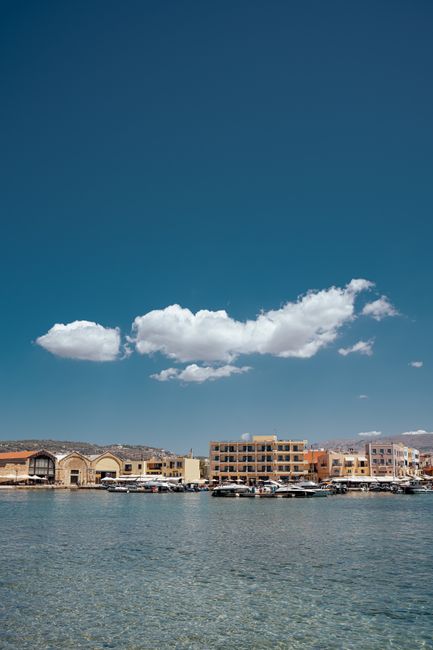
Crete is Greece’s largest island and almost a country of its own, about 260 km from end to end. It has Europe’s oldest palace civilisation at Knossos, Venetian harbour towns such as Chania and Rethymno, high mountains cut by deep gorges, pink-sand lagoons and turquoise bays, and a food culture built on olive oil, wild greens, cheese and raki. You could spend weeks here and not see it all, so choose a side: Chania and the wild west, Heraklion and the Minoan sites in the centre, or Elounda, Spinalonga and the quiet east. The best months are May, June, September and October. Give it at least a week, ideally ten days to two weeks, and rent a car.
Right now in Crete (Heraklion)
- Wed 15–22°C 60–72°F Clear
- Thu 14–24°C 58–74°F Clear
- Fri 15–23°C 58–73°F Clear
Weather: MET Norway (CC BY 4.0) · Sea temperature: NOAA CoastWatch · Air quality: OpenAQ · Rates: ECB
Top tours in Crete
See all tours for Crete →
From local operators, with prices and reviews; you check availability and book on Viator, our partner. We may earn a commission at no extra cost to you. How we earn money
Crete at a glance
- Best months: May–June and September–October. On the north coast, average highs run from about 20 °C in April to 29–31 °C in July and August, and winters are mild, around 15–17 °C by day in Heraklion (HNMS normals 1991–2020); the mountains are much cooler and get snow in winter. The sea is warm enough for swimming from June to October, and on the south coast often into November.
- Days needed: 7 for one half of the island (west, or centre and east); 10–14 to see the whole north coast, a gorge and the south.
- Getting there: fly into Heraklion (HER) or Chania (CHQ), or take an overnight ferry from Piraeus to Heraklion or Chania (Souda).
- Getting around: a car is by far the easiest; KTEL buses link the north-coast towns well and reach the main beaches and gorges in season.
- Budget level: good value for Greece, especially for food and rooms away from the big resorts and Elounda. A climate resilience fee is added per room per night (€2–€15 from April to October). See our Greece guide for money, entry rules and daily costs.
Crete’s areas and who each one suits
- Chania and the west: the prettiest old town on the island, the Samaria Gorge and the White Mountains, the lagoons of Balos and Elafonisi, and remote south-coast villages such as Sougia, Paleochora and Loutro. For beaches, hiking and romance.
- Rethymno: a smaller Venetian and Ottoman old town with a long sandy beach and a big fortress, between Chania and Heraklion, with mountain villages, Arkadi monastery and the south-coast beach of Plakias within reach. A good central base.
- Heraklion and the centre: the capital and its great archaeological museum, Knossos, wine villages, the Minoan palace of Phaistos and the beaches of Matala in the south. For history lovers.
- Lasithi and the east: the chic resorts of Elounda and Agios Nikolaos, Spinalonga, the Lasithi plateau and, further east, the palm beach of Vai and quiet Sitia. For luxury hotels, families and calm.
- The north-coast resorts: Hersonissos, Malia and the strip east of Heraklion, with big hotels and nightlife. For package holidays and parties.
Top things to see in Crete
Prices and hours below come from the Greek Ministry of Culture’s ticketing service (Hellenic Heritage), as of October 2026.
Heraklion and its Archaeological Museum
Heraklion, the capital, is a busy modern city inside massive Venetian walls, with a lively centre around the Lions (Morosini) fountain, a harbour guarded by the Koules fortress and the grave of the writer Nikos Kazantzakis on the walls. Its unmissable sight is the Archaeological Museum of Heraklion, home to the world’s finest collection of Minoan art: the Phaistos Disc, the bull-leaping fresco, the snake goddesses and gold jewellery from 3,500 years ago. See it before or after Knossos, which makes much more sense with the museum. How to visit: €20, €12 reduced. From April to October it opens daily 8:00–20:00, except Wednesdays, when it opens at 13:00; from November to March, 8:30–15:30 (Wednesdays 10:00–17:00). Last entry is 20 minutes before closing.
Knossos
Five kilometres south of Heraklion, Knossos was the largest palace of the Minoans, Europe’s first great civilisation, and the setting of the legends of King Minos, the Labyrinth and the Minotaur. It is a maze of courtyards, storerooms, staircases and royal apartments, with parts boldly rebuilt in concrete and painted by the archaeologist Arthur Evans a century ago, which helps you picture it, whatever purists think. How to visit: €20, €10 reduced. From April to August it opens daily 8:00–20:00; 19:30 in early September, 19:00 in late September, 18:30 in early October, 18:00 in late October; and about 8:00–17:00 from November to March. Last entry is shortly before closing. Buy tickets online through Hellenic Heritage, arrive at opening time or in the last two hours to avoid tour groups and heat, and consider a guide. City buses run from central Heraklion. The site can close at short notice in severe weather, as it did on the afternoon of 3 October 2026.
History lovers can add Phaistos, a Minoan palace on a hill above the Messara plain in the south (€15, €8 reduced), with the beaches and caves of Matala nearby, and the palace of Malia on the north coast.
Chania old town
Chania is the most beautiful town in Crete. Its Venetian harbour is a crescent of pastel houses, a mosque with domes from the Ottoman period and an old lighthouse at the end of a long breakwater; walk out to it at sunset. Behind the waterfront, the lanes of Topanas, the old Jewish quarter of Evraiki and Splantzia are full of small hotels, workshops and courtyard restaurants. See the Venetian arsenals, the maritime museum and the new Archaeological Museum of Chania in the Chalepa district, opened in 2022 (€15, €8 reduced). Chania is the base for the west: the Samaria Gorge, Balos, Elafonisi and the Akrotiri peninsula’s monasteries and beaches.
Rethymno
Rethymno, an hour east of Chania, has an atmospheric old town of Venetian mansions, wooden Ottoman balconies, minarets and the Rimondi fountain, a small Venetian harbour lined with fish restaurants, and a long sandy town beach. Above it all stands the Fortezza, one of the largest Venetian castles in Greece, with a mosque inside and views along the coast. Inland, the monastery of Arkadi is a national symbol of the Cretan struggle for freedom from Ottoman rule.
Spinalonga
A small island at the mouth of the Elounda bay, Spinalonga holds a Venetian sea fortress that later became a village and then, from 1903 to 1957, Greece’s last leper colony, made famous by Victoria Hislop’s novel The Island. Walking its single street of ruined houses, church and hospital is a moving experience; it is the second most visited site in Crete after Knossos. How to visit: €20, €10 reduced; buy online through Hellenic Heritage or on the island. From April to August it opens daily 8:00–20:00, then closes earlier through September and October (18:00 in late October); from November to March it opens 8:30–15:30 and closes on Tuesdays. Boats cross from Plaka in about 10 minutes, and run from Elounda and Agios Nikolaos; go early or late to avoid the coach tours.
Peaks and mountains
- Mount Ida (Psiloritis)
Monasteries and convents
- Arkadi Monastery
Monuments
- Knossos
- Phaistos
- Zakros Palace
Archaeological sites
- Hagia Triada
Caves
- Dikteon Cave
Nature
The Samaria Gorge
The Samaria Gorge, in a national park in the White Mountains south of Chania, is one of Europe’s great day hikes: about 13 km inside the gorge, plus about 2 km to the village of Agia Roumeli on the Libyan Sea, dropping from 1,227 m at Xyloskalo, on the Omalos plateau, to sea level. You walk through pine and cypress forest, past the abandoned village of Samaria and through the Iron Gates (Sideroportes), where the walls close in to a few metres apart and rise hundreds of metres. Most people take 6–7 hours. There is no road out of Agia Roumeli: you leave by boat to Chora Sfakion, Sougia or Paleochora and then by bus or car.
Season, tickets and rules
- Season: the main path may open from 10 April to 31 October each year; the exact opening date depends on the maintenance works and is announced by the park’s management (the Natural Environment and Climate Change Agency, NECCA). It can close at short notice, usually decided the afternoon before, for rain, wind, rockfall or fire risk.
- Hours: you may start the full walk (or any part of it) between 7:00 and 13:00. After 13:00 you may only walk the first 2 km from either end (until 15:00 from Xyloskalo, 16:00 from Agia Roumeli), and everyone must be out of the park by 18:00.
- Tickets: €10 per person, €6 per person for families (parents and their under-18 children), €8 each for organised club groups of more than 10, and €25 for an annual pass; under-18s and over-65s are among those who enter free. Buy online on NECCA’s official ticket site or at either entrance. Keep the small control slip you get at the entrance: it is checked at the exit, so that staff know everyone is out.
- Rules: stay on the main path; no camping or overnight stays, fires, smoking (except in marked spots), alcohol, drones, bicycles or picking plants; dogs only on a lead; carry ID; take your rubbish out with you.
- Getting there: KTEL buses run from Chania to Omalos in about an hour, timed for the morning start and the boat connections in the evening; many agencies sell day tours with transport and the boat.
Closed in early October 2026: because of a severe-weather warning that placed the Region of Crete on red alert at the start of October 2026, NECCA closed the gorge at both entrances until the bad weather passes and the path has been inspected and repaired. Check the official ticket site for the reopening date before you go. Wear broken-in hiking boots, carry snacks and sun protection (there are springs and toilets along the path but no shops), and start early. Small children and anyone with knee problems may prefer the shorter walk in from Agia Roumeli. See our hiking guide.
Balos and Elafonisi: protected lagoons
Crete’s two most famous beaches are both in the far west and both in protected Natura 2000 areas, and both have become so crowded in summer that the authorities are bringing in limits. Go early or late, take nothing away (sand, shells or plants), and expect rules to change.
Balos
Balos is a shallow turquoise lagoon with white and pink sand at the tip of the wild Gramvousa peninsula, north-west of Kissamos. You can get there two ways. By boat, from the port of Kissamos (Kavonisi), on day cruises that also stop at the island of Imeri Gramvousa and its Venetian fortress. By car, from the village of Kalyviani along a rough dirt road of about 8 km, then a steep walk of 20–30 minutes down to the lagoon (and back up in the heat). A small fee per person and per car is collected at the checkpoint on the road. Under protection measures agreed in March 2025 by NECCA, the Region and the local municipalities, cars are to be parked in a new area near Kalyviani with shuttle buses to the path, and sea arrivals limited to at most 2,000 visitors a day in two or three shifts; in 2026 the authorities were also discussing an online booking system and daily caps for Balos, Elafonisi and Falasarna for the 2027 season. Check the latest rules before you go.
Elafonisi
At the south-west tip of Crete, about two hours’ drive from Chania, Elafonisi is a shallow lagoon between the coast and a small island you can wade across to, with pink-tinged sand from crushed shells and dunes covered in juniper. The island and dunes are a strictly protected nature reserve. Since 2023, cars have been barred from the protected zone by a barrier: you park in the designated areas back from the beach (for a small charge) and walk in, and the number of sunbeds and umbrellas has been sharply reduced. Stay on the marked paths through the dunes, do not take any pink sand, and come early in the morning or in the late afternoon. KTEL buses run from Chania in summer, and many tours combine Elafonisi with the Chrysoskalitissa monastery. See our beaches guide and our snorkeling guide.
Other great beaches include Falasarna on the west coast, famous for sunsets; Seitan Limania and Marathi on the Akrotiri peninsula; Preveli, where a palm-lined river meets the sea on the south coast; Matala with its caves; and Vai, with Europe’s largest natural palm forest, in the far east. The south coast is good for diving and snorkeling: see our diving guide.
Cretan food and wine
Cretan cooking is one of the healthiest and tastiest in the Mediterranean. Try dakos (barley rusk with tomato, soft cheese and olive oil), kalitsounia (small cheese or greens pies), snails with rosemary, lamb with wild greens, gamopilafo (wedding rice cooked in meat broth), staka (a rich butter cream), and the island’s graviera cheese and thyme honey. Meals often end with a free shot of tsikoudia (raki) and fruit. The wine region south of Heraklion, around Peza and Archanes, grows local grapes such as Vidiano, Vilana, Kotsifali and Liatiko; many wineries open for tastings. See our wine tasting guide.
Activities and best months
- Beaches and swimmingChania's coast has over 80 beaches: the five sandy beaches of Falasarna, the shallow pink-sand lagoon of Elafonisi beside the Kedrodasos cedar forest, and Balos lagoon at the north-western tip. · source
- Boat tripsBalos lagoon is reached by a dirt road and a walk, or by boat from Kissamos, which also stops at Gramvousa island with its Venetian castle; the beach has no services. · source
- HikingMayJunJulAugSepOctSamaria Gorge: the main path is about 13 km from Xyloskalo (1,227 m) down to the sea, plus 2 km to Agia Roumeli, about 6-7 hours. The park may open from 10 April to 31 October (the date is set each year); entry 07:00-13:00 for the full route; ticket €10 (under-18s free; other exemptions listed on the ticket site), e-ticket from NECCA. On 2026-10-04 the gorge was closed because of a red-alert storm warning for Crete. · source
- Wine tastingMayEvery May the wineries of Crete open their doors (Open Doors) for vineyard walks and tastings; vineyards on the slopes of Heraklion and Rethymno and the hills of Sitia and Chania, with four PDO zones (Peza, Archanes, Dafnes, Sitia). · source
Nearby destinations
Getting there and getting around
Airports: Heraklion (HER) or Chania (CHQ)?
- Heraklion (HER), Nikos Kazantzakis airport: the island’s main and busiest airport, on the edge of the city, with flights from Athens (about 50 minutes) all year and from all over Europe in season. Best for Heraklion, Knossos, the central resorts, Elounda and the east. It is crowded at peak times; a new airport at Kastelli, inland, is being built to replace it later this decade.
- Chania (CHQ), Ioannis Daskalogiannis airport: on the Akrotiri peninsula, about 15 km from Chania town, with flights from Athens and many European cities in season. Best for Chania, Rethymno and the west.
- Fly in and out of different airports if you are touring the whole north coast, to save half a day of driving.
Ferries
Overnight ferries with cabins and car decks sail from Piraeus to Heraklion and to Souda, the port of Chania, in about 8–10 hours, with some daytime sailings in summer. In season, high-speed boats link Heraklion with Santorini in about 2 hours and continue to other Cyclades such as Ios, Naxos and Mykonos. Smaller ports in the east (Sitia) and west (Kissamos) have occasional ferries to other islands and the Peloponnese.
Road trips and distances
Crete is made for road trips. The main road along the north coast (the VOAK) links Kissamos, Chania, Rethymno, Heraklion, Agios Nikolaos and Sitia; it is being upgraded in sections, but much of it is still a busy two-lane road where slower cars drive on the hard shoulder to let others pass. Roads across the mountains to the south coast are narrow and winding, with goats and rockfalls, and take longer than the map suggests. Typical driving times:
| Route | Distance | Driving time |
|---|---|---|
| Chania – Rethymno | about 60 km | about 1 h |
| Rethymno – Heraklion | about 80 km | about 1 h 15 |
| Chania – Heraklion | about 140 km | 2–2½ h |
| Heraklion – Agios Nikolaos | about 65 km | about 1 h |
| Agios Nikolaos – Sitia | about 70 km | about 1 h 30 |
| Chania – Kissamos (for Balos) | about 40 km | about 45 min |
| Chania – Elafonisi | about 75 km | 1 h 45–2 h |
| Chania – Omalos (Samaria) | about 40 km | about 1 h |
| Heraklion – Matala | about 70 km | about 1 h 20 |
A one-week road trip: fly into Chania; three nights there with Balos, Elafonisi or the Samaria Gorge; one night in Rethymno; then Knossos and the museum from Heraklion and two nights around Elounda for Spinalonga, flying home from Heraklion. Without a car, KTEL buses link the north-coast towns often: KTEL Chania-Rethymno serves the west, including Omalos for Samaria, Elafonisi, Falasarna and Kissamos in season, and KTEL Heraklion-Lasithi serves the centre and east. Heraklion city buses go to Knossos. See our cycling guide for riding the island’s quiet back roads.
When to go and how long to stay
Crete has the longest season of the Greek islands: hot, dry summers, long warm autumns and mild, wet winters, with snow on the mountains. July and August are hot and busy, with the meltemi wind on the north coast; the south coast is hotter and calmer. Spring brings wildflowers and green gorges, and is ideal for hiking; September and October have warm sea and fewer people. From November to March many resort hotels close, but the cities stay lively and the sites are quiet. Autumn storms can be severe, as in early October 2026, when a red weather alert closed the Samaria Gorge and some sites for several days.
| Season | Average high / low (Heraklion) | Average high / low (Chania) | What it’s like |
|---|---|---|---|
| Spring (Mar–May) | 17–24 °C / 10–16 °C | 17–25 °C / 10–16 °C | Green and flowery; best for hiking and sightseeing; Samaria usually opens in spring; sea cool until late May. |
| Summer (Jun–Aug) | 28–29 °C / 20–23 °C | 29–31 °C / 20–22 °C | Hot, sunny and dry; meltemi on the north coast; busiest beaches and roads. |
| Autumn (Sep–Nov) | 20–27 °C / 14–20 °C | 20–28 °C / 13–20 °C | Warm sea, harvests and quieter sites; storms possible from October. |
| Winter (Dec–Feb) | 15–17 °C / 9–11 °C | 14–16 °C / 8–10 °C | Mild and green on the coast, rainy spells, snow on the mountains; many resorts closed. |
Temperatures are the 1991–2020 climate normals of the Hellenic National Meteorological Service (HNMS) for its Heraklion and Souda (Chania) stations. Rain falls mostly from November to March, more in the west than the east; summer is almost completely dry.
7 days in western Crete
Fly into Chania. Four nights in Chania with a day at Balos and Gramvousa, a day at Elafonisi and Falasarna, and a day for the Samaria Gorge (in season). Then three nights on the south coast, in Paleochora, Sougia or Plakias, or in Rethymno.
7 days in central and eastern Crete
Fly into Heraklion. Three nights in Heraklion with the museum, Knossos and a winery day; a day trip to Phaistos and Matala; then three nights around Elounda or Agios Nikolaos with Spinalonga, the Lasithi plateau and a beach day.
10–14 days: the whole island
Chania (4 nights), Rethymno (2), Heraklion (2) and Elounda or Agios Nikolaos (3), flying into Chania and out of Heraklion, with a few nights on the south coast if you have more time. Continue by ferry to Santorini, or compare with other big islands such as Sicily or Mallorca.
Where to stay in Crete
- Romance and atmosphere: a boutique hotel in Chania’s old town, near the harbour.
- Central base: Rethymno, between the west and Heraklion, with a town beach.
- History and no car: Heraklion, for the museum, Knossos and good bus links.
- Luxury and families: Elounda and Agios Nikolaos, with resort hotels on calm bays.
- Escape: the south-coast villages of Loutro (reached only by boat or on foot), Sougia, Paleochora or Plakias.
The climate resilience fee is added per room per night and paid at the accommodation.
Practical tips for Crete
- Distances: Crete is big; do not try to see it all from one base in a week.
- Drive carefully: watch for overtaking on the VOAK, goats and rocks on mountain roads, and never drink and drive.
- Gorges and weather: check NECCA’s announcements and the weather before Samaria; flash floods make gorges dangerous after heavy rain.
- Protected beaches: respect the barriers and paths at Elafonisi and Balos, and leave sand and shells where they are.
- Sites early: visit Knossos and Spinalonga at opening time in summer.
- Emergencies: call 112.
Weather month by month
Averages from HNMS normals 1991–2020, Heraklion (airport) (rain: 1955–2010 averages) · Last reviewed 4 Oct 2026
What to pack for Crete
Pack light, breathable clothes, a sun hat, sunglasses, high-factor sunscreen and a refillable water bottle. For the Samaria Gorge and other hikes, bring broken-in hiking boots or sturdy trail shoes, a small daypack and snacks. Water shoes are useful on pebbly and rocky beaches, and a snorkel mask on the clear south coast. In spring and autumn, add a warm layer and a light rain jacket, especially for the mountains, and a scarf or shirt to cover shoulders in monasteries and churches.
What to pack
- City walking shoesQuinta visits and harvest days mean steep terraces, gravel and cellar floors.
- Day packs and anti-theft bagsCarries water, towel and sunscreen down the long stairways to Algarve coves.
- Dry bags and phone pouchesProtects phones and cameras from sand and spray on beaches reached by ferry or steep paths.
- Fleeces and warm layersIt is cooler at sea than on land, especially on morning whale-watching trips.
- HeadlampsLevada routes such as PR1 and PR9 pass through long, dark, wet tunnels.
- Hiking shoes and bootsMadeira's levadas and the Azores' crater rims are wet, rocky and slippery, so grippy shoes matter more than anywhere else in Portugal.
- Quick-dry beach towelsA sand-shedding quick-dry towel packs small for beach days and lido visits.
- Rain jacketsA windproof, waterproof shell keeps you warm on open boats, where wind and spray cool you quickly.
- Reef-friendly sunscreenSummer UV is strong on Portuguese beaches and there is little shade below the cliffs.
- Trekking polesLong stone staircases and steep descents on Madeira's peaks and the Azores' crater rims are easier on the knees with poles.
- Water bottles and hydration packsAlgarve and Alentejo trails are hot and exposed with few refill points.
- Water shoesRocky coves, lava pools and weever fish in shallow sand make water shoes useful.
- WetsuitsOn the west and north coasts the sea stays around 16–18 °C even in summer, so a thin suit helps for long swims.
- Wine bottle travel protectorsPort and Douro wines bought at the quintas travel home safely in checked luggage with padded bottle protectors.
Crete travel FAQ
How many days do you need in Crete?
A week for one half of the island, such as Chania and the west, or Heraklion and the east; ten days to two weeks to see the whole north coast, a gorge and the south.
Should I fly into Heraklion or Chania?
Chania (CHQ) for the west, Balos, Elafonisi and Samaria; Heraklion (HER) for Knossos, the centre and the east. For a full tour, fly into one and out of the other.
How much does Knossos cost?
€20, or €10 reduced, as of October 2026. The Archaeological Museum of Heraklion is a separate €20 ticket.
When is the Samaria Gorge open?
Usually from spring (the official window starts on 10 April) to 31 October, from 7:00, with full crossings starting by 13:00. It closes in bad weather; in early October 2026 it was closed by a red weather alert, so check NECCA’s ticket site.
How much is the Samaria Gorge ticket?
€10 per person, €6 each for families, as of October 2026, bought online or at the entrance. Under-18s and over-65s are among those who enter free.
Is there a fee or limit for Balos and Elafonisi?
Balos has a small per-person and per-car fee on the access road, and sea arrivals are being limited to about 2,000 a day. At Elafonisi, cars must park outside the protected zone. Online booking and daily caps were being discussed for 2027.
How do you get to Spinalonga?
By boat from Plaka (about 10 minutes), Elounda or Agios Nikolaos. The site ticket is €20, or €10 reduced, as of October 2026.
Do you need a car in Crete?
It is strongly recommended. KTEL buses connect the north-coast towns and reach some beaches and gorges, but a car gives you the south coast, villages and beaches at your own pace.
How long does it take to drive across Crete?
Chania to Heraklion is about 140 km, 2–2½ hours on the north-coast road; from Kissamos in the west to Sitia in the east, allow a full day.
What is the best beach in Crete?
Balos and Elafonisi are the most famous; Falasarna for sunsets, Preveli for its palm-lined river, Seitan Limania for a dramatic cove and Vai for its palm forest.
When is the best time to visit Crete?
May, June, September and October: warm, sunny weather for beaches and sightseeing without the July and August heat and crowds. April and May are best for hiking and wildflowers.
Sources
- © OpenStreetMap contributors · ODbL · fetched 4 Oct 2026
- Wikidata · CC0 · fetched 4 Oct 2026
Sources and last review
Researched and last reviewed on 4 October 2026. Prices and hours of Knossos, the Archaeological Museums of Heraklion and Chania, Phaistos and Spinalonga come from the Greek Ministry of Culture (Odysseus portal and Hellenic Heritage). Samaria Gorge season, hours, tickets, rules and the October 2026 closure come from NECCA’s official Samaria ticket site. Balos and Elafonisi measures come from NECCA’s announcement of March 2025, with later plans as reported in the Greek press. The climate resilience fee is set by Greek tax law and collected by AADE. Climate figures are the HNMS 1991–2020 normals for Heraklion and Souda. Distances, driving times and ferry times are approximate and change with roadworks and seasons, so check KTEL, the ferry companies and NECCA before you travel.
Plan your trip
Partner links: TravelerCenter may earn a commission if you book, at no extra cost to you.
🇬🇷 Useful Greek phrases for Crete
All 38 Greek phrases: restaurant, hotel, emergencies, romance (printable) →