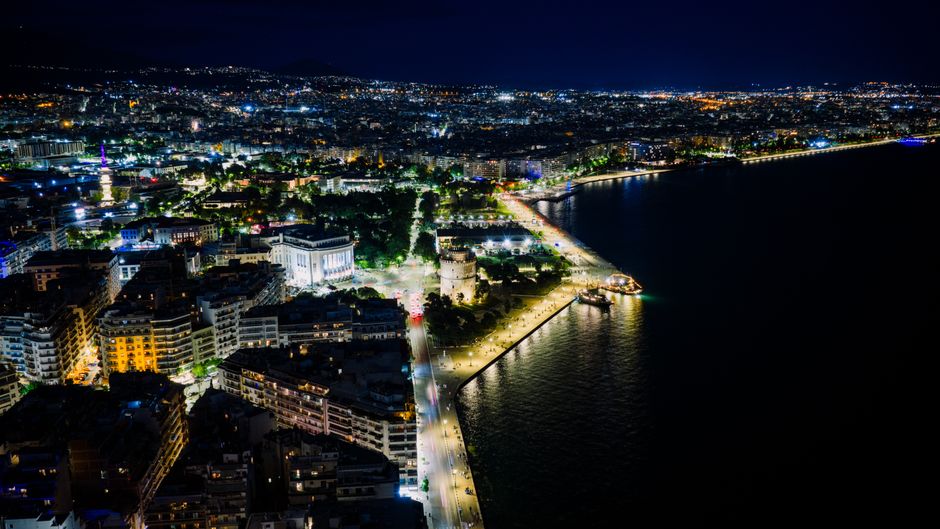
Thessaloniki is Greece’s second city and, many Greeks will tell you, its most fun: a young, open port city on a long bay, with a waterfront promenade made for evening walks, a student crowd that keeps the bars busy until late, and arguably the best food in the country. It has been a crossroads for 2,300 years, and it shows: Roman arches and palaces, some of the finest Byzantine churches anywhere, Ottoman baths and a Jewish heritage that made it the “Jerusalem of the Balkans”. Since late 2024 it also has a driverless metro. You come for the White Tower and the Rotunda, the hillside lanes of Ano Poli, the markets and the meze, and for day trips to the royal tombs of Vergina and the beaches of Halkidiki. Give it two or three days, more with the beaches.
Right now in Thessaloniki
- Wed 13–24°C 56–74°F Partly cloudy
- Thu 15–24°C 58–75°F Clear
- Fri 17–25°C 63–77°F Partly cloudy
Weather: MET Norway (CC BY 4.0) · Sea temperature: NOAA CoastWatch · Air quality: OpenAQ · Rates: ECB
Top tours in Thessaloniki
See all tours for Thessaloniki →
From local operators, with prices and reviews; you check availability and book on Viator, our partner. We may earn a commission at no extra cost to you. How we earn money
Thessaloniki at a glance
- Best for: food lovers, Byzantine and Roman history, city nightlife, and a base for Vergina, Halkidiki and Mount Olympus.
- How long: 2 days for the city, 3–5 with day trips or beach days in Halkidiki.
- Best time: May, June, September and October; summers are hot and humid, winters cool and sometimes windy.
- Getting in: Thessaloniki airport (SKG) is about 15 km from the centre, linked by bus and taxi; trains and KTEL buses arrive from Athens.
- Good value: museums cost far less than in Athens: €8 for the Archaeological Museum and the Museum of Byzantine Culture as of October 2026, and the great churches are free.
- Before you go: entry rules, money and transport around the country are in our Greece travel guide.
Thessaloniki’s neighbourhoods and who each one suits
The centre is a grid of long streets running parallel to the sea, rebuilt after a great fire in 1917, with the old upper town on the hill behind. Most sights are within a 30-minute walk of Aristotelous Square.
Aristotelous Square and the waterfront
The grand square opening onto the sea is the city’s living room, with café terraces and the start of the waterfront promenade (Nea Paralia), which runs about 5 km east past the White Tower and a string of themed gardens. Best for: first visits and evening strolls.
Ladadika and the markets
Ladadika, by the port, is a few blocks of restored warehouses turned into tavernas, ouzeris and bars, busy every night. Inland, the Kapani and Modiano markets sell fish, cheese, olives, spices and sweets, with cheap eateries among the stalls. Best for: food and nights out.
Ano Poli (the Upper Town)
The hillside old town that survived the 1917 fire: steep cobbled lanes, Ottoman-era timber houses, small Byzantine churches, the old city walls and the Heptapyrgion fortress (Yedi Kule) at the top, with sweeping views over the bay to Mount Olympus. Best for: a quiet stay, photographers and sunset.
Kalamaria and the eastern seafront
The residential neighbourhoods east of the centre, now on the metro, with seaside cafés and fish tavernas around Aretsou and Nea Krini. Best for: longer stays and local life.
Top things to see in Thessaloniki
Prices and hours below were checked on the Ministry of Culture’s official site in October 2026. Many state museums in Thessaloniki charge half price from November to March. EU citizens under 25 and under-18s from any country enter state sites free with ID.
The White Tower and the waterfront
The 15th-century Ottoman tower on the seafront is the symbol of the city. Once a fortress and a prison, it now houses a small museum about Thessaloniki’s history, with a rooftop viewpoint over the bay. As of October 2026 the museum ticket costs €6 (€3 from November to March). From the tower, walk east along the seafront to the giant umbrellas sculpture by George Zongolopoulos, one of the best sunset spots in the city.
The Rotunda, the Arch of Galerius and the Palace of Galerius
Around AD 300 the Roman emperor Galerius built a palace quarter here. Its great round building, the Rotunda, has served as a temple or mausoleum, a church with glittering early Christian mosaics, and a mosque, and still has its minaret; the Ministry lists a full ticket at €10 (reduced €5). A short walk downhill, the Arch of Galerius (Kamara), carved with scenes of his victories over the Persians, stands on Egnatia Street and is a popular meeting point; it is free to see. Further down, the excavated remains of the Palace of Galerius are on Navarinou Square.
The Byzantine churches (UNESCO World Heritage)
Fifteen early Christian and Byzantine monuments in Thessaloniki have been a UNESCO World Heritage Site since 1988, spanning a thousand years of church building and mosaics. Don’t miss Agios Dimitrios, the great basilica of the city’s patron saint, with its crypt; Agia Sofia, an 8th-century domed church with a mosaic of the Ascension; the small Panagia Chalkeon in red brick; Osios David in Ano Poli, with a rare early mosaic of Christ; and the 14th-century Agios Nikolaos Orfanos with its frescoes. Working churches are free, but dress modestly and avoid wandering during services. The city’s patron saint’s day, 26 October, brings processions and celebrations.
The Archaeological Museum and the Museum of Byzantine Culture
Two excellent museums sit side by side near the exhibition grounds. The Archaeological Museum covers Macedonia from prehistory to Roman times, with dazzling gold from ancient graves and the bronze Derveni krater. As of October 2026 it costs €8 (€4 for everyone from November to March) and opens daily 8:00–20:00 from mid-April to mid-November, and 9:00–16:00 in winter. The Museum of Byzantine Culture, a prize-winning modern building, tells the story of Byzantine life through icons, mosaics and everyday objects; it also costs €8 (€4 in winter). A €15 three-day combined ticket has covered these museums, the White Tower and the Rotunda, but one museum lists it as temporarily unavailable, so ask at the desk.
Ano Poli, the walls and the Heptapyrgion
Walk or take a bus or taxi up to the Heptapyrgion, a Byzantine and Ottoman fortress that was a prison until 1989, then wander down through Ano Poli past the city walls, the Vlatadon Monastery (with its peacocks and a terrace overlooking the city) and tiny churches. Late afternoon, with the light on the bay, is the best time.
Jewish Thessaloniki and the Ottoman city
For centuries Thessaloniki had one of Europe’s largest Jewish communities, mostly Sephardic Jews expelled from Spain in 1492; almost all were deported and murdered in 1943. The Jewish Museum of Thessaloniki tells their story, and the Monastirioton Synagogue survives. Ottoman landmarks include the Bey Hamam baths, the Hamza Bey mosque and the house where Atatürk was born, now a museum next to the Turkish consulate.
Monuments
- Arch of Galerius and Rotunda
- Basilica of Agios Dimitrios, Thessaloniki
- Church of the Acheiropoietos
- Hagia Sophia, Thessaloniki
Castles and forts
- White Tower of Thessaloniki
Museums
- Archaeological Museum of Thessaloniki
- Yeni Mosque
Eating and drinking in Thessaloniki
Thessaloniki is a UNESCO Creative City of Gastronomy, and food here mixes Greek, Balkan, Anatolian and Sephardic traditions. Start the day with bougatsa, a flaky pastry filled with custard (dusted with sugar and cinnamon) or cheese, or a sesame koulouri. Graze through the Modiano and Kapani markets, then settle into an ouzeri or tsipouradiko, where each round of ouzo or tsipouro comes with small plates of mussels, grilled sardines, peppers and cheese. Try soutzoukakia (spiced meatballs in tomato sauce), Pontic and Asia Minor dishes, and for dessert the cream-filled cones called trigona Panoramatos and syrupy pastries from the old sweet shops. Drink a freddo cappuccino by the sea, and wines from nearby Naoussa (Xinomavro) and Epanomi. See our wine-tasting guide.
Day trips from Thessaloniki
Vergina: the royal tombs of Aigai
About 75 km south-west, Vergina is the site of Aigai, the first capital of ancient Macedonia and a UNESCO World Heritage Site. Under a great earth mound, an atmospheric underground museum displays the royal tombs, including the one believed to belong to Philip II, father of Alexander the Great, with his gold casket and armour. As of October 2026 a €20 ticket covers the whole site: the central museum, the royal tombs, the burial ground, the ancient theatre, the restored Palace of Aigai and a Byzantine church nearby. From April to October it opens 8:00–20:00 (Tuesday from 12:00), with shorter hours in September and October; from November to March it opens 9:00–17:00 and closes on Tuesdays. Go by car (about an hour), on a tour, or by KTEL bus to Veria and local bus or taxi from there.
Halkidiki’s beaches
The three-fingered peninsula south-east of the city has some of the best beaches in northern Greece, with pine woods running down to turquoise water. Kassandra, the nearest finger (about an hour by car), is lively and resort-like; Sithonia, further on, is wilder, with coves such as Kavourotrypes and Kalamitsi. The third finger is Mount Athos, a monastic republic that only men with a special permit may visit, though boat trips along its coast from Ouranoupoli are open to all. KTEL Halkidiki buses run from the city. See our beaches guide and boat trips guide.
Mount Olympus, Pella and Edessa
Mount Olympus, home of the gods and Greece’s highest mountain (2,918 m), rises above the village of Litochoro, about 1¼ hours south by car or train. The Enipeas gorge trail is a lovely day hike; the summit needs two days and a night in a mountain refuge. Pella, the birthplace of Alexander the Great, has fine floor mosaics, and Edessa has waterfalls in the middle of town. See our hiking guide.
Further afield
Meteora is about 2½–3 hours by car, best with a night in Kalambaka. Athens is about an hour by plane or several hours by train or bus.
Activities and best months
- City sightseeingFifteen Early Christian and Byzantine monuments are a UNESCO World Heritage Site: the 4th-century Rotunda, the church of St Demetrius with its crypt, the Acheiropoietos, Hagia Sophia, Latomou Monastery and Vlatadon Monastery in Ano Poli, and the Byzantine bath. · source
Getting to Thessaloniki
By air. Thessaloniki “Makedonia” airport (SKG) has flights from Athens (about 50 minutes) and many European cities. OASTH airport buses (01X by day, 01N by night) run to the centre and the KTEL terminal for a flat fare reported at €2, in about 40–50 minutes. Since the metro extension opened, the X3 bus also links the airport with Mikra metro station. Taxis to the centre take about 25 minutes and charge a fixed fare, reported at €25 by day; in September 2026 the government announced a rise to €28 by day and €38 at night.
By train. Hellenic Train runs between Athens and Thessaloniki’s New Railway Station, normally in about 4½ hours; upgrade works on the line have meant longer journeys and some replacement buses, so check the timetable and live updates before you book. Trains also run north to Skopje and Sofia on some days.
By bus. KTEL Macedonia’s terminal west of the centre has buses to Athens (about 6 hours), Halkidiki, Kalambaka and most of northern Greece.
Getting around Thessaloniki: the metro and buses
After decades of delays (works kept uncovering Roman and Byzantine remains, some now displayed in the stations), Thessaloniki’s driverless metro opened on 30 November 2024, running under the centre from the New Railway Station through Venizelou, Agia Sofia and the university to Nea Elvetia in the east. On 27 August 2026 a branch to Kalamaria added five stations (Nomarchia, Kalamaria, Aretsou, Nea Krini and Mikra), bringing the network to 18 stations. Trains run from 5:15 to 00:30, and until 2:00 on Friday and Saturday nights.
- Metro fares (as of October 2026): a single journey costs €0.60 (reduced €0.30), a 24-hour ticket €2.50 and a bundle of 10+1 tickets €5.80. Children under 6 travel free.
- Buses: OASTH city buses cover the rest of the city, including Ano Poli; buy tickets from machines, kiosks or on board and validate them.
- Walking and cycling: the centre and the waterfront are flat and easy on foot, with a cycle path along the seafront. Ano Poli is steep; take a bus or taxi up and walk down.
- Taxis: plentiful and inexpensive within the city. See our city sightseeing guide for walking tours.
When to go and how long to stay
Thessaloniki has a climate between Mediterranean and continental: hot, often humid summers, cool winters with occasional frost and the cold Vardar wind blowing down from the north, and pleasant springs and autumns. The table uses the 1991–2020 normals of the Aristotle University of Thessaloniki’s station in the city.
| Season | Average high / low | Rain per month | What it’s like |
|---|---|---|---|
| Spring (Mar–May) | 16–25 °C / 7–15 °C | about 40–50 mm | Mild to warm; good for walking and day trips |
| Summer (Jun–Aug) | 30–32 °C / 19–22 °C | about 25–30 mm | Hot and humid; head for Halkidiki’s beaches |
| Autumn (Sep–Nov) | 28 °C falling to 17 °C / 18 °C falling to 9 °C | about 40 mm | Warm September, festivals and the film festival in November |
| Winter (Dec–Feb) | 11–12 °C / 3–5 °C | about 35–50 mm | Cool, sometimes windy and grey; lively city life |
September brings the Thessaloniki International Fair, when hotels fill, and November the Thessaloniki International Film Festival. The feast of Agios Dimitrios on 26 October is the city’s big day. In July and August, many locals spend weekends in Halkidiki.
Thessaloniki in 2 days
Day 1: the White Tower and the waterfront, the Archaeological Museum, then the Rotunda and the Arch of Galerius; dinner in Ladadika. Day 2: breakfast bougatsa, Agios Dimitrios and Agia Sofia, the Modiano and Kapani markets for lunch, the Museum of Byzantine Culture, then up to Ano Poli and the Heptapyrgion for sunset.
Thessaloniki in 4 days
Add a day at Vergina (with Pella on the way back) and a beach day in Kassandra or Sithonia, or a hike in the Enipeas gorge on Mount Olympus.
Weather month by month
Averages from HNMS normals 1991–2020, Thessaloniki (airport) (rain: 1959–2010 averages) · Last reviewed 4 Oct 2026
Where to stay in Thessaloniki
- Around Aristotelous Square: central, near the sea, the markets and the metro.
- Ladadika: lively at night, close to the port and the railway station.
- Near the White Tower: for sea views and the museums.
- Ano Poli: guesthouses with views and quiet nights, but a steep walk home.
Hotel prices are well below Athens and the islands, except during the September fair and big conferences. Every stay pays Greece’s climate resilience fee per room per night (see our Greece guide).
Practical tips for Thessaloniki
- Use the metro: at €0.60 a ride it is the cheapest way across the centre and out to Kalamaria.
- Churches: cover shoulders and knees and avoid sightseeing during services.
- Winter discounts: state museums are half price from November to March, and free on the first and third Sundays of those months.
- Eat late, eat shared: order several plates for the table and let the waiter suggest the day’s fish.
- Check train status: before travelling to Athens or Kalambaka by rail, look at Hellenic Train’s live updates.
What to pack for Thessaloniki
Comfortable walking shoes for the long seafront and the steep lanes of Ano Poli, light clothes and sunscreen for humid summers, a swimsuit for Halkidiki, a scarf or light layer for churches, and a warm, windproof jacket from November to March.
What to pack
- City walking shoesLisbon and Porto are steep, with polished limestone cobbles that get slippery, so grippy soles matter.
- Day packs and anti-theft bagsA small zipped or anti-theft bag makes crowded trams and viewpoints less stressful.
- Rain jacketsFrom October to April Porto and Lisbon see rain on roughly a third of days.
- Travel adapters and convertersPortugal uses Type C and F sockets at 230 V, so most visitors from outside Europe need an adapter.
Thessaloniki travel FAQ
Is Thessaloniki worth visiting?
Yes, especially for food, Byzantine history and city life. It is cheaper and less touristy than Athens, and the beaches of Halkidiki and the tombs of Vergina are within easy reach.
When did the Thessaloniki metro open?
The main line opened on 30 November 2024, and the Kalamaria branch on 27 August 2026, giving 18 stations. A single ride costs €0.60 and a 24-hour ticket €2.50 as of October 2026.
How do I get from Thessaloniki airport to the city?
By OASTH bus 01X (01N at night) to the centre in about 40–50 minutes for about €2, by the X3 bus to Mikra metro station, or by taxi in about 25 minutes at a fixed fare (about €25–28 by day).
Which Byzantine churches should I see in Thessaloniki?
Agios Dimitrios with its crypt, Agia Sofia, the Rotunda’s mosaics, Osios David in Ano Poli and Agios Nikolaos Orfanos. They are part of a UNESCO World Heritage Site, and the working churches are free.
How much does the White Tower cost?
As of October 2026, the White Tower museum costs €6, or €3 from November to March. A €15 three-day combined ticket has also included it with the main museums and the Rotunda.
How do I get to Vergina from Thessaloniki?
About an hour by car, on an organised tour, or by KTEL bus to Veria and a local bus or taxi from there. The €20 ticket covers the whole site, including the royal tombs and the Palace of Aigai.
Can I visit Halkidiki as a day trip?
Yes. Kassandra’s beaches are about an hour away by car or KTEL bus. Sithonia is further and better with a night or two.
What should I eat in Thessaloniki?
Bougatsa for breakfast, meze with ouzo or tsipouro in Ladadika or the markets, soutzoukakia, fresh mussels from the bay, and trigona Panoramatos for dessert.
How many days do you need in Thessaloniki?
Two days for the city’s main sights and food, three or four with Vergina, Halkidiki or Mount Olympus.
How do I get from Athens to Thessaloniki?
By plane in about 50 minutes, by train in about 4½ hours when the line runs normally, or by KTEL bus in about 6 hours. Check Hellenic Train’s updates, as works have affected the line.
Nearby destinations
Sources
- © OpenStreetMap contributors · ODbL · fetched 4 Oct 2026
- Wikidata · CC0 · fetched 4 Oct 2026
Sources and last review
Researched and last reviewed on 4 October 2026. Museum and site prices and hours (White Tower, Archaeological Museum, Museum of Byzantine Culture, Aigai): the Ministry of Culture (odysseus.culture.gr); metro fares: Thessaloniki Metro (thessmetro.gr); Kalamaria extension, hours and the X3 bus: GTP travel news; climate: Aristotle University of Thessaloniki 1991–2020 normals. The Rotunda price, airport bus fare and taxi fares come from secondary sources and are flagged for checking. Prices, timetables and rules change, so check the official links before you go. For entry rules, money and ferries, see our Greece travel guide.
Plan your trip
Partner links: TravelerCenter may earn a commission if you book, at no extra cost to you.
🇬🇷 Useful Greek phrases for Thessaloniki
All 38 Greek phrases: restaurant, hotel, emergencies, romance (printable) →