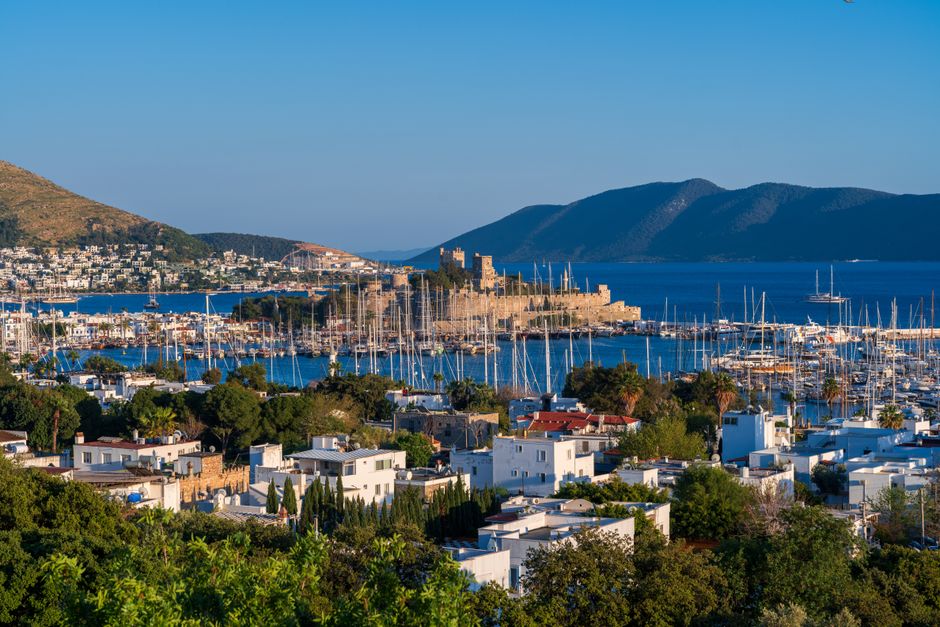
Bodrum is the most stylish resort on the Turkish Aegean: a white town of cube houses and bougainvillea wrapped around two bays, with a crusader castle on the rock between them. It stands on the site of ancient Halicarnassus, home of the Mausoleum, one of the Seven Wonders of the World, and birthplace of the historian Herodotus. The castle now holds the Museum of Underwater Archaeology, with shipwrecks more than 3,000 years old. Around the town, the Bodrum peninsula is ringed by villages and bays that each have their own character, from the fish restaurants of Gümüşlük and the superyachts of Yalıkavak to the beach clubs of Türkbükü. Greek Kos is less than an hour away by boat. The best months are May, June, September and October. Give it four days to a week.
Right now in Bodrum
- Wed 19–25°C 65–77°F Partly cloudy
- Thu 17–23°C 62–74°F Mostly clear
- Fri 18–25°C 64–76°F Clear
Weather: MET Norway (CC BY 4.0) · Sea temperature: NOAA CoastWatch · Rates: ECB
Top tours in Bodrum
See all tours for Bodrum →
From local operators, with prices and reviews; you check availability and book on Viator, our partner. We may earn a commission at no extra cost to you. How we earn money
Bodrum at a glance
- Best months: May–June and September–October. Average highs run from about 27 °C in May to 35 °C in July and August, and it hardly rains from June to September (WMO 1991–2020 normals, Bodrum station). The sea is warmest, around 24–25 °C or more, from July to September.
- Days needed: 2 for the town, the castle and museum and the Mausoleum; 4–7 to explore the peninsula’s bays, take a boat trip and a day trip to Kos.
- Getting there: fly into Milas-Bodrum airport (BJV), about 45 minutes away by Havaş shuttle; or take a ferry from Kos and other Greek islands.
- Getting around: dolmuş minibuses link Bodrum bus station with every village on the peninsula; water taxis and boats cross the bays.
- Budget level: one of the most expensive places in Türkiye, especially at the Yalıkavak and Türkbükü beach clubs; Bodrum town, Bitez and Turgutreis are more affordable. See our Türkiye guide for money, visas and costs.
Bodrum’s areas and who each one suits
- Bodrum town: the castle, the marina, the bazaar and the bar street along the east bay. For first-timers, culture, nightlife and anyone without a car.
- Gümbet: the next bay west, with a sandy beach and a party scene aimed at young holidaymakers.
- Bitez and Ortakent: relaxed bays with sandy beaches, mandarin groves, windsurfing and family hotels.
- Turgutreis and Akyarlar: the west tip, with long beaches, sunsets, a big Saturday market, a marina with boats to the Greek islands, and kitesurfing at Akyarlar.
- Gümüşlük: a low-rise fishing village on the site of ancient Myndos, with fish restaurants on the water and Rabbit Island just offshore. For couples and food lovers.
- Yalıkavak, Türkbükü, Gölköy and Torba: the north coast, with a luxury marina, wooden-pier beach clubs, five-star hotels and the peninsula’s high-end scene.
Top things to see in Bodrum
Türkiye’s state museums and ancient sites charge foreign visitors in euros; Turkish citizens pay in lira and can use the MüzeKart. Prices below are the 2026 rates as of October 2026. The Ministry of Culture and Tourism has already announced higher prices for 2027 (the castle museum rises to €22), so check muze.gov.tr before you go.
Bodrum Castle and the Museum of Underwater Archaeology
The Castle of St Peter was built by the Knights Hospitaller of Rhodes from the early 15th century, partly with stone and sculpture taken from the ruined Mausoleum; its English, French, German and Italian towers were each paid for by a “tongue” of the order, and coats of arms still cover the walls. The Ottomans took it in 1522 and turned the chapel into a mosque. Today it houses the Museum of Underwater Archaeology, the only one of its kind in Türkiye, with finds from the 16th century BC to the 16th century AD. Its highlights are the Uluburun wreck, a Late Bronze Age merchant ship from the 14th century BC with its cargo of copper and tin ingots, glass and gold; the Glass Wreck from Serçe Limanı, an 11th-century ship with tonnes of Islamic glass; the hall of the Carian Princess, with the gold jewellery of a 4th-century BC noblewoman; and one of the world’s largest collections of amphorae.
The ticket for the castle and museum is €20 for foreign visitors in 2026. From 1 October the castle is open daily 08:30–17:30, with the ticket office closing at 17:00; in summer it stays open until about 18:45, with an evening opening from 19:00 to 22:00. Allow at least two to three hours, and climb the towers for the view over both bays.
The Mausoleum at Halicarnassus
The tomb of Mausolus, a 4th-century BC ruler of Caria, was so magnificent that it gave us the word “mausoleum” and was counted among the Seven Wonders of the ancient world. Earthquakes brought it down, and the Knights used its stones for their castle, so today you see foundations, fallen column drums, the burial chamber passages and a model of how it may have looked; many of its best sculptures are in the British Museum in London. The site is small and quiet, a short walk from the harbour, and the entry fee is a few euros (about €3 in 2026). Check opening days before you go; it has been closed on Mondays.
The ancient theatre, Myndos Gate and the windmills
On the hillside above town, the restored ancient theatre of Halicarnassus looks down over the castle and the bay, a good stop at the end of the day; it is free to visit. At the western end of town, the Myndos Gate is the best-preserved part of the city walls Mausolus built, with a moat in front, where Alexander the Great’s army attacked in 334 BC; it is open-air and free. On the ridge between Bodrum and Gümbet, a row of old stone windmills makes a lovely sunset walk.
Bodrum town, the marina and the bar street
The town is made for wandering: through the covered bazaar behind the castle, along the waterfront of the west bay to the marina, full of gulets and yachts, and up the narrow lanes of whitewashed houses. On the east bay, Cumhuriyet Caddesi, the “bar street”, runs along the beach with bars and clubs that stay open until the early morning in summer. Halikarnas, an open-air club at its end, has been a Bodrum landmark for decades.
Castles and forts
- Bodrum Castle
Other sights
- Mausoleum at Halicarnassus
Archaeological sites
- Ancient Theatre of Halicarnassus
- Myndos Gate
- Pedasa
Beaches and bays on the Bodrum peninsula
Bodrum district has more Blue Flag beaches than almost anywhere in Türkiye: 92 of Muğla province’s 113-plus in 2026, according to Turkish press reports of the TÜRÇEV list, including Türkbükü public beach for the first time. Many bays have narrow sand beaches with wooden piers over the water, run by hotels and beach clubs; public beaches are free. For more ideas, see our beach guide.
| Beach or bay | Area | Type | Good for |
|---|---|---|---|
| Bitez | South coast, 6 km west | Sandy, shallow bay | Families, windsurfing, calm water |
| Ortakent (Yahşi) | South coast | One of the longest sandy beaches | Families, space |
| Gümüşlük | West coast | Sand and pebbles by the fish restaurants | Sunsets, wading to Rabbit Island |
| Camel Beach (Kargı) | South coast | Sandy bay | Families, a quiet swim |
| Türkbükü and Gölköy | North coast | Wooden piers and beach clubs | Style, people-watching, calm water |
| Akyarlar | South-west tip | Small sandy beach, windy | Kitesurfing and windsurfing |
Beach clubs charge for a sunbed and umbrella by the day, and prices vary hugely. In 2026, Turkish press reported about 800–3,000 TL a day at Yalıkavak clubs and up to 2,500–5,000 TL at the top Türkbükü clubs, often with a minimum spend per person on food and drink, and more at weekends and events. Ask before you sit down. The north coast is calmer in the summer wind; the south coast bays are sandier and warmer.
Wildfire season and water
Fire-season rules (as of October 2026)
The hills of the Bodrum peninsula are covered in dry scrub and pine, and Muğla province has fires most summers. In June 2025, a fire near Marmaris burned about 4,500 hectares, and a small fire near Güvercinlik, by Bodrum’s airport road, burned about 5 hectares in September 2025 before being contained. The Muğla Governorate’s 2026 order sets the rules:
- Forest entry ban: entering 50 designated forest areas across Muğla province, including in Bodrum district, is banned from 1 June to 31 October 2026.
- No picnics, camping or fires in the banned areas; never light barbecues or campfires in the countryside or throw cigarette ends from cars and boats.
- Penalties: fines for breaking the ban, and prosecution and prison for starting a fire.
- If you see smoke or fire: call 112.
Water shortages
Bodrum’s population swells many times over in summer, and after a dry year its reservoirs ran low: in September 2025 the water utility announced rotating cuts across the district. Hotels have their own tanks, but in rented villas and flats keep showers short, and do your part by reusing towels.
Activities and best months
- Beaches and swimmingGoTürkiye's Bodrum page invites you to swim in the turquoise sea of Bodrum's bays; the Aegean Blue Voyage route stops at Cennet Cove, a Blue Flag beach. · source
- Boat tripsBodrum is a stop on GoTürkiye's 7-day Aegean Blue Voyage by yacht or boat, anchoring in Cennet Cove before sailing on to the Gulf of Gökova. · source
- Scuba divingWreck diving among ancient shipwrecks, with local dive agencies renting equipment and running beginner courses; the Underwater Archaeology Museum in Bodrum Castle shows finds from the Uluburun and Serçe Limanı wrecks. · source
Other things to do in Bodrum
Boat trips and gulets
Day boats leave Bodrum harbour every morning in season for the bays and islands south of the peninsula, such as Karaada with its warm spring cave, Aquarium Bay and Kargı, with three or four swimming stops and lunch on board. Private gulets can be chartered for the day or for a week-long Blue Cruise along the Gulf of Gökova. See our boat trips guide.
Diving, sailing and water sports
The waters around Bodrum, where underwater archaeology began, have reefs, caves and wrecks for divers; choose a centre authorised by the Turkish Underwater Sports Federation (TSSF). Bitez and Akyarlar are known for windsurfing and kitesurfing. See our diving guide and snorkeling guide.
Food and markets
Bodrum is known for its Aegean cooking: wild greens with olive oil, octopus, sea bass, çökertme kebabı (meat on fried potatoes with yoghurt) and Bodrum mandarins. Eat fish at the water’s edge in Gümüşlük, and visit a weekly market, such as the big one in Turgutreis on Saturdays, for fruit, cheese and textiles.
A day trip to Kos
The Greek island of Kos lies just across the strait, and its harbour town has the ruins of the ancient agora, the Castle of the Knights, the plane tree of Hippocrates and, a short ride away, the Asklepion, the healing sanctuary of the father of medicine. Rent a bike, swim at Lambi or Tigaki and have dinner in the old town before the evening boat back.
- Ferries: fast boats and ferries run from Bodrum harbour and from Turgutreis, taking about 20–35 minutes by fast catamaran and up to an hour by conventional boat. There are dozens of crossings a week from June to September and only a few a week in winter. In 2026, one-way fares were mostly in the €17–40 range and returns €20–75, depending on the operator and the ticket type; port taxes may be extra. Book a day or two ahead in summer.
- Documents: you leave Türkiye and enter Greece and the Schengen area. Bring a valid passport (EU citizens can use a national ID card) and a Schengen visa if your nationality needs one. Turkish citizens can use Greece’s express visa for the eastern Aegean islands, including Kos, extended to April 2027.
- Schengen entry: the EU’s Entry/Exit System (EES) has been fully in use at all Schengen external borders since 10 April 2026. Non-EU visitors register fingerprints and a facial image on their first entry, instead of a passport stamp, so allow extra time at Kos port. ETIAS, the EU’s travel authorisation, is not yet required, and its launch now looks likely in 2027.
- Other islands: in July and August there are direct boats to Kalymnos; the rest of the year, change at Kos. A car ferry also crosses the Gulf of Gökova from Bodrum to Körmen near Datça in about 1¾ hours (875 TL per foot passenger after a July 2026 fare rise).
Other day trips: the ancient cities of Ephesus near Selçuk (about 2½ hours north), Didyma and Miletus, and the white terraces of Pamukkale (better with a night). For more Greek islands, see our guide to Rhodes, reached from Marmaris.
Nearby destinations
Getting there and getting around
Milas-Bodrum airport (BJV)
Milas-Bodrum airport, about 35 km north-east of Bodrum, has direct flights from much of Europe in summer and from Istanbul and Ankara all year. The Havaş shuttle runs to Bodrum bus station via Güvercinlik and Torba for 270 TL, in about 45 minutes, timed to domestic arrivals (international passengers walk to the domestic terminal). Back to the airport, buses leave Bodrum at 07:00, 07:45, 08:50, 09:30, 11:40, 12:50, 14:30, 15:15, 17:30, 18:15 and 19:15. There is no Havaş bus to Turgutreis or Yalıkavak: change to a dolmuş at the bus station, or take a taxi or pre-booked transfer.
Dolmuş, cars and water taxis
- Dolmuş: minibuses leave Bodrum bus station for every village on the peninsula, often every 10–20 minutes in summer. Pay in lira.
- Hire car: useful to explore the bays, but summer traffic on the peninsula’s roads and parking in Bodrum town and Yalıkavak are hard.
- Water taxis: link the bays of the north coast and the beaches near Bodrum town.
- Coaches: from Bodrum bus station to İzmir, Selçuk, Marmaris and Istanbul. See our city sightseeing guide for walking the town.
When to go and how long to stay
Bodrum has a hot, dry Aegean summer, cooled by the north wind, and a mild, rainy winter. July and August are hot, busy and expensive, with the beach clubs and nightlife at their peak. May, June, September and October are calmer and better value, with warm water from June. In winter, many hotels and clubs close, but Bodrum town stays open all year.
| Season | Average high / low | Sea temperature | What it’s like |
|---|---|---|---|
| Spring (Mar–May) | 18–27 °C / 10–17 °C | 14–19 °C or more | Green and fresh; good for sightseeing; the sea is cool until June. |
| Summer (Jun–Aug) | 32–35 °C / 22–24 °C | 22–25 °C or more | Hot, sunny and windy; peak season for beaches, boats and nightlife. |
| Autumn (Sep–Nov) | 21–31 °C / 13–21 °C | 18–23 °C or more | Warm sea and fewer crowds in September and October; rain returns in November. |
| Winter (Dec–Feb) | 16–17 °C / 9–10 °C | 13–16 °C | Mild and rainy at times; quiet, with many resort hotels closed. |
Air temperatures are the WMO 1991–2020 climate normals for the Bodrum station, supplied by Türkiye’s State Meteorological Service (MGM); Bodrum gets about 700 mm of rain a year on about 60 rainy days, almost all from November to March. Sea temperatures are MGM’s long-term (1970–2025) averages for the whole Turkish Aegean, including its cooler north; the sea around Bodrum, in the south, is usually a little warmer.
3 days in Bodrum
Day one: the castle and Museum of Underwater Archaeology, the Mausoleum, and sunset at the theatre or the windmills. Day two: a boat trip around the bays. Day three: a dolmuş to Gümüşlük for a swim, Rabbit Island and a fish dinner at sunset.
5–7 days in Bodrum
Add a day trip to Kos, a beach day at Bitez or Ortakent, an afternoon at Yalıkavak marina and a beach club on the north coast, and a day to Ephesus or Didyma. With more time, take the car ferry to Datça and continue to Marmaris, or go north to İzmir.
Where to stay in Bodrum
- Without a car: Bodrum town, close to the castle, the bus station and the boats.
- Families: Bitez, Ortakent or Turgutreis, with sandy, shallow beaches.
- Romance: a boutique hotel in Gümüşlük or a quiet bay on the north coast.
- Luxury: Yalıkavak, Türkbükü or Torba.
- Nightlife: Bodrum town or Gümbet.
Türkiye adds a 2% accommodation tax to room prices, normally already included in the rate shown.
Practical tips for Bodrum
- Money: the currency is the Turkish lira, about 55 TL to the euro and 49 TL to the US dollar in early October 2026. Museums charge foreigners in euros; most other prices are in lira, though top hotels and clubs may quote euros. Pay by card in lira and refuse charges in your home currency.
- Beach clubs: ask about the sunbed price and any minimum spend before you sit down.
- Traffic: in July and August, the peninsula’s roads jam in the evening; plan sunset trips early or take a dolmuş.
- Kos day trip: carry your passport and allow time for the EES border check on the Greek side.
- Fire risk: respect forest closures and never light a fire outdoors in summer.
- Emergencies: call 112.
Weather month by month
Averages from MGM normals 1991–2020, Bodrum · Last reviewed 4 Oct 2026
What to pack for Bodrum
Pack light linen clothes, a sun hat, sunglasses, high-factor reef-safe sunscreen and a refillable bottle. Bring sandals and comfortable walking shoes for the castle’s stairs and the cobbled lanes, water shoes for rocky bays, and a snorkel mask for boat trips. Bodrum dresses up in the evening, so pack something smart for the marina and the clubs. A light jacket helps on windy evenings and boats, and a rain jacket from November to March.
What to pack
- Day packs and anti-theft bagsCarries water, towel and sunscreen down the long stairways to Algarve coves.
- Dry bags and phone pouchesProtects phones and cameras from sand and spray on beaches reached by ferry or steep paths.
- Fleeces and warm layersIt is cooler at sea than on land, especially on morning whale-watching trips.
- Quick-dry beach towelsA sand-shedding quick-dry towel packs small for beach days and lido visits.
- Rain jacketsA windproof, waterproof shell keeps you warm on open boats, where wind and spray cool you quickly.
- Reef-friendly sunscreenSummer UV is strong on Portuguese beaches and there is little shade below the cliffs.
- Water shoesRocky coves, lava pools and weever fish in shallow sand make water shoes useful.
- WetsuitsOn the west and north coasts the sea stays around 16–18 °C even in summer, so a thin suit helps for long swims.
Bodrum travel FAQ
How many days do you need in Bodrum?
Three days covers the castle, the Mausoleum, a boat trip and Gümüşlük. Five to seven days lets you add Kos, more bays and Ephesus.
How much is the ticket for Bodrum Castle?
€20 for foreign visitors in 2026, covering the castle and the Museum of Underwater Archaeology; it rises to €22 in 2027. From October it is open daily 08:30–17:30.
Is the Mausoleum at Halicarnassus worth visiting?
Yes, if you like history: little of the Wonder is left standing, but the foundations, the fallen columns and the model give a sense of its size, and it costs only a few euros.
How long is the ferry from Bodrum to Kos?
About 20–35 minutes by fast catamaran and up to an hour by conventional boat, from Bodrum harbour or Turgutreis. Sailings are frequent from June to September and few in winter.
What documents do I need to go to Kos?
A valid passport (or an EU national ID card), and a Schengen visa if your nationality needs one. Non-EU visitors are registered in the EU’s Entry/Exit System on arrival. ETIAS is not yet required.
How do I get from Bodrum airport to the town?
Take the Havaş shuttle to Bodrum bus station (270 TL, about 45 minutes), then a dolmuş or taxi to your village; or book a transfer.
What are the best beaches in Bodrum?
Bitez and Ortakent for sandy family beaches, Gümüşlük for sunset swims, Türkbükü and Gölköy for beach clubs, and Akyarlar for kitesurfing.
Is Bodrum expensive?
It can be: Yalıkavak and Türkbükü are among the priciest places in Türkiye, with beach-club sunbeds reaching thousands of lira a day in 2026. Bodrum town, Bitez and Turgutreis are much cheaper.
How warm is the sea in Bodrum?
Around 24–25 °C or a little more in July, August and September, and about 21 °C in October, by MGM’s long-term Aegean averages; the southern Aegean around Bodrum is usually a bit warmer.
When is the best time to visit Bodrum?
June and September give you warm sea, a lively town and fewer crowds than July and August; May and October are best for sightseeing and value.
Sources
- © OpenStreetMap contributors · ODbL · fetched 4 Oct 2026
- Wikidata · CC0 · fetched 4 Oct 2026
Sources and last review
Researched and last reviewed on 4 October 2026. Castle hours and museum contents come from Türkiye’s official museum site (muze.gov.tr); ticket prices from the Ministry of Culture and Tourism’s 2026 and 2027 tariffs as published by Turkish sources; Schengen border rules from the European Commission; airport bus fares and times from Havaş; Blue Flag numbers, beach-club prices, ferry fares and the 2025 water cuts from Turkish press and ferry booking sites; forest-fire rules from the Muğla Governorate’s 2026 order; climate from the WMO 1991–2020 normals (MGM data) and sea temperatures from MGM. Ferry times and fares change by season, so check the operators and the official sites before you travel.
Plan your trip
Partner links: TravelerCenter may earn a commission if you book, at no extra cost to you.
🇹🇷 Useful Turkish phrases for Bodrum
All 38 Turkish phrases: restaurant, hotel, emergencies, romance (printable) →