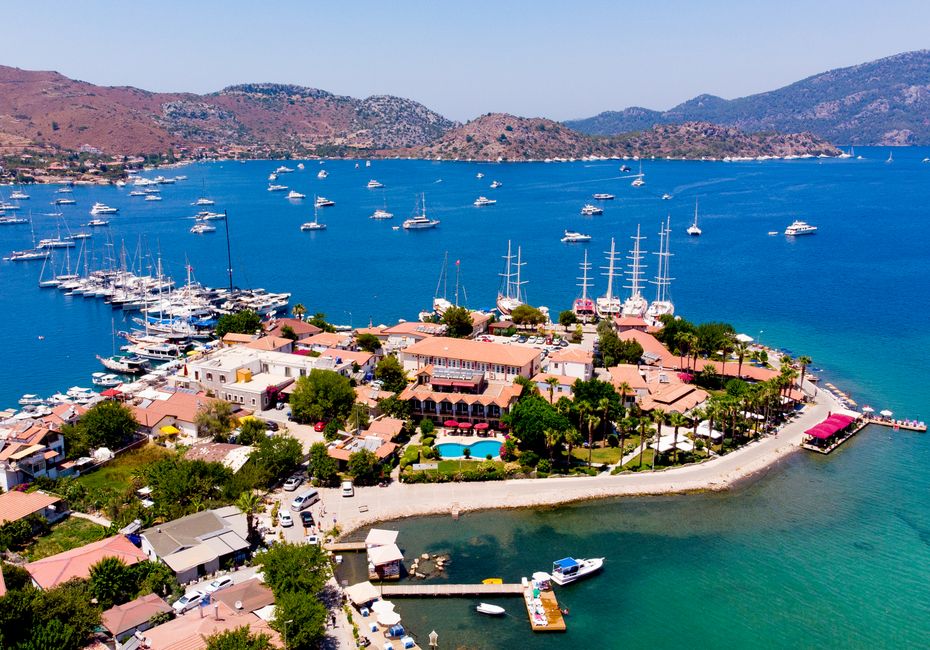
Marmaris is a busy resort and yachting town in south-west Türkiye, set on a deep, almost enclosed bay ringed by pine-covered mountains, where the Aegean meets the Mediterranean. Its harbour is one of the main bases for the Blue Cruise, the week-long gulet voyages along the coves of the Bozburun and Datça peninsulas, and fast boats cross to Greek Rhodes in about an hour. The town itself has a small castle above a lively marina, a long seafront promenade and a famous bar street; quieter resorts such as İçmeler and Turunç lie around the bay. Within easy reach are the river delta of Dalyan, with its rock-cut royal tombs, mud baths and the turtle beach of İztuzu, and the remote villages of the peninsulas. The best months are May, June, September and October. Give it four days to a week.
Right now in Marmaris
- Wed 15–26°C 58–79°F Partly cloudy
- Thu 14–25°C 58–78°F Mostly clear
- Fri 14–26°C 58–79°F Clear
Weather: MET Norway (CC BY 4.0) · Sea temperature: NOAA CoastWatch · Rates: ECB
Top tours in Marmaris
See all tours for Marmaris →
From local operators, with prices and reviews; you check availability and book on Viator, our partner. We may earn a commission at no extra cost to you. How we earn money
Marmaris at a glance
- Best months: May–June and September–October. Average highs run from about 26 °C in May to 35 °C in July and August, and it hardly rains from June to September (WMO 1991–2020 normals, Marmaris station); winters are wet.
- Days needed: 2 for the town, a boat trip and a beach; 4–7 to add Dalyan, a day in Rhodes and the Bozburun or Datça peninsulas; a week or more for a Blue Cruise.
- Getting there: fly into Dalaman (DLM), about 90 minutes away by Havaş shuttle, or take the ferry from Rhodes.
- Getting around: dolmuş minibuses and water taxis link the bay’s resorts; a car or tour is best for Dalyan and the peninsulas.
- Budget level: mid-range, with plenty of package hotels; Blue Cruises and the peninsula boutique hotels cost more. See our Türkiye guide for money, visas and costs.
Marmaris’s areas and who each one suits
- Marmaris town: the old quarter under the castle, the marina, the bazaar and the bar street. For nightlife, boats and anyone without a car.
- The seafront (Siteler and Uzunyalı): a long strip of hotels along the beach and promenade north-east of town. For families and package holidays, with everything in walking distance.
- İçmeler: a calmer resort on its own sandy bay, 8 km south-west, with a promenade to Marmaris. For families and couples.
- Turunç: a small, quiet bay across the water, reachable by a winding road or water taxi. For peace and swimming.
- Bozburun peninsula (Selimiye, Söğüt, Bozburun): fishing villages and boutique hotels on remote bays. For couples, food lovers and sailors; a car is essential.
Top things to see in Marmaris
Türkiye’s state museums and ancient sites charge foreign visitors in euros; Turkish citizens pay in lira and can use the MüzeKart. Prices below are the 2026 rates as of October 2026. The Ministry of Culture and Tourism has already announced higher prices for 2027, so check muze.gov.tr before you go.
Marmaris Castle and Museum
The small castle on the hill above the marina was rebuilt by Sultan Süleyman the Magnificent in the 1520s, when he gathered his fleet here to besiege Rhodes. Inside, a garden courtyard, a few rooms of archaeological and ethnographic finds and the ramparts give fine views over the marina and the bay. It is open daily 08:30–18:45, with evening openings in summer; the ticket is about €13 for foreign visitors. Around it, the lanes of the old town are lined with whitewashed houses, small bars and restaurants.
Dalyan: the Kaunos tombs and the river
Dalyan, about 1½ hours east of Marmaris, is a river town in a delta of reeds and lakes, part of the Köyceğiz-Dalyan Special Environmental Protection Area. Its most famous sight is a row of temple-fronted rock tombs cut into the cliff above the river in the 4th century BC for the kings of Kaunos, best seen from the river boats. Across the river, the ruins of Kaunos, a Carian and Lycian port city now stranded inland, have a theatre, baths and a temple terrace among olive trees (about €3; summer hours 08:30–19:00; bring cash in case card payment is down). River boats from Dalyan’s quay are the easiest way around, combining the tombs, Kaunos, the mud baths and İztuzu beach.
Mud baths and hot springs
On the shore of Lake Köyceğiz, the boats stop at sulphur mud pools, where visitors cover themselves in warm mud, let it dry in the sun and rinse off in the hot spring water. The Sultaniye hot springs, run by the Köyceğiz municipality, have pools of water at about 39 °C, indoor and outdoor, open all year, with a small entry fee in lira. The healing claims are traditional, not medical; people with heart conditions or high blood pressure should be careful in the hot water.
İztuzu, the turtle beach: rules
İztuzu is a 4.5 km sand spit between the Dalyan delta and the sea, and one of the most important nesting beaches in the Mediterranean for loggerhead turtles (Caretta caretta); green turtles also nest here. It is a protected area where people use the beach by day and turtles by night. Reach it by river boat from Dalyan, or by road (in 2026, a car paid about 300 TL to park; entry on foot was free, and a pair of sunbeds with an umbrella cost about 500 TL).
- Closed at night: the beach is closed from 20:00 to 08:00 in the nesting season, so turtles can lay eggs and hatchlings can reach the sea.
- Keep off the nests: nests are marked with cages or stakes; do not touch them, and do not dig holes or push umbrellas into the sand outside the area set aside for sunbeds near the water.
- No lights, litter or vehicles on the sand; take everything back with you.
- Turtle rescue: the DEKAMER sea turtle research and rescue centre, on the beach since 2009, treats injured turtles; it welcomes donations and volunteers.
The Bozburun and Datça peninsulas
South-west of Marmaris, the rugged Bozburun peninsula hides fishing villages such as Selimiye and Söğüt, and the boatyards of Bozburun where gulets are still built by hand. To the west, the long, thin Datça peninsula ends at Knidos, an ancient city with two harbours, temples and a theatre on the tip of the land (open in summer until about 20:00). Both are wonderful for a slow drive, swimming in remote coves and fish lunches.
Castles and forts
- Marmaris Castle
Caves
- Nimara Cave
Protected areas
- Marmaris National Park
Archaeological sites
- Amos
Beaches in and around Marmaris
Marmaris district had around 30 Blue Flag beaches in 2026, according to Turkish press reports of the TÜRÇEV list, part of Muğla province’s more than 110. Public beaches are free; you pay for sunbeds. For more ideas, see our beach guide.
| Beach | Area | Type | Good for |
|---|---|---|---|
| Marmaris town beach | Along the promenade | Long sand-and-shingle beach | Convenience, water sports |
| İçmeler | 8 km south-west | Sandy bay, calm water | Families |
| Turunç | Across the bay | Small sand-and-pebble bay | Quiet, clear water |
| Kumlubük | Beyond Turunç | Sheltered sandy cove | A calm day out of town |
| İztuzu | Dalyan, 1½ hours east | 4.5 km of sand between river and sea | Space, turtles; closed at night |
The bay is sheltered, so the water is usually calm; the clearest swimming is from the boats in the coves outside it. Wear water shoes on pebbly beaches and swim inside the buoyed zones away from boats and jet skis.
Wildfires: what happened and the rules
The 2025 Marmaris fire
On 21 June 2025, a fire broke out at Bördübet on the Bozburun peninsula road and, pushed by strong winds, spread over the following days to the villages of Uzunöz, Kürardı and Yeşilbelde and the hills above İçmeler. According to Turkish press, about 4,500 hectares burned and around 20 villages and neighbourhoods were evacuated before it was contained. Marmaris had already lost large areas of forest in 2021. The town, the bay resorts and the beaches are open, but you will see burned hillsides on the drive south-west.
Fire-season rules (as of October 2026)
- Forest entry ban: under the Muğla Governorate’s 2026 order, entering 50 designated forest areas across the province, including in Marmaris, Datça and Köyceğiz, is banned from 1 June to 31 October 2026.
- No picnics, camping or fires in the banned areas; never light barbecues or campfires in the countryside, and never throw cigarette ends from cars or boats.
- Penalties: fines for breaking the ban, and prosecution and prison for starting a fire.
- If you see smoke or fire: call 112.
Activities and best months
- Boat tripsMarmaris is a major centre for traditional gulet cruises (wooden sailing boats built on this coast) and for luxury yacht charters. · source
- HikingThe Carian Trail runs through the coasts and bays of Muğla; GoTürkiye suggests the scenic sections between Marmaris and Akyaka, such as the Gulf of Gökova. · source
The Blue Cruise from Marmaris
The Blue Cruise (Mavi Yolculuk) is a slow voyage on a gulet, the traditional wooden motor-sailer, anchoring in a different cove each night, with swimming, snorkelling, village visits and meals cooked on board. From Marmaris, the classic week runs around the Hisarönü Gulf to Bozburun, Selimiye, Söğüt and back, or west into the Gulf of Gökova; from Fethiye, it runs east to Kekova. The season runs from about late April to October.
- Cabin charter: you book a cabin and share the boat with other guests. In 2026, published prices for a week with all meals ran from about €650–900 a person in May, €850–1,250 in June and September and €1,050–1,450 or more in July and August. Single travellers pay a supplement, and drinks, port fees and tips (often 5–10%) are usually extra.
- Private charter: the whole boat with its crew, for families and groups, priced by the week.
- Day boats: if a week is too long, day trips from Marmaris harbour cruise the bay’s islands and coves, with swimming stops and lunch.
Check that the boat is licensed for tourism, that there are life jackets for everyone and that the cabin has air conditioning if you sail in July or August. See our boat trips guide, and for diving in the bay, our diving guide.
A day trip to Rhodes
Greek Rhodes is about an hour away by fast boat, close enough to spend a day in its medieval Old Town, walk the Street of the Knights and see the Palace of the Grand Master. See our Rhodes guide for what to see.
- Ferries: passenger catamarans run between Marmaris and Rhodes all year, from several days a week in winter to daily in summer, taking about an hour. For the winter period from 21 September 2026 to 31 March 2027, Marmaris Lines lists €63 one way and €90 for a return or open ticket (children €41 and €65), including port tax. Summer fares differ; check the operators.
- Documents: you leave Türkiye and enter Greece and the Schengen area. Bring a valid passport (EU citizens can use a national ID card) and a Schengen visa if your nationality needs one. Turkish citizens can use Greece’s express visa for the eastern Aegean islands, including Rhodes, extended to April 2027; Greece may refuse entry to Turkish citizens whose passports carry Northern Cyprus stamps.
- Border checks: the EU’s Entry/Exit System (EES) has been fully in use since 10 April 2026, so non-EU visitors register fingerprints and a facial image on first entry; allow extra time. ETIAS is not yet required.
- Coming back: make sure your Turkish visa or visa-free stay allows re-entry.
Nearby destinations
Getting there and getting around
Dalaman airport (DLM)
Dalaman airport has direct flights from much of Europe in summer and from Istanbul and Ankara all year. The Havaş shuttle runs from the airport to Marmaris bus station via Ortaca, Köyceğiz and the Gökova junction for 420 TL, taking about 90 minutes, timed to domestic arrivals (international passengers walk to the domestic terminal). Back to the airport, buses leave Marmaris at 01:00, 05:15, 07:30, 09:00, 11:30, 14:15, 17:30, 19:00 and 20:30. Milas-Bodrum airport (BJV) is an alternative, about 2 hours away by road. Taxis and pre-booked transfers are faster with luggage.
Dolmuş, water taxis and cars
- Dolmuş: minibuses run all day along the bay between Marmaris, Armutalan, Siteler and İçmeler, and less often to Turunç and the peninsula villages. Pay in lira.
- Water taxis: link Marmaris with İçmeler and Turunç in summer, a scenic alternative to the road.
- Coaches: from Marmaris bus station to Fethiye, Dalyan (via Ortaca), Bodrum, İzmir and beyond.
- Hire car: best for Dalyan, Selimiye, Bozburun and Datça; the peninsula roads are narrow and winding. See our city sightseeing guide for walking the old town.
When to go and how long to stay
Marmaris has hot, dry summers and mild but very wet winters: with about 1,250 mm of rain a year, it is one of the rainiest places on the coast in winter. July and August are hot and busy; May, June, September and October are ideal for sailing, Dalyan and the peninsulas, with warm sea. Most resort hotels close from November to March.
| Season | Average high / low | What it’s like |
|---|---|---|
| Spring (Mar–May) | 18–26 °C / 9–16 °C | Green, warm and quiet; great for walking and sightseeing; the sea is fresh until late May. |
| Summer (Jun–Aug) | 32–35 °C / 21–24 °C | Hot, dry and sunny; peak season for boats, beaches and the bar street. |
| Autumn (Sep–Nov) | 21–31 °C / 12–21 °C | Warm sea and calmer resorts in September and October; heavy rain returns in November. |
| Winter (Dec–Feb) | 15–17 °C / 7–9 °C | Mild and very wet at times; most resort hotels closed. |
Air temperatures are the WMO 1991–2020 climate normals for the Marmaris station, supplied by Türkiye’s State Meteorological Service (MGM); Marmaris gets about 1,250 mm of rain a year on about 68 rainy days, almost all from November to March. Marmaris lies where the Aegean meets the Mediterranean: MGM’s long-term (1970–2025) averages put the sea at about 24–25 °C in August for the Turkish Aegean and 28 °C for the Mediterranean, and the bay is somewhere in between.
3 days in Marmaris
Day one: the castle, the old town and the marina, with an evening on the promenade. Day two: a day boat around the bay’s islands and coves. Day three: a river trip in Dalyan to the Kaunos tombs, the mud baths and İztuzu beach.
5–7 days in Marmaris
Add a day trip to Rhodes, a drive around the Bozburun peninsula with lunch in Selimiye, and a day to Datça and Knidos. Or swap the land days for a three- or four-day gulet cruise. With more time, continue to Fethiye or Bodrum.
Where to stay in Marmaris
- Nightlife and boats: Marmaris town, near the marina.
- Families: İçmeler or the Siteler seafront.
- Peace: Turunç or a boutique hotel in Selimiye or Bozburun.
- Nature and turtles: a riverside hotel in Dalyan.
Türkiye adds a 2% accommodation tax to room prices, normally already included in the rate shown.
Practical tips for Marmaris
- Money: the currency is the Turkish lira, about 55 TL to the euro in early October 2026. Museums for foreigners, gulets and the Rhodes ferry price in euros; everyday prices are in lira. Pay by card in lira and refuse charges in your home currency.
- Boat trips: agree the price, route and what is included before you board.
- İztuzu: leave the beach by 20:00 and keep away from turtle nests.
- Rhodes trip: carry your passport and check your Turkish visa allows re-entry.
- Fire risk: respect forest closures and never light a fire outdoors.
- Emergencies: call 112.
Weather month by month
Averages from MGM normals 1991–2020, Marmaris · Last reviewed 4 Oct 2026
What to pack for Marmaris
Pack light clothes, a sun hat, sunglasses, high-factor reef-safe sunscreen and a refillable bottle. On a gulet, bring a soft bag rather than a hard suitcase, deck shoes or sandals, a snorkel mask and a light layer for evenings at anchor. Old swimwear is best for the Dalyan mud baths. Water shoes help on pebbly beaches, and from November to March a proper rain jacket is essential.
What to pack
- Day packs and anti-theft bagsA 20–30 litre pack carries layers, water, a head torch and snacks on full-day levada walks.
- Dry bags and phone pouchesSpray soaks phones and cameras on open boats to the Algarve caves and on whale-watching trips.
- Fleeces and warm layersIt is cooler at sea than on land, especially on morning whale-watching trips.
- HeadlampsLevada routes such as PR1 and PR9 pass through long, dark, wet tunnels.
- Hiking shoes and bootsMadeira's levadas and the Azores' crater rims are wet, rocky and slippery, so grippy shoes matter more than anywhere else in Portugal.
- Rain jacketsA windproof, waterproof shell keeps you warm on open boats, where wind and spray cool you quickly.
- Reef-friendly sunscreenSun reflects off the water on cruises and cave tours.
- Trekking polesLong stone staircases and steep descents on Madeira's peaks and the Azores' crater rims are easier on the knees with poles.
- Water bottles and hydration packsAlgarve and Alentejo trails are hot and exposed with few refill points.
- Water shoesKayak and small-boat trips to the Algarve grottoes land on rock and wet sand.
Marmaris travel FAQ
How many days do you need in Marmaris?
Three days covers the town, a boat trip and Dalyan. Five to seven days lets you add Rhodes and the Bozburun and Datça peninsulas, or a short gulet cruise.
How much does a Blue Cruise cost?
In 2026, a week’s cabin charter with all meals cost about €650–900 a person in May, €850–1,250 in June and September and €1,050–1,450 or more in July and August. Drinks, port fees and tips are usually extra.
How long is the ferry from Marmaris to Rhodes?
About an hour by catamaran. For winter 2026–27, Marmaris Lines lists €63 one way and €90 return, port tax included.
Do I need a visa to visit Rhodes from Marmaris?
You need what you would need for Greece: a passport, and a Schengen visa if your nationality requires one. EU, UK and US citizens need no visa for a short stay. Turkish citizens can use the island express visa, valid to April 2027.
When is İztuzu beach closed?
From 20:00 to 08:00 in the turtle nesting season, so loggerhead turtles can nest and hatchlings can reach the sea. By day it is open to everyone.
How much is the ticket for Kaunos?
About €3 for foreign visitors in 2026. The famous rock tombs can be seen free from the river boats and the Dalyan riverside.
Are the Dalyan mud baths good for you?
They are fun and relaxing, and locals swear by them for skin and joints, but the health claims are traditional rather than proven. Take care in the hot water if you have heart problems or high blood pressure.
How do I get from Dalaman airport to Marmaris?
Take the Havaş shuttle to Marmaris bus station (420 TL, about 90 minutes), or book a transfer.
Was Marmaris affected by wildfires?
Yes. In June 2025 a fire burned about 4,500 hectares of forest south-west of town, near İçmeler and the Bozburun road. The town and resorts are open; in summer, Muğla province bans entry to designated forest areas.
When is the best time to visit Marmaris?
May, June, September and October, for warm sea, sailing weather and comfortable days; July and August are hot and busy.
Sources
- © OpenStreetMap contributors · ODbL · fetched 4 Oct 2026
- Wikidata · CC0 · fetched 4 Oct 2026
Sources and last review
Researched and last reviewed on 4 October 2026. Opening hours come from Türkiye’s official museum site (muze.gov.tr); ticket prices from the Ministry of Culture and Tourism’s 2026 tariff as published by Turkish sources; Rhodes ferry fares and document rules from Marmaris Lines; Schengen border rules from the European Commission; the turtle rescue centre from DEKAMER; İztuzu rules and fees, the 2025 fire and Blue Flag numbers from Turkish press; gulet prices from charter companies; airport bus fares and times from Havaş; forest-fire rules from the Muğla Governorate’s 2026 order; climate from the WMO 1991–2020 normals (MGM data) and sea temperatures from MGM. Prices and timetables change, so check the operators and official sites before you travel.
Plan your trip
Partner links: TravelerCenter may earn a commission if you book, at no extra cost to you.
🇹🇷 Useful Turkish phrases for Marmaris
All 38 Turkish phrases: restaurant, hotel, emergencies, romance (printable) →