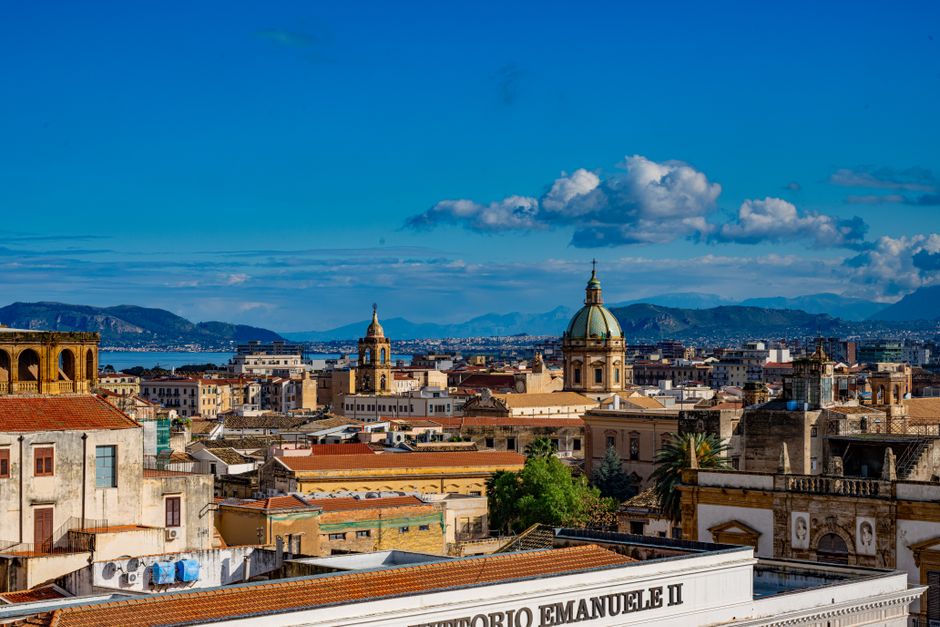
Palermo is Sicily’s capital and its most exuberant city: a sprawling, noisy, beautiful port between the mountains and the sea, where Arab domes, Norman palaces glittering with gold mosaics and baroque churches stand side by side with street markets that have been trading for a thousand years. You come for the Palatine Chapel and the cathedral of Monreale, for the markets of Ballarò and the Capo, for street food eaten standing up, for an evening at the Teatro Massimo and a swim at Mondello. It rewards curiosity more than a checklist. Give it two days for the great monuments, three or four to add Monreale, Mondello and Cefalù.
Right now in Palermo
- Wed22–28°C71–83°FPartly cloudy
- Thu22–31°C71–89°FPartly cloudy
- Fri20–24°C69–75°F5 mm rain
Top tours in Palermo
See all tours for Palermo →
From local operators, with prices and reviews; you check availability and book on Viator, our partner. We may earn a commission at no extra cost to you. How we earn money
Palermo at a glance
- Best for: Arab-Norman art and architecture, street food and markets, opera, lively nightlife and day trips to Monreale, Mondello and Cefalù.
- How long: 2 days for the main sights, 3–4 with Monreale, a beach day and Cefalù.
- Best time: April to June and September to October; July and August are hot, winter is mild and quiet.
- Book ahead: the Palatine Chapel at weekends and in high season, and Teatro Massimo performances.
- Getting in: the Prestia e Comandè airport bus reaches the central station in about 50 minutes, every 30 minutes, for €6.50 on board as of October 2026.
- Before you go: for the rest of the island see our Sicily travel guide; entry rules, money and safety are in our Italy travel guide.
Palermo’s neighbourhoods and who each one suits
The historic centre is divided into four old quarters (mandamenti) by two great streets, the Via Vittorio Emanuele (the Cassaro) and the Via Maqueda, which cross at the baroque Quattro Canti. Most sights are within a 20-minute walk of that crossroads.
Albergheria and the Cassaro
The south-western quarter holds the Royal Palace and Palatine Chapel, the cathedral at its edge, San Giovanni degli Eremiti and the Ballarò market. The Cassaro, now largely pedestrian, links the palace to the sea. Best for: first visits and anyone who wants the big sights on the doorstep.
Kalsa
The old Arab quarter by the sea, once battered and now one of the liveliest areas, with Palazzo Abatellis and its gallery, the church of the Magione, the Piazza Magione lawns, the waterfront Foro Italico and many bars and restaurants. Best for: evenings out, art lovers and couples.
La Loggia, Vucciria and the Capo
The northern quarters around the Vucciria and Capo markets, the oratories decorated by Giacomo Serpotta and the church of San Domenico. The Vucciria is now more of a night-time street party than a market. Best for: food lovers and night owls (it can be loud).
Politeama and the new city
North of the Teatro Massimo, the 19th-century city of Via Ruggero Settimo and Via Libertà has broad streets, Liberty-style villas, shops and the Teatro Politeama. It is calmer, a little more expensive and well connected to the airport bus. Best for: families, shoppers and travellers who prefer quieter nights.
Top things to see in Palermo
Palermo’s Arab-Norman buildings, together with the cathedrals of Monreale and Cefalù, are a UNESCO World Heritage Site. Prices and hours below were checked on the official websites in October 2026. They change, so check before you go.
The Royal Palace and the Palatine Chapel
The Palazzo dei Normanni, the Royal Palace of the Norman kings and today the seat of the Sicilian Regional Assembly, holds Palermo’s greatest treasure: the Cappella Palatina, a 12th-century royal chapel covered in gold Byzantine mosaics under a carved and painted wooden ceiling made by Arab craftsmen. Allow at least an hour and a half for the chapel, the Royal Apartments and the gardens.
Tickets and hours. As of October 2026, run by the Fondazione Federico II, the palace opens every day from 8:30, with last entry at 16:30 Monday to Saturday and 12:30 on Sundays and holidays; it is closed on 25 December and 1 January. From Thursday to Monday a full ticket for the chapel, the Royal Apartments and the gardens costs €14.50 (€12.50 for EU citizens aged 18–25 and teachers, €11 for EU citizens over 65, €9 for ages 14–17). On Tuesdays and Wednesdays, when the Apartments are closed for the Assembly, the ticket covers the chapel and the gardens for €10. Children up to 13 enter free with an adult. Restoration work in the chapel and institutional events can change the hours at short notice, and the chapel is a place of worship, so cover shoulders and knees.
Palermo Cathedral and its rooftops
The cathedral is a fascinating mix of styles: Norman towers, Gothic porches, Catalan details and a neoclassical dome added in the 18th century. Inside lie the royal tombs of the Norman and Swabian kings, including Frederick II. Entry to the church is free, roughly from 7:00 to 19:00 (8:00 on Sundays, with a break during services). The ticketed “monumental area” covers the rooftops, the crypt, the treasury with the jewelled crown of Constance of Aragon and the royal tombs, open Monday to Saturday from 9:30 to 18:00 and Sundays from 10:00 to 18:00, last entry 17:30. As of October 2026, the cathedral’s official ticket shop lists the rooftops alone at up to €7 and the full monumental area at up to €13, with reductions. Part of the roof has been under maintenance, so check that the rooftops are open before you buy.
Quattro Canti, Piazza Pretoria and the domed churches
At the Quattro Canti, four curved baroque façades mark the heart of the old city. A few steps away, the Fontana Pretoria is ringed with marble nudes, and on Piazza Bellini stand two gems side by side: La Martorana, with mosaics as fine as the Palatine Chapel’s, and the little church of San Cataldo with its three red domes. Near the palace, San Giovanni degli Eremiti is a former monastery with red domes and a cloister garden. Small entry fees apply at each.
The Teatro Massimo
Italy’s largest opera house, opened in 1897, is worth seeing even if you do not catch a performance. As of October 2026 the guided tour runs every day from 9:30 to 19:00, takes about 40 minutes and costs €14 (€7 for under-26s; children under six free). A combined ticket with Palazzo Butera costs €19. For performances, book on the theatre’s website.
Galleries, palaces and the catacombs
Palazzo Abatellis, the regional gallery in the Kalsa, holds the haunting “Triumph of Death” fresco and Antonello da Messina’s “Annunciation”. The Salinas archaeological museum displays finds from Selinunte and the island’s Greek cities. The Zisa, a Norman pleasure palace in the west of the city, houses Islamic art. The Capuchin Catacombs, on the western edge of the centre, hold the mummified bodies of about 8,000 Palermitans in their best clothes: fascinating but not for everyone, and not for young children. Check opening times on each site before you go.
Street food and the markets
Palermo is one of Europe’s great street-food cities. Walk through Ballarò and the Capo in the morning, when the stalls are piled with fish, citrus and vegetables and the vendors call out their prices. Eat as you go: arancine (fried rice balls; in Palermo they are feminine), panelle (chickpea fritters) and crocchè in a bun, sfincione (thick, spongy pizza with onions and breadcrumbs), and, for the brave, pani ca’ meusa (spleen sandwich). Finish with a cannolo filled to order or a brioche with gelato. Pay at the stall, watch your bag in the crowds and follow the locals’ queues.
Other things to do in Palermo
Mondello beach
About 20–30 minutes by bus or car north of the centre, Mondello is Palermo’s beach: a long crescent of pale sand and shallow turquoise water between two headlands, with an Art Nouveau bathing pavilion on a pier. Much of the beach is taken by lidos with paid sunbeds; free sections lie at either end. It is packed on summer weekends; go on a weekday morning. See our beaches guide.
Monte Pellegrino and the Santa Rosalia sanctuary
The headland that towers over the city has a cave sanctuary dedicated to Santa Rosalia, Palermo’s patron saint, and views over the bay. Walk up the old stepped road (the Scala Vecchia) in about an hour and a half, or take a bus. On the night of 3–4 September locals walk up in pilgrimage. See our hiking guide.
Sea, boats and the waterfront
Stroll the Foro Italico promenade and the old harbour of La Cala at sunset. From the port, boats go to the island of Ustica, a marine reserve known for clear water, snorkeling and diving, and in summer to the Aeolian Islands. Shorter trips run along the coast to the Capo Gallo reserve from Mondello and Sferracavallo. See our boat trips guide.
Day trips from Palermo: Monreale, Cefalù and the west
Monreale
On the hillside 8 km south-west of the city, the cathedral of Monreale, built by King William II from 1174, has one of the largest cycles of medieval mosaics in the world: some 6,400 square metres of gold, with a huge Christ Pantocrator in the apse. Next door, the Benedictine cloister has more than 200 carved twin columns, some inlaid with mosaic. Entry to the nave is usually free, with tickets for the terraces, the treasury and the cloister; check the current hours locally, as services take priority. City buses run from Piazza Indipendenza, near the Royal Palace, in about 30–40 minutes; a taxi is quicker. Dress modestly.
Cefalù
About an hour east by train, Cefalù packs a Norman cathedral with a glittering mosaic of Christ, a medieval old town and a sandy beach under a great rock, La Rocca. Climb the rock early in the morning for the view, swim off the old harbour and come back in the evening, or stay a night.
Segesta, Erice and the west
With a car or a tour, head west to the Greek temple of Segesta, standing alone in the hills, the medieval hill town of Erice, the salt pans between Trapani and Marsala and the beaches of San Vito Lo Capo and the Zingaro reserve. Each is about an hour to an hour and a half from Palermo.
Nearby destinations
- Sicily81 km
- Aeolian Islands144 km
- Catania166 km
- Taormina171 km
- Gozo244 km
- St. Julian's264 km
- Valletta267 km
- Capri281 km
Getting there and getting around
From the airport
Palermo Falcone Borsellino airport (PMO), at Punta Raisi, is about 35 km west of the city. The Prestia e Comandè shuttle bus runs every 30 minutes, every day of the year, from the terminal to the Politeama and the central station (Stazione Centrale) in about 50 minutes; as of October 2026 a one-way ticket bought on board costs €6.50 (€11 return), cash or card, with lower prices for children aged 3–12 and under-3s free. Trenitalia also runs trains from the airport station to the city; check the current timetable on trenitalia.com. A taxi takes about 35–45 minutes.
By train, bus and ferry
Trains run from Palermo Centrale to Cefalù (about an hour), Agrigento (about 2 hours) and, more slowly, to Messina and Catania; for Catania, the long-distance buses are usually faster. Overnight ferries link Palermo with Naples (about 10–11 hours), Genoa, Livorno, Civitavecchia and Salerno, and the port is a short walk from the centre. See our Sicily guide for crossing the island.
Walking and city transport
The historic centre is best explored on foot (see our city sightseeing guide); the main axes are partly pedestrian, but watch for scooters in the side lanes. City buses run by AMAT, the municipal transport company, reach Monreale, Mondello and the Capuchin Catacombs; buy tickets before boarding. Taxis do not cruise much; use the ranks or call one.
Driving and the ZTL
Do not drive in the historic centre. It is a limited-traffic zone (ZTL) watched by cameras, with daytime and night-time rules, and fines reach you at home through the rental company. Traffic in Palermo is chaotic and parking scarce. If you have a car, leave it at your hotel or in a guarded car park, and ask the hotel how to register your plate if it is inside the ZTL. Pick up a rental car on the day you leave the city.
When to go and how long to stay
Palermo has a hot, dry summer and a mild, rainy winter. There is no Palermo sheet in the WMO 1991–2020 collection, so the table uses the official normals of the Italian Air Force station at Trapani Birgi, the nearest coastal station on the same north-western coast; Palermo city is usually a touch warmer, especially at night. These are long-term averages, not a forecast. Hot scirocco winds from Africa can push summer days near 40 °C.
| Season | Average high / low | Rainy days per month | What it’s like | Good for |
|---|---|---|---|---|
| Winter (Dec–Feb) | 15–16 °C / 7–9 °C | 8–10 | Mild, with sunny spells between showers | Monuments without queues, low prices |
| Spring (Mar–May) | 17–24 °C / 9–14 °C | 3–6 | Warm, bright and green; Easter processions | Walking, markets, day trips |
| Summer (Jun–Aug) | 28–31 °C / 17–21 °C | About 1 | Hot and dry, humid by the sea; Mondello packed | Beaches, boat trips, evenings out |
| Autumn (Sep–Nov) | 28 °C falling to 20 °C / 19 °C falling to 12 °C | 5 in September, 9 in November | Warm sea into October, then storms | Swimming, food, fewer crowds |
Events worth planning around
The Festino di Santa Rosalia, on 14–15 July, is the city’s great festival: a giant triumphal cart is pulled along the Cassaro to the sea, followed by fireworks. Holy Week brings processions, and the opera and ballet season at the Teatro Massimo runs most of the year. In autumn, the Le Vie dei Tesori festival opens many palaces, oratories and churches that are normally closed.
How long to stay: 2-, 3- and 4-day plans
2 days: the Royal Palace and Palatine Chapel at opening time, the cathedral and its rooftops, Ballarò for lunch and the Quattro Canti, La Martorana and the Teatro Massimo in the afternoon on day 1; Monreale in the morning and the Kalsa, Palazzo Abatellis and the waterfront at sunset on day 2. 3 days: add Mondello or Monte Pellegrino, the Capo market and the catacombs. 4 days: add a day in Cefalù, or Segesta and Erice by car.
Where to stay in Palermo and the tourist tax
- Around the Quattro Canti and the Cassaro: central, walkable and full of B&Bs in old palazzi; the best first-time base.
- Kalsa: characterful and lively at night, close to the sea and the port.
- Teatro Massimo and Politeama: calmer streets, good restaurants and the airport bus.
- Mondello: for a beach-first summer stay, with buses into town.
Palermo charges a tourist tax (imposta di soggiorno) per person per night, set by type and star rating of the accommodation; the city updated its rates in September 2023. Check the amount when you book or on the Comune di Palermo’s website; it is usually paid at the property. Choose a room on a quiet lane or with good windows if you are a light sleeper: the centre is loud at night.
Practical tips for Palermo
- Check the palace calendar: the Royal Apartments are closed on Tuesdays and Wednesdays, and the palace can close for Assembly business.
- Dress for churches: covered shoulders and knees for the Palatine Chapel, the cathedral and Monreale.
- Markets in the morning: stalls are at their busiest from about 8:00 to early afternoon; Sunday is quiet.
- Petty theft: watch your bag in markets and on buses, and never leave anything visible in a parked car.
- Crossing the road: traffic rarely stops; cross confidently with locals.
- Emergencies: call 112.
What to pack for Palermo
Bring comfortable shoes with good grip for uneven paving and slippery marble, light breathable clothes for the heat, a scarf or light shirt to cover shoulders in churches, a sun hat, sunglasses and sunscreen, a refillable water bottle, swimwear and a towel for Mondello, and a cross-body bag that zips shut for the markets. From November to March add a light rain jacket and a warm layer for the evenings.
Palermo travel FAQ
How many days do you need in Palermo?
Two days for the Palatine Chapel, the cathedral, the markets and Monreale; three or four to add Mondello, the museums and a day trip to Cefalù.
How much is the Palatine Chapel?
As of October 2026, €14.50 from Thursday to Monday for the chapel, the Royal Apartments and the gardens, and €10 on Tuesdays and Wednesdays for the chapel and gardens only. Children up to 13 go free.
Is Palermo Cathedral free?
Yes, the church itself is free. The rooftops, crypt, treasury and royal tombs need a ticket, up to €13 for the full monumental area as of October 2026.
How do I get from Palermo airport to the city?
By the Prestia e Comandè bus, every 30 minutes, about 50 minutes to the central station, €6.50 on board as of October 2026; by Trenitalia train; or by taxi in about 35–45 minutes.
Is Monreale worth a visit?
Yes. Its cathedral mosaics and cloister are among the finest medieval works in Europe, and it is only about 30–40 minutes by bus or less by taxi from the centre.
Can you visit the Teatro Massimo?
Yes, on 40-minute guided tours every day from 9:30 to 19:00, €14 (€7 for under-26s) as of October 2026, or by booking a performance.
What should I eat in Palermo?
Arancine, panelle and crocchè, sfincione, pasta con le sarde, caponata, and a cannolo or a brioche with gelato. The Ballarò and Capo markets are the best places to graze.
Can I drive in Palermo?
Avoid it. The historic centre is a camera-controlled ZTL, traffic is chaotic and parking is hard. Walk, use buses and taxis, and pick up a rental car when you leave.
Is there a beach in Palermo?
Yes: Mondello, a sandy bay about 20–30 minutes north of the centre. Further afield, Cefalù and San Vito Lo Capo have excellent beaches.
When is the best time to visit Palermo?
April to June and September to October. July and August are hot but good for the beach; the Festino di Santa Rosalia on 14–15 July is the city’s biggest party.
Is Palermo safe for tourists?
Generally yes. Pickpockets work the markets and buses, and bag snatching from scooters happens, so keep valuables close. Use the same caution at night as in any big port city, and call 112 in an emergency.
Plan your trip
Partner links: TravelerCenter may earn a commission if you book, at no extra cost to you.
🇮🇹 Useful Italian phrases for Palermo
All 38 Italian phrases: restaurant, hotel, emergencies, romance (printable) →
Sources · last reviewed 4 October 2026
Researched and last reviewed on 4 October 2026. Royal Palace and Palatine Chapel prices and hours: the Fondazione Federico II (official); cathedral hours and monumental-area tickets: the Cathedral of Palermo and its official ticket shop; Teatro Massimo tours: the Teatro Massimo (official); airport bus: Prestia e Comandè’s timetable and fares (official operator); tourist tax: the Comune di Palermo’s notices (official; current rates not read in full); climate: Italian Air Force 1991–2020 normals for Trapani Birgi from the WMO climate normals collection (official). Monreale and catacomb hours, the ZTL rules and train times are general and should be checked locally. Prices, timetables and rules change, so check the official links before you go. For entry rules, money and general safety, see our Italy travel guide.
Data: Weather: MET Norway (CC BY 4.0) · Sea temperature: NOAA CoastWatch · Rates: ECB · Costs: World Bank ICP and price levels · Wikidata (CC0)