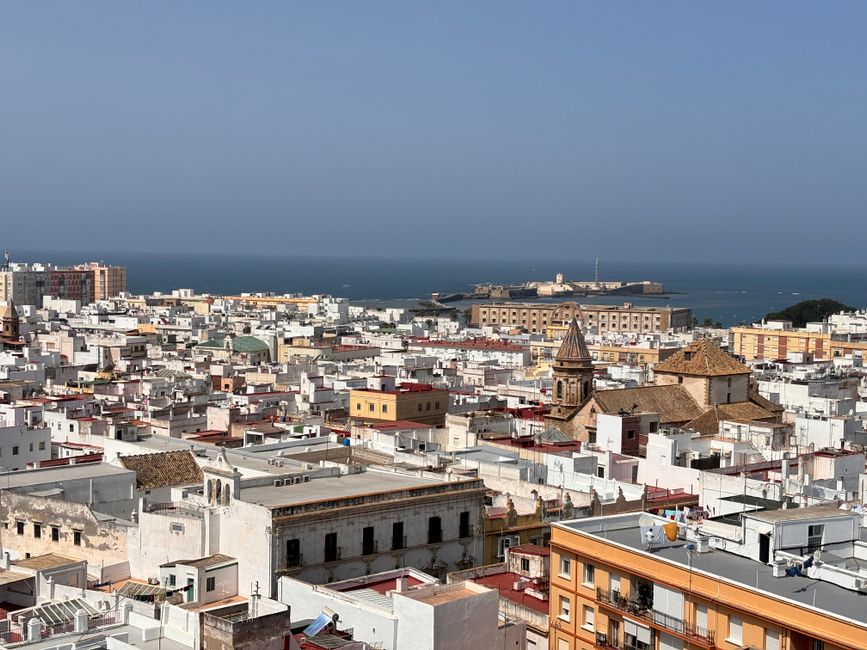
Cádiz is one of the oldest cities in Western Europe, founded by Phoenician traders some 3,000 years ago on a narrow peninsula in the Atlantic. Its old town is almost an island, ringed by sea walls and golden stone, with the domed cathedral rising above the waves and a grid of narrow streets opening onto lively squares. It has a real city beach, the long Playa de la Victoria, a tiny fishing cove at La Caleta, fried-fish bars and Spain’s most famous carnival. Cádiz is a popular day trip from Seville, about 1 hour 40 minutes by train, but it deserves two or three days. The best months are May, June, September and October, with mild, breezy summers.
Right now in Cádiz
- Wed 20–23°C 69–73°F Partly cloudy
- Thu 19–27°C 66–81°F Clear
- Fri 19–23°C 67–74°F 1 mm Cloudy
- Mon 12 Oct National Day of Spain (Fiesta Nacional de España)
Weather: MET Norway (CC BY 4.0) · Sea temperature: NOAA CoastWatch · Air quality: OpenAQ · Rates: ECB · Holidays: Nager.Date
Top tours in Cádiz
See all tours for Cádiz →
From local operators, with prices and reviews; you check availability and book on Viator, our partner. We may earn a commission at no extra cost to you. How we earn money
Cádiz at a glance
- Best for: a walkable old town by the sea, city beaches, seafood and tapas, Carnival, and day trips to Jerez’s sherry bodegas and the Costa de la Luz.
- How long: a day trip covers the highlights; 2–3 days let you add the beaches, the sunset at La Caleta and Jerez.
- Best time: May–June and September–October. Summer is warm rather than hot, around 28 °C, thanks to the sea breeze; February brings Carnival.
- Getting there: regional trains from Seville (about 1 h 40) and through trains from Madrid; the nearest airport is Jerez (XRY), 47–57 minutes by local train.
- Getting around: on foot in the old town; city buses along the seafront to Playa de la Victoria; ferries across the bay.
- Before you go: entry rules, money, trains and general safety are on our Spain travel guide.
Cádiz’s neighbourhoods and who each one suits
The city has two halves: the old town (Casco Antiguo) at the tip of the peninsula, and the newer city (Extramuros) running south along the Atlantic beaches. Most visitors stay in the old town.
El Pópulo and the cathedral quarter
The oldest quarter, entered through medieval arches, wraps around the cathedral and the Roman theatre. Its lanes are full of small bars and guesthouses, and the Campo del Sur sea wall runs along its southern edge. Atmospheric and central; good for first-timers.
Centre: Plaza de las Flores to Plaza de San Antonio
The commercial heart, with the flower stalls of the Plaza de las Flores, the Central Market, the shopping streets of Columela and Ancha, and grand 18th-century squares such as San Antonio and Mina. Lively by day and a short walk from everything.
La Viña and Santa María
La Viña, the old fishermen’s quarter behind La Caleta beach, is the soul of Carnival and full of fried-fish shops and tavernas. Santa María, near the cathedral, is the cradle of flamenco in Cádiz. Both are lively and local; good for food lovers.
Extramuros and Playa de la Victoria
Beyond the old Puerta de Tierra gate, modern Cádiz stretches along the Playa de la Victoria and Cortadura beaches. Hotels and apartments here are newer, with sea views and easier parking; buses take 15–20 minutes to the old town. The best choice for a beach holiday and for families.
Top things to see in Cádiz
Prices and hours below were checked on the official sites in October 2026, unless we say otherwise; check again before you go. Most sights are within a 20-minute walk of each other.
Cádiz Cathedral and the Torre del Reloj
The “New Cathedral”, built between 1722 and 1838, mixes Baroque and Neoclassical styles under a dome covered in golden-yellow tiles that glows above the sea. Inside are a carved choir, side chapels and a crypt under the altar, where the composer Manuel de Falla is buried; the crypt sits below sea level and you can hear the waves. The ticket also includes the climb of the Torre del Reloj, the east tower (also called the Torre de Levante), by a ramp rather than steps, for a view over the rooftops and the bay. As of October 2026 a general ticket costs €12 (€11 over-65s, €10 students aged 13–25, free under 12 with an adult), with an audio guide; allow 1 hour 30 minutes. The cathedral opens Monday to Saturday 10:00–20:00 and Sunday 13:30–20:00 (last entry 19:00); the tower Monday to Saturday 10:00–20:00 and Sunday 12:00–15:00 and 16:00–20:00. Hours change for services.
Torre Tavira and its camera obscura
In the 18th century Cádiz merchants built more than 100 watchtowers on their houses to spot their ships coming home from the Americas. The tallest, the Torre Tavira, was the official lookout of the port and now houses a camera obscura that projects a live, moving image of the city onto a white dish, with a guide pointing out the sights. As of October 2026 entry costs €8 (€6 reduced for over-65s, students and some others); it opens daily 10:00–18:00 from October to April and 10:00–20:00 from May to September, with last entry an hour before closing. The visit takes about 45 minutes, numbers are limited and the operator asks you to book ahead on its website. It closes on 25 December and 1 and 6 January.
The Roman theatre
Discovered by chance in 1980 under houses in El Pópulo, the Theatrum Balbi is one of the largest Roman theatres in Spain, built in the 1st century BC. A visitor centre explains Roman Gades with models and audiovisuals before you walk through a vaulted gallery to the seating. As of October 2026 the Andalusian government lists free entry, open from 1 October to 31 March Monday to Saturday 10:00–16:30 and Sunday 10:00–14:00 (from April to September Monday to Saturday 11:00–17:00). It closes on the first Monday of each month and on several holidays.
La Caleta and the castles
La Caleta is a small sandy cove between two forts, with old bathhouses and colourful fishing boats, and the best place in Cádiz to watch the sun set into the Atlantic. At one end, a causeway leads to the Castillo de San Sebastián on its rocky islet; at the other stands the star-shaped Castillo de Santa Catalina, now an arts space. Check locally whether the causeway is open, as access depends on works and weather.
The Central Market and the squares
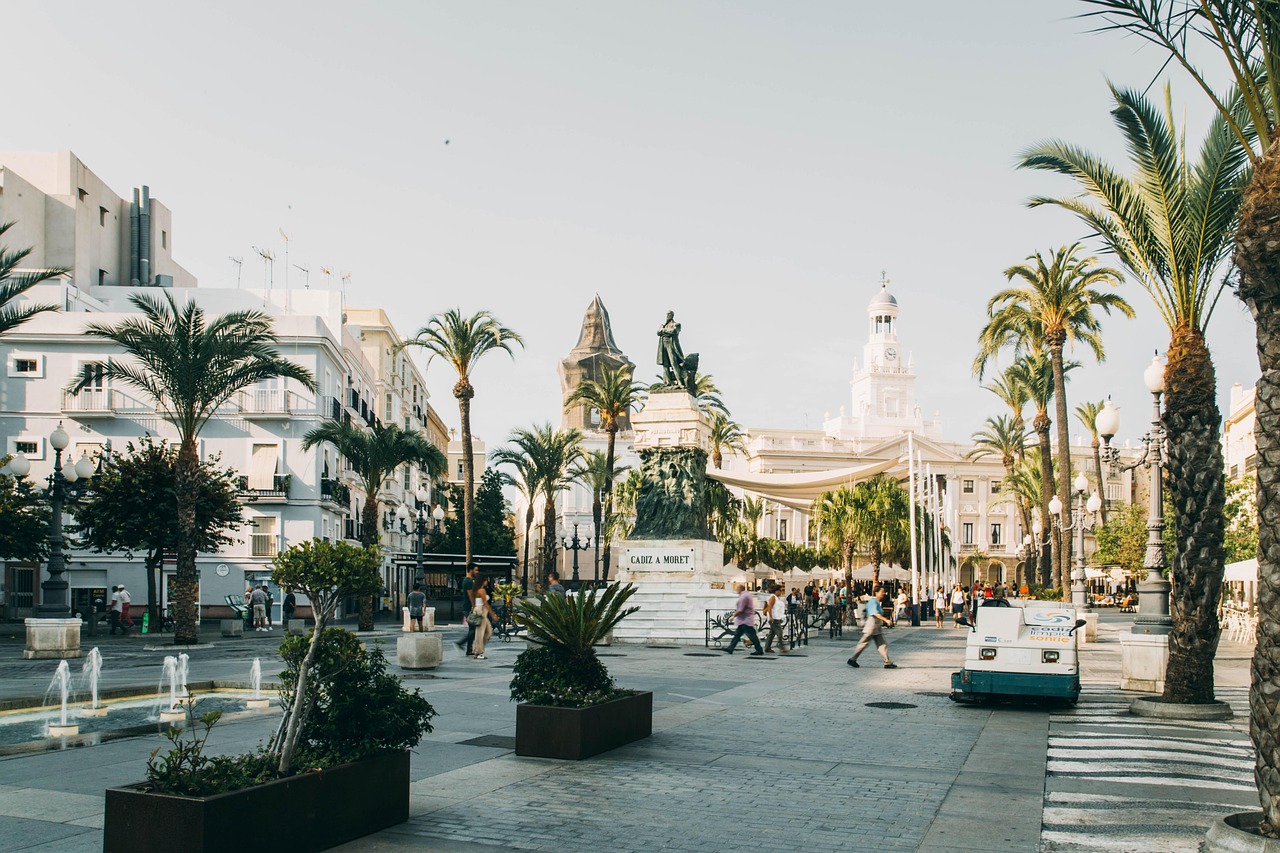
The Mercado Central, the first covered market in Spain, is busiest in the morning, when the fish stalls are piled with tuna, prawns and cuttlefish; around its edges, food stalls serve tapas and fried fish. Nearby, the Plaza de las Flores is lined with florists and the famous fried-fish shops, while the leafy Plaza de Mina is home to the Museo de Cádiz, with Phoenician sarcophagi and paintings by Zurbarán.
More to see
- Oratorio de San Felipe Neri: the church where Spain’s first constitution, “La Pepa”, was proclaimed in 1812.
- Alameda Apodaca and Parque Genovés: seafront gardens with ancient dragon trees and topiary along the north walls.
- Puerta de Tierra: the monumental 18th-century land gate that marks the entrance to the old town.
- Gran Teatro Falla: the red neo-Mudéjar theatre where the Carnival song contest is held.
Other things to do in Cádiz
Beaches
Cádiz has more than 6 km of fine golden sand within the city. La Caleta is small and picturesque, Santa María del Mar sits just outside the old walls, and the Playa de la Victoria is a wide, long urban beach with a promenade, lifeguards and beach bars, continuing south as Cortadura. The Atlantic is cooler than the Mediterranean and the wind (the levante from the east, the poniente from the west) can be strong. See our beaches guide.
Walking the sea walls
A walk right round the old town along the walls and promenades takes about two hours: Campo del Sur with its cathedral views, La Caleta, Parque Genovés and the Alameda. It is lovely at sunset, and it is the best introduction to the city. See our city sightseeing guide.
Surfing, kitesurfing and boat trips
The Playa de la Victoria and Cortadura have surf schools for beginners, and further south the Costa de la Luz beaches of El Palmar and Tarifa are among the best surf and kitesurf spots in Europe. Boats cross the bay to El Puerto de Santa María, and in summer short sightseeing cruises leave the port. See our surfing guide.
Food and flamenco
Cádiz is famous for pescaíto frito, mixed fried fish eaten from a paper cone, tortillitas de camarones (crisp shrimp fritters), Almadraba bluefin tuna in spring and sherry from nearby Jerez and El Puerto. Small flamenco peñas in Santa María and La Viña hold shows, especially at weekends.
Day trips and onward travel
Jerez and El Puerto de Santa María
Jerez de la Frontera, home of sherry, flamenco and Andalusian horses, is about 40 minutes away by train. Tour a bodega and see the riding school’s horse show. El Puerto de Santa María, across the bay, has more bodegas, seafood restaurants and beaches; take the boat for the views. See our wine tasting guide.
Seville, the white villages and the Costa de la Luz
Seville is about 1 hour 40 minutes by train. By car, explore the white villages of Vejer de la Frontera and Arcos de la Frontera, the beaches of Conil and Bolonia with its Roman ruins, and Tarifa, Europe’s southern tip. For Portugal and the Algarve, go via Seville.
Nearby destinations
Getting there and getting around
By train
Cádiz station sits at the edge of the old town, a short walk from the Plaza de San Juan de Dios. Renfe’s regional trains run from Seville Santa Justa in about 1 hour 40 minutes, via Jerez, and through trains run from Madrid via Seville. The Cercanías C1 local line links Cádiz with San Fernando, El Puerto de Santa María, Jerez and Jerez airport.
By air
Jerez airport (XRY), about 40 km north-east, is the closest, with flights from Madrid, Barcelona and, in season, other European cities. According to Aena, the local C1 train takes 57 minutes from the airport station to Cádiz and the regional train 47 minutes, and bus M-050 runs daily between the airport, Jerez and Cádiz. Seville airport (SVQ) has many more flights: take the airport bus into Seville, then the train to Cádiz, allowing about 2 hours 30 minutes in all. Málaga and Gibraltar are other options for a road trip.
Getting around and driving
The old town is compact and best explored on foot; city buses run along the seafront to the Playa de la Victoria and Cortadura. Ferries from the port cross the bay to El Puerto de Santa María and Rota. Driving into the old town is not a good idea: Cádiz brought in a low-emission zone (ZBE) in 2026 covering the inside of the old town (the ring road along the sea walls is outside it). According to the municipal broadcaster, cars from outside the city may enter only with an environmental label of Cero, ECO or C, and fines were due to start after a grace period at the end of 2026. Park in one of the car parks on the ring road or near the station, and ask your hotel if it is inside the zone.
When to go and how long to stay
Surrounded by the Atlantic, Cádiz has one of the gentlest climates in Spain: summers are warm rather than scorching and winters very mild. The table uses AEMET’s 1991–2020 climate normals for its Cádiz observatory weather station, in the city: average daily highs and lows, and days with at least 1 mm of rain. Recent summers have often been warmer.
| Season | Average high / low | Rainy days per month | What it’s like | Good for |
|---|---|---|---|---|
| Winter (Dec–Feb) | 16–17 °C / 10–11 °C | 6–7 | Mild, with rainy spells and wind; Carnival in February | Sightseeing, Carnival, low prices |
| Spring (Mar–May) | 19–23 °C / 12–17 °C | 3–6 | Fresh and sunny; tuna season in May | Walking, Jerez, first beach days |
| Summer (Jun–Aug) | 26–28 °C / 20–22 °C | 0–1 | Warm and dry with sea breezes; the city fills with Spanish holidaymakers | Beaches, sunset at La Caleta, evening life |
| Autumn (Sep–Nov) | 26 °C falling to 20 °C / 21 °C falling to 13 °C | 3 in September, 7 in November | Warm sea in September and October, rain returns in November | Swimming, food, fewer crowds |
Strong easterly levante winds can blow for days in summer, whipping up sand on the beaches; on those days La Caleta, sheltered on the west side, is the best place to swim.
Events worth planning around
- Carnival, 4–14 February 2027: the city’s official dates. The Gran Final of the song contest (COAC) is on Friday 5 February at the Gran Teatro Falla, followed by the opening proclamation on Saturday 6 February, the grand parade on Sunday 7 February and the closing burning of the “Bruja Piti” on Sunday 14 February. The street party with costumed singing groups fills the old town; book rooms months ahead.
- Easter week: processions through the narrow streets.
- Summer: outdoor concerts and the Trofeo Carranza football tournament in August.
How long to stay: day trip, 2 and 3 days
Day trip: arrive by train in the morning, visit the cathedral and its tower, the Central Market and Torre Tavira, eat fried fish in the Plaza de las Flores, then walk the walls to La Caleta.
2 days: add the Roman theatre, El Pópulo, a beach afternoon at La Victoria and the sunset at La Caleta. 3 days: add a day in Jerez for sherry and horses, or a drive to Vejer and the Costa de la Luz beaches.
Where to stay in Cádiz and the tourist tax
- Old town: small hotels and guesthouses in historic houses, walkable to everything; rooms can be compact.
- Near the station and port: practical for day trips and arrivals by train.
- Playa de la Victoria: larger hotels and apartments on the beach, best for summer and families.
Book early for July, August and especially Carnival, when prices soar. There is no tourist tax in Cádiz or anywhere else in Andalusia as of October 2026; check again if you are booking for 2027.
Practical tips for Cádiz
- Book Torre Tavira: visits are timed and limited, so reserve on its website.
- Check the wind: on strong levante days, swim at La Caleta or on the bay side.
- Leave the car outside: use car parks on the ring road; the old town’s streets are narrow and restricted.
- Eat early or late: lunch is from about 14:00, dinner from 21:00; the market stalls are best before noon.
- Carnival crowds: keep valuables safe and plan your train back, as services fill up.
- Emergencies: call 112.
What to pack for Cádiz
Comfortable walking shoes are essential for the cobbled lanes and the walk around the walls. For the beach, pack a swimsuit, a beach towel, sunglasses, a sun hat and high-factor sunscreen; the breeze makes the sun feel weaker than it is. A windproof jacket is useful all year when the levante blows, and in winter add a warm jumper and a small umbrella. If you come for Carnival, bring a costume: almost everybody wears one at the weekend.
Cádiz travel FAQ
Is Cádiz worth a day trip from Seville?
Yes. The train takes about 1 hour 40 minutes, and the old town’s sights, market and sea walls fit into a day. Staying a night lets you see the sunset at La Caleta and the city’s evening life.
How much does Cádiz Cathedral cost?
As of October 2026 a general ticket is €12, including the clock tower and an audio guide; over-65s pay €11, students aged 13–25 €10, and under-12s go free with an adult.
Do I need to book Torre Tavira?
Yes, the operator asks visitors to book ahead because numbers are limited. Entry is €8 (€6 reduced) as of October 2026, and the visit takes about 45 minutes.
When is the Cádiz Carnival in 2027?
From Thursday 4 to Sunday 14 February 2027, according to the city council. The song contest final is on 5 February and the big parade on 7 February.
Which is the best beach in Cádiz?
La Caleta for charm and sunsets, the Playa de la Victoria for space, facilities and a long swim. Both are free and in the city.
What is the nearest airport to Cádiz?
Jerez (XRY), about 40 km away, with trains to Cádiz in 47–57 minutes. Seville airport has more flights, about 2 hours 30 minutes away by bus and train.
Is the Roman theatre in Cádiz free?
Yes. As of October 2026 entry is free; from October to March it opens Monday to Saturday 10:00–16:30 and Sunday 10:00–14:00, and it closes on the first Monday of each month.
Can I drive into Cádiz old town?
It is better not to. The old town is inside a low-emission zone that limits cars from outside the city to those with Cero, ECO or C labels, and its streets are narrow. Park on the ring road and walk.
Is there a tourist tax in Cádiz?
No. As of October 2026 Andalusia does not charge a tourist tax.
Sources and last review
Researched and last reviewed on 4 October 2026. Cathedral prices and hours: Cádiz Cathedral’s official site; Torre Tavira: the operator’s site; Roman theatre: the Junta de Andalucía’s culture agenda; Carnival 2027 dates: the Ayuntamiento de Cádiz; airport trains and buses: Aena; climate: AEMET’s 1991–2020 normals for the Cádiz observatory, published through the WMO. The low-emission zone rules and fine dates come from the municipal broadcaster and press, and the absence of a tourist tax, the Seville train time and the Seville airport connection from secondary sources; these are flagged for checking. Prices, hours and timetables change, so check the official sites before you go. For entry rules, money and general safety, see our Spain travel guide.
Plan your trip
Partner links: TravelerCenter may earn a commission if you book, at no extra cost to you.
🇪🇸 Useful Spanish phrases for Cádiz
All 38 Spanish phrases: restaurant, hotel, emergencies, romance (printable) →