Bermuda is a small, hook-shaped chain of islands alone in the North Atlantic, about 1,050 km (650 miles) east of Cape Hatteras in North Carolina, and a short flight from the US East Coast. It is not in the Caribbean, and its climate is subtropical rather than tropical, with warm summers and mild, breezy winters. Bermuda is famous for its pink-sand beaches, turquoise coves and pastel cottages with stepped white roofs, and for a very British way of life: afternoon tea, cricket, red post boxes, driving on the left, and businessmen in Bermuda shorts, knee socks and blazers. It is the oldest British Overseas Territory, settled in 1612, and the historic town of St. George’s is a UNESCO World Heritage Site. Visitors can’t rent cars, so you get around by bus, ferry, scooter, taxi or tiny electric two-seaters. Bermuda is expensive but safe, clean and easy, and works for a long weekend. May to October is beach season; the hurricane season runs from June to November.
Right now in Bermuda
- Tue 25–28°C 77–82°F 1 mm Partly cloudy
- Wed 25–27°C 76–80°F 16 mm Heavy rain
- Thu 25–27°C 77–81°F 15 mm Partly cloudy
Weather: MET Norway (CC BY 4.0)
Multi-day tours of Bermuda
Multi-day tours from local operators. You check dates and book on Viator, our partner; we may earn a commission at no extra cost to you. How we earn money
Bermuda at a glance: overview and geography
Bermuda is made up of about 180 islands and islets, the largest linked by bridges and causeways into a narrow fishhook about 35 km (22 miles) long and rarely more than 2 km (1.2 miles) wide, with a land area of only about 53 km² (21 square miles). The islands are the limestone cap of an ancient volcano, ringed by coral reefs, the most northerly in the Atlantic, which have wrecked hundreds of ships. The highest point, Town Hill, is just 79 m (259 feet). About 64,000 people live here. The capital, Hamilton, sits on a large harbor in the center; St. George’s is in the east, near the airport, and the Royal Naval Dockyard, with the main cruise port, is at the western tip. The island is divided into nine parishes.
Bermuda was uninhabited when Spanish sailors found it in the early 16th century; it is named after the explorer Juan de Bermúdez. In 1609, the English ship Sea Venture, bound for Jamestown, wrecked on the reefs, and its survivors’ stories are thought to have inspired Shakespeare’s The Tempest. Permanent settlement began at St. George’s in 1612. Enslaved Africans and Indigenous Americans were brought to the islands, and slavery ended in 1834, an event celebrated each summer during Cup Match. Bermuda later became a major British naval base and, from the 20th century, a center of tourism and international insurance and reinsurance. It is a self-governing British Overseas Territory with its own Parliament, dating from 1620, and a Governor appointed by the UK.
Time zone: Bermuda is on Atlantic Time, UTC−4 in winter and UTC−3 in summer, changing on the same dates as the US, so it is always one hour ahead of New York.
The parishes and areas
- Hamilton and Pembroke: the capital’s Front Street shops, restaurants and bars, the ferry terminal, the Cathedral, Fort Hamilton and the harbor.
- St. George’s: the UNESCO-listed old town, the Unfinished Church, Fort St. Catherine, Tobacco Bay, and the airport on St. David’s Island nearby.
- Hamilton Parish and Smith’s: the Crystal and Fantasy Caves, the Bermuda Aquarium, Museum and Zoo at Flatts, John Smith’s Bay and the Spittal Pond nature reserve.
- Paget and Warwick: the south shore beaches of Elbow Beach, Warwick Long Bay and Jobson’s Cove, and the Botanical Gardens.
- Southampton: Horseshoe Bay and the south shore parks, Gibbs Hill Lighthouse and large resorts.
- Sandys and Dockyard: the Royal Naval Dockyard’s museum, shops and cruise piers, Somerset Village, and the world’s smallest drawbridge.
Where to go: pink beaches, old towns and caves
Most visitors stay along the south shore or near Hamilton, and use the buses and ferries to explore. Choose the south shore for beaches, Hamilton for restaurants and nightlife, and St. George’s for history and a quiet, village feel.
Horseshoe Bay and the south shore
Bermuda’s most famous beach, Horseshoe Bay, is a curve of pink-tinged sand, colored by the crushed shells of tiny red organisms called foraminifera, with a beach house, lifeguards in season and rentals. A coastal trail through South Shore Park links it with a string of coves, including Chaplin Bay, Stonehole Bay, Jobson’s Cove and Warwick Long Bay, each sheltered by rocks and reefs. Elbow Beach, further east, is another long, popular strand.
St. George’s
Settled in 1612, St. George’s is one of the oldest continuously inhabited English towns in the Americas, and together with its fortifications was listed by UNESCO in 2000. Walk its narrow lanes to King’s Square, with replica stocks and a ducking stool, St. Peter’s Church, the oldest Anglican church in continuous use outside the British Isles, the haunting Unfinished Church, and the replica sailing ship Deliverance. Nearby, Fort St. Catherine overlooks the beach where the Sea Venture‘s survivors came ashore, and Tobacco Bay is a sheltered snorkeling spot.
Hamilton
Bermuda’s small capital is a mix of pastel colonial buildings and modern offices along the harbor. Front Street has shops, restaurants and bars, and in summer the Harbour Nights street festival on Wednesday evenings. Visit the Bermuda Cathedral, whose tower offers views, the Bermuda National Gallery, and Fort Hamilton’s moat garden and skirling ceremony with bagpipes.
The Royal Naval Dockyard
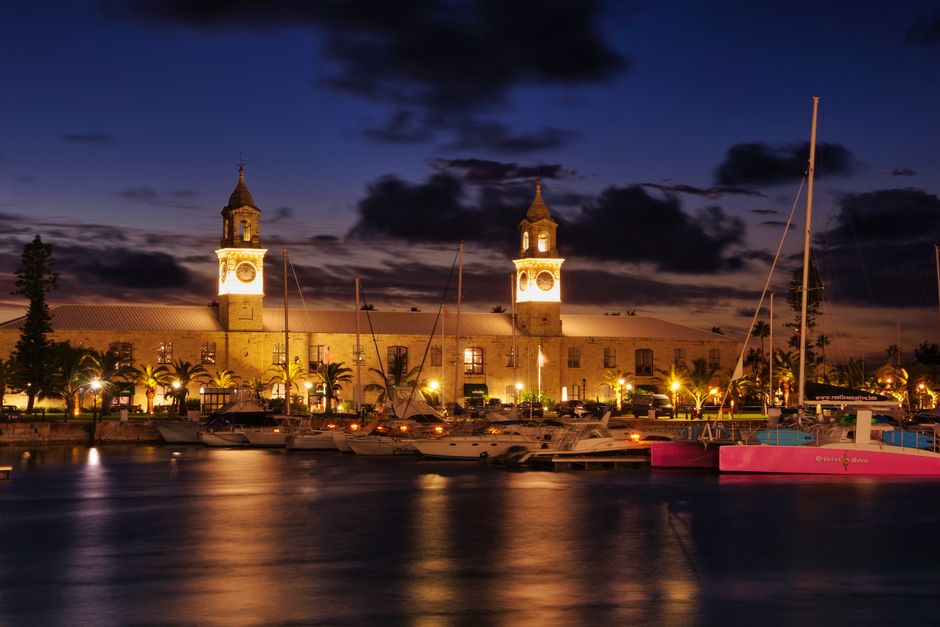
At Bermuda’s western tip, the Royal Naval Dockyard was Britain’s main Atlantic naval base for more than 150 years. Its massive stone buildings now hold the National Museum of Bermuda, with exhibits on shipwrecks and history, craft markets, restaurants, a dolphin center and the main cruise ship piers. Ferries link it with Hamilton and St. George’s.
Crystal and Fantasy Caves
Two caves in Hamilton Parish with crystal-clear underground pools and stalactites, crossed by floating pontoon walkways. Guided tours run throughout the day.
A few more worth your time
Gibbs Hill Lighthouse, a cast-iron tower from 1846 with sweeping views; the Bermuda Aquarium, Museum and Zoo at Flatts; Spittal Pond, a nature reserve with coastal walks; Cooper’s Island Nature Reserve and Clearwater Beach near the airport; the Bermuda Railway Trail, a walking and cycling path along the route of the old railway; and Somerset Bridge, the world’s smallest drawbridge, which opens just enough for a sailboat’s mast.
Best time to visit Bermuda
Bermuda’s climate is subtropical, moderated by the Gulf Stream. Summers are warm and humid, with water warm enough for swimming from about late May to October, while winters are mild, breezy and changeable, better for golf, walking and sightseeing than for the beach. Rain falls throughout the year in short showers. The table shows the official 1991–2020 normals for the Bermuda Weather Service station at the airport, submitted to the World Meteorological Organization and archived by NOAA.
| Season (Bermuda Weather Service, 1991–2020) | Average high | Average low | Rain per month | Days with rain | What it’s like |
|---|---|---|---|---|---|
| Dec–Mar | 20.5–22 °C (69–71 °F) | 15.5–17 °C (60–63 °F) | 105–128 mm (4.1–5.0 in) | 12–14 | Mild, windy and changeable; the sea is cool; quiet and cheaper, good for golf and walking. |
| Apr–Jun | 22–27 °C (72–81 °F) | 17–23 °C (63–73 °F) | 87–110 mm (3.4–4.3 in) | 8–10 | Spring warming; beach season starts in late May; fewer rainy days. |
| Jul–Sep | 29–30 °C (84–86 °F) | 24.5–25 °C (76–77 °F) | 116–165 mm (4.6–6.5 in) | 11–13 | Hot, humid and sunny, the warmest sea; peak season and peak hurricane risk in August and September. |
| Oct–Nov | 24–27 °C (75–80 °F) | 19–22 °C (67–72 °F) | 112–149 mm (4.4–5.9 in) | 12 | Warm and pleasant in October, cooling in November; still hurricane season. |
The airport averages about 1,450 mm (57 in) of rain a year. Sea temperatures range from about 19 °C (66 °F) in February and March to 28–29 °C (82–84 °F) in August.
Hurricanes and sargassum
According to NOAA’s National Hurricane Center (NHC), the Atlantic hurricane season runs from 1 June to 30 November, with most activity between mid-August and mid-October. Bermuda lies in the path of many storms curving north through the Atlantic and is affected by a hurricane every few years, though its strict building codes, stone houses and well-practiced preparations limit damage. Recent storms include Hurricane Ernesto, which made landfall in August 2024, and Hurricane Imelda, whose center passed just south of the island on 2 October 2025 as a Category 1 hurricane, bringing hurricane conditions but, according to the NHC’s report, no significant damage or casualties. As of 4 October 2026, the 2026 season had produced eight tropical storms and no hurricanes, and none had brought watches or warnings to Bermuda, according to the NHC. The Bermuda Weather Service issues local storm watches and warnings, and the airport and ferries close during storms; consider flexible bookings and insurance that covers hurricanes from June to November. Bermuda sits on the edge of the Sargasso Sea, so some sargassum seaweed washes up naturally, especially on south-facing beaches after storms, but rarely in the large amounts seen in the eastern Caribbean.
Crowds, prices and events
May to September is high season, with the most flights, cruise ships and events, and the highest prices. Bermuda Day, a public holiday with a parade and a half-marathon, falls in late May; Cup Match, a two-day cricket match between the east and west ends of the island and Bermuda’s biggest celebration, is held on Emancipation Day and Somers Day at the end of July or start of August; and the Harbour Nights festival runs on summer Wednesdays. In winter, rates drop and the island is quiet, with golf, tennis and walking tournaments. Gombey dancers, in masks and colorful costumes, perform on public holidays, especially on Boxing Day.
How long to stay: sample itineraries
Bermuda is compact, and buses and ferries reach almost everywhere, so a long weekend covers the highlights.
3 days: beaches and St. George’s
Day 1: Horseshoe Bay and the South Shore Park trail to Warwick Long Bay. Day 2: ferry to St. George’s, the old town, Fort St. Catherine and Tobacco Bay. Day 3: the Crystal Caves, then Hamilton’s Front Street and dinner on the harbor.
5 days: the whole island
Add the Royal Naval Dockyard and the National Museum, Gibbs Hill Lighthouse, a snorkel or dive trip to a shipwreck, a walk on the Railway Trail, and the Aquarium at Flatts.
7 days: a slow week
Add a sailing or kayak trip, Spittal Pond, Cooper’s Island and a day of golf or a spa, and time to sample more beaches.
Entry, money, fees and costs
Entry rules and the Bermuda Arrival Card (last reviewed October 2026)
Bermuda sets its own entry rules as a British Overseas Territory; it is not part of the European Union or the Schengen area. You need a passport valid for your stay and a return or onward ticket. Most visitors, including US, Canadian, UK and EU citizens, don’t need a visa; according to the Bermuda Tourism Authority, nationals who need a visa for Bermuda must hold a multiple re-entry visa for the UK, the US or Canada, valid beyond their stay.
- Bermuda Arrival Card: visitors arriving by air or private yacht must complete the free Bermuda Arrival Card online at bermudaarrivalcard.com before or on arrival; you receive an email confirmation to show to border officers. Cruise passengers and residents are exempt. Ignore third-party sites that charge a fee.
- US preclearance: flights from Bermuda to the United States go through US preclearance at L.F. Wade International Airport, so you clear US immigration and customs before boarding.
- Departure tax: airport departure taxes are included in air tickets, and cruise passengers pay port taxes through their cruise line.
Rules change, so check the Bermuda Tourism Authority, the Government of Bermuda and your own government’s information before you travel. For the US side, see our United States travel guide; for the UK, our United Kingdom travel guide.
Money and tipping
Bermuda’s currency is the Bermuda dollar (BMD), fixed one-to-one to the US dollar, and US dollars are accepted everywhere, though you may get change in Bermuda dollars. Credit cards are widely accepted, but carry cash for buses, taxis and small vendors. Bermuda is one of the most expensive places in the world for food, drink and hotels, as almost everything is imported. Many restaurants add a gratuity of 17% or more to the bill, so check before tipping again; otherwise tip 15–20%.
Hotel taxes and fees
Bermuda’s hotel bills include several charges on top of the room rate: a government hotel occupancy tax of 7.25%, a 2.5% tourism guest fee for hotels and guest houses (often shown together as 9.75%), and the hotel’s own service charge or gratuity, often 10–17%, plus energy or resort fees at some properties. Vacation rentals booked through online platforms pay their own occupancy tax. Altogether, expect the final bill to be about a quarter to a third higher than the room rate, and compare total prices when booking.
Typical travel costs
These estimates, per person per day, are a planning guide as of October 2026:
| Style | Estimated cost per day | What that looks like |
|---|---|---|
| Budget | about US$200–300 (BMD 200–300) | Guest house or vacation rental shared by two, supermarket breakfasts and takeaway fish sandwiches, a bus and ferry pass, free beaches |
| Mid-range | about US$400–650 | Hotel or cottage colony room shared by two, restaurant meals, an electric minicar for a day or two, a snorkel trip and museum entry |
| High-end | about US$1,000+ | Beachfront resort, fine dining, private boat charters, golf and spa |
Add hotel taxes and gratuities. The figures are our estimates, not official statistics.
Getting there and getting around
Flights and cruise ships
L.F. Wade International Airport (BDA), on St. David’s Island in the east, opened a new terminal in 2020. It has nonstop flights of about two hours from East Coast cities including New York, Boston, Philadelphia, Charleston, Atlanta and Miami, plus Toronto and London (Gatwick). It is about 15–20 minutes by taxi to St. George’s and 25–30 minutes to Hamilton. Cruise ships from the US East Coast dock mainly at the Royal Naval Dockyard, with smaller ships in Hamilton and St. George’s.
Buses and ferries
The government’s pink-and-blue buses cover the whole island, and ferries link Hamilton with Dockyard, Somerset, Paget, Warwick and, in season, St. George’s. According to the Bermuda Tourism Authority and the ferry service, single fares are about US$3.50–5 depending on distance (cheaper with tokens or ticket books), and transportation passes for unlimited bus and ferry travel cost US$19 for 1 day, US$31.50 for 2 days, US$44 for 3 days, US$48.50 for 4 days and US$62 for 7 days, with lower fares for children aged 5–15. Buy passes, tokens and tickets with the government’s Shorelink app, at the Hamilton bus and ferry terminals or at visitor centers; you can’t buy them at the airport, and buses need exact change.
Minicars, scooters and taxis
Visitors are not allowed to rent conventional cars in Bermuda. Instead, you can rent small electric two-seat minicars or scooters, which need a valid driver’s license; Bermuda drives on the left, roads are narrow, winding and busy, and the island-wide speed limit is 35 km/h (22 mph). Scooter accidents are a leading cause of visitor injuries, so only ride if you are experienced. Taxis are metered and regulated, with fixed rates set by the government; many drivers prefer cash, and some offer island tours by the hour.
Beaches, the sea and safety in the water
All of Bermuda’s south shore beaches are public, and many are in national parks. The south shore faces the open Atlantic, with waves and currents on windy days, while bays sheltered by rocks and reefs, such as Tobacco Bay, Church Bay and Jobson’s Cove, are calmer. See our beaches guide, plus snorkeling, diving and boat trips.
- Lifeguards: only Horseshoe Bay and a few others have lifeguards, in summer; follow posted flags.
- Rip currents: can form on the south shore in high surf; swim parallel to shore if caught.
- Portuguese man-of-war: these jellyfish-like creatures wash in on some days, especially in spring; don’t touch them, even on the sand.
- Reefs: don’t stand on coral; wear water shoes at rocky coves.
- Shipwrecks: many are protected; divers may look but must not remove anything.
Safety, health and connectivity
Safety
Bermuda is generally safe for visitors, and most visits are trouble-free. Petty theft from beaches, scooters and hotel rooms happens, so don’t leave valuables unattended. There has been gang-related gun violence in some residential areas, rarely involving visitors. Road accidents, particularly on scooters, are the most common serious risk. Emergency number: 911 for police, fire and ambulance. The main hospital is King Edward VII Memorial Hospital in Paget.
Health
Healthcare is good but very expensive, so travel insurance with medical cover is strongly recommended. Sunburn is common even on breezy days. Much of Bermuda’s water comes from rain collected on its white-stepped roofs and stored in tanks, plus desalination; hotel tap water is treated, but some visitors prefer bottled water.
Accessibility
Hamilton, Dockyard and the newer resorts are fairly accessible, and some buses and ferries take wheelchairs, but many beaches, older buildings and St. George’s lanes have steps and slopes.
Connectivity and power
Mobile coverage is good, with local providers One Communications and Digicel; check roaming charges first. Wi-Fi is standard in hotels. Electricity is 120 V at 60 Hz with US-style sockets, so North Americans need no adapter, while others need a travel adapter.
Food, drink and culture
Bermuda’s food mixes British, American, Caribbean and Portuguese influences, with plenty of fish. Try fish chowder, seasoned at the table with sherry peppers and black rum, a fried fish sandwich on raisin bread, Bermuda lobster in season, a Sunday breakfast of codfish and potatoes, and Portuguese sweet bread. The national drinks are the Rum Swizzle and the Dark ‘n’ Stormy, made with Gosling’s Black Seal rum and ginger beer. Culture blends British traditions, such as afternoon tea, cricket and Bermuda shorts worn with knee socks for business, with African-Caribbean ones, like the gombey dancers. Beachwear is for the beach; cover up in towns and shops.
Things to do: snorkeling, diving, walks and history
- Snorkeling and diving: Tobacco Bay, Church Bay, and shipwrecks such as the Mary Celestia and the Constellation; Bermuda has more than 300 known wrecks.
- Walking and cycling: the Bermuda Railway Trail, South Shore Park and Spittal Pond. See hiking and cycling.
- Boat trips: glass-bottom boats, snorkel cruises, sailing and kayaking in the sheltered sounds.
- History: St. George’s, the Royal Naval Dockyard and the National Museum, Fort St. Catherine and Fort Hamilton.
- Golf: several courses with ocean views, including Port Royal and Mid Ocean.
- Whale watching: humpback whales pass Bermuda from about March to April.
What to pack
Bring swimwear and light clothes for summer, plus a sweater or light jacket and a rain jacket from November to April, when evenings are cool and windy. Pack reef-safe sunscreen, sunglasses, a hat, water shoes for rocky coves, comfortable shoes for the Railway Trail, smart-casual clothes for restaurants (some ask for collared shirts in the evening), and your driver’s license if you plan to rent a minicar or scooter.
Bermuda travel FAQ
Is Bermuda in the Caribbean?
No. Bermuda is in the North Atlantic, about 1,050 km (650 miles) east of North Carolina, with a cooler, subtropical climate.
Do I need a passport to visit Bermuda?
Yes. US citizens and all other visitors need a passport. Most nationalities, including US, Canadian, UK and EU citizens, don’t need a visa.
What is the Bermuda Arrival Card?
A free online form at bermudaarrivalcard.com that visitors arriving by air or private yacht complete before or on arrival. Cruise passengers don’t need it.
When is the best time to visit Bermuda?
May to October for warm water and beaches; June to August are hottest. November to April is mild and quiet, better for golf and sightseeing than swimming.
Does Bermuda get hurricanes?
Yes, every few years. Hurricane Imelda passed just south of Bermuda in October 2025 without significant damage. The 2026 season had brought no storms to Bermuda as of early October.
Can you rent a car in Bermuda?
No. Visitors can’t rent cars, but you can rent small electric minicars or scooters, or use buses, ferries and taxis.
How much is a Bermuda bus and ferry pass?
A transportation pass costs US$19 for 1 day, US$31.50 for 2 days, US$44 for 3 days, US$48.50 for 4 days and US$62 for 7 days, with cheaper fares for children.
Can I use US dollars in Bermuda?
Yes. The Bermuda dollar is fixed one-to-one with the US dollar, and US dollars are accepted everywhere.
What taxes are added to hotel bills in Bermuda?
A 7.25% hotel occupancy tax and a 2.5% tourism guest fee, plus service charges of about 10–17% and sometimes resort fees.
Why is the sand pink in Bermuda?
The pink color comes from the crushed red shells of foraminifera, tiny organisms that live on the reefs, mixed with white sand.
Do I clear US customs in Bermuda?
Yes. Flights to the US go through US preclearance at L.F. Wade International Airport, so you arrive in the US as a domestic passenger.
Is Bermuda safe for tourists?
Yes, generally. The biggest risks are road accidents, especially on scooters, and petty theft. Call 911 in an emergency.
Sources and last review
Researched and last reviewed on 4 October 2026. The Bermuda Arrival Card, visa rules and bus and ferry fares come from the Bermuda Tourism Authority and the government ferry service; the climate averages from the WMO 1991–2020 normals for the Bermuda Weather Service (NOAA archive); Hurricane Imelda, hurricane season and the 2026 season from NOAA’s National Hurricane Center. Hotel tax rates, US preclearance, flights, the minicar and scooter rules, past hurricanes such as Ernesto, crime, water supply, electricity and the population come from secondary sources and are flagged for checking. Daily costs are estimates. Prices and rules change, so check the official sites before you travel.
Plugs and power in Bermuda
Bermuda uses 120 V, 60 Hz and these plugs (left) and wall sockets (right):
All plug types and voltages by country → · Check what you need to pack →
Plan your trip
Partner links: TravelerCenter may earn a commission if you book, at no extra cost to you.