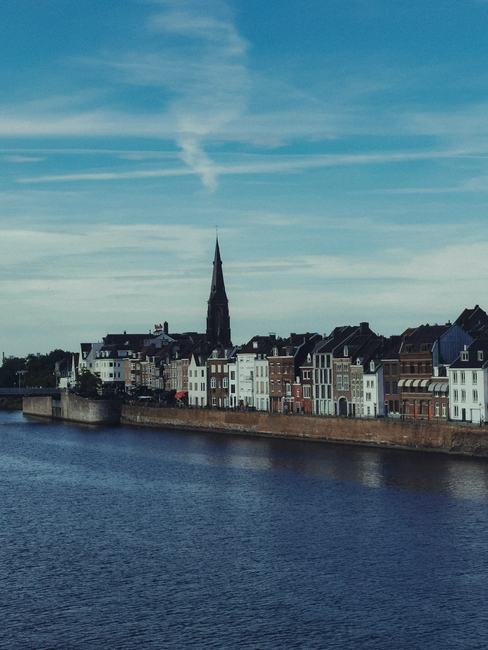
Maastricht feels like a different country from the rest of the Netherlands: at the far south of the province of Limburg, squeezed between Belgium and Germany, it has hills, vineyards, Roman roots, Romanesque churches and a Burgundian love of good food and wine. You come to sit on the café terraces of the Vrijthof, browse in a bookshop inside a Gothic church, walk the medieval walls and the Jeker quarter, explore the man-made caves under the Sint Pietersberg hill by lantern light, see modern art at the Bonnefanten and taste local wine and fruit tart (vlaai). It is about 2 hours 30 minutes from Amsterdam by direct train. Give it two days, or three with the Limburg hills or a hop over the border to Liège or Aachen.
Right now in Maastricht
- Wed10–24°C49–75°F5 mm rain
- Thu11–15°C52–59°F11 mm rain
- Fri9–13°C47–55°F6 mm rain
Top tours in Maastricht
See all tours for Maastricht →
From local operators, with prices and reviews; you check availability and book on Viator, our partner. We may earn a commission at no extra cost to you. How we earn money
Maastricht at a glance
- Best for: food and wine, old churches and city walls, caves and fortresses, shopping, carnival, Christmas markets and a slow weekend.
- How long: 1 day for the Vrijthof, the old town and a cave tour; 2–3 days to add the Bonnefanten, a vineyard and hiking in the hills.
- Best time: May to September for terraces and vineyards; February for carnival; late November to December for the Christmas market on the Vrijthof.
- Getting in: direct Intercity trains from Amsterdam (about 2 hours 30 minutes) and Utrecht (about 2 hours); Eindhoven Airport is about an hour away.
- Getting around: on foot; the centre is compact. Cave tours start at Fort Sint Pieter, a 20-minute walk south.
- Before you go: entry rules, money and general safety are in our Netherlands travel guide.
Maastricht, area by area
The River Maas (Meuse) divides the city. The old centre lies on the west bank; the station and the modern Céramique district are on the east bank, in Wyck. Three bridges, including the medieval Sint Servaasbrug, link them.
The Vrijthof and the old centre
The Vrijthof is Maastricht’s grand living room, a wide square lined with café terraces and overlooked by two churches. From there, shopping streets lead to the Markt with its 17th-century city hall and to the smaller squares around. Best for: first visits, food and nightlife.
Onze Lieve Vrouweplein and the Jekerkwartier
South of the centre, the tree-shaded Onze Lieve Vrouweplein square sits before the Romanesque Basilica of Our Lady. Beyond it, the Jekerkwartier is a quiet, picturesque quarter of narrow streets, little bridges over the River Jeker, old water mills and the medieval city walls, including the Helpoort, the oldest surviving city gate in the Netherlands. Best for: romantic walks and quiet stays.
Wyck and Céramique
Across the river, Wyck has the railway station and the Rechtstraat, a street of boutiques, delis and restaurants; south of it, the modern Céramique district, built on an old pottery works, is home to the Bonnefanten museum. Best for: arrivals by train and foodies.
Maastricht in brief: Romans, sieges and a treaty
Maastricht grew up where a Roman road crossed the Maas; its name comes from the Latin Mosae Trajectum, the crossing of the Meuse. Saint Servatius, an early bishop, was buried here in the 4th century, and his grave made the city a place of pilgrimage. Through the Middle Ages and later, Maastricht sat on a frontier fought over by Brabant, Liège, Spain, France and the Dutch Republic; it was besieged again and again, which is why it has so many walls, bastions and underground passages. During one siege in 1673, the French musketeer d’Artagnan was killed outside the walls, and a statue of him stands in the Waldeck Park.
In 1992, European leaders signed the Maastricht Treaty here, creating the European Union and paving the way for the euro. Today, with a large international university, Belgian and German neighbours a few kilometres away and the local dialect, Mestreechs, still widely spoken, the city feels both very local and very European.
Top things to see in Maastricht
Prices and hours below were checked on the official sites in October 2026. They change, so check before you go.
The Vrijthof, Sint Servaas and Sint Jan
On the Vrijthof stand the Basilica of Saint Servatius, built over the grave of the first bishop of Maastricht, with a treasury of medieval reliquaries, and the Gothic Sint-Janskerk with its red tower, which you can climb in season for a view over the city. The square is the stage for the city’s big events: carnival in February, André Rieu’s summer concerts in July and the Christmas market in winter.
Boekhandel Dominicanen
One of the world’s most beautiful bookshops fills a 13th-century Dominican church near the Markt, with a two-storey steel bookcase rising under the painted vaults and a café in the former choir. Entry is free; please browse quietly and buy something if you can.
The caves of the Sint Pietersberg
For centuries, people quarried soft marl stone from inside the Sint Pietersberg hill south of the city, leaving a maze of tens of kilometres of tunnels. They became a refuge during sieges and wars, and in the Second World War a vault in the North Caves sheltered Rembrandt’s The Night Watch and other national treasures. Walls are covered with centuries of charcoal drawings, signatures and graffiti.
Visiting. You can only enter with an official guide, and tours are run by Maastricht Underground. As of October 2026, guided tours of the North Caves (Grotten Noord) ran daily in Dutch and English, taking about 1 hour 10 minutes, from €9.95 for adults, €8.25 for ages 12–17 and €7.25 for ages 4–11, with under-4s free. Separate tours visit the Zonneberg Caves, used as air-raid shelters in the war, the Vault, the hilltop Fort Sint Pieter (1701) and a combination ticket covers the fort and the North Caves. Tours start from the ticket shop at Fort Sint Pieter (Luikerweg 80) or the Zonneberg entrance; tickets are also sold at the Maastricht Visitor Center. It is cold and damp inside all year (around 10 °C), so bring a warm layer and sturdy shoes, and never enter the tunnels without a guide.
Bonnefanten
The Bonnefanten museum, in a building by Aldo Rossi with a rocket-shaped dome by the river, shows old masters and medieval sculpture alongside bold contemporary art. As of October 2026 adults paid €22 and students €11, and under-18s entered free. It opens Tuesday to Sunday 11:00–17:00 and closes on Mondays, as well as on King’s Day, carnival Sunday, Christmas and New Year’s Day.
City walls, the Helpoort and the casemates
Maastricht was one of Europe’s most fortified cities. Walk along the remaining medieval walls through the Jekerkwartier, pass through the Helpoort (1229), and join a tour of the Casemates in the Waldeck Park, underground passages from the 18th-century fortifications.
Churches and cathedrals
- Basilica of Saint Servatius
Historic centres
- Vrijthof
Monuments
- Château Neercanne
- Sint Servaasbrug
Museums
- Bonnefanten Museum
Peaks and mountains
- Sint-Pietersberg (Mount Saint Peter)
Protected areas
- Savelsbos
Things to do in Maastricht
Eat and drink the Burgundian way
Southern Limburg loves its food. Try a slice of vlaai (fruit tart), zoervleis (a sweet-and-sour beef stew, usually with fries), local cheeses and Limburg beers, and settle into a terrace on the Vrijthof or the Onze Lieve Vrouweplein. The city has a long list of fine restaurants, some with Michelin stars, and lots of relaxed bistros.
Shop the lanes and markets
Maastricht is a favourite shopping city for Belgians, Germans and Dutch alike. The Stokstraat quarter has upmarket boutiques in old merchants’ houses, the streets around the Markt have the big names, and the Rechtstraat and Wyck have delis, wine shops and design stores. A large general market fills the Markt on Wednesday and Friday mornings, with a fish market on Fridays.
Take a boat on the Maas
River boats leave from the Maasboulevard for short city cruises and longer trips south along the Sint Pietersberg towards the Belgian border, with views of the fort and the cliffs. In summer you can combine a cruise with a cave visit. See our boat trips guide.
Visit a vineyard
The chalky slopes of South Limburg have the country’s best-known vineyards, some within the city limits on the Sint Pietersberg and others in the hills around. Many offer tours and tastings in summer and early autumn. See our wine tasting guide.
Walk and cycle the hills
South Limburg is the only hilly corner of the Netherlands. Walk the Sint Pietersberg and the ENCI quarry viewpoint at the city’s edge, or head into the Heuvelland around Valkenburg and Vaals, where the Vaalserberg (322 m) marks the country’s highest point and the meeting point of three borders. Cycle along the Maas to Belgium. See our hiking guide and cycling guide.
Carnival, Christmas and festivals
Carnival (Vastelaovend) is Maastricht’s biggest party, three days of costumes, brass bands and parades before Lent; in 2027 it runs from Sunday 7 to Tuesday 9 February, and the whole city dresses up. In 2026, the Christmas market Magisch Maastricht, with an ice rink and Ferris wheel on the Vrijthof, is scheduled from 27 November to 27 December. In March, the art and antiques fair TEFAF brings collectors from around the world (13 to 18 March 2027), and André Rieu’s open-air concerts fill the Vrijthof on summer evenings.
A note on coffeeshops
Unlike Amsterdam, Maastricht applies the “residents criterion”: coffeeshops may sell only to people who live in the Netherlands, so tourists are turned away. Do not buy from street dealers.
Activities and best months
- Boat tripsRederij Stiphout runs boat tours on the Maas, from short trips past the historic waterfront to a day trip to Liège and back, plus brunch and dinner cruises; Canoe Maastricht offers paddling in the Meuse valley.
- City sightseeingVisit Maastricht lists guided ways to see the city: a 1.5-hour walk through the highlights of Maastricht's history, bike tours over the Hoge Brug with views of the Sint Servaas Bridge and the Basilica of Our Lady, and guided tours of the caves of the Sint-Pietersberg with their charcoal drawings and inscriptions.
- HikingThe Cretaceous Walk on the Sint-Pietersberg (about 7 km, graded challenging: good fitness and sturdy shoes) passes the cave systems, the viewing platforms over the ENCI quarry lakes, Fort Sint Pieter, the Poppelmondedal valley and the Château Neercanne viewpoint.
Day trips from Maastricht
Valkenburg, 10 minutes by train, has a ruined hilltop castle, more caves and, in winter, Christmas markets underground. Belgium’s Liège is about 30 minutes by train, and Aachen in Germany, with Charlemagne’s cathedral, is under an hour by bus or train. The Belgian Voeren villages and the Drielandenpunt at Vaals are lovely by bike or car. Back north, Utrecht and Amsterdam are each two to two and a half hours away on direct trains.
Nearby destinations
- Düsseldorf86 km
- Cologne90 km
- Brussels93 km
- Antwerp98 km
- Ghent139 km
- Utrecht142 km
- Luxembourg City143 km
- Rotterdam144 km
Getting to Maastricht
By train. Direct Intercity trains run from Amsterdam Centraal (about 2 hours 30 minutes) and Utrecht (about 2 hours) via Eindhoven, every half hour. As of October 2026, a second-class single from Amsterdam cost about €33. Tap a contactless card at the gates or buy a ticket in the NS app. Trains also run to Liège in Belgium.
By air. Eindhoven Airport, with many low-cost flights, is about an hour away by bus and train. Maastricht Aachen Airport, north of the city, is small; Brussels and Düsseldorf airports are within two hours.
By car. The A2 motorway runs north to Eindhoven and Amsterdam, passing under the city in a tunnel. Parking in the centre is expensive; use a Park + Ride or a garage on the edge of the old town.
Getting around Maastricht
Walk: from the station it is about 10 minutes across the Sint Servaasbrug to the Markt and the Vrijthof, and most sights are within 20 minutes of each other. Buses (with contactless payment) reach the caves and outlying areas, and bikes are good for the riverbanks and hills.
When to go and how long to stay
Maastricht has the warmest summers in the Netherlands and slightly drier weather than the coast, with cold snaps in winter. The table uses the WMO 1991–2020 normals for Maastricht Aachen Airport, about 10 km north-east of the centre.
| Season | Average high / low | Rainy days per month | What it’s like |
|---|---|---|---|
| Spring (Mar–May) | 11–19 °C / 3–9 °C | 8–10 | TEFAF in March, blossom in the hills, terraces open; April is the driest month |
| Summer (Jun–Aug) | 22–24 °C / 12–14 °C | about 10 | The warmest weather in the country, vineyard visits, André Rieu concerts on the Vrijthof |
| Autumn (Sep–Nov) | 20 °C falling to 10 °C / 11 °C falling to 4 °C | 9–12 | Grape harvest, golden hills, a dry September; good walking weather |
| Winter (Dec–Feb) | 6–7 °C / about 1 °C | 11–13 | Christmas market, frosty mornings, carnival in February |
The airport station records about 760 mm of rain a year on about 126 days, less than the western Netherlands, with about 210 hours of sunshine in each of May and July. The caves stay at about 10 °C whatever the weather, which makes them a good choice on rainy or very hot days.
Maastricht in 1 day
Coffee and vlaai on the Vrijthof, then Sint Servaas and Boekhandel Dominicanen. Walk through the Onze Lieve Vrouweplein and the Jekerkwartier along the walls to the Helpoort, then up to Fort Sint Pieter for an afternoon tour of the North Caves. Finish with dinner on the Rechtstraat in Wyck.
Maastricht in 3 days
Add the Bonnefanten, the Zonneberg Caves or the Casemates, a vineyard tasting, and a day in the hills around Valkenburg and Vaals, or a trip to Liège or Aachen.
Weather month by month
Where to stay in Maastricht
- Around the Vrijthof: historic hotels, some in former convents and monasteries, in the middle of the action.
- Jekerkwartier: small boutique hotels and B&Bs in the quietest, prettiest corner.
- Wyck: good-value and design hotels near the station and the Rechtstraat restaurants.
Book well ahead for carnival, TEFAF and André Rieu concert nights, when prices soar.
Practical tips for Maastricht
- Book a cave tour: tours run at set times, with English tours less often than Dutch ones; reserve online.
- Mondays: the Bonnefanten is closed, and some shops open late.
- Coffeeshops are for residents: tourists cannot buy cannabis legally in Maastricht.
- Bring ID across borders: Belgium and Germany are a short ride away, and spot checks happen.
- Pay by card: cards and phones are accepted almost everywhere.
What to pack for Maastricht
A warm layer and closed shoes for the caves, comfortable shoes for cobbles and hills, a light rain jacket, smart-casual clothes for dinner, and a costume if you are visiting during carnival.
What to pack
- City walking shoesLisbon and Porto are steep, with polished limestone cobbles that get slippery, so grippy soles matter.
- Day packs and anti-theft bagsA small zipped or anti-theft bag makes crowded trams and viewpoints less stressful.
- Dry bags and phone pouchesSpray soaks phones and cameras on open boats to the Algarve caves and on whale-watching trips.
- Fleeces and warm layersIt is cooler at sea than on land, especially on morning whale-watching trips.
- HeadlampsLevada routes such as PR1 and PR9 pass through long, dark, wet tunnels.
- Hiking shoes and bootsMadeira's levadas and the Azores' crater rims are wet, rocky and slippery, so grippy shoes matter more than anywhere else in Portugal.
- Rain jacketsA windproof, waterproof shell keeps you warm on open boats, where wind and spray cool you quickly.
- Reef-friendly sunscreenSun reflects off the water on cruises and cave tours.
- Travel adapters and convertersPortugal uses Type C and F sockets at 230 V, so most visitors from outside Europe need an adapter.
- Trekking polesLong stone staircases and steep descents on Madeira's peaks and the Azores' crater rims are easier on the knees with poles.
- Water bottles and hydration packsAlgarve and Alentejo trails are hot and exposed with few refill points.
- Water shoesKayak and small-boat trips to the Algarve grottoes land on rock and wet sand.
Maastricht travel FAQ
Can you visit the Maastricht caves without a guide?
No. The tunnels under the Sint Pietersberg run for kilometres and are only open on guided tours. As of October 2026, North Caves tours ran daily, about 1 hour 10 minutes, from €9.95 for adults.
How cold is it in the Maastricht caves?
Cool all year, around 10 °C, and damp. Bring a jumper or jacket and closed shoes, even in summer.
How much is the Bonnefanten?
As of October 2026, €22 for adults and €11 for students, with under-18s free. It opens Tuesday to Sunday 11:00–17:00.
Can tourists go to coffeeshops in Maastricht?
No. Maastricht applies the residents criterion, so coffeeshops may only serve people who live in the Netherlands.
When is carnival in Maastricht?
In the three days before Ash Wednesday. In 2027 that is Sunday 7 to Tuesday 9 February, with parties starting on the Saturday evening.
When is the Maastricht Christmas market?
Magisch Maastricht on the Vrijthof is scheduled from 27 November to 27 December 2026, with an ice rink and a Ferris wheel; it is closed on Christmas Day.
How do I get from Amsterdam to Maastricht?
By direct Intercity train in about 2 hours 30 minutes, every half hour, via Utrecht and Eindhoven. A second-class single cost about €33 in October 2026.
How many days do you need in Maastricht?
Two days cover the old town, the caves and the Bonnefanten. A third lets you visit a vineyard, walk in the hills or cross into Belgium or Germany.
Is Maastricht worth visiting?
Yes. It is one of the most attractive cities in the Netherlands, with a different, more southern feel: hills, wine, Romanesque churches, caves and some of the best food in the country, all within walking distance.
Can you combine Maastricht with Belgium and Germany?
Easily. Liège is about 30 minutes by train, and Aachen is under an hour by bus or train. The three countries meet at the Drielandenpunt near Vaals, a short drive or bike ride away.
Plan your trip
Partner links: TravelerCenter may earn a commission if you book, at no extra cost to you.
🇳🇱 Useful Dutch phrases for Maastricht
All 38 Dutch phrases: restaurant, hotel, emergencies, romance (printable) →
Sources · last reviewed 4 October 2026
Researched and last reviewed on 4 October 2026. Cave and fort tours, prices and booking: Maastricht Underground (Explore Maastricht); Bonnefanten prices and hours: Bonnefanten; events: Visit Maastricht and TEFAF; trains: NS; climate: WMO 1991–2020 climate normals for Maastricht Aachen Airport. Prices, timetables and rules change, so check the official links before you go. For entry rules, money and coffeeshop rules across the country, see our Netherlands travel guide.
Also: visitmaastricht.com · KNMI normals 1991–2020, Maastricht Aachen Airport (climate)
Data: Weather: MET Norway (CC BY 4.0) · Rates: ECB · Costs: World Bank ICP and price levels · © OpenStreetMap contributors (ODBL) · Wikidata (CC0)