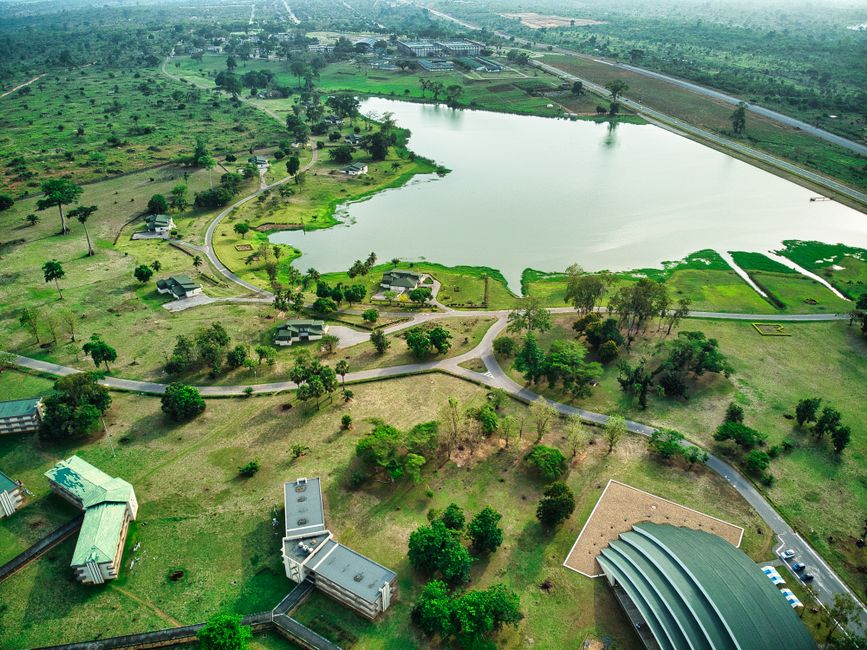
Côte d’Ivoire, the country once called the Ivory Coast in English, is one of West Africa’s most rewarding and least-known destinations: a land of palm-fringed Atlantic beaches and lagoons, rainforest national parks, green mountains in the west and savanna villages in the north, with a skyline of towers rising over the lagoon in Abidjan. Start in Abidjan, the lively economic capital, then add the colonial-era streets of Grand-Bassam, a UNESCO World Heritage Site, the beaches of Assinie, the giant basilica of Yamoussoukro, the waterfalls and mask traditions around Man, and the earthen mosques and craft villages around Korhogo. Most visitors from outside West Africa need an e-visa, applied for online and collected on arrival at Abidjan airport, and a yellow fever certificate. November to March, the main dry season, is the most comfortable time to visit the south. Give it a week to ten days.
Right now in Côte d'Ivoire
- Sat23–32°C74–90°FMostly clear
- Sun23–32°C73–89°F3 mm rain
- Mon22–31°C72–88°FMostly clear
Weather, sun and air quality here are for one point near the centre of Côte d'Ivoire, not the whole country; conditions elsewhere can differ. Readings refresh through the day.
Côte d’Ivoire: quick answers
- Best time to visit Côte d’Ivoire
- The south has a humid tropical climate with two rainy seasons, and the north has one. The table shows the official 1991–2020 climate averages that Côte d’Ivoire’s weather service submitted to the World Meteorological Organization: average daily high temperatures and total rainfall. More
- Places to visit in Côte d’Ivoire
- Abidjan, Grand-Bassam, Assinie and the east coast, Yamoussoukro, Man and the west, Korhogo and the north. More
- Things to do in Côte d’Ivoire
- Beaches, forests, culture and nightlife. More
- Entry rules for Côte d’Ivoire
- Citizens of ECOWAS (Economic Community of West African States) countries don’t need a visa. Almost everyone else, including citizens of the US, Canada, the UK, the EU and Australia, needs a visa, and the standard route is the official e-visa run by SNEDAI, the company appointed by the government, at snedai.com, which states that it is the only website officially recognized by the state for visa applications. The process has three steps: Online pre-enrollment and payment: fill in your details and upload a scan of your passport’s identity page, proof of a round-trip flight booking, and an invitation letter or a certificate of accommodation (from a hotel, for example). All three documents are compulsory, and a missing one means the application is rejected. The fee is 73 euros, including bank charges, paid by Visa or Mastercard, for a visa valid for three months with multiple entries. The online e-visa is for ordinary passports valid for at least six months; Approval: the immigration service replies by email, normally within 48 working hours, although checks can take longer, with a document carrying a barcode. An approved pre-enrollment is valid for three months, and the fee isn’t refunded if the application is refused; Collection on arrival: print the approval and the payment receipt, fly to Abidjan, and go to the “Visa aéroport” desks at arrival, open 24 hours a day, where your fingerprints and photo are taken and the visa is printed on the spot. Children under 12 don’t give fingerprints but must be present. More
- Is Côte d’Ivoire safe?
- Most visits to the main tourist areas are trouble-free. The main issues are practical: health, the sea, roads and petty crime in big cities. More
Côte d’Ivoire at a glance
Côte d’Ivoire lies on the Gulf of Guinea, between Liberia and Guinea to the west, Mali and Burkina Faso to the north and Ghana to the east. The south is coastal and humid, with long sandy beaches, mangroves and a chain of lagoons behind the shore; the center is a mix of forest and savanna; the west rises into the wooded mountains around Man; and the north is open savanna, hot and dry for much of the year. The country’s 2021 census counted about 29.4 million people. Yamoussoukro is the official capital, while Abidjan is by far the largest city and the hub for business, flights and nightlife.
French is the official language, and Dioula is widely used as a common language in markets and across the north; there are around sixty local languages in all. Côte d’Ivoire uses the West African CFA franc (XOF), shared with seven other countries, and keeps UTC+0 all year, with no summer time, the same as London in winter. It has five UNESCO World Heritage Sites: the Historic Town of Grand-Bassam, the Sudanese-style mosques of northern Côte d’Ivoire, Taï National Park, Comoé National Park and the Mount Nimba Strict Nature Reserve, shared with Guinea.
A short history
The coast was a meeting point for traders for centuries before French colonial rule, and kingdoms and chiefdoms such as the Baoulé, Agni and Kong states shaped the interior. Grand-Bassam became the first capital of the French colony in 1893, and Bingerville and then Abidjan followed. Côte d’Ivoire became independent on 7 August 1960, still celebrated as its national day. Cocoa and coffee built the modern economy, and the country is the world’s largest cocoa producer, which you’ll notice in the plantations of the south and center. Yamoussoukro, the home town of the first president, Félix Houphouët-Boigny, was made the official capital in 1983.
The regions for travelers
- Abidjan and the lagoons: the economic capital, spread around the Ébrié Lagoon, with the Plateau business district, markets, museums, the Banco forest and a huge food and music scene.
- The east coast: Grand-Bassam’s colonial streets and beaches, and the long sandy spit of Assinie between lagoon and ocean, a weekend escape from Abidjan.
- The west coast: quieter beaches, fishing towns and rocky coves around Sassandra, San-Pédro and Grand-Béréby, and the edge of the Taï rainforest.
- The center: Yamoussoukro and its basilica, Baoulé villages and the country’s second city, Bouaké.
- The west and the mountains: Man and the “Dent de Man” peak, waterfalls, forest trails, liana bridges and the region’s famous mask dances.
- The north: savanna country around Korhogo, with Senufo villages, weavers, painted cloth and the old earthen mosques of the Kong and Korhogo regions.
Videos of Côte d'Ivoire
Hand-picked travel videos from YouTube creators to help you picture the trip. They play from YouTube; the facts in this guide come from our own research.
Where to go: Abidjan, beaches, forest and savanna
Most first trips start in Abidjan, which has the main international airport, and combine the city with the coast to the east. With more time, head inland to Yamoussoukro, then west to Man or north to Korhogo. Distances are long, so many travelers fly, hire a car with a driver, or use the main bus companies.
Abidjan
West Africa’s great boomtown is a city of lagoons, bridges and districts with very different moods: the towers and cathedral of the Plateau, the leafy villas, restaurants and galleries of Cocody, the markets of Treichville and Adjamé, and the open-air bars and live music of Yopougon and Marcory. Visit the Musée des Civilisations de Côte d’Ivoire, founded in 1942, whose collection of more than 15,000 objects includes masks, textiles and sculpture from across the country; look up at the soaring St. Paul’s Cathedral; walk in the Banco National Park, a rainforest on the city’s edge; and take a boat across the lagoon. See our Abidjan guide for districts, sights and transport.
Grand-Bassam
About an hour east of Abidjan, Grand-Bassam was the colony’s first capital and its old quarter, the Quartier France, is listed by UNESCO for its colonial-era houses, warehouses and public buildings, many faded and some restored, laid out between the lagoon and the ocean. The National Costume Museum is housed in the old governor’s palace. The beachfront is lined with hotels and open-air restaurants, busy with Abidjan families at weekends, and the town is a center for crafts. The Abissa festival of the N’Zima people, usually held in late October or November, fills the town with drumming and dancing.
Assinie and the east coast
Further east, Assinie is a long, narrow strip of sand between the Aby Lagoon and the Atlantic, lined with beach hotels, private villas and lagoon-side restaurants. It is the classic weekend getaway from Abidjan, with boat trips on the lagoon, quiet mangroves and, for experienced surfers, Atlantic waves. Swimming in the ocean here and along the whole coast needs care, as described in the safety section below.
Yamoussoukro
The official capital, about three hours north-west of Abidjan by highway, is a planned city of wide boulevards and grand buildings. Its landmark is the Basilica of Our Lady of Peace, completed in 1989 and inspired by St. Peter’s in Rome, with a vast dome and acres of stained glass; it ranks among the largest churches in the world. The city also has the lakes around the former presidential palace and a large mosque. It makes a good stop on the way to Man or Korhogo.
Man and the west
The mountains around Man are the country’s greenest landscapes: forested hills, the tooth-shaped Dent de Man, waterfalls such as La Cascade, and villages connected by liana bridges. The region is the heartland of the Dan and Wè peoples, whose mask traditions, including stilt dancers, are among the most celebrated in West Africa; local guides can arrange visits and performances. To the south-west lies Taï National Park, one of the last large blocks of primary rainforest in West Africa and a UNESCO site, known for its chimpanzees and pygmy hippos; visits are organized through the national parks office (OIPR) and specialist operators.
Korhogo and the north
Korhogo is the main town of the Senufo country, a region of savanna, granite hills and villages famous for their crafts: the painted cloth of Fakaha, weaving at Waraniéné, woodcarving, blacksmiths and potters. The north is also home to the Sudanese-style mosques, built of earth and timber, eight of which are listed together by UNESCO, including those of Kong, Kouto and Tengréla. Comoé National Park, one of West Africa’s largest protected areas, lies in the north-east; it is remote and best visited with a specialist operator after checking access with the park office.
A few more worth your time
Bingerville, the second colonial capital, with its botanical garden and old governor’s residence on a hill above the lagoon; Sassandra and its fishing harbor, beaches and old colonial buildings; San-Pédro and the beaches and coves of Grand-Béréby, where sea turtles nest; Jacqueville, across the lagoon west of Abidjan, for quiet beaches; and the Baoulé villages around Bouaké and Yamoussoukro, known for gold jewelry, weaving and masks.
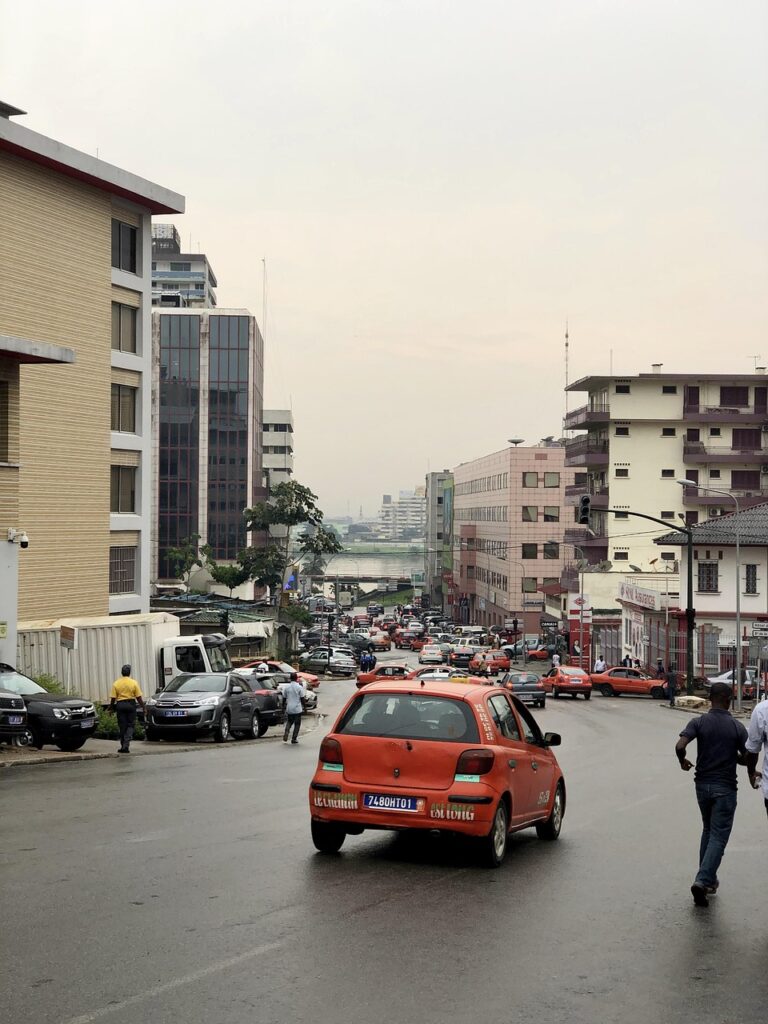
Abidjan Travel Guide
Plan a trip to Abidjan: the Plateau and its skyline, the Musée des Civilisations de Côte d'Ivoire, St. Paul's Cathedral, Banco National Park, the…
Best time to visit Côte d’Ivoire
The south has a humid tropical climate with two rainy seasons, and the north has one. The table shows the official 1991–2020 climate averages that Côte d’Ivoire’s weather service submitted to the World Meteorological Organization: average daily high temperatures and total rainfall.
| Area (weather station) | Average daily high | Wettest months | Driest months | Best months |
|---|---|---|---|---|
| Abidjan and the east coast (Abidjan airport) | 28–32 °C; coolest in August | May–June (441 mm in June); a second peak in October–November | December–February; August is a short dry spell | November–March |
| West coast (San-Pédro) | 28–32 °C | May–June (353 mm in June) | December–February | December–March |
| Center (Yamoussoukro) | 30–37 °C; hottest in February | May–June and September–October | December–January | November–February |
| West and mountains (Man) | not reported | August–September (307 mm in August) | December–February | November–February |
| North (Korhogo) | not reported | July–September (228 mm in August) | November–March, almost rainless | November–February |
Abidjan gets about 1,690 mm of rain a year, with about 97 days of measurable rain, but the rain falls mostly in short, heavy downpours. June is the wettest month, with about 16 rainy days, while January averages fewer than two. August is a surprise: it’s the coolest month on the coast and often cloudy, but with little rain. Inland, Yamoussoukro is the hottest station in the table, with average highs of about 36 °C in February. In the north, Korhogo receives about 1,140 mm a year, nearly all of it between April and October, and from December to February the dusty harmattan wind from the Sahara brings haze, dry air and cooler nights.
Côte d’Ivoire month by month
| Month | Weather | Highlights | Crowds and prices |
|---|---|---|---|
| January | Dry and sunny in the south; harmattan haze in the north | Beaches, savanna trips | Busy after the holidays |
| February | Hottest time inland; dry | Good for the north and the parks | Moderate |
| March | Hot; first storms in the south | Coast and Grand-Bassam | Moderate |
| April | Rains begin in the south | Easter; green landscapes | Quieter |
| May | Heavy rain on the coast | Fewer visitors; lush forest | Low season |
| June | Wettest month on the coast | Rainforest at its greenest | Low season |
| July | Rain easing on the coast; wet in the north | Summer holidays; family visits | Moderate |
| August | Cool, cloudy and fairly dry on the coast | Independence Day (August 7) | Moderate |
| September | Short rains in the south; wettest in the north | Green savanna | Quieter |
| October | Second rainy season in the south | Abissa festival season begins in Grand-Bassam | Quieter |
| November | Rains ending; dry season starts | Abissa; good beach weather returns | Rising |
| December | Dry, sunny and hot | Festive season in Abidjan and Assinie | Very busy; book early |
Festivals and public holidays
Côte d’Ivoire’s festivals mix traditional, Christian and Muslim calendars. Highlights include the Abissa in Grand-Bassam (late October or November), harvest and yam festivals in many regions, mask festivals in the Man region, and big music events in Abidjan, such as the FEMUA urban music festival, usually in spring. Fixed public holidays include New Year’s Day (January 1), Labor Day (May 1), Independence Day (August 7), Assumption (August 15), All Saints’ Day (November 1), National Peace Day (November 15) and Christmas (December 25); Easter Monday, Ascension, Whit Monday and the Muslim holidays of Eid al-Fitr, Eid al-Adha and the Prophet’s Birthday move each year. Banks and offices close on holidays, and beaches and hotels near Abidjan fill up.
How long to stay: sample itineraries
Abidjan to Grand-Bassam is about an hour by road, to Assinie about two hours, to Yamoussoukro about three hours on the highway, and to Man or Korhogo a long day’s drive, so domestic flights are worth considering for the far west and north.
4–5 days: Abidjan and the coast
Two or three nights in Abidjan for the Plateau, the museum, the Banco forest and the markets, then a night in Grand-Bassam and one or two in Assinie, or a day trip to each.
8–10 days: the classic loop
Add Yamoussoukro for the basilica, then continue to Man for two or three nights of hiking, waterfalls and mask traditions, returning via Abidjan, or swap Man for Korhogo and the northern craft villages.
2 weeks: the whole country, or Côte d’Ivoire and Ghana
Combine Abidjan, the east coast, Yamoussoukro, Man and Korhogo, flying one leg; or spend a week in Côte d’Ivoire and continue east along the coast into Ghana, crossing at Noé–Elubo. See our Ghana guide and our Accra guide. For a longer West African trip, Dakar is a short flight away; see our Senegal guide.
Entry, money and costs
Visas and the e-visa (last reviewed November 2026)
Citizens of ECOWAS (Economic Community of West African States) countries don’t need a visa. Almost everyone else, including citizens of the US, Canada, the UK, the EU and Australia, needs a visa, and the standard route is the official e-visa run by SNEDAI, the company appointed by the government, at snedai.com, which states that it is the only website officially recognized by the state for visa applications. The process has three steps:
- Online pre-enrollment and payment: fill in your details and upload a scan of your passport’s identity page, proof of a round-trip flight booking, and an invitation letter or a certificate of accommodation (from a hotel, for example). All three documents are compulsory, and a missing one means the application is rejected. The fee is 73 euros, including bank charges, paid by Visa or Mastercard, for a visa valid for three months with multiple entries. The online e-visa is for ordinary passports valid for at least six months.
- Approval: the immigration service replies by email, normally within 48 working hours, although checks can take longer, with a document carrying a barcode. An approved pre-enrollment is valid for three months, and the fee isn’t refunded if the application is refused.
- Collection on arrival: print the approval and the payment receipt, fly to Abidjan, and go to the “Visa aéroport” desks at arrival, open 24 hours a day, where your fingerprints and photo are taken and the visa is printed on the spot. Children under 12 don’t give fingerprints but must be present.
At the airport you need the payment receipt, the approval, a passport valid for at least six months, and your yellow fever certificate. Apply at least 10 working days before you travel. The e-visa is collected at Abidjan airport; if you plan to arrive by land, check visa arrangements with an Ivorian embassy before you travel.
Yellow fever and other health requirements
A yellow fever vaccination certificate is required for all arriving travelers aged 9 months and over, according to the US CDC and the e-visa rules. Have the vaccine at least 10 days before you go, and carry the original yellow card. Travelers arriving from another African country may also have to complete an online health declaration before arrival and show the QR code it generates; check the current rules with your airline before you fly.
Customs and currency rules
You can bring up to 500,000 CFA francs in cash into the country, and foreign currency must be declared on arrival. Declare anything that may be prohibited or taxable.
Money, cards and mobile money
The currency is the West African CFA franc (XOF, written FCFA), which has a fixed rate of 655.957 francs to the euro, set by the Central Bank of West African States (BCEAO); on 10 November 2026, the BCEAO’s rate for transfers was about 580–587 francs to the US dollar. The West African franc is shared with Senegal, Mali, Burkina Faso and other UEMOA countries, but it is not the same currency as the Central African franc used in Cameroon and its neighbors. Euros are the easiest currency to change. ATMs are common in Abidjan and in larger towns, and cards are accepted in bigger hotels, supermarkets and upscale restaurants, but carry cash for taxis, markets, maquis (open-air eateries) and anywhere outside the cities. Mobile money is everywhere, and small notes are useful.
Tipping
Tipping isn’t compulsory. In sit-down restaurants, leave about 5–10% if service isn’t included, round up for taxis once you’ve agreed the fare, and give a small tip to guides, drivers and hotel staff who’ve looked after you.
What a trip costs
Abidjan is one of West Africa’s more expensive cities, especially for hotels, while food in local maquis and transport outside the city are good value. These estimates per person per day are a planning guide as of November 2026:
| Style | Estimated cost per day | What that looks like |
|---|---|---|
| Budget | about 25,000–40,000 FCFA (US$45–70) | Simple hotel or guesthouse, maquis meals, shared taxis and intercity buses |
| Mid-range | about 60,000–110,000 FCFA (US$100–190) | Three- or four-star hotel, restaurant meals, a driver for some day trips, entrance fees |
| High-end | about 180,000 FCFA (US$300) and up | Top Abidjan or Assinie hotel, private driver-guide, domestic flights |
The figures are our estimates, not official statistics, and don’t include the e-visa (73 euros, about 48,000 FCFA).
Language and a few useful words
French is spoken everywhere in towns, often with lively local slang called Nouchi in Abidjan; English is limited outside upscale hotels and businesses, so a few words of French go a long way. Try bonjour (hello), bonsoir (good evening), merci (thank you), s’il vous plaît (please), combien? (how much?) and, in Dioula, i ni ce (hello, thank you). Greet people before asking a question: it matters here.
Getting there and getting around
By air
Almost all international flights land at Félix Houphouët-Boigny International Airport (ABJ) in Port-Bouët, on the south side of Abidjan, with direct flights from Paris, Brussels, Istanbul, Casablanca, Addis Ababa, Dubai and across Africa, and connections to North America via Europe or Africa. Air Côte d’Ivoire, the national airline, flies to many West and Central African cities and on domestic routes to towns such as San-Pédro, Korhogo, Man and Odienné, which saves long road journeys.
Buses, taxis and shared transport
Large private bus companies run comfortable coaches between Abidjan and the main towns, with stations in Adjamé and other districts. In towns, orange metered taxis in Abidjan and shared woro-woro taxis and gbaka minibuses on fixed routes are cheap but crowded; agree the fare before you get in if there’s no meter. Ride-hailing apps operate in Abidjan and are the easiest option for visitors. Avoid traveling between towns after dark.
Driving
You need your national license and a 1968 International Driving Permit, and you should always carry your license, permit, the car’s registration and insurance papers. Traffic drives on the right. The highway between Abidjan and Yamoussoukro is good, but many other roads are potholed, driving standards are poor, and livestock, pedestrians and broken-down trucks are common hazards, so many visitors hire a car with a local driver. Expect police checkpoints and keep your documents handy.
Crossing borders
The main road crossing to Ghana is at Noé–Elubo, east of Abidjan, on the coastal highway to Accra. A railway runs north from Abidjan to Ouagadougou in Burkina Faso, mainly for freight. Land borders can change their hours or status at short notice, so check before you set off, and make sure you have the right visa for the next country.
Culture, food and everyday etiquette
Food and drink
Ivorian food is one of the joys of a trip. The national staple is attiéké, steamed fermented cassava couscous, eaten with grilled fish or chicken and a spicy tomato and onion relish; garba, attiéké with fried tuna, is the classic street lunch. Try alloco (fried ripe plantain), kedjenou (chicken or guinea fowl slow-cooked in a sealed pot), foutou (pounded plantain or yam) with peanut or palm nut sauce, and placali, a cassava dough served with okra or fish sauce. The best places to eat are the maquis, open-air restaurants and bars where grilled fish and chicken are cooked to order. Drinks include fresh juices of bissap (hibiscus) and ginger, bangui (palm wine) in the villages, and local beers. Chocolate made from Ivorian cocoa is a good souvenir.
Music, crafts and shopping
Abidjan is a music capital of francophone Africa, the home of coupé-décalé and zouglou, and live music fills the maquis at weekends. For crafts, look for Baoulé masks and gold-weight figures, Senufo painted cloth and carvings from Korhogo, kente-style strip weaving, and the woven cloth of Waraniéné. Bargaining is normal in markets.
Etiquette
Greetings are important: say hello and ask how someone is before getting down to business. Use your right hand to give and receive things. Dress modestly in religious places and villages, and ask before photographing people or homes. Respect sacred forests and village customs, and if you visit a chief or village elder, a local guide will tell you whether a small gift or drink is expected.
Safety, health and connectivity
Most visits to the main tourist areas are trouble-free. The main issues are practical: health, the sea, roads and petty crime in big cities.
- Malaria: present throughout the country, and the US CDC recommends preventive medicine for all travelers. Use repellent, sleep under a net or in air conditioning, and see a doctor at once if you develop a fever, even after returning home.
- Yellow fever and other vaccines: a yellow fever certificate is required for entry. The CDC also recommends a meningitis vaccine for the northern savanna during the dry season, roughly December to June.
- The sea: the Atlantic coast has powerful waves and strong currents, and the undertow along much of the coast, including Grand-Bassam and Assinie, can be dangerous even for strong swimmers. Swim only where locals and hotels say it’s safe, stay in your depth, and never swim alone or after drinking.
- Road safety: road accidents are the biggest risk. Avoid traveling between towns after dark, choose reputable bus companies or drivers, and wear seatbelts.
- City precautions: keep valuables out of sight, use ride-hailing apps or taxis arranged by your hotel, especially at night, and use ATMs inside banks or malls. Keep your card in sight when paying.
- Documents and photos: carry your original passport, as copies aren’t always accepted. Photography is forbidden near military sites, government buildings, radio and TV stations, the Presidency and Abidjan airport.
- Emergency numbers: police 110, 111 or 170; fire 180; ambulance (SAMU) 185.
Medical facilities in Abidjan are reasonable but expensive, and limited elsewhere, so take insurance that covers treatment and evacuation. Drink bottled or filtered water. Conditions change, so check current local information shortly before you travel.
Connectivity and power
Orange, MTN and Moov Africa run the mobile networks, with good 4G coverage in towns and along main roads; local SIM cards are cheap and need your passport for registration. Wi-Fi is common in hotels and cafés in Abidjan. Plugs are the European two-pin type (C and E) at 220 volts; see our travel adapters guide.
Things to do: beaches, forests, culture and nightlife
- Beaches and lagoons: Assinie, Grand-Bassam, Jacqueville, Sassandra and Grand-Béréby. See our beaches guide.
- Lagoon boat trips: pirogues and boats on the Ébrié and Aby lagoons, mangroves and island villages. See our boat trips guide.
- Surfing: Assinie and the west coast, for experienced surfers only. See our surfing guide.
- Hiking: the Banco forest in Abidjan, the Dent de Man and the waterfalls and liana bridges of the west. See our hiking guide.
- City sightseeing: Abidjan’s Plateau, museums and markets, and Yamoussoukro’s basilica. See our city sightseeing guide.
- Wildlife: chimpanzees and forest wildlife in Taï, and savanna wildlife in Comoé, with specialist operators.
- Culture: mask dances around Man, craft villages around Korhogo, and live music in Abidjan’s maquis.
What to pack for Côte d’Ivoire
Pack light, breathable cotton or linen clothes, a sun hat and high-factor sunscreen, sandals and comfortable walking shoes, and insect repellent with DEET or picaridin. A light rain jacket or umbrella is useful from April to July and in October–November; hiking shoes help on trails around Man. Bring a cover-up for religious sites, your yellow fever card, printed copies of your e-visa approval and receipt, a power bank, and euros in cash to change.
Côte d’Ivoire travel FAQ
Do I need a visa for Côte d’Ivoire?
Yes, unless you’re a citizen of an ECOWAS country. Apply online for the e-visa at snedai.com, then collect the visa at Abidjan airport on arrival.
How much is the Côte d’Ivoire e-visa?
73 euros, including bank charges, for a visa valid for three months with multiple entries, paid online by Visa or Mastercard. The fee isn’t refunded if the application is refused.
Can I get a visa on arrival in Abidjan?
Only with an approved e-visa pre-enrollment. You apply and pay online first, then your fingerprints and photo are taken and the visa is printed at the airport.
Do I need a yellow fever vaccination for Côte d’Ivoire?
Yes. A yellow fever certificate is required for all arriving travelers aged 9 months and over, and you must show it with your e-visa documents at the airport.
Is there malaria in Côte d’Ivoire?
Yes, throughout the country and all year. The US CDC recommends preventive medicine for all travelers.
What is the best time to visit Côte d’Ivoire?
November to March, the main dry season on the coast, for beaches and sightseeing; November to February for the north and the mountains. May and June are the wettest months in Abidjan.
What currency is used in Côte d’Ivoire?
The West African CFA franc (XOF), fixed at 655.957 francs to the euro. Carry cash, as cards are accepted mainly in bigger hotels and shops.
What is the capital of Côte d’Ivoire?
Yamoussoukro is the official capital, but Abidjan is the largest city, the economic capital and the main gateway for visitors.
Is it safe to swim at the beaches?
Take care: strong waves and currents make the ocean dangerous along much of the coast. Swim only where locals and hotels say it’s safe, and never alone.
How many days do I need in Côte d’Ivoire?
Four or five days for Abidjan, Grand-Bassam and Assinie; eight to ten to add Yamoussoukro and Man or Korhogo.
What language is spoken in Côte d’Ivoire?
French is the official language and is spoken everywhere in towns; Dioula and many local languages are widely used. English is limited.
What is the emergency number in Côte d’Ivoire?
Police 110, 111 or 170; fire 180; ambulance (SAMU) 185.
Plugs and power in Côte d'Ivoire
Côte d'Ivoire uses 220 V, 50 Hz and these plugs (left) and wall sockets (right):
European round two-pin sockets.
All plug types and voltages by country → · Check what you need to pack →
Plan your trip
Partner links: TravelerCenter may earn a commission if you book, at no extra cost to you.
🇫🇷 Useful French phrases for Côte d'Ivoire
All 38 French phrases: restaurant, hotel, emergencies, romance (printable) →
Before you go: guidebooks and travel gear
Affiliate links: we may earn a commission at no extra cost to you. As an Amazon Associate we earn from qualifying purchases. We pick items for the place, not for the commission. How we earn money
Sources · last reviewed 10 November 2026
Researched and last reviewed on 10 November 2026. The e-visa process, fee, validity, documents and airport enrollment: SNEDAI, the government’s official e-visa provider; yellow fever, malaria and meningitis: the US CDC; the ECOWAS exemption, customs and cash limits, health declaration, passport, photography and driving rules, and emergency numbers: the UK government’s factual entry and safety pages, used for practical facts only; the euro parity and exchange rates: the Central Bank of West African States (BCEAO); climate averages: the official 1991–2020 normals submitted to the World Meteorological Organization; the museum’s founding and collection: the Musée des Civilisations de Côte d’Ivoire. The census total, UNESCO listings, history, regions, attractions, festivals and public holidays, transport details, sockets, food and typical prices come from general references or are our estimates, and are flagged for checking. Rules and prices change, so check the official sites before you go.
Data: Weather: MET Norway (CC BY 4.0) · Rates: ECB · Wikidata (CC0)