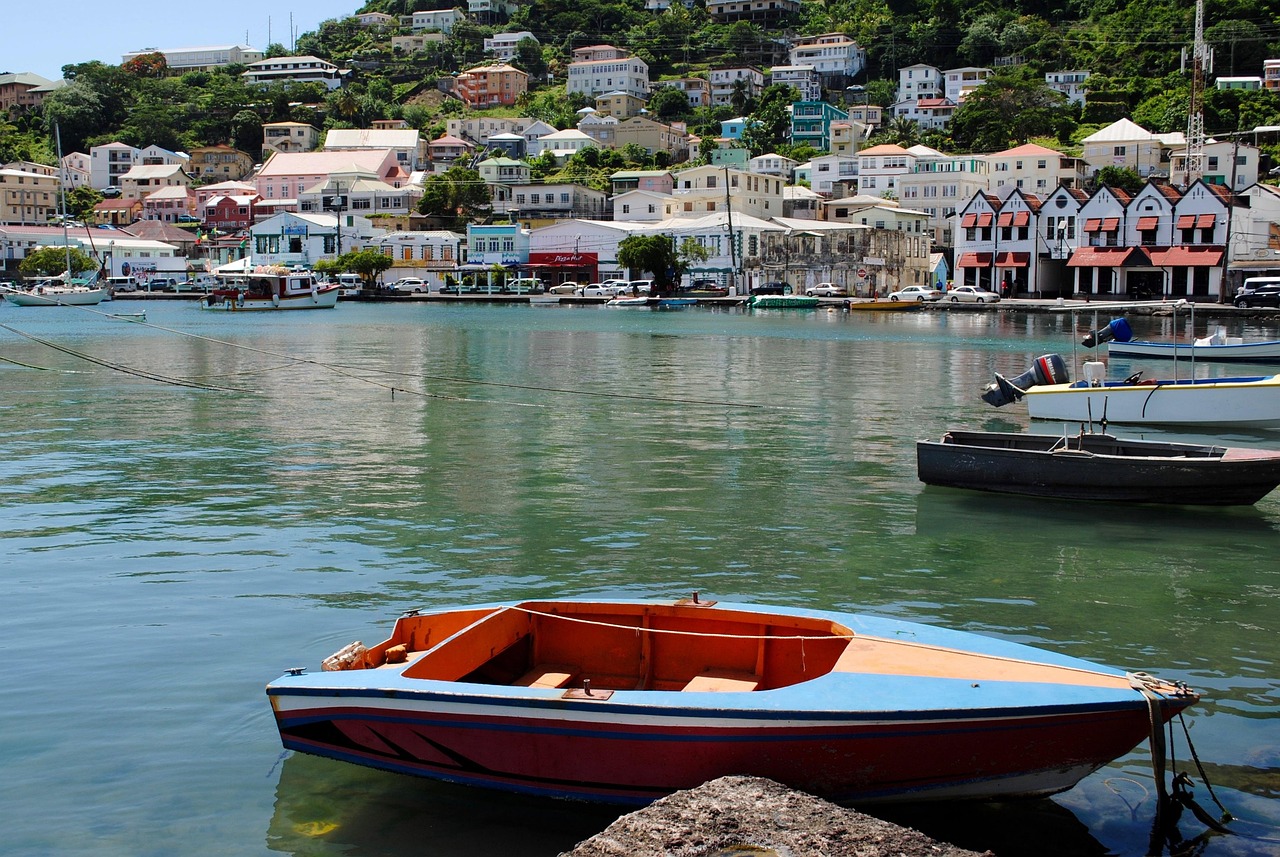
Grenada is a green, mountainous island at the southern end of the Windward Islands, about 160 km (100 miles) north of Venezuela, with two smaller sister islands to the north, Carriacou and Petite Martinique. It is known as the Spice Isle: nutmeg, mace, cinnamon, cloves and cocoa grow on its hillsides, and nutmeg even appears on the national flag. The capital, St. George’s, curves around a deep horseshoe harbor called the Carenage, its red-roofed houses climbing the hills to old forts, and just south of town, Grand Anse is one of the Caribbean’s best-loved beaches. Offshore lies the Underwater Sculpture Park, which the Grenada Tourism Authority calls the world’s first; inland, the Grand Etang rainforest has a crater lake, hiking trails and waterfalls. Grenada is relaxed and uncrowded, with tree-to-bar chocolate makers, rum distilleries and a riotous carnival, Spicemas, every August. English is the official language, the currency is the Eastern Caribbean dollar, and you drive on the left. The dry season runs from about January to May. Give it a week, with a day or two on Carriacou if you can.
Right now in Grenada
- Sat26–30°C79–85°F6 mm rain
- Sun26–29°C80–85°F2 mm rain
- Mon25–30°C77–85°F3 mm rain
Weather, sun and air quality here are for one point near the centre of Grenada, not the whole country; conditions elsewhere can differ. Readings refresh through the day.
Grenada: quick answers
- Best time to visit Grenada
- Grenada is warm all year, with afternoon highs of about 30–31 °C (86–88 °F). More
- Places to visit in Grenada
- St. George’s, Grand Anse and the south-west beaches, The Underwater Sculpture Park, Grand Etang, waterfalls and the rainforest, Spices, chocolate and rum, Carriacou and Petite Martinique. More
- Things to do in Grenada
- Diving, hiking, spices and sailing. More
- Entry rules for Grenada
- According to the Grenada Tourism Authority, visitors need a passport valid for at least six months from arrival and a return or onward ticket. More
Grenada at a glance: overview and geography
The country has three inhabited islands. Grenada itself, about 34 km (21 miles) long and 19 km (12 miles) wide, has nearly all the people, who number around 115,000, and all the main sights. It is volcanic, with a forested spine rising to Mount St. Catherine, about 840 m (2,760 feet), crater lakes at Grand Etang and Lake Antoine, and rivers tumbling down to the coast in waterfalls; the Grenada Tourism Authority counts 40 beaches, 15 waterfalls and about 30 dive sites across the three islands. The south-west, around St. George’s and Grand Anse, is drier and has most hotels. Carriacou, about 20 minutes away by air, is small, flat-topped and laid-back, with boat-building villages and white-sand islets; Petite Martinique, beside it, is smaller still.
Arawak-speaking Amerindians from South America were the first settlers, leaving petroglyphs on boulders at places such as Duquesne Bay; later came the Kalinago (Carib) people. The French settled the island in 1649 and called it La Grenade, a name derived from the Spanish Granada of the 1520s, and Britain took control in 1763; after that, the island changed hands between the two powers several times, which is why French place names, a French-based patois and Catholic churches survive alongside English. Enslaved Africans worked sugar, then cocoa and nutmeg estates, and East Indian laborers came after emancipation; all these strands shape Grenadian food, music and festivals today. Grenada became independent on February 7, 1974, and remains a Commonwealth realm.
Time zone: Grenada uses Atlantic Standard Time (UTC−4) all year, with no daylight saving time, one hour ahead of New York in winter and the same in summer.
The regions
- St. George’s: the capital and cruise port, with the Carenage, the market, Fort George and Fort Frederick. See our St. George’s travel guide.
- Grand Anse and the south-west: Grand Anse Beach, Morne Rouge, the resorts of the south coast, the airport at Point Salines and the marinas and coves around Lance aux Épines and True Blue.
- The west coast: fishing villages such as Gouyave, home of the Friday Fish Fry, and the bays of the Underwater Sculpture Park at Molinere.
- The interior: Grand Etang National Park and Forest Reserve, its crater lake, rainforest trails and waterfalls such as the Seven Sisters.
- The north and east: the cocoa and spice estates around Belmont, the Levera National Park beaches where turtles nest, Bathway Beach and the town of Grenville.
- Carriacou and Petite Martinique: the sister isles, with Hillsborough, Tyrrel Bay, Sandy Island and the Oyster Bed mangroves.
Videos of Grenada
Hand-picked travel videos from YouTube creators to help you picture the trip. They play from YouTube; the facts in this guide come from our own research.
Where to go: St. George’s, Grand Anse, the rainforest and Carriacou
Grenada is small, but its mountain roads are steep and winding: St. George’s to Grand Anse is about 10 minutes, St. George’s to Grand Etang about half an hour, and a full loop of the island takes most of a day. Most visitors stay in the south-west and take day trips.
St. George’s
One of the prettiest harbor towns in the Caribbean, St. George’s spills down two ridges to the Carenage, where fishing boats and yachts tie up in front of old stone warehouses. Walk the Carenage, browse the spice stalls of Market Square, visit the Grenada National Museum, and climb to Fort George above the harbor mouth or Fort Frederick on the hill behind for views over the town and the coast. Our St. George’s guide has the details.
Grand Anse and the south-west beaches
Grand Anse Beach, a long curve of pale sand and calm water just south of the capital, is the island’s most famous beach, with hotels, beach bars, a craft market and views back to St. George’s. Beyond it, Morne Rouge (BBC Beach) is a quieter, sheltered cove, and the south coast has small bays, marinas and sailing charters.
The Underwater Sculpture Park
In the Molinere Beauséjour Marine Protected Area, a few minutes north of St. George’s by boat, sculptures on the seabed have become artificial reefs covered in coral and sponges. The first, by the British artist Jason deCaires Taylor, were installed in 2006, and the best known, Vicissitudes, is a ring of 26 children holding hands about 5 m (16 feet) below the surface, so it can be seen by snorkelers as well as divers. Later works include figures by Grenadian sculptor Troy Lewis and the Coral Carnival masqueraders from Spicemas. The marine protected area fee is EC$10 per person, paid through the Grenada Tourism Authority or your tour operator.
Grand Etang, waterfalls and the rainforest
The road over the mountains from St. George’s to Grenville climbs into Grand Etang National Park and Forest Reserve, where a crater lake sits among cloud forest. Short trails circle the lake, longer ones lead to Mount Qua Qua and the Seven Sisters falls, and you may see mona monkeys. Elsewhere, Annandale, Concord and the Royal Mt. Carmel waterfalls are popular stops; the island has some of the region’s best river swimming after rain.
Spices, chocolate and rum
Grenada’s agriculture is part of the sightseeing. Visit a nutmeg processing station at Gouyave or Grenville to see the nuts sorted and the red mace dried; tour the 17th-century Belmont Estate for cocoa and a farm lunch; taste tree-to-bar chocolate made on the island; and see rum distilled the old way, with a water wheel, at River Antoine. In St. George’s, the House of Chocolate tells the story of Grenadian cocoa.
Carriacou and Petite Martinique
Carriacou is quiet and friendly, with the little capital of Hillsborough, the yacht anchorage of Tyrrel Bay, the boat-building village of Windward, and beaches such as Paradise Beach and Anse La Roche. Day trips go to Sandy Island, a sandbar with palms and snorkeling, and the Oyster Bed mangroves. Petite Martinique, a short boat ride away, is known for its sailors and its Whitsuntide regatta. In July 2024, Hurricane Beryl made landfall on Carriacou as a category 4 storm; the US National Hurricane Center reported that most buildings on Carriacou and many on Petite Martinique were damaged or destroyed. The tourism authority says the islands are rebuilding and welcoming visitors again, so check what is open before you go.
A few more worth your time
Levera National Park and Bathway Beach in the far north-east; Lake Antoine, a second crater lake; Fort Matthew and the Richmond Hill forts above St. George’s; the Tower Estate gardens; Laura’s Herb and Spice Garden; the Amerindian petroglyphs at Duquesne Bay; Gouyave’s Friday Fish Fry; and a sunset sail along the west coast.
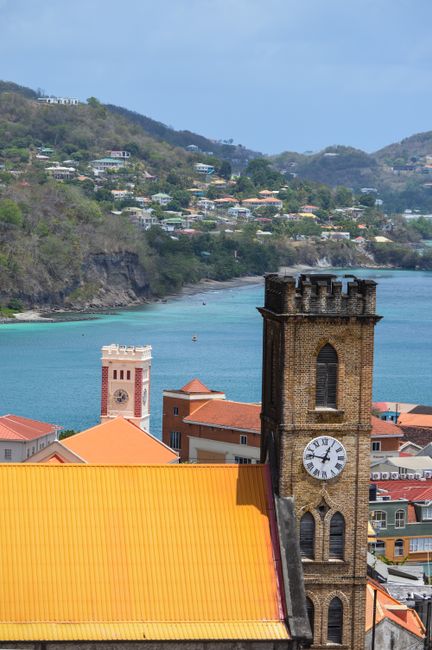
St. George’s Travel Guide
Plan a visit to St. George's, Grenada's capital: the Carenage and its horseshoe harbor, Market Square and the spice stalls, Fort George and Fort…
Best time to visit Grenada
Grenada is warm all year, with afternoon highs of about 30–31 °C (86–88 °F). According to the Grenada Tourism Authority, the dry season runs from January to May and the rainy season from June to December, when showers are heavier and more frequent; the mountains are much wetter and cooler than the coast. The table uses the World Meteorological Organization’s (WMO) 1991–2020 climate normals for Maurice Bishop International Airport, on the dry south-west tip near Grand Anse, which records about 1,150 mm (45 inches) of rain a year.
| Season (Maurice Bishop Airport, 1991–2020) | Average afternoon high | Average night low | Rainfall a month | What it’s like |
|---|---|---|---|---|
| Winter (Dec–Feb) | 30 °C (85–86 °F) | 23–24 °C (74–75 °F) | 39–105 mm (1.5–4.1 in) | The dry season begins; breezy and sunny; peak season. |
| Spring (Mar–May) | 30–31 °C (86–87 °F) | 24–25 °C (75–78 °F) | 26–53 mm (1.0–2.1 in) | The driest months, with March the driest; Chocolate Fest and the Dive and Conservation Fest in May. |
| Summer (Jun–Aug) | 31 °C (87–88 °F) | 25 °C (77 °F) | 123–143 mm (4.9–5.6 in) | The rainy season starts, with about 15 rainy days a month; Spicemas in August. |
| Autumn (Sep–Nov) | 31 °C (87–88 °F) | 25 °C (76–78 °F) | 122–164 mm (4.8–6.5 in) | Showery and humid, with November the wettest; peak storm season; quiet and cheap. |
Rain usually falls in short, heavy bursts: the airport averages only 5 days with 1 mm or more of rain in March and April, against about 15 in July, August and November. The sea is warm enough for swimming all year.
Hurricanes and storms
The Atlantic hurricane season runs from June 1 to November 30, according to the US National Hurricane Center. Grenada lies near the southern edge of the hurricane belt and is hit less often than islands farther north, but it is not immune: Hurricane Ivan struck the main island in 2004, and Hurricane Beryl made landfall on Carriacou on July 1, 2024, with winds of about 120 knots (category 4). If you travel between June and November, take insurance that covers storms and follow the forecasts.
Crowds and prices through the year
Mid-December to April is high season, with the highest hotel prices and the most cruise calls; nearly 370,000 cruise passengers visited in 2025, according to figures reported by the Grenada Tourism Authority. August is busy again for Spicemas, when many Grenadians living abroad come home. May, June and the autumn months are quieter and cheaper.
Festivals and public holidays
Spicemas, Grenada’s carnival, takes place in August, with calypso and soca competitions, the pre-dawn J’ouvert, when the Jab Jab masqueraders cover themselves in black oil, and the costumed parades of Carnival Monday and Tuesday. The tourism authority also lists Carriacou’s pre-Lenten carnival, the Carriacou Maroon and String Band Music Festival (April), the Grenada Chocolate Fest and the Dive and Conservation Fest (May), the Petite Martinique Whitsuntide Regatta, the Carriacou Regatta (August), the Carriacou Corn Festival (October) and the Carriacou Parang Festival (December). Public holidays include New Year’s Day, Independence Day (February 7), Good Friday, Easter Monday, Labour Day (May 1), Whit Monday, Corpus Christi, Emancipation Day (early August), Carnival Monday and Tuesday, Thanksgiving Day (October 25), Christmas Day and Boxing Day.
How long to stay: sample itineraries
A base in the south-west, around Grand Anse, works for most of the island. Carriacou is about 20 minutes away by air or about 90 minutes by fast ferry.
4–5 days: St. George’s, beaches and the sculpture park
Day 1: Grand Anse Beach. Day 2: St. George’s, the Carenage, the market and the forts. Day 3: a snorkel or dive trip to the Underwater Sculpture Park, then Morne Rouge. Day 4: Grand Etang, a waterfall and a spice tour. Day 5: Belmont Estate and the north-east, or a lazy beach day.
7–8 days: Grenada and Carriacou
Add Gouyave’s Friday Fish Fry, the River Antoine rum distillery and Levera, then two or three nights on Carriacou for Sandy Island, Paradise Beach and the slow island pace.
10–14 days: add a neighbor
Grenada combines well with Trinidad and Tobago, a short flight to the south, or with Barbados and Saint Lucia to the north. Sailors often continue from Carriacou up through the Grenadines.
Entry, money, fees and costs
Entry and visas (last reviewed November 2026)
According to the Grenada Tourism Authority, visitors need a passport valid for at least six months from arrival and a return or onward ticket. A visa is not required for citizens of the United States, Canada, the United Kingdom, Commonwealth countries, South Korea, Japan and most Caribbean and European countries; others should check the government’s list of nationalities that need a visa, published by Grenada’s embassies, and apply through a Grenadian mission before travel. Grenada’s Ministry of Foreign Affairs adds that cruise passengers of any nationality staying less than 24 hours do not need a visa, but still need a passport valid for at least six months. Have the address of your accommodation ready for the immigration form.
The Eastern Caribbean dollar, cards and tipping
The currency is the Eastern Caribbean dollar (EC$ or XCD), fixed at EC$2.70 to US$1 and shared with seven other islands. US dollars are widely accepted, but you will often get change in EC dollars at a slightly lower rate; the tourism authority advises changing money at banks, which it says pay about EC$2.67 per US dollar in cash. Hotels and car rental firms accept major cards; carry cash for buses, markets, rum shops and small beach bars. Banks are open from 8 am to 2 pm Monday to Thursday and to 4 pm on Friday. Most hotels and restaurants add a 10% service charge, and further tips are at your discretion.
Taxes and the marine park fee
According to Grenada’s Ministry of Finance, VAT is charged at 15% on most goods and services and at 10% on hotel accommodation and dive operations, so check whether quoted room rates include VAT and service. Snorkelers and divers visiting the Molinere Beauséjour Marine Protected Area, home of the Underwater Sculpture Park, pay a marine protected area fee of EC$10 (about US$3.70) per person, which tour and dive operators usually collect.
Typical travel costs
Grenada has some exclusive resorts, but guesthouses, apartments, local buses and roadside food keep it affordable. These estimates per person per day, sharing a room, are a planning guide as of November 2026:
| Style | Estimated cost per day | What that looks like |
|---|---|---|
| Budget | about US$80–140 | Guesthouse or apartment near Grand Anse, local buses, roti and oil down, free beaches and the Friday Fish Fry |
| Mid-range | about US$200–350 | 3- or 4-star hotel on Grand Anse, a rental car for a day or two, a sculpture park snorkel trip, a spice and waterfall tour, restaurant dinners |
| High-end | about US$600+ | A luxury resort on the south coast, private island tours, sailing charters and fine dining |
Add VAT and service charges to room rates. The figures are our estimates, not official statistics.
Getting there and getting around
Flights to Grenada (GND)
Maurice Bishop International Airport (GND) is at Point Salines on the south-west tip, about 6.5 km (4 miles) from St. George’s and next to Grand Anse. The Grenada Tourism Authority lists nonstop services from New York (JetBlue), Miami (American Airlines) and Atlanta (Delta, weekly), from Toronto (Air Canada Vacations), from London Gatwick (British Airways and Virgin Atlantic) and, in winter, from Frankfurt (Condor), plus regional flights to Barbados, Trinidad, Antigua and other islands, including Caribbean Airlines’ service to Trinidad. Schedules are partly seasonal, so check with the airlines.
Cruise ships and yachts
Cruise ships dock at the purpose-built terminal on the harbor in St. George’s, within walking distance of the town. Grenada is also a major sailing hub, with marinas on the south coast and at Port Louis in St. George’s, and anchorages at most bays; yachts clear in with customs and immigration at designated ports of entry.
To Carriacou and Petite Martinique
According to the tourism authority, SVG Air flies from Maurice Bishop International Airport to Carriacou’s Lauriston Airport in about 20 minutes, and the Osprey fast ferry leaves from the Carenage in St. George’s for Carriacou, a journey of about 90 minutes along the west coast; other boats, such as the MV Dolly C and the Tyrrel Bay Express, also serve the route. Timetables have changed since Hurricane Beryl, so check with the operators before planning your day.
Buses, taxis and water taxis
Grenada’s privately run minibuses are a cheap and lively way to get around. According to the tourism authority, zone stickers on the windshield show the route, a conductor collects fares of EC$2.50 to EC$6.50 depending on the distance, and buses run from 6 am to 9 pm Monday to Saturday, with few on Sundays. The main terminal is in St. George’s, near the Esplanade. Taxis wait at the airport, the cruise terminal and the main hotels; they are not metered, so agree the fare first. Water taxis cross between the Carenage and Grand Anse and run to nearby beaches.
Driving
Drive on the left. You need a local driving permit, which costs EC$60 on presentation of your license at the traffic department of the Central Police Station on the Carenage, according to the tourism authority; many car rental firms issue it for you. Rental cars cost about US$50–75 a day, and most firms require drivers to be 25 or over. Roads are narrow, steep and winding, with blind bends and fast minibuses, so drive slowly and use your horn on hairpins.
Beaches, diving and the sea
The calmest beaches are on the Caribbean side of the south-west: Grand Anse, Morne Rouge, Magazin and Portici, plus Black Bay on the west coast. The Atlantic beaches of the north-east, such as Bathway and Levera, are wilder, with reefs and stronger currents. Grenada is one of the Caribbean’s best dive destinations, with the Underwater Sculpture Park, reefs, drift dives and the wreck of the cruise liner Bianca C, which sank off the south coast in 1961 and is one of the region’s largest diveable wrecks. See our beaches guide, plus snorkeling, diving and boat trips.
- Protect the reef: the tourism authority notes that removing coral from the sea, or wildlife from the forest or national parks, is strictly prohibited.
- Marine park fee: EC$10 per person for the Molinere Beauséjour Marine Protected Area.
- Turtles: leatherback turtles nest on the northern beaches, including Levera, from about March to June; join a guided turtle watch.
- Currents: swim at sheltered west-coast beaches, and be careful on the Atlantic side.
- Footwear: wear water shoes for rocky entries and river pools.
Health, practical tips and connectivity
Health and emergencies
The General Hospital is in St. George’s, the Princess Alice Hospital in St. Andrew’s and the Princess Royal Hospital on Carriacou, with private clinics around the island. According to the Government of Grenada, call 911 for police and fire (fire also on 473-440-2112), and 434 for an ambulance from the General Hospital in St. George’s; the ambulance numbers for the Princess Alice Hospital and Carriacou are 724 and 774. The tourism authority says tap water is very safe to drink. Use high-factor sunscreen and insect repellent, and carry travel insurance that includes evacuation. Grenada has no venomous snakes.
Practical tips
- Swimwear: according to the tourism authority, swimwear is not permitted on main roads or in bars, restaurants and shops; wear a cover-up.
- No camouflage: civilians may not wear camouflage prints in Grenada, so leave camo clothing at home.
- Shop hours: shops generally open 8 am to 4 pm on weekdays and 8 am to 1 pm on Saturdays; craft shops open on Sundays when cruise ships are in.
- Animals: importing pets needs a permit and health documents, and the Government Veterinary Officer must be told your port and time of arrival.
- Taxis: agree the fare, and the currency, before you set off.
Connectivity and power
Flow and Digicel are the mobile networks, and local SIM cards and eSIMs are easy to buy; the area code is +1 473. Wi-Fi is standard in hotels. The tourism authority gives the supply as 220 volts at 50 Hz, and the CIA World Factbook lists British three-pin type G sockets. Visitors from North America need an adapter and, for devices that are not dual-voltage, a converter; most hotels have dual-voltage shaver sockets. See our travel adapters guide.
Food, spices and Grenadian culture
The national dish is oil down, a one-pot stew of breadfruit slow-cooked with salted meat or fish, dumplings and vegetables in coconut milk, callaloo and turmeric, often cooked outdoors for a crowd. Look out also for roti, callaloo soup, lambi (conch), fish cakes, nutmeg ice cream and jam, cocoa tea and spice-laced rum punch topped with grated nutmeg. Grenada makes its own rums, from River Antoine’s strong, rustic spirit to Clarke’s Court and Westerhall, and its own craft beer. Calypso and soca dominate during carnival, while parang is sung at Christmas and string bands play on Carriacou, where the Big Drum dance keeps African traditions alive. The national bird is the rare Grenada dove, and the national flower the bougainvillea. English is the official language, but you will hear a French-based patois in villages. Grenadians are warm and polite: say “good morning” or “good afternoon” before a question.
Things to do: diving, hiking, spices and sailing
- Diving and snorkeling: the Underwater Sculpture Park, the Bianca C wreck and the reefs around the south coast and Carriacou. See our diving guide.
- Hiking: Grand Etang’s lake and Mount Qua Qua trails, the Seven Sisters falls and Mount St. Catherine, with guides. See our hiking guide.
- Boat trips and sailing: catamaran snorkeling trips, sunset cruises, day sails to the Grenadines and yacht charters. See our boat trips guide.
- Spice and chocolate tours: nutmeg stations, Belmont Estate, chocolate makers and rum distilleries.
- Town sightseeing: St. George’s Carenage, market and forts. See our city sightseeing guide.
- Festivals: Spicemas in August, the Carriacou Regatta and the Chocolate Fest.
What to pack
The tourism authority recommends light, casual clothing and a sun hat by day, a light cover-up for cooler evenings, and long trousers, long sleeves and proper hiking shoes for the rainforest and waterfalls. Add a light rain jacket, reef-safe sunscreen, insect repellent, water shoes, a snorkel mask, a dry bag for boat trips, a type G plug adapter, and old clothes if you plan to join J’ouvert at Spicemas. Leave anything in camouflage print at home.
Grenada travel FAQ
Do I need a visa for Grenada?
Not if you are a citizen of the United States, Canada, the UK, a Commonwealth country, South Korea, Japan or most European and Caribbean countries. You need a passport valid for six months from arrival and a return or onward ticket. Cruise passengers staying under 24 hours need no visa.
What is the best time to visit Grenada?
January to May, the dry season, with March and April the driest months. August is the time for Spicemas. September to November is the wettest stretch and the peak of hurricane season.
How much is the Underwater Sculpture Park fee?
The Molinere Beauséjour Marine Protected Area fee is EC$10 per person, about US$3.70, usually collected by your tour or dive operator.
Can you snorkel the Underwater Sculpture Park?
Yes. The best-known work, Vicissitudes, a ring of 26 children, lies about 5 m (16 feet) down, clearly visible from the surface on calm days. Divers can see the deeper pieces.
When is Spicemas?
In August, building up through the month to J’ouvert and the parades of Carnival Monday and Tuesday. Check the dates for the year you travel and book hotels early.
How do I get from Grenada to Carriacou?
By SVG Air from Maurice Bishop International Airport, about 20 minutes, or by the Osprey fast ferry from the Carenage in St. George’s, about 90 minutes. Check current timetables, which have changed since Hurricane Beryl.
Can I use US dollars in Grenada?
Yes, widely, but the local currency is the Eastern Caribbean dollar, fixed at EC$2.70 to US$1, and change usually comes in EC dollars.
Which side of the road do they drive on in Grenada?
The left. You need a local permit, EC$60 from the Central Police Station on the Carenage or through your rental company.
Is the tap water safe to drink in Grenada?
The Grenada Tourism Authority says it is very safe to drink, and bottled water is easy to buy.
What are the emergency numbers in Grenada?
911 for police and fire, and 434 for an ambulance from the General Hospital in St. George’s; 724 and 774 for ambulances in St. Andrew’s and on Carriacou.
What plugs are used in Grenada?
British three-pin type G sockets, at 220–230 volts and 50 Hz. Bring an adapter, and a converter for single-voltage North American devices.
Plugs and power in Grenada
Grenada uses 230 V, 50 Hz and these plugs (left) and wall sockets (right):
The Grenada Tourism Authority gives 220 V; most hotels have dual-voltage shaver sockets.
All plug types and voltages by country → · Check what you need to pack →
Plan your trip
Partner links: TravelerCenter may earn a commission if you book, at no extra cost to you.
Before you go: guidebooks and travel gear
Affiliate links: we may earn a commission at no extra cost to you. As an Amazon Associate we earn from qualifying purchases. We pick items for the place, not for the commission. How we earn money
Sources
Researched and last reviewed on November 10, 2026. Entry rules, the dry and rainy seasons, money and banks, the driving permit, buses, car rental, flights, ferries and flights to Carriacou, the marine protected area fee, the Underwater Sculpture Park, festivals, dress rules, electricity, water and health facilities come from the Grenada Tourism Authority; the cruise-passenger visa exemption from Grenada’s Ministry of Foreign Affairs; VAT from Grenada’s Ministry of Finance; emergency numbers from the Government of Grenada; the climate averages (Maurice Bishop International Airport, 1991–2020) from the World Meteorological Organization normals; the hurricane season and Hurricane Beryl from the US National Hurricane Center; and plug types from the CIA World Factbook. The 2025 cruise total comes from press reports of Grenada Tourism Authority figures, and the island’s size, population and heights, independence date, history, Hurricane Ivan, the Bianca C , food, rum, waterfalls, beaches, public holidays and some travel times come from secondary sources and are flagged for checking. Daily costs are estimates. Fees, timetables and rules change, so check the official sites before you travel.
Data: Weather: MET Norway (CC BY 4.0) · Rates: ECB · Wikidata (CC0)