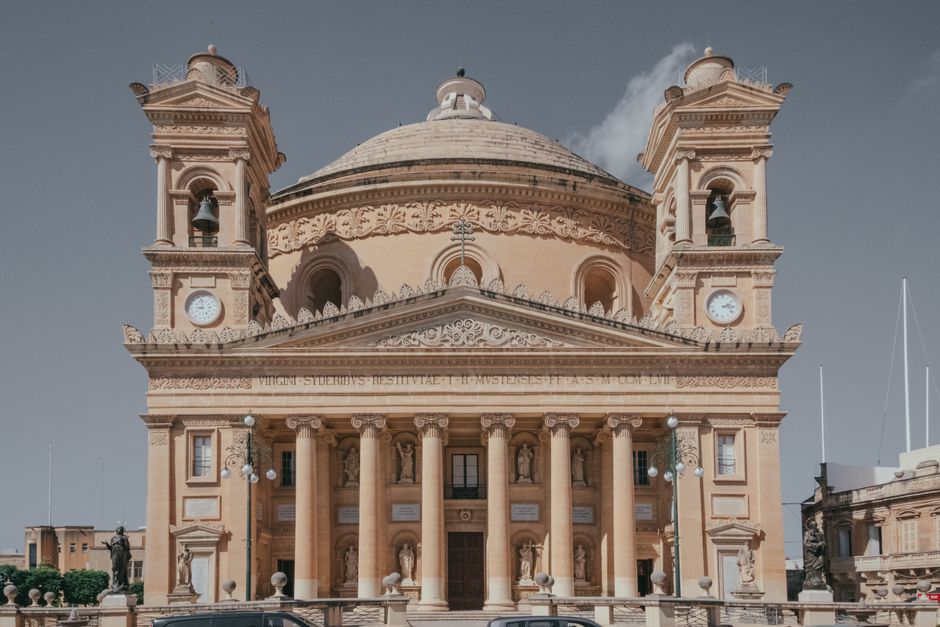
Malta is a small, sunny island nation in the middle of the Mediterranean, about 90 km south of Sicily: three inhabited islands with 7,000 years of history packed into a space smaller than many cities. Start in Valletta, the honey-coloured fortress capital built by the Knights of St John, and cross the Grand Harbour to the Three Cities; climb to the silent walled town of Mdina; walk among some of the oldest free-standing stone temples in the world; swim in the clear water of Comino’s Blue Lagoon; and slow down on green, rural Gozo. English is an official language, Malta uses the euro and is part of the Schengen area, and distances are tiny, so you can see a lot without long journeys. April to June and September to early November are the sweet spots. Give it five days for a first trip, a week or more to add Gozo properly.
Right now in Malta
- Wed 23–28°C 74–82°F Mostly clear
- Thu 23–29°C 74–84°F Partly cloudy
- Fri 24–29°C 75–84°F Partly cloudy
Weather: MET Norway (CC BY 4.0) · Air quality: OpenAQ
Multi-day tours of Malta
Multi-day tours from local operators. You check dates and book on Viator, our partner; we may earn a commission at no extra cost to you. How we earn money
Malta at a glance: overview and geography
The Maltese archipelago covers only about 316 km². Malta itself, the largest island, is roughly 27 km long; Gozo lies a short ferry ride to the north-west; and tiny Comino sits in the channel between them, with only a handful of residents. There are no rivers, mountains or forests: the landscape is low limestone plateaus, terraced fields divided by rubble walls, dramatic sea cliffs on the south and west coasts, and deep natural harbours on the east. It is one of the most densely populated countries in the world. Malta’s National Statistics Office (NSO) estimated the population at 588,254 at the end of 2025, and the towns around Valletta and the harbours run into one another as a single built-up area.
History is the main attraction. The megalithic temples of Ġgantija, Ħaġar Qim and Mnajdra were built more than 5,000 years ago, and the underground Ħal Saflieni Hypogeum is a unique prehistoric burial complex carved out of the rock. Phoenicians, Romans, Arabs, Normans and Aragonese all left their mark; St Paul is said to have been shipwrecked here in AD 60. In 1530 the islands were given to the Knights of the Order of St John, who survived the Great Siege by the Ottomans in 1565 and then built Valletta. Napoleon took Malta in 1798, the British held it from 1800 to 1964, and the islands’ resistance under heavy bombing in the Second World War earned them the George Cross, which still appears on the national flag. Malta became independent in 1964, a republic in 1974 and a member of the European Union in 2004. Valletta, the Hypogeum and the megalithic temples are UNESCO World Heritage Sites.
Time zone: Malta runs on Central European Time (UTC+1, UTC+2 in summer), the same as Italy.
The islands and areas
- Valletta and the Grand Harbour: the capital on its peninsula, Floriana just outside the walls, and the Three Cities of Birgu (Vittoriosa), Senglea and Cospicua across the harbour.
- Sliema and St Julian’s: the busy resort and residential strip north of Valletta, with seafront promenades, hotels, restaurants and Malta’s nightlife district, Paceville.
- Mdina and the centre: the old walled capital of Mdina and neighbouring Rabat, with catacombs, plus the Dingli Cliffs and the village churches of the interior.
- The south: the fishing village of Marsaxlokk, the Blue Grotto, the temples of Ħaġar Qim and Mnajdra, and the Hypogeum in Paola.
- The north: Mellieħa, Golden Bay and Malta’s best sandy beaches, Bugibba and Qawra resorts, and Ċirkewwa, the port for Gozo and Comino.
- Gozo and Comino: Gozo is greener, quieter and more rural, with its citadel in Victoria, the Ġgantija temples, red-sand Ramla Bay and superb diving. Comino is almost uninhabited and known for the Blue Lagoon.
Where to go: Valletta, Mdina, Gozo and the coast
Because Malta is so small, many visitors stay in one base and take day trips: Valletta for history and atmosphere, Sliema or St Julian’s for restaurants and nightlife, Mellieħa or Bugibba for beaches, and Gozo for peace and diving. Nowhere on the main island is much more than an hour away by bus, though traffic can be slow at rush hour.
Valletta and the Three Cities
Valletta was built by the Knights after 1565 on a grid of steep, straight streets between two harbours, and it is small enough to walk across in 15 minutes. See St John’s Co-Cathedral, with its gilded interior and two paintings by Caravaggio, the Grand Master’s Palace, Fort St Elmo and the National War Museum, and the Upper Barrakka Gardens, where the Saluting Battery fires its guns at noon. Then take the ferry or a traditional dgħajsa water taxi across the Grand Harbour to Birgu, the Knights’ first base, with its waterfront, Fort St Angelo and quiet lanes.
Mdina and Rabat
Mdina, Malta’s capital before Valletta, is a hilltop walled town of palaces, convents and narrow, quiet lanes, often called the Silent City. It is free to walk in, and its bastions look out over most of the island. Next door, Rabat has St Paul’s Grotto, the Roman Domvs Romana and the underground St Paul’s Catacombs. Come early in the morning or at dusk, when the day trippers have gone.
St Julian’s and Sliema
North of Valletta, Sliema and St Julian’s form Malta’s busiest resort area: a long seafront promenade with rocky swimming spots, Spinola and Balluta bays, big hotels, shopping and, in Paceville, the islands’ late-night bars and clubs. It is convenient for buses and the Sliema–Valletta ferry, and popular with English-language students.
Gozo
Gozo is Malta’s greener, slower sister island, 25 minutes by car ferry from Ċirkewwa or about 45 minutes by fast ferry from Valletta. Visit the Ċittadella above Victoria, the Ġgantija temples, Ramla Bay, the salt pans near Marsalforn and the cliffs, Inland Sea and Blue Hole at Dwejra, where the famous Azure Window arch collapsed into the sea in 2017. Gozo deserves at least two nights.
Comino and the Blue Lagoon
The Blue Lagoon, a shallow channel of brilliant turquoise water between Comino and the islet of Cominotto, is Malta’s most photographed spot, and on summer afternoons one of its most crowded. Boats run from Ċirkewwa, Mġarr (Gozo), Sliema and Bugibba. Since May 2025, the Malta Tourism Authority has required a free online booking, with a QR code, for one of three daily time slots if you go ashore at the lagoon, and numbers are capped at 4,000 people at a time. Go early in the morning, or in May, June or late September, and bring shade: there is very little on the rocks.
The south: temples, Marsaxlokk and the Blue Grotto
Malta’s south packs in some of its best sights. The cliff-top temples of Ħaġar Qim and Mnajdra, under protective tents, are aligned with the sunrise at the solstices and equinoxes. The Ħal Saflieni Hypogeum in Paola, an underground necropolis around 5,000 years old, admits only small groups and sells out weeks ahead. Marsaxlokk is a fishing village full of brightly painted luzzu boats, with a big Sunday market and seafood restaurants, and small boats take visitors into the sea caves of the Blue Grotto from Wied iż-Żurrieq when the sea is calm.
A few more worth your time
The Dingli Cliffs at sunset; the sandy bays of Golden Bay, Għajn Tuffieħa and Mellieħa (Għadira) in the north; Popeye Village, a film set turned family attraction above Anchor Bay; the Mosta Rotunda, whose dome was pierced by a wartime bomb that failed to explode; the Lascaris War Rooms beneath Valletta; St Peter’s Pool, a natural rock pool near Marsaxlokk; and Gozo’s Ramla Bay and Wied il-Għasri gorge.
Gozo Travel Guide
Plan a trip to Gozo: Victoria and the Ċittadella, the Ġgantija temples with 2026 Heritage Malta prices, Dwejra's Inland Sea and Blue Hole after…
St Julian’s Travel Guide
Plan a stay in St Julian's, Malta: Spinola and Balluta bays, St George's Bay beach and the rocky lidos, Paceville nightlife and how to…
Valletta Travel Guide
Plan a trip to Valletta: St John's Co-Cathedral and its Caravaggios, the Grand Master's Palace, the Upper Barrakka Gardens and the noon gun, Fort…
Best time to visit Malta
Malta has a hot Mediterranean climate: long, dry, very sunny summers and mild, short winters with most of the year’s rain between October and February. It almost never freezes, and even January afternoons are often around 15–16 °C. The table shows the 1991–2020 averages for Malta International Airport at Luqa, the islands’ main weather station; Gozo is very similar, slightly cooler at night and a little wetter.
| Season (Luqa, 1991–2020) | Mean temperature | Average afternoon high | Days with rain a month | Sunshine a day | What it’s like |
|---|---|---|---|---|---|
| Spring (Mar–May) | 14–20 °C | 17–24 °C | 2–6 | 7–10 hours | Warm, green and flowery; ideal for sightseeing and walking; sea still cool until June. |
| Summer (Jun–Aug) | 24–28 °C | 29–32 °C | 0–1 | 11–12 hours | Hot, dry and humid; peak crowds, festas and fireworks; warmest sea in August. |
| Autumn (Sep–Nov) | 25 °C falling to 18 °C | 29 °C falling to 21 °C | 4–9 | 6–9 hours | Warm sea into November; occasional heavy thunderstorms; a lovely time to visit. |
| Winter (Dec–Feb) | 13–15 °C | 16–17 °C | 8–10 | 5–6 hours | Mild, with sunny spells, rain showers and strong winds; quiet and cheaper. |
Malta is one of the sunniest places in Europe, with close to 3,000 hours of sunshine a year and almost no rain in June, July and August. The sea is comfortable for most swimmers from about June to early November, and warmest, around 26–27 °C, in August.
Winds, heat and the shoulder seasons
The wind matters more than the rain. The prevailing majjistral (north-westerly) keeps summer afternoons breezy. The gregale, a strong north-easterly mostly in winter, piles waves into the east-facing harbours and bays and can delay or cancel boat trips, the Blue Grotto boats and occasionally the Gozo fast ferry. The xlokk (sirocco) from the south-east brings hot, humid, hazy air, sometimes with Saharan dust. Summer heatwaves of 38–40 °C have become more frequent: in July and August, sightsee in the morning and evening and keep the middle of the day for the sea or a siesta. April, May, June, late September and October have the best balance of warm weather, open beaches and smaller crowds.
Crowds and prices through the year
July and August are the busiest and most expensive months, when Comino, Golden Bay and Valletta are packed and many Maltese families take their holidays. Easter and the autumn half-term holidays in Britain and Ireland are also busy. Winter is quieter and cheaper, and unlike many Mediterranean resorts, Malta does not shut down: hotels, museums, buses and ferries run all year, though some beach clubs and boat trips stop from November to March.
Festivals and public holidays
Every parish celebrates its patron saint with a festa, mostly between June and September: decorated streets, brass bands, processions and spectacular fireworks. Other highlights include Carnival in February (the wildest in Nadur on Gozo), Holy Week processions, the Malta International Fireworks Festival over the Grand Harbour in late April, the Mnarja harvest festival at Buskett in late June, Notte Bianca in Valletta in autumn, and the opera season in Victoria on Gozo in October. Malta has 14 public holidays: New Year’s Day, St Paul’s Shipwreck (10 February), St Joseph (19 March), Freedom Day (31 March), Good Friday (26 March 2027), Labour Day (1 May), Sette Giugno (7 June), St Peter and St Paul (29 June), the Assumption (15 August), Victory Day (8 September), Independence Day (21 September), the Immaculate Conception (8 December), Republic Day (13 December) and Christmas Day. Heritage Malta’s museums and sites close on 1 January, Good Friday and 24, 25 and 31 December.
How long to stay: sample itineraries
Malta is compact, but the buses are slow at busy times and the Gozo crossing takes a chunk of the day. Two bases, one on Malta and one on Gozo, work well for a week.
4 days: Valletta, Mdina and Comino
Base yourself in Valletta or Sliema. Day 1: Valletta’s sights and the Upper Barrakka Gardens. Day 2: the Three Cities by ferry, then the Hypogeum (if you have booked) and Marsaxlokk. Day 3: Mdina and Rabat in the morning, the Dingli Cliffs at sunset. Day 4: an early boat to Comino’s Blue Lagoon, or a Gozo day trip.
7 days: Malta and Gozo
Four nights in Valletta or Sliema, adding Ħaġar Qim and Mnajdra, the Blue Grotto and a beach afternoon at Golden Bay or Mellieħa. Then three nights on Gozo: the Ċittadella and Ġgantija, Ramla Bay, Dwejra and a walk along the cliffs, with a morning boat to Comino from Mġarr.
10 days: slow Malta with diving or walking
Add a few days of diving or snorkelling on Gozo or at Ċirkewwa, coastal walks along the north and west coasts, a village festa, and a day trip by fast catamaran to Sicily for Modica, Noto or Mount Etna.
Entry, money, fees and costs
Entry and visas (last reviewed October 2026)
Malta has been part of the Schengen area since December 2007 (air borders since March 2008), so flights from other Schengen countries such as Italy, Germany or Spain arrive without routine passport checks. Citizens of EU and EEA countries and Switzerland can enter with a national ID card or passport. Visitors from many other countries, including the United States, Canada, the UK and Australia, can stay without a visa for up to 90 days in any 180-day period, counting time in all Schengen countries. Others need a Schengen visa.
- Entry/Exit System (EES): the EU’s digital border system has been fully running at all Schengen external borders since 10 April 2026. Non-EU visitors arriving from outside Schengen, for example on a flight from the UK or a ferry from a non-Schengen port, have their passport details, a photo and fingerprints recorded at their first entry instead of getting passport stamps; children under 12 are not fingerprinted. Registration is free and lasts three years. Allow extra time at Malta International Airport for flights from outside Schengen.
- ETIAS: the EU’s planned online travel authorisation (fee €20) is not in operation as of October 2026. The EU had pointed to the last quarter of 2026, but no start date has been published and press reports point to 2027. Until the EU confirms a date, you don’t need one. Ignore websites selling “ETIAS applications” before then.
- Passports: for non-EU visitors, your passport should have been issued less than 10 years before you arrive and be valid for at least 3 months after the day you plan to leave the Schengen area.
- Ferries from Sicily: the catamaran from Pozzallo is a journey inside Schengen, so there are no routine passport checks, but carry your passport or ID card anyway.
Rules change, so check the official pages before you travel: the European Commission’s EES and ETIAS pages, the Maltese government’s Identità agency, and your own government’s travel information.
Maltese basics: language and a few useful words
Malta has two official languages, Maltese and English, and almost everyone speaks English, so signs, menus and museum labels are easy. Italian is widely understood too. Maltese is a Semitic language, related to Arabic but written in the Latin alphabet and full of Italian and English words. A few letters look unusual: ċ sounds like “ch”, x like “sh”, ġ like “j”, ż like “z”, j like “y”, and għ and ħ are mostly silent or breathy. A few words go a long way: bonġu (good morning), bonswa (good evening), grazzi (thank you), jekk jogħġbok (please), iva (yes), le (no), saħħa (goodbye, and also “cheers”).
The euro, cash and tipping
Malta has used the euro since 1 January 2008, when it replaced the Maltese lira. Cards and phone payments are accepted almost everywhere, including on buses and at most museums, but carry a little cash for pastizzi shops, village bars, markets, small boats and some taxis. If a cash machine or card terminal offers to charge you in your home currency, choose euros. Tipping is appreciated but not compulsory: around 5–10% in restaurants for good service if no service charge has been added, and rounding up for taxis.
Eco-contribution (tourist tax)
Malta charges an eco-contribution on stays in licensed accommodation, from hotels to guesthouses and holiday flats, usually collected by your host and often not included in the price shown by booking sites. From 1 July 2026 it rose to €1.50 per person per night for guests aged 18 or over, with a maximum of €22.50 per person per visit (reached after 15 nights), according to the Malta Tourism Authority’s 2026 guidelines under the Eco-Contribution Act. Under-18s pay nothing. Before July 2026 the rate was €0.50 a night, capped at €5.
Typical travel costs
Malta is mid-priced by Mediterranean standards: cheaper than much of Italy for food and public transport, but accommodation in Valletta and St Julian’s is expensive in summer. These estimates, per person per day, are a planning guide as of October 2026:
| Style | Estimated cost per day | What that looks like |
|---|---|---|
| Budget | about €60–90 | Hostel bed or simple guesthouse room, pastizzi and ftira for lunch, one restaurant meal, buses on an Explore card, free beaches |
| Mid-range | about €120–190 | 3- or 4-star hotel shared by two, restaurant lunches and dinners, a museum or the Hypogeum, a boat trip to Comino or Gozo |
| High-end | about €300+ | Boutique palazzo hotel in Valletta or a farmhouse on Gozo with a pool, fine dining, private boat charters and guided tours |
Add the eco-contribution and €20–50 a day in July and August. The Hypogeum costs €35 and most Heritage Malta sites €5–12; a 30-day Heritage Malta Multisite Pass costs €60 for adults and covers most of them, but not the Hypogeum. The figures are our estimates, not official statistics.
Getting there and getting around
Arrival: the airport and ferries from Sicily
Malta International Airport (MLA), at Luqa in the south of the main island, is the only airport, with flights all year from across Europe and North Africa and a few from further away; the national airline is KM Malta Airlines. Airport Direct buses (TD routes) run to Valletta and the Gozo fast ferry (TD4, every 30 minutes), St Julian’s and Sliema (TD2 and TD3, every 30 minutes), and Rabat, Bugibba, Mellieħa and Ċirkewwa (TD1 and TD5, hourly), for €3 a trip (€3.50 on TD1). By sea, Virtu Ferries runs fast catamarans between Valletta and Pozzallo in Sicily, a crossing of under two hours, with coach connections to Catania; adult fares on its site start at about €37–44 each way.
Buses
Malta Public Transport runs the buses on Malta and Gozo, branded tallinja. Most routes on Malta start or end at the terminus outside Valletta’s City Gate, and on Gozo at Victoria. You can pay on board by contactless card, phone or cash: a single day fare is €2.50 in summer and €2 in winter (winter fares applied from 19 October 2025 to 13 June 2026), valid for two hours including transfers; night routes and Airport Direct cost €3. For a longer stay, the Explore cards give unlimited travel for 4 days (€21) or 7 days (€27), with add-ons for the Gozo fast ferry or a harbour cruise, and the 12 Single Day Journeys card (€19) can be shared. A €50 fine applies if you cannot show a valid ticket. Buses are cheap and cover the whole island, but can be crowded and slow in traffic; use the tallinja app for live times.
Ferries to Gozo and Comino, and around the harbour
- Gozo Channel car ferry (Ċirkewwa–Mġarr, about 25 minutes, around the clock): you pay only when leaving Gozo. The return fare is €4.65 for a foot passenger (€4.05 at night from November to March), €1.15 for children aged 3–12 and €15.70 for a car and driver.
- Gozo fast ferry (Gozo Highspeed, Valletta–Mġarr, foot passengers only, about 45 minutes): about €7.50 one way for an adult. Handy if you are staying in Valletta or Sliema; book in summer.
- Comino: small boats run from Ċirkewwa, Mġarr, Sliema and Bugibba, mostly from spring to autumn. Book the free Blue Lagoon time slot too if you plan to go ashore.
- Harbour ferries: Valletta Ferry Services crosses from Valletta to Sliema and to the Three Cities (Cospicua) in a few minutes. Adults pay €3 single or €5 return by day, and €3.50 single after 19:30; services run until about 01:30 in summer (1 June–31 October) and until early evening in winter.
Driving, taxis and ride-hailing
Malta drives on the left, a legacy of British rule. A hire car is useful on Gozo and for remote beaches and cliffs, but on the main island traffic is heavy, roads are narrow, signposting is patchy and parking in Valletta, Sliema and St Julian’s is very hard; vehicle access to central Valletta is controlled and charged. Speed limits are usually 50 km/h in towns and 80 km/h on open roads, and the blood alcohol limit is 0.5 g/l. Taxis, including white taxis at the airport with fixed fares by zone, and app-based ride-hailing services are widely used and reasonably priced for short trips.
Beaches, the sea and safety in the water
Malta’s sea is clear, warm and often deep right off the rocks, which is why the islands are so good for snorkelling and diving. Much of the coast is rocky: in Sliema, St Julian’s and St Peter’s Pool you swim from flat limestone shelves with ladders into the water. The best sandy beaches are in the north and on Gozo: Golden Bay, Għajn Tuffieħa, Mellieħa Bay (Għadira) and Paradise Bay on Malta, Ramla Bay and San Blas on Gozo. Several beaches fly the Blue Flag, and lifeguards cover the busiest sandy beaches in summer. See our beaches guide, plus snorkeling, diving and boat trips.
- Flags and waves: obey the lifeguards’ red flags. When the gregale or a strong north-westerly blows, waves and rip currents can be dangerous on exposed beaches, and rocks become slippery.
- Jellyfish: the mauve stinger (Pelagia noctiluca) swarms in some summers. Stings hurt but are rarely dangerous; rinse with seawater, not fresh water, and ask a lifeguard or pharmacy for help.
- Sea urchins and rocks: wear water shoes on rocky shores and in places such as St Peter’s Pool.
- Boats: stay inside the buoyed swimming zones, especially at the Blue Lagoon, where tour boats and jet skis come close to swimmers.
- Cliff jumping: popular at spots such as Comino and Għar Lapsi, but depths and rocks are hard to judge; check first and never jump alone.
Safety, heat, health and connectivity
Safety
Malta is a safe country with low violent crime. Watch your bags in crowds in Valletta, on busy buses and in Paceville at night, where fights and drink spiking are occasional problems; keep an eye on your drink and go home in a licensed taxi or ride-hailing car. Pavements are narrow or missing on many roads and drivers can be impatient, so take care walking along busy streets. Dress modestly in churches. Emergency number: 112 for police, ambulance and fire.
Heat and the sun
There is little natural shade on Malta’s rocky coast and in the temples, and the limestone reflects heat and light. In July and August carry plenty of water, wear a hat and high-factor sunscreen, avoid long walks at midday and take the heat warnings of the Malta Meteorological Office seriously. Dry grassland and scrub do catch fire in summer: don’t light fires or barbecues outside designated places, and never throw cigarettes away in the countryside.
Health
Tap water is safe to drink, but much of it comes from desalination and tastes slightly salty, so many people drink bottled or filtered water. EU visitors should carry a European Health Insurance Card; everyone else should have travel insurance. Mater Dei Hospital near Msida is the main public hospital, and Gozo has its own general hospital in Victoria. Pharmacies are plentiful and pharmacists speak English.
Accessibility
Valletta’s streets are steep and many are stepped, and Mdina’s lanes are cobbled, though Valletta has the Upper Barrakka lift from the Grand Harbour and many newer buses are low-floor. Heritage Malta lists the accessibility of each museum and site on its website: the Hypogeum and some temple sites are only partly accessible.
Connectivity and power
4G and 5G coverage is good across the islands. EU visitors roam at home rates; others can buy a local SIM or eSIM. Wi-Fi is standard in accommodation and cafés and free on buses. Plugs are the British three-pin type (G), at 230 V, so most visitors from continental Europe and North America need an adapter.
Food, wine and culture
Maltese food is Mediterranean with a Sicilian accent and a few Arab and British touches. Try pastizzi (flaky pastries filled with ricotta or peas, sold for small change), ftira (a ring-shaped bread filled with tuna, tomatoes, olives and capers), ħobż biż-żejt (bread with tomato paste and oil), bigilla (bean dip), rabbit stew (stuffat tal-fenek), the national dish, fresh fish such as lampuki (dorado, in season from late summer) and Gozo’s small sheep’s cheeses, ġbejniet. Local wines are made from the native Ġellewża and Girgentina grapes as well as international varieties; the local beer is Cisk, and Kinnie is a bittersweet orange soft drink. Malta is a strongly Catholic country, with more than 350 churches: cover shoulders and knees inside. See our wine tasting guide and our city sightseeing guide.
Things to do: history, diving, boats and walking
- History and museums: the Knights’ Valletta and Birgu, Mdina, the prehistoric temples and the Hypogeum, and the wartime tunnels and museums.
- Diving: warm, clear water, caves, arches and wrecks, including the scuttled ferry and patrol boat at Ċirkewwa, the Um El Faroud tanker near Wied iż-Żurrieq and Gozo’s Blue Hole and Inland Sea. Malta is one of Europe’s best places to learn.
- Boat trips: harbour cruises from Sliema, trips to Comino and the Blue Lagoon, round-Gozo cruises and the Blue Grotto.
- Walking: cliff paths along the west coast of Malta and around Gozo, best from October to May. See our hiking guide.
- Kayaking and snorkelling: around Comino, Gozo’s coves and the north of Malta.
- Festas and fireworks: village feasts nearly every summer weekend.
What to pack
For summer, bring light clothes, a sun hat, sunglasses, high-factor sunscreen, a refillable water bottle, swimwear, a quick-dry towel, water shoes for rocky swimming spots, a snorkel mask and a light scarf or shirt for churches. Add comfortable shoes with grip for Valletta’s steep, polished streets and cliff paths. In winter, pack a warm layer, a windproof jacket and an umbrella: it rarely gets cold, but the wind and showers can be fierce, and many older buildings have little heating. Don’t forget a type G (UK-style) plug adapter.
Malta travel FAQ
When is the best time to visit Malta?
April to June and late September to early November: warm, sunny weather, a warm sea in autumn and fewer crowds than in July and August. Winter is mild and quiet, good for sightseeing but not for beaches.
How many days do you need in Malta?
Four days for Valletta, Mdina and Comino; a week to add Gozo and the south; ten days if you want to dive, walk or take a day trip to Sicily.
Is Malta in the Schengen area?
Yes, since December 2007. There are no routine passport checks on flights from other Schengen countries, and non-EU visitors arriving from outside Schengen are registered by the EU’s Entry/Exit System.
Do I need ETIAS to visit Malta?
Not as of October 2026. ETIAS is not running yet, the EU has not set a start date, and press reports point to 2027.
What is Malta’s eco-contribution?
A tourist tax on licensed accommodation: from 1 July 2026, €1.50 per person aged 18 or over per night, up to €22.50 per visit. It is usually collected by your hotel or host.
Does Malta use the euro, and do people speak English?
Yes to both. Malta has used the euro since 2008, and English is an official language alongside Maltese.
Which side of the road do they drive on in Malta?
The left. Traffic and parking are difficult on the main island, so many visitors use buses, ferries and taxis there and hire a car only on Gozo.
How do I get from Malta to Gozo?
By the Gozo Channel car ferry from Ċirkewwa (about 25 minutes, around the clock, €4.65 return for foot passengers, paid in Gozo), or by the Gozo Highspeed fast ferry from Valletta (about 45 minutes, foot passengers only).
Do I need to book the Blue Lagoon?
If you plan to go ashore, yes: book a free time slot online with the Malta Tourism Authority’s system and show the QR code on arrival. You don’t need one if you stay on a boat.
How far ahead should I book the Hypogeum?
As early as you can, often several weeks ahead, because only small groups are admitted. Tickets cost €35 for adults; a limited number of €50 last-minute tickets go on sale the day before at a few Heritage Malta sites. Children under 6 are not admitted.
Does Malta have sandy beaches?
A few good ones, mostly in the north and on Gozo: Golden Bay, Għajn Tuffieħa and Mellieħa Bay on Malta, and Ramla Bay on Gozo. Elsewhere you swim from the rocks.
Is Malta expensive?
Moderately. Food, buses and museums are good value, but hotels in Valletta and St Julian’s are pricey in summer. Winter and Gozo are cheaper.
Is Malta safe for tourists?
Yes. Watch your belongings in crowds and in Paceville at night, take care crossing busy roads, respect the sea flags and call 112 in an emergency.
Can I combine Malta with Sicily?
Yes. Fast catamarans link Valletta with Pozzallo in under two hours, and there are short flights to Catania and Palermo. See our Sicily guide and our Italy guide.
Sources and last review
Researched and last reviewed on 4 October 2026. Entry rules come from the European Commission; the population from Malta’s National Statistics Office; the eco-contribution from the Malta Tourism Authority’s 2026 guidelines; the Blue Lagoon booking system from the Malta Tourism Authority; museum prices and closures from Heritage Malta; bus fares and cards from Malta Public Transport; ferry fares from Gozo Channel, Valletta Ferry Services and Virtu Ferries. The climate averages (Luqa, 1991–2020), the Gozo fast ferry fare, the driving rules and some festival dates come from secondary sources and are flagged for checking. Daily costs are estimates. Prices, timetables and rules change, so check the official sites before you travel.
Plugs and power in Malta
Malta uses 230 V, 50 Hz and these plugs (left) and wall sockets (right):
All plug types and voltages by country → · Check what you need to pack →
Plan your trip
Partner links: TravelerCenter may earn a commission if you book, at no extra cost to you.