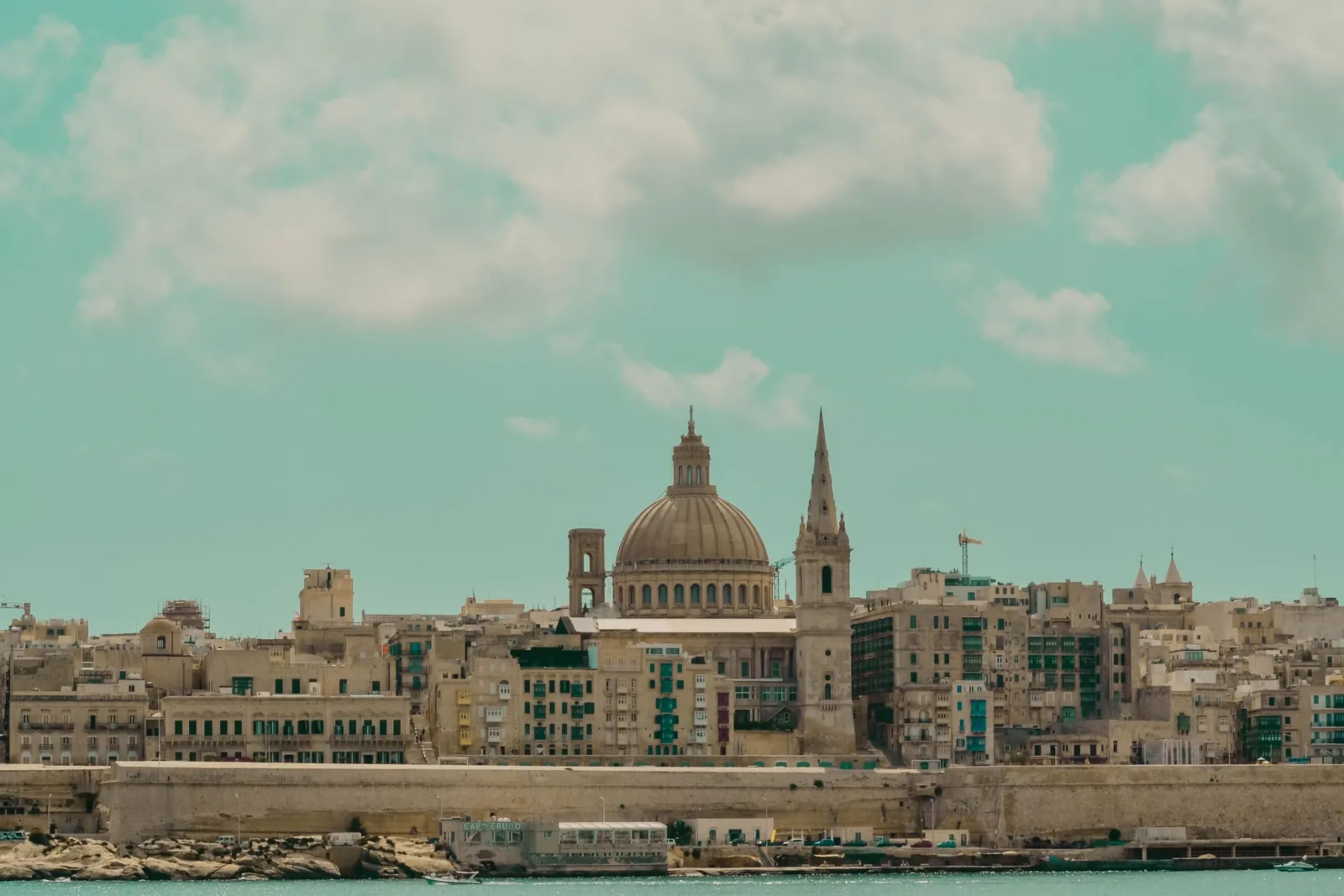
Short answer: For a first trip, the top places to visit in Malta are the fortress capital Valletta, the green sister island of Gozo, the silent walled city of Mdina, the turquoise Blue Lagoon on Comino and the Three Cities across the Grand Harbour. Round out the list with the underground Ħal Saflieni Hypogeum, the cliff-top temples of Ħaġar Qim and Mnajdra, the fishing village of Marsaxlokk, the seaside towns of St Julian’s and Sliema, and the sandy beaches of the north.
The list is ordered the way we would recommend places to a first-time visitor: Valletta and Gozo first, then the history and the coast. Malta is small, so you can see most of it from one or two bases. Ticket prices are the official 2026 figures, in euros.
1. Valletta
Why it made the list: Malta’s capital is a fortified city of honey-colored limestone on a narrow peninsula between two deep harbors, built by the Knights of St John after they survived the Great Siege of 1565. The whole city is a UNESCO World Heritage Site, and it is small enough to walk across in about 15 minutes.
Best time to go: March to June and September to November, when the steep stone streets are warm but not baking. Summer afternoons are hot, with highs of about 32 °C (90 °F) in August.
Don’t miss: St John’s Co-Cathedral, with its gilded interior and Caravaggio’s The Beheading of St John the Baptist, his largest painting and the only one he signed. Then go to the Upper Barrakka Gardens for the view over the Grand Harbour; the Saluting Battery below fires its guns at 12:00 and 16:00.
Getting there and how long: Malta International Airport is about 8 km away, and the Airport Direct TD4 bus runs to Valletta every 30 minutes for €3. Stay two or three days, more if you use the city as a base.
Practical note: the Grand Master’s Palace costs €12 for adults. If you plan to see five or more state museums and sites, Heritage Malta’s Multisite Pass costs €60 for adults and lasts 30 days, but it does not cover the Hypogeum. See our Valletta travel guide.
2. Gozo
Why it made the list: Malta’s second island is greener, quieter and more rural, with terraced hills, village churches, red-sand Ramla Bay, the Ċittadella above Victoria and some of the best diving in the Mediterranean. It is where the Maltese go to slow down.
Best time to go: April to June for green fields and walking, and September and October for the warmest sea. July and August are busy, when weekend ferries fill up.
Don’t miss: the Ġgantija temples, built more than 5,000 years ago and part of the UNESCO-listed Megalithic Temples of Malta (€10 for adults), and the cliffs at Dwejra, with the Inland Sea and the Blue Hole. The famous Azure Window arch there collapsed into the sea in March 2017.
Getting there and how long: the Gozo Channel car ferry crosses from Ċirkewwa, at the north-west tip of Malta, to Mġarr, and a fast ferry for foot passengers runs from Valletta. A day trip is possible, but two or three nights are much better.
Practical note: on the car ferry you pay only when you leave Gozo: a return costs €4.65 for a foot passenger and €15.70 for a car and driver. The Gozo Museum of Archaeology in the Ċittadella closed on April 13, 2026, to prepare a new museum. See our Gozo travel guide.
3. Mdina and Rabat
Why it made the list: Mdina, Malta’s capital before Valletta, is a hilltop walled town of palaces, convents and narrow, quiet lanes, often called the Silent City. Its bastions look out over most of the island, and neighboring Rabat adds Roman and early Christian sites underground.
Best time to go: any time of year; come early in the morning or at dusk, when the day trippers have gone.
Don’t miss: a slow walk through Mdina’s lanes to the bastion viewpoint, then St Paul’s Catacombs and the Domvs Romana in Rabat (€6 each for adults). Finish at the Dingli Cliffs for sunset.
Getting there and how long: buses from Valletta take about 30 to 40 minutes. Half a day covers Mdina; give it a full day with Rabat and Dingli.
Practical note: Mdina is free to walk in. Its lanes are cobbled, so wear shoes with grip. See our Malta travel guide.
4. Comino and the Blue Lagoon
Why it made the list: the Blue Lagoon, a shallow channel of brilliant turquoise water between Comino and the islet of Cominotto, is Malta’s most photographed spot. Comino itself is a nature reserve with almost no residents and no cars.
Best time to go: May, June and late September, ideally on the first boat of the morning. On summer afternoons it is one of the most crowded places in Malta.
Don’t miss: a swim in the lagoon, then a walk inland to Santa Marija Tower and the quieter bays once the lagoon fills up.
Getting there and how long: boats run from Ċirkewwa, from Mġarr on Gozo, and from Sliema and Bugibba, mostly from spring to autumn. Plan half a day or a full day.
Practical note: since May 2025, the Malta Tourism Authority has required a free online booking for one of three daily time slots if you go ashore at the lagoon, with a cap of 4,000 people at a time. Bring water and shade: there is very little on the rocks. See our Gozo travel guide.
5. The Three Cities
Why it made the list: Birgu (Vittoriosa), Senglea and Cospicua were the Knights’ base before Valletta existed, and they bore the brunt of the Great Siege. Today they are calm, lived-in towns of narrow lanes, churches and a marina, with the best views back to Valletta.
Best time to go: all year. Late afternoon is lovely, when the light turns Valletta’s walls gold across the water.
Don’t miss: Fort St Angelo, the Knights’ stronghold at the tip of Birgu (€10 for adults), and the Gardjola Gardens in Senglea, with a carved watchtower that has eyes and ears facing the harbor.
Getting there and how long: the Valletta Ferry Services boat crosses from below the Upper Barrakka Gardens to Cospicua in a few minutes, or you can hail a dgħajsa, a traditional painted water taxi. Half a day is enough.
Practical note: the ferry costs adults €3 single or €5 return by day; the Barrakka Lift saves you the climb back up into Valletta. See our Valletta travel guide.
6. Ħal Saflieni Hypogeum
Why it made the list: this underground burial complex in Paola, carved out of the rock around 5,000 years ago, is unique in the world and a UNESCO World Heritage Site. Only small groups go in, which keeps the visit quiet and atmospheric.
Best time to go: any time of year, as the visit is underground. The hard part is getting a ticket.
Don’t miss: the carved chambers that imitate built temple architecture; the famous Sleeping Lady figurine found in the Hypogeum is on show at the National Museum of Archaeology in Valletta (€5 for adults).
Getting there and how long: Paola is about 15 minutes by bus from Valletta. The visit itself is short; pair it with Marsaxlokk on the same day.
Practical note: book as early as you can, often several weeks ahead. Tickets cost €35 for adults; a few €50 last-minute tickets go on sale the day before at selected Heritage Malta sites. Children under 6 are not admitted. See our Malta travel guide.
7. Ħaġar Qim, Mnajdra and the Blue Grotto
Why it made the list: on the wild south coast, the temples of Ħaġar Qim and Mnajdra stand above the sea under protective tents, among the oldest free-standing stone buildings in the world. Mnajdra’s temples are aligned with the sunrise at the solstices and equinoxes.
Best time to go: spring and autumn, early or late in the day; there is little shade in summer.
Don’t miss: the cliff path between the two temple sites, then a small-boat trip into the sea caves of the Blue Grotto from nearby Wied iż-Żurrieq.
Getting there and how long: about 45 minutes by bus from Valletta. Allow half a day for both.
Practical note: the temple park costs €10 for adults. The Blue Grotto boats sail only when the sea is calm; the gregale, a strong north-easterly wind, can stop boat trips, mostly in winter. See our Malta travel guide.
8. Marsaxlokk and St Peter’s Pool
Why it made the list: Marsaxlokk is a fishing village full of brightly painted luzzu boats, with seafood restaurants along the harbor and a big Sunday market. Nearby St Peter’s Pool is a natural rock pool where people swim from flat limestone ledges.
Best time to go: Sunday morning for the market; June to October for swimming at St Peter’s Pool.
Don’t miss: lunch on the waterfront after a walk past the boats, then an afternoon swim at St Peter’s Pool.
Getting there and how long: buses run from Valletta. Half a day, or combine it with the Hypogeum.
Practical note: wear water shoes on the rocks at St Peter’s Pool, and stay out of the water when the waves are up. See our Malta travel guide.
9. St Julian’s and Sliema
Why it made the list: just north of Valletta, St Julian’s and Sliema form Malta’s busiest resort area: a long seafront promenade, fishing boats in Spinola Bay, the small sandy beach at St George’s Bay, and Paceville, the islands’ late-night district. It is a convenient, sociable base for the rest of Malta.
Best time to go: May, June, September and October for swimming without the crush. July and August bring the busiest beaches and the loudest nights.
Don’t miss: the seafront walk from Balluta Bay to Tigné Point, with views across to Valletta’s skyline, and dinner at sunset on Spinola Bay.
Getting there and how long: Airport Direct buses TD2 and TD3 run every 30 minutes for €3. The Sliema–Valletta ferry takes a few minutes. One or two days for the towns, longer as a base.
Practical note: most of the shore here is rock, with ladders into deep, clear water; the sandy beach is at St George’s Bay. Light sleepers should ask for a room away from Paceville’s main streets. See our St Julian’s travel guide.
10. Golden Bay, Mellieħa and the north
Why it made the list: Malta’s best sandy beaches are in the north: Golden Bay, Għajn Tuffieħa and Mellieħa Bay (Għadira). Above Anchor Bay, Popeye Village, a film set turned family attraction, is a favorite with children.
Best time to go: June to October, when the sea is warm enough for most swimmers. It is warmest in August, around 25 °C (77 °F) on long-term averages.
Don’t miss: sunset at Golden Bay or from the headland above Għajn Tuffieħa, and a lazy morning on the long, shallow sand of Mellieħa Bay.
Getting there and how long: about an hour by bus from Valletta or Sliema. A day trip works, or stay two or three nights in Mellieħa for a beach break; it is also close to the Gozo ferry at Ċirkewwa.
Practical note: obey the lifeguards’ red flags; when strong winds blow, waves and rip currents can be dangerous on exposed beaches. See our Malta travel guide.
How to fit them into one trip
Distances in Malta are short, but buses can be slow at busy times and the Gozo crossing takes a chunk of the day, so two bases work best for a week.
Four days: stay in Valletta or Sliema. Spend a day on Valletta and the Three Cities, a day on Mdina, Rabat and the Dingli Cliffs, a day on the Hypogeum (booked ahead), Marsaxlokk and the southern temples, and a day on an early boat to Comino or a Gozo day trip.
One week: four nights in Valletta or Sliema, adding a beach afternoon at Golden Bay or Mellieħa, then three nights on Gozo for the Ċittadella, Ġgantija, Ramla Bay and Dwejra, with a morning boat to the Blue Lagoon from Mġarr.
Ten days: add diving or snorkeling on Gozo, coastal walks, a village festa in summer, or a day trip to Sicily by fast catamaran.
Timing matters most for the sea and the crowds: April to June and late September to early November are the sweet spots, and July and August are hot and packed. Our best time to visit Malta guide goes month by month, and our AI trip planner builds the day-by-day plan for your dates.
Plan your trip
Start with our Malta travel guide for ferries, buses, entry rules and the eco-contribution, a tourist tax of €1.50 per person aged 18 or over per night since July 1, 2026, up to €22.50 per visit. Use the AI trip planner to turn this list into a route, and check air and sea temperatures for your dates with the Destination weather tool.
Frequently asked questions
What is the most beautiful place in Malta?
Many visitors name Valletta’s Grand Harbour seen from the Upper Barrakka Gardens, the turquoise water of the Blue Lagoon on Comino, and the cliffs and Inland Sea at Dwejra on Gozo.
How many days do you need in Malta?
Four days covers Valletta, Mdina and a day on Comino or Gozo. A week lets you spend three nights on Gozo, and ten days adds diving, walking or a trip to Sicily.
What is the best place to stay in Malta for first-time visitors?
Valletta, for history and atmosphere, or Sliema, for more hotel choice and the ferry to Valletta. Both have buses to the rest of the island. Add a few nights on Gozo if you have a week.
Do I need to book the Blue Lagoon in advance?
If you plan to go ashore, yes: book a free time slot online with the Malta Tourism Authority’s system. Boats still sail as usual; go early in the day for the calmest water and fewest people.
Is Gozo worth visiting?
Yes. It is quieter and greener than the main island, with the Ġgantija temples, the Ċittadella, Ramla Bay and excellent diving, and it is the best base for the Blue Lagoon. Two or three nights are ideal.