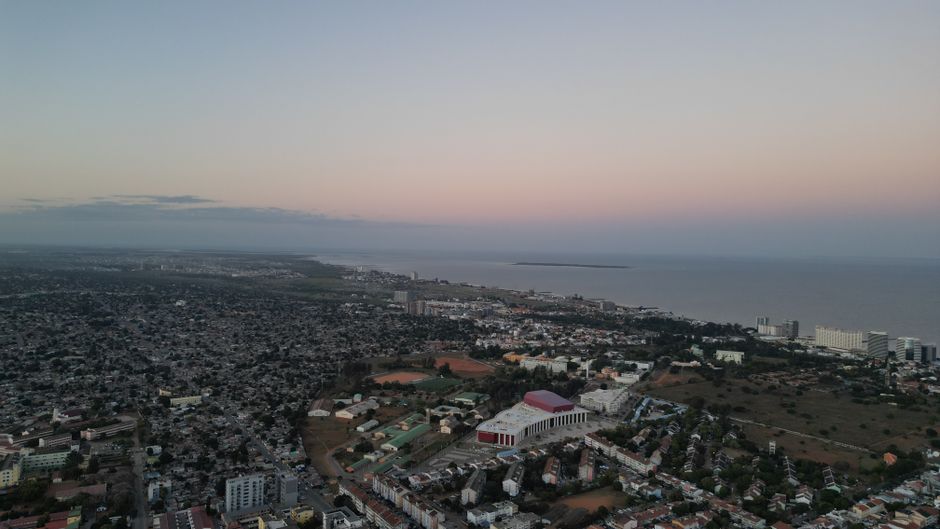
Mozambique stretches for about 2,500 km (1,550 miles) along the Indian Ocean in southeastern Africa, and its coastline is one of the most beautiful and least crowded in the world. Warm turquoise water, white sand dunes, coral reefs and palm-fringed bays run from the South African border to Tanzania, with island chains such as the Bazaruto Archipelago and the Quirimbas, where dhows still sail between fishing villages. The sea is the star: you can snorkel with whale sharks and dive with manta rays at Tofo, look for dugongs around Bazaruto, and watch humpback whales pass offshore in the southern winter. Inland, Gorongosa National Park has become one of Africa’s great wildlife recovery stories. Mozambique’s Portuguese heritage gives it a distinctive flavor, from the colonial avenues and cafés of Maputo to the old stone town of Ilha de Moçambique, a UNESCO World Heritage Site, and to food built around grilled prawns and fiery piri-piri. Travel has become easier since visa rules were relaxed for many nationalities, though distances are long, roads can be slow, and the best beaches are often reached by small plane or boat. Plan ahead for the online travel authorization, malaria protection everywhere, the summer cyclone season, and the north, where some areas are off the tourist routes.
Right now in Mozambique
- Wed 20–27°C 67–81°F 2 mm Partly cloudy
- Thu 17–29°C 63–83°F Clear
- Fri 19–34°C 67–94°F Clear
Weather: MET Norway (CC BY 4.0)
Multi-day tours of Mozambique
Multi-day tours from local operators. You check dates and book on Viator, our partner; we may earn a commission at no extra cost to you. How we earn money
Mozambique at a glance
Mozambique covers about 801,600 km² (309,500 square miles), a little larger than Texas, and borders Tanzania, Malawi, Zambia, Zimbabwe, South Africa and Eswatini. The Zambezi River divides the country roughly in half. The south is low and sandy, with lagoons, dunes and long beaches; the center rises to the Chimanimani mountains on the Zimbabwe border; and the north has inland plateaus, the shores of Lake Niassa (Lake Malawi) and a coral coast. The population is more than 30 million. Maputo, in the far south, is the capital and largest city.
Mozambique’s National Tourism Institute (INATUR) says Portuguese has been the official language since independence, English is the language of business, used mainly in cities and tourist areas, and about 43 national languages are spoken, of which the most common are Emakhuwa, Xichangana and Elomwe. The National Administration of Conservation Areas (ANAC) adds that most park staff also speak English. Mozambique is on Central Africa Time (UTC+2) all year, the same as South Africa. ANAC says electricity is 220 V, 50 Hz, with type C or F two-pin sockets; South African-style three-pin sockets are also common. The country code is +258.
A short history
For many centuries the coast was part of the Swahili trading world, with Arab, Persian and Indian merchants calling at ports such as Sofala and Ilha de Moçambique to trade gold and ivory. Vasco da Gama landed in 1498, and Portugal gradually took control, making Ilha de Moçambique its capital until the late 19th century, when the capital moved south to Lourenço Marques, today’s Maputo. Mozambique became independent on June 25, 1975. Since the 1990s, tourism has grown along the southern coast and in the national parks, and the country has developed large natural gas and mining industries.
Mozambique’s regions for travelers
- Maputo and the far south: the capital, Inhaca Island, Ponta do Ouro’s dolphins and diving, Maputo National Park and the beaches of Bilene and Xai-Xai.
- The Inhambane coast: the historic town of Inhambane, the beaches of Tofo and Barra, Vilankulo and the Bazaruto Archipelago.
- The center: Gorongosa National Park, the port city of Beira, the Chimanimani mountains and the Zambezi.
- The north: Ilha de Moçambique, Nampula, Pemba, the Quirimbas islands, the Niassa Special Reserve and the shores of Lake Niassa around Lichinga.
Regions
Where to go: islands, beaches, reefs and parks
Most first trips focus on the south and the Inhambane coast: a night or two in Maputo, a few days diving or snorkeling at Tofo, and then the islands of Bazaruto, reached by boat from Vilankulo. Many visitors combine Mozambique with South Africa’s Kruger National Park, just across the border. See our guide to the country’s best-known islands:
- Bazaruto Archipelago: dunes, lagoons and reefs in a marine national park, with dugongs, turtles and dhow safaris from Vilankulo.
Maputo and the far south
Maputo is a lively city of wide, jacaranda-lined avenues, Art Deco and modernist buildings, Portuguese bakeries and busy markets, overlooking a large bay. Highlights include the old fortress, the domed railway station, the central market, the crafts market and the seafood restaurants along the waterfront. Boats cross to Inhaca Island for reefs and beaches. Two hours south, near the South African border, Ponta do Ouro is known for dolphins and diving, and Maputo National Park protects coastal lakes, forests and elephants.
Inhambane, Tofo and Vilankulo
About 450–500 km (280–310 miles) north of Maputo, the Inhambane peninsula has a sleepy colonial town on a bay of dhows and mangroves, and, on the ocean side, the beach villages of Tofo and Barra. Tofo is one of the world’s best places to see whale sharks and manta rays, with dive centers and ocean safaris year-round. Farther north, Vilankulo is the gateway to the Bazaruto Archipelago, with a long beach, kitesurfing and seafood restaurants.
Gorongosa and the center
Gorongosa National Park, in the center of the country, lies at the southern end of the Great Rift Valley, with floodplains, lakes and forested Mount Gorongosa. After decades of decline, its wildlife has been restored, and visitors can now see elephants, lions, hippos, buffalo, antelope and a rich birdlife on game drives and walks. ANAC lists Gorongosa, Bazaruto, Quirimbas, Maputo, Limpopo, Zinave and other national parks among the country’s conservation areas, which cover about a quarter of Mozambique.
Ilha de Moçambique and the north
Ilha de Moçambique, a small island linked to the mainland by a 3.5 km (2-mile) bridge, was Portugal’s East African capital for centuries. Its Stone Town of churches, palaces and the Fort of São Sebastião, and its Makuti town of thatched houses, form a UNESCO World Heritage Site. It’s reached from Nampula, about three hours by road. Farther north, Pemba has a large bay and beaches, and the Quirimbas Archipelago, with the historic town on Ibo Island, offers remote island lodges.
Lake Niassa and the wild interior
Mozambique shares Lake Niassa, known in Malawi as Lake Malawi, with its neighbors. The Mozambican shore, reached from the town of Lichinga, is remote and quiet, with clear water, sandy coves and a handful of community lodges, and it’s a good add-on for travelers coming from Malawi; see our Lake Malawi National Park guide for the Malawian side. In the far north, the Niassa Special Reserve is one of Africa’s largest and wildest protected areas, visited by very few people. In the southwest, Limpopo National Park forms part of a transfrontier park with Kruger, linked by the Giriyondo border post, while Zinave, inland from Vilankulo, has been restocked with elephants, giraffes and other wildlife.
Mozambique’s wildlife
Mozambique’s marine life is world-class. Whale sharks and manta rays feed off the Inhambane coast, humpback whales migrate along the coast from about July to October, and five species of sea turtles nest on its beaches. The Bazaruto Archipelago protects one of the last dugong populations in the western Indian Ocean. On land, ANAC says the country has about 220 mammal species and 690 bird species, and the parks of Gorongosa, Niassa, Limpopo and Maputo have elephants, lions, wild dogs and antelope.
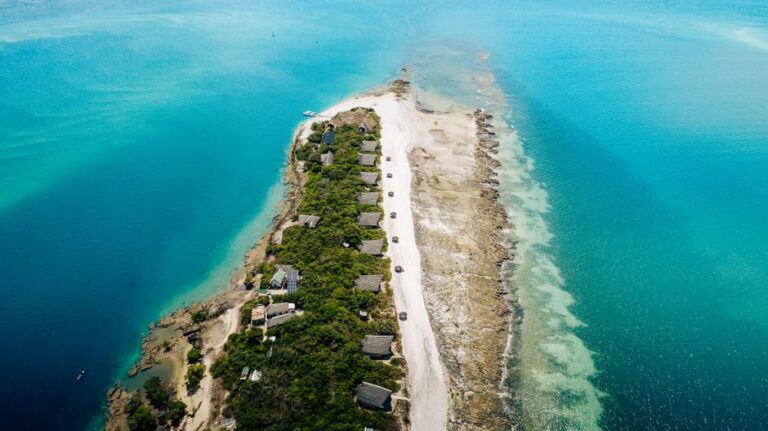
Bazaruto Archipelago Travel Guide
Plan a trip to the Bazaruto Archipelago: Mozambique's oldest marine national park, its five islands and where to stay on Bazaruto, Benguerra or in…
Best time to visit Mozambique
Mozambique has a tropical climate with two main seasons. The dry season, from about May to October, is sunny, less humid and pleasantly warm on the coast, with cool nights in the south; it’s the best time for beaches, diving, safaris and whale watching. The wet season, from about November to April, is hot and humid, with heavy downpours, especially from December to March, and it’s also the cyclone season, when tropical storms can hit the coast. INATUR notes that Mozambique has no real cold season, and that the hottest months on the Bazaruto coast, November to April, bring temperatures of 22–35 °C (72–95 °F). The table shows rounded average daily highs and lows in January and July and yearly rainfall for five stations of Mozambique’s National Meteorological Institute (INAM), from 1961–1990 averages published by the World Meteorological Organization (WMO).
| Region (INAM station) | January high / low | July high / low | Rain a year |
|---|---|---|---|
| Maputo and the far south (Maputo) | 30 °C (86 °F) / 22 °C (72 °F) | 24 °C (75 °F) / 14 °C (57 °F) | about 810 mm (32 in) |
| Tofo and Inhambane (Inhambane) | 31 °C (88 °F) / 23 °C (73 °F) | 25 °C (77 °F) / 16 °C (61 °F) | about 950 mm (37 in) |
| Vilankulo and Bazaruto (Vilankulo) | 31 °C (88 °F) / 24 °C (75 °F) | 25 °C (77 °F) / 14 °C (57 °F) | about 780 mm (31 in) |
| The center (Beira) | 31 °C (88 °F) / 24 °C (75 °F) | 25 °C (77 °F) / 16 °C (61 °F) | about 1,590 mm (63 in) |
| The north coast (Pemba) | 31 °C (88 °F) / 23 °C (73 °F) | 28 °C (82 °F) / 18 °C (64 °F) | about 870 mm (34 in) |
Mozambique month by month
| Month | Weather | Highlights | Crowds and prices |
|---|---|---|---|
| January | Hot, humid and rainy; cyclone risk | Turtle hatchlings on some beaches; warm sea | Busy with South African holidaymakers early in the month |
| February | Hot and wet; cyclone risk | Whale sharks and mantas at Tofo | Quiet; low season |
| March | Hot; rains easing late in the month | Good diving when the sea is calm | Quiet; busy over Easter |
| April | Warm; rains ending | Green landscapes; Easter holidays | Rising at Easter |
| May | Dry season begins; pleasant | Beaches and diving; Gorongosa reopens fully as roads dry | Moderate |
| June | Dry, sunny, cool nights in the south | Independence Day (June 25); whale season begins | Moderate; busy in South African school holidays |
| July | Dry and coolest; windy at times | Humpback whales; safaris | Busy in school holidays |
| August | Dry and sunny | Whales, dolphins and diving; kitesurfing | High season |
| September | Dry and warming | Whales; excellent visibility for diving | Moderate |
| October | Hot and mostly dry | Last whales; turtle nesting starts | Moderate |
| November | Hot; first rains | Turtles nesting; quiet beaches | Quieter |
| December | Hot, humid, rainy; cyclone season begins | Christmas and New Year beach holidays | Very busy over the holidays |
Public holidays
Mozambique’s national holidays include New Year’s Day, Heroes’ Day (February 3), Mozambican Women’s Day (April 7), Workers’ Day (May 1), Independence Day (June 25), Victory Day (September 7), Peace and Reconciliation Day (October 4) and Christmas Day, celebrated as Family Day (December 25). South African school holidays, Easter and the Christmas period are the busiest times on the southern beaches, when lodges near the border fill up.
How long to stay: sample itineraries
- 5 days: fly to Vilankulo and spend four nights on a Bazaruto island or in Vilankulo with island day trips.
- 7–8 days: Maputo (1 night), Tofo (3 nights) for whale sharks and diving, and Vilankulo and Bazaruto (3 nights).
- 10 days: add Gorongosa National Park (2–3 nights), flying via Beira.
- 14 days: combine Kruger National Park in South Africa with Maputo, Tofo and Bazaruto. See our Kruger National Park guide.
- Culture and islands: Ilha de Moçambique (2–3 nights) from Nampula, plus a few days on the Inhambane coast.
Entry, money and costs
Visa-free entry and the eTA (last reviewed October 2026)
In 2023, Mozambique dropped visa requirements for tourist and business visits by citizens of a list of countries, including the United States, Canada, the United Kingdom and many EU countries. The government now runs a single official portal for entry authorizations, evisa.gov.mz, operated for the National Migration Service (SENAMI) and relaunched on February 11, 2026. According to the portal, citizens of 29 countries need an Electronic Travel Authorization (eTA) rather than a visa, allowing a stay of up to 30 days for tourism or business. The list includes the United States, Canada, the United Kingdom, Ireland, France, Germany, Italy, Spain, Portugal, the Netherlands, Belgium, Denmark, Finland, Norway, Sweden, Switzerland, Japan, South Korea, Singapore, China and the United Arab Emirates, among others. The portal’s FAQ explains that the eTA requirement was introduced in 2025 for some visa-exempt travelers and recommends applying at least 48 hours before departure. Citizens of neighboring countries in southern and eastern Africa, including South Africa, Botswana, Eswatini, Kenya, Malawi, Tanzania, Zambia and Zimbabwe, are visa-exempt for 30 or 90 days. Other nationalities, including Australians and New Zealanders, apply for a tourist eVisa, which the portal says can be issued for 30, 60 or 90 days with multiple entries, is valid for use for two months from issue, and is normally processed in about five business days. Fees depend on nationality and category and are shown when you apply; they’re non-refundable. Print your approval and show it at check-in and on arrival. Your passport must be valid for at least six months, and ANAC says it should have at least three blank pages.
The portal explains that if you stay longer than 30 days, or travel for another purpose, you’ll need an eVisa instead of an eTA, and it asks tourist-visa applicants to upload proof of accommodation, return tickets and financial means; minors need extra documents from their parents or guardians. Citizens of a few countries, including Ethiopia, Nigeria and Pakistan, can’t use the portal and must apply at a Mozambican mission abroad. Apply only on evisa.gov.mz and check your spam folder for the approval email.
Health requirements
According to the US CDC, Mozambique requires a yellow fever vaccination certificate from travelers aged one year and over arriving from a country with yellow fever risk, including after an airport transit of more than 12 hours in such a country; direct travelers from the US don’t need one, and the vaccine isn’t recommended for Mozambique itself. ANAC asks visitors to carry their vaccination booklet when crossing the border.
Customs
ANAC says arriving visitors fill in a customs declaration, personal items and medicines for personal use are duty-free, and you can import goods worth up to US$200 duty-free, with limits of 400 cigarettes, 1 liter of spirits and 2.25 liters of wine. Customs officers often check bags at the airport. Families traveling through South Africa with children must carry full birth certificates for each child.
Money, cards and tipping
The currency is the metical (MZN, written MT locally; plural meticais). On October 2, 2026, the Banco de Moçambique’s reference rate was about MZN 63.9 to the US dollar, while exchange bureaus were selling at around MZN 70. INATUR and ANAC say South African rand, US dollars and euros are accepted in many tourist places, Visa and Mastercard work at larger hotels and businesses, and ATMs are found at airports and in all large towns. Carry meticais for markets, chapas (minibuses), fuel and small restaurants, especially outside the cities, and tell your bank you’re traveling. ANAC says a tip of about 10% is customary and expected in hotels and restaurants.
Park fees
Mozambique’s national parks and reserves, managed by ANAC, often with partners such as African Parks at Bazaruto and the Gorongosa Restoration Project, charge daily conservation fees per person and per vehicle or boat. Lodges and boat operators usually collect them and include them in their prices, so ask what’s included when you book. See our Bazaruto Archipelago guide for the marine park.
What a trip costs
Prices are approximate, for October 2026, converted at about MZN 63.9 to the US dollar.
| Item | Typical cost |
|---|---|
| Chapa (minibus) ride in town | MZN 20–50 (about US$0.30–0.80) |
| Local lunch (chicken or fish with xima or rice) | MZN 300–600 (about US$4.70–9.40) |
| Grilled prawn dinner at a beach restaurant | MZN 1,200–2,500 (about US$19–39) |
| Local beer (2M or Laurentina) | MZN 80–150 (about US$1.25–2.35) |
| Bus Maputo–Inhambane, one way | about MZN 1,200–1,800 (about US$19–28) |
| Domestic flight Maputo–Vilankulo, one way | about US$150–300 |
| Ocean safari or snorkeling trip at Tofo | about US$50–80 |
| Mid-range beach lodge double, per night | about US$80–200 |
| Luxury island lodge, per person per night, full board | about US$500–1,500 |
A comfortable mid-range trip on the southern coast costs about US$120–250 per person per day, including lodges, meals, transport and some activities; backpackers can manage on less, and the island resorts of Bazaruto and the Quirimbas are among the most expensive in Africa.
Getting there and getting around
By air
Most international flights land at Maputo International Airport (MPM), with connections from Johannesburg, Lisbon, Addis Ababa, Nairobi, Doha and Istanbul. INATUR says Vilankulo has direct flights from Johannesburg and Nelspruit (near Kruger), and other visitors can fly to Maputo and on to Vilankulo. Domestic flights by LAM, the national airline, and other carriers link Maputo with Inhambane, Vilankulo, Beira, Nampula, Pemba, Tete and Lichinga; distances are huge, so flying saves days. See our Addis Ababa guide for Ethiopian Airlines connections.
By road
Mozambique drives on the left. The main north–south highway, the EN1, runs along the coast from Maputo through Xai-Xai and Maxixe (for Inhambane) to the junction for Vilankulo, and INATUR describes it as passing palm forests and farmland with towns for fuel and meals. Long-distance buses link the main towns, and chapas (shared minibuses) cover shorter routes. Many beach lodges are reached on sandy tracks that need a 4×4. Police checkpoints are common: carry your passport (or a certified copy), driving license, vehicle papers, two hazard triangles and a reflective vest, and stay calm and polite.
Boats, ferries and island transfers
Much of coastal Mozambique is best explored by water. Small passenger ferries and motorboats cross the bay between Maxixe, on the EN1, and the town of Inhambane in about 20–30 minutes, a pleasant shortcut if you arrive by bus. From Vilankulo, motorboats and traditional sailing dhows run day trips and transfers to the Bazaruto islands, and island lodges also use light aircraft and helicopters. Boats leave Maputo for Inhaca Island, and in the north, transfers to the Quirimbas lodges go by boat or small plane from Pemba. Sea conditions decide the timetable, so allow a buffer day before international flights, and travel only with operators that carry life jackets.
Overland from neighboring countries
The busiest crossing is Lebombo–Ressano Garcia, on the highway from Johannesburg and Kruger to Maputo. Kosi Bay–Ponta do Ouro, in the far south, serves the beach resorts and is best with a 4×4, and Giriyondo links Kruger with Limpopo National Park. Other crossings lead to Eswatini (Namaacha and Goba), Zimbabwe (Machipanda, near Mutare) and Malawi; see our Malawi travel guide. Bring cash for road fees and third-party insurance at the border if you’re driving.
Culture, food and everyday etiquette
Food and drink
Mozambican food blends African, Portuguese, Arab and Indian flavors. The coast is famous for prawns, grilled with garlic and piri-piri, the small fiery chili that flavors much of the country’s cooking, along with crab, lobster, calamari and fresh fish. Matapa is cassava leaves cooked with ground peanuts and coconut milk, often with prawns or crab, and frango à cafreal is chicken grilled with chili and lemon. The staple is xima, a stiff maize porridge, or rice, and Portuguese-style bread rolls (pão) and pastries are sold everywhere. Snack on chamuças (samosas) and roasted cashews, which Mozambique grows in large quantities. Local beers include 2M, Laurentina and Manica, and South African wines are widely sold.
Where to stay
Accommodation ranges from backpacker lodges and beach campsites in Tofo and Vilankulo to boutique guesthouses in Inhambane and Ilha de Moçambique, city hotels in Maputo and exclusive island resorts on Bazaruto, Benguerra and the Quirimbas. Book early for South African school holidays, Easter and Christmas.
Etiquette
- Language: a few words of Portuguese go a long way: “bom dia” (good morning), “boa tarde” (good afternoon) and “obrigado” or “obrigada” (thank you).
- Dress: beachwear belongs on the beach; cover up in towns and villages, especially in the largely Muslim north.
- ID: carry your passport or a certified copy, as police may ask to see it.
- Photos: ask before photographing people, and don’t photograph government buildings, police, security installations or airports.
- Bargaining: expected at craft markets, but keep it friendly.
Safety, health and connectivity
Most visits to Mozambique’s southern coast, islands and parks are relaxed and trouble-free. The main things to plan for are health, the sea, the roads and the remote north.
- Malaria: the US CDC says malaria transmission occurs in all areas and recommends antimalarial medicine; ANAC advises repellent and sleeping under a mosquito net.
- Sea conditions: currents can be strong on exposed beaches such as Tofo; swim where locals do and avoid swimming alone. Choose licensed dive and boat operators with life jackets and radios, and follow the guidelines for swimming with whale sharks and dolphins.
- Cyclones: from about November to April, tropical storms can bring flooding and close roads and airports; follow INAM forecasts and your lodge’s advice.
- Fresh water: the CDC warns that schistosomiasis (bilharzia) can be caught in freshwater lakes and rivers, including Lake Niassa.
- Roads: avoid driving at night because of unlit vehicles, pedestrians and livestock, and keep to speed limits at checkpoints.
- City precautions: in Maputo, keep valuables out of sight, use registered taxis or ride-hailing at night, and don’t walk alone on quiet streets or beaches after dark.
- The far north: parts of Cabo Delgado province on the mainland, north and west of Pemba, are off the tourist routes, and road travel there is not part of standard itineraries; island lodges in the Quirimbas are reached by air or boat. Check the current status of roads, flights and transfers before you travel.
- Medical care: good hospitals are found mainly in Maputo; ANAC recommends travel insurance that covers medical emergencies, and evacuation to South Africa is common for serious cases.
Connectivity: ANAC says you can buy a starter pack with a SIM card at mobile phone shops; the main networks are Vodacom, Movitel and Tmcel. Coverage is good in towns and along the EN1 but patchy on islands and in parks.
Things to do: diving, islands, safaris and culture
- Diving: manta rays and reef sharks at Tofo, Two Mile Reef at Bazaruto, Ponta do Ouro and the Quirimbas. See our diving guide.
- Snorkeling: whale sharks on ocean safaris at Tofo, and coral gardens around Bazaruto and Inhaca. See our snorkeling guide.
- Beaches: Tofo, Barra, Vilankulo, Bilene, Ponta do Ouro and the islands. See our beaches guide.
- Dhow trips: island hopping and sandbank picnics from Vilankulo and Inhambane. See our boat trips guide.
- Kitesurfing and surfing: Vilankulo’s lagoon and Tofo’s point break. See our surfing guide.
- Safaris: Gorongosa, Maputo National Park, Limpopo and Niassa.
- Culture: Maputo’s architecture and markets, Inhambane’s old town and Ilha de Moçambique. See our city sightseeing guide.
Responsible marine encounters
Whale sharks, mantas, dolphins and turtles are the reason many people come to Mozambique, and they’re best enjoyed with care. Go with established operators who brief you before entering the water and keep boats at a distance. Snorkelers should slip in quietly, stay a few meters from the animals, never touch or chase them, and avoid flash photography. On nesting beaches from about October to March, keep lights low at night and give turtles plenty of space. In the marine parks, don’t collect shells or coral, and use reef-safe sunscreen.
What to pack for Mozambique
Light, breathable clothes, a sweater for cool winter evenings in the south, swimwear and a cover-up for towns, a reef-safe sunscreen, a wide-brimmed hat and sunglasses, insect repellent with DEET or picaridin, water shoes for rocky beaches and sea urchins, a rash vest or shorty wetsuit for snorkeling in the cooler months, a dry bag for boat trips, a rain jacket for the wet season, a headlamp, any antimalarials and medicines, a printed copy of your eTA or eVisa approval, small US dollar or rand notes and meticais, and an adapter for type C, F and South African-style plugs. See our water shoes, wetsuits, rain jackets and travel adapters guides.
Mozambique travel FAQ
Do I need a visa to visit Mozambique?
Citizens of 29 countries, including the US, Canada, the UK and much of the EU, don’t need a visa for up to 30 days but must get an online eTA from evisa.gov.mz; most other nationalities apply for an eVisa on the same site.
When should I apply for the Mozambique eTA?
The official portal recommends applying at least 48 hours before departure; eVisas take about five business days.
Do Australians need a visa for Mozambique?
Australia isn’t on the eTA list on the official portal, so Australians apply for a tourist eVisa online before travel.
How long can I stay in Mozambique without a visa?
Up to 30 days with an eTA; for longer stays or other purposes, apply for an eVisa of 30, 60 or 90 days.
What is the best time to visit Mozambique?
May to October is dry, sunny and best for beaches, diving and whales; November to April is hot and wet, with a risk of cyclones.
Can I use US dollars or rand in Mozambique?
In many tourist places, yes, according to INATUR and ANAC, but you’ll need meticais for markets, chapas and local restaurants.
Do I need a yellow fever certificate for Mozambique?
Only if you arrive from a country with yellow fever risk, including after a transit of more than 12 hours there, according to the US CDC.
Is there malaria in Mozambique?
Yes, in all areas. The CDC recommends antimalarial medicine, and repellent and nets are essential.
Where can I swim with whale sharks in Mozambique?
Off Tofo, near Inhambane, on ocean safaris with licensed operators; sightings are possible all year but never guaranteed.
How do I get to the Bazaruto Archipelago?
Fly to Vilankulo, which INATUR says has direct flights from Johannesburg and Nelspruit, then take a boat or a short charter flight to the islands.
Can I combine Mozambique with Kruger National Park?
Yes. Drive via the Lebombo–Ressano Garcia border to Maputo, use the Giriyondo crossing into Limpopo, or fly from Nelspruit to Vilankulo.
Is the north of Mozambique open to visitors?
Ilha de Moçambique, Nampula and Pemba receive visitors, and Quirimbas island lodges are reached by air or boat. Parts of mainland Cabo Delgado are off the tourist routes, so check road and flight status before you travel.
How many days do I need in Mozambique?
Five days for one island area; 10–14 days to combine Maputo, Tofo, Bazaruto and Gorongosa or Kruger.
Sources and last review
Researched and last reviewed on 5 October 2026. The eTA and eVisa, the country lists, stay lengths, processing times, validity, documents, the portal’s relaunch and the 2025 eTA requirement: Mozambique’s official eVisa and eTA portal for the National Migration Service; languages, currency, cards, the Bazaruto park, flights to Vilankulo and the EN1: Mozambique’s National Tourism Institute (INATUR); time zone, electricity, park staff languages, money, tipping, passport pages, vaccination booklet, customs allowances, driving side, children’s documents via South Africa, insurance, mosquito nets, SIM cards and conservation areas: the National Administration of Conservation Areas (ANAC); yellow fever, malaria and schistosomiasis: the US CDC; climate averages: the National Meteorological Institute (INAM) via the World Meteorological Organization; the exchange rate: the Banco de Moçambique. Area and population, history, coastline length, the 2023 visa change, the wildlife and whale seasons, holidays, airline routes, border crossings, road rules, food, sea and cyclone details, the far-north status, park management partners and typical prices are general references or estimates, flagged for checking. Rules and prices change, so check the official sites before you go.
Plugs and power in Mozambique
Mozambique uses 220 V, 50 Hz and these plugs (left) and wall sockets (right):
All plug types and voltages by country → · Check what you need to pack →
Plan your trip
Partner links: TravelerCenter may earn a commission if you book, at no extra cost to you.
🇵🇹 Useful Portuguese phrases for Mozambique
All 38 Portuguese phrases: restaurant, hotel, emergencies, romance (printable) →