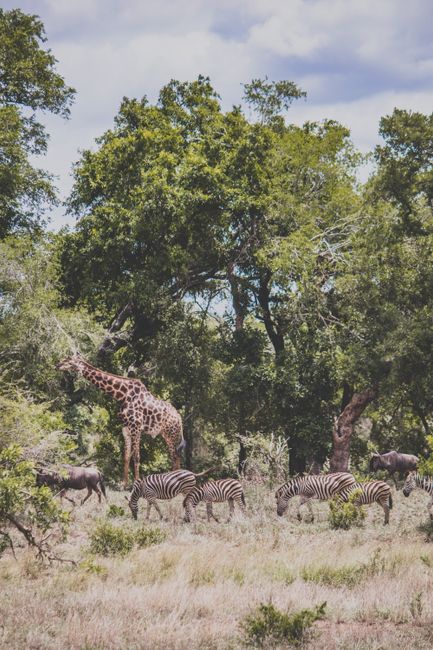
Kruger National Park is one of the great wildlife parks of Africa and the easiest place on the continent to go on safari on your own terms. Stretching about 350 km (220 miles) from north to south along South Africa’s border with Mozambique, and covering close to 20,000 km² (7,700 square miles), it is home to the Big Five (lion, leopard, elephant, buffalo and rhino) as well as cheetahs, wild dogs, giraffes, hippos, crocodiles and more than 500 bird species. What makes Kruger special is that you can drive yourself on a network of tarred and gravel roads, stop at waterholes for as long as you like, and spend the night in a fenced public rest camp with bungalows, campsites, shops and restaurants, at a fraction of the cost of a private safari. Along its western edge, private reserves such as Sabi Sand and Timbavati, part of the Greater Kruger, offer luxury lodges with guided game drives. The park is run by South African National Parks (SANParks). It lies in the subtropical Lowveld, where summer (November to March) is hot and wet and winter (May to September) is dry, sunny and the classic game-viewing season.
Right now in Kruger National Park (Skukuza)
- Thu16–30°C62–86°FClear
- Fri20–37°C68–99°FMostly clear
- Sat22–31°C71–87°F1 mm rain
Top tours in Kruger National Park
See all tours for Kruger National Park →
From local operators, with prices and reviews; you check availability and book on Viator, our partner. We may earn a commission at no extra cost to you. How we earn money
Kruger at a glance
- Best months: May to September for game viewing, when the bush is thin and animals gather at rivers and waterholes. October is hot and dry with excellent sightings; November to March is green, hot and humid, with newborn animals and migrant birds.
- Time needed: at least three nights; five or more nights to explore both the south and the center, a week or more for the remote north.
- Getting there: about 400–600 km (250–370 miles) by road from Johannesburg depending on the gate, or a short flight to Skukuza, Kruger Mpumalanga International (Mbombela), Phalaborwa or Hoedspruit.
- Costs (as of October 2026): the daily conservation fee for international visitors is R602 per adult (about US$36) and R300 per child until 31 October 2026, rising to R692 (about US$42) and R345 from 1 November 2026.
- Before you go: visas, money and the SANParks Wild Card are covered in our South Africa travel guide.
Conservation fees, gate times and park rules
Daily conservation fees
Every visitor pays a daily conservation fee for each day (or night) in the park, in addition to accommodation and activities. Rates for 1 November 2025 to 31 October 2026, according to SANParks:
| Visitor category | Adult (12+), per day | Child (2–11), per day |
|---|---|---|
| — | — | — |
| South African citizens and residents (with ID) | R134 | R67 |
| SADC nationals | R275 | R137 |
| International visitors | R602 (about US$36) | R300 (about US$18) |
Children under 2 enter free. From 1 November 2026 to 31 October 2027, SANParks charges R692 (international), R296 (SADC) and R140 (South African) per adult, and R345, R147 and R70 per child. If you’ll spend about eight days or more in SANParks parks within a year, the Wild Card (International All Parks Cluster: R4,680 for one person, R7,310 for a couple, R8,745 for a family) can save money. A community fund levy of 1% is added to accommodation and activity bookings.
Gate times
Kruger’s gates open and close at fixed times that change through the year, and they are strictly enforced. Times for the entrance gates, according to SANParks:
| Months | Entrance gates open | Gates close |
|---|---|---|
| — | — | — |
| January and February | 05:30 | 18:30 |
| March | 05:30 | 18:00 |
| April | 06:00 | 18:00 |
| May to July | 06:00 | 17:30 |
| August and September | 06:00 | 18:00 |
| October | 05:30 | 18:00 |
| November and December | 05:30 | 18:30 |
Rest camp gates follow the same closing times but open earlier, at 04:30, from November to January. You must be inside your camp, or out of the park, before the gates close. Latecomers at entrance gates are refused entry; late arrivals are only allowed in emergencies, up to 21:00, for guests with booked accommodation at certain camps within 10 km of the gate, with an escort fee of R500 per vehicle. There is no late admission at Phabeni, Phalaborwa or Pafuri gates. Allow plenty of time: average driving speeds in the park are slow, and you’ll stop for animals.
Booking and day visits
Book accommodation and activities through SANParks online or its central reservations office; rest camps open for booking well in advance and fill quickly for school holidays, long weekends and the June to September season. The park has a daily maximum number of visitors; when it is reached, only guests with booked overnight accommodation can enter, which happens mainly on public holidays and long weekends. Day visitors can pre-book a day visit online to be sure of entry. Complete the gate registration and indemnity form before you arrive and show your passport at the gate.
Self-drive rules
- Stay in your vehicle except at rest camps, picnic sites and marked viewpoints or hides, and keep your arms and head inside.
- Don’t feed any animal, including monkeys and baboons at camps and picnic sites; it is illegal and leads to animals being destroyed.
- Keep to the speed limits, generally 50 km/h (31 mph) on tarred roads and 40 km/h (25 mph) on gravel roads, and stay on public roads.
- Give elephants space: never drive between a mother and calf, and back off if an elephant flaps its ears or walks toward you.
- No pets, and no animal products may be removed from the park; rules are enforced under the Protected Areas Act, and transgressions are fined.
Kruger regions and who each one suits
The south: Skukuza, Lower Sabie, Pretoriuskop and Berg-en-Dal
The southern third, between the Sabie and Crocodile rivers, has the highest concentration of animals, the best chance of the Big Five in a short stay, and the busiest roads. Skukuza, the largest camp, has an airport, restaurants and shops; Lower Sabie, on the river, is a favorite for sightings; Berg-en-Dal and Pretoriuskop lie in hillier, wooded country near Malelane and Numbi gates. Ideal for first visits and short trips.
The center: Satara, Olifants and Orpen
The open grasslands around Satara are known for lions, cheetahs and big herds of zebra, wildebeest and buffalo. Olifants camp sits on a cliff above the Olifants River, with one of the park’s finest views. Orpen gate is convenient from the Hoedspruit area and the private reserves.
The north: Letaba, Mopani, Shingwedzi and Punda Maria
North of the Olifants River, mopane woodland dominates and visitors are fewer. Letaba has the Elephant Hall museum, and the far north around Punda Maria and Pafuri is the wildest part of the park, renowned for birds, baobab trees and the archaeological site of Thulamela. It suits returning visitors and birders.
Private reserves of the Greater Kruger
Along the park’s western boundary, fences have been removed between Kruger and private reserves such as Sabi Sand, Timbavati, Klaserie and Manyeleti. Their lodges offer guided game drives in open vehicles, off-road tracking, night drives and walking safaris, with meals included. They are much more expensive but give the closest encounters, especially with leopards.
Top things to see in Kruger
Self-drive game viewing
The best times are early morning, when the gates open, and late afternoon before they close. Drive slowly, stop at rivers, dams and waterholes, and check the sightings boards at camp receptions. Popular routes include the H4-1 along the Sabie River between Skukuza and Lower Sabie, the S100 gravel road near Satara, and the river roads around Letaba and Olifants. A good field guide or app and binoculars make a big difference.
Guided game drives and night drives
SANParks rangers run sunrise, sunset and night drives in open vehicles from the main camps. Night drives are the only way for self-drive visitors to be out after the gates close and give a chance of seeing leopards, hyenas, genets and bushbabies. Book at the camp or in advance.
Guided bush walks and wilderness trails
Morning and afternoon walks with armed rangers from most camps focus on tracks, plants and smaller creatures, and sometimes bring you close to big game on foot. Multi-night wilderness trails and backpacking trails in remote areas, for small groups, are booked months ahead.
The Big Five and the Little Five
Elephants and buffalo are seen daily; lions are most often found in the south and center; leopards are elusive but regularly seen along rivers; and rhinos are fewer than they were because of poaching, so rangers don’t share their locations. SANParks also encourages visitors to look for the Little Five (buffalo weaver, elephant shrew, leopard tortoise, ant lion and rhino beetle) and the Birding Big Six, including the ground hornbill and Pel’s fishing owl.
Letaba Elephant Hall and cultural sites
The Letaba Elephant Hall displays the tusks of Kruger’s legendary “Magnificent Seven” elephants. Historic sites include the Masorini and Thulamela archaeological sites, the Albasini ruins and the Stevenson-Hamilton Memorial Library at Skukuza.
Other things to do in Kruger
- Hides and picnic sites: bird hides on dams and rivers, and picnic sites such as Tshokwane and Nkuhlu, where you can get out of the car.
- 4×4 adventure trails: guided off-road routes in the park’s own vehicles or your own 4×4.
- Mountain biking: guided rides from some camps, such as Olifants.
- Overnight hides: basic, fenced hides where you can sleep beside a waterhole.
- Birding: more than 500 species, best in summer when migrants arrive.
Food and drink
Main rest camps have restaurants, cafés or take-away outlets and shops selling groceries, firewood and braai packs, and most bungalows have a kitchen or braai area. Many visitors self-cater, cooking on a braai under the stars. The camp shops sell basic food, drinks and alcohol; stock up on specialty items in Mbombela, Hazyview, Malelane or Phalaborwa before you enter.
Day trips and nearby
The Panorama Route and Blyde River Canyon
West of the park, the escarpment drive passes God’s Window, Bourke’s Luck Potholes, the Three Rondavels viewpoint above the Blyde River Canyon, and waterfalls near Graskop and Sabie. It is a full day from the southern gates, or a stop on the way from Johannesburg.
Hazyview, Mbombela and Hoedspruit
The towns outside the gates have lodges, restaurants, supermarkets and car rental. Hazyview is near Phabeni and Paul Kruger gates, Mbombela (Nelspruit) is the regional capital with Kruger Mpumalanga International Airport, and Hoedspruit is the base for the private reserves of the center-west.
Johannesburg and Pretoria
Many visitors drive from Johannesburg or Pretoria, a journey of five to seven hours to the southern gates. For a malaria-free alternative closer to Johannesburg, see Pilanesberg National Park.
Getting there and getting around
By road
National roads to all gates are tarred. SANParks gives these distances from Johannesburg: Malelane 428 km (266 miles), Numbi 411 km, Phabeni 430 km, Paul Kruger (for Skukuza) 460 km, Crocodile Bridge 475 km, Orpen 490 km, Phalaborwa 490 km, Punda Maria 550 km and Pafuri 600 km. Most routes follow the N4 toll road via eMalahleni (Witbank) and Mbombela. Leave early so you arrive before the gates close, and avoid driving at night outside the park.
By air
Skukuza Airport (SZK), inside the park, has flights from Johannesburg and Cape Town; Kruger Mpumalanga International (MQP) near Mbombela, Hoedspruit (HDS) and Phalaborwa (PHW) are just outside. Rent a car at the airport or arrange transfers with your lodge.
Getting around inside the park
Any ordinary car can handle the tarred roads and most gravel roads in the dry season; a higher vehicle gives better views. Fuel is sold at the main camps. Guided safaris in open vehicles from the camps, or tours from Johannesburg and the gateway towns, are alternatives if you don’t want to drive.
When to go and how long to stay
Kruger has a summer-rainfall climate. Winter (May to September) is dry and sunny, with warm days around 23–26 °C (73–79 °F) and cool to cold nights and early mornings, sometimes near 5 °C (41 °F); grass and leaves die back, animals concentrate at water, and game viewing is at its best. October and early November are hot and dry before the rains. Summer (November to March) is hot, often above 30 °C (86 °F) in the Lowveld, with afternoon thunderstorms, lush vegetation, baby animals and superb birding, but thicker bush makes animals harder to spot.
| Month | Average high | Average low | Rain | Rain days |
|---|---|---|---|---|
| Jan | 28 °C (82 °F) | 18 °C (65 °F) | 132 mm (5.2 in) | 13 |
| Feb | 28 °C (82 °F) | 18 °C (64 °F) | 124 mm (4.9 in) | 12 |
| Mar | 27 °C (81 °F) | 17 °C (63 °F) | 99 mm (3.9 in) | 11 |
| Apr | 25 °C (78 °F) | 14 °C (58 °F) | 45 mm (1.8 in) | 7 |
| May | 24 °C (76 °F) | 10 °C (51 °F) | 13 mm (0.5 in) | 3 |
| Jun | 22 °C (72 °F) | 8 °C (46 °F) | 8 mm (0.3 in) | 2 |
| Jul | 22 °C (72 °F) | 7 °C (45 °F) | 10 mm (0.4 in) | 2 |
| Aug | 24 °C (74 °F) | 9 °C (49 °F) | 10 mm (0.4 in) | 3 |
| Sep | 26 °C (78 °F) | 12 °C (54 °F) | 23 mm (0.9 in) | 4 |
| Oct | 26 °C (78 °F) | 14 °C (58 °F) | 61 mm (2.4 in) | 10 |
| Nov | 26 °C (79 °F) | 16 °C (61 °F) | 103 mm (4.1 in) | 12 |
| Dec | 27 °C (81 °F) | 17 °C (63 °F) | 115 mm (4.5 in) | 12 |
| Year | 25 °C (78 °F) | 14 °C (56 °F) | 743 mm (29 in) | 93 |
Figures are the South African Weather Service’s 1981–2010 normals for Mbombela (Nelspruit), the nearest SAWS station in the WMO’s World Weather Information Service, at about 660 m (2,170 ft), as published by the World Meteorological Organization. Inside Kruger, at lower altitude, temperatures are usually a few degrees higher, especially in summer and in the north.
How long to stay: 2, 4 and 7 nights
- Two nights: stay in the south (Skukuza or Lower Sabie) and drive the Sabie River roads, with a sunset or night drive.
- Four nights: two nights in the south and two in the center at Satara or Olifants.
- Seven nights: add Letaba and Shingwedzi or Punda Maria in the north, or two nights in a private reserve lodge.
Where to stay in Kruger
- Main rest camps: Skukuza, Lower Sabie, Satara, Olifants, Letaba and others have bungalows, cottages, safari tents and campsites, with shops, fuel and restaurants.
- Bushveld camps and satellite camps: smaller, quieter camps with no shops or restaurants, such as Talamati, Sirheni and Biyamiti, for self-caterers.
- Overnight hides and campsites: the most basic and immersive options.
- Concession and private lodges: luxury lodges inside the park and in the private reserves, with game drives and meals included.
- Outside the gates: hotels and guesthouses in Hazyview, Marloth Park, Malelane and Hoedspruit, with day entry into the park.
Check-in at SANParks camps is from 14:00, and rooms must be vacated by 10:00.
Typical costs in Kruger
| Item (as of October 2026) | Rand | About US dollars |
|---|---|---|
| — | — | — |
| Conservation fee, international adult, per day (to 31 Oct 2026 / from 1 Nov 2026) | R602 / R692 | $36 / $42 |
| Conservation fee, international child, per day (to 31 Oct 2026 / from 1 Nov 2026) | R300 / R345 | $18 / $21 |
| Wild Card, International All Parks Cluster, one person | R4,680 | $282 |
| Late-entry escort, per vehicle | R500 | $30 |
| Rest camp bungalow for two, per night | about R1,500–3,000 | about $90–180 |
| Guided sunset or night drive, per person | about R500–800 | about $30–48 |
| Private reserve lodge, per person per night, all-inclusive | about R8,000–30,000+ | about $480–1,800+ |
| Rental car, small, per day | about R400–800 | about $24–48 |
Conservation fees, Wild Card prices and the escort fee are official SANParks figures; accommodation, drives, lodges and car hire are typical ranges. Conversions use about R16.60 to US$1.
Safety in Kruger
- Wildlife: stay in your vehicle, keep windows up near elephants and lions, and never approach animals on foot outside camps. Walk only with SANParks rangers.
- Malaria: Kruger is in a malaria area. SANParks describes the risk as usually low, even in summer, with the highest risk from November to April, at the end of the rainy season; the risk is lowest in the dry winter months. Use insect repellent from dusk to dawn, wear long sleeves in the evening, keep screens closed, and talk to a travel-health professional about preventive tablets. Any fever within weeks of your visit needs a malaria test.
- Heat: summer temperatures can exceed 35 °C (95 °F); carry water and avoid the midday sun.
- In camps: monkeys and baboons steal food; keep it locked away and doors and screens closed. Use a flashlight at night, as snakes and scorpions are about.
- Driving outside the park: avoid driving at night on the access roads, watch for pedestrians, animals and potholes, and keep valuables out of sight.
- Emergencies: contact the camp reception or the SANParks emergency numbers on your permit; for national services call 10111 (police) or 10177 (ambulance), or 112 from a mobile.
Practical tips for Kruger
- Book early: rest camps open for reservations months ahead and sell out for June to September and the school holidays.
- Cash-free: SANParks camps and gates take cards.
- Signal: mobile coverage is good near the main camps and patchy elsewhere; download offline maps.
- Fuel: fill up whenever you can.
What to pack for Kruger
Pack neutral-colored clothes (khaki, olive, tan), a warm fleece and jacket for winter mornings and night drives, a sun hat, sunglasses and SPF 50 sunscreen, insect repellent with DEET or picaridin, long sleeves for the evenings, binoculars, a camera with a zoom lens, a flashlight or headlamp, a reusable water bottle, and a cooler bag for the car. A field guide to mammals and birds adds a lot to the drive. See our hiking shoes guide for walking safaris.
Kruger National Park travel FAQ
How much is the Kruger National Park entrance fee?
For international visitors, the daily conservation fee is R602 per adult and R300 per child (2–11) from 1 November 2025 to 31 October 2026. SADC nationals pay R275 and South Africans R134 per adult. From 1 November 2026, the fees are R692 per international adult and R345 per child, R296 for SADC nationals and R140 for South Africans.
What time do the Kruger gates open and close?
It depends on the month. From November to February, entrance gates open at 05:30 and close at 18:30; from May to July they open at 06:00 and close at 17:30. You must be in your camp or out of the park before closing.
Can I drive myself in Kruger?
Yes. Any car can use the tarred roads and most gravel roads. Stay in your vehicle except in designated areas, keep to the speed limits and don’t feed animals.
Is Kruger National Park malaria-free?
No. Kruger is in a malaria area, though SANParks describes the risk as usually low; it is highest from November to April. Take precautions and ask a travel-health professional about tablets.
When is the best time to visit Kruger?
May to September, the dry winter season, for the best game viewing. October is hot but still excellent; summer is green and great for birds and baby animals.
How far is Kruger from Johannesburg?
About 410–490 km (255–305 miles) to the southern and central gates, a drive of five to seven hours, and up to 600 km to Pafuri in the far north. Flights to Skukuza take about an hour.
Do I need to book a day visit to Kruger?
It is wise in busy periods. Kruger has a daily visitor limit; when it is reached, only overnight guests can enter, so pre-book your day visit online for holidays and long weekends.
Is the Wild Card worth it for Kruger?
For about eight or more days in national parks, yes: the International All Parks Cluster costs R4,680 for one person and covers daily conservation fees for a year.
What is the difference between Kruger and the private reserves?
In Kruger you can self-drive and stay in affordable SANParks camps; in the private reserves of the Greater Kruger, you stay in lodges with guided off-road game drives and walks, at much higher prices.
How many days do you need in Kruger?
At least three nights to have a good chance of the Big Five; five nights or more to explore the south and center without rushing.
Plan your trip
Partner links: TravelerCenter may earn a commission if you book, at no extra cost to you.
Sources · last reviewed 6 October 2026
Researched and last reviewed on 6 October 2026. Conservation fees (2025/26 and 2026/27), gate times, late-arrival rules and the escort fee, distances from Johannesburg, the daily visitor limit, camp check-in times, park rules, malaria seasons and Wild Card prices come from South African National Parks (SANParks); the exchange rate from the European Central Bank; climate from the South African Weather Service’s 1981–2010 normals for Mbombela via the World Meteorological Organization. The park’s size, speed limits, camp and route details, airports, wildlife details and typical prices are general references and flagged for checking. For entry rules and money, see our South Africa travel guide.
Data: Weather: MET Norway (CC BY 4.0) · Rates: ECB · Costs: World Bank ICP and price levels · Wikidata (CC0)