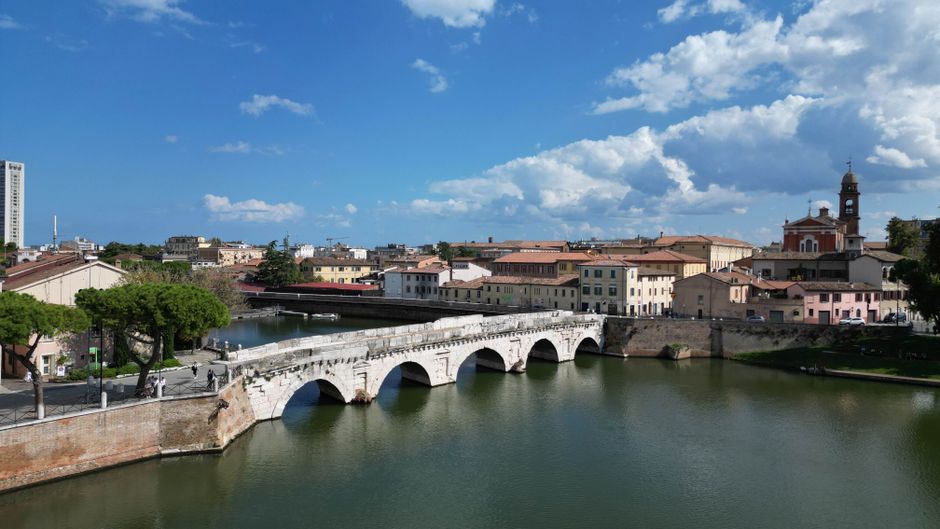
Rimini is two cities in one. On the Adriatic shore it is Italy’s classic seaside resort: 15 km of soft sand lined with numbered beach clubs, hotels, piadina kiosks and bike paths, busy with families by day and clubbers by night in summer. A few minutes inland is a handsome historic town that most beach visitors never see, with a 2,000-year-old Roman bridge and triumphal arch, the Renaissance Tempio Malatestiano, the castle of the Malatesta lords and a museum to Federico Fellini, who was born here. Rimini is also the gateway to the tiny Republic of San Marino, 55 minutes away by bus on its mountain. Come in June or September for the beach, or any time of year for the old town.
Right now in Rimini
- Wed16–23°C60–73°FMostly clear
- Thu18–26°C65–78°F1 mm rain
- Fri16–18°C60–65°F3 mm rain
Top tours in Rimini
See all tours for Rimini →
From local operators, with prices and reviews; you check availability and book on Viator, our partner. We may earn a commission at no extra cost to you. How we earn money
Rimini at a glance
- Best for: family beach holidays, Roman and Renaissance sights, Fellini, food, cycling, nightlife in summer and a day in San Marino.
- How long: 2 days for the old town and San Marino; a week for a beach holiday with day trips.
- Best time: June and September for the beach; July and August are hottest and busiest; the old town is pleasant all year.
- Getting there: fast trains on the Adriatic line (Bologna about an hour away); Rimini’s Federico Fellini airport has mostly seasonal flights, and Bologna airport is the main alternative.
- Getting around: on foot or by bike in the centre and along the seafront; the Metromare rapid bus runs down the coast to Riccione.
- Before you go: entry rules, money, trains and general safety are on our Italy travel guide.
Rimini’s areas and who each one suits
The railway line separates the historic centre, inland, from the seaside districts, Rimini Marina. The station sits between them, about ten minutes’ walk from both the old town and the beach.
The historic centre
Inside the old walls, between the Arch of Augustus and the Tiberius Bridge: Piazza Cavour and Piazza Tre Martiri, the castle, the cathedral and the museums, with good restaurants, wine bars and a lively evening scene, especially at weekends. The best base for a city break or an off-season visit.
Borgo San Giuliano
The old fishermen’s quarter just across the Tiberius Bridge, a small village of low, colourful houses with murals inspired by Fellini’s films, and some of the town’s most charming osterias. Quiet, characterful, and ten minutes from both the centre and the sea.
Marina Centro
The heart of the seafront, around the Grand Hotel (made famous by Fellini) and the Piazzale Fellini, with the main beaches, the port canal, big hotels and plenty of restaurants. Ideal for a short beach stay close to the station.
The southern seafront: Bellariva to Miramare
South of Marina Centro, a long line of family hotels and beach clubs runs through Bellariva, Marebello, Rivazzurra and Miramare towards Riccione. Generally good value, with the Metromare and buses to the centre.
The northern seafront: Rivabella to Viserba
North of the port canal, quieter districts with smaller hotels and family beaches, close to the Italia in Miniatura park.
Top things to see in Rimini
Rimini’s old town is compact and walkable, ideal for city sightseeing. Prices and hours were checked on the official sites in October 2026, unless we say otherwise; check again before you go.
The Tiberius Bridge
The Ponte di Tiberio, begun under Augustus and completed under Tiberius in AD 21, still carries traffic over the old course of the Marecchia river after 2,000 years. Its five arches of Istrian stone are best seen from the floating walkway and park on the water below, at the start of the old Via Aemilia to Piacenza. Free, and lovely at sunset.
The Arch of Augustus
At the other end of the main street, the Arco d’Augusto, built in 27 BC, is the oldest surviving Roman triumphal arch. It marked the end of the Via Flaminia from Rome and the entrance to the Roman city of Ariminum. Free to see at any time.
The Tempio Malatestiano
Rimini’s cathedral is one of the key buildings of the early Renaissance. In the 1450s the lord of Rimini, Sigismondo Pandolfo Malatesta, had Leon Battista Alberti wrap a Gothic church in a classical marble shell inspired by the Arch of Augustus, as a monument to himself and his beloved Isotta. Inside are a painted crucifix by Giotto and a fresco by Piero della Francesca. Entry is free outside services.
The Fellini Museum
Federico Fellini, director of La Dolce Vita and Amarcord, grew up in Rimini, and the city’s museum to him spreads across three sites: the 15th-century Castel Sismondo, the castle of Sigismondo Malatesta; the Palazzo del Fulgor, with the Cinema Fulgor, where the young Fellini watched his first films; and the square between them, Piazza Malatesta, with a water mirror and installations. As of October 2026 a ticket costs €10, or €8 for everyone on Wednesdays, and entry is free for anyone aged up to 30. The castle opens 10:00–13:00 and 16:00–19:00 and the Palazzo del Fulgor 10:00–19:00; both are closed on Mondays except public holidays. On Tuesdays from 16:00, entry to the Palazzo del Fulgor is free with screenings of Fellini films.
The Surgeon’s House and the Museo della Città
The Domus del Chirurgo, in Piazza Ferrari, is the excavated house of a Roman surgeon, buried in a fire in the 3rd century AD, with fine mosaics and the largest set of surgical instruments surviving from the Roman world, displayed in the city museum nearby. The Art Card, valid for seven days from first use, covers the Fellini Museum, the Museo della Città and the Domus for €14 (€10 reduced), according to the Fellini Museum in October 2026.
More to see
- Piazza Cavour: the medieval main square, with the Palazzo dell’Arengo, the Pescheria (the old fish market, now full of bars in the evening) and the Teatro Galli, rebuilt and reopened in 2018.
- Piazza Tre Martiri: the site of the Roman forum, where tradition says Julius Caesar addressed his troops after crossing the Rubicon.
- Parco del Mare: the redesigned seafront promenade, with gardens, playgrounds, cycle paths and sports areas along the beaches.
Beaches and the seaside
Rimini’s beach is one long ribbon of fine golden sand, shallow and gently shelving, ideal for children. Almost all of it is divided into numbered bagni, beach clubs with rows of umbrellas and sunbeds, lifeguards, showers, play areas and often a restaurant, where you rent a spot by the day, week or season. Prices depend on the row and the season; many hotels include a beach spot or a discount. There are also free public stretches (spiaggia libera), mostly near the port and at the ends of the beach. The water is calm and warm in summer, though not as clear as further south; see our beaches guide.
Beyond sunbathing, the beach clubs offer beach volleyball, padel, kids’ clubs and water sports, and the flat seafront cycle path is perfect for cycling; bikes are for hire everywhere. Boat trips leave from the port canal in summer for short cruises along the coast; see our boat trips guide.
Nightlife and the Notte Rosa
Rimini and the Riviera have been Italy’s summer party capital since the 1960s, with beach bars, discos in the hills behind the coast and late-night piadina stands. Every June the Riviera holds the Notte Rosa, a festival of concerts, fireworks and events along the whole coast of Emilia-Romagna; in 2026 it ran from 19 to 21 June. Watch the official programme for 2027.
Theme parks
The Riviera is full of family parks: Italia in Miniatura in Viserba, with miniature models of Italian monuments; Fiabilandia in Rivazzurra; the Oltremare marine park in Riccione; and Mirabilandia, a big amusement park near Ravenna.
Food in Rimini
The local staple is the piadina, a flatbread cooked on a griddle and filled with ham, squacquerone cheese and rocket, sold at kiosks everywhere. Try passatelli (pasta of breadcrumbs and Parmesan) in broth, strozzapreti with sausage, grilled Adriatic fish and the little clams called poveracce. The wines are Sangiovese di Romagna and the white Albana; see our wine tasting guide.
Day trips from Rimini
San Marino
The world’s oldest surviving republic sits on the ridge of Monte Titano, about 25 km inland, with three towers on the cliff edge and views to the sea. The shuttle bus run by Bonelli Bus and Fratelli Benedettini leaves from the square outside Rimini railway station (with a stop at the Arch of Augustus) every day of the year and takes about 55 minutes; as of October 2026 the fare is €7 one way. From 15 September to 7 November 2026 buses leave Rimini station at 08:00, 09:25, 10:40, 11:45, 14:25, 15:40, 17:00 and 19:00, and San Marino at 08:10, 09:15, 10:30, 12:00, 14:15, 15:30, 17:00 and 19:00; buy online in busy periods, as seats are not guaranteed. A new timetable starts on 8 November. San Marino has no border checks, but you can buy a souvenir passport stamp. Read our San Marino guide for the towers, museums, cable car and walks.
Ravenna
About an hour north by train, Ravenna has the most beautiful early Christian and Byzantine mosaics in the world, in eight UNESCO-listed monuments including San Vitale, the Mausoleum of Galla Placidia and Sant’Apollinare in Classe. Book the combined ticket for the main monuments.
Santarcangelo, San Leo, Verucchio and Gradara
The hills behind Rimini are dotted with medieval towns: Santarcangelo di Romagna, with its caves and lively squares, 15 minutes by train or bus; the fortress of San Leo on its rock; Verucchio, cradle of the Malatesta family; and the perfectly preserved castle of Gradara, linked with the story of Paolo and Francesca from Dante. Urbino, the Renaissance city of the Montefeltro, is about an hour by car.
Nearby destinations
Getting there and getting around
By train
Rimini station is on the main Adriatic line, with Frecciarossa, Intercity and regional trains to Bologna (about an hour on the fastest trains), Milan, Ancona and the south, and regional trains to Ravenna and Riccione. From Florence or Venice, change in Bologna. The station is between the old town and the beach, about ten minutes’ walk from each.
By air
Rimini’s Federico Fellini airport (RMI), a few kilometres south of the centre, has mostly seasonal flights. Bologna airport (BLQ) has many more connections; coaches link it directly with Rimini, or take the shuttle train to Bologna Centrale and a train to Rimini. Ancona airport is another option to the south.
Metromare and buses
The Metromare is a rapid electric bus line on its own lane, running parallel to the coast from Rimini station to Riccione station with stops every few hundred metres along the southern seafront. Local buses are run by Start Romagna, which moved to zone-based fares on 1 June 2026: buy tickets in the app, at sales points or on board with a contactless card. Service changes are posted on startromagna.it; for example, from 5 to 10 October 2026 the Metromare stops at 20:00, with replacement buses in the evening.
Bikes
Rimini is flat and full of cycle lanes, including the seafront path and the riverside park of the Marecchia. Hotels often lend bikes, and there are rental shops and a bike-sharing scheme.
Driving and parking
The A14 motorway has exits at Rimini Nord and Rimini Sud. The historic centre has a ZTL restricted traffic zone controlled by cameras, and seafront parking is tight and paid in summer; leave the car at your hotel or in a car park and walk, cycle or take the bus.
When to go and how long to stay
Rimini has a humid subtropical climate, colder in winter than you might expect by the sea. The table uses the WMO 1991–2020 climate normals of the Italian Air Force weather station at Rimini airport: average daily highs and lows, and days with at least 1 mm of rain. These are long-term averages; recent summers have often been hotter.
| Season | Average high / low | Rainy days per month | What it’s like | Good for |
|---|---|---|---|---|
| Winter (Dec–Feb) | 8–10 °C / 1–2 °C | 5–7 | Cool, damp and often foggy; beach hotels closed | Old town, museums, Christmas, low prices |
| Spring (Mar–May) | 14–22 °C / 4–12 °C | 7 | Mild and changeable; beaches open from May | Sightseeing, cycling, San Marino |
| Summer (Jun–Aug) | 27–29 °C / 17–19 °C | 4–5 | Hot, humid and sunny; peak season in July and August | Beach holidays, nightlife, the Notte Rosa |
| Autumn (Sep–Nov) | 25 °C falling to 14 °C / 15 °C falling to 7 °C | 7–8 | Warm early September, then cooler and rainier | Late-season swims, food, Ravenna and the hills |
The beach season runs from about May to September, when the beach clubs are open; many seafront hotels close from October to Easter, while the old town stays lively all year.
Events worth planning around
- June: the Notte Rosa along the whole Riviera (19–21 June in 2026).
- Summer: concerts, festivals and fireworks; the Sagra Musicale Malatestiana classical music season in late summer and autumn.
- December: Christmas markets, ice-rinks and the New Year’s Eve party, one of the biggest in Italy.
How long to stay: 2-, 3- and 7-day plans
2 days: Day 1, the old town: the Arch of Augustus, the Tempio Malatestiano, the Domus del Chirurgo, the Fellini Museum, the Tiberius Bridge and dinner in Borgo San Giuliano. Day 2, San Marino by bus, back for an evening walk on the seafront.
3 days: add a beach day, or Ravenna’s mosaics. 7 days: a classic beach week with San Marino, Ravenna, Santarcangelo, San Leo or Gradara and an evening in Riccione.
Where to stay in Rimini and the tourist tax
- Historic centre and Borgo San Giuliano: for sightseeing, food and off-season breaks.
- Marina Centro: the most convenient seaside base, close to the station and the old town.
- Bellariva to Miramare: family hotels, often with full board and beach deals; on the Metromare line.
- Rivabella and Viserba: quieter, smaller hotels to the north.
Rimini has hundreds of hotels, many family-run, often sold with half or full board in summer. A tourist tax (imposta di soggiorno) is charged per person per night, paid at your hotel. We could not confirm the 2026 rates on the city’s website, so ask when you book.
Practical tips for Rimini
- Pick your beach club: book a sunbed for the week through your hotel in July and August; it is usually cheaper than paying daily.
- Don’t skip the old town: it is a ten-minute walk from the beach and quietest in the morning.
- Use the free under-30 entry at the Fellini Museum, and the Art Card if you visit the city museum too.
- Book the San Marino bus online on busy days and weekends.
- Watch your bike: lock it well; bike theft is common in summer.
- Emergencies: call 112.
What to pack for Rimini
For summer, light clothes, swimwear, a beach towel, sunscreen, sunglasses and a sun hat, plus flip-flops for the hot sand and a light layer for the evening breeze. Bring comfortable shoes for the old town and San Marino’s steep lanes, where it is cooler and windier than on the coast. Something smarter is useful for dinner and the clubs. In spring and autumn pack layers and a compact umbrella; in winter a warm coat, as the Adriatic coast is cold and damp. Mosquito repellent helps on summer evenings.
Rimini travel FAQ
Is Rimini worth visiting outside the beach season?
Yes. The old town, with the Roman bridge and arch, the Tempio Malatestiano and the Fellini Museum, is lively all year, hotels are cheap, and San Marino and Ravenna are easy day trips.
How do I get from Rimini to San Marino?
Take the Bonelli Bus / Benedettini shuttle from the square outside Rimini railway station. It takes about 55 minutes and costs €7 one way as of October 2026, with eight departures a day each way in autumn 2026.
How many days do you need in Rimini?
Two days covers the old town and San Marino; a week suits a beach holiday with day trips to Ravenna and the hill towns.
How much are the beaches in Rimini?
Most of the beach belongs to numbered beach clubs, which charge for umbrellas and sunbeds by the day or week, with prices that vary by row and season. There are also free public stretches.
How much is the Fellini Museum?
€10 as of October 2026, or €8 on Wednesdays; anyone aged up to 30 enters free. The Art Card (€14) adds the city museum and the Surgeon’s House.
What is the Notte Rosa?
The Riviera’s summer festival of concerts, fireworks and events along the Emilia-Romagna coast, held over a weekend in June; in 2026 it ran from 19 to 21 June.
How do I get from Bologna to Rimini?
By train, about an hour on the fastest services and longer on regional trains. From Bologna airport there are direct coaches, or take the airport shuttle train to Bologna Centrale.
What is the Metromare?
A rapid electric bus line on a reserved lane between Rimini station and Riccione, with frequent stops along the southern seafront. It uses Start Romagna tickets, which you can buy on board with a contactless card.
Is Rimini good for families?
Very. The beach is sandy and shallow, the beach clubs have lifeguards and play areas, hotels are family-run and there are theme parks nearby.
When is the best time to visit Rimini?
June and September for the beach without the August crowds; July and August for the full summer scene; any time for the old town.
Plan your trip
Partner links: TravelerCenter may earn a commission if you book, at no extra cost to you.
🇮🇹 Useful Italian phrases for Rimini
All 38 Italian phrases: restaurant, hotel, emergencies, romance (printable) →
Sources · last reviewed 4 October 2026
Researched and last reviewed on 4 October 2026. Fellini Museum prices, hours and the Art Card: the Fellini Museum’s official site; Metromare and bus fares: Start Romagna; the Notte Rosa dates: the festival’s official site; San Marino bus fares and timetable: Bonelli Bus and Fratelli Benedettini, as on our San Marino page; climate: WMO 1991–2020 normals of the Italian Air Force station at Rimini. The city’s websites could not be reached, so the tourist tax, the ZTL, the Domus del Chirurgo and beach club prices are not confirmed and are flagged for checking. Prices, hours and timetables change, so check the official sites before you go. For entry rules, money and general safety, see our Italy travel guide.
Data: Weather: MET Norway (CC BY 4.0) · Sea temperature: NOAA CoastWatch · Rates: ECB · Costs: World Bank ICP and price levels · Wikidata (CC0)