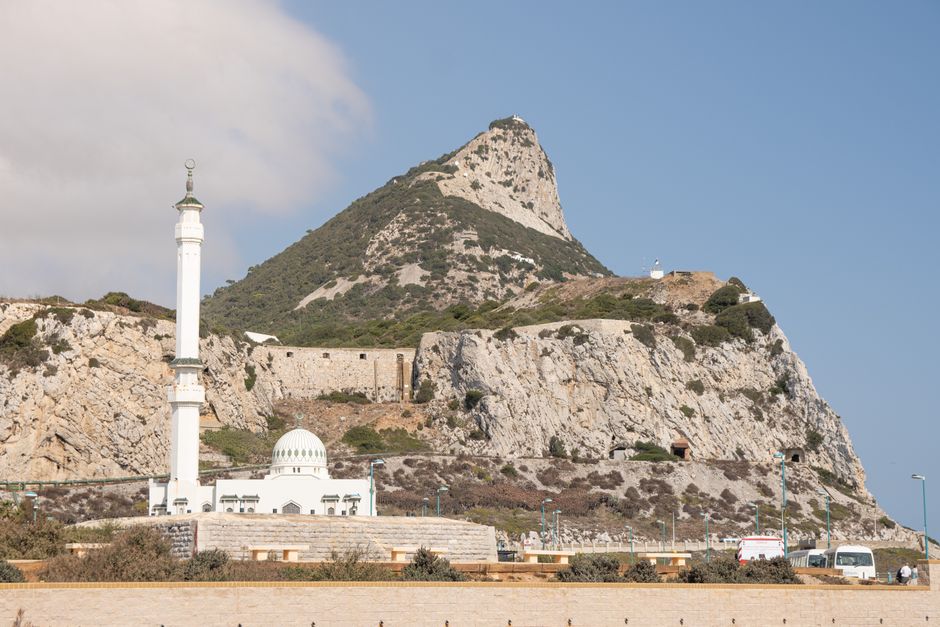
Gibraltar is a tiny British Overseas Territory at the southern tip of the Iberian Peninsula, where a single limestone mountain, the Rock, rises 426 m (1,398 feet) straight out of the sea at the entrance to the Mediterranean. Africa is in plain view across the Strait. In less than 7 km² (under 3 square miles) you find wild Barbary macaques, the only free-living monkeys in Europe, a vast cave used as a concert hall, tunnels dug through the Rock during sieges and world wars, a Moorish castle, small beaches, dolphin trips and a busy Main Street of red post boxes, pubs and shops. English is the official language, prices are in pounds, and cars drive on the right, as in Spain. Most people visit on a day trip from the Costa del Sol or a cruise ship, walking in from La Línea de la Concepción in Spain; since 15 July 2026 there have been no routine passport checks at that land border. One full day covers the highlights; stay two to enjoy the Rock at a slower pace. Spring and autumn are the most pleasant seasons.
Right now in Gibraltar
- Wed17–24°C63–75°F1 mm rain
- Thu16–23°C61–73°FClear
- Fri17–19°C63–65°F42 mm rain
Multi-day tours of Gibraltar
Multi-day tours from local operators. You check dates and book on Viator, our partner; we may earn a commission at no extra cost to you. How we earn money
Gibraltar at a glance: overview and geography
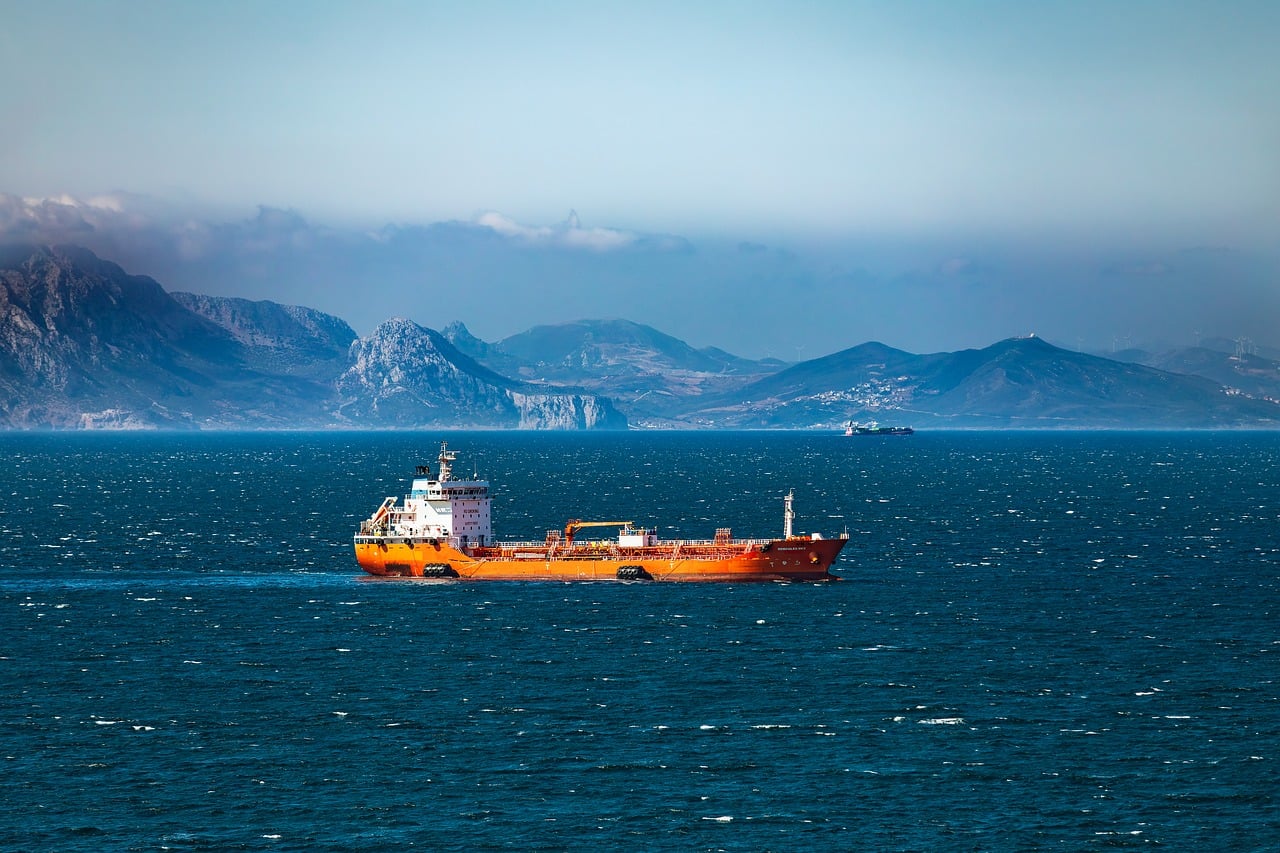
Gibraltar is a narrow peninsula about 5 km (3 miles) long and just over 1 km wide, joined to Spain by a flat, sandy isthmus where the airport runway now lies. Almost all of it is taken up by the Rock, whose sheer northern face looks towards Spain and whose long ridge, the Upper Rock, is a protected nature reserve. The town, with its narrow lanes, squares and old fortifications, climbs the gentler western slope above the harbor and the Bay of Gibraltar, facing Algeciras in Spain. The steep eastern side drops to the sea at Catalan Bay and Sandy Bay, and the southern tip, Europa Point, looks across the Strait of Gibraltar to the mountains of Morocco, about 21 km (13 miles) away at the narrowest point between the two continents. Around 38,000 people live here.
The Rock was one of the two Pillars of Hercules of the ancient world, the edge of the known Mediterranean. Neanderthals lived in its sea caves for tens of thousands of years, and Gorham’s Cave Complex on the eastern cliffs is a UNESCO World Heritage Site. The name comes from Jabal Tariq, “Tariq’s mountain”, after the Berber commander Tariq ibn Ziyad, who landed here in 711 at the start of the Moorish conquest of Iberia. Gibraltar was Moorish for most of the next seven centuries, then Spanish, and was captured by an Anglo-Dutch fleet in 1704 and ceded to Britain by the Treaty of Utrecht in 1713. It survived the Great Siege of 1779–1783, served as a key naval base in both world wars, and today is a self-governing British Overseas Territory with its own Parliament and government, and an economy based on finance, online gaming, shipping and tourism. Its people, the Gibraltarians, are a mix of British, Genoese, Spanish, Maltese, Portuguese, Jewish, Indian and Moroccan origins, and many switch easily between English and Spanish.
Time zone: Gibraltar is on Central European Time, UTC+1 in winter and UTC+2 in summer, the same as Spain and one hour ahead of the UK.
The areas of Gibraltar
- The frontier and the isthmus: the land border with La Línea, the airport and its runway, which pedestrians still cross on Winston Churchill Avenue, and the road tunnel under it.
- Casemates and Main Street: the old town’s big square, the pedestrian shopping street, the Convent, the Cathedral of St Mary the Crowned, the Gibraltar National Museum and King’s Bastion.
- The waterfront: Ocean Village and Marina Bay, with marinas, restaurants, a casino and dolphin-trip boats, and the cruise terminal and Queensway Quay.
- The Upper Rock Nature Reserve: the macaques, St Michael’s Cave, the Great Siege Tunnels, the Skywalk, the Windsor Suspension Bridge and the summit batteries.
- The South District and Europa Point: the Alameda Botanic Gardens, Trafalgar Cemetery, the 100-ton gun, Camp Bay and Little Bay, and the lighthouse, mosque and shrine at the southern tip.
- The east side: the fishing village of Catalan Bay, and the beaches of Eastern Beach and Sandy Bay below the cliffs.
Where to go: the Rock, the old town and Europa Point
Gibraltar is small enough to walk, but the Rock is steep, so most visitors combine walking with a bus, a taxi tour or a minibus up the hill. Our separate Rock of Gibraltar guide covers the Nature Reserve in detail.
The Upper Rock Nature Reserve
The reason most people come. One ticket covers the reserve and all its sites: St Michael’s Cave, a huge, lit limestone cavern with an auditorium for concerts; the Great Siege Tunnels, galleries hacked through the north face by British soldiers in the 1780s to mount guns over the isthmus; the World War II Tunnels; the glass-floored Skywalk and the Windsor Suspension Bridge across a gorge; O’Hara’s Battery on the summit; the Moorish Castle; and the exhibition “City Under Siege”. Everywhere along the roads you meet the Barbary macaques, especially at the Apes’ Den. The views stretch from the Bay of Gibraltar to the Rif mountains of Morocco. The cable car from the town to the top of the Rock is closed for a full refurbishment and, according to the Gibraltar Nature Reserve, is expected to reopen in 2027, so go up by taxi tour, minibus or on foot.
Main Street and Casemates Square
Casemates Square, just inside the old walls from the frontier, is Gibraltar’s meeting place, lined with cafés and pubs. From here, Main Street runs south for about 1 km through the town, with shops selling perfume, electronics, jewelry, spirits and British brands, and side lanes climbing towards the Rock. Along the way, see the Cathedral of St Mary the Crowned, built on the site of a mosque, the Convent, the Governor’s official residence, and, nearby, the Gibraltar National Museum, built over well-preserved Moorish baths. King’s Bastion, part of the old sea defenses, is now a leisure center.
Europa Point
At the southern tip, Europa Point has the classic view across the Strait to Africa, the red-and-white Europa Point Lighthouse of 1841, the Ibrahim-al-Ibrahim Mosque, a gift from the King of Saudi Arabia completed in 1997, the Shrine of Our Lady of Europe, a Catholic chapel in a medieval mosque building, and Harding’s Battery, a restored gun battery with a small visitor center. On the way, the Alameda Botanic Gardens, laid out in 1816, are free to visit, and Trafalgar Cemetery holds graves of men who died of wounds after the battle in 1805. Bus route 2 runs from Market Place to Europa Point.
Catalan Bay and the east side
On the eastern side of the Rock, Catalan Bay is a former fishing village of pastel houses on a small sandy beach, with a hotel and seafood restaurants. Nearby, Eastern Beach is the longest stretch of sand, close to the frontier, and Sandy Bay sits below the cliffs further south. The east side often stays sunny when the Levanter cloud covers the town.
A few more worth your time
The 100-ton gun at Napier of Magdala Battery, a Victorian monster of a cannon; Ocean Village and Marina Bay for dinner by the water; the walk across the airport runway, which pedestrians still cross between flights; the Gorham’s Cave Complex, seen from a viewing platform at Europa Point or on a guided tour booked through the National Museum; and the Mediterranean Steps, a steep, spectacular path up the eastern cliffs.
Rock of Gibraltar Travel Guide
Plan a visit to the Rock of Gibraltar and the Upper Rock Nature Reserve: tickets (£30 adults) and opening hours, the cable car closure…
Best time to visit Gibraltar
Gibraltar has a mild Mediterranean climate: hot, dry summers, mild winters, and almost all of its rain between October and April. The table shows the long-term averages for the Gibraltar weather station published by Germany’s national weather service, the Deutscher Wetterdienst (DWD), for 1961–1990, the latest official station normals we could find for Gibraltar.
| Season (DWD, Gibraltar station, 1961–1990) | Average high | Average low | Rain per month | Days with rain (1 mm+) | What it’s like |
|---|---|---|---|---|---|
| Dec–Feb | 15.7–16.6 °C (60–62 °F) | 10.2–11.4 °C (50–53 °F) | 100–146 mm (3.9–5.7 in) | 8–9 | Mild, with spells of heavy rain and wind; quiet, good for walking the Rock. |
| Mar–May | 18.4–22.6 °C (65–73 °F) | 12.3–15.4 °C (54–60 °F) | 35–75 mm (1.4–3.0 in) | 3–7 | Pleasant and green; spring bird migration; one of the best times to visit. |
| Jun–Sep | 25.4–28.6 °C (78–83 °F) | 18.0–20.8 °C (64–69 °F) | 1–15 mm (under 0.6 in) | 0–2 | Hot, sunny and dry, busy with cruise passengers; the Levanter cloud can sit on the Rock. |
| Oct–Nov | 19.1–22.9 °C (66–73 °F) | 13.9–16.9 °C (57–62 °F) | 64–141 mm (2.5–5.6 in) | 5–7 | Warm in October, wetter in November; autumn migration over the Strait. |
The station averages about 775 mm (30.5 in) of rain a year and about 7 hours of sunshine a day, from around 4 hours in November and December to 10–11 hours from June to August. According to the DWD, the sea averages about 15–16 °C (59–61 °F) from January to April and 20–21 °C (68–70 °F) from July to September.
The Levanter and the wind
When the easterly wind, the Levanter, blows, moist air rises over the Rock and forms a long banner cloud over its western side, which can leave the town gray and humid while Spain and the east side of the Rock are sunny. It is most common in summer. Strong westerlies and easterlies also blow through the Strait, cancelling boat trips and occasionally diverting flights at the short, windy runway. If the summit is in cloud, visit the town in the morning and try the Rock later, or the next day.
Crowds and events
Gibraltar is busiest from spring to autumn, especially on days when several cruise ships are in port, when the Nature Reserve roads and Main Street fill up from mid-morning; arrive early. In spring and autumn, Gibraltar is one of Europe’s great places to watch migrating birds of prey, storks and other birds crossing the Strait. On Gibraltar National Day, 10 September, the town turns red and white with celebrations, and the Nature Reserve closes early that afternoon; it also closes early on 24 and 31 December and is closed on 25 December and 1 January.
How long to stay: sample itineraries
Gibraltar is compact, so one full day covers the main sights, and many visitors combine it with a stay in Andalusia.
1 day: the Rock and the town
Walk across the border and the runway to Casemates Square. Take a taxi tour or the reserve’s minibus up the Rock in the morning for St Michael’s Cave, the Skywalk, the macaques and the Great Siege Tunnels. In the afternoon, stroll down Main Street, then take bus 2 to Europa Point for the view to Africa, and have dinner at Ocean Village.
2 days: slower and on foot
Day 1 as above, but walk up the Rock from the town and take your time at each site. Day 2: a morning dolphin trip from Marina Bay, the National Museum and its Moorish baths, the Botanic Gardens, and an afternoon at Catalan Bay. Fit walkers can climb the Mediterranean Steps early in the morning.
Combining Gibraltar with Spain and Morocco
Gibraltar sits between the Costa del Sol, with Marbella about an hour away by road, and the Atlantic coast of Cádiz province, with the kitesurfing town of Tarifa about 45 km (28 miles) west. Ronda, Cádiz, Málaga and Seville make good stops on a longer trip; see our Spain travel guide. Ferries to Tangier in Morocco leave mainly from Tarifa and Algeciras, across the bay.
Entry, the border, money and costs
Entry rules after 15 July 2026 (last reviewed October 2026)
Gibraltar’s entry rules changed on 15 July 2026, when the UK–EU Agreement in respect of Gibraltar, signed on 14 July 2026, began to apply provisionally, pending formal ratification. The Gibraltar authorities remain responsible for entry into Gibraltar, but under the agreement its conditions for short-stay visitors are aligned with the Schengen rules. According to the UK government:
- Passports: British visitors need a passport issued within the previous 10 years and valid for at least 3 months after the day they leave Gibraltar or the Schengen area. EU citizens can travel with a national ID card.
- 90 days in 180: British nationals don’t need a visa for up to 90 days in any 180-day period, and time spent in Gibraltar now counts together with time in the Schengen area towards that limit. Other nationalities follow the Schengen visa rules; check with the Gibraltar Borders and Coastguard Agency.
- Arriving by air: at Gibraltar International Airport you go through two sets of checks, Gibraltar’s own immigration control and a Schengen control carried out by the Spanish authorities, including registration in the EU’s Entry/Exit System (EES) where it applies. The European Travel Information and Authorisation System (ETIAS) will also apply once it is running. After these checks you can move freely into Spain and the rest of the Schengen area.
Crossing the land border with Spain
The land frontier with La Línea de la Concepción is open 24 hours a day, every day, and there is no charge to enter Gibraltar. According to HM Government of Gibraltar’s tourist board, since 15 July 2026 people can move between Gibraltar and Spain without routine passport checks at the land frontier, but you must still carry a valid passport or, for EU citizens, an ID card. The government also states that, for now, there are no customs controls at the land frontier; the area is covered by police patrols and cameras. Pedestrians walk through from La Línea, whose bus station is about five minutes away, then cross the airport runway on Winston Churchill Avenue; cars use the tunnel under the runway. Traffic into and out of Gibraltar can still be slow at busy times, so many day-trippers park in La Línea and walk in.
Shopping allowances and taxes
Gibraltar has long been known for shopping without VAT and for cheap tobacco, spirits and fuel, but this is changing under the agreement. Gibraltar has introduced a transaction tax on goods, starting at 15% (food and soft drinks are zero-rated), and its tobacco, alcohol and fuel duties are moving closer to Spain’s. According to HM Government of Gibraltar, goods you carry from Gibraltar into Spain for personal use or as gifts are duty-free up to €300 when you travel by land and €430 by sea or air, with the standard limits on tobacco, alcohol and fuel; this allowance regime is temporary, for an initial three years. When you fly in, you may need to declare certain goods to HM Customs Gibraltar at the airport.
Rules are new and may be adjusted, so check HM Government of Gibraltar, the Gibraltar Borders and Coastguard Agency and your own government’s travel information before you go. For the UK side, see our United Kingdom travel guide.
Money and tipping
Gibraltar’s currency is the pound sterling. The Government of Gibraltar issues its own notes and coins, worth exactly the same as UK pounds, and Bank of England notes and UK coins are used alongside them. According to the UK government, Scottish and Northern Irish notes are not usually accepted, and Gibraltar notes are not usually accepted in the UK, so spend them before you leave. Many shops and restaurants take euros, but at their own exchange rate, and you get change in pounds; paying by card is usually better. Cards are widely accepted. Tipping is like the UK’s: check whether a service charge is already on the bill; if not, leave about 10% in restaurants for good service, and round up taxi fares.
Typical travel costs
These estimates, per person per day, are a planning guide as of October 2026. Hotels in Gibraltar are few and fairly expensive, so many visitors stay in La Línea or on the Costa del Sol and come in for the day.
| Style | Estimated cost per day | What that looks like |
|---|---|---|
| Budget | about £90–140 (€105–165) | Room in La Línea shared by two, café breakfasts and pub lunches, walking up the Rock with a Nature Reserve ticket, buses |
| Mid-range | about £180–300 | Hotel room in Gibraltar shared by two, restaurant meals, a taxi tour of the Rock and a dolphin trip |
| High-end | about £450+ | Waterfront or historic hotel, fine dining, private guided tours and a boat charter |
For reference, the Nature Reserve ticket costs £30 for adults and £22 for children aged 5–11 (as of October 2026), and a bus day ticket £8.80. The figures are our estimates, not official statistics.
Getting there and getting around
Flights
Gibraltar International Airport (GIB) is on the isthmus, a short walk or a five-minute drive from the town. According to Visit Gibraltar, British Airways flies from London Heathrow and easyJet from London Gatwick, Manchester, Bristol and Birmingham. Its runway is short and exposed to the wind, so flights are occasionally diverted to Málaga. For more choice, Málaga airport (AGP) is about 130 km (80 miles) away, roughly 1 hour 30 minutes to 2 hours by road, and Seville and Jerez airports are further.
By road, bus and sea
From Spain, drive the A-7 or N-340 along the coast and take the turn-off for La Línea; long-distance buses from Málaga, Marbella, Algeciras, Cádiz and Seville stop at La Línea bus station, about five minutes on foot from the frontier. Cruise ships dock at the cruise terminal, a short walk or bus ride from the town. Ferry links to Morocco from Gibraltar itself have been limited; most crossings to Tangier leave from Algeciras and Tarifa in Spain.
Getting around
Gibraltar is walkable, but steep. Two companies, Citibus and the Gibraltar Bus Company, run the buses, and route 2 goes to Europa Point. According to Citibus, a single fare is £1.80 (€2.70), a return £2.40, and a Hopper day ticket, valid on all routes, £8.80 (€12) for adults and £5.50 for children. Taxis wait at the frontier and in the town, and many offer tours of the Upper Rock. Driving is on the right; the streets are narrow and parking is scarce, so leave a car in Spain if you can. UK licences are valid. The cable car to the top of the Rock is closed for refurbishment until 2027.
The Barbary macaques and the Nature Reserve rules
Gibraltar’s macaques, known locally as the Rock apes, are wild animals and the only free-living monkeys in Europe. They live in several groups across the Upper Rock and are cared for by the Gibraltar Ornithological and Natural History Society and the government. Feeding them is illegal and punished with a fine, according to HM Government of Gibraltar, because human food makes them ill and teaches them to raid bags. Don’t touch them or carry food or drinks in your hands or open bags, keep zips closed, and keep a respectful distance, especially from mothers with babies. If a macaque grabs something, let it go. Stay on paths near the cliffs, and carry water: there is little shade on the Upper Rock in summer.
Beaches, the sea and boat trips
Gibraltar’s beaches are small and busy in summer. On the east side, Eastern Beach, Catalan Bay and Sandy Bay face the Mediterranean; on the west, Camp Bay and Little Bay have rocky swimming areas and pools. The Bay of Gibraltar and the Strait are rich in marine life, and dolphin-watching boats leave Marina Bay and Ocean Village most days; the bay also has wreck dives. See our beaches guide, plus boat trips and diving.
- Wind and waves: the Levanter can bring waves to the east-side beaches; check flags where lifeguards are on duty in summer.
- Shipping: the bay is one of Europe’s busiest anchorages; swim only at beaches and pools.
- Boat trips: are often cancelled in strong wind, so allow a spare day if a trip matters to you.
Safety, health and connectivity
Safety
Gibraltar is a safe, well-policed place to visit; according to the UK government, violence and street crime are rare, though sensible care with belongings is wise, especially in crowds. The main everyday risks are the steep paths and heat on the Upper Rock, the macaques, and traffic in narrow streets. Emergency number: 999 for police, ambulance and fire, a single number since March 2024 (press 1 for police, 2 for ambulance, 3 for fire). The hospital is St Bernard’s Hospital at Europort.
Health
Healthcare is good. According to the UK government, UK residents can get emergency treatment by showing a British passport, but should bring a GHIC or EHIC, because some patients are transferred to hospitals in Spain; neither replaces travel insurance. Visit Gibraltar says the tap water, produced by desalination, is safe to drink. Bring sun protection and a hat for the Rock in summer.
Accessibility
Main Street, Casemates, Ocean Village and Europa Point are fairly flat and easy, but much of the old town is built on steep lanes and steps. On the Upper Rock, St Michael’s Cave and the tunnels have uneven floors and stairs, and the Mediterranean Steps are only for fit walkers. A taxi tour is the easiest way to see the reserve with limited mobility.
Connectivity and power
Gibraltar’s phone code is +350. Phones often connect to Spanish networks near the border, and Gibraltar is not covered by every roaming deal, so check your plan to avoid surprise charges. Electricity is 230–240 V at 50 Hz with UK-style Type G three-pin sockets, so visitors from Spain and most of Europe need a travel adapter.
Food, drink and culture
Gibraltar’s food reflects its mix of peoples. Pubs serve fish and chips, pies and Sunday roasts, while local dishes include calentita, a baked chickpea-flour flatbread often called the national dish, rosto, pasta with a meat and tomato sauce of Genoese origin, panissa, fried chickpea-flour slices, and torta de acelgas, a Swiss chard pie. Seafood is good at Catalan Bay and the marinas, and Spanish tapas bars are a short walk away in La Línea. Locals speak English and Spanish and mix them in a dialect called Llanito (Yanito). British traditions, from red phone boxes to pub quizzes, sit beside Mediterranean habits such as long lunches and evening strolls. Dress is casual, but cover up away from the beach.
Things to do: hiking, history, wildlife and the sea
- Hiking: walk up the Rock from the town, or take the Mediterranean Steps from Jews’ Gate to the summit. See hiking.
- History: the Great Siege and World War II Tunnels, the Moorish Castle, the National Museum and the batteries around the Rock. See city sightseeing.
- Wildlife: the macaques, dolphins in the bay, and birds of prey and storks crossing the Strait in spring and autumn.
- The sea: dolphin trips, sailing, kayaking and wreck dives. See boat trips.
- Shopping: Main Street for perfume, watches, jewelry, spirits and British brands, though price gaps with Spain are narrowing.
What to pack
Bring your passport or EU ID card, comfortable walking shoes with grip for the steep paths and the damp floor of St Michael’s Cave, sunscreen, a hat and a refillable water bottle for the Upper Rock, a light layer for the windy summit, a bag that closes fully (for the macaques), a Type G plug adapter, and swimwear in summer. From November to March, add a rain jacket.
Gibraltar travel FAQ
Do I need a passport to visit Gibraltar?
Yes. Carry a valid passport, or a national ID card if you are an EU citizen, even though there are no routine passport checks at the land border since 15 July 2026. Arriving by air, you go through Gibraltar and Schengen checks at the airport.
Are there still passport checks at the border with Spain?
Not routinely. Since the UK–EU agreement on Gibraltar began to apply provisionally on 15 July 2026, people cross between La Línea and Gibraltar without routine passport checks, and the checks take place at the airport instead.
Does time in Gibraltar count towards the Schengen 90 days?
Yes, for non-EU visitors such as British nationals. According to the UK government, time spent in Gibraltar counts alongside time in the Schengen area towards the 90-days-in-180 limit.
Can I pay in euros in Gibraltar?
Often, yes, but prices are in pounds and shops set their own exchange rate, giving change in pounds. A card is usually the better deal.
Is the Gibraltar cable car open?
No. The cable car is closed for a full refurbishment and is expected to reopen in 2027, according to the Gibraltar Nature Reserve. Go up the Rock by taxi tour, minibus or on foot.
How much is the Gibraltar Nature Reserve ticket?
£30 for adults and anyone over 11, £22 for children aged 5–11, and free for under-5s, as of October 2026. It covers all sites in the reserve, including St Michael’s Cave and the tunnels.
Can you feed the monkeys in Gibraltar?
No. Feeding the Barbary macaques is illegal and you can be fined. Keep food out of sight and bags closed.
Is one day enough for Gibraltar?
Yes, for the highlights: the Upper Rock, Main Street and Europa Point. Stay two days to walk up the Rock and add a dolphin trip and the beaches.
When is the best time to visit Gibraltar?
April to June and September to October, when it is warm but not too hot. Summer is hot, dry and busy; winter is mild but brings most of the year’s rain.
Which side of the road do they drive on in Gibraltar?
On the right, as in Spain, even though Gibraltar is British. Parking is limited, so many visitors leave their car in La Línea and walk across.
What plugs are used in Gibraltar?
UK-style Type G three-pin plugs, at 230–240 V and 50 Hz.
Plugs and power in Gibraltar
Gibraltar uses 230 V, 50 Hz and these plugs (left) and wall sockets (right):
UK-style three-pin sockets; Visit Gibraltar gives 220–240 V.
All plug types and voltages by country → · Check what you need to pack →
Plan your trip
Partner links: TravelerCenter may earn a commission if you book, at no extra cost to you.
Sources · last reviewed 5 October 2026
Researched and last reviewed on 5 October 2026. Entry rules, airport checks, money, health, safety and the emergency number come from the UK government’s travel advice for Gibraltar (updated 14 July 2026); the land border, customs and allowance rules, the transaction tax and the macaque feeding rule from HM Government of Gibraltar and Visit Gibraltar; Nature Reserve tickets, hours and the cable car closure from the Gibraltar Nature Reserve; the single 999 number from the Royal Gibraltar Police; bus fares from Citibus; climate averages from the Deutscher Wetterdienst (Gibraltar station, 1961–1990). History, population, distances, food, beaches, dolphin and bird watching, and ferry services come from general or secondary sources and are flagged for checking. Daily costs are estimates. Rules under the new agreement are recent and may change, so check the official sites before you travel.
Data: Weather: MET Norway (CC BY 4.0) · Rates: ECB · Wikidata (CC0)