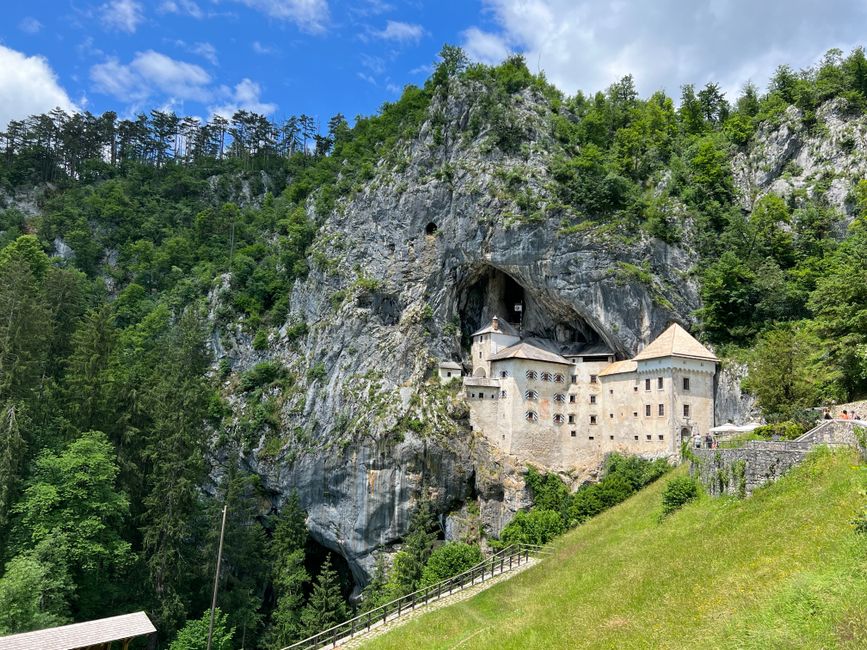
Slovenia is one of Europe’s smallest countries and one of its greenest: more than half of it is forest, and in a single day you can drive from the peaks of the Julian Alps to the Adriatic. It packs in a relaxed, café-lined capital in Ljubljana; Lake Bled, with its island church and clifftop castle; quieter Lake Bohinj and the emerald Soča river in Triglav National Park; vast show caves at Postojna and Škocjan; vineyards on the Italian and Hungarian borders; and a short, pretty coast centred on the Venetian-style town of Piran. Distances are short, the euro is the currency and the welcome is easy-going. May, June and September are the best months for most trips. A week covers the highlights; ten days to two weeks lets you add hiking and the wine country.
Right now in Slovenia
- Wed 9–19°C 48–67°F 1 mm Partly cloudy
- Thu 12–16°C 53–61°F 13 mm Heavy rain
- Fri 10–14°C 51–57°F 13 mm Partly cloudy
Weather: MET Norway (CC BY 4.0) · Air quality: OpenAQ · Rates: ECB
Key facts
| Currency | Euro (EUR, €) since 2007; ATMs take the major cards; prices include taxSource: slovenia.info · Last reviewed 4 Oct 2026 |
|---|---|
| Languages | Slovene; Italian on the coast (Piran, Koper, Izola) and Hungarian in Prekmurje are also official in their areasSource: slovenia.info · Last reviewed 4 Oct 2026 |
| Plugs and voltage | Type C and F · 230 V, 50 HzSource: slovenia.info · Last reviewed 4 Oct 2026 |
| Emergency number | 112 (ambulance, fire, mountain rescue); 113 police; 1987 roadside assistance; 9155 sea rescueSource: slovenia.info · Last reviewed 4 Oct 2026 |
| Driving side | Drive on the right; dipped headlights on all day; motorways need an e-vignette (cars EUR 16 for 7 days)Source: slovenia.info · Last reviewed 4 Oct 2026 |
| Tap water | Safe to drink (Slovenian Tourist Board); avoid it if it runs cloudy after heavy rainSource: slovenia.info · Last reviewed 4 Oct 2026 |
| Tipping | Not required; round up, about 10% in restaurants for good serviceSource: portoroz.si · Last reviewed 4 Oct 2026 |
| Calling code | +386 (dial 00 for international calls)Source: slovenia.info · Last reviewed 4 Oct 2026 |
| Time zones | All of Slovenia: CET (UTC+1), summer CEST (UTC+2)Source: transport.ec.europa.eu · Last reviewed 4 Oct 2026 |
| Entry summary | Schengen area since 2007 · EU member. Temporary checks at the borders with Croatia, Hungary, Italy and Austria in 2026. See the entry section for rules by passport.Source: home-affairs.ec.europa.eu · Last reviewed 4 Oct 2026 |
Multi-day tours of Slovenia
Multi-day tours from local operators. You check dates and book on Viator, our partner; we may earn a commission at no extra cost to you. How we earn money
Slovenia at a glance: Alps, karst, coast and plains in one small country
Slovenia sits where the Alps, the Mediterranean, the Pannonian plain and the Balkans meet, bordered by Italy, Austria, Hungary and Croatia. It was part of the Habsburg lands for centuries and then of Yugoslavia, became independent in 1991, joined the European Union in 2004 and adopted the euro and joined the Schengen area in 2007. According to the Statistical Office of the Republic of Slovenia (SURS), it had 2,135,107 residents on 1 January 2026, about 300,000 of them in Ljubljana. The country covers just over 20,000 km², a little smaller than Wales or New Jersey, so almost everywhere is within two to three hours of the capital.
The official language is Slovene, a South Slavic language; Italian is also official on the coast and Hungarian in the far north-east, where signs are bilingual. English is widely spoken, especially by younger people and anyone working in tourism, and German and Italian are common near those borders. Time zone: Central European Time (UTC+1), with summer time (UTC+2) from the last Sunday in March to the last Sunday in October, the same as Austria and Italy.
Slovenia’s regions
- Ljubljana and central Slovenia: the capital on the Ljubljanica river, with its castle hill, Jože Plečnik’s bridges and market colonnades, and day trips to Škofja Loka, the Velika Planina herders’ plateau and the Kamnik Alps.
- The Julian Alps (Gorenjska and the Soča valley): Slovenia’s mountain heart and Triglav National Park: Lake Bled, Lake Bohinj, the Vintgar gorge, Kranjska Gora, the Vršič pass and, on the far side, the turquoise Soča river around Bovec, Kobarid and Tolmin.
- The Karst and the coast: the limestone plateau that gave “karst” its name, with the Postojna and Škocjan caves, Predjama Castle, the Lipica stud farm and red Teran wine; then 47 km of Adriatic coast with Koper, Izola, Piran and Portorož.
- Primorska wine country: the Goriška Brda hills on the Italian border, often compared with Tuscany, and the Vipava valley, both known for white wines, orange wines and cherry orchards.
- Štajerska and the north-east: Maribor, Slovenia’s second city, with the world’s oldest productive vine; Ptuj, the oldest town, famous for its Kurentovanje carnival; the Jeruzalem and Haloze wine hills; and the flat Prekmurje region beyond the Mura river, with thermal spas.
- Dolenjska and the south: the Krka valley, castles such as Otočec on its river island, Cviček wine and the spa towns of Dolenjske Toplice and Čatež; to the south, the forests of Kočevje and the Kolpa river on the Croatian border, good for rafting and canoeing.
Regions
- Ajdovščina Municipality
- City Municipality of Celje
- City Municipality of Koper
- City Municipality of Kranj
- City Municipality of Krško
- City Municipality of Murska Sobota
- City Municipality of Nova Gorica
- City Municipality of Novo Mesto
- City Municipality of Slovenj Gradec
- City Municipality of Velenje
- Hrastnik Municipality
- Laško Municipality
- Ljubljana City Municipality
- Ljutomer Municipality
- Maribor City Municipality
- Municipality of Brezovica
- Municipality of Brežice
- Municipality of Cerknica
- Municipality of Domžale
- Municipality of Dravograd
- Municipality of Grosuplje
- Municipality of Hoče-Slivnica
- Municipality of Idrija
- Municipality of Ilirska Bistrica
- Municipality of Ivančna Gorica
- Municipality of Izola
- Municipality of Jesenice
- Municipality of Kamnik
- Municipality of Kočevje
- Municipality of Lendava
- Municipality of Litija
- Municipality of Logatec
- Municipality of Medvode
- Municipality of Postojna
- Municipality of Radovljica
- Municipality of Ravne na Koroškem
- Municipality of Ribnica
- Municipality of Rogaška Slatina
- Municipality of Sežana
- Municipality of Slovenska Bistrica
- Municipality of Tolmin
- Municipality of Trbovlje
- Municipality of Tržič
- Municipality of Vojnik
- Municipality of Vrhnika
- Municipality of Šenčur
- Municipality of Škofja Loka
- Municipality of Škofljica
- Municipality of Šmarje pri Jelšah
- Municipality of Šoštanj
- Municipality of Žalec
- Ormož Municipality
- Piran Municipality
- Sevnica Municipality
- Slovenske Konjice Municipality
- Trebnje Municipality
- Urban Municipality of Ptuj
- Zagorje ob Savi Municipality
- Črnomelj Municipality
- Šentjur Municipality
Where to go: lakes, mountains, caves and coast
Most first trips are a loop from Ljubljana: north to Bled and Bohinj, over the Vršič pass (in summer) to the Soča valley, down to the Karst caves and the coast, then back to the capital. Each leg takes one to two hours by car, so you can see a lot without long drives.
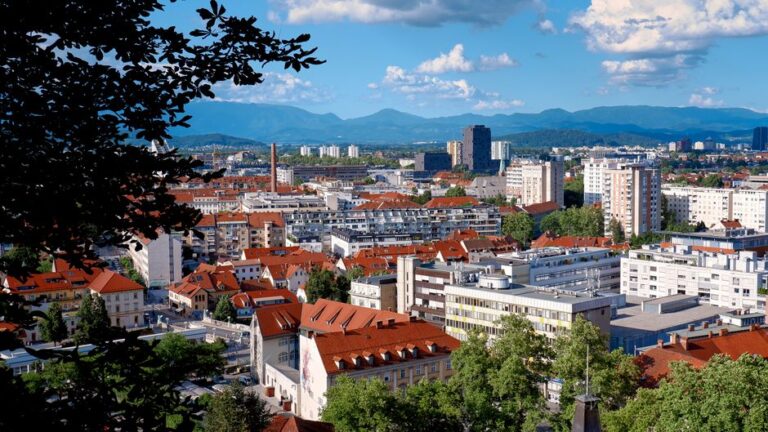
Ljubljana
The capital is small, green and lively, with a car-free old town along the Ljubljanica river. Walk across the Triple Bridge to Prešeren Square, browse the Central Market under Jože Plečnik’s riverside colonnades, ride the funicular up to Ljubljana Castle and see the Dragon Bridge. Plečnik, the architect who reshaped the city between the wars, left so many buildings, bridges and squares that his Ljubljana works are a UNESCO World Heritage Site. In the evening, riverside cafés fill up, and the Metelkova arts quarter hosts alternative music. Ljubljana is also the hub for buses and trains, and the best base for day trips if you don’t have a car.
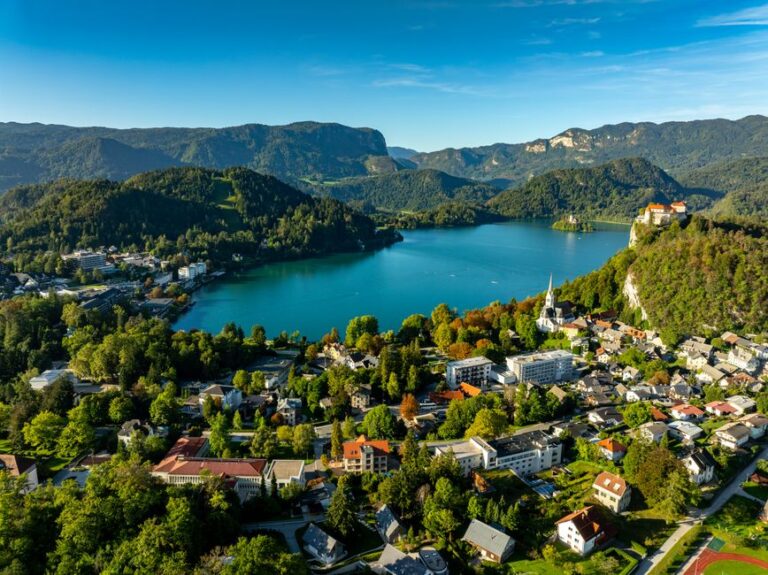
Lake Bled
Bled is Slovenia’s postcard: a small Alpine lake with a church on its only island and a medieval castle on a cliff above. Ride a traditional wooden pletna boat to the island and ring the wishing bell, walk the 6 km path around the lake, climb to the Ojstrica or Mala Osojnica viewpoints for the classic view, visit the castle, and try the local cream cake, kremšnita. As of October 2026, the pletna ride costs €20 for adults and the island entrance €12. The Vintgar gorge, with wooden walkways above a rushing river, is a short ride north. Bled is busy from late morning in summer, so go early or stay the night.
Lake Bohinj and Triglav National Park
Half an hour beyond Bled, Lake Bohinj is bigger, wilder and quieter, ringed by mountains and with clear water for summer swimming. From its western end, the Vogel cable car climbs to views of Mount Triglav (2,864 m), Slovenia’s highest peak and national symbol, and a path leads to the Savica waterfall. Bohinj is the gateway to Triglav National Park, the country’s only national park, which covers much of the Julian Alps: the Valley of the Triglav Lakes, the Pokljuka plateau, high pastures with dairy huts and hundreds of kilometres of marked trails.
Kranjska Gora, the Vršič pass and the Soča valley
Kranjska Gora, near the Austrian and Italian borders, is a ski resort in winter and a hiking and cycling base in summer, with the Jasna lake and the ski-jumping hills at Planica nearby. From here, the Vršič pass, at 1,611 m Slovenia’s highest road pass, climbs through 50 numbered hairpin bends past the wooden Russian Chapel and down into the Trenta valley. On the far side runs the Soča, an astonishingly blue-green river. Bovec is the centre for rafting, kayaking and canyoning; Kobarid has a fine museum about the First World War Isonzo Front; and Tolmin has the gorges of the Tolminka. The Vršič road is usually closed by snow in winter and spring.
Postojna, Škocjan and the Karst
Slovenia has more than 14,000 known caves. The two famous ones are very different. Postojna Cave, an hour south-west of Ljubljana, is the big show cave: an electric train takes you deep inside, then you walk past halls of stalactites and meet the “human fish” (olm), a blind cave salamander. Nearby, Predjama Castle is built into the mouth of a cave halfway up a cliff. Škocjan Caves, a UNESCO World Heritage Site, are wilder: the Reka river roars through an underground canyon more than 140 m deep, crossed by a narrow bridge. Many visitors think Škocjan is the more impressive of the two; with time, see both. The surrounding Karst plateau has stone villages, Teran wine and air-dried pršut ham, and the Lipica stud farm, home of the Lipizzaner horses.
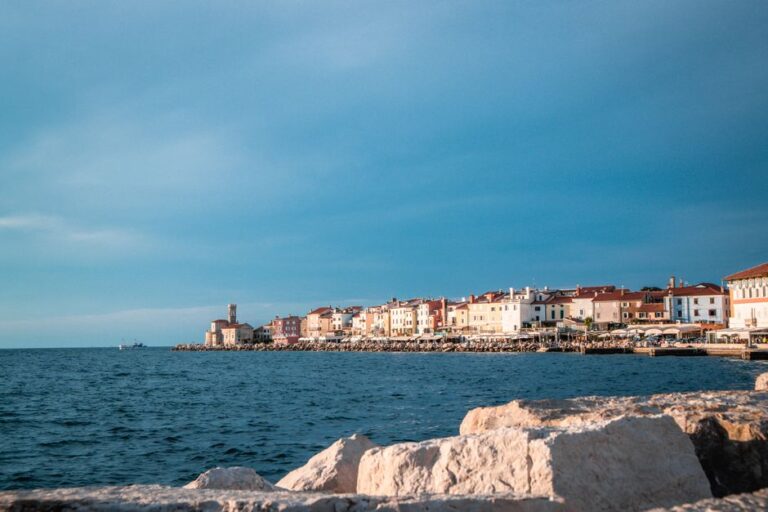
Piran and the coast
Slovenia’s 47 km of coast is short but charming. Piran, on a narrow peninsula, is a car-free tangle of Venetian lanes around the marble Tartini Square, with a hilltop church, town walls with views over the Gulf of Trieste, and seafood restaurants along the water. Next door, Portorož is the beach and spa resort; Izola is a working fishing town; Koper, the largest, has a fine Venetian square. The Sečovlje salt pans, still worked in the traditional way, and the cliffs of Strunjan are both protected nature parks. The beaches are mostly concrete platforms and pebbles, and the sea is warm from June to September.
Goriška Brda and the Vipava valley
In the far west, the rolling hills of Goriška Brda are covered with vineyards and cherry orchards, with the hilltop village of Šmartno and the Gonjače lookout tower for views to the Alps and the sea. Wineries welcome visitors, many with tastings of Rebula (Ribolla Gialla) and skin-contact “orange” wines. The Vipava valley, on the way to the coast, has small family wineries and good country restaurants. See our wine tasting guide.
Maribor, Ptuj and the north-east
Maribor, on the Drava river, is a relaxed university city with a riverside Lent district and the Old Vine, more than 400 years old and recognised as the world’s oldest vine still bearing grapes. Nearby, Ptuj is Slovenia’s oldest town, with a castle above red roofs, and the setting of Kurentovanje, a carnival of shaggy, bell-wearing kurent costumes listed by UNESCO. The Jeruzalem hills and the Pohorje mountains (skiing in winter) are close, and thermal spas such as Radenci and Moravske Toplice lie in the plains to the east.
Logar valley and the Kamnik–Savinja Alps
The Logarska dolina is a glacial valley of meadows and farms below a wall of limestone peaks, with the Rinka waterfall at its head. It is a quieter alternative to the Julian Alps, and the scenic Panoramic Road over the Solčava highlands is one of Slovenia’s loveliest drives. Closer to Ljubljana, the cable car from Kamniška Bistrica climbs to Velika Planina, a high plateau where herders still spend the summer in shingle-roofed wooden huts.
Bled Travel Guide
Plan a trip to Lake Bled: pletna boat and island prices and hours, Bled Castle tickets, the 6 km lake walk, the Ojstrica and…
Ljubljana Travel Guide
Plan a trip to Ljubljana: Prešeren Square and the Triple Bridge, Ljubljana Castle and funicular tickets and hours, the Central Market and Open Kitchen,…
Piran Travel Guide
Plan a trip to Piran on the Slovenian coast: Tartini Square, St George's Church and bell tower, the town walls, Punta and swimming off…
Triglav National Park Travel Guide
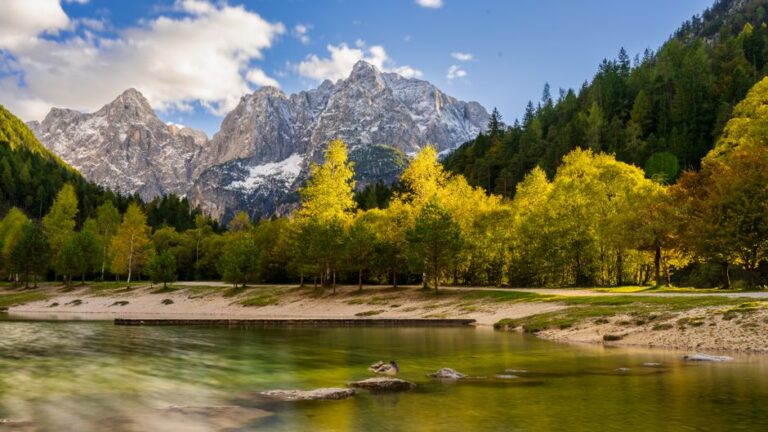
Plan a visit to Triglav National Park: Lake Bohinj, the Vogel cable car and Savica waterfall, the Valley of the Triglav Lakes, the Vršič…
Best time to visit Slovenia, region by region
Slovenia’s climate changes over short distances. Inland, it is continental: warm summers with afternoon thunderstorms, cold winters with frost and fog in the basins. The mountains are cooler and much wetter, and the coast has a mild sub-Mediterranean climate. Autumn is the wettest season almost everywhere. The table shows rounded average daily highs from the national weather service ARSO (Slovenian Environment Agency); inland stations use the official 1991–2020 averages, while for Portorož the latest published table covers 1971–2000.
| Region (ARSO station) | Spring highs (Mar–May) | Summer highs (Jun–Aug) | Autumn highs (Sep–Nov) | Winter highs (Dec–Feb) | Rain a year | Days with 1 mm+ of rain |
|---|---|---|---|---|---|---|
| Ljubljana (Bežigrad) | 12–22 °C | 26–28 °C | 22 °C falling to 10 °C | 4–7 °C | about 1,370 mm | about 108 |
| Bled area (Lesce airfield) | 11–20 °C | 24–26 °C | 20 °C falling to 9 °C | 4–6 °C | about 1,330 mm | about 107 |
| Lake Bohinj and the Julian Alps (Bohinjska Češnjica) | 11–20 °C | 24–26 °C | 21 °C falling to 9 °C | 4–6 °C | about 1,940 mm | about 119 |
| Coast (Portorož, 1971–2000) | 13–22 °C | 26–28 °C | 24 °C falling to 13 °C | 9–10 °C | about 930 mm | about 87 |
Winter nights are cold inland: average January lows are about −2 °C in Ljubljana and about −5 °C at Bohinj, and Ljubljana is often under fog on winter mornings. The coast is far milder, with about 2,300 hours of sunshine a year at Portorož, but the cold bora (burja) wind can blow hard down from the Karst in winter. In the high mountains, snow often lingers on north-facing slopes into June, and summer afternoons bring thunderstorms, so start hikes early. The north-east is the driest and warmest part of the interior in summer.
Crowds and prices through the year
- April to early June: green valleys, waterfalls at their fullest and moderate prices; the high mountains are still snowy and the Vršič pass usually opens in late spring.
- Mid-June to August: the best time for hiking, swimming in the lakes and sea, and rafting on the Soča, but also the busiest and most expensive time. Bled, the Vintgar gorge, the Soča valley and the coast are crowded, and parking near Bled and Bohinj fills early. Book rooms ahead.
- September and October: excellent: warm days, autumn colours in the forests, the grape harvest in the wine regions and far fewer people. Some seasonal services, such as the free Vršič bus and boat trips, stop at the end of September, and mountain huts close during October.
- November to March: quiet and cheap, with Christmas markets, skiing at Kranjska Gora, Vogel, Krvavec and Pohorje, and thermal spas. Lake Bled can be magical under snow. Days are short, the Vršič pass is closed and some coastal restaurants shut.
Festivals and events: late 2026 and 2027
Confirmed dates for the next big ones, as published by the organisers:
| Event | Dates | Good to know |
|---|---|---|
| St Martin’s Day (new wine) | 11 November 2026 | Must turns into wine; wine festivals in Maribor, Ljubljana and the wine regions on the nearest weekend |
| Festive December in Ljubljana | 27 November 2026 to 15 January 2027 | Christmas market along the river, lights across the old town and free concerts; entry is free |
| Kurentovanje, Ptuj | 3–9 February 2027 | The 67th edition of Slovenia’s biggest Shrovetide carnival, with parades of kurent figures |
- December: Christmas markets in Ljubljana, Maribor and Bled, and the living nativity scene in the Postojna Cave in some years.
- March: the Planica ski-jumping finals in the Upper Sava valley draw huge crowds.
- Summer: the Ljubljana Festival of music, opera and dance (July to early September); the Lent Festival in Maribor; music festivals in Tolmin; concerts in Piran’s Tartini Square; the Bled Days in late July.
- September and October: the Cows’ Ball in Bohinj, when herds come down from the high pastures; harvest and chestnut festivals across the countryside.
Public holidays
Shops close on most public holidays, and buses and trains run reduced timetables. Museums and big attractions often stay open. Holidays that fall on a weekend are not moved to the Monday. The next ones, from October 2026:
| Holiday | Date |
|---|---|
| Reformation Day | Saturday 31 October 2026 |
| All Saints’ Day (Remembrance Day) | Sunday 1 November 2026 |
| Christmas Day; Independence and Unity Day | Friday 25 and Saturday 26 December 2026 |
| New Year | Friday 1 and Saturday 2 January 2027 |
| Prešeren Day (culture day) | Monday 8 February 2027 |
| Easter Sunday and Monday | 28 and 29 March 2027 |
| Day of Uprising Against Occupation | Tuesday 27 April 2027 |
| Labour Day | Saturday 1 and Sunday 2 May 2027 |
| Whit Sunday | 16 May 2027 |
| Statehood Day | Friday 25 June 2027 |
| Assumption Day | Sunday 15 August 2027 |
Weather month by month
Averages from ARSO normals 1991–2020, Ljubljana-Bežigrad · Last reviewed 4 Oct 2026
How long to stay: sample itineraries
Slovenia is compact, and motorways link Ljubljana with the Alps, the coast and Maribor. Buses reach Bled, Bohinj, the Soča valley and the coast from Ljubljana, but a car gives far more freedom in the mountains and the wine country. Many people spend a few days in Ljubljana without a car and then rent one.
4 days: Ljubljana and Bled
Two days in Ljubljana (the old town, the market, the castle, Plečnik’s buildings, a river cruise), then two in Bled, with a pletna ride to the island, the castle, the Vintgar gorge in season and a half-day at Lake Bohinj. Postojna Cave can be a stop on the way to the airport, or a day trip from Ljubljana.
7 days: the classic loop
Two nights in Ljubljana, two in Bled or Bohinj, then (June to October) over the Vršič pass to the Soča valley for a night in Bovec or Kobarid, and down through the Goriška Brda or Vipava wine country to Piran for two nights, visiting Škocjan or Postojna on the way back to Ljubljana. Out of season, when the Vršič is closed, reach the Soča valley via Italy’s Predel pass or skip it.
10 days: add the mountains
Follow the seven-day loop, adding a hiking day from Bohinj (the Vogel ridge or the Triglav Lakes Valley), a rafting or canyoning day on the Soča, and a night in Goriška Brda among the vineyards.
14 days: all of Slovenia, or across the borders
Add the east: Maribor and Ptuj, the Jeruzalem wine hills, a spa in Prekmurje and the Logar valley. Slovenia also combines easily with its neighbours: Istria and Zagreb in Croatia are a short drive away; Venice is about two and a half hours from Ljubljana by road; and Graz and Vienna are reached by train or motorway. From Bled or Kranjska Gora, the Austrian lakes of Carinthia are less than an hour away.
Entry, money and costs
Entry: Schengen, EES, ETIAS and border checks (last reviewed October 2026)
Slovenia is in the European Union and the Schengen area. Citizens of the EU, the European Economic Area and Switzerland need only a valid passport or national ID card. Many other nationalities, including citizens of the United Kingdom, the United States, Canada, Australia and New Zealand, can visit without a visa for up to 90 days in any 180-day period across the whole Schengen area. Others need a Schengen visa.
- Entry/Exit System (EES): the EU’s digital border system has been fully running at all Schengen external borders since 10 April 2026. Non-EU visitors on short stays have their passport details, a facial photo and fingerprints recorded on their first entry instead of getting passport stamps; children under 12 are not fingerprinted. Registration is free and the record lasts three years. Because Slovenia’s neighbours are all in Schengen, you will usually register at the airport where you first enter the Schengen area, such as Ljubljana, Venice, Vienna or Zagreb.
- ETIAS: the EU’s planned online travel authorisation (fee €20) is not in operation as of October 2026. The EU has not set a start date and says it will announce one several months in advance; press reports point to 2027. Until then, you don’t need one, and you should ignore websites that sell “ETIAS applications”.
- Temporary border checks: although Croatia and Hungary are also in Schengen, Slovenia has run temporary checks at its borders with both countries since October 2023. The government has extended them until 21 December 2026. Police can stop vehicles at crossings, so carry your passport or ID card when you drive or take a bus or train to Croatia or Hungary, and allow extra time on summer weekends. Austria also carries out checks on some crossings from Slovenia.
Rules change, so check the official pages before you travel: the Slovenian government (gov.si), the European Commission’s EES and ETIAS pages, and your own government’s travel information.
Language
A few words of Slovene are always appreciated: dober dan (good day), živjo (hi), hvala (thank you), prosim (please, or you’re welcome), na zdravje (cheers) and nasvidenje (goodbye). On signs, izhod means exit, vhod entrance, odprto open and zaprto closed.
Money: euro, cards and cash
Slovenia uses the euro (€), adopted in 2007. Cards and phone payments are accepted in most hotels, restaurants, shops and petrol stations, and on Ljubljana’s city buses. Carry some cash for the pletna boats at Bled (cash only), small mountain huts, farm stalls, some parking machines, bell towers and small museums. Cash machines (bankomat) are common; if a machine or card terminal offers to charge you in your home currency, choose euros instead. Avoid stand-alone cash machines with high fees in tourist areas.
Tipping and tourist tax
Service is included in prices, and tipping is appreciated but modest: round up or leave 5–10% in restaurants for good service, round up taxi fares and leave a little for guides. Hotels and apartments add a municipal tourist tax per adult per night, usually a few euros; children pay less. It is often shown separately on booking sites and paid on arrival.
VAT and tax-free shopping
Prices include VAT (DDV), at a standard rate of 22% and a reduced rate of 9.5% for many foods, books and accommodation. Visitors who live outside the EU can reclaim VAT on goods they take home if they spend more than €50 in one shop on the same day: ask the shop for a tax-free form, have it stamped by customs when you leave the EU (at your last EU airport or border) within three months of the end of the month of purchase, and claim the refund from the shop or its refund agent, who keeps a fee.
Typical travel costs
Slovenia is cheaper than Austria or Italy but no longer a budget destination, especially at Bled and on the coast in summer. Eating out is good value at lunchtime, when many restaurants serve a set daily menu (dnevno kosilo). These estimates, per person per day, are a planning guide as of October 2026:
| Style | Estimated cost per day | What that looks like |
|---|---|---|
| Budget | about €60–90 | Hostel dorm or campsite, bakery breakfasts, lunch menus, buses, free walks and viewpoints |
| Mid-range | about €120–200 | Double room in a 3- or 4-star hotel or good guesthouse shared by two, restaurant dinners, one or two paid sights a day, a share of a hire car |
| High-end | about €300+ | Lakeside or boutique hotels, wine-estate stays, fine dining, private guides and adventure sports |
Big-ticket sights add up: as of October 2026, Postojna Cave costs €34.90 for adults, and Bled’s pletna ride and island entrance together cost €32. The figures above are our estimates, not official statistics.
Getting there and getting around
Airports
- Ljubljana Jože Pučnik Airport (LJU): Slovenia’s main airport, 26 km north of the capital and about 35 km from Bled, with flights from many European hubs. Regional buses run to Ljubljana’s bus station in about 45–55 minutes for a few euros, and shuttle vans go to Ljubljana and Bled (pre-book).
- Nearby airports abroad: many visitors fly to Venice (Marco Polo or Treviso), Trieste, Zagreb, Graz or Klagenfurt, which often have cheaper or more frequent flights. Trieste is about half an hour from the Slovenian coast, and Zagreb about two hours from Ljubljana.
Trains: Slovenske železnice
Slovenian Railways (Slovenske železnice, SŽ) links Ljubljana with Kranj, Lesce-Bled and Jesenice (for the Alps and Austria), Postojna, Divača (for Škocjan) and Koper, and with Maribor, Ptuj and Zagreb. The scenic Bohinj railway runs from Jesenice through Bled Jezero station and Bohinjska Bistrica to Nova Gorica, and in summer historic steam trains run on it. Trains are cheap but not always faster than buses. As of October 2026, major works around Ljubljana station and on the line to Jesenice mean replacement buses on many days, including dates in mid- and late October and early November 2026; check the SŽ website before you travel.
Buses
Buses are the backbone of public transport. From the bus station next to Ljubljana’s railway station, frequent services run to Bled (about 1 hour 15 minutes), Bohinj, Kranjska Gora, Postojna, Piran and Maribor, and international coaches go to Zagreb, Trieste, Venice, Vienna and beyond. Buy tickets at the station or from the driver. From June to September, a free bus links Kranjska Gora with Bovec over the Vršič pass (in 2026 it ran from 1 June to 30 September). In Ljubljana, city buses are run by LPP: a single fare costs €1.50 as of October 2026, paid by contactless bank card or the rechargeable Urbana card; only Urbana gives free transfers within 90 minutes.
Driving and the e-vignette
A car is the easiest way to see the Alps, the Soča valley, the Karst and the wine country.
- E-vignette (e-vinjeta): to use any motorway or expressway, cars up to 3.5 tonnes need an electronic vignette linked to the number plate. As of October 2026, the prices for a car are €16 for 7 days, €32 for a month and €117.50 for a year. Buy it before you drive onto the motorway, on the official DARS webshop (evinjeta.dars.si) or at petrol stations and DARS points of sale; avoid reseller sites that add fees. Fines for driving without one are high. The Karawanken tunnel to Austria has a separate toll.
- Rules: drive on the right; speed limits are 130 km/h on motorways, 110 on expressways, 90 on other roads and 50 in towns. Headlights must be on at all times. The drink-driving limit is 0.5 g per litre of blood (zero for new and professional drivers). From 15 November to 15 March, and whenever there is winter weather, cars must have winter tyres, or summer tyres with chains in the car.
- Mountain roads: the Vršič pass is steep, with cobbled hairpins and many cyclists; it closes in winter, usually from late autumn until spring. In summer 2026, barriers controlled traffic on the pass and parking at the top was closed until the end of August.
- Parking: parking is paid and strictly enforced at Bled, Bohinj, the Vintgar gorge and on the coast; Piran’s old town is closed to visitors’ cars, so you park in the garage at Fornače and take the shuttle. Payment by app (such as EasyPark) is common.
- Licences: EU licences are valid. Visitors from the UK, US, Canada and Australia can usually drive on their national licence for a short stay, but an International Driving Permit is recommended for licences not in Latin script.
The Bohinj car train
A shortcut beloved by locals: a car-carrying train runs through the 6.3 km Bohinj tunnel between Bohinjska Bistrica and Most na Soči in the Soča valley in about 45 minutes, saving a long drive round when the Vršič pass is closed. There are several departures a day, and tickets are bought on board; check the SŽ motorail timetable before you go.
Bikes, taxis and boats
Ljubljana has a cheap bike-share system, and cycling is a great way to explore the lakes, the Soča valley and the Parenzana trail on the coast, an old railway line turned into a cycle path. Taxis are metered; in Ljubljana you can also book them by app. In summer, catamarans link Piran with Venice on certain days.
Culture, food and everyday etiquette
Slovenes love the outdoors: weekends are for hiking to a mountain hut, cycling, skiing or swimming in a river, and climbing Triglav at least once in a lifetime is something of a national duty. Many people also tend a vineyard, a garden or a beehive. Beekeeping is a point of pride: Slovenia proposed World Bee Day (20 May), and you will see painted wooden beehive panels in museums and on houses.
Food reflects the neighbours. In the Alps, try žganci (buckwheat spoonbread), štruklji (rolled dumplings, sweet or savoury), Bohinj’s Mohant cheese, trout from the Soča and kranjska klobasa (Carniolan sausage). On the Karst and the coast, eat pršut, jota (sauerkraut and bean stew), seafood and olive oil from Slovenian Istria. In the east, prekmurska gibanica, a rich layered cake with poppy seeds, walnuts, apple and cottage cheese, is a national dessert. A gostilna is a traditional inn, and a turistična kmetija is a tourist farm serving its own produce. Wine is excellent and good value: try Rebula and orange wines in Brda, Teran on the Karst, Cviček in Dolenjska and Šipon in the east.
Slovenes are polite and a little reserved at first, and they don’t like being called “Slavonia” or confused with Slovakia. Greet shop staff when you enter, and say dober tek (enjoy your meal) before eating. Mountain huts have their own etiquette: greet other hikers on the trail, take your rubbish home and, in huts, use slippers or hut shoes indoors. Smoking is banned in all enclosed public places. You must be 18 to buy alcohol.
Safety, health, accessibility and connectivity
Safety
Slovenia is one of the safest countries in Europe. Petty theft is rare, though you should not leave valuables in cars at trailheads and viewpoints. The real risks are in the mountains: summer thunderstorms, slippery limestone, snow on high trails into early summer and steep via ferrata routes on Triglav. Check the forecast, start early, carry waterproofs and turn back if the weather turns. The Soča and other rivers are fast and very cold; go rafting or canyoning only with licensed operators. Brown bears live in the southern forests around Kočevje and Notranjska, and occasionally elsewhere; they avoid people, but don’t leave food out when camping.
Emergency numbers: 112 for ambulance, fire service and mountain rescue, and 113 for the police. 112 works from any phone.
Health
EU, EEA and Swiss visitors should bring their European Health Insurance Card (EHIC), and UK residents their UK Global Health Insurance Card (GHIC), for necessary state healthcare. Everyone should have travel insurance that covers mountain rescue if you plan to hike or climb. Pharmacies (lekarna) are found in every town. Tap water is safe to drink. Ticks live in forests and meadows and can carry tick-borne encephalitis, so use repellent and check yourself after walks.
Accessibility
Ljubljana’s flat, car-free centre, newer buses and the castle funicular are accessible, and the main path around Lake Bled is largely flat. Older towns such as Piran have steep, cobbled lanes, and gorges, caves and island steps (99 of them on Bled Island) are hard or impossible for wheelchair users. Postojna Cave’s train and main paths are partly accessible; ask the operator in advance.
Connectivity and power
EU mobile plans work in Slovenia at home prices; others can buy a prepaid SIM or eSIM from A1, Telekom Slovenije or Telemach. Coverage is good in towns and along the main roads, patchy in deep valleys and high mountains. Wi-Fi is standard in hotels and cafés. Slovenia uses 230 V and type C and F sockets, the standard round two-pin European plugs; visitors from the UK, US and Australia need an adapter. See our guide to travel adapters.
Things to do: hiking, cycling, caves, wine and the sea
- Hiking: more than 10,000 km of marked trails and about 170 mountain huts. Easy walks include the Lake Bled circuit, the Vintgar and Tolmin gorges, the Pokljuka gorge and Velika Planina; bigger days include the Vogel ridge, the Valley of the Triglav Lakes and, for experienced hikers with a guide or proper gear, Triglav itself. The Juliana Trail is a multi-day loop around the Julian Alps.
- City sightseeing: Ljubljana’s old town and Plečnik architecture, Venetian Piran and Koper, medieval Škofja Loka and Ptuj, and Maribor’s Lent district.
- Cycling: riverside paths around Ljubljana, the lakes of Bled and Bohinj, the Soča valley, the climb over the Vršič pass, the Parenzana railway trail on the coast and quiet roads through the Brda vineyards.
- Wine tasting: Goriška Brda, the Vipava valley, the Karst (Teran), Jeruzalem and the Haloze hills, and Maribor’s wine cellars and Old Vine.
- Boat trips: the pletna boats on Lake Bled, panoramic boats on Lake Bohinj, river cruises on the Ljubljanica and summer boat trips from Piran and Portorož along the coast.
- Swimming: the lakes of Bled and Bohinj in July and August (water around 20–24 °C), the Soča’s cold pools, and the Adriatic at Piran, Portorož, Strunjan and Izola.
Adventure sports are a speciality: rafting, kayaking and canyoning on the Soča, paragliding from Kobarid and Bovec, ziplining in the Bovec area and via ferrata climbs. In winter, ski at Kranjska Gora, Vogel, Krvavec or Pohorje, or soak in one of the many thermal spas.
What to pack
Pack for both mountains and sea. A light waterproof jacket is useful in every season (see our guide to rain jackets), with warm layers for evenings in the Alps even in July. Bring comfortable walking shoes for cobbles, and proper hiking shoes with good grip for gorges and mountain trails. For the rocky and concrete beaches on the coast and the river pebbles of the Soča, water shoes make life easier. Add a swimsuit, sunscreen and a sun hat for summer, a warm coat, hat and gloves from November to March, insect and tick repellent, a refillable water bottle and a type C or F plug adapter if you need one.
Slovenia travel FAQ
When is the best time to visit Slovenia?
June and September are the best all-round months: warm weather for the lakes, the mountains and the coast, with fewer crowds than in July and August. May and October are lovely for cities, waterfalls and autumn colours. Winter suits skiing, spas and Christmas markets.
How many days do you need in Slovenia?
Four days covers Ljubljana and Bled. A week lets you add Bohinj, the Soča valley, a cave and Piran, and ten days to two weeks gives time for hiking, the wine regions and the north-east.
Does Slovenia use the euro?
Yes, since 2007. Cards are widely accepted, but carry some cash for Bled’s pletna boats, mountain huts, small museums and parking machines.
Is Slovenia in the Schengen area, and are there border checks?
Yes, Slovenia has been in Schengen since 2007. As of October 2026, it runs temporary checks at its borders with Croatia and Hungary, extended until 21 December 2026, so carry your passport or ID card when you cross. Non-EU visitors are registered by the EU’s Entry/Exit System when they first enter the Schengen area.
Do I need ETIAS to visit Slovenia?
Not as of October 2026. ETIAS is not yet running and the EU has not set a start date; it says it will announce one several months ahead, and press reports point to 2027.
Do I need a vignette to drive in Slovenia?
Yes, for motorways and expressways. As of October 2026, the e-vignette for a car costs €16 for 7 days, €32 for a month and €117.50 for a year. Buy it on the official DARS webshop or at a petrol station before you join the motorway, and check the number plate carefully.
Can I travel around Slovenia without a car?
Yes, for the main places: buses link Ljubljana with Bled, Bohinj, Kranjska Gora, Postojna, Piran and Maribor, and trains reach the coast and the east. A car or a tour is much easier for the Vršič pass outside the free summer bus, the Soča valley, Škocjan and the wine regions.
Which is better, Postojna or Škocjan?
Postojna is the easier, more family-friendly show cave, with a train ride, rich formations and the olm. Škocjan is wilder and more dramatic, with an underground river canyon and many steps. If you can only do one and are reasonably fit, many people prefer Škocjan; it is also cheaper, from €16 to €24 for adults depending on the month as of October 2026.
Can you swim in Lake Bled and Lake Bohinj?
Yes. The water is warmest in July and August, around 20–24 °C at Bled and a little cooler at Bohinj. There are paid bathing areas with facilities as well as free spots along the shore. Motorboats are not allowed on either lake.
Is Slovenia expensive?
It is mid-priced: cheaper than Austria and Italy, a little dearer than Croatia inland. Expect about €120–200 a day per person for a comfortable mid-range trip; lunch menus, buses and free hiking keep costs down.
What plug type does Slovenia use?
Types C and F, the round two-pin European plugs, at 230 V. Visitors from the UK, Ireland, North America and Australia need an adapter.
Can I combine Slovenia with Croatia, Italy or Austria?
Easily. Istria is less than an hour from Piran, and Zagreb about two hours from Ljubljana; Venice is about two and a half hours by road, with summer catamarans from Piran; and trains and motorways continue to Graz and Vienna. See our Croatia guide and Austria guide.
Sources
- Natural Earth · Public domain · fetched 4 Oct 2026
- © OpenStreetMap contributors · ODbL · fetched 4 Oct 2026
- Wikidata · CC0 · fetched 4 Oct 2026
Sources and last review
Researched and last reviewed on 4 October 2026. Population from the Statistical Office of the Republic of Slovenia (SURS); climate from ARSO’s official station tables (1991–2020, and 1971–2000 for Portorož); border checks from the Government of Slovenia; e-vignette prices from DARS; Bled boat, island and castle prices from the Municipality of Bled, Bled Island and Bled Castle; Postojna and Škocjan prices from the cave operators; Ljubljana buses from LPP; the Vršič bus and traffic regime from AMZS and the Municipality of Kranjska Gora; Festive December and Kurentovanje dates from Visit Ljubljana and the organisers. The VAT refund rules, the car-train timetable, railway works, holiday dates and some tourist-tax details come partly from secondary sources and are flagged for checking. Daily costs are estimates. Prices, timetables and entry rules change, so check the official links before you travel.
Plugs and power in Slovenia
Slovenia uses 230 V, 50 Hz and these plugs (left) and wall sockets (right):
All plug types and voltages by country → · Check what you need to pack →
Plan your trip
Partner links: TravelerCenter may earn a commission if you book, at no extra cost to you.
🇸🇮 Useful Slovenian phrases for Slovenia
All 38 Slovenian phrases: restaurant, hotel, emergencies, romance (printable) →