Short answer: On long-term averages, cherry blossoms reach full bloom around 31 March in Tokyo and around 4 April in Kyoto and Osaka, then move north to Sendai in mid-April, Aomori in late April and Sapporo in early May. In Washington, D.C., peak bloom most often falls in the last week of March or the first week of April, and the 2027 National Cherry Blossom Festival runs from 20 March to 11 April. Forecasts for 2027 are not out yet: they usually appear from February in Japan and Korea and in early March for Washington.
Cherry blossom season is short, and it moves. In Japan the flowers open first in the far south and travel north for about two months, a progression the Japanese call the cherry blossom front. South Korea follows a similar pattern, and Washington and Vancouver bloom in the same weeks as Tokyo.
This guide gives you the typical timing for each place, taken from official long-term averages (for Japan, the Japan Meteorological Agency’s 1991–2020 normals). They describe what is normal, not what will happen in 2027: a warm spring can bring the flowers a week or more early, a cold one can hold them back. We also tell you when and where each official forecast is published, so you can fine-tune your dates once it appears.
How bloom timing works
Two dates matter. In Japan, the weather agency declares flowering (kaika) on the first day that five or six blossoms are open on a city’s official sample tree; in Tokyo that tree stands at Yasukuni Shrine. Full bloom (mankai) is the first day that about 80 percent of the tree’s flowers are open. Full bloom usually comes about a week after flowering, and it is the date to aim for. The agency observes the Somei-yoshino cherry, the pale pink variety planted in most parks, except where it does not grow.
In Washington, the National Park Service uses peak bloom: the day 70 percent of the Yoshino cherry blossoms around the Tidal Basin are open. The Park Service says the blossoms typically last seven to ten days once peak begins, but rain or wind can end the show sooner, while cool, calm weather makes it last longer.
Typical bloom dates at a glance
| Place | Typical flowering | Typical full or peak bloom |
|---|---|---|
| Okinawa (Naha, hikanzakura cherry) | 16 January | 4 February |
| Fukuoka | 22 March | 31 March |
| Tokyo | 24 March | 31 March |
| Hiroshima | 25 March | 3 April |
| Kyoto | 26 March | 4 April |
| Osaka | 27 March | 4 April |
| Nara | 28 March | 4 April |
| Kanazawa | 3 April | 8 April |
| Sendai | 8 April | 13 April |
| Aomori | 22 April | 26 April |
| Hakodate | 28 April | 2 May |
| Sapporo | 1 May | 6 May |
| Washington, D.C. | — | Last week of March to first week of April |
Japan figures are Japan Meteorological Agency normals (1991–2020 averages) for each city’s sample tree; Washington is the National Park Service’s most likely peak window. For South Korea and Vancouver, see their sections below.
Japan
Japan’s season starts with a different, deep pink cherry in Okinawa in January, reaches Kyushu and the big cities of Honshu in late March and early April, and ends in Hokkaido in May. The Japan National Tourism Organization describes the main season as running from the second half of March to as late as early May. See our Japan travel guide for the bigger picture.
Okinawa and Kyushu: the early start
When: in Naha, the hikanzakura, a darker pink cherry suited to the subtropics, flowers around 16 January and is in full bloom around 4 February. On the main islands, Fukuoka is usually the first big city to bloom, with flowering around 22 March and full bloom around 31 March.
Why go: Okinawa lets you see cherry blossoms in winter, with mild weather and far fewer visitors than the spring rush on Honshu. See our Okinawa Island travel guide and Fukuoka travel guide.
Tokyo
When: flowering around 24 March and full bloom around 31 March. In 2026 the trees ran early, flowering on 19 March and reaching full bloom on 28 March, a reminder that the date can move by a week.
Best things to do: picnic under the trees, as Japanese families and office groups do in the custom of hanami, in one of the big parks such as Ueno Park, or walk the moat around Chidorigafuchi near the Imperial Palace. Yasukuni Shrine, home of the city’s official sample tree, sits close by. Combine the blossoms with a visit to Sensō-ji Temple in Asakusa.
Practical note: late March and early April is one of Japan’s busiest travel periods, so book rooms and long-distance train seats early. See our Tokyo travel guide.
Kyoto and Nara
When: Kyoto flowers around 26 March and Nara around 28 March, and both are in full bloom around 4 April.
Why go: blossoms against temples, wooden houses and gardens are the classic image of the season. In Kyoto, the canal-side Philosopher’s Path and Maruyama Park are among the best-loved spots. South of Nara city, Mount Yoshino, which the tourism organization features as one of Japan’s great cherry trails, is covered in trees that bloom in stages from the foot of the mountain to the top.
Practical note: Kyoto charges an accommodation tax per person per night, set by room rate, so check the total when you book. Go early in the morning for quieter paths. See our Kyoto travel guide and Nara travel guide.
Osaka, Himeji and Hiroshima
When: Osaka flowers around 27 March and is in full bloom around 4 April. The weather agency no longer observes a tree in Himeji, but nearby Kobe is in full bloom around 5 April. Hiroshima is a little earlier, with full bloom around 3 April.
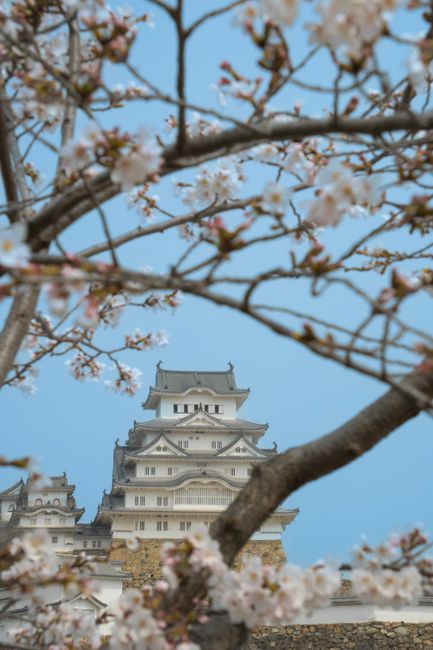
Best things to do: walk the grounds of Osaka Castle Park, then take the train west to Himeji, where the white castle framed by cherry trees is one of the spring scenes the tourism organization highlights. In Hiroshima, the blossoms add color to the city’s riverside parks.
Practical note: Osaka, Kyoto, Nara and Himeji are all close together by train, so a base in one lets you move to whichever spot is at its best that day. See our Osaka travel guide.
Northern Honshu: Sendai and Hirosaki
When: Sendai flowers around 8 April and is in full bloom around 13 April. Aomori, at the top of Honshu, follows with flowering around 22 April and full bloom around 26 April.
Why go: this is the answer if your trip falls after the Tokyo and Kyoto peak. In Hirosaki Park, in Aomori Prefecture, about 2,600 cherry trees of more than 50 varieties surround Hirosaki Castle. The Hirosaki Cherry Blossom Festival runs from late April to early May, with rowboats on the moat, food stalls and evening illuminations, and fallen petals gather on the water in pink “flower rafts”.
Practical note: late April overlaps with Japan’s Golden Week holidays at the start of May, so book well ahead if your dates touch the end of the month.
Hokkaido: the last of the season
When: Hakodate flowers around 28 April and is in full bloom around 2 May. Sapporo comes last among the big cities, with flowering around 1 May and full bloom around 6 May.
Best things to do: in Hakodate, see the cherry trees inside the star-shaped walls of Goryokaku, the old fort. Southwest of Hakodate, Matsumae Park, around the castle in Matsumae town, is another of the spots the tourism organization recommends. In Sapporo, the blossoms arrive with the first warm days of the northern spring.
Practical note: spring evenings in Hokkaido are still cool, so pack a warm layer for night-time viewing.
South Korea
Korea’s cherry blossoms open from the south coast and Jeju Island upward to Seoul, usually from late March into April. As a guide to the order, the 2026 forecast published by the Korea Tourism Organization had Jeju and Busan flowering first, on 25 March, then Jeonju and Gyeongju on 28 March, Gangneung on 1 April, Seoul on 3 April and Incheon on 7 April, with full bloom about a week after flowering. That forecast said the 2026 season would be two to seven days earlier than average, so treat those dates as one year’s example, not a promise for 2027. See our South Korea travel guide.
Jeju Island and Busan
Why go: they bloom first. On Jeju Island, Jeonnong-ro is a 1.2-kilometer road lined with king cherry trees, about ten minutes by car from the airport, and it closes to traffic for the Jeju Cherry Blossom Festival in late March. In Busan, the Democracy Park on Bosusan Mountain has double-flowered cherry trees with sea views, which bloom later, from mid- to late April.
Jinhae, Changwon
Why go: Jinhae, now part of Changwon on the south coast, has about 360,000 cherry trees and hosts the Jinhae Gunhangje Festival, Korea’s best-known cherry blossom festival. The famous views are the 1.5-kilometer blossom tunnel along Yeojwacheon Stream and the trees lining an 800-meter stretch of railway at Gyeonghwa Station.
When: the 2026 festival ran from 27 March to 5 April. The organizers had not published 2027 dates when we checked, so look for the announcement on Changwon’s official festival pages over the winter. It is an easy day trip from Busan.
Gyeongju
Why go: the old royal capital pairs blossoms with tombs, temples and lakes. The Bomun Lake resort area is one of the country’s major cherry tree locations, and Gyeongju had a forecast flowering date of 28 March in 2026. See our Gyeongju travel guide.
Seoul
Why go: the capital blooms in early April. Yeouido’s cherry blossom road runs 1.7 kilometers along Yunjung-ro beside the Han River, with about 1,800 trees, and is the setting for the Yeongdeungpo Yeouido Spring Flower Festival (3–7 April in 2026). Seokchon Lake, near Lotte World Tower, is ringed by about 1,000 cherry trees.
Practical note: traffic is restricted on the main Yeouido section during the festival, so go by subway: Yeouinaru Station on Line 5 or National Assembly Station on Line 9. See our Seoul travel guide.
Washington, D.C.
Why go: the cherry trees around the Tidal Basin, framing the Jefferson Memorial and the Washington Monument, go back to Japan’s gift of 3,000 cherry trees to the city in 1912.
When: according to the National Park Service, peak bloom is most likely between the last week of March and the first week of April. It has come as early as 15 March (1990) and as late as 18 April (1958); in 2026 it was 26 March. The 2027 National Cherry Blossom Festival runs from Saturday 20 March to Sunday 11 April, with the Opening Ceremony on 20 March, the Blossom Kite Festival on 27 March, Petalpalooza with fireworks on 3 April and the parade on 10 April. The festival notes that all dates are subject to change.
Best things to do: walk the full loop of the Tidal Basin early in the morning, before the crowds, then visit East Potomac Park (Hains Point) and the Washington Monument grounds, where more trees grow.
Practical note: the Park Service says forecasting peak bloom is almost impossible more than ten days ahead. It usually announces its prediction in early March (in 2026, on 5 March) and then posts the trees’ progress through the bud stages on its Bloom Watch page. See our Washington, D.C. travel guide and United States travel guide.
Vancouver, Canada
Why go: Vancouver is full of cherry trees planted along ordinary neighborhood streets, so the city turns pink block by block. The Vancouver Cherry Blossom Festival says its 2027 edition will run from March to April; in 2026 it ran from 27 March to 12 April, when the 100 Akebono cherry trees at David Lam Park in Yaletown were in full bloom for the opening Big Picnic.
Best things to do: see the blossoms with magnolias and tulips at VanDusen Botanical Garden, which hosts the festival’s Sakura Days Japan Fair; visit Nitobe Memorial Garden at the University of British Columbia; and walk the cherry streets of Kitsilano, Strathcona and the West End. The festival’s online tree finder shows which trees are blooming near you.
Practical note: different varieties bloom at different times, so the city has flowers for several weeks. See our Vancouver travel guide and Canada travel guide.
When the 2027 forecasts come out
- Japan: the Japan Meteorological Agency stopped publishing its own cherry blossom forecast after 2009 and left forecasting to private weather companies, but it still announces the official flowering and full-bloom dates. Its observation pages are updated three times a day from December to June. The Japan National Tourism Organization’s cherry blossom forecast page carries the Japan Weather Association’s forecast, with daily updates from March; in 2025 the organization announced its forecast in early February.
- South Korea: the Korea Tourism Organization publishes a forecast in its VISITKOREA travel news; the 2026 forecast appeared on 26 February, followed by its spring blossom guide in March.
- Washington, D.C.: the National Park Service announces its peak bloom prediction in early March and tracks the trees on its Bloom Watch page. Festival details are on the National Cherry Blossom Festival site.
- Vancouver: the Vancouver Cherry Blossom Festival publishes its program and a live bloom map.
Until then, the typical dates above are your best guide. If you are booking now, aim for the middle of the usual window, choose flexible bookings, and plan a route that lets you shift a day or two toward wherever the flowers are best.
Plan your trip: our free trip planner can turn any of these cities into a day-by-day plan from our guides. Check typical spring conditions for your dates with the Destination weather tool, and work out your budget in yen, won or Canadian dollars with the Money exchange tool.
Frequently asked questions
When is cherry blossom season in Japan in 2027?
The 2027 forecasts are not out yet. On long-term averages, full bloom is around 31 March in Tokyo and Fukuoka, around 4 April in Kyoto, Osaka and Nara, around 13 April in Sendai, around 26 April in Aomori and around 6 May in Sapporo. Okinawa’s different cherry blooms in January and February.
When will the 2027 cherry blossom forecast be released?
For Japan, forecasts from private weather companies usually appear in winter, and the Japan National Tourism Organization published its 2025 forecast in early February. Korea’s forecast came out on 26 February in 2026. In Washington, the National Park Service announces its peak bloom prediction in early March.
How long do cherry blossoms last?
Not long at any one spot. In Japan, full bloom usually comes about a week after the first flowers open. In Washington, the Park Service says the blossoms typically last seven to ten days once peak begins, less if rain or wind arrive. Moving north or up into the hills is the way to stretch your season.
When is the National Cherry Blossom Festival in 2027?
From Saturday 20 March to Sunday 11 April 2027, with the parade on 10 April, according to the festival. Dates are subject to change, and peak bloom itself depends on the weather.
Where can I see cherry blossoms in late April or May?
Go north in Japan. Aomori, home of Hirosaki Park, is usually in full bloom around 26 April, Hakodate around 2 May and Sapporo around 6 May. In Korea, Busan’s double cherry blossoms in Democracy Park bloom from mid- to late April.
Travel guides in this post
Keep reading
Before you go: guidebooks and travel gear
Affiliate links: we may earn a commission at no extra cost to you. As an Amazon Associate we earn from qualifying purchases. We pick items for the place, not for the commission. How we earn money