For warm water and long beach days, head to the Mediterranean between June and October: Mallorca, Ibiza, Sicily, the Amalfi Coast, Crete, Rhodes and the Greek islands, where the sea reaches about 25–28 °C in August. For winter sun, the Canary Islands stay around 19–23 °C. The Atlantic beaches of Portugal, the Basque coast, Normandy and Cornwall are wilder and cooler, with real waves. Wherever you go, swim at lifeguarded beaches in their season and learn the local flags.
This page compares beaches in the six countries TravelerCenter publishes, Portugal, Spain, France, Italy, Greece and the United Kingdom: which coast suits which trip, when the sea is warmest, and the safety rules and protected-area limits you need to know.
Beaches at a glance
- Warmest sea: Rhodes (about 28 °C in August), Palermo and Mallorca (about 27 °C), Crete, Zakynthos and the Amalfi Coast (about 26–27 °C).
- Best winter beaches: the Canary Islands, where Tenerife and Gran Canaria rarely drop below about 19 °C, followed by Madeira.
- Coolest sea: Cornwall (about 17 °C at best) and Portugal’s west coast (about 17–18 °C in September).
- Sand or pebbles: Nice, the Amalfi Coast and many Greek coves are pebbly, so pack water shoes; the Algarve, Gran Canaria, Naxos and Cornwall’s surf beaches are sandy.
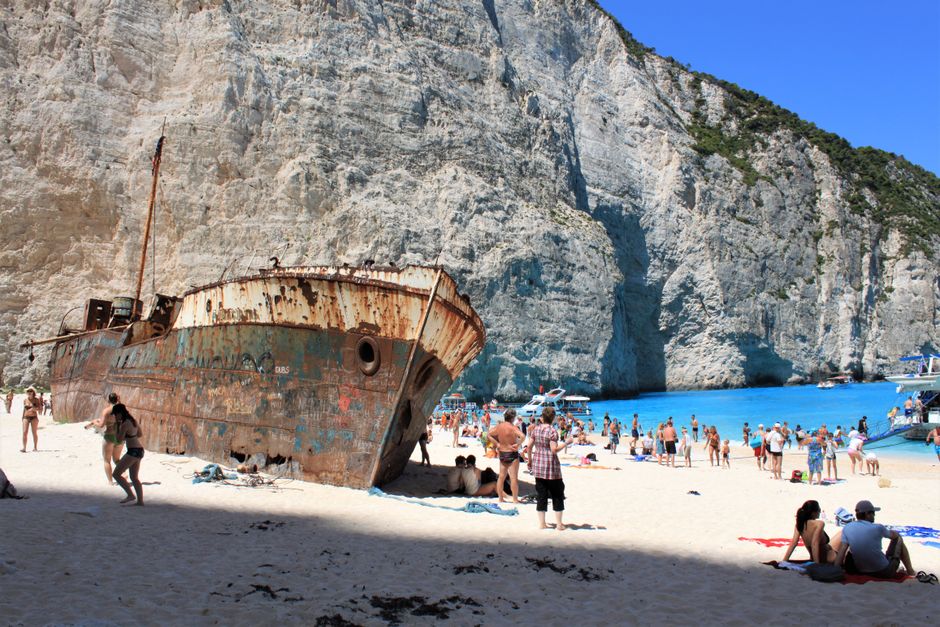
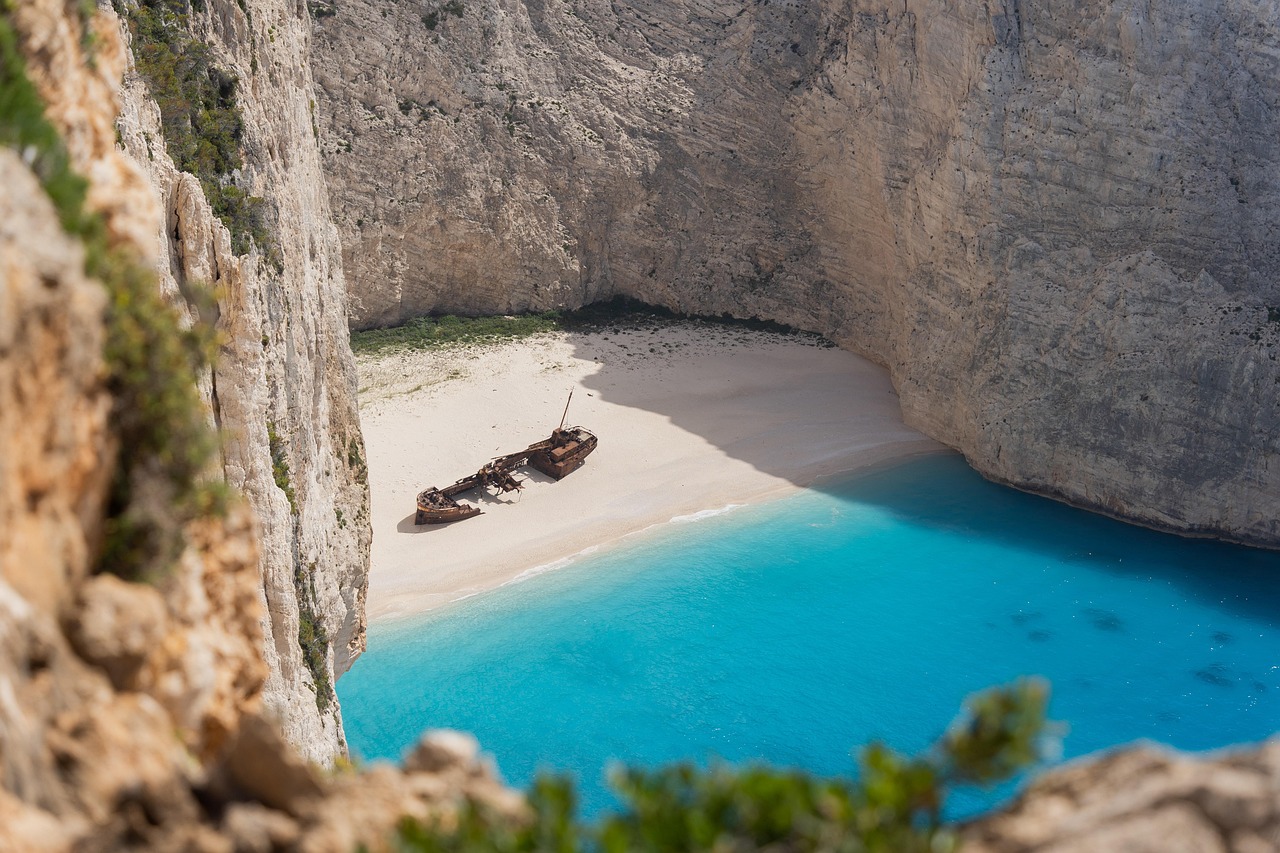
- Rules to know: turtle-nesting beaches on Zakynthos close at sunset; Navagio beach is closed to landing until at least 31 October 2026; Benagil cave in the Algarve cannot be reached by swimming; and the Calanques near Marseille can close on high fire-risk days.
What a beach day involves
Southern Europe’s beaches come in several kinds. On the Mediterranean you’ll find small coves between cliffs, long resort beaches with rows of sunbeds, and city beaches you can reach by bus or metro. The water is usually calm, clear and warm in summer. On the Atlantic, beaches are bigger and wilder, with waves, tides and cooler water. The islands add volcanic black sand (Santorini, Tenerife), natural rock pools (Madeira, the Azores) and dune beaches (Gran Canaria’s Maspalomas, Naxos).
In most countries the beach itself is public and free; you pay only if you rent a sunbed and umbrella from a beach club or concession. In Italy many beaches are split between paid lidos and free public sections; in Greece, a 2024 law requires part of every organised beach to stay free of sunbeds. Families with small children and less confident swimmers will be happiest on gently sloping sand with lifeguards.
Safety and rules
Flags and lifeguards
- Most of southern Europe: green means swimming is allowed, yellow means take care or paddle only, and red means do not enter the water. Portugal adds a chequered flag (lifeguard post temporarily unstaffed) and a red-and-yellow striped flag for the supervised zone.
- United Kingdom: the RNLI marks the lifeguarded zone with red-and-yellow flags; black-and-white chequered flags mark the zone for surfboards and kayaks, where you should not swim; a red flag means never go in. Its rule: no flags, no lifeguards.
- Seasons: lifeguards work only in each beach’s season. In 2026 most mainland Portuguese beaches were covered from June to mid-September (Albufeira 15 May to 15 October); San Sebastián’s beaches from 1 June to 30 September; and in Cornwall most RNLI patrols ran from May to September, with Fistral, Perranporth, Porthmeor and Sennen starting at Easter.
Protected beaches and local rules
- Zakynthos turtle beaches: in the National Marine Park of Zakynthos, the loggerhead turtle nesting beaches open at 07:00 and must be left at sunset; stay within about 5 m of the waterline, keep 15 m from turtles, and don’t put up umbrellas on Gerakas, Daphni or Marathonisi.
- Navagio (Shipwreck) beach: closed by a government decision until at least 31 October 2026; boats may not land, anchor or come within 50 m of the shore, and swimming in the bay is banned. See our Navagio beach guide.
- Benagil cave, Algarve: since 13 August 2024 nobody may swim or float into the cave or land on its beach. See our Benagil cave guide.
- Calanques, Marseille: on high fire-risk days in summer, land access to the national park can be closed; boats still run but landing is forbidden. Check the prefecture’s map, published at 18:00 for the next day. See our Calanques guide.
- Étretat, Normandy: a town order of April 2025 bans the beaches at the foot of the cliffs (except in front of the promenade), the cliff tunnels, and walking within 5 m of the cliff edge. See our Étretat cliffs guide.
- Maspalomas dunes, Gran Canaria: a nature reserve: keep to marked paths, don’t build stone windbreaks and don’t camp. See our Maspalomas guide.
- Posidonia seagrass: in the Balearics, leave dried seagrass on the beach (it protects the sand), and if you rent a boat, anchor on sand, never on the meadows.
Sun, currents and cliffs
Rip currents are a real risk on Atlantic beaches; if one pulls you, swim parallel to the shore and signal for help. Stay back from cliff edges and never sit under crumbling cliffs, from the Algarve to Santorini’s Red Beach, which has been officially restricted since 2013 after repeated rockfalls. The Mediterranean sun is fierce from May to September; there is often no natural shade. Emergencies: 112 in the EU, 999 in the UK.
The best beaches by country
Portugal
Portugal identified 671 official bathing waters for 2026, and 396 beaches won a Blue Flag.
- Algarve: golden cliffs and coves around Lagos, Carvoeiro and Benagil, long resort beaches around Albufeira, calm lagoon islands in the Ria Formosa, and wild surf beaches on the west coast. In 2026, 85 of its sea beaches won a Blue Flag. Don’t miss Praia da Marinha. See our Algarve travel guide.
- Lisbon coast: the Cascais train-line beaches (lifeguards 1 May to 30 September in 2026), Costa da Caparica’s long sands and the calm coves of Arrábida. See our Lisbon travel guide and Sintra guide for the cliff beaches of Adraga and Praia Grande.
- Porto: the Foz beaches, such as Ourigo and Ingleses, hold a Blue Flag; the sea averages only about 16–17 °C in summer. See our Porto travel guide.
- Madeira and the Azores: lidos and lava pools, such as the lifeguarded Porto Moniz natural pools, and Porto Santo’s nine-kilometre sandy beach; on São Miguel, Areal de Santa Bárbara is the favourite summer beach. See our Madeira and Azores guides.
Spain
- Mallorca and Ibiza: from busy holiday beaches to quiet coves, many inside natural parks: Es Trenc’s dunes, Caló des Moro and Formentor on Mallorca; fine-sand beaches and cliff coves on Ibiza, some inside Ses Salines Natural Park.
- Canary Islands: Gran Canaria has almost 60 km of beaches, from the Maspalomas dunes to calm Amadores and Las Canteras city beach, where a reef calms the water; Tenerife mixes golden and black volcanic sand, with the calmest beaches in the south and seawater pools in the north.
- City beaches: La Concha in San Sebastián, one of Europe’s great city beaches; Valencia‘s Cabanyal, Malvarrosa and Patacona, more than 3 km of golden sand; Málaga‘s 16 beaches, including La Malagueta; and Barcelona‘s city beaches from Barceloneta to Mar Bella.
France
- Nice and the Riviera: the Promenade des Anglais runs almost 7 km along white-pebble beaches, public ones and private beach clubs. See our Nice travel guide.
- Marseille: 21 beaches, from the Prado beaches to the Sormiou calanque; the tourist office calls July–August the peak season and September still summery with fewer people. See our Marseille travel guide.
- Corsica: more than 1,000 km of coast with clear water, long sandy beaches such as Palombaggia, Santa Giulia and Rondinara, and protected coast at the Agriates and Cap Corse. See our Corsica travel guide.
- Normandy: more than 620 km of coast with resort beaches at Deauville, Cabourg and Étretat, lifeguards on family beaches in summer, and the D-Day landing beaches. See our Normandy travel guide.
- Atlantic coast: from Bordeaux, head to Arcachon and the Dune du Pilat. See our Bordeaux travel guide.
Italy
- Sicily: Visit Sicily’s favourites include San Vito Lo Capo, Scopello, the Scala dei Turchi, Vendicari, Isola dei Conigli on Lampedusa, Mondello near Palermo and Isola Bella below Taormina; Mondello’s beach facilities run May to September. See our Sicily travel guide.
- Amalfi Coast: mostly small, pebbly beaches split between beach clubs and free sections: Positano’s Spiaggia Grande and Fornillo, Amalfi’s Marina Grande, and Santa Croce, reached by boat. See our Amalfi Coast travel guide.
- Cinque Terre: Fegina beach in Monterosso is the only long sandy beach, with free sections and lidos. See our Cinque Terre guide.
- Tuscany: Versilia’s resort beaches, Cala Violina in the Maremma, and Elba’s Sansone, Biodola and Fetovaia. See our Tuscany travel guide.
- Lakes: Lake Como has lidos at Como, Bellagio, Cernobbio and Menaggio.
Greece
- Crete: Chania’s coast has more than 80 beaches, including Falasarna, the pink-sand lagoon of Elafonisi and Balos lagoon. See our Crete travel guide.
- Ionian islands: Myrtos on Kefalonia, one of the most photographed beaches in Greece; the turtle beaches of Zakynthos; Paleokastritsa’s coves and Glyfada on Corfu.
- Cyclades: Santorini‘s volcanic black-sand Kamari and Perissa; about 25 beaches on Mykonos, from calm Kalo Livadi to the beach bars of Paradise; and the long sands of Agios Prokopios and Plaka on Naxos.
- Rhodes: 253 km of coast, from Anthony Quinn Bay and Lindos to family beaches at Tsambika. See our Rhodes travel guide.
- Near Athens: the Athens Riviera’s serviced beaches at Voula, Vouliagmeni and Kavouri, swimmable for about six months a year; see our Athens and Nafplio guides.
United Kingdom
- Cornwall: around 300 beaches. St Ives alone has five, with Blue Flags at Porthminster and Porthmeor; Kynance Cove, Porthcurno and Sennen are favourites. The south coast is calmer for swimming; on the north coast, swim only between the flags. See our Cornwall travel guide.
When to go: sea temperature by region
Sea temperatures are 10-year monthly averages from satellite and in-situ data (seatemperature.info), except Madeira, where the figure is an official 2024 reading at Funchal’s Pontinha pier (DREM, from IPMA data). All as of October 2026.
| Region | Sea temperature, coldest month | Warmest month | Best months to swim |
|---|---|---|---|
| Algarve (Faro) | 15.7 °C (Feb–Mar) | 21.1 °C (Aug–Sep) | July–October |
| Lisbon coast (Cascais) | 14.4 °C (Feb) | 18.3 °C (Sep) | July–September |
| Madeira (Funchal) | 19.3 °C (Mar–Apr, 2024) | 23.6 °C (Aug, 2024) | June–October |
| Mallorca (Palma) | 14.3 °C (Feb) | 27.1 °C (Aug) | June–October |
| Málaga | 14.8 °C (Feb) | about 24 °C (Aug) | June–October |
| Gran Canaria (Las Palmas) | 18.9 °C (Mar) | 23.4 °C (Sep) | All year |
| San Sebastián | 12.2 °C (Feb) | 22.5 °C (Aug) | July–September |
| Nice | 13.7 °C (Feb) | 25.4 °C (Aug) | June–September |
| Corsica (Ajaccio) | 13.7 °C (Feb) | 25.4 °C (Aug) | June–October |
| Amalfi Coast (Positano) | 14.5 °C (Feb–Mar) | 26.7 °C (Aug) | June–October |
| Sicily (Palermo) | 14.5 °C (Feb) | 27.4 °C (Aug) | June–October |
| Crete (Chania) | 15.8 °C (Feb) | 26.5 °C (Aug) | June–October |
| Rhodes | 17.1 °C (Mar) | 28.2 °C (Aug) | June–October |
| Cornwall (Newquay) | 9.4 °C (Feb–Mar) | 16.6 °C (Aug) | July–September |
The sea lags behind the air, so September is often the best beach month of all: the water is near its warmest, the crowds thin out after the school holidays, and prices drop. July and August are the busiest and hottest months everywhere.
How to plan beach days, and what to pack
You don’t need to book the beach itself. Arrive early in summer, because car parks at famous coves fill by mid-morning: Anthony Quinn Bay on Rhodes and Myrtos on Kefalonia are often full by about 9:30–10:00 in high season. Some places limit numbers: the Sugiton calanque near Marseille needs a free booking on set summer dates (daily from 27 June to 30 August in 2026), and visitor numbers are capped at Gerakas and Marathonisi on Zakynthos in high season. Many of the best coves, from Santa Croce on the Amalfi Coast to Balos on Crete, are easiest by boat (see our boat trips guide). A Blue Flag means a beach met that year’s criteria for water quality, safety and services; many beautiful coves simply don’t apply.
What to pack
- Day packs and anti-theft bagsCarries water, towel and sunscreen down the long stairways to Algarve coves.
- Dry bags and phone pouchesProtects phones and cameras from sand and spray on beaches reached by ferry or steep paths.
- Quick-dry beach towelsA sand-shedding quick-dry towel packs small for beach days and lido visits.
- Reef-friendly sunscreenSummer UV is strong on Portuguese beaches and there is little shade below the cliffs.
- Water shoesRocky coves, lava pools and weever fish in shallow sand make water shoes useful.
- WetsuitsOn the west and north coasts the sea stays around 16–18 °C even in summer, so a thin suit helps for long swims.
Sun protection comes first: high-factor sunscreen, a hat, sunglasses and, for long days, a beach umbrella or sun tent, because many beaches have no natural shade and on some protected beaches you can’t put one up. Water shoes are worth it on the pebbles of Nice, Amalfi and the Greek coves, and on lava and rock. Add a mask for the clear Mediterranean coves, a light layer for windy Atlantic afternoons, a refillable water bottle, and a dry bag if you’ll take a boat to the beach.
Beaches in Europe: questions and answers
Where is the warmest sea in southern Europe?
In late summer, the eastern Mediterranean: the sea off Rhodes averages about 28 °C in August, and Mallorca, Sicily, Crete, Zakynthos and the Amalfi Coast reach about 26–27 °C. On the Atlantic, the Canary Islands are the warmest in winter.
Which European beaches are warm in winter?
The Canary Islands: the sea off Gran Canaria and Tenerife averages about 19 °C at its coldest, in March, and the air is mild all year. Madeira is the next best, at around 19 °C in early spring.
What is the best month for a beach holiday in Europe?
September, for most places: the sea is near its warmest, schools have gone back and prices fall. June is also good on the Mediterranean, though the water is a few degrees cooler.
Are Nice’s beaches sandy?
No. Nice’s beaches are smooth white or grey pebbles. Bring water shoes or rent a sunbed, or take the train to the sandy beaches of Antibes, Juan-les-Pins or Cannes.
Can I visit Navagio (Shipwreck) beach in 2026?
Not on foot or by landing. A government decision keeps the beach closed until at least 31 October 2026: boats may not come within 50 m of the shore, and swimming in the bay is banned. You can still see it from boats passing outside that line and from the clifftop viewpoint when it is open.
What are the rules on Zakynthos turtle beaches?
The nesting beaches of the National Marine Park of Zakynthos are open from 07:00 to sunset. Stay close to the water, keep at least 15 m from turtles, don’t touch nests, and don’t put up umbrellas on the beaches where they are banned.
Can I swim into Benagil cave?
No. Since 13 August 2024, nobody may swim or float into the cave or land on its beach. See it from a licensed boat or on a guided kayak or paddleboard tour.
Are Cornish beaches safe for swimming?
Yes, if you choose a lifeguarded beach in season and swim between the red-and-yellow flags. The Atlantic swell and rip currents are strong, especially on the north coast, and the sea is cold, at about 16–17 °C at best.
Do I have to pay to use beaches in Italy or Greece?
No. The beaches are public; you pay only for sunbeds and umbrellas from beach clubs. Many Italian beaches mix paid lidos with free sections, and Greek law requires part of every organised beach to stay free.
More ideas for your trip: snorkelling, surfing and boat trips.
Sources and last review
Researched and last reviewed by TravelerCenter on 4 October 2026. Portuguese bathing waters and lifeguard seasons come from the Portuguese Environment Agency and Portaria 204-A/2026/1, flags from the Maritime Authority’s lifeguard institute, and Benagil rules from the Portimão harbour master; Zakynthos rules from the National Marine Park of Zakynthos and Navagio’s closure from the 2026 joint ministerial decision as reported by the Greek press; Calanques access from the Calanques National Park, the Bouches-du-Rhône prefecture and the City of Marseille; Étretat from the town’s 2025 order; UK flags and patrols from the RNLI; San Sebastián’s season from Donostia city council; beaches from Visit Portugal, the Balearic and Ibiza tourist boards, Turismo de Tenerife, the Gran Canaria tourist board, Visit València, Spain.info, Explore Nice Côte d’Azur, Marseille’s tourist office, Visit Corsica, Normandy’s tourist board, Italia.it, Visit Sicily, Visit Tuscany, Visit Greece, This is Athens and Visit Cornwall; sea temperatures from seatemperature.info’s 10-year averages and, for Madeira, DREM from IPMA data. Rules and seasons change every year, so check before you go.