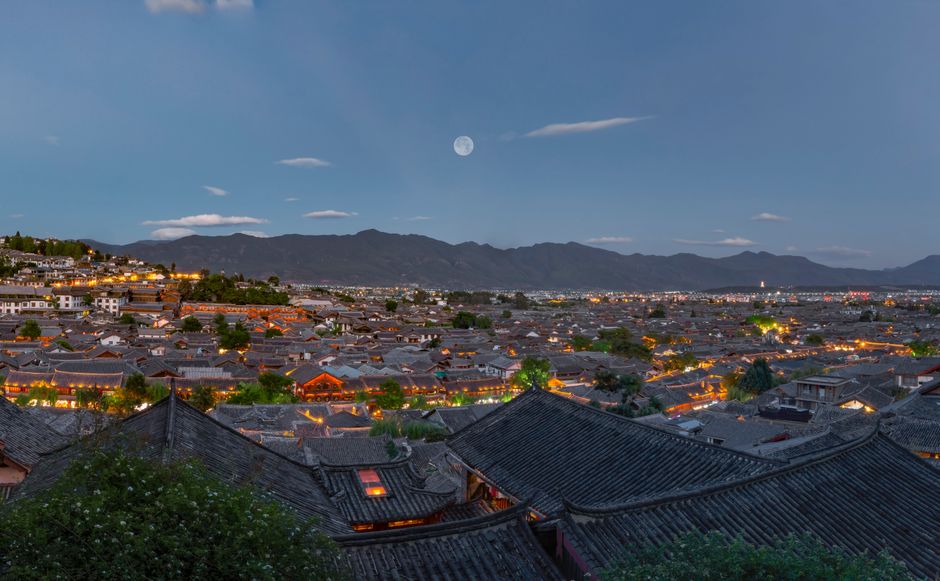
Lijiang, high on a plateau in northwest Yunnan province in southwest China, is famous for its Old Town, a maze of cobbled lanes, wooden houses with upturned eaves and clear canals fed by mountain springs, the historic home of the Naxi people, with their own pictographic Dongba script. The Old Town of Lijiang, including Dayan and the nearby villages of Baisha and Shuhe, is a UNESCO World Heritage Site. Above the town rises the Jade Dragon Snow Mountain, whose glaciated summit reaches about 5,596 m (18,360 ft); a cable car lifts visitors to a viewing platform at about 4,500 m (14,800 ft). Within a few hours are the deep Tiger Leaping Gorge on the Yangtze, the lake villages of Lugu Lake and the Tibetan town of Shangri-La. The Old Town is busy, commercial and lively at night, but early mornings, the quieter lanes, Black Dragon Pool and the villages around it are still beautiful. At about 2,400 m (7,900 ft), Lijiang has strong sun, cool nights and thin air. Visitors pay a maintenance fee for the Old Town, now valid for a year. The city has about 1.25 million people, and its airport is a port for the 240-hour visa-free transit. The best seasons are March to May and October to November.
Right now in Lijiang
- Thu9–21°C48–70°FMostly clear
- Fri9–21°C48–70°FMostly clear
- Sat11–21°C53–70°F1 mm rain
Top tours in Lijiang
See all tours for Lijiang →
From local operators, with prices and reviews; you check availability and book on Viator, our partner. We may earn a commission at no extra cost to you. How we earn money
Lijiang at a glance
- Best for: the UNESCO Old Town, Naxi culture, mountain scenery, Jade Dragon Snow Mountain, hiking Tiger Leaping Gorge and the road to Shangri-La.
- How long: 3–4 days, plus 2 days for Tiger Leaping Gorge or Lugu Lake.
- Best time: March to May and October to November, sunny and dry; June to September is the rainy season; winters are sunny but cold at night.
- Getting there: by air to Lijiang Sanyi (LJG), or by train from Kunming, Dali and Shangri-La.
- Getting around: on foot in the Old Town; by taxi, DiDi, bus or hired car to Baisha, Shuhe and the mountain.
- Good to know: the town is at about 2,400 m (7,900 ft); take it easy on day one, and book Jade Dragon Snow Mountain cable cars in advance.
- Before you go: visa-free entry, the 240-hour transit, the arrival card, payments and general safety are in our China travel guide.
Lijiang’s areas and where to stay
Lijiang’s historic areas sit at the foot of the hills on the northwest side of the modern city; the mountain is about 30 km (19 miles) north.
Dayan Old Town
Dayan, the main Old Town, centers on Sifang Square, where four streets meet, and spreads out in lanes along three branches of the Yu River. Courtyard guesthouses and boutique hotels in traditional Naxi houses fill the town; the streets near Sifang Square and the bar street along the canal are lively until late, while the upper lanes toward Lion Hill and the outer edges are quieter. Cars can’t enter; porters and handcarts carry luggage.
Shuhe
About 4 km (2.5 miles) northwest, Shuhe is a smaller, calmer old town on the old tea-horse road, with streams running through its lanes and courtyard inns. It is a good choice if you want the atmosphere without the crowds.
Baisha
Baisha, about 10 km (6 miles) north at the foot of the mountain, was the Naxi capital before Dayan. It is a village of farms, temples with Ming-dynasty murals and a few small inns, and the closest base to the mountain.
The new city
The modern city south and east of the Old Town has larger international and chain hotels, shopping malls, the railway station and easier car access, but less charm.
Where to stay in Lijiang
- Dayan Old Town: courtyard inns in the heart of the action.
- Upper Dayan and Lion Hill: views over the roofs, quieter nights.
- Shuhe: calmer old-town atmosphere.
- Baisha: rural, closest to Jade Dragon Snow Mountain.
- New city: larger hotels, near the station.
Rooms fill and prices rise during Chinese New Year, May Day and Golden Week.
The Old Town maintenance fee
The Lijiang Old Town maintenance fee funds the protection of the World Heritage site. Under the city’s rules in force from 1 August 2025, as reported in China’s state media, the fee is 50 yuan per person, and one payment is valid for 365 days, with unlimited entries after you are checked. It covers the three inscribed areas: Dayan (including Black Dragon Pool), Baisha and Shuhe. Tour groups pay through their travel agency; independent visitors pay at check points or when buying tickets for sights such as the Mu Family Mansion, and keep the receipt or e-ticket with their passport. Children, local residents and some other groups are exempt. How strictly the fee is checked at the town’s entrances varies; check the current arrangements when you arrive.
Top things to see in Lijiang
Wandering the Old Town
Explore Dayan’s cobbled lanes early in the morning before the crowds, when shopkeepers wash the stones and mist rises from the canals. Walk from Sifang Square along the water to the old water wheels at the north entrance, and up through the quieter lanes.
Mu Family Mansion
The Mu Family Mansion (Mufu) was the palace of the Mu clan, the hereditary Naxi rulers of Lijiang for centuries. Rebuilt after the 1996 earthquake, its halls, gates and gardens climb the hillside in the southwest of the Old Town; separate ticket.
Lion Hill and Wangu Tower
Wangu Tower, a tall wooden pavilion on Lion Hill above the Old Town, gives the classic view over a sea of gray-tiled roofs to Jade Dragon Snow Mountain beyond.
Black Dragon Pool
North of the Old Town, the Black Dragon Pool park surrounds a spring-fed lake with a marble bridge and pavilion, the most famous view in Lijiang when the snow peaks are reflected on a clear morning. The Dongba Culture Museum nearby explains the Naxi script and religion.
Naxi music
The Naxi Ancient Music orchestra performs ancient Chinese and Daoist music in the Old Town most evenings, with elderly musicians on traditional instruments.
More classic sights
- Shuhe Old Town: a quieter old town with springs, an old bridge and tea-horse road history.
- Baisha murals: Ming-dynasty frescoes mixing Buddhist, Daoist and Tibetan styles in Baisha village.
- Yuhu village: a stone village below the mountain, once home to the botanist and explorer Joseph Rock.
- Lashi Lake: a wetland lake west of town, with birds in winter and horse rides on the old tea-horse trail.
- Yufeng Monastery: a Tibetan Buddhist temple with an ancient camellia tree.
Other things to do in Lijiang
Jade Dragon Snow Mountain
The Jade Dragon Snow Mountain (Yulong Xueshan) is a range of 13 peaks, about 30 km (19 miles) north of town; the main summit, Shanzidou, about 5,596 m (18,360 ft), has never been officially climbed. The scenic area is visited by bus and cable car. The Glacier Park cable car rises from about 3,350 m (11,000 ft) to an upper station at about 4,500 m (14,800 ft), where boardwalks climb toward the glacier; two lower cable cars serve the Spruce Meadow (Yunshanping) and the Yak Meadow. At the foot of the mountain, the turquoise pools of Blue Moon Valley and the outdoor show Impression Lijiang, performed by local villagers at about 3,100 m (10,200 ft), are part of the same visit. You pay an entrance ticket plus an environmental bus fare, and each cable car separately. Cable car tickets are real-name and limited each day, and the Glacier Park cable car often sells out; book through the scenic area’s official channels or a licensed agency several days ahead with your passport, especially in holidays. Cable cars close in high winds and bad weather. At the top, the air has about 60 percent of the oxygen at sea level: move slowly, and many visitors carry small oxygen canisters sold locally.
Food and drink
Lijiang’s Naxi and Yunnan cooking is hearty mountain food. Try cured pork rib hotpot (larou paigu huoguo), the local specialty; Naxi baba, a fried layered flatbread, sweet or savory; chicken pea jelly (jidou liangfen), served cold or fried; Yunnan rice noodles and Yunnan ham; yak meat from the highlands; and, in the rainy season, wild mushrooms in hotpots and stir-fries. Drink Pu’er tea and yak butter tea, and try local Yunnan coffee, increasingly common in the Old Town’s cafés.
Day trips from Lijiang
- Tiger Leaping Gorge: one of the deepest gorges in the world, where the Jinsha (upper Yangtze) River squeezes between the Jade Dragon and Haba mountains, about 2 hours west; walk to the river at the Upper Gorge, or hike the high trail over 2 days with guesthouses along the way.
- Lugu Lake: a high lake on the Sichuan border, home to the Mosuo people, about 4–5 hours by road; best overnight.
- Shangri-La (Zhongdian): a Tibetan town with the great Songzanlin Monastery, about 1.5 hours by train; best overnight, at about 3,300 m (10,800 ft).
- Dali: the old town and Erhai lake, about 1.5–2 hours by train.
- First Bend of the Yangtze and Shigu: where the river turns sharply north, about 1.5 hours west.
Nearby destinations
- Dali134 km
Getting there and getting around
By air
Lijiang Sanyi International Airport (LJG), about 25 km (16 miles) southeast of the city, has flights from Kunming and most major Chinese cities and some international routes. It is a designated port for the 240-hour visa-free transit; the permitted area in Yunnan covers nine cities and prefectures, including Kunming, Dali and Lijiang. Airport buses run to the city in about 40 minutes; taxis take about 30 minutes.
By train
Lijiang station, southeast of the city, has fast D trains to Kunming (about 3–3.5 hours) via Dali (about 1.5–2 hours), and trains north to Shangri-La (about 1.5 hours). Book on the 12306 website or app with your passport; buses and taxis link the station with the Old Town in about 20–30 minutes.
Around town
The Old Town is pedestrian only; taxis drop you at the gates. Use taxis, DiDi or local buses for Shuhe, Baisha and Black Dragon Pool, and buses or a hired car for the mountain.
When to go and how long to stay
Lijiang has a highland climate with a dry, sunny season and a monsoon season. From October to May, days are mostly clear and sunny, with highs of 14–23 °C (57–74 °F); winter nights drop to around freezing, and the snow peaks are at their sharpest. March to May is warm and dry, with spring flowers. From June to September, the monsoon brings frequent afternoon rain and clouds that often hide the mountain, but the countryside is green and wild mushrooms are in season. Because of the altitude, the sun is strong all year. The table uses the 1991–2020 climate normals for the Lijiang station of the China Meteorological Administration (CMA), at 2,382 m (7,815 ft), as submitted to the World Meteorological Organization (WMO): average daily highs and lows, total precipitation, and days with at least 1 mm of rain.
| Month | Average high / low | Rain (days with 1 mm or more) | What to expect |
|---|---|---|---|
| January | 14 °C (57 °F) / 1 °C (33 °F) | 5 mm (0.2 in), 1 day | Sunny and dry; cold nights |
| February | 16 °C (60 °F) / 3 °C (38 °F) | 5 mm (0.2 in), 2 days | Sunny; Chinese New Year crowds |
| March | 18 °C (64 °F) / 6 °C (43 °F) | 13 mm (0.5 in), 3 days | Warm days; dry; very good |
| April | 21 °C (69 °F) / 9 °C (48 °F) | 20 mm (0.8 in), 4 days | Warm and dry; spring flowers |
| May | 23 °C (74 °F) / 12 °C (54 °F) | 69 mm (2.7 in), 8 days | Warm; first showers |
| June | 25 °C (76 °F) / 15 °C (59 °F) | 147 mm (5.8 in), 14 days | Rainy season begins |
| July | 23 °C (74 °F) / 15 °C (59 °F) | 253 mm (10.0 in), 19 days | The wettest month; clouds on the peaks |
| August | 23 °C (74 °F) / 14 °C (58 °F) | 229 mm (9.0 in), 18 days | Rainy; mushrooms in season |
| September | 22 °C (71 °F) / 13 °C (55 °F) | 157 mm (6.2 in), 16 days | Showery; clearing late in the month |
| October | 20 °C (69 °F) / 9 °C (48 °F) | 57 mm (2.2 in), 7 days | Clear and mild; Golden Week crowds |
| November | 17 °C (63 °F) / 4 °C (39 °F) | 12 mm (0.5 in), 2 days | Sunny and crisp; very good |
| December | 15 °C (59 °F) / 1 °C (33 °F) | 2 mm (0.1 in), 1 day | Sunny; cold nights |
Lijiang receives about 970 mm (38 in) of rain a year, almost all of it from June to September.
Three days in Lijiang
Day one, take it easy at altitude: the Old Town, Sifang Square, Wangu Tower at sunset and Naxi music. Day two, Jade Dragon Snow Mountain, Blue Moon Valley and Impression Lijiang. Day three, Black Dragon Pool in the morning, then Baisha and Shuhe by bike or taxi.
Five days
Add a two-day hike on the high trail at Tiger Leaping Gorge, or a night at Lugu Lake; continue to Shangri-La or south to Dali and Kunming by train.
What a trip to Lijiang costs
Prices are approximate, for October 2026, converted at about 6.74 yuan to the US dollar.
| Item | Typical cost |
|---|---|
| Old Town maintenance fee, valid 365 days | 50 CNY (about US$7.40) |
| Jade Dragon Snow Mountain entrance and bus | about 100–130 CNY (about US$15–19) |
| Glacier Park cable car | about 120–180 CNY (about US$18–27) |
| Impression Lijiang show | about 190–300 CNY (about US$28–45) |
| Mu Family Mansion | about 40–60 CNY (about US$6–9) |
| Tiger Leaping Gorge entrance | about 45–65 CNY (about US$6.70–9.60) |
| Cured pork rib hotpot, per person | 60–120 CNY (about US$9–18) |
| Mid-range courtyard inn double, per night | 250–600 CNY (about US$37–89) |
Practical tips for Lijiang
- Acclimatize: rest on your first day, drink water and avoid alcohol until you feel normal.
- Book the cable car: Glacier Park tickets are limited each day; book ahead with your passport.
- Go early: the Old Town is magical at dawn and crowded from late morning.
- Keep your fee receipt: show it with your passport if asked in Dayan, Shuhe or Baisha.
- Dress in layers: sunny days turn cold quickly after sunset.
- Check road and weather: rain and landslides can affect the gorge and mountain roads in summer.
Safety
Lijiang is safe for visitors. The main issue is altitude: the Old Town is at about 2,400 m (7,900 ft), the Glacier Park cable car reaches about 4,500 m (14,800 ft), and Shangri-La is at about 3,300 m (10,800 ft). Headaches, breathlessness and poor sleep are common on arrival; rest, drink plenty of water and go slowly, and descend and seek medical help if symptoms become severe. People with heart or lung conditions should take extra care at the mountain. Mountain weather changes quickly: cable cars close in high winds, and it can snow on the upper slopes at any time of year. In the rainy season, landslides and rockfalls can close roads and trails, especially at Tiger Leaping Gorge, where hikers should keep to the main trail and avoid it in heavy rain. The UV index is high all year. Crowds fill the Old Town and the mountain during Golden Week (1–7 October), Chinese New Year and the May Day holiday. Watch for pickpockets in busy lanes, and agree prices before buying jade, silver or tea. Carry your passport for tickets and checks. In an emergency, call 110 for police, 120 for an ambulance and 119 for fire.
What to pack for Lijiang
Layers, including a warm fleece or down jacket for evenings and the mountain, sunglasses, a sun hat and high-factor sunscreen, lip balm, a light rain jacket for June to September, and comfortable walking or hiking shoes for cobbles and gorge trails. China uses 220 V, with flat two-pin, round two-pin and angled three-pin sockets. See our hiking shoes, rain jackets and travel adapters guides.
Lijiang travel FAQ
Do I have to pay to enter Lijiang Old Town?
There is no gate ticket, but visitors are charged the Old Town maintenance fee: 50 yuan per person, valid for 365 days, covering Dayan, Shuhe and Baisha, under the rules in force from August 2025.
How do I book Jade Dragon Snow Mountain?
Book the cable car tickets several days ahead with your passport through the scenic area’s official channels or a licensed agency; the Glacier Park cable car is limited each day and sells out in busy periods.
How high is Jade Dragon Snow Mountain?
The main peak is about 5,596 m (18,360 ft); the Glacier Park cable car takes visitors to about 4,500 m (14,800 ft).
Will I get altitude sickness in Lijiang?
Many visitors feel mild symptoms at about 2,400 m (7,900 ft); rest on the first day and drink plenty of water. The mountain is much higher, so go up only when you feel well.
What is the best time to visit Lijiang?
March to May and October to November, when skies are clear and dry. June to September is the rainy season.
Should I stay in Dayan or Shuhe?
Dayan for the full Old Town experience and restaurants; Shuhe for a quieter old town about 15 minutes away.
How do I get from Dali to Lijiang?
By train in about 1.5–2 hours, or by road in about 3 hours.
Can I hike Tiger Leaping Gorge from Lijiang?
Yes. Take a bus or car to Qiaotou, about 2 hours, and hike the high trail over 2 days, staying in guesthouses; avoid it in heavy rain.
Can I use the 240-hour visa-free transit in Lijiang?
Yes. Lijiang Sanyi airport is a designated port, and the permitted area covers nine Yunnan cities and prefectures, including Lijiang, Dali and Kunming.
How many days do I need in Lijiang?
Three to four days, or five to six with Tiger Leaping Gorge, Lugu Lake or Shangri-La.
Plan your trip
Partner links: TravelerCenter may earn a commission if you book, at no extra cost to you.
🇨🇳 Useful Mandarin Chinese phrases for Lijiang
All 38 Mandarin Chinese phrases: restaurant, hotel, emergencies, romance (printable) →
Sources · last reviewed 4 October 2026
Researched and last reviewed on 4 October 2026. Visa-free transit, Lijiang Sanyi airport as a designated port and the nine permitted Yunnan cities and prefectures: the National Immigration Administration; train booking with a passport: China Railway’s official 12306 site; climate normals and the station height: the China Meteorological Administration via the World Meteorological Organization’s 1991–2020 normals; the exchange rate: the CFETS central parity rate; the Old Town of Lijiang inscription: the UNESCO World Heritage List. The Old Town maintenance fee (50 yuan, 365 days, the three areas, from 1 August 2025) comes from the Lijiang city rules as reported by state media; the Lijiang government site could not be read from here, so it is flagged for checking. Jade Dragon Snow Mountain tickets, cable car heights, prices and booking channels, show and sight prices, distances, train times, population and typical prices are general references or estimates, flagged for checking. Prices and rules change, so check locally before you go. For entry rules, money and general safety, see our China travel guide.
Data: Weather: MET Norway (CC BY 4.0) · Rates: ECB · Costs: World Bank ICP and price levels · Wikidata (CC0)