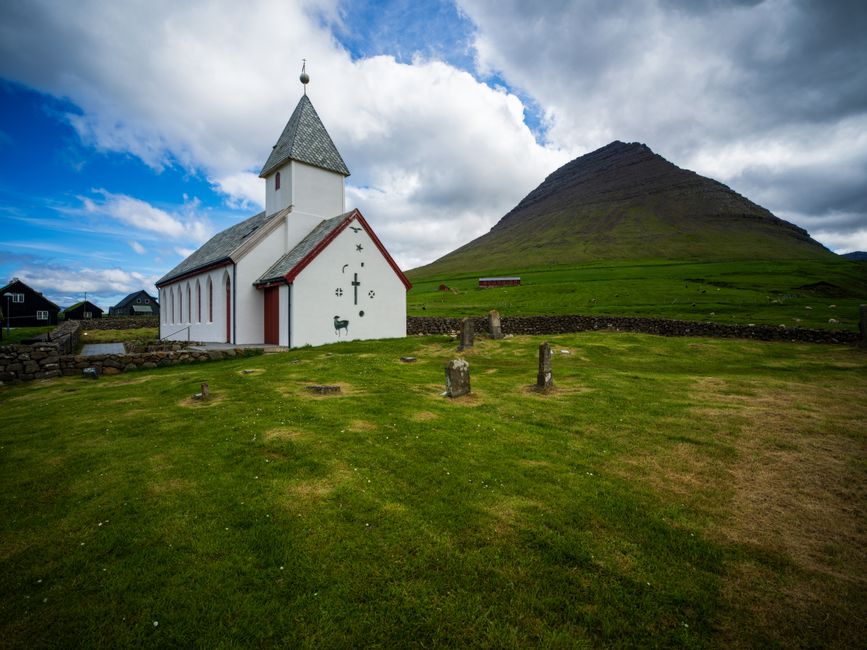
The Faroe Islands are 18 steep, green volcanic islands in the North Atlantic, roughly halfway between Scotland and Iceland. They are a self-governing part of the Kingdom of Denmark, home to about 55,700 people and around 1,399 km² (540 square miles) of land. This is a place of sheer sea cliffs, grass-roofed villages, waterfalls dropping into the ocean, fjords, seabird colonies and more sheep than people, all linked by mountain roads, subsea tunnels, ferries and a reliable bus network. The small capital, Tórshavn, has a turf-roofed old town and a lively food scene, and the airport island of Vágar has some of the islands’ most famous views: the Múlafossur waterfall at Gásadalur, the “lake above the ocean” and the puffin island of Mykines. The weather is mild, wet and changeable all year, with cool summers and long June days. Come between May and August for the best hiking, ferries and birdlife, and allow five days to a week; many popular hikes cross private land and charge a fee, so plan and book them ahead.
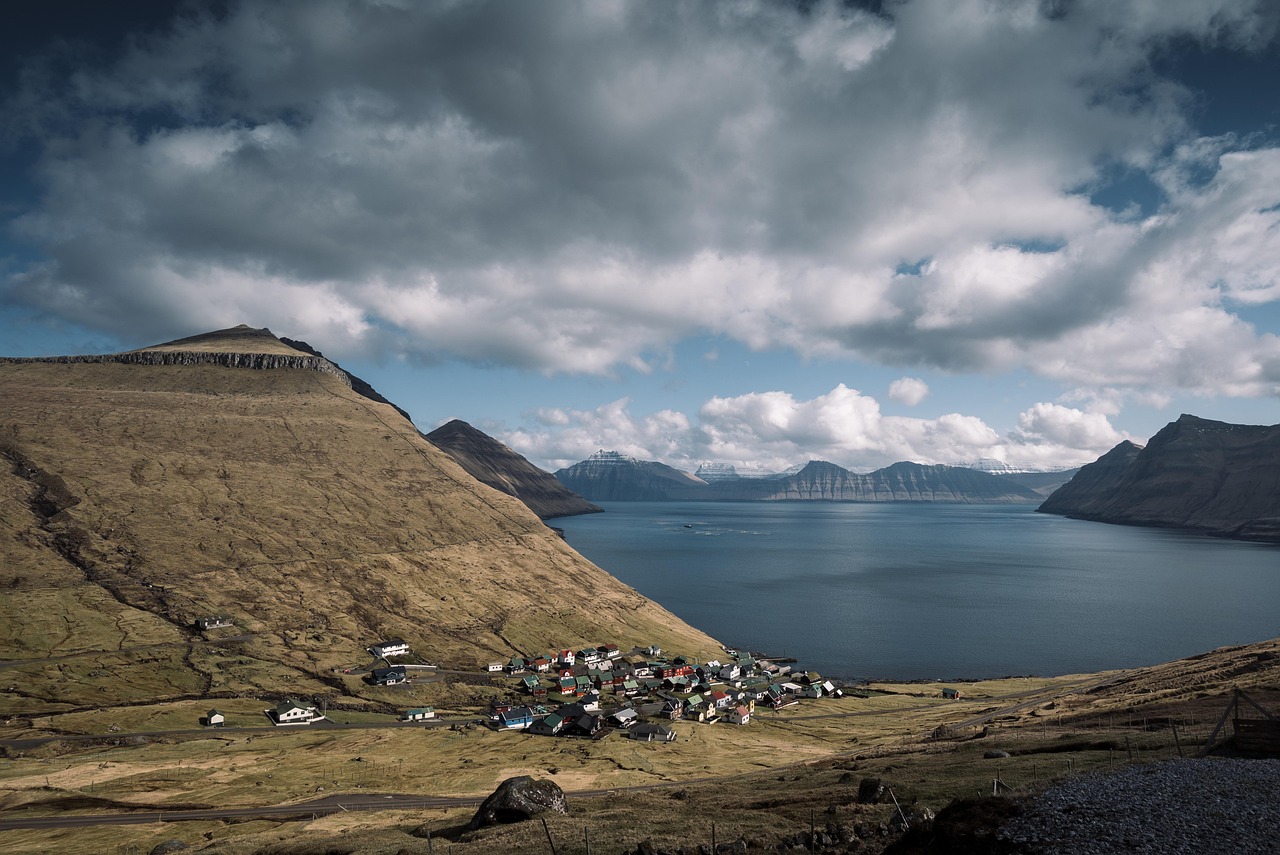
Right now in Faroe Islands
- Wed6–9°C43–49°F1 mm rain
- Thu6–9°C44–47°F11 mm rain
- Fri9–10°C48–50°F8 mm rain
Multi-day tours of Faroe Islands
Multi-day tours from local operators. You check dates and book on Viator, our partner; we may earn a commission at no extra cost to you. How we earn money
The Faroe Islands at a glance: overview and geography
The Faroe Islands (Føroyar in Faroese) are a self-governing nation within the Kingdom of Denmark, with their own parliament, the Løgting, and their own flag, language and stamps. They are not part of the European Union or the Schengen area, which matters for entry rules and health cover (see below). According to Statistics Faroe Islands (Hagstova), 55,726 people lived in the islands in August 2026, and Visit Faroe Islands puts the population of Tórshavn municipality at about 22,700.
The archipelago is about 113 km (70 miles) long and 75 km (47 miles) wide, with roughly 1,100 km (690 miles) of coastline, and Visit Faroe Islands notes that no point is more than 5 km (3 miles) from the sea. Seventeen of the 18 islands are inhabited. The land is mountainous and almost treeless, with an average height of about 300 m and a highest peak of 880 m (2,887 ft), Slættaratindur on Eysturoy. The west and north coasts are walls of cliffs, some of the highest in Europe, while the villages sit at the heads of fjords and in sheltered bays.
The islands were settled by Norse farmers in the Viking Age, and the Faroese still speak their own Nordic language, closely related to Icelandic and old West Norwegian. Tinganes in Tórshavn is one of the oldest parliamentary meeting places in the world, and the national day, Ólavsøka, on 28–29 July, is the biggest celebration of the year. The Faroese name for the islands is often explained as “sheep islands,” and sheep still graze almost every hillside.
Time zone: the Faroe Islands use Western European Time, the same as London: GMT (UTC+0) in winter and UTC+1 from late March to late October, one hour behind Copenhagen and five hours ahead of New York.
The main islands and regions
- Streymoy: the largest island, with Tórshavn, the medieval site of Kirkjubøur, the village of Saksun in its lagoon, and the cliffs and sea stacks around Vestmanna.
- Vágar and Mykines: the airport island, with Gásadalur and the Múlafossur waterfall, Lake Sørvágsvatn and Trælanípa, the sea stacks of Drangarnir, and Mykines, the westernmost island and the best place to see puffins.
- Eysturoy: linked to Streymoy by a bridge and a subsea tunnel; home to Slættaratindur, the village of Gjógv with its natural harbor in a gorge, and Gøta, host of the G! Festival.
- The Northern Isles (Norðoyar): Klaksvík, the second town, and the islands of Kalsoy (with the Kallur lighthouse) and Viðoy (with the cliffs of Enniberg).
- Sandoy, Skúvoy and Hestur: gentler, quieter islands south of Tórshavn; Sandoy is now reached by a subsea tunnel.
- Suðuroy: the southernmost large island, reached by car ferry from Tórshavn, with high western cliffs and a slower pace.
Where to go in the Faroe Islands: capital, cliffs, villages and islands
Distances are short: thanks to bridges and subsea tunnels, you can drive from the airport on Vágar to Tórshavn in about 45 minutes, and to Klaksvík in the north in a little over an hour. Most visitors base themselves in Tórshavn, sometimes adding a night or two on Vágar or in the north.
Tórshavn
One of the world’s smallest capitals, Tórshavn is the islands’ hub for hotels, restaurants, ferries and buses. Its heart is Tinganes, a rocky point of red-painted, turf-roofed wooden buildings where the Faroese assembly met in Viking times and where the government still has its offices. Around it are the old town of Reyn, the harbor, the old harbor fort of Skansin, the National Museum, the National Gallery (Listasavn Føroya) and the Nordic House, the islands’ main concert and culture venue. See our Tórshavn travel guide for sights, food and where to stay.
Vágar: Gásadalur, Múlafossur and the lake above the ocean
Most visitors land on Vágar, and many of the islands’ best-known pictures were taken here. At Gásadalur, the Múlafossur waterfall pours off a cliff straight into the sea below the village, a short, free walk from the parking area. On the south coast, Lake Sørvágsvatn (also called Leitisvatn) seems to hang above the ocean when seen from the cliff of Trælanípa, which you reach by a walk across private land with a fee. From Sørvágur, boats and ferries head to Mykines, and guided hikes lead to the sea stacks of Drangarnir. See our Vágar travel guide.
Mykines and the puffins
Mykines, the westernmost island, is a small village and a grassy plateau full of puffin burrows. It is reached by a 45-minute ferry from Sørvágur on Vágar, which, according to the public transport company SSL, sails three times a day from 1 May to 31 August. Between those dates, Visit Faroe Islands says visitors who go beyond the village must hike with a guide and pay a fee of 500 DKK (400 DKK booked online in advance) for ages 15 and over; the path to the lighthouse on Mykineshólmur was closed when we checked. Ferries fill quickly in summer and are often cancelled in rough seas, so book early and keep a spare day.
Kirkjubøur
About 15 km from Tórshavn, at the southern tip of Streymoy, Kirkjubøur was the seat of the Faroese bishops in the Middle Ages. Visit Faroe Islands describes the walls of the unfinished St. Magnus Cathedral, Saint Olav’s Church, in use since about 1250 and the oldest active church in the islands, and Roykstovan, an ancient log farmhouse that has been home to the same family for 17 generations. It is an easy half-day trip from the capital.
Saksun, Gjógv and the northern villages
In the north of Streymoy, the tiny village of Saksun sits above a tidal lagoon with a turf-roofed church; on Eysturoy, Gjógv has a natural harbor in a narrow sea gorge and is a base for walks. Farther north, Klaksvík is the main town of the Northern Isles, and from there a car ferry crosses to Kalsoy for the walk to the Kallur lighthouse, where Visit Faroe Islands lists a fee of 200 DKK for adults (100 DKK for ages 13–17, free under 13).
Vestmanna and the bird cliffs by boat
From the village of Vestmanna on Streymoy, boat trips sail under the towering bird cliffs and into sea caves and narrow sounds between the stacks. It is one of the most popular tours in the islands, best from late spring to late summer when the seabirds are nesting. See our boat trips guide.
Beyond the Faroes: Denmark and Iceland
Most travelers connect through Copenhagen, so a few days in Copenhagen or elsewhere in Denmark fit easily into a Faroes trip. The islands are also an easy add-on to Iceland: flights link Vágar with Reykjavík, and the Smyril Line ferry Norröna continues from Tórshavn to Seyðisfjörður in East Iceland for much of the year.
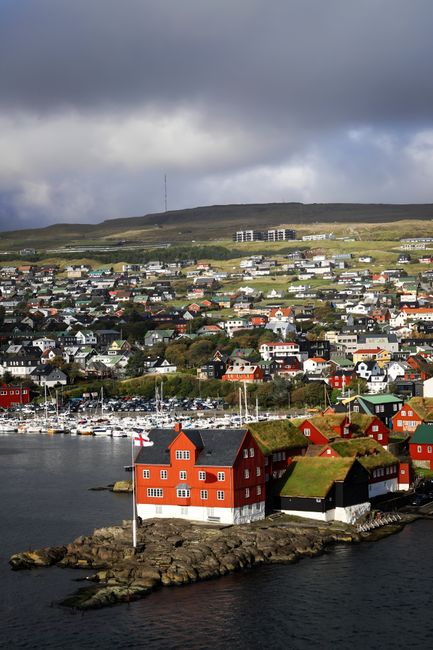
Tórshavn Travel Guide
Plan a visit to Tórshavn, capital of the Faroe Islands: Tinganes and the turf-roofed old town of Reyn, the cathedral, Skansin, the National Museum…
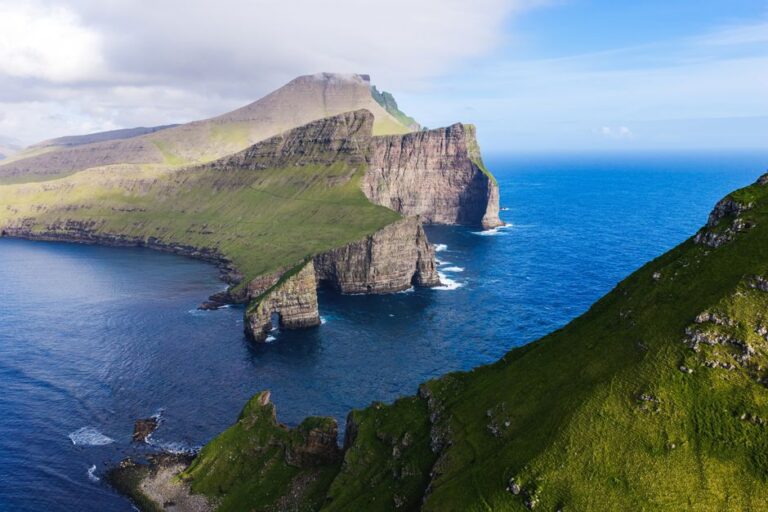
Vágar Travel Guide
Plan a visit to Vágar, the Faroe Islands' airport island: Gásadalur and the Múlafossur waterfall, the Trælanípa hike above Lake Sørvágsvatn with the 2026…
Best time to visit the Faroe Islands
The Faroes have a cool, very maritime climate, warmed by the Gulf Stream: winters are mild for the latitude and summers are cool, and the temperature rarely strays far from the yearly average. It rains or drizzles often, fog is common in summer, and the weather can change several times a day. The table uses the Danish Meteorological Institute’s (DMI) official 1991–2020 climate normals for Tórshavn (sunshine is DMI’s 2007–2020 average).
| Season (Tórshavn, 1991–2020) | Mean daily temperature | Average afternoon high | Sunshine a month | Rainfall a month | What it’s like |
|---|---|---|---|---|---|
| Spring (Mar–May) | 4.3–7.1 °C (40–45 °F) | 6.4–9.3 °C (44–49 °F) | 92–158 hours | 70–130 mm | Lengthening days, lambs in the fields and the first puffins; May is the sunniest month. |
| Summer (Jun–Aug) | 9.1–11.2 °C (48–52 °F) | 11.3–13.3 °C (52–56 °F) | 102–135 hours | 63–93 mm | The driest season and nearly endless daylight in June; fog and drizzle are common; peak season for hiking, ferries and birds. |
| Autumn (Sep–Nov) | 10.0 °C falling to 5.8 °C (50–42 °F) | 11.9 falling to 7.6 °C (53–46 °F) | 89 falling to 39 hours | 118–155 mm | September can be lovely and quiet; storms and rain increase from October. |
| Winter (Dec–Feb) | 4.0–4.5 °C (39–40 °F) | 6.0–6.5 °C (43–44 °F) | 23–53 hours | 131–167 mm | Short, dark days, gales and rain, occasional snow on the hills; cozy, quiet and good for northern lights on clear nights. |
Over the year, Tórshavn averages 7.0 °C (45 °F), about 1,400 mm (55 in) of precipitation and some 1,000 hours of sunshine, and DMI counts rain or drizzle on about 264 days a year. The highest temperature measured in Tórshavn from 1991 to 2020 was just 20 °C (68 °F). The best months for a first visit are May to August, when Mykines and most guided hikes run and buses and ferries are most frequent; June and July have the most visitors, so book flights, cars and hotels early. Pack for rain and wind in every season.
Faroese holidays and events
- Flag Day: 25 April, a public holiday celebrating the Faroese flag.
- Ólavsøka: 28–29 July every year, the national celebration in Tórshavn honoring Saint Olav, with rowing races in the harbor, concerts, art shows, Faroese chain dancing and crowds in national dress. On 29 July the Løgting meets after its summer break. Hotels in Tórshavn fill up, and buses and ferries run changed timetables.
- G! Festival: a music festival held each July on the beach at Gøta on Eysturoy; check the organizer’s site for 2027 dates.
- Other holidays: Easter, Great Prayer Day, Ascension, Whit Monday, Constitution Day (5 June, half day) and Christmas, when shops and some services close.
How long to stay: sample itineraries
Four days
Day one: land on Vágar and see Gásadalur and Múlafossur, then walk to Trælanípa above Lake Sørvágsvatn before driving to Tórshavn. Day two: Tórshavn, with Tinganes, Reyn, Skansin and the National Museum, and an afternoon at Kirkjubøur. Day three: north to Saksun, then over to Eysturoy for Gjógv and the viewpoints near Slættaratindur. Day four: a boat trip from Vestmanna under the bird cliffs, or a day in Klaksvík and on Kalsoy.
A week
Add a day for Mykines and its puffins (May to August, with a weather backup day), the guided hike to Drangarnir, a day on Kalsoy for the Kallur lighthouse and one on Sandoy or Nólsoy. A week lets you choose the clearest days for the big hikes.
Ten days or more
Take the ferry to Suðuroy for its western cliffs, climb Slættaratindur, visit Viðoy and the far north, and book a home-hospitality meal (heimablídni) with a Faroese family. Or arrive or leave on the Norröna ferry from Denmark or Iceland, with your own car.
Entry rules, money and costs
Entry rules
The Faroe Islands are outside the Schengen area and have their own entry rules, set by the Danish authorities. According to Visit Faroe Islands and the Danish Immigration Service:
- Nordic citizens (Denmark, Finland, Iceland, Norway and Sweden) can enter with photo ID and do not need a permit.
- EU and Schengen-country citizens need a valid passport or national ID card and no visa.
- Other nationalities need a passport valid for at least three months beyond the planned stay. If you can enter Denmark without a visa, as US, Canadian, British and Australian citizens can, you can also visit the Faroes without one, for short stays of up to 90 days.
- Visa nationals need a visa specifically valid for the Faroe Islands, applied for through a Danish embassy or consulate. A Schengen or Danish visa alone is not valid for entry.
If you connect through Copenhagen or another Schengen airport, you go through Schengen border control there, and non-EU travelers are registered in the EU’s Entry/Exit System (EES).
Money
The currency is the Faroese króna, which has exactly the same value as the Danish krone; Danish notes and coins are used alongside Faroese ones everywhere. The Danish krone, in turn, is pegged to the euro by Danmarks Nationalbank at a central rate of 7.46 kroner per euro, so prices are easy to convert. Visit Faroe Islands says most shops, restaurants, petrol stations, hotels and taxis take cards, mainly Visa, with Mastercard, Maestro and JCB at larger places, while American Express is generally not accepted; ATMs are found by bank branches across the islands, so there is little need to bring cash. Prices include 25% VAT, and visitors can claim a partial refund on purchases of at least 300 DKK in shops with a “Tax-Free” sign, at Vágar Airport or on the Norröna.
Healthcare
Because the Faroes are outside the EU, the European Health Insurance Card does not apply there. Visitors from the Nordic countries and the UK are covered by their national schemes for short stays, according to Visit Norðoy, the regional tourist office; everyone else should have travel insurance that includes medical care and evacuation. The National Hospital (Landssjúkrahúsið) is in Tórshavn, and the after-hours medical advice line is 1870.
How expensive are the Faroe Islands?
The Faroes are expensive, with prices similar to Denmark or Norway, and accommodation is limited, so it sells out in summer. Rental cars, tunnel tolls and hiking fees add up, but the scenery from the roads and many walks are free. Our estimates for one person per day, sharing a double room, as of October 2026:
| Style | Estimated cost per day | What that looks like |
|---|---|---|
| Budget | about 700–1,100 DKK (US$110–170) | A hostel, campsite or guesthouse, buses with a travel card, supermarket meals, one paid hike |
| Mid-range | about 1,500–2,500 DKK (US$230–390) | A hotel or apartment, a shared rental car, a boat trip or guided hike, restaurant dinners |
| High-end | about 3,500 DKK+ (US$540+) | A design hotel, tasting menus, private guides and a helicopter or boat tour |
Hiking fees and private land
Almost all land in the Faroes is privately owned farmland, and under Faroese law you need the landowner’s permission to walk on it. On some of the most popular routes, landowners charge a fee or allow access only with a guide. As listed by Visit Faroe Islands and the landowners when we checked in 2026:
- Trælanípa and Bøsdalafossur (Vágar): 200 DKK per person to walk on your own, paid at the café at the trailhead in Miðvágur (children up to 15 free, according to the landowners); guided tours cost more and must be booked ahead.
- Drangarnir (Vágar): guided hikes only, 600 DKK per person, on set days from April to October.
- Mykines: 500 DKK (400 DKK online) with a mandatory guide for ages 15 and over, 1 May–31 August, plus the ferry fare.
- Kallur lighthouse (Kalsoy): 200 DKK for adults, 100 DKK for ages 13–17, free under 13; cards accepted on site.
- Villingardalsfjall (Viðoy): 200 DKK per person, paid in the mailbox by the gate; the Enniberg hike requires a guide.
Fees and rules change from season to season, so check the Visit Faroe Islands hiking-fees page before you go. Close gates, keep dogs on a lead, stay on paths and keep away from sheep at lambing time.
Getting there and getting around
By air
The only airport, Vágar Airport (FAE), is on the island of Vágar, about 50 minutes from Tórshavn by bus 300 or around 45 minutes by car. Atlantic Airways, the Faroese airline, flies daily from Copenhagen and year-round from Billund and Reykjavík. In 2026 it also flew to Edinburgh, Oslo and Aalborg, and in summer to Paris, Barcelona and London Gatwick; check the airline’s route pages for the 2027 schedule. From North America, the usual route is via Copenhagen or Reykjavík.
By sea
Smyril Line’s car ferry Norröna sails from Hirtshals in northern Denmark to Tórshavn all year, once a week for most of the year and twice a week in summer, and continues to Seyðisfjörður in East Iceland from about late March to November. According to Smyril Line’s 2027 schedule, the summer sailings (29 May to 5 September 2027) leave Hirtshals on Saturdays and Tuesdays and reach Tórshavn about 30 hours later; in other seasons, the ship leaves Hirtshals on Sunday afternoons and arrives early on Tuesday morning. It is a popular way to bring your own car or camper. Cruise ships also call at Tórshavn and Klaksvík in summer.
Getting around
- Bus and ferry: the public transport company Strandfaraskip Landsins (SSL) runs the blue intercity buses and the ferries between the islands. Its tourist travel card costs 500 DKK for 4 days and 700 DKK for 7 days (children half price) and covers buses and ferries, but not the Mykines ferry, vehicles or seat reservations. Bus 300 links Tórshavn, the airport and Sørvágur, and SSL’s timetables show about 50 minutes from Tórshavn to the airport. Tórshavn’s own red city buses are free.
- Car: a rental car gives the most freedom, and you need one for many villages and trailheads. Traffic drives on the right; the speed limit is 50 km/h in towns and 80 km/h on other roads, headlights must be on day and night, and phones may not be used while driving, according to Visit Faroe Islands. Watch for sheep on the roads and for single-lane tunnels with passing bays.
- Subsea tunnels: four toll tunnels link the main islands. According to tunnil.fo, a single car trip costs 50 DKK for the Vágar tunnel (Vágatunnilin) and the Northern Isles tunnel (Norðoyatunnilin), charged when leaving Vágar or Klaksvík and covering the return, and 175 DKK each way for the Eysturoy tunnel (Eysturoyartunnilin) and the Sandoy tunnel (Sandoyartunnilin). With a Faroese rental car you pay the rental company, whose rates may differ.
- Helicopter: Atlantic Airways runs helicopter flights to remote islands, mainly for residents; visitors can book one-way only, a couple of days before departure.
Outdoors: hiking, birds, boats and the sea
The Faroes are made for walking, from short strolls to clifftop viewpoints to the climb up Slættaratindur. Visit Faroe Islands recommends a guide for long routes, and many of the best-known walks cross private land with fees (see above). Weather is the main challenge: fog can roll in within minutes, cliff edges are unfenced and often overhanging, and the grass is slippery when wet. Check the forecast, tell someone your plan, stay well back from the edges and turn around if the cloud comes down. See our hiking guide.
Seabirds are a big draw from late spring to August: puffins on Mykines, gannets near Mykineshólmur, and guillemots, fulmars and kittiwakes on the cliffs at Vestmanna and elsewhere. The best way to see the cliffs and sea stacks is from the water, on boat trips from Vestmanna, Tórshavn, Klaksvík or Sørvágur. Swimming is for the brave: the sea stays cold all year.
Safety, health and staying connected
The Faroes are a calm, low-crime place, and the main risks are natural: sudden fog, wind, slippery grass and high cliffs without railings, strong currents and narrow roads. The emergency number for police, fire and ambulance is 112. The police non-emergency number is 114, the after-hours medical advice line is 1870, and the emergency dentist is on +298 314544.
Electricity is 230 V, 50 Hz, with Danish-style sockets; Visit Faroe Islands advises bringing a two-pin European adapter, and visitors from North America and the UK need one. The country code is +298, followed by six digits. Two mobile operators, Føroya Tele and Nema, cover most of the islands with 4G and 5G, and prepaid SIM cards are sold at Vágar Airport, kiosks, petrol stations and post offices. As the Faroes are outside the EU, EU roaming rules do not automatically apply, so check your plan.
Food and culture
Faroese food is built on what the sea and the hills provide: fish and shellfish, lamb and mutton, and seabirds in season. The traditional technique is ræst, fermentation in the wind and salty air, used for fish and for skerpikjøt, wind-dried mutton. You will also find dried fish, blood sausage, rye bread and stewed rhubarb on traditional tables. Tórshavn has an ambitious restaurant scene focused on local produce, and heimablídni, home-hospitality dinners in Faroese homes and farms, are a highlight. Visit Faroe Islands notes that service is always included in prices, so tipping is not expected.
Alcohol is sold only to people aged 18 and over, and spirits, wine and imported beer are sold by the state monopoly, Rúsdrekkasøla Landsins, which has six shops; restaurants and bars need a license, so not every café serves alcohol. Faroese breweries make good local beer. Culturally, look out for the Faroese chain dance, sung to long ballads, the knitwear made from local wool, and the traditional rowing races in summer. People are friendly and speak excellent English; Faroese is the national language, and Danish is also widely understood.
Things to do in the Faroe Islands
- See the Múlafossur waterfall drop into the sea at Gásadalur.
- Walk to Trælanípa for the view of the “lake above the ocean.”
- Take the ferry to Mykines to see the puffins (May to August).
- Wander the turf-roofed houses of Tinganes and Reyn in Tórshavn.
- Visit the medieval ruins and churches of Kirkjubøur.
- Sail under the bird cliffs and into the sea caves at Vestmanna.
- Hike with a guide to the sea stacks of Drangarnir.
- Walk to the Kallur lighthouse on Kalsoy.
- Photograph the turf church and lagoon at Saksun.
- See the gorge harbor at Gjógv and climb Slættaratindur on a clear day.
- Drive through the Eysturoy tunnel and its underwater roundabout.
- Book a home-hospitality dinner with a Faroese family.
- Join the crowds in Tórshavn for Ólavsøka on 28–29 July.
Faroe Islands travel FAQ
Are the Faroe Islands part of Denmark?
They are a self-governing nation within the Kingdom of Denmark, with their own parliament, flag and language. Unlike Denmark, they are not part of the European Union or the Schengen area.
Do I need a visa for the Faroe Islands?
Not if you can enter Denmark without a visa, as US, Canadian, UK and Australian citizens can; bring a passport valid for at least three months beyond your stay. Visa nationals need a visa specifically valid for the Faroes, because a Schengen visa does not cover them.
How do I get to the Faroe Islands?
Fly to Vágar Airport with Atlantic Airways, most often from Copenhagen, which has daily flights, or from Reykjavík, Billund and, seasonally, other European cities. Or take Smyril Line’s Norröna ferry from Hirtshals in Denmark, about 30 hours in summer.
What currency is used in the Faroe Islands?
The Faroese króna, worth exactly the same as the Danish krone; Danish money is accepted everywhere. Cards, especially Visa, are taken almost everywhere, while American Express generally is not.
What is the best time to visit the Faroe Islands?
May to August, for long days, the driest weather, puffins on Mykines and the fullest bus and ferry timetables. Expect cool weather even then: average summer highs in Tórshavn are only 11–13 °C (52–56 °F).
How many days do you need in the Faroe Islands?
Four days covers Vágar, Tórshavn and a loop of Streymoy and Eysturoy. A week lets you add Mykines, Kalsoy and a boat trip, with spare days for bad weather.
Do you need a car in the Faroe Islands?
Not strictly: SSL buses and ferries reach most villages, and a 4- or 7-day travel card makes them good value. But a car is much more flexible for trailheads and small villages; budget for tunnel tolls.
Why do you have to pay to hike in the Faroe Islands?
Most land is privately owned farmland, and walkers need the owner’s permission. On a few popular routes, such as Trælanípa, Mykines, Drangarnir and Kallur, landowners charge a fee or require a guide; many other walks are free.
Where can I see puffins in the Faroe Islands?
Mykines is the best place, from about May to August. Between 1 May and 31 August, you need the ferry from Sørvágur and a guided hike (500 DKK, or 400 DKK online) to go beyond the village.
Is the European Health Insurance Card valid in the Faroe Islands?
No, because the islands are outside the EU. Nordic and UK visitors are covered by their national schemes for short stays; everyone else needs travel insurance.
What language is spoken in the Faroe Islands?
Faroese, a Nordic language close to Icelandic. Danish has equal official status, and almost everyone speaks good English.
Plugs and power in Faroe Islands
Faroe Islands uses 230 V, 50 Hz and these plugs (left) and wall sockets (right):
Danish-style sockets; two-pin European (Type C) plugs fit everywhere, as Visit Faroe Islands advises.
All plug types and voltages by country → · Check what you need to pack →
Plan your trip
Partner links: TravelerCenter may earn a commission if you book, at no extra cost to you.
Sources · last reviewed 6 October 2026
Researched and last reviewed on 6 October 2026. Population figures come from Statistics Faroe Islands (Hagstova) and Visit Faroe Islands; climate normals from the Danish Meteorological Institute (DMI, Tórshavn 1991–2020); entry rules from Visit Faroe Islands and the Danish Immigration Service; money, tax-free shopping, electricity, phones, alcohol, driving rules, emergency numbers, holidays, hiking fees and tipping from Visit Faroe Islands; health cover from Visit Norðoy; the euro peg from Danmarks Nationalbank; the Trælanípa fee from the landowners; bus, ferry and travel card prices and timetables from Strandfaraskip Landsins (SSL); tunnel tolls from tunnil.fo; flights from Atlantic Airways; the Norröna schedule from Smyril Line; and museum details from the National Museum (Tjóðsavnið). Free city buses in Tórshavn and some historical details come from general sources and are flagged for checking; daily costs are our estimates. Prices, timetables and fees change, so check the official sites before you travel.
Data: Weather: MET Norway (CC BY 4.0) · Rates: ECB · Wikidata (CC0)