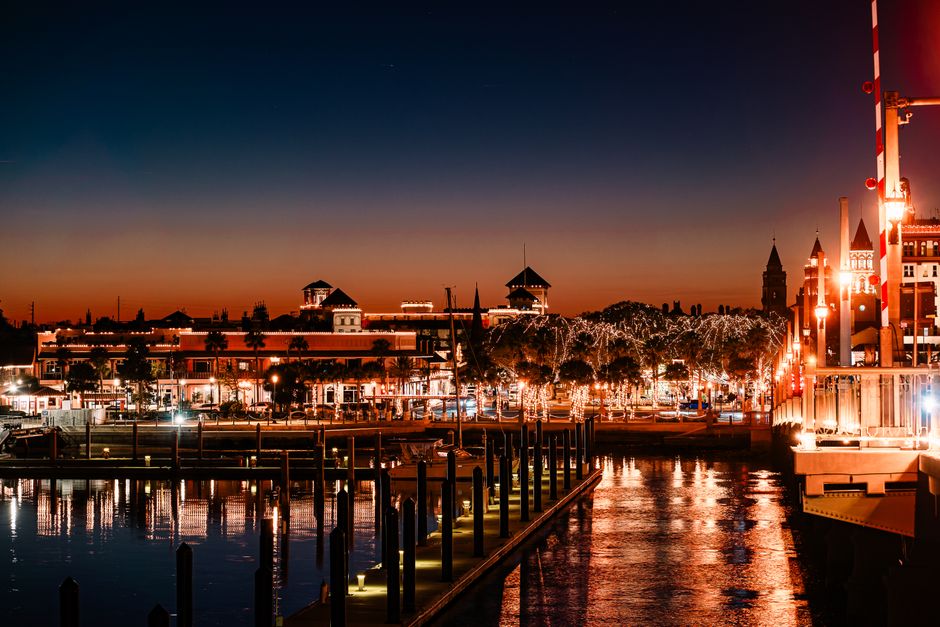
St. Augustine, on Florida’s north-east Atlantic coast, is the oldest continuously inhabited European-founded city in the United States, established by the Spanish in 1565. Its compact historic district is a joy to explore on foot: narrow lanes and coquina-stone houses, the 17th-century Castillo de San Marcos on the bay, the grand Gilded Age hotels built by the railway magnate Henry Flagler, and the striped lighthouse across the Bridge of Lions. Wide, uncrowded beaches and Anastasia State Park are ten minutes away, and from late November to mid-January the whole old town glows with millions of white lights. Spring and autumn are the most pleasant seasons; summer is hot, humid and stormy.
Right now in St. Augustine
- Thu24–28°C76–82°F2 mm rain
- Fri25–27°C77–81°F4 mm rain
- Sat25–26°C76–80°F24 mm rain
- Mon 12 Oct Columbus Day
Top tours in St. Augustine
See all tours for St. Augustine →
From local operators, with prices and reviews; you check availability and book on Viator, our partner. We may earn a commission at no extra cost to you. How we earn money
St. Augustine at a glance
- Best for: Spanish colonial history, forts and museums, walkable streets, ghost tours, the Nights of Lights, and quiet Atlantic beaches.
- How long: 2 days for the historic district; 3–4 days to add the beaches, the lighthouse and Fort Matanzas.
- Best time: March to May and October to November, with average highs of 74–85 °F (24–30 °C). From June to September it is about 87–91 °F (31–33 °C), with storms on 8–11 days a month.
- Getting there: drive in from I-95 (exit 318, State Road 16), or fly to Jacksonville to the north or Daytona Beach to the south and rent a car.
- Getting around: park once and walk; hop-on, hop-off trolleys and the free shuttles on busy event nights help.
- Before you go: entry rules, money, driving and general safety are on our United States travel guide.
St. Augustine’s areas and who each one suits
The historic district sits on the west bank of the Matanzas River, the city’s bayfront, with the barrier island of Anastasia across the Bridge of Lions. St. Augustine is in St. Johns County, about midway between Jacksonville and Daytona Beach.
The historic district and St. George Street
The old Spanish town between the Castillo and the Plaza de la Constitución, centered on pedestrianised St. George Street with its shops, cafés, restored colonial houses and the Colonial Quarter. It is the most atmospheric place to stay, in small inns and B&Bs, and the best base for first-timers; it is busy by day and on weekends.
Uptown and the Lincolnville district
North of the Castillo, San Marco Avenue leads past the Mission Nombre de Dios and the Fountain of Youth attraction, with more inns and restaurants. South of the center, historic Lincolnville, founded by freed African Americans after the Civil War and a key site of the 1964 civil rights protests, has Victorian houses and a quieter local feel.
Anastasia Island and St. Augustine Beach
Across the Bridge of Lions, the island has the lighthouse, Anastasia State Park and the small town of St. Augustine Beach, with beach hotels, condos and casual seafood places. Good for families and anyone who wants the sea on the doorstep and the old town a 10-minute drive away. Vilano Beach, across the bridge to the north, is quieter still.
Top things to see in St. Augustine
Prices and hours below were checked on the official sites in October 2026, unless we say otherwise; check again before you go.
Castillo de San Marcos National Monument
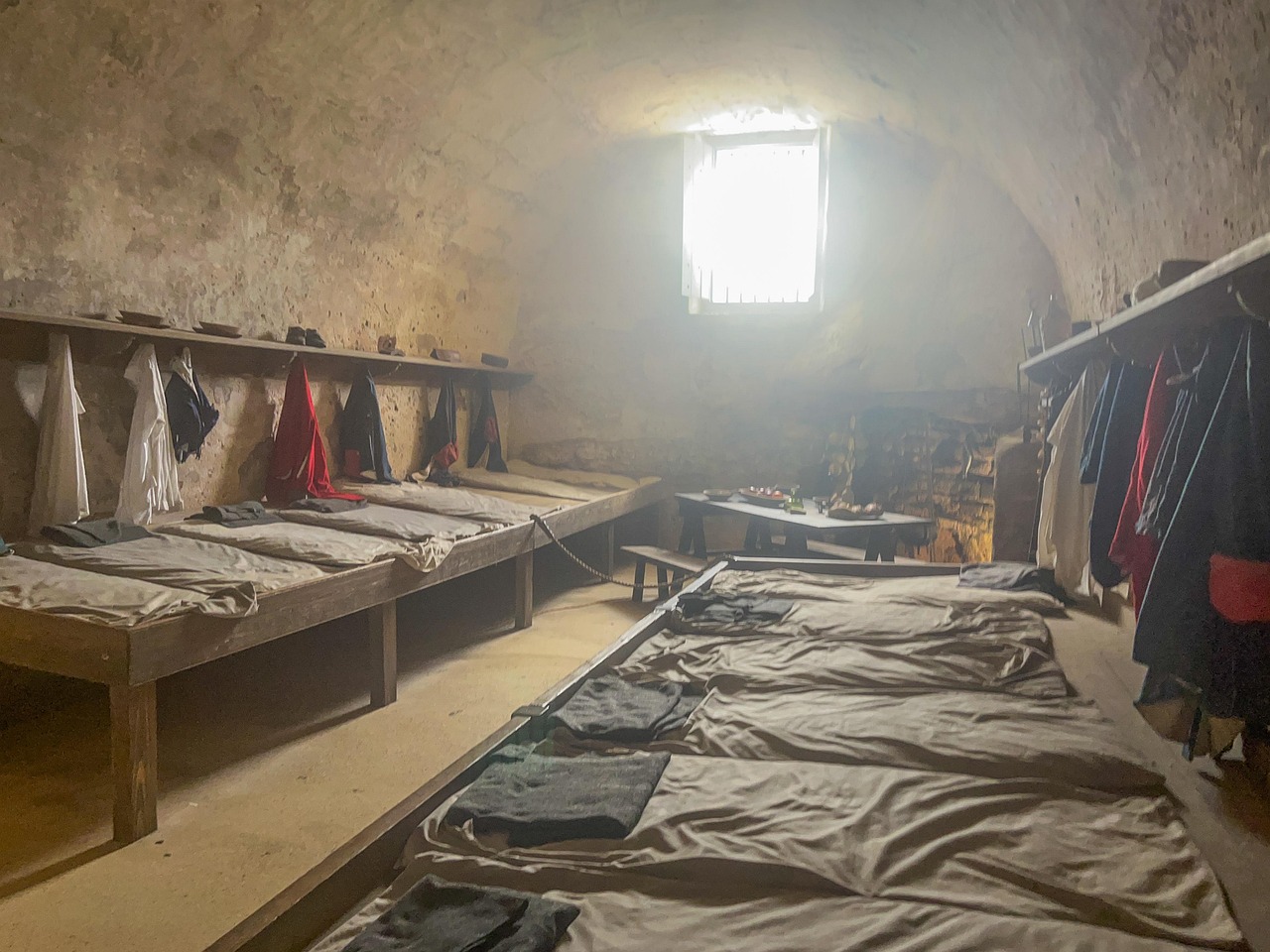
The oldest masonry fort in the continental United States, built by Spain from 1672 out of coquina, a local shell stone that absorbed cannonballs instead of shattering. Walk the gun deck for views over the bay, explore the vaulted rooms and catch a cannon-firing demonstration on many days. It is run by the National Park Service. As of October 2026 entry costs $15 for adults aged 16 and over, valid for 7 consecutive days, and children aged 15 and under go free with an adult; only cards are accepted, and America the Beautiful passes are honored. First admission is at 9:00 a.m. and last admission at 5:00 p.m.; it is open daily except Thanksgiving and Christmas Day. The gun deck closes during thunderstorms. The city lot in front charges $2.50 an hour, or use the nearby city garage.
Fort Matanzas National Monument
A small coquina watchtower fort from the 1740s guarding the southern inlet, about 15 miles (24 km) south of town, reached by a short ferry ride. Everything here is free, including the ferry, but you need a free boarding pass for every person, babies included, collected in person at the Fort Matanzas visitor center on the day. According to the park, passes are first come, first served, often run out before 11:00 a.m., and there is no ferry on Tuesdays or Wednesdays. Boats leave hourly from 9:30 a.m. to 3:30 p.m., and the visit lasts 45–55 minutes; no pets, food or drink on the boat or at the fort. The park opens 9:00 a.m.–5:30 p.m. daily except Thanksgiving and Christmas Day, and its parking is limited.
Flagler College and the Gilded Age hotels
Henry Flagler’s railway brought wealthy winter visitors from the 1880s, and he built them the Hotel Ponce de Leon, a Spanish Renaissance fantasy with Tiffany windows, now Flagler College. Guided tours of its grand rooms are run by the college; check times and prices on its site. Across the street, the former Hotel Alcazar houses the Lightner Museum of Gilded Age collections, and City Hall shares the building. Nearby, the Cathedral Basilica on the plaza is one of the oldest Catholic parishes in the United States.
St. Augustine Lighthouse and Maritime Museum
The black-and-white spiral tower of 1874 on Anastasia Island is still a working aid to navigation. Climb its 219 steps for a 360° view over the inlet, the old town and the ocean; the grounds also have the keepers’ house, maritime archaeology exhibits and a children’s play area. According to the museum, it opens daily 9:00 a.m.–6:00 p.m. from 1 October to 28 February and until 6:30 p.m. from 1 March to 30 September. Children must be at least 44 inches (112 cm) tall to climb and must climb on their own. Buy tickets on the museum’s website, where current prices are shown; parking is free.
More to see
- Colonial Quarter: a living-history site on St. George Street with reconstructed 18th-century buildings and demonstrations.
- Mission Nombre de Dios: the peaceful bayside site where the city’s founders landed in 1565, with a giant stainless-steel cross.
- Bridge of Lions: the 1927 drawbridge guarded by two marble lions; walk across at sunset.
- Plaza de la Constitución: the town square laid out under Spanish planning rules, with the old market and the Cathedral Basilica.
Other sights
- Bridge of Lions
- Flagler College
Museums
- Colonial Quarter
- Lightner Museum
Castles and forts
- Castillo de San Marcos
Protected areas
- Fort Matanzas National Monument
Beaches and other things to do
Anastasia State Park and the beaches
Anastasia State Park protects about 4 miles (6 km) of beach, high dunes, a tidal lagoon for kayaking and paddleboarding, the old coquina quarries that supplied the Castillo, and a campground. Expect a small per-vehicle entrance fee, about $8 per car as of 2026; check the Florida State Parks site before you go. South of it, St. Augustine Beach and Crescent Beach are broad and family-friendly. St. Johns County allows driving on some beach stretches: from 1 March to 30 September you need a pass, sold at the beach toll booths, and as of October 2026 a daily pass costs $15 for anyone; outside that period no pass is needed.
County lifeguards cover several miles of beach from Memorial Day weekend to Labor Day weekend, 10:00 a.m. to 6:00 p.m., weather permitting. Florida uses a uniform system of beach warning flags under state law: green for low hazard, yellow for medium, red for high hazard with strong surf or currents, double red when the water is closed, and purple for dangerous marine life such as Portuguese man o’ war. Rip currents are the biggest danger; swim near a lifeguard. Seaweed (sargassum) sometimes washes ashore on Atlantic beaches in spring and summer, and you can check water-quality advisories on the Florida Department of Health’s Healthy Beaches site and red tide status with the Florida Fish and Wildlife Conservation Commission. Sea turtles nest on these beaches in summer, so keep lights off the sand at night.
Tours, food and evenings
Ghost tours on foot or by trolley are a St. Augustine institution, and hop-on, hop-off trolleys and small trains are an easy way to see the spread-out sights in one day. Boat trips and sunset sails leave from the City Marina by the Bridge of Lions. Look out for Minorcan clam chowder, spiced with the local datil pepper, and fresh shrimp, which have been fished from the town’s harbor for generations. Aviles Street, said to be the oldest street in the country, has galleries and wine bars.
Day trips and onward travel
Along the coast
Drive south on the scenic A1A past Fort Matanzas, Marineland and Washington Oaks Gardens State Park, with its formal gardens and coquina-rock beach, to Flagler Beach and on to Daytona Beach, about an hour away, where you can drive on the sand. North, Ponte Vedra Beach and the Guana Tolomato Matanzas reserve’s trails and dunes lead towards Jacksonville.
Orlando and inland Florida
Orlando’s theme parks are about 1¾ hours away by car, so many visitors combine a few days of history and beach with a park holiday. The springs of the St. Johns River valley, such as Blue Spring with its winter manatees, make a good stop on the way.
Nearby destinations
- Daytona Beach81 km
- Orlando152 km
- Savannah241 km
- Tampa244 km
- Clearwater259 km
- Hilton Head Island260 km
- St. Petersburg269 km
Getting there and getting around
By air and by road
The nearest big airport is Jacksonville International (JAX), about an hour’s drive north; Daytona Beach International (DAB) is about an hour south, and Orlando International (MCO), with the most international flights, about 1¾ hours. From I-95, take exit 318 (State Road 16) and follow the signs to the historic district, as the National Park Service advises; US 1 and the coastal A1A also lead into town. Florida’s toll roads are cashless; there are none on the direct routes into St. Augustine, but if you use one with a rental car, the rental company’s toll program applies, with its own fees.
Parking and getting around
The historic district is small and best seen on foot. The city’s Historic Downtown Parking Facility, a large garage next to the Visitor Information Center, is open around the clock; as of October 2026 it costs $20 per vehicle per entry from 7:00 a.m. to 5:00 p.m. and $5 from 5:00 to 9:00 p.m. City lots and street meters cost $2.50 an hour with a 4-hour limit. Hop-on, hop-off trolleys and trains start near the visitor center, and rideshare and bikes cover the short hops to the beaches. On Light-Up Night and busy weekends during the Nights of Lights, use the free park-and-ride shuttles from outlying lots.
When to go and how long to stay
St. Augustine has a humid subtropical climate, cooler in winter than central and southern Florida. The table uses NOAA’s 1991–2020 climate normals for the St. Augustine Lighthouse weather station: average daily highs and lows, and days with at least 0.10 in (2.5 mm) of rain. According to the National Park Service, the Castillo is quietest from mid-September to mid-November and busiest around holidays, school breaks and weekends.
| Season | Average high / low | Rainy days per month | What it’s like | Good for |
|---|---|---|---|---|
| Winter (Dec–Feb) | 68–70 °F (20–21 °C) / 48–51 °F (9–11 °C) | 4–5 | Mild days, chilly nights and the odd cold, windy spell | Nights of Lights, sightseeing, museums |
| Spring (Mar–May) | 74–85 °F (24–30 °C) / 55–67 °F (13–20 °C) | 4–5 | Warm and pleasant; busy at spring break and Easter | Walking the old town, the beaches, the fort |
| Summer (Jun–Aug) | 89–91 °F (31–33 °C) / 72–74 °F (22–23 °C) | 8–11 | Hot and humid, with afternoon thunderstorms | Beaches, early-morning sightseeing, evening tours |
| Autumn (Sep–Nov) | 87 °F (31 °C) falling to 75 °F (24 °C) / 73 °F (23 °C) falling to 58 °F (14 °C) | 9 in September, 4 in November | Stormy early, then dry and comfortable; the quietest time | History, ghost tours, good-value stays |
The station averages about 50.6 in (1,286 mm) of rain a year, with August and September the wettest months. The Atlantic hurricane season runs from 1 June to 30 November, with most activity from mid-August to mid-October, according to NOAA’s National Hurricane Center. The low-lying historic district floods in strong storms and even at very high tides, as it did during Hurricanes Matthew in 2016 and Irma in 2017. In the season, follow the National Hurricane Center and the National Weather Service, check your evacuation zone with St. Johns County Emergency Management, obey evacuation orders and consider travel insurance.
Events worth planning around
- Nights of Lights: nightly from 21 November 2026 to 18 January 2027, when more than three million white lights cover the historic district; free to see on foot.
- Light-Up! Night: 21 November 2026, with live entertainment from 4:00 p.m. and the lighting ceremony at 6:30 p.m. in the Plaza de la Constitución.
- Spring: Easter and spring-break weeks bring crowds; book ahead.
How long to stay: 2, 3 and 4 days
2 days: day one, the Castillo at opening, St. George Street, the plaza and the Cathedral, then a ghost tour; day two, Flagler College and the Lightner Museum, then the lighthouse and sunset on the Bridge of Lions.
3 days: add Fort Matanzas in the morning (not on Tuesday or Wednesday) and an afternoon at Anastasia State Park. 4 days: add a drive down A1A to Washington Oaks and Flagler Beach, or a day in Daytona Beach.
Weather month by month
Where to stay in St. Augustine and the hotel taxes
- Historic district: B&Bs and boutique inns in old houses; walk everywhere, but parking can be extra.
- Bayfront and San Marco Avenue: inns and small hotels with water views, a short walk from the fort.
- St. Augustine Beach and Anastasia Island: beach hotels and condos for families.
- I-95 / State Road 16: cheaper chain hotels, a drive from the center.
St. Augustine is in St. Johns County. On a hotel or vacation-rental stay of six months or less you pay 6.5% sales tax (the 6% state rate plus a 0.5% county surtax) and the county’s 5% tourist development tax, about 11.5% in total; the St. Johns County Tax Collector confirms the 5% rate, in force since 1 October 2021. Some hotels and inns charge for parking or add a resort or amenity fee. Under a US Federal Trade Commission rule in force since 12 May 2025, mandatory fees such as resort fees must be included in the advertised total price (taxes may be shown separately), so compare total prices. Rooms in the historic district sell out on Nights of Lights weekends, Easter and holiday weekends.
Practical tips for St. Augustine
- Arrive early: be at the Castillo at 9:00 a.m. and at Fort Matanzas before 10:00 a.m. for ferry passes.
- Bring a card: the Castillo accepts only cards for entry.
- Park once: use the city garage and walk; the historic district is small and traffic is slow.
- Mind the heat and storms: in summer, sightsee in the morning and evening, and head indoors when thunder starts.
- Watch your step: old streets and coquina walls are uneven; wear flat, comfortable shoes.
- Emergencies: call 911.
What to pack for St. Augustine
Comfortable walking shoes come first: you will cover a lot of brick, paving and coquina. Add a sun hat, sunglasses, sunscreen and a refillable water bottle, as there is little shade on the Castillo’s gun deck. Bring swimwear and a towel for the beaches, a light rain jacket or small umbrella for summer storms, insect repellent for marsh walks at dusk, and layers for winter: Nights of Lights evenings can be chilly, with temperatures around 50 °F (10 °C).
St. Augustine travel FAQ
How much does it cost to visit Castillo de San Marcos?
As of October 2026, $15 for adults aged 16 and over, valid for 7 consecutive days; children 15 and under are free with an adult. Payment is by card only, and America the Beautiful passes are accepted.
Is the Fort Matanzas ferry free?
Yes, but everyone needs a free boarding pass, collected in person at the Fort Matanzas visitor center on the day. Passes often run out before 11:00 a.m., and there is no ferry on Tuesdays or Wednesdays.
When are the Nights of Lights in 2026?
Nightly from 21 November 2026 to 18 January 2027. Light-Up! Night is on 21 November, with the lighting ceremony at 6:30 p.m. in the Plaza de la Constitución. Seeing the lights on foot is free.
Where should I park in St. Augustine?
The city’s Historic Downtown Parking Facility by the Visitor Information Center is the easiest: as of October 2026, $20 per entry from 7:00 a.m. to 5:00 p.m. and $5 in the evening. Street meters and city lots cost $2.50 an hour, with a 4-hour limit.
Can you climb the St. Augustine Lighthouse?
Yes, all 219 steps, if you are at least 44 inches (112 cm) tall and can climb on your own. It opens daily from 9:00 a.m., until 6:00 p.m. from October to February and 6:30 p.m. from March to September.
Can you drive on the beach near St. Augustine?
Yes, on designated St. Johns County beaches. From 1 March to 30 September a pass is required, sold at the beach toll booths; as of October 2026 a daily pass costs $15.
What is the hotel tax in St. Augustine?
About 11.5%: 6.5% sales tax plus St. Johns County’s 5% tourist development tax, on stays of six months or less. Resort fees and parking are extra unless included in the total price.
Is St. Augustine worth a day trip from Orlando?
It is possible, at about 1¾ hours each way, but you will only see the highlights. An overnight stay lets you add the lighthouse, the beaches or Fort Matanzas, and see the old town in the evening.
What is the best month to visit St. Augustine?
October, November, March and April combine warm, mostly dry weather with manageable crowds. December is cool but magical during the Nights of Lights; July and August are hot and stormy.
Plan your trip
Partner links: TravelerCenter may earn a commission if you book, at no extra cost to you.
Sources · last reviewed 4 October 2026
Researched and last reviewed on 4 October 2026. Castillo de San Marcos and Fort Matanzas fees, hours and ferry rules, and the I-95 directions: the National Park Service; lighthouse hours and climbing rules: St. Augustine Lighthouse and Maritime Museum; parking rates and Nights of Lights dates: St. Augustine Ponte Vedra, the official St. Johns County visitors bureau; beach driving passes and lifeguard season: St. Johns County; tourist tax: the St. Johns County Tax Collector and the Florida Department of Revenue; beach flags: Florida law and Volusia County Beach Safety; resort-fee rule: the US Federal Trade Commission; hurricane season: NOAA’s National Hurricane Center; climate: NOAA’s 1991–2020 normals for the St. Augustine Lighthouse station. The Anastasia State Park fee, drive times, Flagler College tours and past storm details are general references and flagged for checking. Prices, hours and rules change, so check the official sites before you go. For entry rules, money and general safety, see our United States travel guide.
Also: NOAA NCEI normals 1991–2020, St. Augustine Lighthouse (climate)
Data: Weather: MET Norway (CC BY 4.0) · Sea temperature: NOAA CoastWatch · Rates: ECB · Holidays: Nager.Date · Costs: World Bank ICP and price levels · © OpenStreetMap contributors (ODBL) · Wikidata (CC0)