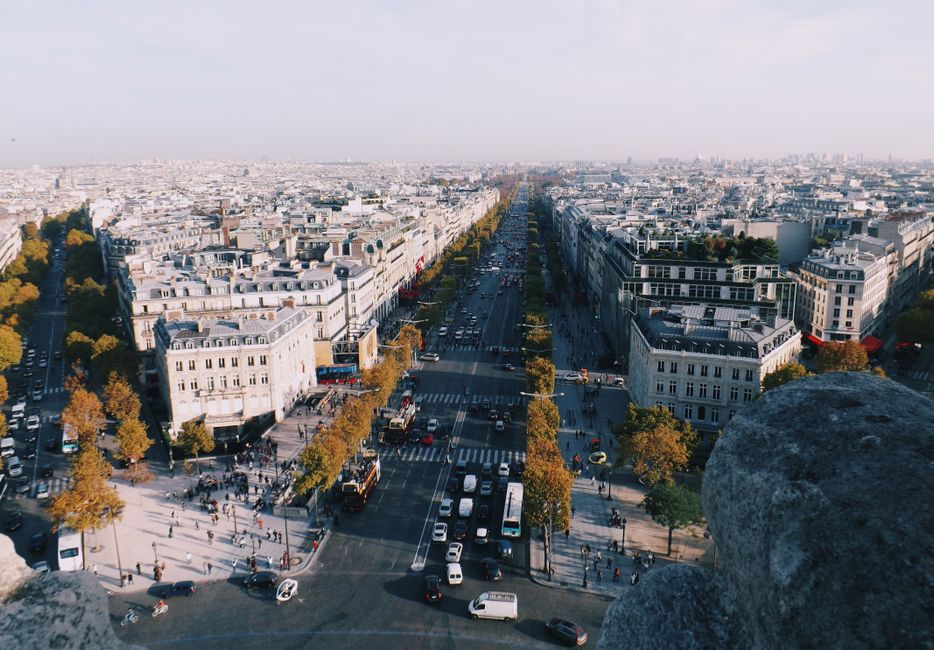
The Avenue des Champs-Élysées is the 1.9 km avenue that runs straight from the Place de la Concorde up to the Arc de Triomphe, with gardens along its lower end and shops, cafés and cinemas along its upper half. It is free and open at all hours. As of October 2026 the next car-free Sunday is 1 November (10:00–17:00), and the Christmas lights shine from mid-November to early January. Walking the full length takes about 30 minutes; allow two hours with the gardens and a coffee stop.
Right now in Champs-Élysées
- Fri14–21°C57–69°FPartly cloudy
- Sat9–16°C49–61°FMostly clear
- Sun6–13°C44–56°F1 mm rain
Why the Champs-Élysées matters
The avenue began as a royal garden walk. In 1667 Louis XIV had a road laid out on the line of the central path of the Tuileries Garden, and his gardener André Le Nôtre lined it with rows of elms; the City of Paris dates the avenue itself to 1674. The name, made official in 1698, comes from the Elysian Fields of Greek mythology, the resting place of heroes: a hint to strollers that they could rest in the king’s gardens. It first meant only the green area near the bottom of the avenue and spread to the whole street after the Revolution. “Les Champs” stayed largely gardens until 1833, when the prefects Rambuteau and later Haussmann gave the avenue its present shape.
Today it is the city’s stage for big shared moments. The military parade of 14 July marches down it from the Place de l’Étoile to the Place de la Concorde, the New Year’s Eve countdown is held on it, and the avenue welcomes around 100,000 visitors a day, according to the City of Paris.
What you’ll see
- The Arc de Triomphe: at the top of the avenue, on the Place Charles-de-Gaulle (Étoile). Its rooftop terrace gives the classic view straight back down the avenue; see our Arc de Triomphe guide for tickets and hours.
- The upper avenue: from the Rond-Point des Champs-Élysées to the Étoile, wide tree-lined sidewalks with flagship stores, cafés, car showrooms and cinemas.
- The Jardins des Champs-Élysées: between the Rond-Point and Concorde, twelve historic garden squares, protected since 1910, with shady walks, the Fontaine des Ambassadeurs, a playground, a carousel and a traditional Guignol puppet theater. The gardens are open around the clock.
- The Place de la Concorde: the largest square in Paris, at the bottom of the avenue, with its Egyptian obelisk and fountains, and the Tuileries Garden beyond leading to the Louvre.
- The Grand Palais and Petit Palais: the two exhibition palaces built for the 1900 World’s Fair, facing each other just off the lower avenue.
Events through the year
From the City of Paris and Paris je t’aime, the official tourist office, as of October 2026:
- Car-free Sundays: on the first Sunday of most months the avenue is closed to cars and open to walkers, cyclists and scooters, 11:00–18:00 from April to October and 10:00–17:00 from November to March. The next one is Sunday 1 November 2026. Dates, hours and the area can change around other events.
- Christmas lights: the trees along the avenue are lit from mid-November 2026 to early January 2027, every evening from 17:00 to midnight, and all night on 24 and 31 December. The launch evening date is announced each autumn.
- New Year’s Eve: on 31 December the avenue closes to traffic in the evening and becomes a free open-air party, with a sound-and-light show on the Arc de Triomphe, a countdown and fireworks at midnight. Arrive early for the security checks; animals, alcohol, glass and dangerous objects are not allowed.
- Bastille Day, 14 July: the national military parade comes down the avenue from the Étoile to Concorde in the morning, with flypasts overhead. Spectators line the sidewalks; the best spots go early.
The avenue is changing
The City of Paris is giving the avenue a greener, more pedestrian look. A first phase from 2022 to 2024 repaired paving and pedestrian crossings, restored 146 historic benches, planted 107 trees and turned 7,700 m² of roadway into garden paths in the Jardins des Champs-Élysées. A wider redesign of the avenue and its surroundings is being studied for the years after 2024. Its first big piece is the Place de la Concorde: a new layout with about 3 hectares of extra lawns and green space and easier walking links to the Tuileries, with work planned between 2027 and 2030.
How long to allow and when to go
The walk from Concorde to the Arc de Triomphe is about 1.9 km and gently uphill, so 30 minutes at an easy pace; start at the bottom and finish with the climb up the arch, or take metro line 1 up and walk down. A first-Sunday morning is the calmest time, and a weekday evening from mid-November shows off the Christmas lights. The avenue is busiest on weekend afternoons and around big events.
Accessibility
The sidewalks are wide and paved, with a gentle slope up toward the Étoile, and the City of Paris lists the Jardins des Champs-Élysées as accessible to visitors with reduced mobility. There are no public toilets in the gardens. To reach the Arc de Triomphe itself, use the underground passage at the top of the avenue; the arch’s lift is out of service as of October 2026, so check our Arc de Triomphe guide before you plan a visit to the terrace.
Getting there
Metro line 1 runs under the whole avenue, with stations at Champs-Élysées–Clemenceau, Franklin D. Roosevelt, George V and Charles-de-Gaulle–Étoile. Line 9 also stops at Franklin D. Roosevelt and line 13 at Champs-Élysées–Clemenceau, and RER A stops at Charles-de-Gaulle–Étoile. Buses 22, 28, 32, 42, 52, 73 and 93 run close to the avenue.
Combine it with
Climb the Arc de Triomphe at the top for the view back down the avenue, then carry on along Avenue Kléber to the Trocadéro and the Eiffel Tower. At the other end, cross the Place de la Concorde into the Tuileries Garden and walk on to the Louvre, or over the river to the Musée d’Orsay. For more walking routes, see our city sightseeing guide and our Paris travel guide.
Champs-Élysées FAQ
How long is the Champs-Élysées?
About 1.9 km (1,910 meters), from the Place de la Concorde to the Arc de Triomphe. Walking it end to end takes around 30 minutes.
When is the Champs-Élysées car-free?
On the first Sunday of most months: 11:00–18:00 from April to October and 10:00–17:00 from November to March. The next date is Sunday 1 November 2026.
When are the Champs-Élysées Christmas lights on?
From mid-November 2026 to early January 2027, every evening from 17:00 to midnight, and all night on 24 and 31 December.
Can you watch the Bastille Day parade on the Champs-Élysées?
Yes. The 14 July military parade comes down the avenue from the Étoile to Concorde in the morning, and anyone can watch from the sidewalks for free. Arrive early for a good spot.
Which metro stop is best for the Champs-Élysées?
Metro line 1 has four stops along it. Use Charles-de-Gaulle–Étoile (also lines 2 and 6 and RER A) to start at the Arc de Triomphe or Champs-Élysées–Clemenceau (also line 13) to start near the gardens at the lower end.
Is the Champs-Élysées being redeveloped?
Yes, in stages. The gardens and sidewalks were renovated from 2022 to 2024, and the Place de la Concorde at the bottom is due to be redesigned between 2027 and 2030.