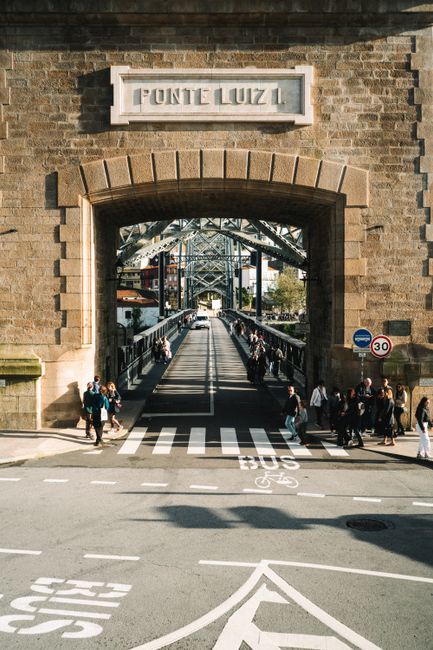
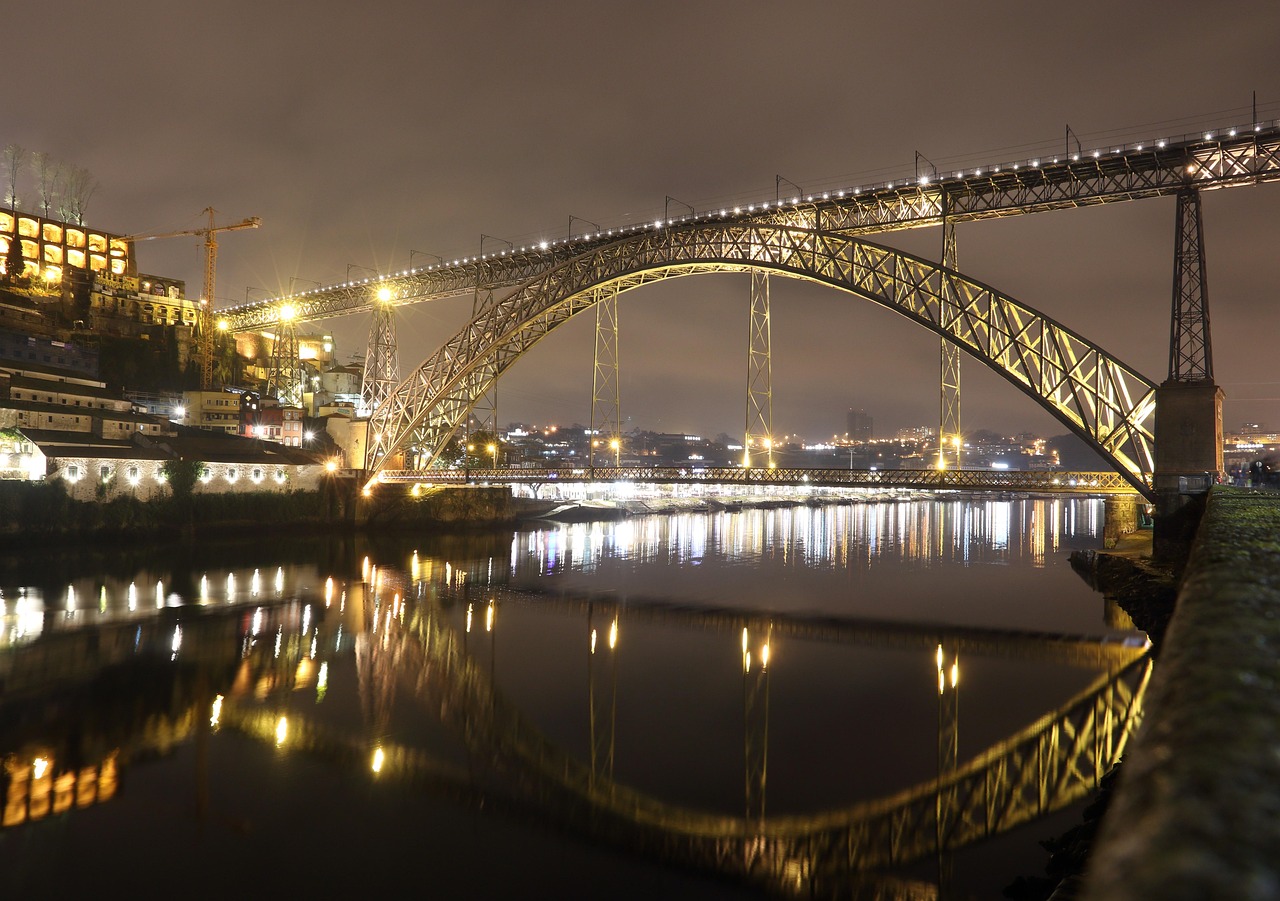
The Dom Luís I bridge (Ponte Luiz I) is the double-deck iron arch that joins Porto’s Ribeira to Vila Nova de Gaia and the port wine cellars. It is free, open day and night, and you can walk both decks: the upper one, high above the river, for the big view over the rooftops and the river, and the lower one at quay level. Allow 30 minutes to cross both ways and longer at sunset.
Right now in Luiz I Bridge
- Thu14–23°C58–74°FMostly clear
- Fri14–22°C56–71°FClear
- Sat12–20°C53–68°FMostly clear
Tickets and tours for Luiz I Bridge
See all tours for Luiz I Bridge →
From local operators, with prices and reviews; you check availability and book on Viator, our partner. We may earn a commission at no extra cost to you. How we earn money
Why this bridge matters
When it opened in the 1880s, the bridge gave Porto a fixed, two-level crossing over the deep Douro gorge: a high road between the upper town and the top of Gaia, and a low road between the two riverside quays. It was designed by the engineer Théophile Seyrig for the Belgian company Société de Willebroeck. Seyrig had earlier worked with Gustave Eiffel on Porto’s Maria Pia railway bridge, which is why you will often hear this one wrongly called “Eiffel’s bridge”.
The main arch spans 172 metres with a rise of 45 metres, and the upper deck is about 385 metres long. Work started in 1881, the upper deck opened on 31 October 1886 and the lower deck on 31 October 1888. Crossing it cost a toll until 1 January 1944. It has been listed as a property of public interest since 1982, and since 1996 it has been part of the UNESCO World Heritage Site “Historic Centre of Oporto, Luiz I Bridge and Monastery of Serra do Pilar”. For the rest of the city, see our Porto travel guide.
What you’ll see from each deck
The upper deck
Since 2005 the upper deck has carried metro line D, with footpaths on both sides of the tracks. From up here you look straight down onto the terracotta roofs of Ribeira, the cathedral on its hill, the rabelo boats moored at Gaia and, upstream, the newer bridges. On the Gaia side you step off by the Jardim do Morro garden and below the Serra do Pilar monastery, Porto’s favourite sunset spots. Trains run down the middle every few minutes, so keep to the footpaths and keep children close.
The lower deck
The lower deck links the Ribeira quay with the Gaia riverfront, where the cellars, terraces and boat piers are. It is the easy, flat way to walk between dinner in Ribeira and a tasting in Gaia, and the view up at the arch and its rivets is just as striking. Since the 2023 renovation it has been reserved by day for pedestrians, bicycles, public transport, taxis and emergency vehicles, and the two councils opened it to all traffic at night, from 20:00 to 06:00. Expect cars on it after dark.
How to visit
- Tickets and hours: none needed. Both decks are open to pedestrians 24 hours a day, free.
- Time needed: about 10 minutes to walk one deck end to end, 30 minutes for a loop (up one deck, down the other), and an hour or more if you stop for the sunset at Jardim do Morro or Serra do Pilar.
- The classic loop: start at the cathedral, walk the upper deck to Gaia, watch the sunset, walk or take the Gaia cable car down to the riverfront, have a drink by the cellars and cross back to Ribeira on the lower deck.
- By metro: line D stops at São Bento on the Porto side and Jardim do Morro on the Gaia side. A Z2 Andante ride covers the hop (€1.40 as of October 2026).
- From the water: the six bridges river cruise passes under the arch (from about €18 with one official operator as of October 2026).
Best time to go
Sunset is the busiest and best moment: the river turns gold, the Ribeira houses light up and the Jardim do Morro fills with people. Get there 30–45 minutes early in summer. Early morning is quieter and good for photos without crowds. On cruise-ship days and summer weekends the lower deck and the Ribeira quay get very crowded around midday. In winter, bring a jacket: the upper deck is exposed to the wind.
Safety
- On the upper deck, stay on the footpaths: metro trains pass in the middle and the gap between the tracks and the railings is narrow in places.
- If you are uneasy with heights, the lower deck gives the same crossing with no drop under your feet.
- In summer you may see local teenagers jumping from the lower deck into the river. Don’t copy them: the Douro here is deep, cold and busy with boats.
- Watch for bicycles and, at night, cars on the lower deck. Mind your bag in the crowds at sunset.
- Ribeira is a steep climb from the bridge’s lower end. Plan routes downhill and use the metro to go up.
Combine it with
The bridge is the hinge of a classic Porto half-day. On the Porto side, the cathedral (Sé) and its square sit right above the upper deck, and the Palácio da Bolsa and São Francisco church are five minutes’ walk along the river. São Bento station and its tiled hall are at the top of the hill. In Gaia, choose one of the port lodges for a cellar tour and tasting. For a morning, pair the bridge with Livraria Lello and the Clérigos Tower, 15 minutes uphill.
Dom Luís I bridge FAQ
Can you walk across the Dom Luís I bridge?
Yes, on both decks, at any time and for free. The upper deck has footpaths beside the metro tracks; the lower deck has wide pavements at river level.
Did Gustave Eiffel design the Dom Luís I bridge?
No. It was designed by Théophile Seyrig, a former partner of Eiffel who had worked with him on Porto’s Maria Pia railway bridge. The resemblance to Eiffel’s ironwork is real, but the design is Seyrig’s.
Which deck has the best view?
The upper deck, high above the river, with the whole of Ribeira and the Gaia cellars below you. The lower deck is better for close-up views of the ironwork and for walking between the two riverfronts.
Can cars use the Dom Luís I bridge?
Not on the upper deck, which carries metro line D and pedestrians. The lower deck has been open by day only to pedestrians, bicycles, public transport, taxis and emergency vehicles since 2023, with all traffic allowed at night from 20:00 to 06:00. Check locally, as the councils review this rule.
When is the best time to visit the bridge?
At sunset, when the light turns gold over the river; arrive 30–45 minutes early in summer to find a spot at Jardim do Morro or Serra do Pilar. Early morning is quietest.
Is the Dom Luís I bridge part of the UNESCO site?
Yes. Since 1996 the bridge has been listed together with Porto’s historic centre and the Serra do Pilar monastery as one World Heritage Site.
Sources
Researched and last reviewed by TravelerCenter on 3 October 2026. Bridge history and dimensions come from the Portuguese heritage records and standard references; deck use from Porto and Vila Nova de Gaia city councils (2023 announcement); metro fares from Andante; the river cruise price from an official operator. Traffic rules and fares change, so check locally before you rely on them.
Data: Weather: MET Norway (CC BY 4.0) · Air quality: OpenAQ · Rates: ECB · Costs: World Bank ICP and price levels · © OpenStreetMap contributors (ODBL) · Wikidata (CC0)