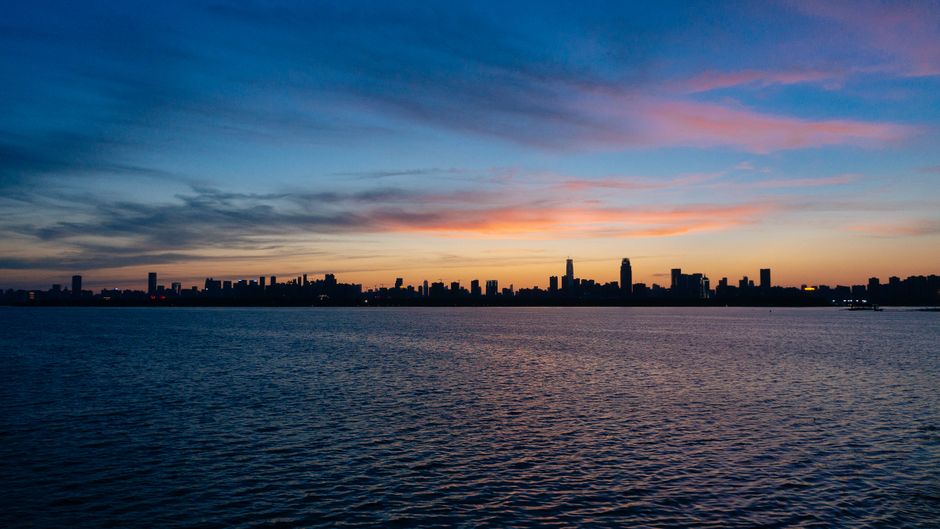
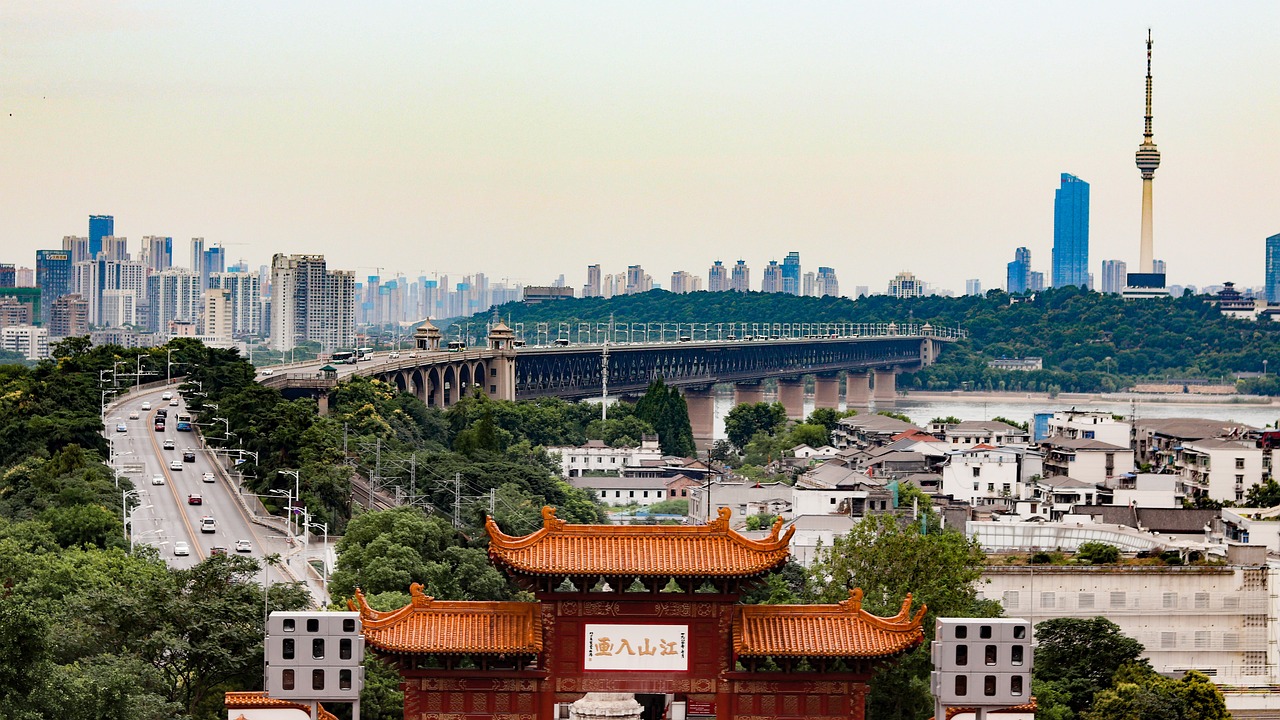
Wuhan, the capital of Hubei province in central China, stands where the Han River flows into the Yangtze, which splits the city into three historic towns: Wuchang on the south bank, and Hankou and Hanyang on the north. It is one of China’s great river cities, crossed by more than a dozen bridges and full of ferries, embankment parks and riverside promenades. Above Wuchang, the five-story Yellow Crane Tower, celebrated by Tang dynasty poets, looks out over the river and the first Yangtze bridge. Hankou, a treaty port from the 1860s, keeps a riverside “Bund” of colonial-era banks and consulates and old lane houses; East Lake, one of China’s largest urban lakes, has parks, forests and a long cycling greenway; and the Hubei Provincial Museum holds one of the country’s finest ancient collections, including the bronze bells of the Marquis Yi of Zeng. Wuhan was also the site of the 1911 Wuchang Uprising, which led to the end of imperial rule. A huge university and industrial city of about 12 million, it is famous for hot dry noodles and an early-morning street breakfast culture, and it sits at the center of China’s high-speed rail network. Visit in spring or autumn; summers are long and very hot.
Right now in Wuhan
- Wed15–25°C59–77°FClear
- Thu16–25°C60–77°FClear
- Fri16–26°C61–78°FClear
Top tours in Wuhan
See all tours for Wuhan →
From local operators, with prices and reviews; you check availability and book on Viator, our partner. We may earn a commission at no extra cost to you. How we earn money
Wuhan at a glance
- Best for: the Yellow Crane Tower, Yangtze views and ferries, East Lake, the Hubei Provincial Museum, colonial-era Hankou and breakfast street food.
- How long: 2–3 days.
- Best time: March to May and late September to November; July and August are very hot and humid.
- Getting there: by high-speed train to Wuhan, Hankou or Wuchang stations from Beijing, Shanghai, Guangzhou and Changsha, or by air to Wuhan Tianhe (WUH).
- Getting around: by metro, ferry, bus, taxi and DiDi; the metro crosses the river several times.
- Good to know: the Yellow Crane Tower no longer needs real-name booking; the provincial museum is free with a reservation.
- Before you go: visa-free entry, the 240-hour transit, the arrival card, payments and general safety are in our China travel guide.
Wuhan’s areas and where to stay
The three towns face each other across the Yangtze and the Han, linked by bridges, tunnels, ferries and the metro.
Hankou and Jianghan Road
Hankou, on the north bank of the Yangtze and east of the Han, is Wuhan’s commercial center. The pedestrian Jianghan Road runs through the former concession district to the Hankou Riverside Park, a riverside promenade several kilometers long, past European-style banks, consulates and the old customs house. The lanes of lilong houses nearby, mixing Chinese and Western styles, are being restored as cafés and shops. Hankou has the widest choice of hotels and nightlife.
Wuchang and the Yellow Crane Tower
Wuchang, on the south bank, is the old administrative city, with the Yellow Crane Tower on Snake Hill, the Red House of the 1911 uprising, the Hubu Alley breakfast street and the riverfront. It is close to Wuhan University and the provincial museum.
Hanyang
Hanyang, across the Han from Hankou, is quieter, with Guiyuan Temple, Guqin Terrace and Turtle Hill, at the north end of the first Yangtze bridge.
East Lake
East Lake, east of Wuchang, has resort-style hotels by the water, the East Lake Greenway and Wuhan University; it is green and calm but further from the center.
Where to stay in Wuhan
- Jianghan Road and Hankou Riverside: historic streets, river views, shopping and nightlife.
- Wuchang riverside: close to the Yellow Crane Tower and breakfast streets.
- Optics Valley (Guanggu): a modern hub of malls and hotels in the southeast, near the universities.
- East Lake: greenery and lake views.
Rooms fill and prices rise during Chinese New Year, May Day, Golden Week and the cherry blossom weeks of March.
Top things to see in Wuhan
Yellow Crane Tower
The Yellow Crane Tower (Huanghe Lou), on Snake Hill above the Yangtze in Wuchang, is one of China’s most famous towers, linked to legends of an immortal who flew away on a yellow crane and to poems by Cui Hao and Li Bai. The tower has been destroyed and rebuilt many times; the present five-story tower, with golden-yellow glazed tiles and upturned eaves, was completed in 1985 near the original site and houses exhibitions on its history. Climb to the top for wide views over the river, the bridge and the city.
Tickets cost 70 yuan, the price set under Hubei’s list of government-priced scenic areas. The park around the tower is open from 8:00 to 18:00 from 1 April to 31 October and 8:00 to 17:00 from 1 November to 31 March. Since July 2024 visitors no longer need a real-name reservation: buy tickets at the windows or online, and show discount documents at the windows. After dark, the “Night on Yellow Crane Tower” light-and-performance show takes place in the park; it resumed on 13 July 2026 after a typhoon closure, with separate tickets.
Hubei Provincial Museum
The Hubei Provincial Museum, on the shore of East Lake, is one of China’s top museums. Its star exhibits come from the tomb of the Marquis Yi of Zeng, buried about 433 BC: a set of 65 bronze bells, still playable, which are demonstrated in short concerts in the museum’s concert hall, along with bronze ritual vessels and lacquer coffins. It also displays the Sword of Goujian, a bronze sword still sharp after some 2,500 years. Entry is free with a real-name booking; it is closed on Mondays.
East Lake
East Lake (Donghu) covers a vast area of water, hills and forest in the east of the city, much of it free to enter, including the Moshan and Tingtao areas. The East Lake Greenway, a car-free path more than 100 km (62 miles) long, is perfect for cycling, with bike rentals at the entrances. Moshan has botanical gardens and a cherry blossom garden that draws crowds in March. See our cycling guide.
The Hankou Bund and Jianghan Road
The riverside of Hankou is lined with buildings from the treaty-port era, including the Jianghan Customs House with its clock tower, banks and consulates. Walk the pedestrian Jianghan Road at dusk, then the long Hankou Riverside Park to watch the lights on the Yangtze and its bridges.
Wuhan Yangtze River Bridge and the ferries
Opened in 1957, the Wuhan Yangtze River Bridge was the first bridge across the Yangtze; you can walk across its lower road deck, with trains rumbling below. For the best river views, take the cheap commuter ferry between Wuchang’s Zhonghua Road pier and Hankou, or an evening sightseeing cruise. See our boat trips guide.
More classic sights
- Wuchang Uprising Memorial (Red House): the headquarters of the 1911 revolutionary government, with the Xinhai Revolution Museum nearby.
- Guiyuan Temple: a Buddhist temple in Hanyang with a hall of 500 arhat statues.
- Wuhan University: a beautiful campus with 1930s buildings and cherry trees in March; visits by booking.
- Hubu Alley: a lively street of breakfast stalls near the Yellow Crane Tower.
- Guqin Terrace: a garden in Hanyang linked to a legend of two friends who shared a love of music.
Other things to do in Wuhan
Breakfast culture
Wuhan has a special word, guozao, for eating breakfast out, and locals take it seriously. Start the day at Hubu Alley or a neighborhood stall with hot dry noodles (re gan mian), springy noodles tossed in sesame paste, chili oil and pickles; doupi, a crisp skin of tofu and egg wrapped around sticky rice and meat; mianwo, savory fried rice-and-soybean rings; and soup dumplings with a bowl of rice wine. See our city sightseeing guide.
Evenings on the river
After dark, the skylines on both banks light up in a synchronized show, best seen from the Hankou Riverside Park, the Wuchang riverfront below the Yellow Crane Tower or the deck of an evening cruise. Locals stroll, fly kites, dance and swim in summer along the embankments, and the bars and restaurants of the former concession streets stay open late. Chuhehanjie, a pedestrian district in Wuchang, has restaurants and shops in a modern take on old Hubei streets.
Food and drink
Beyond breakfast, Wuhan cooking is hearty and spicy. Try Wuchang fish, a steamed bream praised in a poem by Mao Zedong; pork rib and lotus root soup, slow-cooked with the starchy lotus roots of Hubei’s lakes; spicy duck necks, a famous snack; crayfish in summer; and Hubei fish dishes. Evening food streets and riverside bars in Hankou stay busy late.
Day trips from Wuhan
- Wudang Mountains: Taoist temples and palaces on forested peaks, a UNESCO World Heritage Site, about 2 hours by high-speed train to Wudangshan; best over two days.
- Three Gorges Dam and Yichang: the world’s largest hydropower project and the start of Yangtze cruises upstream through the Three Gorges, about 2 hours by high-speed train to Yichang.
- Mulan Mountains: forested hills and lakes in Huangpi, north of the city, linked to the legend of Hua Mulan, about 1–1.5 hours by road.
- Chibi: the site of the Battle of Red Cliffs of AD 208, about 1 hour by high-speed train.
- Changsha: Orange Isle, the Hunan Museum and spicy food, about 1.5 hours by high-speed train.
Nearby destinations
- Changsha296 km
Getting there and getting around
By air
Wuhan Tianhe International Airport (WUH), about 26 km (16 miles) north of Hankou, has flights across China and international routes in Asia and beyond. It is a designated port for the 240-hour visa-free transit, with all of Hubei province as the permitted area. Metro line 2 runs from the airport to Hankou Station, Jianghan Road and Wuchang in about 40–60 minutes.
By train
Wuhan is a hub of the high-speed network. Wuhan Station, in the east of the city, and Wuchang Station are on the Beijing–Guangzhou line, with trains to Beijing West (about 4.5–5 hours), Guangzhou South (about 4 hours) and Changsha (about 1.5 hours). Hankou Station serves lines toward Shanghai (about 4–5 hours), Chongqing, Yichang and Xi’an. Book on the 12306 website or app with your passport.
Around town
Wuhan’s large metro network crosses the Yangtze several times and reaches the three main stations and the airport. Ferries cross the Yangtze between Wuchang and Hankou. Buses, taxis, DiDi and shared bikes fill the gaps; the riverside parks and Jianghan Road are best on foot.
When to go and how long to stay
Wuhan has a humid subtropical climate with four distinct seasons. Spring (March–May) is mild and the best time to visit, with cherry blossoms in March, although rain increases from April. The plum rains (meiyu) usually arrive in mid-June and continue into July. Summer (July–August) is long and very hot, with highs around 33 °C (92 °F) and humid nights; Wuhan is traditionally counted among China’s “furnace” cities. Autumn (late September–November) is clear and pleasant, with osmanthus scent in the parks. Winter (December–February) is cold and damp, with occasional snow. The table uses the 1991–2020 climate normals for the Wuhan station of the China Meteorological Administration (CMA), as submitted to the World Meteorological Organization (WMO): average daily highs and lows, total precipitation, and days with at least 1 mm of rain.
| Month | Average high / low | Rain (days with 1 mm or more) | What to expect |
|---|---|---|---|
| January | 8 °C (47 °F) / 1 °C (34 °F) | 53 mm (2.1 in), 7 days | Cold and damp; occasional snow |
| February | 11 °C (53 °F) / 4 °C (38 °F) | 66 mm (2.6 in), 8 days | Cool; Chinese New Year |
| March | 16 °C (61 °F) / 8 °C (46 °F) | 91 mm (3.6 in), 9 days | Mild; cherry blossoms at East Lake and Wuhan University |
| April | 23 °C (73 °F) / 14 °C (57 °F) | 138 mm (5.4 in), 9 days | Warm; showers increase |
| May | 27 °C (81 °F) / 19 °C (66 °F) | 161 mm (6.3 in), 9 days | Warm and wet; May Day crowds |
| June | 30 °C (87 °F) / 23 °C (73 °F) | 213 mm (8.4 in), 9 days | Hot; plum rains begin |
| July | 33 °C (92 °F) / 26 °C (79 °F) | 256 mm (10.1 in), 8 days | Very hot and humid; the wettest month |
| August | 33 °C (91 °F) / 25 °C (78 °F) | 106 mm (4.2 in), 7 days | Very hot; storms |
| September | 29 °C (84 °F) / 21 °C (69 °F) | 72 mm (2.8 in), 5 days | Warm and drier |
| October | 23 °C (74 °F) / 15 °C (59 °F) | 66 mm (2.6 in), 6 days | Mild and clear; Golden Week crowds |
| November | 17 °C (63 °F) / 8 °C (47 °F) | 58 mm (2.3 in), 6 days | Cool and pleasant |
| December | 11 °C (51 °F) / 3 °C (37 °F) | 31 mm (1.2 in), 5 days | Cold and quiet |
Wuhan receives about 1,310 mm (52 in) of rain a year, most of it from April to July.
Two days in Wuhan
Day one: breakfast at Hubu Alley, the Yellow Crane Tower, a walk across the Yangtze River Bridge, then the ferry to Hankou, Jianghan Road and the riverside at night. Day two: the Hubei Provincial Museum and a bell concert, then cycling or walking around East Lake, with a crayfish or fish dinner.
Three to four days
Add the Red House and the Xinhai Revolution Museum, Guiyuan Temple and Wuhan University, then a day trip or overnight trip to the Wudang Mountains or Yichang; or continue to Changsha, Nanjing or Chongqing.
What a trip to Wuhan costs
Prices are approximate, for October 2026, converted at about 6.74 yuan to the US dollar.
| Item | Typical cost |
|---|---|
| Yellow Crane Tower | 70 CNY (about US$10.40) |
| Hubei Provincial Museum | free, with reservation |
| East Lake (Moshan and Tingtao areas) | free |
| Hot dry noodles, a bowl | 6–12 CNY (about US$0.90–1.80) |
| Yangtze ferry | about 1.5–2 CNY (about US$0.20–0.30) |
| Metro ride | 2–7 CNY (about US$0.30–1) |
| High-speed train, Wuhan–Changsha South | about 160–170 CNY (about US$24–25) second class |
| Mid-range hotel double, per night | 300–650 CNY (about US$45–96) |
Practical tips for Wuhan
- Go out for breakfast: the street breakfast scene is a highlight; most stalls open early and sell out by mid-morning.
- Reserve museums: the Hubei Provincial Museum needs a real-name booking with your passport and closes on Mondays.
- Use the ferry: it is cheap, fast and the best way to see the river.
- Avoid the midday heat in summer: plan indoor sights for the afternoon in July and August.
- Choose your station: Wuhan, Hankou and Wuchang stations are far apart; check which one your train uses.
- Carry your passport: for trains, hotels, bookings and checks.
Safety
Wuhan is a safe and busy city. The main challenges are heat, rain and crowds. In July and August, highs above 33 °C (92 °F) and high humidity make heat exhaustion a real risk; drink plenty of water, rest in the shade or air conditioning and avoid long walks at midday. The plum rain season in June and July brings heavy downpours and, in some years, local flooding; the Yangtze rises in summer, so stay behind barriers on the embankments and follow signs. Thunderstorms and the edges of typhoons can bring storms and closures, as in July 2026, when the Yellow Crane Tower park briefly closed. Swim only in designated areas. Traffic is heavy and electric scooters are silent, so cross carefully. The Yellow Crane Tower, Hubu Alley and Jianghan Road are packed on holidays; watch your belongings in crowds and use official taxis or DiDi. In an emergency, call 110 for police, 120 for an ambulance and 119 for fire.
What to pack for Wuhan
Light, breathable clothes, a hat and sunscreen for the long summer; an umbrella and light rain jacket for spring and the plum rains; comfortable walking shoes; and a warm coat for the damp winters. China uses 220 V, with flat two-pin, round two-pin and angled three-pin sockets. See our rain jackets and travel adapters guides.
Wuhan travel FAQ
How much is the Yellow Crane Tower ticket?
70 yuan. Real-name booking is no longer needed; buy at the windows or online.
What are the Yellow Crane Tower opening hours?
8:00 to 18:00 from 1 April to 31 October and 8:00 to 17:00 from 1 November to 31 March.
Is the Hubei Provincial Museum free?
Yes, with a real-name booking; it is closed on Mondays.
What is Wuhan famous for?
The Yellow Crane Tower, the Yangtze and its bridges, East Lake, the bronze bells of the Marquis Yi of Zeng, the 1911 Wuchang Uprising and hot dry noodles.
How many days do I need in Wuhan?
Two to three days for the tower, the river, Hankou, the museum and East Lake.
What is the best time to visit Wuhan?
March to May and late September to November; summer is very hot and humid.
Can I use the 240-hour visa-free transit in Wuhan?
Yes. Wuhan Tianhe airport is a designated port, and all of Hubei province is in the permitted area.
How do I get from Wuhan to Changsha?
By high-speed train in about 1.5 hours, from Wuhan or Wuchang station to Changsha South.
What should I eat in Wuhan?
Hot dry noodles, doupi, Wuchang fish, pork rib and lotus root soup, spicy duck necks and, in summer, crayfish.
Can I visit the Three Gorges from Wuhan?
Yes. High-speed trains reach Yichang, the base for the Three Gorges Dam and Yangtze cruises, in about 2 hours.
Plan your trip
Partner links: TravelerCenter may earn a commission if you book, at no extra cost to you.
🇨🇳 Useful Mandarin Chinese phrases for Wuhan
All 38 Mandarin Chinese phrases: restaurant, hotel, emergencies, romance (printable) →
Sources · last reviewed 5 October 2026
Researched and last reviewed on 5 October 2026. The Yellow Crane Tower ticket price: Hubei’s list of government-priced scenic areas (2023 edition), published by Hubei government sites; its seasonal opening hours: the Wuchang district government’s list of scenic areas; the end of real-name booking: Changjiang Daily, republished by the Wuhan municipal government in July 2024; the park’s reopening and the “Night on Yellow Crane Tower” show on 13 July 2026: the Wuhan municipal government; free entry to East Lake’s Moshan and Tingtao areas: the same price list; visa-free transit and Wuhan Tianhe airport as a designated port: the National Immigration Administration; train booking with a passport: China Railway’s official 12306 site; climate normals: the China Meteorological Administration via the World Meteorological Organization’s 1991–2020 normals; the exchange rate: the CFETS central parity rate; the Wudang Mountains inscription: the UNESCO World Heritage List. Museum booking and Monday closures, tower history, bridge and greenway details, train times, distances, population and typical prices are general references or estimates, flagged for checking. Prices and rules change, so check locally before you go. For entry rules, money and general safety, see our China travel guide.
Data: Weather: MET Norway (CC BY 4.0) · Rates: ECB · Costs: World Bank ICP and price levels · Wikidata (CC0)